
eBook on UAE AML Federal Decree-Law No. 10 of 2025

eBook on UAE AML Federal Decree-Law No. 10 of 2025

eBook on UAE AML Federal Decree-Law No. 10 of 2025

eBook on UAE AML Federal Decree-Law No. 10 of 2025

The Federal Decree Law No. 10 of 2025 replaces the Federal Decree No. 20 of 2018. It solidifies the ML/TF/PF legal framework in UAE. The 2025 Law transforms the mechanism of operation for businesses across Emirates.

The changes elucidated under the Federal Decree Law No. 10 of 2025 include:

  • Integrated the category of Proliferation Financing
  • VASPs now directly fall under the regulatory ambit
  • Increased penalties and extended freezing powers
  • Stricter Beneficial Ownership requirements and strengthened international cooperation
  • Constructed a two-tiered supervisory framework which consists of the Supreme Committee and National Committee
  • Mandated disclosure requirements for individuals leaving or entering UAE with cash, precious metals or stones, negotiable instruments.

Our Latest Publications

Confused with how to mitigate ML, FT, and PF risks within your Regulated Entity?

Share via :

Share via :
Vulnerability Assessment

Pathik Shah

Last Updated: 01/23/2026

Table of Contents

Protect your business with reliable and effective AML strategies with AML UAE.

What’s in Store

  • Vulnerability Assessment in AML identifies weaknesses within an organisation’s AML program that could be exploited for ML/TF/PF activities.

  • It evaluates the efficacy of existing AML measures to mitigate the identified inherent risk.

  • It facilitates an opportunity for Regulated Entities to work on their internal deficiencies before regulatory eyes reach them.

  • An effective Vulnerability Assessment must be regularly updated with a clear rationale and should be aligned with the expectations of Regulatory Authorities.

Introduction to Vulnerability Assessment in AML

Vulnerability Assessment in Anti-Money Laundering (AML) program refers to the structured identification of weaknesses within a Regulated Entity’s AML/CFT controls, processes, system and governance that could be exploited for Money Laundering (ML), Terrorism Financing (TF) or Proliferation Financing (PF).

Vulnerability Assessment primarily focuses on AML/CFT failures that may occur internally even when the inherent risk of the organization appears low.

It differs from the traditional AML/CFT Risk Assessment. The ML/TF risk in Risk Assessment is understood with simple formula of Risk= Threat x Vulnerability x Impact. This denotes that vulnerabilities, if not detected can act as a multiplier that can notably elevate overall ML/TF risk exposure of an organization.

In simpler terms, it means that even if gross risk appears low, weak controls can impact the outcome of the net ML/TF/PF risk negatively. This is why Vulnerability Assessment plays a critical role in understanding the residual risk of an organization.

Therefore, UAE Regulators such as MoET, MOJ, CBUAE, SCA, VARA, FSRA, and DFSA expect Regulated Entities in UAE to focus on identifying and fixing internal vulnerabilities and not just the documented inherent risk.

Why Vulnerability Assessment is Critical for UAE AML Compliance

In UAE’s AML/CFT Compliance landscape, AML/CFT control effectiveness is as important as ML/TF risk identification.

A business may operate in inherently low ML/TF risk sector, yet still present high residual risk if AML/CFT controls are not properly applied. Many a times, controls just exist in policies, however their execution is completely failed. Most regulatory enforcement actions often stem from the failed execution rather than policy gaps.

Therefore, Regulators in UAE desire Regulated Entities to focus on the successful implementation of their AML/CFT controls, and work on the deficiencies if any. Vulnerability Assessment proves to be a critical tool to evaluate those lacking.

Assessing internal vulnerabilities facilitates Regulated Entities to accurately defend the conclusions of their Enterprise-Wide Risk Assessment (EWRA) and Customer Risk Assessment (CRA) with clear rationale and logic.

Most importantly, identifying vulnerabilities early help prevent common regulatory findings such as ineffective transaction monitoring, screening gaps, weak governance or documentation failures.

Key Areas of Vulnerability in AML Frameworks

There are multiple areas in an AML/CFT framework that are prone to vulnerabilities, these key areas include governance, process, system, people and third parties.

Governance Vulnerabilities in AML/CFT framework arise from unclear accountabilities, weak oversight, and ineffective escalation channels. Without clearly implemented hierarchy and accountability structure, the issues remain unresolved.

Process Vulnerabilities appear from gaps in onboarding channel, inconsistency in Customer Due Diligence (CDD) /Enhanced Due Diligence (EDD) application, delays in updating customer information etc.

System Vulnerabilities in AML/CFT framework surface from poorly calibrated screening rules, inadequate tools, outdated software implementation, weak data quality issues etc. These system weaknesses lead to a high rate of false positives or false negatives and missed alerts.

People Vulnerabilities stem from inadequate training, understaffing of compliance team or a lack of subject matter expertise in employees. This leads to failure in execution.

Third-Party Vulnerabilities occur when Regulated Entities rely on vendors, agents or outsourced service providers with weak AML/CFT controls and insufficient oversight for AML/CFT compliance obligations.

Vulnerability Assessment Within EWRA/BRA

In an EWRA/BRA, Vulnerability Assessment is to identify systematic weaknesses that affect the organization as a whole. This includes evaluation of Regulated Entities’ AML/CFT/CPF program and whether it is concrete enough to manage ML/TF/PF risks across various categories such as customer, products, services, geographies and delivery channels.

Regulated Entities assess whether implemented AML/CFT/CPF controls are adequate to restrain the identified inherent risks.

An efficient Vulnerability Assessment also includes reviewing former audit findings, inspection history and previous remediation actions to estimate the effectiveness of the deployed controls.

Moreover, Regulatory Authorities in UAE expect Regulated Entities to be transparent regarding the effectiveness of their control environment by thoroughly documenting and articulating the identified control gaps and corresponding mitigation actions in their EWRA/BRA.

Vulnerability Assessment Within CRA

Within a Customer Risk Assessment (CRA), Vulnerability Assessment majorly focuses on recognizing the control weaknesses at customer level. These vulnerabilities basically can be related to the reliance on outdated KYC, incomplete UBO identification in layered ownership structures, insufficient verification of Source of Funds or Source of Wealth, underestimating PEP or high-risk individual that may impact overall risk scoring of a customer.

In simpler terms, it recognizes gaps in system that may impact the risk scoring of a customer negatively. For example, due to weak controls, a high-risk customer is scored as low risk.

Another major component of a robust Vulnerability Assessment in CRA is that it scrutinizes the efficacy of present Screening tools, Ongoing Monitoring and Transaction Monitoring systems.

Through validated control testing, it measures the effectiveness of these tools to gauge whether they provide accurate Screening results, whether these Screening tools are calibrated with updated PEP databases and Sanctions List, whether real-time monitoring of complex or high-risk customers is provided, whether the tools are accurate to give alerts for any anomalies in customer profiles.

Additionally, the effective Vulnerability Assessment provides understanding of the instances where the probability of customer behavior outpacing the existing controls is strong. For that it actively compares current compliance capabilities to manage evolving customer tactics such as use of cryptocurrencies, third-party wire transfers etc. to ensure existing controls are not outdated to deal with new and complex methodologies.

Evaluation of these controls at customer level provides real insights into the gaps and helps in forming an informed risk mitigation strategy. A high level of identified vulnerabilities in CRA provides the justification to implement Enhanced Due Diligence (EDD), increased monitoring frequency or necessary account restrictions.

Common AML Vulnerabilities Identified by UAE Regulators

In UAE, during inspections Regulatory Authorities such as MoET, SCA, MOJ, CBUAE, VARA, DFSA, and FSRA often come across AML/CFT vulnerabilities that are recurrent and consistent across Regulated Entities.

These common vulnerabilities are both system based and structure based.

One of the persistent gaps is in managing the Sanctions List updates. Regulated Entities often fall short in adopting practices that provide up to date alignment with UAE Local Terrorist List, UNSC Consolidated List and other relevant International Sanctions Lists. This mismanagement causes REs to onboard prohibited parties.

Another common gap is recognized at system level. Regulated Entities implement Screening and Transaction Monitoring tools with poor calibration that results in generation of excessive false negatives and failure in flagging actual suspicious activity or customer.

It has been observed that lack of oversight on complex trade finance activities by Regulated Entities pave the easy way for miscreants to conduct Trade-Based Money Laundering (TBML).

Another major compliance failure on part of Regulated Entities is insufficient and scattered documentation without any systematic approach to maintain and retain it.

Moreover, Regulated Entities often overly rely on automated solutions without any proper validation and testing. The misconception that software alone guarantees thorough compliance led to critical control error.

Methodology for Conducting an Effective AML Vulnerability Assessment

Methodology for Conducting an Effective AML Vulnerability Assessment

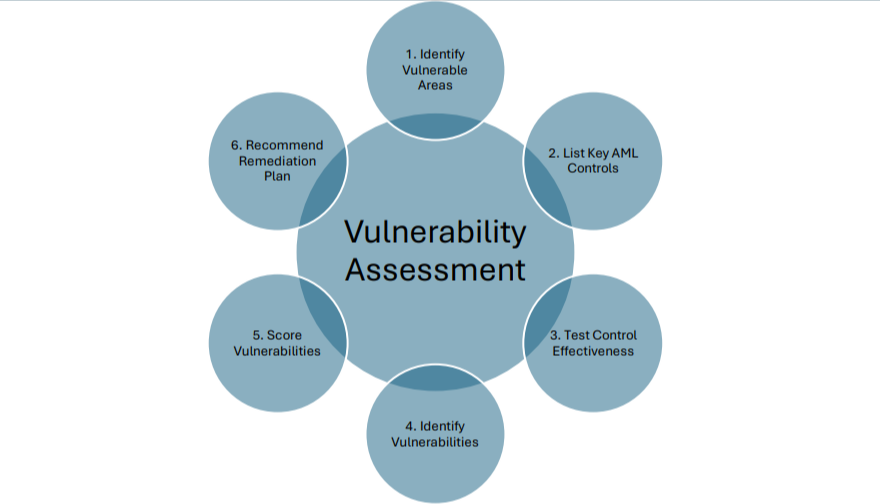
The effectiveness of Vulnerability Assessment in AML depends on the structured methodologies that facilitate evidence based dynamic review of the AML/CFT program to bridge the gap between policy and execution.

It begins with mapping existing AML/CFT controls against the inherent risk identified in EWRA/BRA and CRA. Subsequently, control testing, walkthroughs and scenario reviews are conducted to determine the operationality of the controls as intended.

Post control testing, data-driven analysis is conducted, where alert metrices, STR trends, backlog data and audit findings are analyzed to identify patterns of failure or inefficiency.

The process of Vulnerability Assessment is continued with an operational review through staff interviews and systematic audits of procedures to verify the efficacy of frontline compliance team.

After this, the identified vulnerabilities are given appropriate ratings based on the likelihood of occurrence and the impact they can have on the business.

The Vulnerability Assessment ends with the clear documentation of all findings and a formal remediation plan to overcome vulnerabilities with defined ownership and timeframe for the same.

Role of AML UAE Services in Vulnerability Assessment

It is critical for Regulated Entities in UAE to periodically evaluate the effectiveness of their AML/CFT controls and recognize gaps that may expose them to ML/TF/PF risks.

Vulnerability Assessment is vital in ensuring that deficiencies in governance, systems, processes and staffing are discovered in the earliest possible way before it reaches the eyes of Regulatory Authorities.

AML UAE supports Regulated Entities in UAE to conduct independent Vulnerability Assessment that identify practical weaknesses. AML/CFT Health Check provides a comprehensive review of control effectiveness. AML/CFT Policy, Controls and Procedures Documentation service ensures that internal framework is aligned with Risk-Based Approach and regulatory expectations.

Through AML Screening Software Testing and Validation Services, system level vulnerabilities are addressed. It facilitates recognizing gaps in Transaction Monitoring and Screening configurations.

These services help Regulated Entities to prioritize remediation plan, strengthen EWRA/BRA and CRA outcomes and maintain Vulnerability Assessment rationale recorded as per the expectations of Supervisory Authorities.

Strengthening AML Resilience Through Vulnerability Assessment

It is of utmost importance for Regulated Entities to understand the weak links in their control programs and Vulnerability Assessment can provide that third eye perspective for it. Deficiencies in control left unchecked can easily pave way for threats to become risks.

AML UAE comes here as savior to make the complex process of Vulnerability Assessment smooth and accurate for Regulated Entities. Through its efficient services it aids in salvaging the weak controls before the wrongdoers can exploit it for illicit activities. Moreover, a structured Vulnerability Assessment displays a sheer commitment to Supervisory Authorities, enhancing the goodwill of Regulated Entities.

Frequently Asked Questions

What is Vulnerability Assessment in AML?

Vulnerability Assessment in AML is the process to understand inherent vulnerabilities and identify gaps in an organization’s AML/CFT controls, processes, systems and governance that can be exploited for financial crimes such as ML/TF/PF.

AML Risk Assessment is a broad concept that encompasses identification of ML/TF/PF risk exposure through customers, products, geographies, delivery channels and other risk factors. In contrast, Vulnerability Assessment in AML is a subdivision of AML Risk Assessment, where the internal AML/CFT controls of an organization is examined to determine the effectiveness of these controls to curb the financial crime risks.

Regulators in UAE, such as MoET, MOJ, SCA, FSRA, DFSA, VARA, and CBUAE, focus on the AML Vulnerabilities because AML breaches arise from the incapable controls rather than unidentified risks. Thus, they expect Regulated Entities to identify, document and remediate gaps to ensure controls work adequately.

Common AML Control weaknesses consist of poor management of Sanction Lists, ineffective transaction monitoring tools, poorly calibrated screening rules, insufficient documentation, overreliance on automated tools etc.

Mostly, Regulated Entities should consider performing the Vulnerability Assessment at least annually, assessments that are more frequent or less frequent may be justified as per the circumstances.

Vulnerability Assessments impact the EWRA and CRA by recognizing weaknesses in AML/CFT control program. It helps to determine residual risk by assessing whether existing controls mitigate inherent risk effectively.

Unsure if your watchlist screening meets UAE AML requirements?

Partner with us to strengthen your sanctions and watchlist compliance framework.

Share via :

About the Author

Pathik Shah

FCA, CAMS, CISA, CS, DISA (ICAI), FAFP (ICAI)

Pathik is an ACAMS-certified AML consultant specialising in governance, risk, and compliance for regulated entities in the UAE. He brings over 28 years of experience, with 1,000+ hours of AML training and 200+ advisory engagements across DNFBPs, VASPs, and FIs. He supports businesses in aligning with AML/CFT requirements from the CBUAE, DFSA, MoET, MoJ, VARA, CMA, FSRA, and FATF. Known for translating complex regulations into audit-ready procedures, Pathik enables operational clarity and compliance readiness.

Reach Out to Pathik

What is a sanction list?

Sanctions List

What is a Sanctions List?

Table of Contents

Protect your business with reliable and effective AML strategies with AML UAE.

Key Highlights: What is a Sanctions List

  • Sanctions Lists recognise individuals, entities or countries subject to restrictions due to security, political and economic risks.
  • Sanctions Lists are a crucial part in combating the TF and PF crimes and protecting the integrity of the financial
  • Businesses must conduct daily Screening of customer databases, which includes names of parties to any transactions, directors or agents acting on behalf of customers, persons with indirect relationships with designated individuals or groups, existing customer databases, potential customers’ databases prior to initiating transactions or commencing business relationships, and former customers upto a period of five (5) years.
  • Failure to comply with Sanctions obligations can result in severe legal fines and penalties including reputational harm for regulated entities.

What is a Sanctions List?

Sanctions List typically includes names of sanctioned individuals, , or commercial organisations that are considered a threat to national or global security, financial systems or economic stability. Along with government officials, international authorities publish Sanctions Lists to restrict and control individuals, entities and jurisdictions involved in illegal, unethical or high-risk activities.

Sanctions are imposed on Terrorist Financing and Proliferation Financing. Screening across Sanctions Lists help prevent onboarding any customers or continuing business relationship with any newly classified sanctioned individual or entity, thus helping Regulated Entities ensure compliance with Targeted Financial Sanctions (TFS) requirements.

Businesses are required to apply Sanctions Screening as part of their Customer Due Diligence (CDD) to mitigate these risks. This process involves screening customer database against relevant Sanctions Lists before establishing the business relationship, and during the course of business relationship, to ensure that they are not subject to restrictions or prohibitions. Sanctions Screening must also be conducted on database of former customers for a period of five (5) years.

However, Sanctions Screening does not end at onboarding. Enterprises must also implement Ongoing Sanctions Screening for their existing clients, as clients’ risk profiles might change over time. Ongoing Monitoring enables entities to identify newly sanctioned individuals or entities to take appropriate measures.  Hence, organisations must carefully consider the screening of the Sanction Lists.

A Sanctions list incorporates sanctioned individuals, governments, or commercial organizations. Firms, government officials, and individual entities are enlisted into this category as these individuals or organizations pose a high risk to the business or the economy of the country or world as a whole.

Economic sanctions are undoubtedly an essential tool to fight against financial crime such as anti-money laundering. If such sanction lists are not followed or are breached, one may face severe consequences under AML/CFT regulations. Hence, business organizations must apply sanction control to their clients while establishing business relationships with any customer. The process of screening the sanctioned list is one of the steps in the customer due diligence (CDD) procedures.

What are Sanctions in AML? Anti-Money Laundering Sanction List

Understanding Sanctions in AML requires understanding the origin of Targeted Financial Sanctions (TFS)  imposed by the United Nations Security Council under Article 41 of Chapter VII of the UN Charter, which are reinforced by the Financial Action Task Force (FATF) Recommendations 6 and 7 (R6/R7), requiring immediate asset freezing and prohibition on providing services to designated persons and entities.

As UAE is UN member, it implements and enforces TFS obligations through Cabinet Decision No. 74 of 2020 and maintains a UAE Local Terrorist List under UNSCR 1373 (2001), enabling the application of UN-mandated and domestic designations within its AML regime.

Sanctions List Meaning in AML Compliance

Sanctions Lists in AML Compliance refers to any official list issued by local government of a country or international body which contains names of sanctioned individuals, entities, vessels or jurisdictions due to their involvement in terrorism financing or proliferation of weapons of mass destruction. Sanctions lists serve as control measure while implementing TFS Compliance, which is carried out by screening names of potential, existing, and former customers across relevant and applicable sanctions lists.

Sanction List meaning in simplest terms is, a publicly listed directory of entities and individuals upon whom economic or legal restrictions have been imposed.

Sanctions lists should be used by Regulated Entities to prevent sanctioned entities from entering the financial system. AML, CFT and TFS laws mandate Regulated Entities to screen the customers, transactions and counterparties against applicable Sanctions Lists such as UAE Local Terrorist Lists, the UNSC Consolidated List or any other applicable list such as OFAC or the European Union.

Financial authorities and governments across the world maintain a list of sanctions. These lists are available in the public domain. Here are a few examples of sanctions lists necessary for a better understanding of the concept:

Who appears on a Sanctions List?

In order to understand who appears on a sanctions list, its important to understand that Sanctions might be leveled as a result of explicit or illegal activities or in order to achieve a foreign policy or a diplomatic aim. These sanctions lists are usually passed by the act of an international authority or by governments, for instance, the United Nations Security Council Resolution.

Several international sanctions lists incorporate targets involved in the financing of criminal or terrorist activities. Sanctions screening lists basically include organizations, individuals, or the entire nation engaged in severe crimes like terrorist financing. As a result, sanctioned individuals, sanctioned persons, and sanctions companies or entities appear on sanctions list when they are found to be involved in below mentioned activities:

  • Terrorism and terrorist financing
  • Violation of human rights
  • Narcotics trafficking
  • Weapons proliferation
  • Money laundering activities
  • Violation of international treaties
  • Violation of international contracts

What is the purpose of AML Sanctions Lists?

  • The purpose of Sanctions Lists is to prevent designated individuals and entities or groups from accessing means to violate international peace and security, fund or support terrorism in any manner, or finance the proliferation of weapons of mass destruction. Sanctions Lists, particularly the UAE Local Terrorist List and the UNSC Consolidated List serve as bedrock for implementations of TFS measures.
  • Sanctions Lists fulfil the following objectives, in alignment with AML/CFT and TFS obligations, such as
  • Operational objectives including denial of resources to sanctioned individuals and entities by imposing freezing measures and denial of providing goods and services to such individuals or entities and prevention of misuse of financial systems by reporting such individuals and entities to the FIU
  • Achieving global and political goals such as international security, conflict resolutions, non-proliferation objectives, and non-military enforcement providing means of action for triggering specific obligations such as freezing and prohibition of services in alignment with AML/CFT and TFS provisions of UAE
  • Compliance with international standards such as UNSC decisions and FATF recommendations.

Compliance. Trust. Transparancy

Customized and cost-effective AML compliance services to support your business always

Impact of being on the Sanctioned List

Being listed on a Sanctions List can have significant consequences for individuals, entities or countries. Key impacts include:

  • Restrictions on financial transactions and business dealings: once, added to the Sanctions List, an individual, entity or nation is forbidden from having any financial or business relationships with the rest of the economies.
  • Travel bans and visa restrictions: As per UN Sanctions measures in the Travel ban, all member countries are required to deny entry or transit to designated individuals. This process, in turn, will restrict the physical movements of the sanctioned.
  • Reputation and perception of individuals and entities on the listthe designated individual carries reputational risk, as this is perceived as the individual or entity being involved in high-risk or illicit activities. Prompting others to sever business ties.

United Arab Emirates AML Sanctions List

The UAE is a member of three main regional bodies that issue sanctions – the Arab League, the Terrorist Financing Targeting Centre (‘TFTC’), and the Gulf Cooperation Council (‘GCC’).

Additionally, the UAE maintains two main lists of sanctioned individuals and entities, under UNSC Resolutions:

UAE Sanctions List

Also known as the local list – This list consists of a local terrorism list issued pursuant to the Anti-Terrorism Law. It is also called the UAE Sanctions List.

UNSC Sanctions List

Sanctions List Screening for AML Compliance

Sanctions list screening is again one of the essential aspects of Customer Due Diligence (CDD) under Anti-money Laundering regulations. Business houses have to implement AML risk assessment throughout the client onboarding and client monitoring processes. Anti-money laundering regulators impose heavy AML fines on organizations that fail miserably to comply with all the CDD Processes.

AML UAE provides Anti-Money Laundering Consulting Services to help companies adhere to the requirements of the AML Laws in UAE.

Check out Circular 1 of 2022: Implementation of Targeted Financial Sanctions on UNSCRs 1718 (2006) and 2231 (2015)

sanctions Screening in UAE

Final Overview: Sanctions Lists in AML Compliance

Hope this article has helped you to understand the meaning, need, and importance of Sanction Lists for any business organisation. However, you may need an expert's help, like us, to implement the process for screening the Sanction List to adhere to the AML/CFT regulations.

FAQs About Sanctions List

What is a sanction? 

A Sanction means a ban or restriction of specific individuals, countries, or entities directly or indirectly engaged in crimes and illegal activities.

The types of Sanctions include Sanctions for activities of:

Terrorism, narcotics trafficking, violation of human rights, weapons production, violation of international contracts and treaties.

Businesses in UAE have to follow two Sanctions lists, one is the UAE Local Terorist List that contains a list of local terrorists and the second one is the UNSC Consolidated List by the UN Security Council.

AML Sanction List is a list of individuals, entities or countries engaged in Terrorism Financing, and other crimes against international peace and security.

Sanctions check means trying all ways and measures to avoid engaging in business transactions with persons, entities or countries featuring on the Sanctions List.

Sanctions check involves screening customers against the UAE local terrorist list and the UNSC sanctions list.

A sanctioned individual is an individual mentioned in a Sanction List and so barred or prohibited from engaging in specific transactions.

The Office of Foreign Assets Control (OFAC), United States of America, issues the Sanctions List. The OFAC list aims to safeguard US foreign policy objectives and protect international trade from terrorist activities and illegal trading in arms and drugs. The individual and entities listed in the OFAC list are called specially Designated nationals (SDNs). Check the OFAC Website for the current SDN List.

If an individual or entity fails to comply with the Targeted Financial Sanctions (TFS) obligations in the UAE, such a natural or legal person will be subject to imprisonment or a fine Imprisonment and/or fine ≥AED 20,000,

TFS regimes must be complied with by individuals and entities located in the UAE, and such UAE persons must comply with the targeted financial sanctions restrictions when they are located or engaged in activities abroad.

If a current or former customer is listed on a Sanctions List, then the financial institutions or DNFBP must freeze funds and stop providing services to such customer and must immediately inform the Supervisory Authority and FIU via goAML Portal.

The Federal Cabinet Resolution No.74 of 2020 establishes the legal framework for the implementation of the UAE Local Terrorist List and the UN Consolidated List.

OFAC sanction programs are categorised under four main topics:

  • Country-based sanctions
  • List-based sanctions
  • Secondary sanctions
  • Sectorial sanctions

Executive Officer for Control & Non-Proliferation (EOCN) is the focal authority in the UAE to coordinate the implementations of all UN-imposed resolutions & Sanctions by combating Terrorism Financing (TF) and Proliferation Financing (PF).

The EOCN circulated the names of designated entities and individuals by the UN sanctions and UAE Terrorist List. It ensures the implementation and compliance of all Supervisory Authorities with the UN sanctions and UAE Terrorist Lists in coordination with the Supreme Council of National Security.

It analyses private sector TFS reports and provides feedback in coordination with FIU & Supervisory Authorities. It also works on increasing awareness in the Government and Private sector in regards to Targeted Financial Sanctions (TFS).

The purpose of Targeted Financial Sanctions (TFS) is as follows:

To deny certain individuals, groups, organisations, and entities the means to support terrorism or finance the proliferation of weapons of mass destruction.

To ensure no funds, financial assets, or economic resources of any kind are made available to such individuals, groups, organisations, and entities as long as they remain subject to the sanction’s measures.

Sanction regimes mainly seek to support the settlement of political conflicts, non-proliferation of nuclear weapons, and counter-terrorism by enforcing comprehensive economic and trade sanctions or more targeted measures.

The reporting entities in UAE need to implement international sanctions regimes, including OFAC, EU, HMT, etc., as per the guidance and instructions issued by the relevant supervisory authority.

The supervisory authorities in UAE:

  • Create awareness about the obligations of FIs, DNFBPs, and VASPs in relation to Targeted Financial Sanctions via several measures like outreach, training, online guidelines, etc.
  • Conduct examination and ensure compliance with decisions and regulations in relation to Targeted Financial Sanctions in UAE
  • Monitor compliance, prescribe remedial measures, and enforce penalties for Targeted Financial Sanctions non-compliance

The United Nations Consolidated List, and UAE Terrorist List can be downloaded from the EOCN website https://www.uaeiec.gov.ae/en-us/un-page?p=2.

One can download the UAE Local Terrorist List in PDF and Excel format from the above page. UN Sanction list can be downloaded in PDF, HTML, and XML format from the above link.

One can subscribe to the Executive Office for Control & Non-Proliferation (EOCN) mailing list on https://www.uaeiec.gov.ae/en-us/un-page?p=6 and keep track of additions, deletion, and amendments to the sanctions list.

If you ever come across an individual who is a sanctioned individual or entity per the UAE Terrorist List or UNSC Consolidated List, you should immediately (within 24 hours) freeze funds belonging to such designated individual or entity in your custody. A prior intimation to the sanctioned person is not needed in this case, and if done, amounts to tipping off, punishable by fines and penalties.

Further, you should prohibit the transfer, conversion, disposition, alteration, use, or dealing of funds or economic resources which result in Change in their volume, amount, location, ownership, possession, nature, or destination or that would in any way enable the use of such funds or economic resources for any purpose.

To conclude:

If the sanctioned person is an existing customer, then you should freeze funds within 24 hours and submit Confirmed Name Match Report (CNMR) with the goAML portal of FIU UAE within 5 days.

If the sanctioned person is a potential customer, you should reject the customer and submit the Confirmed Name Match Report (CNMR) Report within 5 days.

These CNMR reports are then forwarded by the goAML portal to the UAE FIU.

The freezing of funds shall remain in effect until such designated person is de-listed from the sanctions list.

The main obligations of FIs, DNFBPs, and VASPs in relation to the Targeted Financial Sanctions are as under:

  • To register with the EOCN mailing list to keep them updated with the change in local and UN sanction lists.
  • To screen customers, potential customers, beneficial owners, and transactions to identify possible matches with the UAE local sanction list and the UN sanction list.
  • To implement Targeted Financial Sanctions (TFS) measures and freeze and prohibit funds, and file CNMR with the goAML portal of the UAE FIU.
  • To prepare and implement internal AML policies and procedures in relation to the targeted financial sanctions.

As a DNFBP, you are supposed to screen the following:

  • Existing customer databases. All systems containing customer data and transactions need to
  • be mapped to the screening system to ensure full compliance.
  • Potential customers before conducting any transactions or entering a business relationship with
  • any Person.
  • Names of parties to any transactions (e.g., buyer, seller, agent, freight forwarder, etc.)
  • Ultimate beneficial owners, both natural and legal.
  • Names of individuals, entities, or groups with direct or indirect relationships with them.
  • Directors and/or agents acting on behalf of customers (including individuals with power of attorney).

The AML compliance officer is supposed to submit the Partial Name Match Report when a Potential Match to a sanctioned person is identified in the UAE Local Terrorist List or UNSC Consolidated List.

Here is the list of action items for the AML compliance officer for a partial name match:

Suspend without any delay the transaction and refrain from offering any funds, products, or services

Submit the Partial Name Match via goAML platform of UAE FIU by selecting the Partial Name Match Report (PNMR) within 5 days

Submit as much information as possible in relation to the partial name match

Do not enter into a transaction with the customer until further instructions are obtained from the UAE FIU.

One need not obtain any prior approval while freezing funds or suspending a transaction

A person (natural or legal) who, in good faith, freezes funds or refuses to provide services or report information in relation to designated individuals, groups, or entities in the UAE Terrorist List or UN consolidated list shall be exempt from any damages or claims, resulting from such actions.

Violating UAE Cabinet Resolution No. 74 of 2020 can expose the FI or DNFBP to administrative penalties and criminal prosecutions, including:

  • Increased scrutiny of future actions from the UAE Government
  • The supervisory authority may determine a ban of certain individuals from employment within the relevant sectors for a period of time.
  • A suspension, restriction, or prohibition of activity, business, or profession causes either revocation or withdrawal of the business license

As per Federal Decree by Law No. (10) of 2025 Regarding Anti-Money Laundering, and Combating the Financing of Terrorism and Proliferation Financing , Article (33), every natural or legal person shall immediately comply with the instructions issued by the EOCN and any Competent Authorities in the State concerning the implementation of the resolutions issued by UN Security Council.

  • The AML Policy Manual must prescribe the appropriate internal controls to ensure compliance with the most recent publication of targeted financial sanctions of the UNSC Consolidated lists and the UAE Local Lists.
  • The AML Policy Manual must have a section dealing with internal controls and procedures to ensure compliance with the obligations arising from Cabinet Resolution 74 of 2020.
  • The AML Policy Manual must have a clause prohibiting staff from, directly or indirectly, informing the customer or any third party that freezing action or any other measures are going to be implemented as per provisions of Cabinet Resolution 74 of 2020.

Article 19 (e) of Federal Decree by Law No. (10) of 2025 requires the prompt application of the directives when issued by the competent authorities in the state for implementing the decisions issued by the UN Security Council under Chapter (7) of UN Convention for the Prohibition and Suppression of the Financing of Terrorism and Proliferation of Weapons of Mass Destruction, and other related directives.

In addition, the UAE issued the Cabinet Decision No. 74 of 2020, establishing the framework regarding TFS, including the Local Terrorist List and the UN Consolidated List and the procedures to implement TFS.

Targeted Financial Sanctions (TFS) measures must be implemented by any Person (both natural and legal entities), including government authorities and FIs, DNFBPs, and VASPs located in the UAE and operating within the UAE’s jurisdiction

The Cabinet Decision No. 74 of 2020 deals only with the UAE Local Terrorist List and UN Consolidated List. Other international lists, like OFAC, EU, HMT, etc., are out of the scope of the cabinet decision.

Since you are not a FI, DNFBP, or VASP and therefore, you are not required to register with the goAML portal, If you come across a sanctioned individual or entity, you can send an email to the Executive Office iec@uaeiec.gov.ae with information about the confirmed or potential match.

Yes, supervisory authority checks compliance with the Cabinet Decision No. 74 of 2020 and carries out the onsite inspections of FIs, DNFBPs, and VASPs. The reporting entities should have adequate processes, policies, and procedures to comply with the provisions of the cabinet decision. A failure to comply with the TFS provisions may result in the application of criminal as well as supervisory sanctions.

No. FIs, DNFBPs, and VASPs may notify their customers after the freezing measures have been implemented, and it will not be considered as tipping off. However, FIs, DNFBPs, and VASPs must not inform their customers prior to taking the freezing measures.

The individuals and entities involved in acts of terror, violations of international law, and detrimental to global growth, development, and peace are added to the sanction lists.

Sanctioned lists are widely used as a go-to list by member countries which helps in the identification of the sanctioned. The member countries come together as a group to the identification of unethical wrongdoers.

The individuals and entities in those lists are prohibited from having business relations.

The sanctions list claims to encounter and restrict any individual or entity that disturbs international peace and security.

Individuals and Corporates are added when they pose an international threat to the economy. The process of removal or de-listing involves various requests such as petitions and reviews from the government and their recommendation. After that, the committee makes a final decision on whether to de-list or not. 

Individuals and companies can subscribe to both UN Consolidated list and Local Terrorist list from the EOCN website.

Sanctions in money laundering indirectly come under Economic sanctions. Disturbance of international peace by money laundering directly or indirectly will lead to sanctioning.


The period of sanctions depends on the activity status of that person or entity means whether that person is still operating in the same manner. Hence the sanction will last until it is actively involved in harming international peace.

Compliance. Trust. Transparancy

Customized and cost-effective AML compliance services to support your business always

Share via :

Add a comment

About the Author

Pathik Shah

FCA, CAMS, CISA, CS, DISA (ICAI), FAFP (ICAI)

Pathik is an ACAMS-certified AML consultant specialising in governance, risk, and compliance for regulated entities in the UAE. He brings over 28 years of experience, with 1,000+ hours of AML training and 200+ advisory engagements across DNFBPs, VASPs, and FIs. He supports businesses in aligning with AML/CFT requirements from the CBUAE, DFSA, MoET, MoJ, VARA, CMA, FSRA, and FATF. Known for translating complex regulations into audit-ready procedures, Pathik enables operational clarity and compliance readiness.

Reach Out to Pathik

UAE’s 12 Strategic Goals to fight money laundering and terrorism financing

A guide to Anti Money Laundering AML Laws in UAE

UAE's 12 Strategic goals related to AML and CFT

UAE's 12 Strategic goals related to AML and CFT

UAE is committed to fighting financial crimes. In this regard, the UAE’s National Committee for Anti-Money Laundering and Combatting the Financing of Terrorism and Financing of Illegal Organizations (NAMLCFTC) has set twelve strategic goals around anti-money laundering and combatting of financing of terrorism.

The goals focus on strengthening the AML regulations in the country and improvising the law enforcement’s measures towards the identification and prosecution of these crimes in the UAE.

Here is the infographic to know more about these strategic goals set by NAMLCFTC and contribute your bit to the nation’s efforts in mitigating money laundering and terrorism financing.

AML UAE is an AML Compliance firm providing a comprehensive range of AML services, from AML Business Risk Assessment to assistance in regulatory reporting of SAR/STR, to safeguard your business and country against these financial crimes.

Related Posts

Transaction Screening

Pathik Shah

Last Updated: 01/19/2026

Table of Contents

Protect your business with reliable and effective AML strategies with AML UAE.

Brief Overview of Transaction Screening in AML

  • Transaction screening is a real-time or near-real-time analysis of transactions against sanctions lists and other risk indicators to stop illicit or high-risk transactions before they are executed, unlike post-transaction monitoring.
  • UAE regulators require organisations to have a risk-based transaction screening system across all payment channels, especially for cross-border payments, fintech platforms, and VASPS.
  • Effective Transaction Screening involves analysing multiple datasets, including parties involved, transaction amounts, free-text fields, geographic indicators, and virtual asset identifiers, to detect sanctions breaches and ML/TF risks.
  • A risk-based approach, strong list governance, data standardisation, advanced matching logic, and regular system testing are essential for an effective Transaction Screening framework.

What is Transaction Screening in AML?

Transaction screening is the process of analysing transactions in real time or near real time against sanctions lists, AML rules, and risk indicators to identify prohibited or high-risk transactions before they are executed. It is more of a preventative measure that is implemented to stop the movement of funds to sanctioned entities and other criminals.

Transaction screening differs from both customer screening, which focuses mainly on identifying risks associated with customers at onboarding, and transaction monitoring, which is the generic term covering transaction screening as well. Transaction screening is done before the transaction occurs by checking transaction details, which play a critical role in preventing prohibited or suspicious transactions before execution.

UAE regulators expect regulated entities to have effective, comprehensive, and real-time sanctions screening controls across all payment and transfer channels, including domestic transfers, cross-border payments, fintech platforms, and virtual asset transactions.

Why Transaction Screening Is a Critical AML Control in the UAE

Transaction screening is a critical AML control in the UAE because it enables the early detection and thus prevention of sanctions breaches, terrorist financing, and illicit fund transfers. This reduces regulatory exposure by stopping high-risk transactions before settlement, rather than post-transaction reviews. It is especially important for high-risk transactions like cross-border payments, fintech platforms, and Virtual Asset Service Providers (VASPs), due to the increased complexity of transactions and higher exposure to ML/TF risks.

UAE regulatory authorities such as the Central Bank of the UAE (CBUAE), Ministry of Economy (MOE), Virtual Assets Regulatory Authority (VARA), and Securities and Commodities Authority (ESCA) expect organisations to have a strong transaction screening system in place as an integral part of their risk-based approach to Anti-Money Laundering and Counter-Terrorist Financing (AML/CFT). Effective transaction screening is therefore essential to meet regulatory expectations and maintain strong internal controls against ML/TF.

What Data Is Screened in Transaction Screening Systems

Transaction Screening Systems analyse various data sources to identify potential sanctions breaches and other financial risks. One of the important datasets of such analysis is the details of the parties involved in a transaction. This includes verification of details of the originator, beneficiary, agents, intermediaries, and financial institutions.

Transaction attributes are also assessed, which involves checking the amount, currency, frequency, and velocity to confirm if they are unusual or inconsistent with expected behaviour. Payment data, including the payment purpose, references, addresses, and narrative fields, is scanned for keywords associated with illegal activities or sanctioned entities.

The screening system scrutinises geographic indicators like country of origin/destination, routing paths, and helps in identifying high-risk or sanctioned jurisdictions.

For digital transactions and virtual assets, data like wallet addresses and transaction hashes are also screened (wherever applicable).

Accurate, consistent and complete datasets are essential for effective detection of illicit activities/transactions before they are executed and to minimise unnecessary alerts, false positives and false negatives.

UAE Regulatory Requirements for Transaction Screening

Federal Decree-Law No. 10 of 2025 states the core obligations for combating Money Laundering, Terrorism Financing (ML/TF), and Proliferation Financing (PF), requiring institutions to have robust systems in place to prevent sanctions breaches.

As per Article 21.2 of Cabinet Decision 74, LFIs are obliged to regularly screen their databases and transactions against names on lists issued by the UNSC and its relevant Committees (UN Consolidated List) or by the UAE Cabinet (Local Terrorist List), and also immediately when there are any changes to any of these lists. 

The CBUAE expects FIs to screen all payments prior to completing the transaction on a real-time basis, utilising all transaction records necessary to the movement of value between parties to prevent a violation.

VARA has also issued guidance requiring VASPs to screen virtual asset transactions, wallet addresses, and counterparties using a risk-based approach. Firms must maintain proper documentation, manage alerts effectively, and submit Suspicious Transaction Reports (STRs) via the goAML platform where suspicion arises.

Transaction Screening vs Transaction Monitoring

Transaction screening is a preventative measure to check for risks on a real-time basis, such as sanction breaches or prohibited entities, which occur before or at the point of execution.

Transaction monitoring is more of an investigative measure, and it’s a generic term that also covers transaction screening. It is a control where transactions are analysed for a period of time to identify suspicious patterns, activities, and behaviour.

Integrating both these controls is crucial for having an effective, efficient, and layered Anti-Money Laundering (AML) defence model.

As screening provides protection before execution, monitoring will offer a holistic view of risk exposure, suspicious behaviour, and patterns.

Failing to detect and prevent illicit transactions on a real-time basis is a regulatory finding that is fairly common when firms rely on just monitoring, without having an effective screening system in place.

This results in significant repercussions for the entities, including legal penalties, strict regulatory actions, reputation & trust damage, and overall disruption of business operations.

An integrated approach is necessary for quick corrective action, as well as long-term management of risk.

Common Challenges in Transaction Screening

Organisations face several challenges while screening transactions. High false positives are a significant challenge, often caused by overly broad matching rules that require manual review.

This increases the workload of compliance teams and operational costs. Like false positives, false negatives also pose a serious issue as they can lead to genuine risk being missed during screening, caused by numerous factors like poor data quality, incomplete transaction fields, or inconsistent formatting.

With name variation between languages like Arabic and English, transliteration makes accurate name matching challenging.

Detection of the ultimate beneficiary and origin of funds can also become difficult due to complex transaction chains and intermediary routing.

Alert fatigue is common in high-volume payment environments. Excessive alerts not only overwhelm the compliance team but also increase the chance of errors and overlooking critical risks by the personnel.

Addressing these challenges often requires efficient compliance efforts, regular staff training, technological improvements, and strong governance measures.

Best Practices for Effective Transaction Screening

A risk-based approach is essential for an effective transaction screening system to be able to combat ML/TF and financial risks. Risk-based matching thresholds aligned with customer and product risk profiles should be applied such that risk-prone transactions are subjected to heightened scrutiny while lower risk transactions are processed efficiently.

Transaction data must be enriched and standardised before screening it for accurate matching and significantly reducing false positives/negatives. Strong and updated list governance with clear ownership and management controls must be maintained for sanctions, PEPs, and internal blocklists by Regulated Entities. AI-assisted or rules-based logic must be applied to improve matching accuracy and identify complex risk patterns.

Transaction screening should be integrated with the overall customer risk scoring system and behavioural analytics for a more holistic view of risk across the customer lifecycle.

Periodic testing, calibration, and independent validation of screening systems must be conducted to ensure the effectiveness of controls, regulatory compliance, and alignment with ever-evolving risk exposures and regulatory expectations.

Clear escalation procedures, documentation, and periodic audits further help in strengthening the transaction screening framework.

Role of AML UAE Services in Transaction Screening Optimisation

AML UAE plays a critical role in optimising transaction screening by offering comprehensive services and support across several key areas.

AML UAE helps organisations design transaction screening frameworks that align specifically with the UAE regulatory requirements to ensure compliance.

Services typically include independent testing and validation of screening engines to identify gaps, reduce false positives, and false negatives.

AML UAE experts also help entities review list management, matching logic, and escalation workflows to streamline the whole process and improve efficacy.

AML UAE also assists with alert handling procedures, clear documentation, and regulatory audit/inspection readiness.

Services are also provided to aid organisations in the complex process of STR/SAR decision-making and submission of reports via the goAML system.

By using AML advisory services, organisations can ensure compliance, improve operational efficiency, and reduce exposure to regulatory and financial risks.

Conclusion: Strengthening AML Defences Through Robust Transaction Screening

Transaction screening is a crucial measure for strengthening AML defences and preventing other financial crimes. UAE regulators mandate timely, accurate, and well-governed screening processes. Organisations must adopt a risk-based strategy, well-tested screening solutions supported by expert AML UAE services to ensure compliance and prevent ML and other financial crimes.

Frequently Asked Questions

What is transaction screening in AML?

Transaction screening is the real-time or near-real-time analysis of transactions against sanctions lists and risk indicators to detect and stop prohibited or high-risk transactions before they are executed.

Transaction screening occurs before or at execution to stop illicit transactions, and transaction monitoring is a generic term that encompasses both real-time and post-transaction monitoring.

Transactions should be screened before or at execution, particularly for high-risk transactions.

Key data fields checked are parties involved, transaction amounts and attributes, free-text fields, geographic indicators, and digital identifiers such as wallet addresses.

False positives can be reduced by implementing risk-based thresholds, standardisation of data, enhanced matching logic, and periodic system calibration.

UAE regulators expect risk-based, real-time transaction screening across all payment channels, along with strong governance measures, documentation, and robust alert management.

Unsure if your watchlist screening meets UAE AML requirements?

Partner with us to strengthen your sanctions and watchlist compliance framework.

Share via :

About the Author

Pathik Shah

FCA, CAMS, CISA, CS, DISA (ICAI), FAFP (ICAI)

Pathik is an ACAMS-certified AML consultant specialising in governance, risk, and compliance for regulated entities in the UAE. He brings over 28 years of experience, with 1,000+ hours of AML training and 200+ advisory engagements across DNFBPs, VASPs, and FIs. He supports businesses in aligning with AML/CFT requirements from the CBUAE, DFSA, MoET, MoJ, VARA, CMA, FSRA, and FATF. Known for translating complex regulations into audit-ready procedures, Pathik enables operational clarity and compliance readiness.

Reach Out to Pathik

Risk-Based Compliance

Pathik Shah

Last Updated: 01/19/2026

Table of Contents

Protect your business with reliable and effective AML strategies with AML UAE.

Key Takeaway

  • Risk-Based Compliance is a crucial part of the AML framework in identifying, assessing and understanding the ML/TF and PF risk to allocate appropriate control measures.

  • UAE regulators expect Regulated Entities to move away from one-size-fits-all approaches towards tailored, risk-driven measures.

Why Risk-Based Compliance is Central to AML in UAE

Risk-Based Compliance plays a key role in the AML/CFT framework by focusing compliance efforts on the higher risk areas. Regulated Entities identify, assess and understand the financial crime risks and tailor mitigation measures according to their risk exposure and regulatory landscape.

In UAE, regulatory obligations are evolving, and the AML/CFT framework has moved away from the rule-based, rigid expectations of one-size-fits-all towards a Risk-Based Compliance. This change is crucial as proportional controls ensure that high-risk activities are subjected to stringent(enhanced) measures, while low-risk activities will be subjected to simplified measures. Overall, this strengthens the compliance effectiveness.

Risk-Based Compliance plays a key role in the AML/CFT framework by focusing compliance efforts on the level of risks posed by customers, transactions, products and services and geographic exposure. Regulated entities assess and understand these risks and apply tailored mitigation measures according to their risk exposure and regulatory landscape.

What is Risk-Based Compliance in UAE?

Risk-Based Compliance for Regulated Entities in UAE refers to the approach that focuses on identifying, assessing and mitigating ML/TF/PF risks commensurate with the nature and size of their business. The core principles of this approach are Proportionality, Materiality and Prioritisation.

Proportionality ensures that AML/CFT controls are aligned with risk severity. Materiality focuses on risks that might leave a significant impact on the business. Prioritisation ensures that higher-risk areas receive enhanced controls, while lower-risk areas are subject to simplified measures.

In contrast, Checklist-oriented compliance relies on uniform and systematic controls for all. At the same time, the Risk-based compliance focuses on judgment, flexibility and continuous Risk Assessment. This approach is aligned with international AML standards set by FATF, which underpins the UAE’s AML/CFT Framework.

Why Risk-Based Compliance is a Regulatory Expectation in the UAE

UAE regulators, including the Ministry of Justice (MoJ), Ministry of Economy and Tourism (MoET), and the Central Bank of the UAE (CBUAE), emphasise Risk-Based Compliance. This ensures that appropriate mitigation measures are applied in line with ML/TF and PF risks faced by entities. Rather than following a rigid process one for all, businesses are advised to identify, assess and understand risks based on their needs, nature and size.

These regulatory expectations are harboured in UAE National Risk Assessment, which provides a detailed evaluation of ML/TF threats across the country. The NRA serves as a benchmark for Regulated Entities to align their internal risk assessments with the NRA.

Non-compliance with regulatory obligations of the Risk-Based Approach under Article 19 of 2025 Federal Decree Law No.10 of 2025 exposes Financial Institutions, DNFBPs, and VASPs to criminal penalties under Article 35 (3), including imprisonment and/or fine of not less than AED 10,000.

Key Components of a Risk-Based Compliance Framework

A Risk-Based Compliance framework is a combination of several components which enable REs to focus their compliance efforts where financial crime risks are highest. Together, these components support the Risk Assessment and the application of appropriate control measures. The framework usually includes the following components.

  • Enterprise-Wide Risk Assessment: Identify businesses’ risk exposure to ML, TF and PF and implement mitigating controls accordingly.
  • Customer Risk Profiling and Segmentation: Categorise customers according to the risk they pose, applying due diligence measures proportionate to their risk level.
  • Product, Service and Delivery channel risk analyses: Assess which products, services and delivery channels might be vulnerable to ML, TF and PF risks.
  • Geographic and jurisdictional risk Considerations: Evaluate risk associated with specific jurisdictions, including Jurisdiction Under Increased Monitoring (greylist) by FATF, or subject to sanctions.
  • Governance, policies and documented risk appetites: Establish and approve policies, define entities’ risk appetite in accordance with ML, TF and PF risks and ensure accountability and oversight throughout the entity.

Applying Risk-Based Compliance Across AML Controls

A Risk-Based Compliance ensures that AML controls are equivalent to the level of risk posed by each risk factor. It enhances operational efficiency by enabling institutions to focus resources where they are most needed.

Risk-Based Compliance approach requires tailoring controls to customers’ risk profile. Low-risk customers require Simplified or Standard Customer Due Diligence (CDD), while high-risk customers require Enhanced Due Diligence (EDD). Transaction Monitoring is essential for monitoring transactions with higher ML/TF.

Risk-Based Compliance also ensures that each customer has been screened against the Sanctions list, PEP database and an Adverse Media search is conducted on them.

As customer profiles and associated risks evolve, Risk-Based Compliance involves continuous monitoring and periodic risk reviews to update risk profiles and adapt controls accordingly. Regulated Entities can focus on the vulnerable areas by applying Risk-Based Compliance across these AML controls.

Common Weaknesses in Risk-Based Compliance Programs

While the Risk-Based Compliance is an effective risk management strategy, it is not completely failsafe. There are a few common weaknesses in Risk-Based Compliance programs that Regulated Entities might face.

When Regulated Entities overly rely on generic risk scoring models, such risk models may fail to catch the unique trait of the risk factors, which can lead to inaccurate risk classification. Some businesses follow the old way of controls rather than tailoring the controls based on the real levels, reducing the accuracy.

Regulated Entities, not understanding the importance of proper documentation and governance, provide fewer resources than needed, which leads to inconsistent oversight and unclear accountability.

UAE regulators, while conducting regulatory inspections, found common issues such as insufficient EDD on high-risk customers, gaps in monitoring and improper screening.

How AML UAE Services Strengthen Risk-Based Compliance

AML UAE provides specialised services to businesses by tailoring and designing a Risk-Based AML framework according to the organisation’s size, complexity and risk profile.

AML UAE also conducts Risk Assessment and gap analyses to identify weaknesses and recommend appropriate control measures. Additionally, Regulated Entities can engage with us to draft AML Policies and Procedures, deliver AML staff training and prepare teams for regulatory inspection.

AML.UAE is a trusted AML advisory partner supporting organisations in meeting their compliance obligations.

Embedding Risk-Based Compliance into UAE AML Programs

Risk-Based Compliance is a pillar of an effective AML framework in UAE. By embedding Risk-Based Compliance in any Regulated Entity’s framework, institutions can identify, assess and understand the areas which are weak, allowing resources to be deployed more efficiently. This approach helps in achieving regulatory alignment with AML/CFT laws.

Ultimately, incorporating Risk-Based Compliance provides the foundation for a robust AML program that adapts to evolving risks while staying compliant with regulatory obligations and global best practices.

FAQs on Risk-Based Compliance

What is Risk-Based Compliance in AML?

Risk-Based Compliance means identifying, assessing and understanding the risks related to ML/TF and PF within the Regulated Entity and incorporating the mitigation measures according to the risk levels.

A Risk-Based Approach is required under AML laws because it is the most effective way for Regulated Entities to allocate their resources proportionately to the risks and meet the regulatory standards.

Regulators assess Risk-Based Compliance programs of businesses by evaluating their process of identifying, assessing and understanding ML/TF/PF risks.

The key elements of risk-based AML frameworks include EWRA, Customer Due Diligence, transaction monitoring, staff training, and independent testing to adapt controls.

AML Risk Assessments should be updated on a periodic basis and whenever significant changes occur. Such changes include updates to applicable laws and regulations or the FATF jurisdictions list, the launch of new products or services, or changes in entities’ customers, operations or geographic exposure.

Common failures in Risk-Based Compliance are failure to align controls with actual risk exposure, inadequate documentation, governance, and static risk assessments that are not updated regularly.

Unsure if your watchlist screening meets UAE AML requirements?

Partner with us to strengthen your sanctions and watchlist compliance framework.

Share via :

About the Author

Pathik Shah

FCA, CAMS, CISA, CS, DISA (ICAI), FAFP (ICAI)

Pathik is an ACAMS-certified AML consultant specialising in governance, risk, and compliance for regulated entities in the UAE. He brings over 28 years of experience, with 1,000+ hours of AML training and 200+ advisory engagements across DNFBPs, VASPs, and FIs. He supports businesses in aligning with AML/CFT requirements from the CBUAE, DFSA, MoET, MoJ, VARA, CMA, FSRA, and FATF. Known for translating complex regulations into audit-ready procedures, Pathik enables operational clarity and compliance readiness.

Reach Out to Pathik

Best AML Consultants in UAE

Best AML Consultants in UAE

Best AML Consultants in UAE

UAE’s leading anti-money laundering advisory & compliance experts
35% faster onboarding | 100% audit-ready | Trusted by 300+ clients

Table of Contents

Protect your business with reliable and effective AML strategies with AML UAE.

Key Highlights: AML Consulting in the UAE

  • AML UAE helps DNFBPs, financial institutions, and VASPs build audit-ready AML compliance programmes in the UAE. Our delivery typically includes an Enterprise-Wide Risk Assessment, AML policy and procedures, customer due diligence controls, sanctions and PEP screening workflows, goAML reporting readiness, staff training, and independent audit support. We align the programme to your supervisory authority, such as MoET, DFSA, FSRA, SCA, VARA, and UAE Central Bank. Many organisations reach an operational compliance baseline within 2 to 6 weeks, depending on their readiness and complexity.
  • Best for: DNFBPs, Financial Institutions, and VASPs seeking practical implementation and supervisory readiness
  • Typical deliverables: EWRA, AML policy manual, templates, training, goAML workflows, evidence packs, AML consulting

The best AML consultants in the UAE are certified experts with deep knowledge of UAE AML regulations (CBUAE, DFSA, FSRA, CMA, MoET, MOJ, etc.), proven compliance frameworks, and a strong track record of helping banks, VASPs, and DNFBPs achieve and maintain AML/CFT compliance.

Top AML Consultants in UAE

Our team comprises globally certified AML professionals with sector-specific experience and UAE jurisdictional expertise.


Name

Qualifications

Professional

Experience

Sector

Regulatory Framework

Key Expertise

Pathik Shah

CAMS, FCA, CS, CISA, DISA (ICAI), FAFP (ICAI)

28+ Years

FIs, DNFBPs, VASPs

MoET, MoJ, CBUAE, CMA, FSRA, DFSA, VARA

AML Compliance, AML/CFT Framework, RegTech, AML Consulting

Jyoti Maheshwari

CAMS, ACA

11+ yrs

FIs, DNFBPs, VASPs

MoET, MoJ, CBUAE, CMA, FSRA, DFSA, VARA

AML/CFT/CPF Framework, AML Consulting, Health Check

Dipali Vora

CAMS, ACS,

10+ yrs

FIs, DNFBPs, VASPs

MoET, MoJ, CBUAE, CMA, FSRA, DFSA, VARA

AML/CFT/CPF Consulting, Training, and Implementation

AML Consulting in the UAE

Who typically needs AML consulting in the UAE

Any business classified as a Financial Institution, a Designated Non-Financial Business or Profession, or a Virtual Asset Service Provider may need AML support, especially when starting operations, scaling, entering a new product line, or preparing for supervisory reviews.

What does an AML consultant in the UAE actually deliver

A practical compliance operating model including an Enterprise Wide Risk Assessment, an AML policy and procedures manual, KYC and CDD templates, screening and ongoing monitoring controls, goAML reporting readiness, training, and audit support.

How long does it take to become AML compliant?

Timelines depend on readiness and complexity. Many organisations can reach an operational baseline in 2 to 6 weeks, provided data, documents, and decision-makers are available.

Which regulators and supervisors does this cover

AML UAE supports programmes aligned with the supervisory expectations of CBUAE, MoET, MoJ, DFSA, FSRA, CMA, VARA, GCGRA, and other relevant competent authorities, depending on your licence and activities.

What makes a consultant “best” in the UAE context

A combination of regulatory clarity, evidence-led controls, sector experience, implementation capability, and the ability to produce an audit-ready trail that stands up to supervisor, bank, and auditor queries.

Facing high-risk customers, complex onboarding, and constant compliance demands?

Get Financial Institution-grade AML support that strengthens your governance, monitoring, and regulatory readiness.

Why should DNFBPs, VASPs, and FIs choose AML UAE for AML Consulting?

Leading AML Consultants in UAE

The best AML consultants in the UAE are not simply advisers. They are implementation partners who can translate UAE legal and supervisory expectations into a working control set that your business can operate on a daily basis.

A leading AML consultant should be able to do six things consistently:

  1. Set a clear risk-based position for your business.
  2. Design documentation that matches what you actually do.
  3. Align the AML/CFT/CPF Policy manual with EWRA and the legal framework.
  4. Operationalise KYC, screening, monitoring, and reporting.
  5. Train teams to spot issues early and respond correctly.
  6. Support inspections and audits with evidence, not opinions.

Comprehensive AML Consulting Services

We provide end-to-end AML consulting services that cover design, implementation, and ongoing support.

1. Enterprise-Wide Risk Assessment and Risk Methodology

  • ML, TF, and PF risk assessment aligned to your sector, products, customers, geography, and delivery channels
  • Risk appetite and risk acceptance approach
  • Control effectiveness review and residual risk outcomes
  • Board and senior management reporting packs

2. AML policy and procedures manual

  • AML and sanctions policy aligned to your licence and supervisory authority
  • Customer risk assessment approach and onboarding procedures
  • CDD, EDD, and PEP handling procedures
  • Ongoing monitoring and transaction monitoring procedures, where applicable
  • Record keeping, governance, escalation, and reporting procedures

3. Managed KYC and Customer Due Diligence support

  • Practical KYC packs and templates for your sector
  • Document checklists, source of funds, and source of wealth workflows
  • UBO identification approach and verification support
  • Remediation support

4. Screening and ongoing monitoring

  • Name screening process design for sanctions, PEPs, and adverse media
  • Tuning guidance to reduce false positives and improve match quality
  • Ongoing screening workflows and audit trail expectations
  • Independent validation support for screening controls, where required

5. goAML registration and regulatory reporting readiness

  • goAML registration readiness support and internal workflows
  • Reporting decision trees and escalation governance
  • Filing support for relevant reports based on your sector and supervisor
  • Quality checks on narratives and supporting documents

6. AML training and awareness

  • Role-based training for compliance, operations, sales, and management
  • Practical case studies and red flags tailored to your sector
  • Assessment, attendance tracking, and training records for supervisory evidence

7. Independent AML audit support

8. AML Software Selection

  • Requirements Identification and Specifications
  • RFI, RFP, Software Selection
  • Vendor Negotiation, Contract Drafting
  • Implementation, Training, and Project Management

Struggling to stay AML-compliant in a fast-changing UAE regulatory environment?

Speak to our AML consultants today and get a clear, practical roadmap to fix gaps quickly.

Our Proven AML Consulting Process

This is how we move from intent to an operational AML programme.

Step 1: Discovery and initial consultation

We confirm licence type, supervisory authority, business model, products, customer types, and delivery channels. We also agree on the priority risks and outcomes.

Step 2: Compliance gap assessment

We compare your current arrangements to UAE expectations and produce a clear gap list, including quick wins and structural changes.

Step 3: Compliance roadmap

You receive a staged roadmap with responsibilities, timelines, and evidence requirements.

Step 4: Design and implementation

We deliver the EWRA, documentation, templates, workflows, and training, then support implementation across teams.

Step 5: Technology enablement where relevant

We support screening configuration and validation, as well as operational tuning, so your team can use tools confidently.

Step 6: Ongoing support and readiness

We support inspections, audit preparation, reporting readiness, and continuous improvement.

UAE AML Laws and Supervisory Expectations We Work With

Your AML programme must be aligned with UAE law and the expectations of your supervisory authority. We support alignment of compliance across the following.

  • UAE Federal Decree Law No. 10 of 2025 regarding Anti-Money Laundering and Combating the Financing of Terrorism and Proliferation Financing
  • Cabinet Decision No. 134 of 2025 and relevant executive requirements
  • UAE Central Bank AML guidelines were applicable
  • MoET supervisory requirements for DNFBPs
  • MoJ expectations for legal professionals, where applicable
  • DFSA rulebook requirements for DIFC firms
  • FSRA rulebook requirements for ADGM firms
  • CMA rulebook requirements for CMA-regulated entities
  • FIU goAML reporting expectations and filing workflows
  • Sector-specific supervisory measures as applicable to your activity

Which Industries Require AML Consulting in the UAE?

  • Real Estate Agents & Brokers
  • Dealers in Precious Metals & Stones
  • Legal Firms and Legal Professionals
  • Accounting & Auditing Firms
  • Trust and Company Service Providers
  • Commercial Gaming Operators
  • Banks
  • Financial Institutions
  • Virtual Asset Service Providers

AML Compliance Obligations in UAE

According to the Federal Decree Law No. (10) of 2025 and Cabinet Decision No. (134) of 2025, reporting entities carry the following AML compliance obligations:

  • Compliance Officer Appointment
  • goAML Registration
  • ML/FT/PF Risk Assessment
  • AML/CFT/PF Policy and Procedures
  • AML/CFT/CPF Training
  • Customer Due Diligence
  • Ongoing Monitoring
  • Regulatory Reporting (SAR, STR, CNMR, PNMR, REAR, DPMSR, HRC, HRCA)
  • Record Keeping
  • Periodic Report to Senior Management
  • Independent AML/CFT/CPF Audit

Proven AML Outcomes in the UAE

  • DNFBPs: Experienced a 35% faster AML compliance readiness compared to the industry average
  • Real Estate: Enabled REAR reporting and trained 650+ agents
  • VASPs: Full compliance within 4 weeks, including audit-readiness
  • 50%+ time-saving through compliance automation/AML software
  • 45%+ Cost-saving by adopting a risk-based approach
  • <4 Hours of TAT when it comes to solving AML/CFT/CPF compliance queries
  • 100% audit-ready records & documentation to have a complete peace of mind

Testimonials From Google:

  • DNFBPs: Experienced a 35% faster AML compliance readiness compared to the industry average
  • Real Estate: Enabled REAR reporting and trained 650+ agents
  • VASPs: Full compliance within 4 weeks, including audit-readiness
  • 50%+ time-saving through compliance automation/AML software
  • 45%+ Cost-saving by adopting a risk-based approach
  • <4 Hours of TAT when it comes to solving AML/CFT/CPF compliance queries
  • 100% audit-ready records & documentation to have a complete peace of mind

Our Latest Success Stories

Worried about penalties, inspections, or compliance gaps you cannot evidence properly?

Request an AML readiness review and get an action plan designed for your business model.

Sector-specific AML Consultancy Services

AML Consulting for Real Estate Brokers and Agents in the UAE

Real estate firms face ML and TF exposure due to high-value transactions, third-party payments, complex ownership structures, and cross-border buyers. Our support focuses on an EWRA tailored to your business model, customer risk rating logic, enhanced due diligence triggers, screening workflows, red-flag guidance for agents, escalation pathways, and a clean evidence trail to meet MoET supervisory expectations. We also help make reporting workflows practical, so staff know when and how to raise internal alerts.

AML Consulting for Dealers in Precious Metals and Stones in the UAE

DPMS businesses need controls that match the speed and value of trade, without slowing operations unnecessarily. We help implement customer due diligence workflows, sanctions and PEP screening, source of funds reasonableness checks for high-value transactions, record-keeping standards, and staff training on sector-specific red flags such as rapid buy-sell patterns, unusual split payments, and opaque beneficial ownership. The result is a compliance programme that is practical, defensible, and audit-ready.

AML Consulting for Trust and Corporate Service Providers in the UAE

TCSP risk commonly arises from beneficial ownership opacity, nominee arrangements, cross-border structures, and the misuse of corporate vehicles. We help design an EWRA that captures these risk drivers effectively, implement robust onboarding and EDD for UBOs and controllers, improve purpose and rationale checks for structures, and build ongoing monitoring triggers for ownership changes, unusual instructions, and high-risk jurisdictions. We also help maintain a strong trail of decisions for audits and bank queries.

AML Consulting for Accounting and Auditing Firms in the UAE

Accounting and audit firms often need a practical AML programme that fits professional workflows. We help implement client risk assessment logic, onboarding checklists, screening procedures, escalation steps for suspicious indicators, training aligned to staff roles, and record-keeping practices that satisfy MoET supervisory expectations without creating unnecessary bureaucracy.

AML Consulting for Legal Professionals and Law Firms in the UAE

Legal professionals need clear, defensible controls for client onboarding, matter risk assessment, screening, and escalation, especially where client funds, corporate structuring, or property transactions are involved. We help design procedures that are practical for fee earners, aligned to MOJ regulatory expectations, and supported by training and evidence templates that are easy to use.

AML Consulting for VASPs and Crypto Businesses in the UAE

VASPs typically operate under heightened expectations due to cross-border exposure, speed of transactions, and evolving typologies. We support governance, EWRA, customer risk rating, screening controls, monitoring logic where applicable, reporting readiness, and audit preparation. Our focus is on operational reality, so your team can implement controls consistently and evidence decisions properly.

AML Consulting for Banks and Financial Institutions in the UAE

Banks and Financial Institutions operate under strict AML/CFT expectations set by the CBUAE due to high transaction volumes, complex products, and cross-border exposure. We support governance and MLRO frameworks, EWRA, customer risk rating, sanctions and PEP screening, and transaction monitoring effectiveness. Our approach is practical and evidence-led, helping your teams implement controls consistently and document decisions properly. We also strengthen STR/SAR reporting readiness and support audit and supervisory review preparation.

AML Consulting for Commercial Gaming Operators in the UAE

Commercial Gaming Operators operate under heightened AML/CFT scrutiny, with expectations influenced by the GCGRA due to player behaviour risks and rapid fund movement. We help you build a risk-based AML framework, including EWRA, player due diligence, risk scoring, and ongoing screening. We also support detection logic, escalation workflows, and reporting readiness aligned to operational realities. The focus is on controls that teams can run confidently and evidence clearly during audits and inspections.

In-house vs AML Consultant vs Hybrid Model

This table explains the three most common AML compliance operating models used by UAE reporting entities and where each one works best. It highlights the strengths and limitations of relying only on internal resources, outsourcing fully, or combining both approaches. The comparison helps decision makers quickly identify which model delivers sustainable, audit-ready AML compliance for their organisation.

Decision Option

Best for

Strengths

Common gaps if not managed

What AML UAE typically does

In-house only

Larger firms with mature compliance teams and strong governance

Deep business knowledge, daily control ownership, faster internal coordination

Documentation may lag operations, limited sector benchmarking, weaker audit trail discipline, inconsistent training evidence

Supports with targeted gap reviews, EWRA refresh, policy upgrades, training packs, audit readiness support

External consultant only

New entities, fast-growth businesses, firms with no experienced AML lead

Speed, specialist expertise, frameworks built quickly, independence

If not implemented properly, it becomes a “manual on a shelf”; staff adoption is often weak

Builds a working programme with templates, workflows, training, evidence standards, and handover support

Hybrid model

Most DNFBPs, fintechs, and VASPs in the UAE

Best balance: implementation speed plus internal ownership; continuous improvement becomes easier

Needs clear RACI and decision-making governance, otherwise duplication occurs

Co-builds the programme, trains teams, sets escalation rules, defines roles, and establishes audit ready evidence packs

Recommendation in one line: For most UAE reporting entities, hybrid is the most sustainable model because it gives you internal ownership with specialist build and assurance support.

Not sure what exactly your AML/CFT obligations are under UAE supervision?

Book a consultation and we will map your obligations, controls, and next steps in plain language.

What You Get with AML UAE vs a Typical AML Consultant

This comparison highlights the difference between receiving documents and achieving real, audit-ready AML compliance. It shows how AML UAE focuses on implementation, evidence, and operational readiness, rather than theoretical advice. The table helps businesses understand what truly supports regulatory inspections, audits, and ongoing compliance in the UAE.

Area

AML UAE approach

Typical consultant approach

Outcome

An AML programme that is operational, evidence-led, and inspection ready

Documentation delivered, implementation left to the client

Risk Assessment

EWRA that translates business model risks into controls, training, and monitoring triggers

Generic EWRA template with limited linkage to workflows

Policies and Procedures

Written to match actual operations, supported by templates and decision trees

Often theoretical and not connected to day-to-day processes

KYC and CDD delivery

Practical onboarding packs, checklists, EDD triggers, QA standards for files

High-level guidance without file-level operational detail

Sanctions and PEP screening

Workflow design, tuning guidance, disposition rules, audit trail expectations

Tool recommendation only or limited procedural write-up

goAML readiness

End-to-end process design: internal escalation, decision logic, evidence packs, filing readiness

Basic overview without operational workflow integration

Training

Role-based training with sector scenarios and record-keeping support

Generic training slides with limited sector relevance

Audit readiness

Evidence packs, remediation planning, corrective action tracking

Audit preparation left to internal teams

Sector coverage

DNFBPs, FIs, VASPs with UAE supervisory alignment

Limited sector depth or single-sector focus

Support model

Structured implementation plan with clear handover and ongoing support options

Project closes after document delivery

“Best AML Consultant” Checklist for UAE Buyers

This checklist helps UAE businesses understand what they should reasonably expect from a competent AML consultant. It sets out the essential capabilities, deliverables, and questions that indicate whether a consultant can deliver practical, inspection-ready compliance. The aim is to support informed decision-making, not marketing comparisons.

What you should demand

Why it matters in the UAE

What to ask on a call

Supervisor-specific alignment

UAE obligations differ based on licence and authority

“Which authority do you align my programme to, and how?”

EWRA that drives controls

Risk assessment must lead to practical control design

“Show me how the EWRA links to procedures and monitoring.”

Templates and workflows

Without them, staff cannot implement consistently

“Do you provide onboarding templates and decision trees?”

Evidence standards

Supervisors, auditors, and banks ask for proof

“What evidence pack will I have after implementation?”

Training with attendance records

Training must be demonstrable and role relevant

“How do you make training defensible in inspections?”

Reporting readiness

goAML workflows must be operational, not theoretical

“Do you set internal escalation and reporting logic?”

Quality assurance and remediation

Existing files often need uplift

“Can you review and remediate our customer files?”

AML Implementation Timeline in the UAE

(Typical 2 to 6 Week Roadmap for DNFBPs and Regulated Entities)

This timeline shows how AML compliance is typically implemented when approached as a control design and operational exercise, rather than just a documentation task.

Week 1: Discovery and Risk Scoping

Objective: Establish context and risk ownership

  • Confirm licence type and supervisory authority
  • Understand business model, products, customers, geographies, and delivery channels
  • Identify inherent ML, TF, and PF risk drivers
  • Collect existing documents, if any
  • Agree scope, timelines, and responsibilities

Key output:
Business model understanding and agreed implementation scope

Week 2: Enterprise-Wide Risk Assessment (EWRA)

Objective: Set the foundation for all controls

  • Assess inherent risks across customers, products, geography, delivery channels, and transactions
  • Define risk appetite and risk acceptance approach
  • Map existing controls and assess effectiveness
  • Determine residual risk levels
  • Prepare senior management-ready EWRA output

Key output:
Approved EWRA driving policy, procedures, and monitoring depth

Week 3: AML Policy and Procedures Design

Objective: Translate risk into clear rules

  • Draft AML and sanctions policy aligned to UAE requirements
  • Design customer onboarding, CDD, EDD, and PEP handling procedures
  • Define screening, escalation, and reporting workflows
  • Set record-keeping and governance expectations
  • Align procedures to how teams actually work

Key output:
AML Policy and Procedures Manual ready for implementation

Week 4: Operationalisation and Templates

Objective: Make compliance usable

  • Provide onboarding checklists and KYC templates
  • Define customer risk assessment methodology
  • Design screening disposition and escalation workflows
  • Prepare reporting decision logic and internal escalation paths
  • Align procedures with goAML reporting expectations

Key output:
Operational templates and workflows teams can apply consistently

Week 5: Training and Go-Live Support

Objective: Embed compliance into daily activity

  • Deliver role-based AML training
  • Use sector-specific red flags and scenarios
  • Train staff on escalation, documentation, and evidence standards
  • Address practical questions before go-live

Key output:
Trained staff with defensible training records

Week 6: Audit Readiness and Quality Review

Objective: Ensure defensibility

  • Review sample customer files for consistency
  • Validate documentation and evidence trail
  • Prepare audit and supervisory readiness checklist
  • Identify residual gaps and remediation actions

Key output:
Audit-ready AML compliance programme

AML Compliance RACI Matrix (DNFBPs, FIs, and VASPs)

This RACI clarifies who does what in a typical UAE AML compliance framework. It is especially useful for inspections, audits, and internal accountability.

R = Responsible | A = Accountable | C = Consulted | I = Informed

AML Ops

Board / Senior Management

Compliance Officer / MLRO

Operations / Front Office

External AML Consultant

Approve AML framework and risk appetite

A

C

I

C

Enterprise-Wide Risk Assessment

A

R

C

R

AML policy and procedures

A

R

C

R

Customer onboarding and CDD

I

C

R

C

Enhanced due diligence

I

R

C

C

Sanctions and PEP screening

I

R

R

C

Ongoing monitoring

I

R

R

C

Suspicious activity escalation

I

R

C

C

goAML reporting

I

R

I

C

Staff AML training

I

R

C

C

Record keeping

I

R

R

C

Internal quality assurance

I

R

C

C

Independent AML audit / review

I

C

I

R

Regulatory inspection support

A

R

C

C

Why this RACI matters

Supervisors and auditors expect clarity on ownership, accountability, and evidence. A documented RACI helps demonstrate that AML compliance is not informal or personality-driven, but structured and governed.

FAQs About AML Consulting in UAE

Who needs an AML consultant in the UAE?

Any business that falls under the UAE’s AML/CFT regulatory scope can benefit from an AML consultant. This typically includes Financial Institutions, DNFBPs (Designated Non-Financial Businesses and Professions), and Virtual Asset Service Providers (VASPs). If your firm handles customer onboarding, payments, high-value transactions, company formation, or any form of financial services, AML support is not optional. It is a key compliance requirement.

An internal compliance function is essential, but it can still face gaps in complex regulatory interpretation, audit readiness, and implementation depth. We support your team by bringing specialised AML/CFT expertise, practical frameworks aligned with UAE supervisory expectations, and proven execution support. In short, we help you reduce compliance risk, save time, and build controls that actually stand up during inspections.

In most cases, full AML compliance implementation takes 2 to 6 weeks, depending on your current readiness, documentation status, and operational complexity. If you already have partial controls in place, we can move faster. If you are starting from scratch, we will still keep the process structured, efficient, and focused on building an inspection-ready compliance framework.

AML UAE stands out because we combine deep regulatory understanding across UAE supervisory authorities with a hands-on, implementation-led approach. We do not just advise. We help you build, fix, document, train, and operationalise the compliance framework. With 300+ AML projects delivered and 750+ professionals trained, our work reflects not just knowledge, but real-world outcomes you can evidence confidently to regulators, auditors, and banking partners.

DNFBPs often engage AML consultants when they are establishing their AML framework, remediating gaps, preparing for a supervisory review, or implementing goAML reporting processes. A consultant helps translate supervisory expectations into workable processes, training, and evidence.

Typical services include an Enterprise Wide Risk Assessment, AML policy and procedures, KYC and CDD templates, screening and monitoring workflows, reporting readiness, AML software selection, training, and audit support. The exact scope should match your licence, activities, and supervisor.

Yes. We support readiness assessments, internal workflows, escalation governance, and reporting decision logic. We also help ensure narratives and evidence packs are robust and consistent.

Yes. We support firms aligned to DFSA and FSRA expectations, including governance, risk assessments, policy frameworks, and operational procedures, subject to the firm’s licence and activities.

We need Licence details, supervisory authority, business model summary, products and services, customer types, geography, delivery channels, existing policies and procedures, if any, and any prior inspection or audit findings.

DNFBPs include real estate brokers and agents, dealers in precious metals and stones, trust and corporate service providers, auditors and accountants, legal professionals, and commercial gaming operators, subject to licensing and activity scope.

An EWRA is a structured assessment of your exposure to money laundering, terrorist financing, and proliferation financing risks across customers, products, geography, delivery channels, and transactions, and it sets the foundation for controls, policies, and monitoring.

An EWRA assesses your business model risk. A Customer Risk Assessment evaluates risk at the individual customer level and determines the depth of due diligence, ongoing monitoring, and review frequency.

Common documents include the EWRA, AML and sanctions policy and procedures manual, customer onboarding procedures, CDD and EDD templates, screening procedures, reporting procedures, training plan and records, and an audit or independent review report.

Yes, real estate firms frequently require AML support for risk assessment, onboarding and EDD processes, recordkeeping, training, and reporting workflows, including ensuring staff understand red flags and escalation procedures.

VASPs often require robust frameworks due to higher risk profiles and supervisory expectations. Consulting support typically covers governance, risk assessment, screening, transaction-monitoring logic, reporting readiness, and audit preparedness.

The Compliance Officer typically oversees AML programme implementation and operations, ensures reporting workflows function properly, maintains training records, monitors effectiveness, and reports to senior management as required.

Yes. This includes defining roles, drafting procedures, building templates, training staff, creating case-handling workflows, and establishing evidence standards for supervisory reviews.

Audit-ready means your risk assessment, policies, procedures, files, training records, screening logs, and reporting decisions are properly documented and can be evidenced quickly during audits, supervisory reviews, or bank queries.

This is typically done through risk-based tuning, sensible matching thresholds, quality data capture, clear disposition rules, and consistent escalation workflows, without weakening compliance expectations.

Common reasons include weak documentation, inconsistent due diligence files, poor training evidence, unclear escalation, weak screening governance, and a lack of records showing how decisions were reached.

Yes. Support can be aligned to the DFSA and FSRA expectations, subject to the firm’s licence type and regulated activities, including governance, documentation, and operational procedures.

Yes. This includes file reviews, gap identification, remediation templates, risk reclassification, and QA checks to ensure the portfolio meets the expected standard.

We focus on aligning and implementing UAE supervisory requirements. The aim is not a theoretical manual, but a working control set with training, templates, evidence standards, and operational workflows.

Need AML consulting support but do not have time for long, drawn-out projects?

Start with a focused compliance sprint and get essential controls implemented within days.

Share via :

About the Author

Pathik Shah

FCA, CAMS, CISA, CS, DISA (ICAI), FAFP (ICAI)

Pathik is an ACAMS-certified AML consultant specialising in governance, risk, and compliance for regulated entities in the UAE. He brings over 28 years of experience, with 1,000+ hours of AML training and 200+ advisory engagements across DNFBPs, VASPs, and FIs. He supports businesses in aligning with AML/CFT requirements from the CBUAE, DFSA, MoET, MoJ, VARA, CMA, FSRA, and FATF. Known for translating complex regulations into audit-ready procedures, Pathik enables operational clarity and compliance readiness.

Reach Out to Pathik

Cyber Security Risk Management

Pathik Shah

Last Updated: 01/16/2026

Table of Contents

Protect your business with reliable and effective AML strategies with AML UAE.

Key Highlights: Mapping Cyber Security Risk Management to AML Controls

  • Cyber Security Risk Management helps with AML Asset, Threat, and Vulnerability Identification.

  • Cybersecurity control measures such as Multi-Factor Authentication (MFA) and Privileged Access Management (PAM), and Identity & Access Management (IAM), help with access control and governance, directly safeguarding Regulated Entities’ AML Systems from cyber-criminals.

  • Translating Cyber Risk Identification in AML Controls includes Asset Identification into AML Risk Scope, Threat Assessment into Financial Crime Typologies, and Vulnerability Identification into Control Effectiveness Ratings

Why Cyber Security Risk Management Is an AML Control Dependency

Cyber Security Risk Management is not a parallel function to AML Control Measures, it acts as a control enabler, as AML Frameworks rely on confidentiality, integrity and availability of customer data to function. In simple words, if Cyber Security and data integrity fail, the Customer Due Diligence/Know Your Customer data used for due diligence activities such as screening, risk scoring, etc., becomes susceptible to unauthorised access and modification, resulting in corrupted or erroneous risk scoring and regulatory reporting.

Cybersecurity weaknesses undermine AML Controls as Customer Data Reliability is compromised. These cybersecurity weaknesses can creep in due to endpoint security or password policy lapses, allowing threats such as phishing and social engineering to materialise, leading to identity and/or credential theft. Without cybersecurity control measures such as Multi-Factor Authentication (MFA) and Privileged Access Management (PAM), Regulated Entities expose their customer databases to exploitation by cybercriminals, making AML Controls dependent on the effectiveness of Cyber Security Risk Management.

Mapping Cyber Risk Identification to AML Risk Assessments

In the Cyber Security realm, Cyber Risk Identification is the foundation of cybersecurity risk management processes, which are developed to discover and document the specific elements or factors that could compromise a business’s digital assets before they can be analysed or mitigated. Its components include

  • Asset Identification, that is, the inventory of hardware, software and other assets, and then these assets are classified or prioritised based on the level of protection required and business criticality involved. It includes determining exactly what data is accessible, to whom it is accessible and where it resides.
  • Threat Identification, i.e., the who and how of threat sources such as human errors, structural failures, and insider threats, and threat modelling to map out threat or attack vectors such as phishing or malware and understanding the motives of potential attackers
  • Vulnerability Identification, i.e., finding the weaknesses such as security procedures, internal controls, and implementing discovery methods to find blind spots in defences

These Cyber Risk Identification components can be used by Regulated Entities to map into AML Risk Assessments by translating:

  • Asset Identification into AML Risk Scope: Wherein assets supporting critical AML functions are identified in the cyber inventory and servers, and applications are required to be categorised by their role in transaction monitoring, sanctions screening, or record-keeping.
  • Threat Assessment into Financial Crime Typologies: Technical threat modelling translates into specific financial crime typologies such as phishing and social engineering with Account Takeover and Fraud risks, ransomware with operational disruption, and insider threats with internal fraud and compliance evasion.
  • Vulnerability Identification into Control Effectiveness Ratings: Evidencing through the calculation of Inherent Risks and Control Effectiveness, and checking Transaction Monitoring integrity, justification for higher Residual Risk ratings.

Through this mapping, cyber risk identification strengthens AML risk assessments, and system resilience supporting AML compliance can be identified.

Access Control, Identity Governance, and AML Controls

Identity & Access Management (IAM) controls act as a prerequisite for effective KYC/CDD. IAM, MFA, PAM, and privilege controls enhance AML integrity by mitigating identity threats and impersonation risks faced by Regulated Entities during customer onboarding.

These cybersecurity controls, along with User Entity and Behaviour Analytics (UEBA), actively prevent unauthorised access misuse, ensuring that Ongoing Monitoring and Transaction Monitoring systems operate free from cybersecurity threats, ultimately leading to effective functioning of AML Controls through access governance protocols.

Detection Controls: Aligning Cyber Monitoring with AML Transaction Monitoring

Cyber Security Monitoring works conceptually in the same fashion as AML Transaction Monitoring Software. Here, both use technology to identify anomalies that appear distinct from normal behaviour. AML Transaction Monitoring helps Regulated Entities identify deviations in customer transaction patterns from their customer profile, and cybersecurity tools like UEBA help identify unusual user habits such as drastic changes in login location, timing, and frequency.

Regulated Entities can bridge detection gaps caused by siloed monitoring systems through coordination across IT, Security and Compliance teams.

Incident Response and Escalation Mapped to AML Reporting Obligations

Cyber Incident Response is a protocol that creates a dedicated team to detect, isolate, investigate, and remediate cybersecurity breaches in a timely manner, minimising operational delays and financial impact.

Regulated Entities must align Cyber Incident Response with AML Reporting timelines to ensure that regulatory violations requiring reporting are identified, escalated, and filed with the UAE FIU through goAML portal in time-bound manner.

Syncing these Incident Response and AML Reporting processes helps Regulated Entities ensure rapid technical and compliance responses to support the transparency and accountability standards imposed by the AML/CFT regime and globally accepted cybersecurity standards.

Governance, Accountability, and Unified Control Ownership

Unified Control Ownership or Unified Governance helps Regulated Entities from operating in disconnected confusion due to accountability gaps amongst IT, Security, and Compliance teams. Instead of viewing cybersecurity as just an IT department responsibility, every relevant function must share specific control ownership to prevent operational blind spots.

AML/CFT Regulations in the UAE hold leadership accountable for managing third-party and internal vulnerabilities, along with predefined expectations of ensuring AML Compliance.

Regulated Entities, by formally aligning and syncing IT, Security, and AML Compliance teams, can ensure that their cybersecurity, as well as AML Controls or assets, such as AML Software and applications, actually work, creating transparency and a documentary trail, which helps during regulatory inspections and audits.

Regulatory Defensibility of Integrated Cyber – AML Control Frameworks

When Cyber Security and AML Control Frameworks are integrated, Regulated Entities can achieve regulatory defensibility by creating an audit trail of every decision related to cybersecurity operations and AML risk identification and mitigation.

Instead of simply claiming regulatory compliance through the existence of cybersecurity and AML policies, Regulated Entities, through an audit trail, demonstrate the actual cybersecurity and AML reporting triggers and measures they take to escalate, investigate, and report to the relevant authority in a timely manner. This traceability facilitates auditors and regulators to witness how risks were handled at every step.

Rigorous record-keeping helps Regulated Entities remain inspection-ready rather than scrambling during regulatory inspections.

Supporting Integrated Cyber Security and AML Frameworks with AML UAE Services

AML UAE supports Regulated Entities in translating regulatory expectations into operational frameworks by aligning cyber monitoring, AML systems, and reporting while building scalable, defensible cyber risk and AML control environments

FAQs

How does cybersecurity support AML compliance?

Cybersecurity supports AML Compliance by protecting the integrity of AML Systems and supporting Customer Data Reliability by preventing unauthorised access, data manipulation, and various cybercrimes such as identity theft, ransomware, phishing, etc. Strong cybersecurity enhances AML Compliance by providing security, access, and system governance.

Regulators assess whether AML Controls can operate reliably within a business’s cyber environment, as weak cybersecurity controls undermine the accuracy and effectiveness of AML control measures such as screening, monitoring, timely reporting and safe record-keeping.

Identity and access management controls, such as Identity & Access Management (IAM), Multi-Factor Authentication (MFA), and Privileged Access Management (PAM), ensure that only authorised users can access and modify customer data or AML controls and records. Poor access governance increases risks of insider manipulation, account compromise, control override, and compliance evasion.

Cyber incidents impact a business’s AML assets, i.e., AML control systems and may compromise its ability to generate timely alerts and support accurate escalations, leading to failure to file AML reports such as SAR/STR, CNMR, and PNMR in a timely manner, subsequently leading to AML Compliance failure. Hence cyber incident reports help identify issues that can potentially impact the efficacy of AML systems and compromise a business’s AML reporting capabilities.

Yes, cybersecurity gaps can lead to AML compliance failures as cybercriminals can misuse cybersecurity gaps to disable ongoing monitoring, enable data manipulation, or delay escalation. Such failures are often identified during AML inspections as control design weaknesses.

Third parties that have access to a business’s AML systems can expose AML processes and workflows to cyber compromise. Mitigating this requires continuous alignment among the cyber risk management, KYB, and sanctions screening controls.

Businesses can make Cyber-AML integration regulator-ready by defining clear control ownership, aligned escalation workflows, and auditable and traceable documentation. This facilitates businesses to demonstrate how cyber risks are identified, mitigated, and documented in AML decisions.

Unsure if your watchlist screening meets UAE AML requirements?

Partner with us to strengthen your sanctions and watchlist compliance framework.

Share via :

About the Author

Pathik Shah

FCA, CAMS, CISA, CS, DISA (ICAI), FAFP (ICAI)

Pathik is an ACAMS-certified AML consultant specialising in governance, risk, and compliance for regulated entities in the UAE. He brings over 28 years of experience, with 1,000+ hours of AML training and 200+ advisory engagements across DNFBPs, VASPs, and FIs. He supports businesses in aligning with AML/CFT requirements from the CBUAE, DFSA, MoET, MoJ, VARA, CMA, FSRA, and FATF. Known for translating complex regulations into audit-ready procedures, Pathik enables operational clarity and compliance readiness.

Reach Out to Pathik

Cyber Crime

Pathik Shah

Last Updated: 01/13/2026

Table of Contents

Protect your business with reliable and effective AML strategies with AML UAE.

In a Nutshell: Minimising Cyber Crime Risks Through AML Infrastructure

  • AML infrastructure enables mitigating cyber-enabled financial crime risks by relying on KYC/CDD, Transaction Monitoring, Sanctions Screening, and Regulatory Reporting to identify and manage cybercrime risks holistically.

  • AML Controls help identify cyber-enabled money laundering through account takeover, phishing, ransomware, malware, and other typologies, and red flags while supporting navigation through regulatory updates and changes in risk management throughout the customer lifecycle.

  • Regulatory defensibility of managing cyber-enabled financial crime risks is achieved through the use of traceable, explainable, and auditable cybercrime risk identification and mitigation measures.

Understanding Cyber Crime as an ML Risk for UAE Businesses

Cybercrime cannot be viewed merely as an IT problem, as it is often carried out by cybercriminals to commit crimes such as money laundering, extortion, ransomware, etc. Treating cybersecurity solely as an IT issue creates dangerous blind spots, enabling criminals to pass through the IT infrastructure undetected and infuse illicit proceeds into the legitimate economy.

Cyber-enabled criminal activity feeds into money laundering risks as Predicate Offences generate illicit proceeds, and cybercrimes like identity fraud are used by criminals to open fraudulent accounts or impersonate legitimate customers to move, i.e., place, layer, and integrate illicit funds through the financial systems while remaining undetected.

Additionally, cyber-enabled money laundering often banks upon insider threats, i.e., employees within an organisation, who exploit or misuse their access to facilitate crimes such as Sanctions Evasion, switching off Ongoing Monitoring automation, or overriding Enhanced Due Diligence protocols such as Sources of Wealth and Sources of Funds verification, acceptance of first payment through the customer’s own bank account. This calls for stringent accountability, employee background screening and monitoring that goes beyond standard firewalls.

If a cyber-breach or leak enables or facilitates financial crime like money laundering, Regulated Entities in UAE stand to face hefty fines, penalties, imprisonment, and potential loss of business license, as such a financial crime would amount to violations of AML, CFT, CPF and TFS regulations in UAE.

Role of AML Infrastructure in Managing Cyber Crime Exposure

AML infrastructure serves as the financial crime prevention layer that aligns with usual cybersecurity defences. Cyber security tools such as encryption and firewalls protect the boundaries of a Regulated Entity’s IT framework, but AML infrastructure protects the flow of the customer lifecycle.

AML infrastructure comprises Customer Due Diligence (CDD)/ Know Your Customer (KYC) Software, Transaction Monitoring System (TMS), Sanctions and Watchlist Screening, Risk Scoring and Assessment Engine, Regulatory Reporting and Audit Trails, which relies on a technological foundation of Data Aggregation and Integration for Screening, Advanced Analytics for Transaction Monitoring, and so on.

AML infrastructure helps Regulated Entities move beyond awareness to operationalising cybersecurity controls by deploying measures such as encryption, multi-factor authentication, etc., to enable strict access controls to ensure that customer identities and credentials are not stolen or misused.

The IT, Security, and AML Compliance Infrastructure of a Regulated Entity must work in coordination with one another to avoid a fragmented or siloed approach, which criminals misuse to further their illicit motives.

AML and IT Security systems require unified governance through the use of certified frameworks that provide a common language and structure to compliance, audit and security teams to align controls and reporting across the business.

Customer Onboarding Controls to Mitigate Cyber Crime Risks

Customer Due Diligence (CDD) & KYC Software solutions form part of the AML Infrastructure that aids Customer Onboarding. Customer Onboarding Controls, such as identity and access governance, act as gatekeepers against the risk of identity theft, phishing, and social engineering.

Robust CDD/KYC processes, when integrated with Multi-Factor Authentication (MFA), help Regulated Entities ensure that the person logging in is indeed who they claim to be and prevent “account takeover” fraud where criminals use a legitimate account to launder proceeds of crime.

Transaction Monitoring and Detection of Cyber-Enabled Financial Crime

Transactions Monitoring Systems (TMS) examines transactions of Regulated Entities with their customers to identify and recognise patterns indicating potential structuring or laundering of proceeds of crime. Many Transaction Monitoring tools rely on User Entity and Behaviour Analytics (UEBA), which tracks how a particular user behaves in terms of their login timings, device usage patterns, usual navigation speed, etc, making it possible to identify unusual or suspicious behaviour that might indicate that the customer account is hacked or misused by criminals.

The integration of Transaction Monitoring Software with UEBA helps Regulated Entities detect anomalies and recognise patterns that indicate underlying cyber breach, for instance, a legitimate user suddenly accessing RE’s software from a foreign or high-risk jurisdiction IP address or at an unusual speed, before the funds are laundered or funnelled.

Monitoring patterns associated with cyber fraud and scams is possible through Continuous Security Monitoring (CSM) backed by behavioural analytics. The existence of escalation workflows within AML systems, particularly TMS helps detection of cyber-enabled financial crime typologies and red flags and ensures risk mitigation of the same by deployment of EDD measures or subsequent reporting of the same to UAE FIU through goAML portal, thus stopping cyber-criminals from carrying out their motives.

Regulated Entities can capitalise on Transaction Monitoring software to maintain consistency between alerts, reviews, and outcomes, thus ensuring compliance with AML/CFT requirements while protecting their business from cyber-enabled financial crimes.

Sanctions Screening and Cyber Crime-Related Exposure

The Sanctions Screening infrastructure of Regulated Entities in the prevention of cybercrime context, directly relates to Third-party Risk Management or Vendor Due Diligence, and Supply Chain Security. Vendors, suppliers, or third parties often expose Regulated Entities to cyber-attacks.

The Sanctions Screening, Watchlist Screening, or Name Screening infrastructure helps assess the cyber resilience of these third parties. If a vendor, supplier or third-party is found to have their names listed on the sanctions list, is identified as a Politically Exposed Person (PEP), or has any adverse news about them in the public domain, they pose a financial crime risk to the Regulated Entity. If they or their organisation has poor cybersecurity controls and non-existent data privacy protocols, they are a cyber liability that could lead to a data breach, which increases cyber-enabled crime exposure.

Sanctions Screening helps manage cybercrime related exposure due direct or indirect involvement with sanctioned individuals or entities and jurisdictions, and helps with aligning controls with UAE TFS expectations.

Risk Scoring and Assessment Engine and Quantifying Cybercrime Risks

The AML Risk Scoring Engine used for Enterprise-Wide risk Assessment (EWRA), Business Risk Assessment (BRA) or Customer Risk Assessment (CRA) helps calculate or quantify the cyber risk in financial terms. Tools like FAIR (Factor Analysis of Information Risk) enable Regulated Entities to quantify or express, in numeric terms, the cybersecurity risks in terms of financial liability should the cybercrime risk materialise. In simple words, Risk Scoring helps with Quantitative Risk Assessment of cybercrime risks.

Risk Scoring tools do not merely apply risk scores to money laundering risks, but they also help identify and quantify cybercrime exposure. It uses data to quantify the impact of cyber breach in terms of legal penalties, revenue loss, remediation costs, etc. It helps determine Threat Event Frequency and derive Loss Magnitude (minimum, most likely, maximum), making it an invaluable tool for quantifying cybercrime risk and deploying risk-based mitigation measures to reduce such risks.

Regulatory Reporting and Audit Trails Mapped with Incident Response & Forensics

Regulatory Reporting Software and Audit trails through Record Keeping form a part of AML Infrastructure. Regulatory Reporting requirements in the AML domain align with Incident Response Protocols in the cybersecurity realm.

Regulated Entities can trace how a cyber-criminal entered the system, what data they touched, stole, manipulated, or misused, and where illicit funds were moved through Regulatory Reporting Software used to identify and report SAR/STR, ensuring timely and accurate reporting to regulators and reducing legal penalties for ML, TF, PF risks as well as reporting potential cyber-crime event in time.

Ongoing Monitoring and Change-in-Risk Management

Cyber-enabled money laundering exposure evolves over time as the Regulated Entities are prone to changes or switches from one AML infrastructure to another. The cyber–Attack Surface expands over time as Regulated Entities adopt new technologies, scale across the country and globe, launch new products or services, thus exposing the business to hundreds of third parties, vendors and suppliers.

It is also interesting to note that an RE’s cybercrime-enabled ML risk evolves whenever their vendor, supplier or third-party changes, updates, or upgrades their cybersecurity and data privacy stance or posture.

Additionally, changes in the regulatory landscape, be in terms of AML, TFS, privacy, cyber security, or AI governance regime require Regulated Entities to ensure constant monitoring and recalibration of control measures through Ongoing Monitoring to ensure sound transition during Change-in-Risk-Management.

Regulatory Defensibility of AML Controls Addressing Cyber Crime

Regulators expect businesses to not just manage cyber-enabled money laundering risks, but to prove through their AML Controls, i.e., AML/CFT Policies, Procedures, Systems and Controls Framework, that they managed cyber-enabled ML/TF risks effectively.

Some of the common gaps identified during regulatory inspections are major coordination gaps across IT, Security and Compliance teams when they work in isolation or siloes. Failure to update, upgrade and revise AML infrastructure, such as software and policy documentation, leads to compliance failure in the long run. Failure to assign owners or assign accountability to specific risks leads to the bystander effect, where risks are identified but fail to be remedied.

Regulatory Defensibility of AML Controls addressing Cybercrime lies in the documentation of the risk identification, escalation, and decision-making processes. Regulated Entities must document the identification of cyber-enabled ML threats, vulnerabilities and potential business impacts in terms of likelihood vs. consequences and enable the implementation of risk-based due diligence or control measures.

Supporting Cyber Crime Risk Management with AML UAE Services

AML UAE helps translating regulatory expectations into operational AML systems by integrating monitoring, screening, and reporting workflows to help with building scalable AML infrastructure for cyber-enabled risks.

AML Cybersecurity Infrastructure — Common FAQs

How is cybercrime linked to money laundering risks in the UAE?

Cybercrime often generates as well as provides medium to move illicit proceeds that require laundering to legitimise their illegal origins. Regulators expect AML controls to identify and mitigate ML risks proactively, as the nexus between cybercrime and money laundering exists due to the same actors misusing cyber infrastructure to launder money.

Yes, AML systems, including Name Screening, CDD/KYC, Transaction Monitoring, Ongoing Monitoring, etc., help detect cyber-enabled money laundering as ML, TF and PF typologies often intersect with those of cybercrime and make use of cyber-enabled methods to perpetrate financial crimes.

Regulators assess cybercrime risks to identify whether Regulated Entities are equipped to identifymitigate, and report cyber-enabled ML risks due to phishing, ransomware, malware, identity theft, etc.

Most relevant AML controls for managing cybercrime exposure are KYC/CDD Software, Sanctions Screening Software, Transaction Monitoring Software, Regulatory Reporting Software, and Risk Scoring or Risk Assessment Software.

Firms can demonstrate regulatory defensibility for cybercrime-related AML decisions by maintaining auditable and accessible due diligence measures and explainable decision records, enabling them to justify actions taken.

Unsure if your watchlist screening meets UAE AML requirements?

Partner with us to strengthen your sanctions and watchlist compliance framework.

Share via :

About the Author

Pathik Shah

FCA, CAMS, CISA, CS, DISA (ICAI), FAFP (ICAI)

Pathik is an ACAMS-certified AML consultant specialising in governance, risk, and compliance for regulated entities in the UAE. He brings over 28 years of experience, with 1,000+ hours of AML training and 200+ advisory engagements across DNFBPs, VASPs, and FIs. He supports businesses in aligning with AML/CFT requirements from the CBUAE, DFSA, MoET, MoJ, VARA, CMA, FSRA, and FATF. Known for translating complex regulations into audit-ready procedures, Pathik enables operational clarity and compliance readiness.

Reach Out to Pathik

Vendor Due Diligence

Pathik Shah

Last Updated: 01/12/2026

Table of Contents

Protect your business with reliable and effective AML strategies with AML UAE.

Key takeaways

  • Vendor Due Diligence is the process of identifying, assessing, and continuously monitoring third-party suppliers to keep ML/FT/PF risks in check.
  • Vendor Due Diligence is a crucial part of the AML/CFT compliance and helps ensure that third-party relationships do not expose firms to financial crimes.
  • Vendor Due Diligence is not a one-time exercise, it requires continuous monitoring throughout the Vendor life cycle.

Introduction to Vendor Due Diligence in AML

Vendor Due Diligence in AML refers to the process of assessing and continuously monitoring third-party suppliers, service providers and agents to evaluate any potential ML/FT/PF risk they might pose to Regulated Entities.

Vendors can indirectly make the businesses vulnerable to financial crime risks such as Money Laundering, Terrorism Financing, sanctions, bribery, corruption and regulatory breaches through unsafe business practices, involvement in illicit activities or failure to follow the regulations set by organisations.

In UAE, regulators mandate Regulated Entities to conduct appropriate due diligence for vendors as part of the AML/CFT and CPF compliance framework. Failure to monitor third parties or vendors can lead to damage in the compliance framework as well as reputational harm.

Regulated Entities are expected to comply with legal obligations to safeguard the business against concealed vulnerabilities.

Why Vendor Due Diligence is Critical for AML Compliance in the UAE

Vendors play an essential role in regulated activities, creating indirect AML exposure for Regulated Entities. Vendors might handle payments, customer data, customer onboarding, KYC processes, and IT systems.

Relying on ineffective Vendor Due Diligence can lead to exploitation by shell companies, sanctioned subcontractors, or illicit third parties to operate undetected within the AML/CFT framework. UAE regulators increasingly scrutinise outsourcing and third-party arrangements, especially when it comes to outsourcing AML functions.

Failure to comply with AML/CFT regulations can lead to regulatory penalties and reputational harm. As a result, effective Vendor Due Diligence is crucial to maintain regulatory obligations.

Types of Vendors That Require AML-Focused Due Diligence

Certain Vendors pose a higher level of risk due to the nature of their services or transaction exposure.  These include payment processor, fintech partners, digital wallet providers and IT system vendors that deals with financial transactions or maintain vulnerable systems.

Customer onboarding, KYC, Screening and data vendors play a direct role in AML Compliance, any error in their processes can directly impact the RE’s AML framework.

Agents, introducers, brokers, escrow agents and property service providers also pose high risk because of their role in facilitating high-value transactions.

Logistics providers, trade facilitators or vendors operating in high-risk jurisdictions or involved in high-value transactions require the stringiest regulations applied to them due to geopolitical, regulatory and financial crime risks.

UAE Regulatory Expectations for Vendor and Third-Party Due Diligence

UAE has established robust regulatory obligations for relying on a Vendor or third party to ensure that such reliance does not weaken the AML/CFT framework.

Cabinet Decision No. 134 of 2025 mandates that Designated Non-Financial Businesses and Professions (DNFBPs), Financial Institutions (FIs), and Virtual Asset Service Providers (VASPs) perform appropriate due diligence on third parties and ensure their alignment with regulatory obligations.

Core Elements of an Effective Vendor Due Diligence Process

A robust Vendor Due Diligence is a crucial element of the AML/CFT framework. It enables businesses to identify and verify the Vendor’s legal existence, corporate structure, regulatory status, and beneficial ownership.

Once the identity and ownership structure have been established, Vendors should be screened against the sanctions list, PEP global database and conduct an adverse media search. Based on the screening results, Regulated Entities must conduct a Risk Assessment based on risk factors such as geography, product and services, transaction, etc., which enables entities to assign appropriate due diligence measures.

Regulated entities are required to assess whether the Vendor’s AML/CFT Policies and Procedures align with regulatory obligations and evaluate their internal controls to identify gaps.

All this should be formally added into their contractual relationship, which should clearly define expectations, AML laws, requirements to maintain effective controls and clear termination provisions in case of breach.

Red Flags and Risk Indicators in Vendor Relationships

There are specific indicators that elevate the AML risks within Vendor relationships. A Vendor based in or originating from a high-risk or sanctioned jurisdiction may raise the risk of Money Laundering, Terrorism Financing and Proliferation Financing. Unclear ownership structures, including the use of nominee shareholders or nominee directors to hide the identity of the Ultimate Beneficial Owner (UBO), indicate an attempt to hide the illicit activities.

Similarly, requesting payment to an unrelated third party or to an offshore account without a proper business relationship can indicate layering or misuse of funds.

Financial red flags include excessive commissions, inflated invoices, or a vague service description which does not align with the nature of the business. Additionally, any Vendor that shows resistance in providing documentation or is unwilling to undergo due diligence should be treated as a higher risk.

Ongoing Monitoring and Governance of Vendors

Vendor Due Diligence is not a checklist exercise within AML frameworks. It must be conducted on a regular basis to ensure that Vendor relationships remain aligned with AML/CFT obligations throughout their life cycle. Regulated Entities should conduct periodic screening of Vendors and their UBO to identify emerging risks.

Furthermore, Regulated Entities should monitor changes in the Vendor’s environment, including ownership, Senior Management, location, transaction patterns, or the services provided.

An appropriate escalation procedure should be in place to address emerging AML concerns, ensuring timely review, EDD and discontinuation of the relationship when required. Vendor risk rating should be aligned with the business’s EWRA/BRA and CRA frameworks to maintain consistency across the management.

Comprehensive documentation and record keeping should be maintained to support audit or regulatory inspection.

Role of AML UAE Services in Vendor Due Diligence

Regulated Entities need to conduct Vendor Due Diligence to ensure alignment with the AML/CFT framework and regulatory expectations.

AML UAE plays a vital role in supporting REs by providing managed KYC services to design and implement a Vendor Due Diligence that stays aligned with UAE regulations. AML UAE also assists in conducting independent Risk Assessment and Enhanced Due Diligence on high-risk Vendors.

Additionally, AML UAE also supports the development of the AML Policy and the regulatory inspections process, enabling Regulated Entities to be compliant during supervisory inspection.

Strengthening AML Frameworks Through Robust Vendor Due Diligence

Vendors represent critical but underestimated AML/CFT risks for Regulated Entities. Therefore, AML/CFT regulations expect firms to apply a risk-based approach to Vendor relationships as they do with customers.

UAE regulators encourage organisations to adopt a structured Vendor Due Diligence framework that is aligned with entities’ needs and AML/CFT programs to enhance compliance and protect their reputation.

FAQs on Employee Background Screening

What is Vendor Due Diligence in AML?

Vendor Due Diligence in AML refers to the process of assessing and evaluating third parties to ensure that they do not introduce financial crime risks into your institution.

Vendor Due Diligence is important for AML Compliance because it helps in identifying and mitigating ML, TF and PF risks posed by third parties.

Enhanced Due Diligence is required for Vendors who are involved in high-risk activities, high-risk jurisdictions or elements which are crucial to AML Compliance.

Regulated Entities check that the Vendors are subject to proper regulations and supervision. Additionally, REs must make sure that vendors comply with CDD and record-keeping requirements outlined in AML/CFT laws.

The law does not prescribe any fixed timeline, but it suggests adopting a Risk-Based Approach. This means Vendors should be reviewed periodically, with the frequency decided by their risk classification.

UAE regulators expect Regulated Entities to apply a Risk-Based Approach when they rely on third parties to ensure that such parties are regulated and supervised, as reliance on a third-party does not end the ultimate responsibility of Regulated Entities.

Unsure if your watchlist screening meets UAE AML requirements?

Partner with us to strengthen your sanctions and watchlist compliance framework.

Share via :

About the Author

Pathik Shah

FCA, CAMS, CISA, CS, DISA (ICAI), FAFP (ICAI)

Pathik is an ACAMS-certified AML consultant specialising in governance, risk, and compliance for regulated entities in the UAE. He brings over 28 years of experience, with 1,000+ hours of AML training and 200+ advisory engagements across DNFBPs, VASPs, and FIs. He supports businesses in aligning with AML/CFT requirements from the CBUAE, DFSA, MoET, MoJ, VARA, CMA, FSRA, and FATF. Known for translating complex regulations into audit-ready procedures, Pathik enables operational clarity and compliance readiness.

Reach Out to Pathik