


Risk Assessment Software
Risk Assessment Software assesses the ML/FT and PF risks faced by Regulated Entities operating in UAE, including Designated Non-Financial Businesses and Professions (DNFBPs), Financial Institutions (FIs) and Virtual Assets Service Providers (VASPs), whether in Mainland or within the Free-Trade Zones, helping them in developing appropriate risk mitigation strategies and in ensuring that the overall AML program aligns well with their acceptable risk appetite.
What is Risk Assessment Software?
Risk Assessment Software is a specialised solution that enables Regulated Entities to identify, assess and evaluate the Money Laundering, Terrorism Financing, and Proliferation Financing (ML, FT, and PF) risks inherent in their business as well as gain a proper understanding of overall business exposure. Assessment of these risks help Regulated Entities in determining appropriate risk mitigation strategies which aligns with their overall risk appetite and helps them in identifying areas which require implementation of more stringent internal controls.
Risk Assessment Software automates and centralises the Risk Assessment Process by offering Regulated Entities a holistic view of the risk exposure by collating various data sources to build dynamic risk profiles considering factors such as customer characteristics, products or services offered, geography and onboarding channels to fortify their business against financial crime while safeguarding their reputation and building trust with stakeholders and customers.

Identifying, assessing and mitigating ML/FT and PF risks faced by Regulated Entities enables them to direct their efforts where they will be most effective and strengthen their ability to timely detect and prevent financial crimes. Gaining a proper understanding of business exposure to illicit financial activities is an essential element in the implementation of UAE’s AML/CFT regulatory framework.
AML/CFT Regulatory Requirements Governing Risk Assessment
UAE’s AML/CFT regulatory framework places a core obligation for all Regulated Entities (DNFBPs, FIs, VASPs) to identify, assess and evaluate the risks associated with ML, FT and PF. The AML/CFT law stipulates that Regulated Entities must incorporate a Risk-Based Approach in their AML Compliance program, and control measures must be proportionate to the assessed risk level. Several key legal mandates and executive regulations which dictates for efficient implementation of risk-based AML Compliance strategy are as follows:
Federal Decree by Law No. (10) of 2025 Regarding Anti-Money Laundering, and Combating the Financing of Terrorism and Proliferation Financing, requires Regulated Entities to identify, assess and mitigate ML/TF risks.
Cabinet Resolution No. (134) of 2025 concerning the Implementing Regulation, mandates Regulated Entities to apply risk risk-based approach and assessment of inherent risk across various risk factors.
The supervisory authorities , including the Central Bank of the UAE (CBUAE), the Financial Intelligence Unit (FIU), the Dubai Financial Services Authority (DFSA), and the Financial Services Regulatory Authority (FSRA), have issued guidelines outlining the structure and scope of Risk Assessments.
Challenges Faced while Conducting Risk Assessments
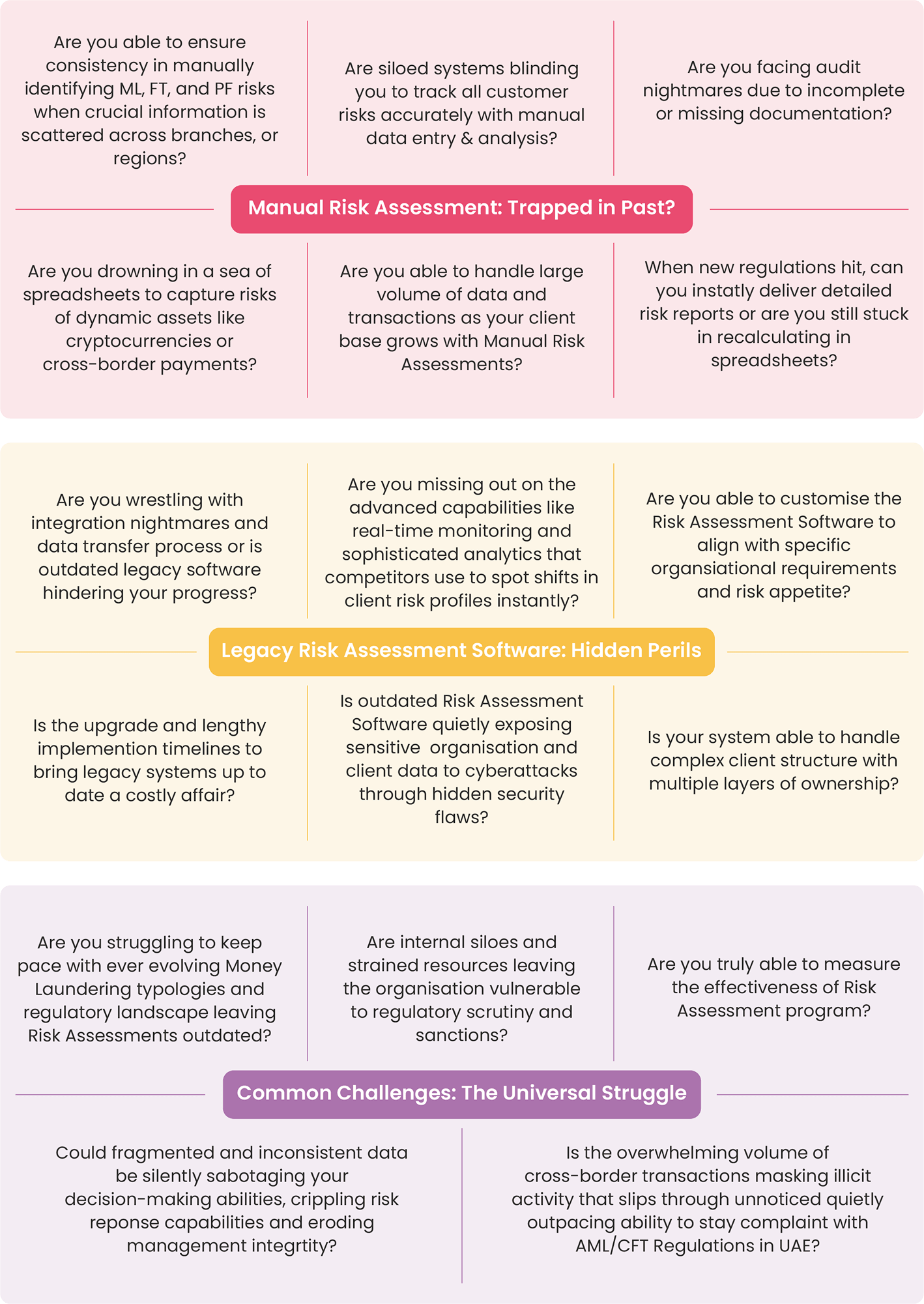
Challenges faced during Manual Risk Assessments act as costly operational hurdle for Regulated Entities which undermines the effectiveness of AML Compliance program. Key challenges faced by Regulated Entities when conducting AML/CFT Risk Assessments are:
Put an End to Compliance Chaos
Discover a Smart Risk Assessment Software that Enhances Your Compliance
Types of Risk Assessment Software
Risk Assessment Software enables Regulated Entities to successfully prevent, detect, and respond to threats of Money Laundering and Terrorist Funding. REs must conduct Risk Assessments to identify and evaluate risks while aligning them with the National Risk Assessments and sector-specific requirements to ensure an integrated approach to risk management.
Regulated Entities are required to identify, assess, and understand their risks in accordance with their business nature and size. Risk evaluation must consider all relevant risk factors such as clients, countries or geographic areas, products, services, transactions and delivery channels, before determining the level of overall risk and document appropriate risk mitigation measures on an ongoing basis.
Types of Risk Assessment Software
Customer Risk Assessment Software
Identifies and evaluates ML, FT, and PF Risks posed by potential and existing customers, facilitating risk scoring or risk categorisation for implementing commensurate due diligence measures.
Enterprise-Wide Risk Assessment Software
Identifies and evaluates risk factors impacting the business itself, such as customers, geographics, product/services, transactions, and delivery channels facilitating risk-based allocation of control measures.
Simplify Risk. Increase Resilience. Amplify Confidence.
Free your team from manual reviews with Ongoing Monitoring Software!
How to Select the Right Risk Assessment Software?
Selection of the right Risk Assessment Software doesn’t look the same for all kinds of FIs and DNFBPs. Each has its own unique sector-specific risks. For instance, DPMS have supply chain or ethical sourcing risk, whereas service-based DNFBPs face pertinent risk from misuse of complex ownership structures. The selection parameters for right Risk Assessment Software are discussed below:
Trust and Company Service Providers (TCSPs)
TCSPs should consider comprehensive Risk Assessment Software which has a dynamic risk profiling feature which covers all types of businesses, holding companies, and offshore entities including legal arrangements such as trusts. The Risk Assessment Software should be able to evaluate multidimensional risk factors including Beneficial Ownership, geographical risk factors, and perform ongoing risk reassessment based on regulatory changes, client activities, and any modifications in the business structure. Advanced algorithms should quantify the risk scores, considering the business nature, type of entity, customer profiling, sources of funds, and assess the risk of family offices, free-zone establishments, trusts, and SPVs, ensuring real-time Risk Assessment throughout the business relationship.
Dealers in Precious Metals and Stones (DPMS)
DPMS, while selecting a Risk Assessment Software, should select a system which can evaluate transaction-specific risks across diverse customer bases and the high-volume-based distributors and supply chain. While conducting the Risk Assessment, the system should consider real-time risk factors including transaction patterns, geographic origins of the product, methods of payment used, and type of commodity-related concerns such as conflict mineral sourcing. DPMS should look for a system which has a dynamic risk threshold mechanism that can automatically adapt as per the fluctuations due to market volatility while instantly providing DPMS with risk scoring for individual customers and complex supply chain-based wholesalers.
Real Estate Agents and Brokers
Businesses operating within the real-estate sector must focus on a system which incorporates a comprehensive Risk Assessment which can assess every kind of stakeholder, including buyers, sellers, guarantors, PoA holders, corporate entities, shell companies, and offshore entities who are dealing with property-related transactions to detect potential risk profiles with red flags trigger mechanism, especially when the shell companies are involved in high-value property transactions which may indicate ML/TF or PF based risks.
Auditors and Accountants
Auditors and accountants are involved in providing “professional services.” They need to have comprehensive Risk Assessment Software which can evaluate multidimensional risk factors across a diversified customer base spanning across multiple industries from different geographic locations, to be able to integrate with existing accounting tools and CRM systems so that the risks could be optimized while balancing the compliance workflows and their business operations.
Lawyers, Notaries, and Other Legal Professionals
All the legal professionals, including attorneys, notaries, consultants, need to have a Risk Assessment Software that can evaluate client profile risks. Legal professionals and firms should look for a system which can navigate a delicate balance between due-diligence requirements with maintaining the attorney-client privilege which would help legal professionals in maintaining the professional confidentiality standards throughout the legal practices. It should also have an automated trigger mechanism where it can reg flag any risk instantly on an ongoing basis whenever it detects any significant changes in a legal professionals or law firm’s customer profile on case-to-case basis.
Other Regulated Entities Such as VASPs and FIs
As Virtual Asset Service Providers (VASPs) deal with digital transactions such as crypto assets and FIs are increasingly relying on virtual assets hence they should look for a Risk Assessment Software which has a dedicated blockchain management mechanism to maintain the transaction trails while assessing the risks of the customers. The system should be able to assess the inherent risks associated with virtual assets when transaction is made cross-border, while it could be seamlessly integrated with the VASPs or FIs payment system to process Risk Assessment efficiently.
Benefits of Risk Assessment Software
Risk Assessment Software empowers Regulated Entities to conduct Risk Assessments with greater accuracy, efficiency, and consistency by automating risk data collection and analysis and helps RE in making informed decisions. Implementing Risk Assessment Software offers numerous benefits for UAE businesses:
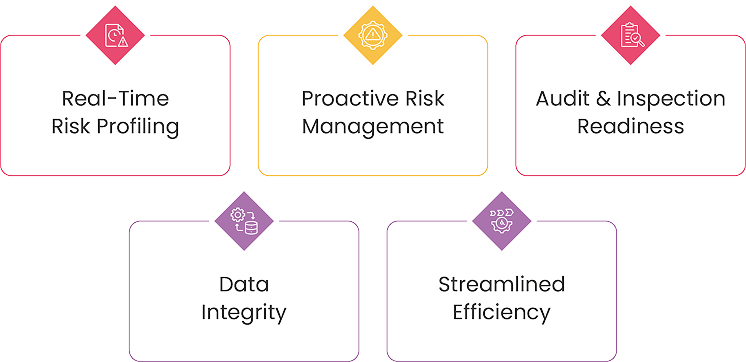

Real-Time Risk Profiling
Risk Assessment Software enables Regulated Entities (REs) to evaluate customer and business relationships by assigning them risk ratings in real-time across key dimensions such as customers, products, services, transactions, and geographies. Enabling seamless integration of data from multiple sources, the Risk Assessment Software delivers a comprehensive risk overview that improves the RE’s ability to timely detect and report suspicious activities.

Proactive Risk Management
Risk Assessment Software provides a holistic view of AML/CFT risks that the RE is exposed to, enabling them to make informed and strategic decisions. Regulated Entities can leverage data driven insights to enhance the effectiveness of AML/CFT controls and strengthen compliance strategies. Risk mitigation strategies can be customised to align internal controls with REs overall risk appetite and risk tolerance level.
Audit and Inspection Readiness
Risk Assessment Software helps Regulated Entities streamline audit trails by automating data collection, analysing risks, maintaining detailed logs of decisions and risk ratings, and minimising risk of human error by ensuring proper documentation. Real-time dashboards and alerts generated by Risk Assessment Software help Regulated Entities in linking internal control strategy with the UAE AML/CFT compliance obligations.

Data Integrity
Risk Assessment Software must be configured to safeguard risk-related information from unauthorised access and maintain comprehensive audit trails whenever a change to any document is made. Regulated Entities must validate that the data stored in the Risk Assessment Software and restrict access to limited personnel only, which is crucial to demonstrate compliance during audits and foster confidence in stakeholders.
Streamlined Efficiency
Risk Assessment Software automates manual tasks and streamlines the Risk Assessment Process, saving time and resources. Risk Assessment Software should be scalable to accommodate business growth, high volume of transactions and evolving UAE AML/CFT regulatory requirements. Easy integration with legacy system, efficient workflows and continuous monitoring enables Regulated Entities improve operational efficiency and accelerate decision making with precision.
Importance of Risk Assessment Software
Risk Assessment Software is an indispensable tool for Regulated Entities operating in UAE, providing a structured and an efficient approach to AML/CFT compliance. By understanding UAE’s AML/CFT regulatory landscape, leveraging automation and implementing best practices across the organisation, REs can mitigate risks, protect their reputation and contribute to fight against financial crime. Proactive compliance is not just about avoiding penalties; it’s about building a resilient and ethical business.


“Business is like a fortress of conflict, and risk is the primary enemy. This makes it crucial to identify, evaluate and mitigate every risk to overcome the fight. An effective Risk Assessment Software proves to be the sword of dominion to conquer ML/TF or PF risks.”

What to Look for in a Risk Assessment Software Vendor?
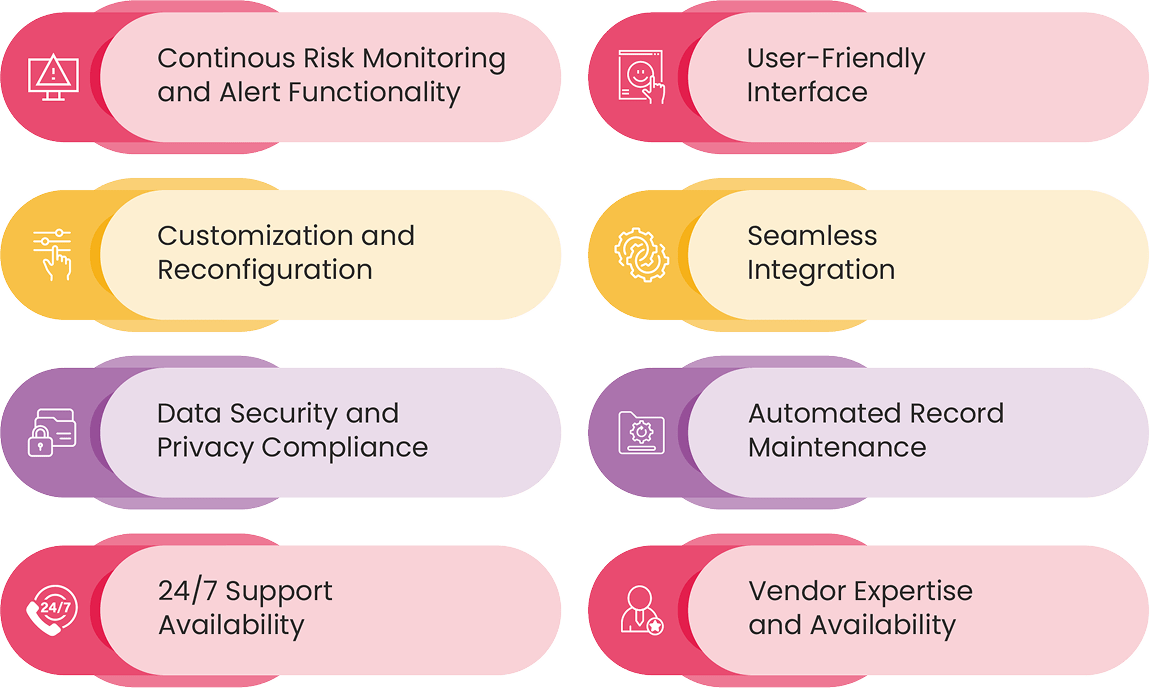
While selecting the Risk Assessment Software vendor, Reporting Entities should focus upon a system which is equipped with a dedicated multi-dimensional risk analysis capabilities paired with advanced risk scoring and profiling mechanisms, real time risk monitoring and alert functionality, complemented with a user-friendly interface which should also have an option of full customization and reconfiguration options.
Risk Assessment Software should also support a seamless integration capability with any of the existing systems, maintain data security and privacy compliance standards with automated record maintenance functionalities while ensuring 24/7 support availability backed by proven vendor expertise and availability to efficiently assess the risks.
Continuous Risk Monitoring and Alert Functionality
Risk Assessment Software must be able to conduct risk monitoring on an ongoing basis to maintain real-time monitoring and instantly detect any evolving risk landscapes, which would let the RE’s personnel intervene promptly and act upon them without wasting any time. Through the dedicated round-the-clock monitoring facility, it can detect if there is any kind of significant change in the activities of customers, their transaction patterns, geographic exposure of the business, nature of the product and the delivery channel usage to ensure efficient risk monitoring without disrupting the business operations.
User-Friendly Interface
User Interface (UI) is the primary medium through which compliance team navigate through the Risk Assessment Software. The interface of the Risk Assessment Software should be intuitive with a clean dashboard which would enable the compliance teams to operate easily and efficiently without any technical expertise. A user-friendly interface also saves RE’s time from conducting long training sessions. The interface of the system should also provide easy access to the track records of risk assessment, with detailed reports of each of RE’s clients. A simple interface makes the whole process of Risk Assessment very easy and efficient for the compliance team.
Customization and Reconfiguration
As most of the businesses operating in UAE are dealing with a diversified industry, each one of them have their own specific and unique requirements as per their industry-based needs, magnitude of the risk involved and their customer profile. RE’s should look for Risk Assessment Software, which lets them tailor the whole system according to their particular operational needs and lets them configure the Risk Assessment parameters as per their industry.
Seamless Integration
Risk Assessment Software must be able to smoothly integrate with any of Regulated Entity’s existing systems to ensure that there will not be any operational disruptions or task duplications while maintaining efficiency. The Risk Assessment Software should upgrade an RE’s current Risk Assessment infrastructure rather than forcing them to change their entire system. The integration process should come with a simple execution method with minimal downtime. RE’s business operations should not face long periods of interruptions due to the implementation process of the new system. RE’s must look for a Risk Assessment Software, which should have a comprehensive implementation support system and can quickly complete the integration during off-business hours to minimize business interruptions.
Data Security and Privacy Compliance
Concerns related to data security stand as one of the pivotal factors to consider while choosing a Risk Assessment Software. The system must be equipped with the highest levels of security standards to protect all the sensitive information of RE’s customers and maintain the regulatory compliance requirements as well. While transmitting the data related to the assessed risks of the customers and storing it as well, the Risk Assessment Software must have a dedicated data encryption protocol with intact cloud storage.
It should have multiple layers of security, such as firewall protection, data-breach detection, and consistent updates of security patches to ultimately detect any attempt at forced access or unauthorized login attempts. Also, the Risk Assessment Software should ensure compliance with the UAE’s Data Protection Law and with other relevant privacy regulations. All the data of Risk Assessment must be handled by a predetermined process, providing an active customer consent mechanism, and also a dedicated data erasure process when the Risk Assessment-based information is not required anymore for the business.
Automated Record Maintenance
As per the AML/CFT laws prevailing in UAE, record keeping is one of the most fundamental requirements, and so Risk Assessment Software should have a dedicated record maintenance feature which will help REs to ensure that all the Risk Assessment activities are well documented in an organised way and also must be easily accessible for regulatory purposes. The Risk Assessment Software should automatically maintain all information related to customers which was used for Risk Assessment purpose, and it must include all the data which was collected while conducting Risk Assessment, with all their risk related records for tracing purposes.
For ease of traceability, it should also have a dedicated automated timestamp mechanism, which would help in tracking the retention periods of the data, and it would provide alerts as well before records approach their deletion dates.
24/7 Support Availability
Any of the Risk Assessment Software an RE choses, should come with a dedicated round-the-clock technical support for getting an uninterrupted compliance operation, especially considering the critical nature of compliance operations when RE’s business presence is in different time zones at a time. The system should be well-equipped with online ticketing feature, a support system through call or email assistance. A well-organized ticketing system would let RE’s track the progress of their issue while maintaining all the communication records, and classifying all the urgent matters on priority, whenever necessary.
It should also have automated periodic health check system, performance optimization, and a preventive mechanism by which unexpected downtime can be reduced, and a consistent risk performance can be ensured without any interruptions. In any kind of unforeseen circumstance, such as any major technical glitches, especially during peak business hours, the Risk Assessment Software should have dedicated support channels to ensure a rapid solution and continued compliance operations.
Vendor Expertise and Availability
In any business, the market reputation of Risk Assessment Software is one of the most crucial factors which will provide a sense of reliability which would significantly determine long-term compliance success. Regulated Entities must look for a Risk Assessment Software Vendor who has a proven track record in the compliance industry within UAE with specific knowledge of the field to establish a sense of credibility to ensure a reliable partnership to assist with complying with AML/CFT compliance. The Risk Assessment Software provider should also have a system update policy to enhance their risk assessment tools’ capabilities.

Eliminate any ML/FT/PF Risk Blind Spots with Risk Assessment Software
As in the evolving times of financial landscapes, all the Regulated Entities operating in the UAE faces the risk of MF/TF and PF and to counter them, the manual process of Risk Assessment has become inadequate due to its operational inefficiencies and compliance gaps which can lead you to regulatory penalties. Risk Assessment Software is one of the best solutions which can help you transforming your compliance through its automation feature and a multidimensional approach of assessing the risks of your customers in the most efficient way.
While Risks are Inevitable but Detecting the Risk is First Step to Eliminate them.
Stay one step ahead with Real-Time Risk Signals