


Transaction Monitoring Software
Transaction Monitoring Software is an integral part of AML Software. A well-designed Transaction Monitoring Software not only detects and reports suspicious transactions but also supports a robust risk management framework, ensures regulatory reporting readiness, and provides a clear audit trail for supervisory authorities. Regulated Entities must select Software that are adaptive to emerging threats, capable of integrating AI-driven insights, and flexible enough to accommodate evolving risk typologies.
What is Transaction Monitoring Software
Transaction Monitoring Software is a tool that enables Regulated Entities to continuously track and analyse financial transactions. It reviews a customer’s historical activity, profile details, account information, and interactions to assess potential risks and anticipate future transaction behaviour.
Transaction Monitoring Software operates in real time, tracking transactions as they occur to detect and block suspicious activity immediately, thereby helping prevent fraud. It also analyses completed transactions to identify unusual patterns or behaviours that may indicate potential Money Laundering (ML) and Terrorist Financing (TF) activities.
By automating periodic reviews, Transaction Monitoring Software helps Financial Institutions (FIs), and Designated Non-Financial Businesses and Professions (DNFBPs) maintain compliance with AML regulatory requirements and ensure proactive risk management.

Regulatory Requirements under UAE AML Law for Transaction Monitoring
All Regulated Entities (REs) in the UAE, whether operating in the Mainland or in Free Zones such as Dubai International Financial Centre (DIFC), Abu Dhabi Global Market (ADGM), Jebel Ali Free Zone, etc., are subject to the following core national Anti-Money Laundering laws:
Federal Decree by Law No. (10) of 2025
Anti-Money Laundering and Combating the Financing of Terrorism and Illegal
Organisations.
Cabinet Resolution No. (134) of 2025 :
Concerning the Implementing Regulation of the above Decree-Law.
Entities regulated by the UAE Central Bank, DFSA (Dubai), or FSRA (Abu Dhabi) must also follow sector-specific AML/CFT guidelines for Transaction Monitoring.
Issues Faced by Regulated Entities While Conducting Transaction Monitoring
Regulated Entities in UAE may be facing issues like manual inefficiency, human error, false positives, scalability, tool complexity, poor data quality, and outdated software use when it comes to Transaction Monitoring.
Whether you are relying on manual reviews, Rule-Based Systems, Machine Learning, or existing Transactional Monitoring Software solutions, these common pain points could be putting your compliance and reputation at risk.
Challenges Faced While Relying on Manual Transaction Monitoring
- Still stuck in spreadsheets? Can you keep up with high-volume transactions when everything is manually reviewed?
- Can human eyes catch what machines miss? Are you risking undetected suspicious activity due to fatigue or inconsistent judgment?
Challenges Faced While Relying on Rule-Based Transaction Monitoring
- Is your system flagging too much… or too little? Are you overwhelmed with false positives from rigid rules that don’t adapt to changing behaviours?
- Are outdated rules costing you real threats? How often do you update detection rules to keep pace with evolving ML/TF tactics?
Challenges Faced While Relying on Machine Learning Based Transaction Monitoring
- Are you trading transparency for tech? Are your current tools too complex for compliance staff to understand or act on efficiently?
- Is your data smart enough for smart tech? Do you have the clean, labeled data your ML model needs to actually learn and perform?
Challenges Faced While Relying on Legacy Transaction Monitoring Software
- Still patching up yesterday’s tech? Are you relying on outdated software that can’t adapt to today’s financial crime risks?
- Can your existing Software scale with your success? Can your monitoring system keep up as your transaction volume or business expands?
Struggling with Transaction Monitoring? It’s Time to Upgrade!
Manual reviews, outdated rules, forget pains with Transaction Monitoring Software
How Transaction Monitoring Software Supports AML Compliance for Regulated Entities
Transaction Monitoring Software helps Regulated Entities stay AML Compliant through a systematic procedure that begins by integration with KYC and internal systems. The next steps include policy alignment, data monitoring & transaction behaviour analysis, alert prioritisation, case creation & review, filing STR, rule refinement and recordkeeping, which are explained below:

Step 1- Integration with KYC Software and Internal Systems
The Transaction Monitoring Software first integrates seamlessly with the Regulated Entity’s internal environment, pulling data from KYC Software, POS systems, CRM, ERP, onboarding systems, payment platforms, accounting software, e-wallets, and customer databases. By consolidating this information, it creates a unified data stream that includes essential customer identification details, risk scores, source of funds, and transaction data such as amounts, timestamps, and destinations.
Step 2- Alignment with AML/CFT Policies and Risk Appetite
Once the Transaction Monitoring Software connects with the internal systems, it requires the Transaction Monitoring Analyst to configure its rule engine and detection models. This configuration aligns with the Regulated Entity’s AML/CFT policies, sector-specific obligations, and overall risk appetite.
The Transaction Monitoring Software adapts its monitoring logic based on the parameters defined by the Transaction Monitoring Analyst, which includes:
- Customer risk classifications
- Business types (e.g., real estate, crypto, legal services)
- Transaction behaviour thresholds
- Applicable regulatory requirements
This configuration ensures that the Transaction Monitoring Software is context-aware and aligned with how the RE defines and manages financial crime risk.
Step 3- Continuous Data Monitoring and Transaction Behaviour Analysis
With the system in place, the Transaction Monitoring Software continuously monitors transactions in real-time. It applies predefined rules (e.g., high-value transfers, structuring patterns, or cross-border flows), and AI/ML models that learn from historical data to detect evolving or hidden risks.
For instance, if a DNFBP customer suddenly receives a large third-party transfer that deviates from their usual transaction patterns or declared business activity, the Transaction Monitoring Software will automatically flag it for further review.
Step 4- Alert Generation and Prioritisation
When a suspicious transaction is detected, the Transaction Monitoring Software automatically sends an alert to the Transaction Monitoring Analyst for review. The Transaction Monitoring Analyst assesses the alert and assigns a risk score based on the nature and context of the transaction.
This risk score helps prioritise alerts for further investigation. Transactions involving high-risk indicators, such as high-risk jurisdictions and unusual transaction velocity, are escalated with higher urgency.
Step 5-Case Creation and Review
Based on the assigned risk score and urgency level, the Transaction Monitoring Software automatically generates a review case within its case management module.
Compliance Officers can then review the customer’s profile and full transaction history, access related documents, the risk assessments, KYC records, cross-check information against sanctions lists, PEP databases, and media screening tools.
Step 6- Filing Suspicious Transaction Reports (STRs)
If an alert, upon analysis by a Transaction Monitoring Analyst or an AML Compliance Officer, is validated as suspicious, the Transaction Monitoring Software facilitates them with the preparation of a Suspicious Transaction Report (STR) for submission to the UAE FIU via the goAML platform. The Transaction Monitoring Software supports internal approvals, document attachments, and ensures that reporting is completed within regulatory timeframes.
Step 7- Ongoing Monitoring
The Transaction Monitoring Software continuously monitors customer transactions in real-time, even after an investigation is completed. Updated risk profiles, behavioural patterns, and transactional history feed into ongoing surveillance to ensure timely detection of new or emerging suspicious activity.
This persistent monitoring ensures that changes in customer behaviour or risk exposure are immediately captured, enabling dynamic risk management.
Step 8- Rule Refinement
To stay effective and risk-aligned, the Transaction Monitoring Software’s detection rules, logic, and thresholds are periodically refined and re-tuned. This process is led by compliance teams to ensure the Transaction Monitoring Software reflects the Regulated Entity’s evolving risk appetite and remains compliant with changing regulatory expectations.
Ongoing refinement of the Transaction Monitoring Software’s logic ensures it continues to detect relevant threats accurately, and adapts to emerging financial crime risks, enabling Transaction Monitoring Analysts to focus on genuine suspicious transactions.
Step 9- Secure Recordkeeping and Audit Readiness
The Transaction Monitoring Software automatically logs all activities in an audit-ready trail. The Transaction Monitoring Software ensures full compliance with record retention requirements under the UAE law, which mandates keeping these records for at least five years for inspection by supervisory authorities.
From Red Flags to Reports Monitor Smarter, Not Harder
Make Every Transaction Count with Intelligent Monitoring
Must-Have Features and Functionalities in a Transaction Monitoring Software
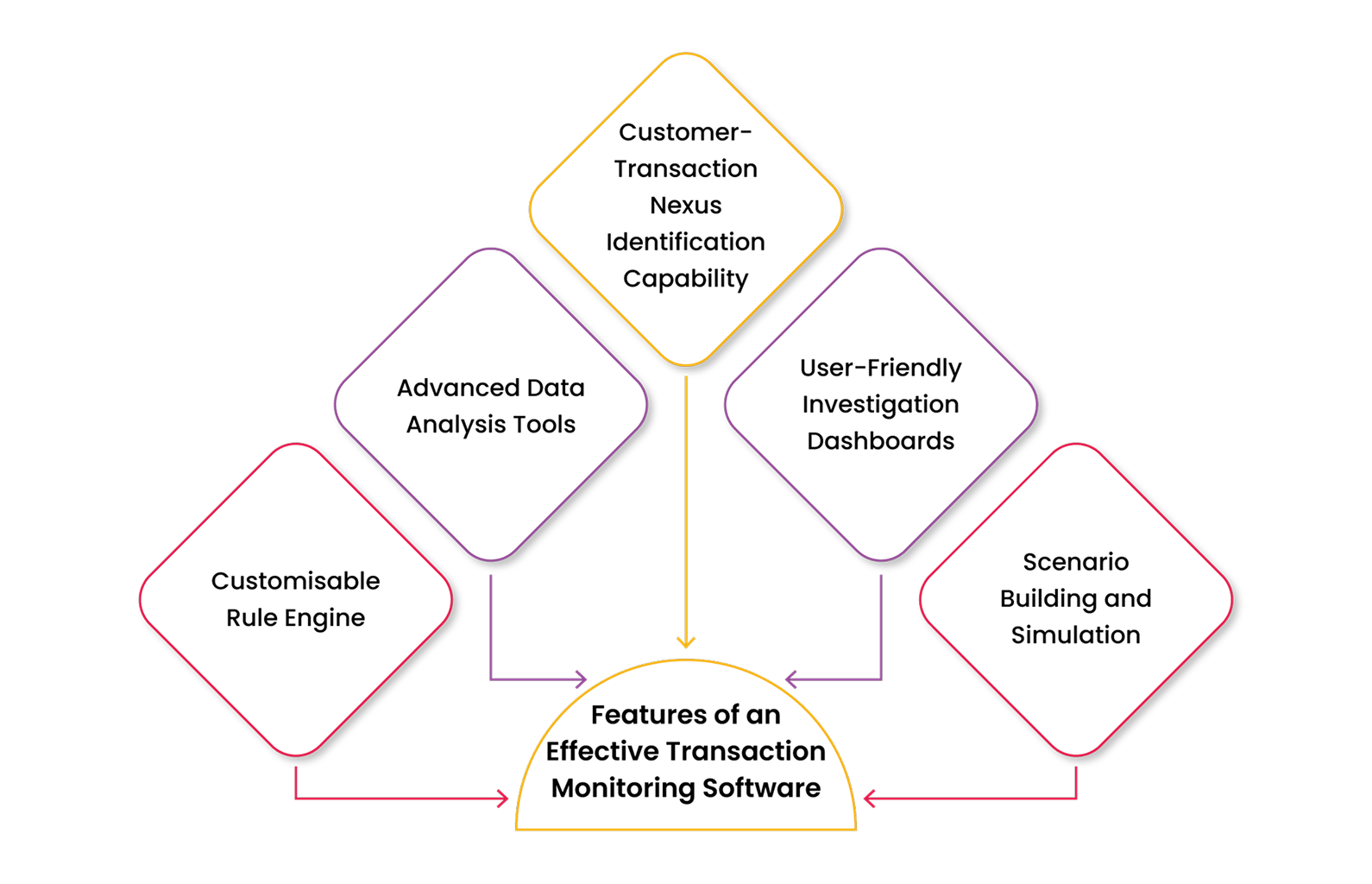
Transaction Monitoring Software features must include a customisable rule engine, customer-transaction nexus identification capability, advanced data analysis tools, user-friendly investigation dashboards, and scenario building & simulation.
Regulated Entities need to ensure regulatory compliance, operational efficiency, and effective detection of financial crime, which can be achieved by ensuring that Transaction Monitoring Software offers the following key features and functionalities:
Customisable Rule Engine
A flexible rule engine in a Transaction Monitoring Software automatically triggers alerts with the set predefined rules and thresholds. It is for this reason that Transaction Monitoring Software must have a customised rule engine for creating, updating, and testing Transaction Monitoring rules based on industry-specific risks, red flag indicators, customer profiles, and business operations.
Advanced Data Analysis Tools
The Transaction Monitoring Software must offer in-depth data analysis features that allow Transaction Monitoring Analysts to examine high volumes of transaction data, segregate suspicious transactions, and perform disambiguation efficiently. Built-in filters, visualisation tools, and advanced search capabilities support quick identification of unusual patterns and potential financial crime risks.
Customer-Transaction Nexus Identification Capability
The Transaction Monitoring Software must be equipped to detect relationships between seemingly unrelated customers or transactions. This capability helps in uncovering hidden linkages indicative of mule accounts, smurfing networks, or collusive behaviour. It further helps to expose complex laundering structures that may otherwise go undetected in linear transaction reviews.
User-Friendly Investigation Dashboards
The Transaction Monitoring Software must provide intuitive dashboards that support end-to-end investigation workflows, allowing compliance analysts to review alerts, access related data, and act efficiently. The user-friendly dashboard must empower teams to concentrate on analysing data for efficient and accurate investigations that enable crime detection and improve productivity.
Scenario Building and Simulation
The Transaction Monitoring Software must support creation and testing of monitoring scenarios, allowing the Transaction Monitoring Analyst to simulate how defined rules and triggers respond to various typologies. This feature ensures proper scenario development, validation, and calibration aligned with both rule-based logic and machine learning to strengthen risk-based monitoring capabilities.
Click Less, Catch More: Smarter Monitoring for Smarter Compliance.
Reimagine Transaction Monitoring with a Solution Tailored to Your Needs
Benefits of Transaction Monitoring Software for Regulated Entities
The benefits of Transaction Monitoring Software for Regulated Entities include enhancing institutional integrity, streamlining alert prioritisation, ensuring end-to-end compliance, improving operational efficiency, and aligning monitoring capabilities with risk profiles. The below explains these benefits more clearly:

Enhances Institutional Integrity Through Real-Time Detection of Suspicious Transaction
For Regulated Entities, the ability to respond swiftly to financial crime risks is vital in maintaining operational credibility. Transaction Monitoring Software provides real-time detection of unusual or potentially illicit transactions, enabling immediate intervention. This proactive capability not only mitigates the risk of undetected ML/TF activity but also reinforces institutional accountability in the eyes of regulators, partners, and stakeholders.
Streamlines Alert Prioritisation for Efficient Case Management
Transaction Monitoring Software allows Regulated Entities to systematically prioritise alerts into levels based on severity and review needs. It enables Transaction Monitoring Analysts to quickly identify false positives, create cases for valid alerts, and escalate issues requiring STR filings. This structured alert flow improves response times, reduces backlog, and ensures regulatory timelines are met without unnecessary delays in investigations.
Ensuring End-to-End Compliance Through System Integration
Transaction Monitoring Software supports full AML compliance by integrating monitoring, case management, documentation, and reporting in one system. Analysts can easily access relevant records, manage alerts, and prepare STR filings within the same platform. This centralised process enhances oversight, reduces operational gaps, and ensures strong internal controls. By bringing all compliance processes together, it ultimately helps Regulated Entities meet AML/CFT regulatory requirements with ease.
Improves Operational Efficiency by Reducing False Alerts
A high rate of false alerts can overwhelm compliance teams and delay response to genuine risks. Transaction Monitoring Software equipped with AI and machine learning refines detection logic and adapts based on past alerts. This intelligent optimisation ensures that analysts can prioritise high-risk transactions, allowing Regulated Entities to allocate resources efficiently while maintaining a strong defence against financial crime.
Aligns Monitoring Capabilities with Sector-Specific Risk Profiles
Every Regulated Entity, from DNFBPs to VASPs, faces unique exposure to financial crime. Transaction Monitoring Software allows institutions to customise detection rules and monitoring thresholds based on their risk appetite, customer base, and business model. This tailored approach ensures monitoring efforts are both effective and proportionate, reflecting a deep understanding of the institution’s regulatory obligations.


“Compliance journey seems no easier; you also must work as an ECG machine that regulates the patients. However, navigating the journey with a software packed with AI-powered analytics and customisable rules might help your team detect and investigate suspicious transactions.”

How to Select and Implement Transaction Monitoring Software: Best Practices for DNFBPs, VASPs & SCA-Regulated Entities
Selecting the right Transaction Monitoring Software leads to alignment with AML/CFT obligations, alert management, rule customisation, reassessing historical transactions, and establishing escalation procedures. These best practices that help Regulated Entities in UAE to make informed decisions and implement effective monitoring systems are explained below:

Aligning Transaction Monitoring Software with AML/CFT Risk Mitigation Objectives
While selecting and implementing Transaction Monitoring Software, REs must ensure that the software is fully aligned with their risk-based AML/CFT compliance framework, as mandated by the UAE’s AML Laws. Effective integration of Transaction Monitoring Software strengthens customer risk classification, enhances ongoing due diligence, and ensures timely detection and reporting of suspicious transactions.
Prioritising Quality Over Quantity in Alert Management
Regulated Entities should select a Transaction Monitoring Software that supports a quality-driven approach to alert review. Regulated Entities should avoid making monitoring a volume-based operational task and instead focus on the efficiency, accuracy, and depth of investigation into each alert generated. Choosing a Transaction Monitoring Software should also involve using Machine Learning Models to predict the genuineness of an alert.
Customising Transaction Scenarios and Risk-Based Rule Parameters
Regulated Entities should select Transaction Monitoring Software that allows for the custom creation and calibration of detection scenarios. The Transaction Monitoring Software should support configuration of rules based on customer types, transaction thresholds, geographies, and typologies such as structuring and smurfing. This flexibility ensures that detection logic mirrors the RE’s specific risk profile and regulatory obligations.
Reassessing Historical Transactions to Enhance Risk-Based Monitoring
Regulated Entities must ensure their Transaction Monitoring Software enables reassessment of historical and related transactions upon detecting suspicious activity. This enhances detection of concealed patterns, improves customer risk profiling, and supports emerging typology identification. A centralised data strategy is essential to facilitate timely access, cross-departmental analysis, and alignment with the UAE’s risk-based AML/CFT compliance framework.
Establishing Escalation and Review Procedures
Regulated Entities should choose Transaction Monitoring Software that supports clear escalation and review workflows. The Transaction Monitoring Software must allow configuration of review rules based on risk tier, for instance, flagging all high-risk transactions for manual review, while enabling auto-closure of low-risk and low-value alerts. This structured escalation framework ensures consistency, accountability, and efficient resource allocation in the review process.
You know your business. Your Transaction Monitoring Software should too.
Go for a Software that emphasises precision over volume.
Facing Transaction Monitoring Challenges? Here’s What Smart Transaction Monitoring Software Can Do
The challenges of Transaction Monitoring may feel like navigating a storm with a broken compass. Manual reviews, irrelevant rules, legacy systems, and high compliance costs all slow down your ability to detect Money Laundering activities efficiently.

Compliance Chaos
What Smart Transaction Monitoring Software Brings to the Table
“Stuck in the Stone Age of manual reviews.” Manual monitoring slows down compliance and increases human error.
A robust Transaction Monitoring Software offers automated, real-time transaction screening, drastically reducing manual intervention and errors.
“Too many rules, too little relevance.” Outdated or generic rules result in unnecessary alerts or missed red flags.
Smart Transaction Monitoring Software allows dynamic, customizable rule engines that adapt to your business model, risk profile, and regulatory changes.
“Trying to patch modern leaks with legacy tools.” Outdated software lacks integration, scalability, and analytics capabilities.
Modern Transaction Monitoring Software supports API integrations, modular scalability, and advanced analytics, future-proofing your compliance framework.
“Compliance teams running on empty.” Limited skilled staff struggle with complex investigations and high alert volumes.
A powerful Transaction Monitoring Software comes with intuitive dashboards, workflow automation, and case management tools, reducing analyst burden and improving productivity.
“Blindfolded navigation in an evolving threat landscape.” Static systems can’t keep up with new ML/TF typologies.
Effective systems leverage Artificial Intelligence and Machine Learning to detect emerging patterns and behavioural anomalies, offering adaptive financial crime detection.
“One-size-fits-none.” Generic systems don’t align with sector-specific risks or customer behaviours.
Tailored Transaction Monitoring Software solutions provide industry-specific configurations and risk-based customization aligned to your products, customers, and jurisdictions.
“Cost concerns clouding compliance clarity.” High setup and ongoing costs limit investment in quality monitoring tools.
A scalable Transaction Monitoring Software offers modular pricing, cloud-based deployment, and cost-efficiency through automation, reducing total cost of ownership.
“Reporting to regulators feels like decoding ancient scripts.” Regulatory reports are manual, time-consuming, and error prone.
Advanced Transaction Monitoring Software support automated SAR/STR filing and regulatory templates, streamlining compliance submissions.
Smart Transaction Monitoring for Smarter AML Compliance
Transaction Monitoring Software is no longer a compliance luxury; it is a regulatory necessity and a strategic enabler for detecting and mitigating Money Laundering and Terrorist Financing activities. For DNFBPs, VASPs, and other Regulated Entities in the UAE, the implementation of an intelligent, customizable, and scalable Transaction Monitoring Software is essential to meet the requirements of the UAE AML law and align with international best practices.
By investing in the right Transaction Monitoring Software and following industry aligned implementation strategies, Regulated Entities can significantly reduce their exposure to financial crime and reinforce trust among regulators, clients, and the broader financial ecosystem.
Struggling with Compliance Chaos?
Let Smart Transaction Monitoring Software Do the Heavy Lifting.
FAQs on Transaction Monitoring Software
An advanced Transaction Monitoring Tool comes with a dedicated integration system which helps the Regulated Entities in smoothly filing the Suspicious Transaction Reports (STRs) through automation with goAML platforms which saves time and streamlines the workflow. The integration feature should support real-time monitoring on an ongoing basis to avoid detecting any kind of potential suspicious transactions which could lead the businesses to ML/TF or PF-based risks.
Real-time Transaction Monitoring can be integrated with banking and KYC systems through API-based connections. By combining Customer Due Diligence (CDD) data with transaction data, organisations can efficiently detect anomalies and meet AML/CFT compliance requirements while maintaining operational efficiency.
Regulated Entities operating within the UAE should focus on selecting advanced Transaction Monitoring Software which is specifically designed to fulfill the requirements of their regulator which can be UAE Central Bank, ADGM, or DIFC and complying with AML regulatory frameworks. While picking Transaction Monitoring Software, businesses should consider that the monitoring tool should be aligned with local regulatory frameworks, supporting goAML reporting, covering all local watchlists and having a dedicated trigger mechanism to instantly redlarge any suspicious transactions.
Yes, advanced Transaction Monitoring Software can automatically generate STRs for goAML submission. When suspicious patterns are detected, the system analyses the activity and creates detailed reports highlighting potential ML/TF and PF risks.
As per the AML/CFT laws, all the Regulated Entities operating in different types of zones within the UAE are supposed to perform Transaction Monitoring on an ongoing basis to detect any kind of suspicious transaction patterns and instantly report them through the goAML portal.
Best practices for implementing AML Transaction Monitoring in the UAE include the following:
- Conducting an effective Risk Assessment
- Implementing risk-based monitoring
- Robust Case Management
- Conducting regular Training
ML and AI improve Transaction Monitoring by continuously learning from data and customer behaviour, and they help in decreasing false positives and increasing detection accuracy. Additionally, they make monitoring more effective and seamless by enabling automated configurations tailored to business needs, making monitoring more efficient and seamless.
Transaction Monitoring Software is a digital tool that analyses financial transactions to identify suspicious or unusual activities that may indicate ML/TF and PF risks. In the UAE, AML/CFT regulations require Regulated Entities to report such activities via the goAML portal, making Transaction Monitoring essential for automated reporting and regulatory compliance.
Advanced Transaction Monitoring Software offers a dedicated integration option to businesses for seamless operations.
API (Application Programming Integration) based monitoring tools are the most widely used integration system which is primarily used for seamless exchange of data related to customers and transactions, helps in connecting with external databases such as sanctions lists or PEP databases, and overall provides a flexible integration solution with the utmost security.
Integration with the ERP system helps businesses to handle their financial transactions and provides more dynamic analysis of the customers and the transactional patterns.
Transaction Monitoring Software should also be connected through the core banking system for better data extraction related to transactions, including account-related information and customer data.
Regulated Entities operating within the UAE should consider Transaction Monitoring Software which has a dedicated integration system backed by AI and machine learning with an automated trigger and a reporting mechanism with the goAML portal for any suspicious transaction patterns. Also, businesses should look for a monitoring tool which offers a user-friendly interface for easy navigation through dashboard of the software, and it must be cost-effective and ultimately saves immense amount of time.
Transaction Monitoring Software flags any kind of unusual transaction patterns which includes a wide range of risks, such as, high-value transactions, more unusual than regular transactions. While analysing the transactions, if the payments are found to be made from any high-risk jurisdictions, rapid movement of funds, splitting of a high amount is detected, the system identifies it as a risky transaction.
The frequency of updating the rules for the Transaction Monitoring Software varies by vendor as it’s not fixed by any regulatory authority. Regulated Entities must take initiative in changing the threshold limits for reporting purposes or resetting the criteria to determine the suspicious transactions.