


Address Verification
Verifying the residential proof of customers before onboarding or during ongoing business relationship is very imperative component of efficient Customer Due Diligence (CDD) measures in UAE. This helps Regulated Entities to establish the reliability and legitimacy of the customer while entering into the business relationship.
What is Address verification?
Address Verification is the process used by organisations to confirm that a customer’s stated residential or business address is correct and matches Government issued documents.
It is a key part of Customer Due Diligence (CDD) and Know Your Customer (KYC) obligations, especially in regulated sectors like Designated Non-Financial Businesses and Professions (DNFBPs) and Virtual Asset Service Providers (VASPs).
It typically involves comparing the customer-provided address during KYC with legitimate and reliable residential proof documents such as electricity/water bill, bank statement, property contracts etc.

Why Address verification is Important?
It is pertinent for Regulated Entities to ensure that they are conducting thorough Address Verification as it helps customers gain some credibility and legitimacy.
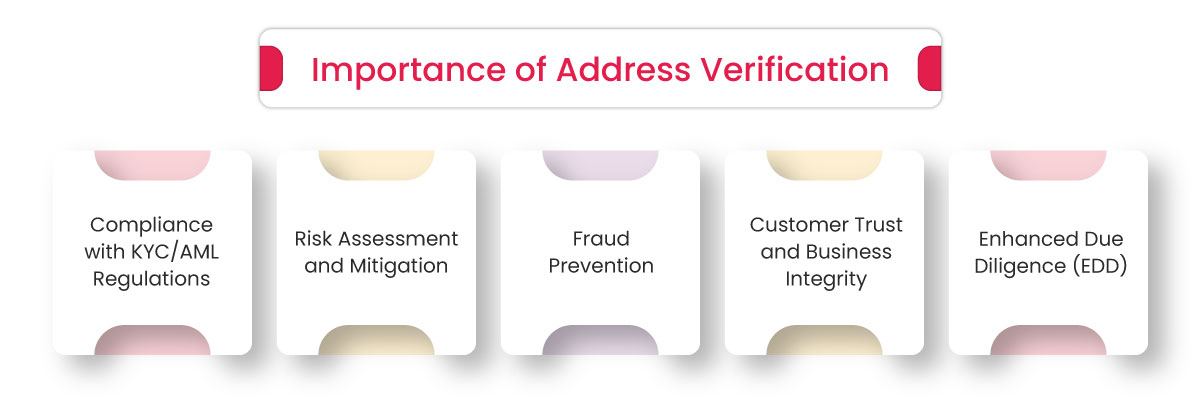
Address Verification is important because it helps in complying with KYC/AML Regulations, ensuring risk management measures are undertaken, assists in preventing fraud, helps in building customer trust and business integrity, and supports Enhanced Due Diligence (EDD).
Compliance with KYC/AML Regulations
The due diligence is empowered through Article (9) of the Cabinet Resolution No. (134) of 2025 requires Regulated Entities to carry out identifying and verifying the address of the natural person, legal person or legal arrangement.
Risk Assessment and Mitigation
The process of Address Verification helps in assessing location-based risks like high-risk countries, sanctioned regions etc. It also helps in preventing fake identities and avoid onboarding high-risk clients unknowingly.
Fraud Prevention
Address Verification works towards helping Regulated Entities to avoid fraudulent accounts being opened using fake locations, which are often used as a tactic in identity theft and Money Laundering activities. It also assists the incident response teams to identify, flag and report suspicious activities.
Customer Trust & Business Integrity
The step of collecting and verifying addresses helps in building trust among legitimate customers and reassures them about compliance framework and security measures employed by the organisation.
Enhanced Due Diligence (EDD)
Address Verification forms an important part of Enhanced Due Diligence (EDD), especially for high-risk customers or transactions. It is also a key component of Know Your Customer (KYC) and Know Your Business (KYB) processes.
In an incident response scenario, it helps compliance teams to quickly determine the customer’s risk profile and the legitimacy of the transaction.
Operational Pain Points in Address Verification
Regulated Entities (REs) often end up relying on manual processes or outdated systems for verifying customer addresses. These measures end up being insufficient for compliance in the digitally evolving landscape of UAE. The common challenges faced during address verification are:
Are your Address Verification processes aligned with the latest regulatory expectations, including proof of residence, tenancy validation, and verification of both local and foreign addresses based on your customer risk exposure?
Do you have a robust mechanism in place for ongoing / periodic Address Verification to ensure that customers who change residences or submit inconsistent address information are re-verified promptly, even after onboarding?
Does your Address Verification solution support automated document validation, geo-tagging, multilingual address formats, and intelligent comparison to detect mismatches or forged proofs without overwhelming your compliance team?
Does your Address Verification platform provide a unified dashboard with real-time status updates, risk flags, and exception reporting — while ensuring UAE-compliant data security, encryption, secure storage, and role-based access to sensitive customer information?
Are your Address Verification records fully documented, with timestamped logs, OCR-verified documents, and audit trails that can be easily retrieved and presented during regulatory inspections, audits, or internal reviews?
Is your Address Verification workflow fully UAE-compliant, integrated with your KYC / CRM systems, and capable of producing regulator-ready reports for audits or inquiries without extensive manual intervention?
Don’t let these pain points become a pain in your neck!
Alleviate yourself of this pain and choose us!
Regulatory Obligations for Address Verification in UAE
In UAE, the process of carrying out Address Verification is empowered through Article (9) of the Cabinet Resolution No. (134) of 2025 which states that it is pertinent for Regulated Entities to undertake identifying and verifying the address as a part of due diligence.
Address verification is mandatory under the KYC/CDD requirements set forth by the UAE AML/CFT regulations. As per the Federal Decree Law No. (10) of 2025, REs must verify customer identity and address using reliable, independent sources and ensure their information remains up to date throughout the relationship.
The opportunity for conducting Address Verification arises in the following circumstances:
- During onboarding of the customer
- Periodically during ongoing due diligence
- Whenever any suspicious activity is detected.
What Counts as Valid Proof of Address in UAE?
The Risk-Based Approach entails the Regulated Entities to use certain documents as proof of address. The proof of address being used may be one or more of the following documents:
For Natural Persons:
- Utility bills (not older than 3 months)
- UAE tenancy or lease contracts(Ejari Certificate)
- Bank statements / Credit card statements
- Government-issued address certificates
- Municipality documents
- Geo-tagged address verification (through approved third-party systems).
For Legal Persons:
- Utility Bill of principle place of business and registered place of business (not older than 3 months)
- UAE tenancy or lease contracts
- Bank statements/Credit card statements
- Municipality documents
In case of legal persons, verifying the residential address proof of its Ultimate Beneficial Owner (UBO) is necessary as per the UAE’s AML/CFT legislations.
Step-by-Step Guide for Effective Address Verification Compliance
The compliance requirements for REs to carry out Address Verification, certain measures must be taken such as collecting, verifying, recording, monitoring and updating the address information from the customer.
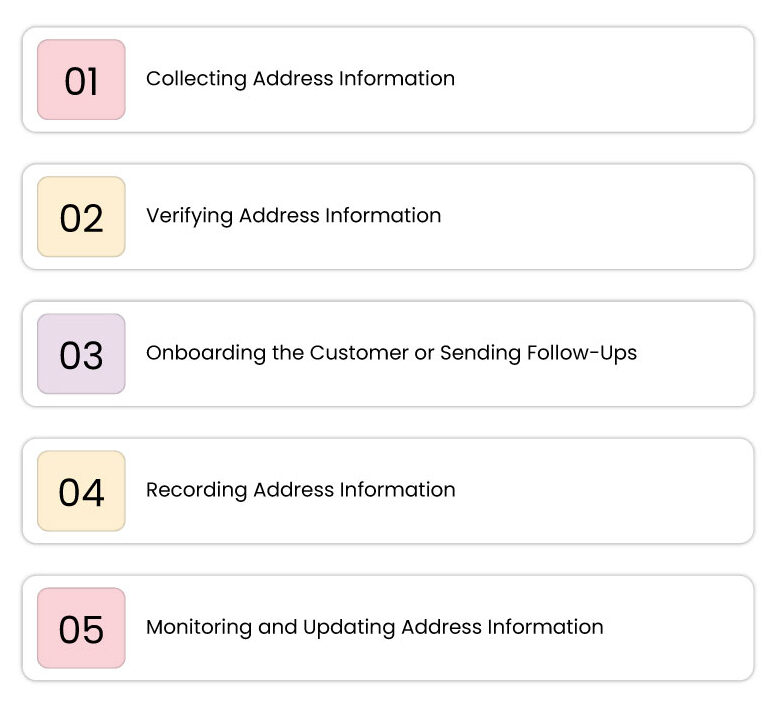
Collecting Address Information
The process of address verification begins with collecting the valid and updated address information of the customer during customer onboarding or periodic review.
Updated here refers to the address proof that is not older than 3 to 4 months if it is a Utility Bill.
It is a residential address proof for the natural customer. For legal customer, the address proof of both registered place of business and principal place of business is collected. Also, in case of legal customer, collecting the residential address proof of the Ultimate Beneficial Owner (UBO) or senior management is required.
Verifying Address Information
After collecting the address proof, the following step for Regulated Entities is to verify the collected address. This process is imperative to determine that the provided address is not forged or lack existence.
This address verification process includes checking elements such as issuance date, document authenticity, and matching, validating using regular formats and official data sources.
Onboarding the Customer or Sending Follow-Ups
After verifying the address, if address successfully matches with the collected address, then customer is onboarded or following CDD requirements are conducted.
If there are discrepancies in provided address, then communicating the same to customers and requesting the valid address proof is necessary. Until the Regulated Entities are satisfied with the provided address proof, the customer is deemed to be considered on hold or pendency in documentation is recorded.
It is to be noted that onboarding the customer without valid address verification is deemed to be breach of AML/CFT Compliance and can subject the Regulated Entities to strict penalties.
Recording Address Information
The next step for Regulated Entities is to record the address information or whatever the course of action is taken in case of unsatisfactory address proof. Maintaining strict audit trail of documents used for address verification, verification dates, and any discrepancies identified, enhances transparency.
Monitoring & Updating address information
Post Onboarding the customer with thorough address verification and other AML/CFT checks, it is very imperative for Regulated Entities to continue monitoring any key changes in the verified address.
Periodic address re-verification serves the purpose to identify any material changes in the address. There periodic re-address verifications are based on the customer profile, changes in ownership structures or regulatory triggers.
Eliminate address-related compliance risks.
Get in touch with AML UAE for tailored, compliant Address Verification solutions.
Types of Address Verification Outcomes and Required Actions
There are different types of matches obtained once an address is verified. The actions to be undertaken based on the address match type are as follows:

Valid Address Match
A valid address match is obtained when the address provided by the customer matches the address present at verified source. Regulated Entities can proceed with onboarding the customer and begin the business relationship once a valid address match is obtained.
Partial Address Match
A partial address match is obtained when the address provided by the customer has minor inconsistencies and missing elements when compared to the address present at verified source. Regulated Entities should begin additional verification by following up with the customer.
High-Risk or Mismatch Address Match
A high-risk or mismatch address match is obtained when the address provided by the customer has critical mismatches or forged documents are detected when compared to the address present at verified source.
Regulated Entities should commence the process of conducting Enhanced Due Diligence. In case if the provided address is way too suspicious then REs must file Suspicious Activity Report or reject the customer.
Unverifiable Address Match
An unverifiable address match is obtained when the address provided by the customer has no legitimate documentation to check against the address present at verified source.
Regulated Entities should begin by rejecting the opportunity to build a business relationship with such a customer or escalating the matter as laid out in their policy.
Common Address Verification Challenges Faced by Regulated Entities
There are several roadblocks which prevent REs from verifying the address this includes inconsistent documentation, regulatory ambiguity, manual workflows, relocation issues, high false positives or false negatives in the system, and privacy and storage concerns. The challenges outlined are as follows:
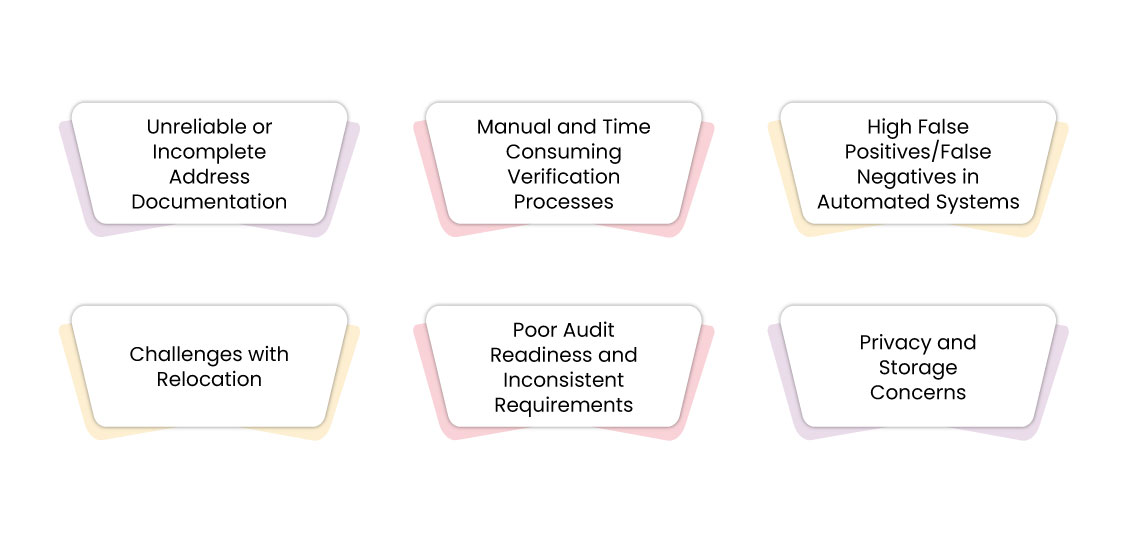

Unreliable or Incomplete Address Documentation
Customers often submit documents as proof-of-address that are outdated, unclear, or unverifiable. Thus, confirming the legitimacy of documents also becomes challenging.
There is increased inconsistency due to varying formats, lack of standardisation and easily available forged documents prove to be obstacles in having additional verification checks in place.
Manual & Time-Consuming Verification Processes
As business volumes grow, these legacy models become financially unsustainable for compliance teams. Such traditional address verification process depends more on manual work like manual review, data entry, or field visits.
This leads to increase in onboarding time and operational cost and becomes hard to scale with large and remote customer bases due to courier-based verifications, field agents, and manual checks being expensive and slow.
High False Positives / False Negatives in Automated Systems
Low-quality scans, handwritten text, or multi-language documents can make OCR and AI tools difficult to use. During data collection if there are minor spelling variations, missing components, or multi-language content, it can result in failed matches and false alerts that require unnecessary manual review.
This can also lead to missed risk signals due to extraction errors or incomplete matches.
Challenges With Relocation
A majority of the institutions/businesses conduct address verification only at the time of onboarding. The lack of automated triggers or system of periodic verification, customer relocations might go unnoticed which would result in unverified outdated data increasing the ML/TF/PF risk and non-compliant KYC records during audits, regulations, or inquiries.
Poor Audit Readiness and Inconsistent Requirements
Without an integrated and a well-defined framework, verification logs and proofs are scattered across departments or platforms such that when the regulators request evidence, or data teams scramble to retrieve documents leading to delays and gaps in investigations and audits.
Another issue that arises with address verification is that different regulators might have different policies regarding what is considered as an acceptable proof of address. This frequent change in requirements leads to compliance teams being constantly reinterpreting guidelines.
Privacy & Storage Concerns
Documents that contain address proof usually contains other sensitive personal information. Therefore, improper access controls, weak security measures, or non-compliant storage practices end up increasing the risk of data being leaked or misused.
If customer data is breached, it increases the chance for REs to be subject to regulatory penalties. Having a robust security and access control system solves the problem.
Struggling to verify addresses accurately?
Let us simplify your KYC and AML compliance journey.
Best Practices for Regulated Entities to Conduct Robust Address Verification
Adopting the right best practices for address verification not only ensures higher accuracy, faster onboarding, but also stronger compliance across the whole KYC process.
The best practices for Regulated Entities in UAE include automation and multi-source checks, integrating systems and geolocation tools, risk-based re-verification, audit trails, security controls, centralised storage, staff training and risk-based escalation which are as follows:
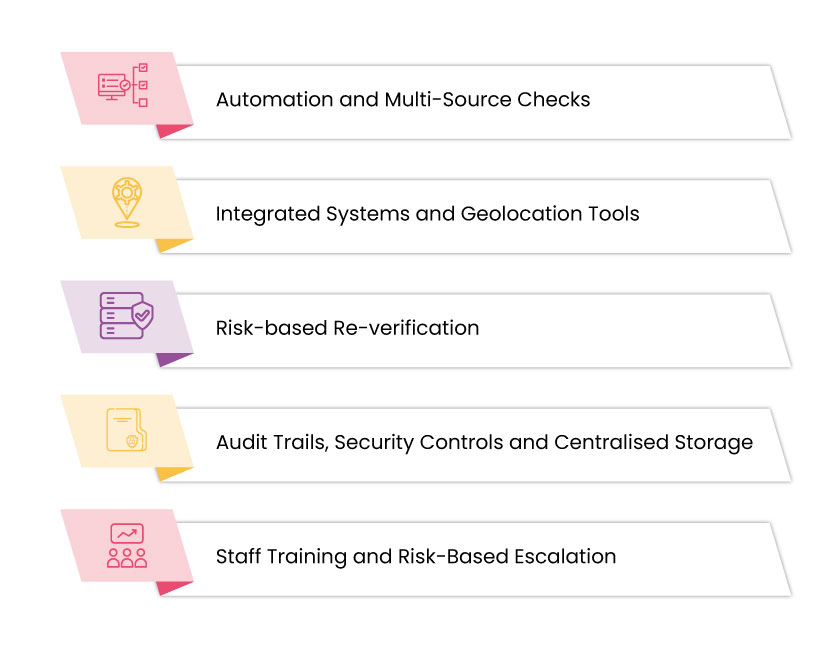

Automation & Multi-Source Checks
Regulated Entities must begin using multiple documents instead of relying on one single source to eliminate fraud and inconsistencies.
REs must utilize OCR and AI-based extraction tools which help in capturing data automatically and manage multilingual documents and minimise human errors. Automated validation decreases the onboarding time, improves accuracy and reduce the operational burden on compliance teams.

Integrated Systems & Geolocation Tools
Regulated Entities must ensure that uniform address format is maintained across all internal systems to avoid mismatches caused by varied data entry styles. The process of verifying the address must be well integrated with KYC/AML platforms so that it updates everywhere automatically.
For hard-to-verify locations, mapping APIs, geo-tagging, and coordinate matching must be used to confirm that the address exists and aligns with the proof submitted.

Risk-Based Re-Verification
Regulated Entities must make sure that the periodic re-verification of address is conducted as the details might change over time. Risk-based cycles must be implemented such that it proactively updates the record rather than waiting for customer to make the disclosure.
This ensures that your customer files remain compliant and up to date for audits, inspections, and ongoing due diligence requirements.
Audit Trails, Security Controls & Centralised Storage
Regulated Entities must ensure that address verification process should be logged with timestamps, reviewer details, and document versions. In order to ensure quick retrieval during audits a centralised and regulator-ready storage system must be in place.
All documents must be encrypted and stored securely, strict access control must be followed, and compliant retention policies must be adopted to protect personal customer information.
Staff Training & Risk-Based Escalation
Compliance teams must be well trained for spotting forged documents, handling non-standard address formats, and applying updated regulations. It is pertinent for Regulated Entities to train their staff accordingly, so no error is missed.
Exception-based workflow must be present so that suspicious or mismatched addresses automatically escalate for enhanced review. This ensures that high-risk cases receive focused attention without slowing down overall operations.
Need help implementing these best practices?
AML UAE offers tailored, compliant solutions for address verification and beyond.
Mitigate Address Verification Gaps: How AML UAE Supports You
At AML UAE, we support businesses in achieving full compliance with UAE KYC/CDD regulations by implementing strong Address Verification frameworks, automated document validation tools, and risk-based re-verification mechanisms.
Our goal is to help Regulated Entities eliminate manual inefficiencies, reduce verification errors, and maintain accurate, audit-ready customer address records in line with UAE regulatory expectations and global FATF standards.
| Address Verification Pain Points | Smart Solutions Offered by AML UAE | Benefits of Robust Address Verification Compliance |
| “We don’t have a clear, documented workflow for Address Verification, even though we conduct KYC.” | We provide end-to-end Address Verification Policies aligned with UAE KYC/CDD rules, FATF requirements, and sector-specific guidelines. | You get a structured, consistent, and audit-ready verification framework. |
| “Customers submit unclear, outdated, or unverifiable address documents, causing delays.” | Our solution enables multi-source document validation with OCR, automated extraction, and cross-checks to verify data accuracy. | You receive faster, error-free verification with reduced dependency on manual review. |
| “Manual verification is slow, resource-heavy, and prone to human errors.” | Not anymore! We automate data extraction, matching, and validation using AI/OCR tools designed for multilingual address formats. | You get quicker onboarding, higher accuracy, and minimal operational effort. |
| “It’s hard to validate rural, non-standard, or landmark-based addresses.” | We integrate advanced geolocation tools, mapping APIs, and coordinate matching to verify non-standard addresses. | You achieve reliable verification even in locations without formal addressing systems. |
| “Our team struggles to detect mismatches and escalate suspicious address cases.” | You will not now! AML UAE provides automated risk flags, mismatch alerts, and escalation workflows for high-risk cases. | You can act swiftly and accurately before risks escalate. |
| “Our systems don’t sync address data across KYC, CRM, and onboarding tools.” | We ensure seamless integration with your KYC/CRM platforms, ensuring verified address data auto-updates across all systems. | You get one unified compliance ecosystem without data silos. |
| “We are unclear about ongoing address update requirements and re-verification cycles.” | AML UAE supports risk-based periodic re-verification frameworks aligned with UAE regulations and FATF expectations. | You remain fully compliant with continuous due diligence requirements. |
| “We face high false positives due to OCR errors, inconsistent formats, or low-quality documents.” | It will not be the case henceforth—our system provides fuzzy matching, transliteration support, and intelligent extraction for cleaner results. | You get fewer false alerts and smoother processing. |
| “Our staff lacks training in identifying forged POA documents or non-standard address formats.” | We offer UAE-focused Address Verification, KYC, and document fraud detection training tailored to your team. | You gain confident, skilled, and regulation-ready compliance professionals. |
Residential address verification
Review residential address evidence
Address information can be difficult to substantiate when a customer has recently moved, lives with family or has no utility bill in their name. We help you assess the evidence available against your policy, customer risk and applicable requirements.
Resolve inconsistencies proportionately
We compare declared addresses with supporting records, investigate material differences and identify alternative evidence for consideration. A location pin or customer statement is assessed for what it actually demonstrates; it does not automatically establish residence or replace required independent verification.
A clear exception record
You receive an evidence review, the remaining gaps and a proposed follow-up or escalation route. Your compliance officer approves any permitted exception. Share the customer’s explanation, available records and your acceptance criteria so the outcome can be documented consistently across similar cases.

Let Address Verification Overcome Possible Compliance Risks
Regulated Entities are often faced with several challenges during Address Verification while implementing their KYC/AML Compliance measures, despite having robust regulatory requirements in place.
AML UAE designs customized solutions to overcome these obstacles and ensure compliance with UAE’s AML/CFT regulations. We help you understand the importance of Address Verification during any stage of due diligence and help map your compliance measures better.