



Liveness Check Software
Liveness Check Software plays a crucial role in safeguarding the integrity of ID Verification process across AML/CFT/CPF compliance obligations in the UAE.
The presence of advanced AI-driven algorithms, the Liveness Check Software enables Designated Non-Financial Businesses and Professions (DNFBPs), Virtual Asset Service Providers (VASPs) to detect deepfakes, 3D masks fraud, and other manipulated biometric inputs.
This helps in preventing impersonation attempts and enhancing the reliability of remote onboarding procedures.
What is a Liveness Check Software?
Liveness Check Software is a digital solution which is used to verify whether the person undergoing ID Verification is physically present and not using a photo, video, deepfake, or any other form of spoofing attempt.
The software also banks on biometric recognition and AI-driven technology for detecting subtle signs of life, such as blinking, facial movements, skin texture, and 3D facial depth during the verification process.
The Liveness Check Software plays a critical role in Anti-Money Laundering (AML), Counter-Terrorist Financing (CTF), and Counter-Proliferation Financing (CPF) compliance, particularly during Customer Due Diligence (CDD) and Know Your Customer (KYC) procedures by confirming the presence of a real, physically present user.
The software ensures that the ID being verified belongs to a real individual, effectively preventing identity fraud, impersonation, and the misuse of stolen or synthetic identities.
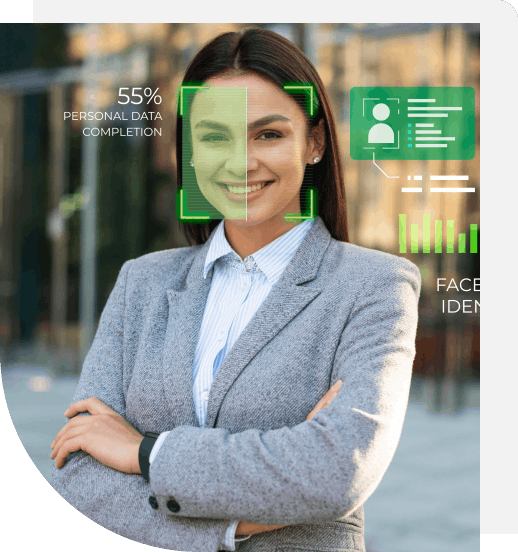
Liveness Check Software: Regulatory Framework in UAE
The process of verifying a customer’s identity in UAE goes beyond document collection, it also involves confirming the authenticity of the individual behind the information.
The CDD process is crucial, and lack of Liveness Check would render the process incomplete. Thus, Liveness Check is not optional, it is a core requirement embedded in regulatory guidance for remote onboarding.
There has been an increasing need for digital adoption and the evolving tactics of financial crime. Regulated Entities (REs) must go beyond conducting static checks and begin incorporating active checks to stay compliant.
In order to stay compliant, aligning Liveness Check Software with the regulatory framework in UAE becomes essential. The following UAE’s AML/CFT regulations are to be adhered to:
Cabinet Resolution No. (134) of 2025
mandates REs to undertake identifying the customer and verifying their identity, whether the customer happens to be natural/legal person or a legal arrangement and to take all due diligence procedures and measures.
Article 19 of Federal Decree Law No. (10) of 2025
mandates DNFBPs and VASPs to comply by undertaking CDD measures for verifying customers and Beneficial Owners.
The FATF Guidance on Digital ID (2020)
directs Financial Institutions to use verification methods that link the individual to the identify evidence provided, explicitly recommending the use of biometric solutions such as facial recognition and Liveness Check.
The process of verifying a customer’s identity in UAE goes beyond document collection, it also involves confirming the authenticity of the individual behind the information.
The CDD process is crucial, and lack of Liveness Check would render the process incomplete. Thus, Liveness Check is not optional, it is a core requirement embedded in regulatory guidance for remote onboarding.
There has been an increasing need for digital adoption and the evolving tactics of financial crime. Regulated Entities (REs) must go beyond conducting static checks and begin incorporating active checks to stay compliant.
In order to stay compliant, aligning Liveness Check Software with the regulatory framework in UAE becomes essential. The following UAE’s AML/CFT regulations are to be adhered to:
One Face. One Match. One Compliant Journey.
Use Biometric Liveness Check That Auditors Love
Operational Challenges Faced by Regulated Entities while Conducting Liveness Check
Regulated Entities operating in UAE often face certain challenges while conducting Liveness Check. The challenges that might arise are as follows:
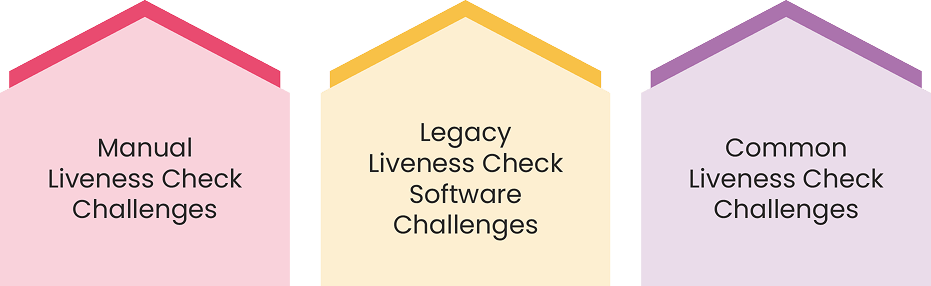
Manual Liveness Check Challenges
- Still relying on manual reviews that drain time and increase error rates?
- Can your team fully catch a deepfake or printed photo with the naked eye?
- What happens when a manual reviewer misses a red flag at scale?
- Are your identity checks audit-ready or are you missing a compliance trail?
Legacy Liveness Check Software Challenges
- Are false rejections frustrating real users and killing your conversions?
- Is your liveness algorithm truly fair or is it leaving certain demographics behind?
- Can your Liveness Check Software keep up with deep-fake-driven fraud that evolves daily?
- Struggling to integrate Liveness Checks without disrupting your onboarding flow?
Legacy Liveness Check Software Challenges
- How do you balance rock-solid security with a frictionless onboarding experience?
- Can you prove to regulators that your Identity Checks are both reliable and explainable?
- Are you aligned with both UAE mandates and global standards?
- Is your current Liveness Check Solution scalable or is compliance costing you more than it should?
Facing similar challenges? You’re not alone and you’re in the right place!
How Liveness Check Software Empowers Regulated Entities to Meet AML/CFT Obligations
The process of collecting identity documents alone no longer satisfies AML compliance expectations amid today’s stringent AML/CFT environment.
The Liveness Check Software systematically supports AML compliance by including user onboarding and identity document capture, real-time facial recognition and liveness check, deepfake and spoofing detection, risk-based scoring and decisioning, user feedback and retaking options.
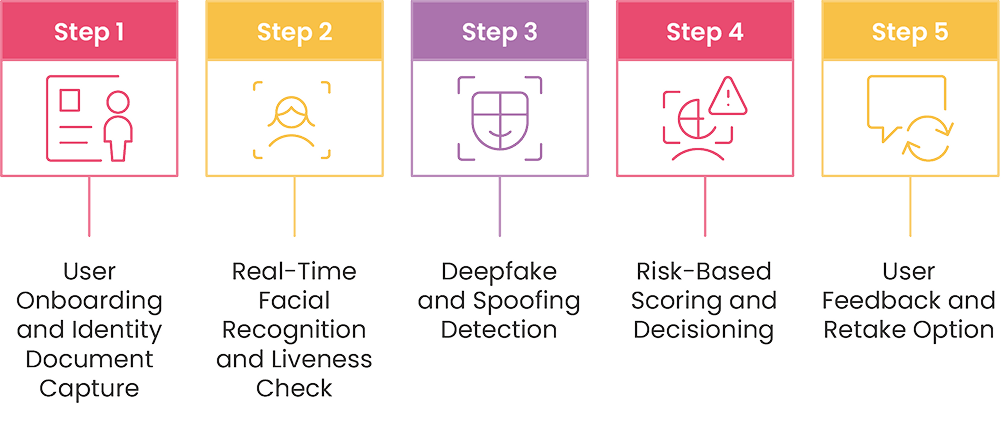
Step 1: User Onboarding and Identity Document Capture
At the time of digital onboarding, Liveness Check Software initiates facial capture using the customer’s device camera to confirm real-time presence.
The Liveness Check Software performs either passive detection, by analysing micro-expressions, 3D facial geometry, and light reflection, or active detection, requiring minimal user interaction like blinking or head turns.
This ensures the individual is physically present and not a spoofed image, video, or deepfake.
Step 2: Real-Time Facial Recognition and Liveness Check
Post-Liveness confirmation, the Liveness Check Software executes anti-spoofing checks to detect deepfakes, synthetic identities, printed images, or 3D masks.
Using AI-based image analysis and contextual recognition, it identifies anomalies and flags suspicious attempts for enhanced manual review.
These AI-driven spoofing controls support Enhanced Due Diligence (EDD) protocols for high-risk or non-standard verifications, in accordance with UAE’s Federal AML/CFT laws and FATF standards.
Step 3: Deepfake and Spoofing Detection
The Liveness Check Software matches the live captured face with the photo on official identity documents such as Emirates ID, Passport, or Driving License.
Leveraging biometric facial recognition, it confirms the legitimacy of the customer’s identity under varied lighting or angle conditions. Any mismatch or quality concern prompts automatic retake suggestions or flags the case for compliance review, supporting Customer Due Diligence (CDD) obligations mandated by UAE AML/CFT frameworks.
Step 4: Risk-Based Scoring and Decisioning
Based on the results of Liveness Check, document verification, and customer risk indicators (e.g., nationality, transaction type, business category), the Liveness Check Software applies pre-defined Risk-Based Approach (RBA) to generate onboarding decisions to approve, escalate, or decline by the compliance team.
This decisioning logic integrates into the Regulated Entity’s broader AML/CFT risk matrix, automating compliance actions in line with FATF recommendations and local regulatory expectations.
Step 5: User Feedback and Retake Option
The Liveness Check Software ensures regulatory integrity and customer usability by delivering instant feedback if facial capture fails due to poor lighting or obstruction.
Users can securely retake the Liveness test, and each attempt is logged with timestamps, geolocation data, and device metadata. This audit trail facilitates regulatory reporting, internal review, and goAML filing, aligning with UAE’s AML standards.
Secure Every Selfie
Let Your Customers Onboard Remotely, Without Compromising Compliance
Must Have Features of a Robust Liveness Check Software in UAE
It is pertinent to have a robust Liveness Check Software in place to ensure effective and compliant execution. There are several features that grant proper assistance to REs to fulfil AML/CFT regulations.
These features include conducting passive and active liveness checks, maintaining accuracy against printed photos, masks, deepfakes, integrating eKYC systems, generating real-time results and audit trails, and supporting multi-device and low-light scenarios.
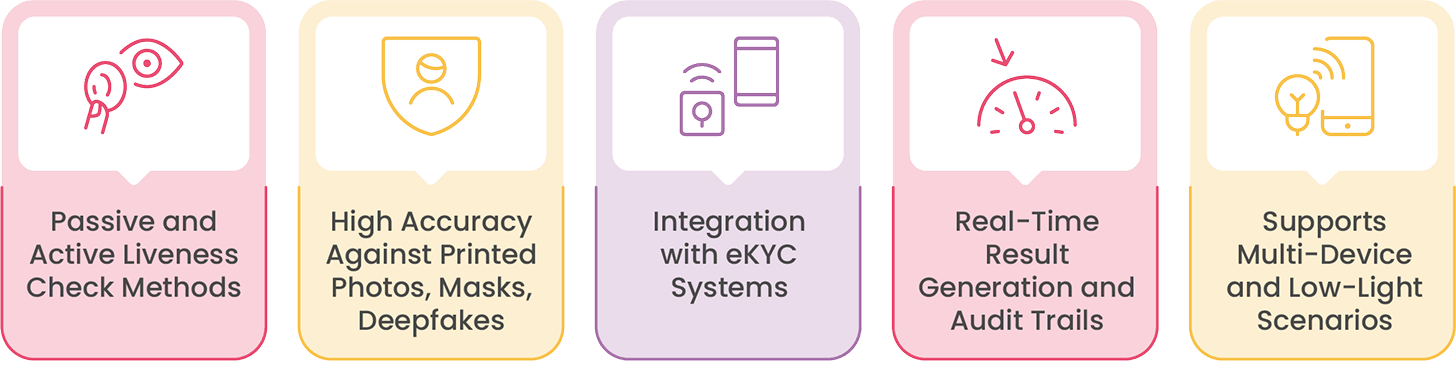
Passive and Active Liveness Check Methods
The Liveness Check Software must support both Passive and Active Liveness Check Methods, as it is essential to adapt to varied risk levels and use cases, strengthening AML controls by effectively identifying spoofing and impersonation attempts.
High Accuracy Against Printed Photos, Masks, Deepfakes
The Liveness Check Software must ensure its topmost priority is delivering high spoof resistance, accurately detecting and rejecting printed images, silicone masks, and AI-generated deepfakes. This precision helps in minimising identity fraud risk and strengthens the integrity of biometric KYC processes.
Integration with eKYC Systems
The Liveness Check Software must be integrated with eKYC platforms for automating ID Verification, reducing manual intervention, and maintaining consistent, AML compliant onboarding processes for both natural and legal persons.
Real-Time Result Generation and Audit Trails
The Liveness Check Software must ensure it is generating real-time results, maintaining immutable audit trails to support instant ID Verification, enhancing internal review accuracy, and ensuring full traceability for regulatory audits as mandated under AML/CFT compliance frameworks.
Supports Multi-Device and Low-Light Scenarios
The Liveness Check Software must be optimised for performing across multiple device types and environmental conditions, including low-light or low-resolution situations. This flexibility improving user accessibility and maintains reliable liveness detection across diverse onboarding contexts.
Benefits of Leveraging an Advanced Liveness Check Software for Regulated Entities
The benefits of using Liveness Check Software in AML/CFT/CPF compliance go beyond basic ID Verification, by ensuring that the individual being verified is physically present. This enhances the reliability of CDD and reduces identity fraud risks.
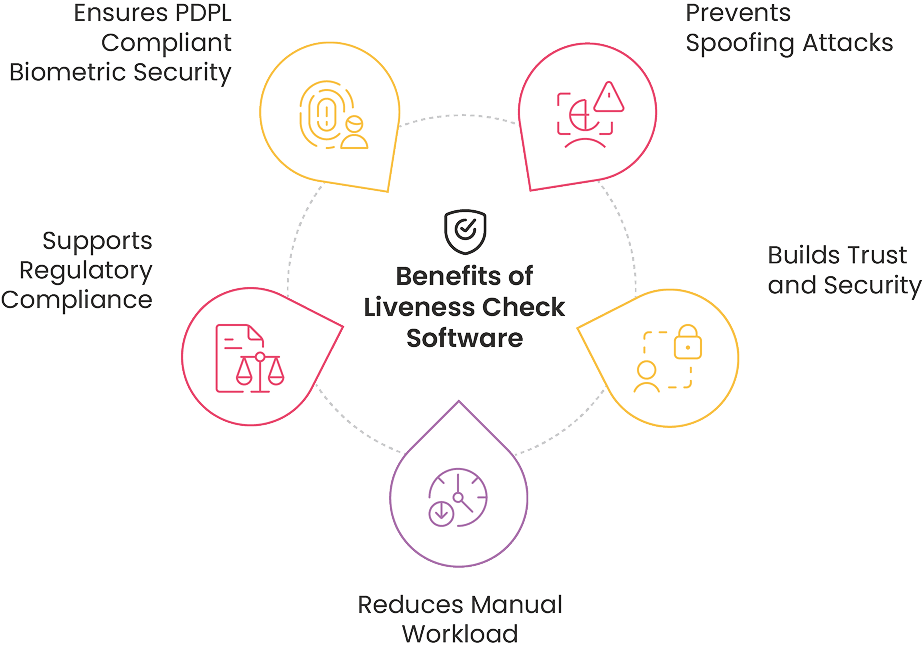
These benefits include preventing spoofing attacks, building trust and security, reducing manual workload, supporting regulatory compliance, ensuring Personal Data Protection Law (PDPL) compliant biometric security.
Prevents Spoofing Attacks
Liveness Check Software aids in stopping fraudsters from using photos, videos, masks, or deepfakes during identity checks. It promotes verifying real user presence in real time, helping prevent impersonation, account takeovers, and synthetic identity fraud before further verification even starts.
Builds Trust and Security
When users know that system can detect identity spoof attempts, their confidence increases. This trust helps in strengthening RE’s platform reputation, reduces fraud risk, and supports safer remote transactions without requiring any human intervention or manual oversight.
Reduces Manual Workload
The automated Liveness Check filters out low-quality or fraudulent submissions in real time and helps in minimising false positives. This significantly helps in reducing the number of manual reviews, allowing compliance teams to focus on higher-risk cases and cutting operational costs.
Supports Regulatory Compliance
The Liveness Check Software is configured with standards that supports compliance with UAE’s Personal Data Protection Law. This facilitates in meeting KYC and biometric security requirements. It ensures auditability, privacy, and integrity, key to operating legally and securely in regulated environments.
Ensures PDPL-Compliant Biometric Security
The Liveness Check Software applies encryption, pseudonymisation, and real-time access controls which assist in protecting biometric data. It ensures secure, confidential availability of personal data during Identity Verification and ongoing processing.
Best Practices for Regulated Entities for Enforcing All-Rounded Liveness Check Software
The efficient selection and implementation of Liveness Check Software require REs in the UAE to adopt some best practices which are tailored to meet the regulatory and operational AML/CFT requirements.
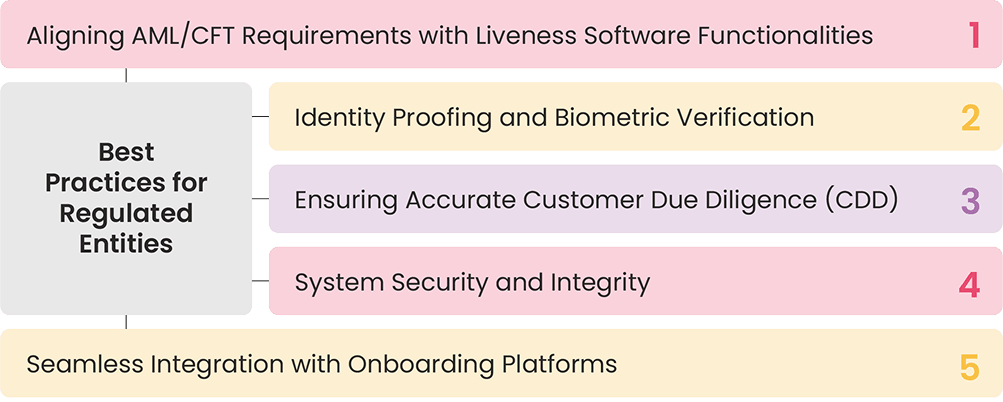
These best practices consist of aligning AML/CFT requirements with Liveness Software Functionalities, identity proofing, and biometric verification, ensuring accurate CDD, minimising identity fraud risk, seamlessly integrating it with onboarding platforms.
Aligning AML/CFT Requirements with Liveness Software Functionalities
Regulated Entities must ensure they are selecting Liveness Check Software that helps to meet AML/CFT obligations by verifying that the person undergoing identification is physically present and real.
This process goes beyond the ordinary document verification. It helps in ensuring that digital onboarding aligns with FATF standards and UAE regulatory expectations.
This aids in preventing impersonation risks in non-face-to-face interactions and improves the overall AML control environment through reliable, real-time biometric verification.
Identity Proofing and Biometric Verification
Regulated Entities must select Liveness Check Software that enhances identity proofing by confirming that the individual is both the document holder and physically alive during verification. This biometric validation helps in reducing reliance on static data, which can be easily faked or stolen.
At this point, establishing secure and accurate identity verification helps in building trust in the onboarding process for VASPs and DNFBPs, forming a vital foundation for effective AML/CFT/CPF compliance and ongoing customer monitoring.
Ensuring Accurate Customer Due Diligence (CDD)
The process of effective CDD is more than collecting customer details, it also involves verifying them with precision. REs must select Liveness Check that adds a layer of assurance by confirming the identity presented is authentic and the individual is real.
This whole process reduces onboarding risks, strengthens the credibility of customer profiles, and supports risk-based AML/CFT/CPF programs by preventing fraudulent entities from exploiting gaps in standard document-only verification methods.
System Security and Integrity
Regulated Entities must ensure that Liveness Check system is integrated securely with existing onboarding and verification processes. Moreover, it should be embedded with data privacy features to prevent any attempts of data breaches.
Appropriate safeguards in the Liveness Check Software ensures that there is no room for manipulation, misuse or unauthorised system access. As part of the system security and integrity measures, only authorised personnel should be allowed to access liveness check results.
Seamless Integration with Onboarding Platforms
Effortless AML compliance requires integrating ID verification into onboarding systems in a way that minimizes operational friction. Liveness Check Software should offer seamless compatibility with digital onboarding platforms, ensuring fast, automated, and secure identity validation.
This minimises manual effort, accelerates customer acquisition, and ensures every identity check is logged and auditable, helping Regulated Entities maintain compliance while offering a smooth user experience.
CDD That Goes Beyond Documents
Elevate Your Onboarding with Biometric Accuracy
Face Spoofing? A Smart Liveness Check Software Proves It’s Really Them
In the age of deepfakes, AI spoofing, and remote onboarding, verifying the identity goes beyond just checking IDs. A reliable Liveness Check Software ensures your customer is not only who they claim to be, but that they’re actually there.
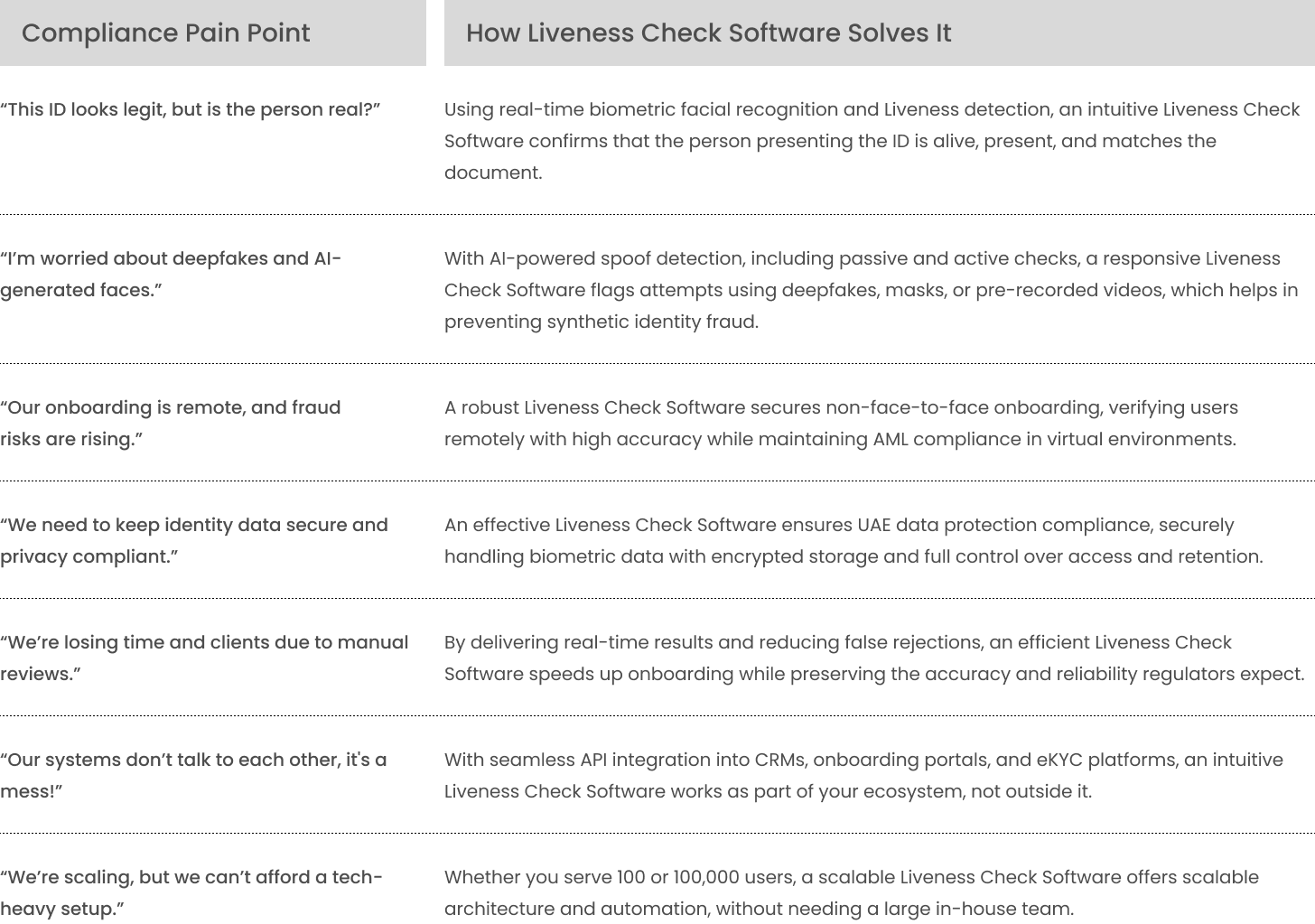
A simple selfie is not enough. The true test for AML compliance would require real-time proof of life. Liveness Check Software filters out fakes, enhances CDD, and protects your business from identity-driven fraud.

Real-Time Fraud Prevention via Advanced Liveness Check Algorithms
In the era of digital revolution, Liveness Check Software plays a pivotal role in strengthening Identity Verification by verifying the real-time presence of individuals during onboarding and authentication. Integrating advanced technology driven solutions are the need of the hour for Regulated Entities in UAE.
Using AI-driven biometrics and anti-spoofing algorithms, the Liveness Check Software detects deepfakes, 3D masks, and synthetic identities, mitigating identity fraud at the source.
Aligned with UAE’s AML/CFT laws, the Liveness Check Software supports compliance necessities for Mainland and Free Zone Regulated Entities, including DNFBPs and VASPs. Seamless integration with digital KYC platforms enables secure, automated verifications while maintaining a smooth user experience.
Ready to Secure Your Compliance Journey?
Liveness Checks Made Simple, Seamless, and Secure