



AML Regulations for CMA-Regulated Advisors and Promoters in UAE
Regulatory Reporting Software
Regulatory Reporting Software
Regulatory Reporting is part of AML Software. Regulatory Reporting Software helps in establishing robust internal and external regulatory reporting chains across organizations. It supports Regulated Entities in UAE such as DNFBPs, VASPs to understand their reporting necessities and provide advanced solutions to make the extensive reporting process hassle-free through built-in automation tools.
It analyzes data, recognizes the need to report, selects a specific report type, generates and enables submitting the report as per the mandatory goAML format. This facilitates effortless journey of Anti Money Laundering (AML), Counter-Terrorism Financing (CTF), and Counter-Proliferation Financing (CPF) Compliance for Regulated Entities in the UAE mainland and other Free Zones.
What is Regulatory Reporting Software?
Regulatory Reporting Software is an expert compliance software particularly designed to automate, manage and submit mandatory Regulatory Reports such as Suspicious Transaction Reports (STRs), Suspicious Activity Reports (SARs), Confirmed Name Match Report (CNMR), Partial Name Match Report (PNMR) and many other reports in line with the AML/CFT compliance necessities.
It enables Regulated Entities in UAE to collect, validate, and transmit data related to suspicious activities or transactions in an accurate and timely manner.
It ensures compliance with the UAE’s AML/CFT laws by monitoring reporting timelines and displaying readiness. This software helps eliminate human errors and streamlines AML compliance operations.

Regulatory Reporting Requirements for Regulated Entities in UAE
Regulated Entities in the UAE such as Designated Non-Financial Business and Professions (DNFBPs), Virtual Assets Service Providers (VASPs) are subject to follow core national AML/CFT laws that lay down various reporting obligations for them.
Federal Decree Law No. 10 of 2025 Provides obligations for Regulated Entities to report suspicious transactions to the UAE Financial Intelligence Unit (FIU) without delay and to cooperate by providing additional information when requested.
Mandate that Financial Institutions and DNFBPs identify and report suspicious transactions (STRs) without delay, respond to FIU requests for additional information, and maintain confidentiality to prevent tipping off clients or third parties.
Cabinet Resolution No. (74) of 2020 regarding the Terrorism Lists Regulation and Implementation of UN Security Council Resolutions, establishes obligations for Regulated Entities to promptly inform and file relevant reports to regulatory authorities.
In addition to these regulations, Entities located in Financial Free Zones must also comply with zone-specific AML/CFT frameworks for their reporting obligations.
- Dubai International Financial Centre (DIFC) Regulated Entities must adhere to the DFSA (Dubai Financial Services Authority) AML Rulebook, which aligns with federal law while incorporating additional reporting obligations specific to the DIFC.
- Abu Dhabi Global Market (ADGM) Regulated Entities are governed by the Financial Services Regulatory Authority (FSRA) AML Rulebook.
Types of Regulatory Reports and the Automation Workflow Enabled by Regulatory Reporting Software
Regulatory Reporting Software is purpose-built to help Regulated Entities in the UAE including DNFBPs, VASPs to seamlessly comply with the goAML reporting obligations under UAE Federal laws and Free Zone Regulations. Here is a consolidation of all key report types managed flawlessly by Regulatory Reporting Software.
Suspicious Transaction Report (STR)
When to File?
When there is a reasonable ground to suspect that a transaction whether attempted or conducted is linked to nexus of ML/TF/PF activities.
Trigger for Regulatory Reporting Software
Detects anomalous transactions through seamless integration with transaction monitoring software and predefined red flag indicators.
Automated Action through the Software
Auto-generates STR with pre-filled customer and transaction data, sends out alerts to submit to FIU via goAML without any delay.
Suspicious Activity Report (SAR)
When to File?
When an unusual, irregular or abnormal customer behavior is detected and signals towards some potential ML/TF/PF activity.
Trigger for Regulatory Reporting Software
Monitors customer behavior through seamless integration with ongoing monitoring software, flags unusual login patterns, frequent changes in key details, structuring attempts or high-risk interactions.
Automated Action through the Software
Consolidates activity data and auto-generates an SAR with detailed activity logs and internal notes, sends out alerts to submit it to FIU via goAML without delay.
Confirmed Name Match Report (CNMR)
When to File?
While screening, when a customer’s name matches with an individual or entity designated as terrorist under the UAE Local Terrorist List or the UNSC Consolidated Sanctions List.
Trigger for Regulatory Reporting Software
Detect Confirmed Match through seamless integration with Sanction Screening Software
Automated Action through the Software
Promptly triggers a freezing protocol, auto-generates a CNMR in the goAML required format and sends out alert to file CNMR within 5 business days.
Partial Name Match Report (PNMR)
When to File?
While screening when a customer’s name partially matches with an individual or entity designated as terrorist under the UAE Local Terrorist List or the UNSC Consolidated Sanctions List.
Trigger for Regulatory Reporting Software
Identify partial name match through seamless integration with Sanction Screening Software
Automated Action through the Software
Send out alert for initial suspension of business relationship based on customer’s status (potential, existing, former).
Existing: Auto-generates PNMR with key details and sends out alerts to file within 5 business days.
Potential: send out alerts to request ID documents within 10 days, if not received in 10 days, auto-generates PNMR and sends out alerts to file within 5 business days. If ID documents are received after 10 days, handles it as new case file.
High-Risk Country Transaction Report (HRC)
When to File?
When a financial transaction linked to high-risk jurisdiction is identified during customer onboarding, the course of a business relationship or while conducting transactions on behalf of a customer.
Trigger for Regulatory Reporting Software
Seamless integration with transaction monitoring software and country risk engine flags transaction involving high-risk countries.
Automated Action through the Software
Auto-produces HRC with jurisdictional details, counterparties and risk rationale, gives out notifications to submit it to FIU via goAML portal.
High-Risk Country Activity Report (HRCA)
When to File?
When a customer activity linked to high-risk jurisdiction is identified during customer onboarding, the course of a business relationship or while conducting activities on behalf of a customer.
Trigger for Regulatory Reporting Software
Flags high-risk customer actions even before the transaction occurs through seamless integration with KYC Software. Trigger an internal alert to Compliance officer.
Automated Action through the Software
Compiles HRCA report with linked CDD/EDD records, transaction history and auto-generate a HRCA report, gives out alert to submit it to FIU via goAML Portal.
Dealers in Precious Metals and Stones Repot (DPMSR)
When to File?
Individuals or entities engaged in business of precious metals and stones need to file when conducting transactions that equal or exceed AED 55,000.
Trigger for Regulatory Reporting Software
Integration with transaction monitoring software, flags transactions exceeding threshold of AED 55,000.
Automated Action through the Software
Auto-prepares DPMSR with customer, transaction and item details, validates thresholds and sends out alerts to submit it to FIU via goAML.
Real Estate Activity Report (REAR)
When to File?
Individuals or entities engaged in real estate business need to file when any real estate transaction equals or exceeds AED 55,000 in cash or virtual assets.
Trigger for Regulatory Reporting Software
Integration with transaction monitoring software, flags real estate transactions exceeding threshold of AED 55,000.
Automated Action through the Software
Auto-prepares REAR with property, buyer and payment data, sends out notification to upload REAR to FIU via goAML.
Challenges Faced by Regulated Entities while Filing Regulatory Reports
If your current Regulatory Reporting process feels like a constant race against time and shifting regulations, it is time to reassess. In today’s high-stakes compliance landscape, outdated methods and manual workflows are not just inefficient, they are risky.
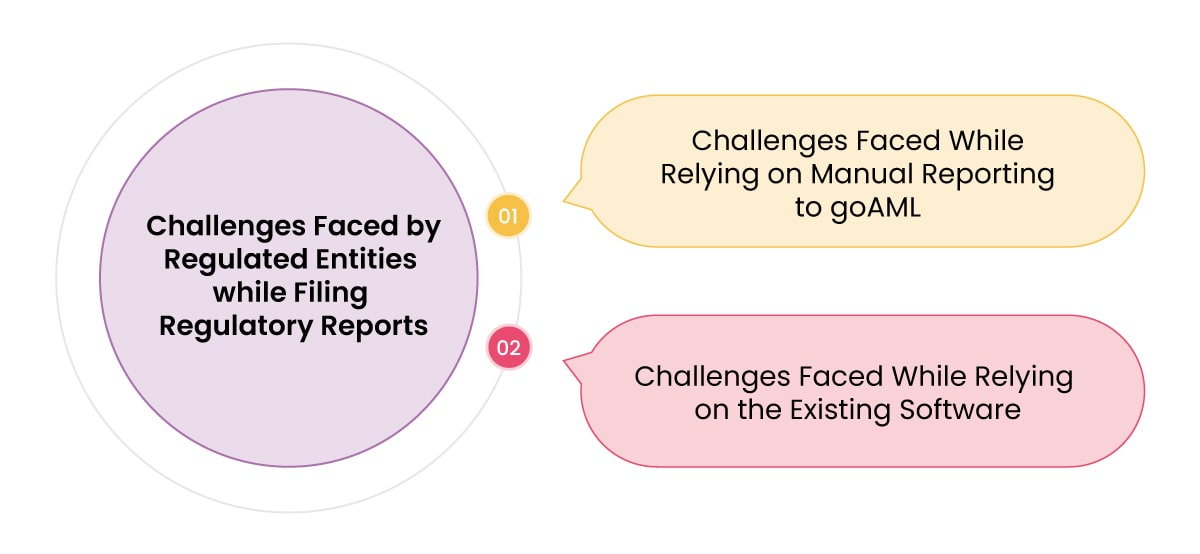
Challenges Faced While Relying on Manual Reporting to goAML
- Are you relying on spreadsheets and emails to compile and submit STRs or SARs, increasing the risk of formatting errors and data inconsistency in goAML submissions?
- Do you lack a centralised dashboard to view the status of all regulatory filings, exposing your organisation to missed submissions or non-compliance?
- Is your compliance team spending hours cross-checking transaction data manually, instead of focusing on risk analysis and internal investigations?
- Are you manually reviewing large volumes of transactions without an automated risk rule engine to flag suspicious patterns in real time?
Challenges Faced While Relying on the Existing Software
- Is your current Regulatory Reporting Software unable to generate reports in the exact format required by the goAML portal, resulting in repeated validation errors?
- Does your existing Regulatory Reporting System fail to alert you about evolving AML reporting obligations under UAE Federal Laws or free zone–specific guidance (like from DFSA or FSRA)?
- Are you facing integration issues between your core Transaction Monitoring Software and the Regulatory Reporting Software, forcing your team to duplicate data entry across platforms?
- Is your current Regulatory Reporting Software lacking in automated red flag detection, resulting in missed suspicious activity and regulatory exposure?
Manual Reporting = Frequent Errors
Reduce Human Error and Streamline goAML Submissions with Smart Reporting Automation.
How Regulatory Reporting Software Helps: Step-by-Step Guide for Regulated Entities for Smooth Compliance
Modern compliance demands more than manual tracking and effective reporting. The Regulatory Reporting Software works to help REs meet their AML/CFT reporting obligations by defining reporting outcomes and reporting scope, integrating and centralising data from all sources, detecting alerts and real-time alert generation, escalation case for internal investigation, generating required regulatory reporting, submitting the report to FIU via goAML, managing feedback and follow-ups, tracking and audit trail maintenance, continuous monitoring and reporting improvements.

Defining Outcomes and Reporting Scope
The Regulatory Reporting Software begins by translating legal and regulatory obligations into a prioritised set of desired outcomes for the reporting program. It clearly identifies what needs to be reported, to whom and why.
It maps the obligations under UAE AML/CFT laws to specific report types such as STRs, SARs, CNMRs, PNMRs, DPMSRs etc. It allows compliance teams to set clear reporting objectives, define the frequency and format for each report as per goAML requirements and establish internal systems and data sources that support these objectives.
Integrating and Centralizing Data from all Sources
Once the reporting scope is identified, the Regulatory Reporting Software brings together data from all relevant internal and external systems. It integrates seamlessly with other internal systems for AML/CFT obligations such as Transaction Monitoring Software, Ongoing Monitoring Software, customer databases, and KYC/CDD Software to create a unified data environment.
The Regulatory Reporting Software extracts relevant data from all these sources into one centralised platform, eliminating the need for manual intervention.
Detecting Triggers and Real-Time Alert Generation
After data integration, the Regulatory Reporting Software continuously monitors transactions and customer activities to detect triggers. It uses predefined rules and risk parameters to identify suspicious patterns such as unusual transaction volumes, threshold breaches, name matches, involvement with high-risk countries or deviation from customer risk profiles.
It automatically determines which report type is appropriate to file, as per the nature of triggered action. The Regulatory Reporting Software immediately generates real-time alerts when such trigger occurs, allowing compliance team to take prompt action.
Escalating Case for Internal Investigation
Once an alert is generated, the Regulatory Reporting Software autonomously converts it into a case file that contains all relevant transaction details, activity logs, customer information and risk indicators.
It provides centralized dashboard to track the progress of each internal escalation. The Regulatory Reporting Software directs the case file to Compliance Officer for review.
Generating Required Regulatory Report
Once the suspicion is established through internal review by the AML Compliance Officer, the Regulatory Reporting Software automatically converts findings into a standardized regulatory report.
It generates ready-to-submit files for relevant regulatory reports such as STR, SAR, CNMR, PNMR, REAR, HRC, HRCA, DPMSR and other reports suitable to the raised case file and regulatory requirements mandated under UAE laws.
Submitting the Report to FIU via goAML
After generating the report, when it is validated by the AML Compliance Officer, the Regulatory Reporting Software facilitates secure electronic submission through the goAML platform as mandated by the UAE FIU.
It ensures that all reports such as STR, SAR, CNMR, PNMR, REAR etc. are uploaded in the correct format and structure defined by the FIU.
Managing Feedback and Follow-ups
Through its integrated system, the Regulatory Reporting Software manages the feedback or inquiries raised by the FIU or other regulators after the submission of relevant regulatory reports.
It records responses received through goAML platform, links it to the corresponding case file and notifies the Compliance Officer for timely follow-ups.
Tracking and Audit Trail Maintenance
The Regulatory Reporting Software maintains transparent and verifiable records of all activities. It automatically logs every action from alert generation, case escalation, to report submission and regulator communication, which creates a comprehensive audit trail.
It allows the AML Compliance Officer to have an overview of each action taken, simplifying the compliance process.
Continuous Monitoring and Reporting Improvements
Regulatory compliance is not a one-time process and hence the Regulatory Reporting Software continuously monitors system performance, data accuracy and reporting trends to identify areas for improvements.
This cycle of continuous monitoring and enhancements ensures that reporting remains accurate, adaptive and aligned with the UAE’s AML/CFT regulatory expectations.
Must Have Features and Functionalities in Regulatory Reporting Software
Robust Regulatory Reporting Software must offer certain non-negotiable features such as intelligent trigger detection system, internal escalation module, investigation support configuration, regulatory deadline alerts, real-time kanban dashboard, scalable, data-driven framework for end-to-end AML/CFT compliance and seamless coordination with the UAE’s goAML platform.

Intelligent Trigger Detection Engine
Regulatory Reporting Software must be equipped with an intelligent red-flag trigger detection engine to identify suspicious activities, transactions or potential name matches, ensuring real-time detection of reportable events.
Internal Reporting and Escalation Module
Regulatory Reporting Software must enable seamless creation of internal reports and automated escalation to the Compliance Officer for timely review, approval and further action.
Investigation and Decision Support
The Regulatory Reporting Software should have built-in investigation tools that help compliance teams in assessing red flags and determine whether external reporting to the FIU is required.
Regulatory Deadline Alerts
Regulatory Reporting Software must provide real-time alerts, reporting deadlines, review cycles and follow-up actions to ensure timely compliance with AML/CFT laws. It must account for a strict 5-day window for CNMR and PNMR filing and support immediate transaction-triggered reports like REAR/DPMSR.
Real-Time Kanban Dashboard
Regulatory Reporting Software must offer a dynamic Kanban dashboard that visually tracks the status of reporting workflows across all stages from detection to submission, enabling a clear track of escalations, submission status and pending reviews on a single screen.
Scalable and Data-Driven Framework
The Regulatory Reporting Software must have system to support large scale data ingestion, encryption and secure success controls. It should connect with internal and external AML systems for data consolidation in one secure environment.
Benefits of Integrating Regulatory Reporting Software in Compliance Function
Integrating robust Regulatory Reporting Software in AML/CFT Compliance Program is very advantageous for the Regulated Entities. It streamlines compliance functions, improves data integrity, accuracy, ensures real-time risk visibility, swift decision making, enhances auditability, and saves cost and time efficiency.
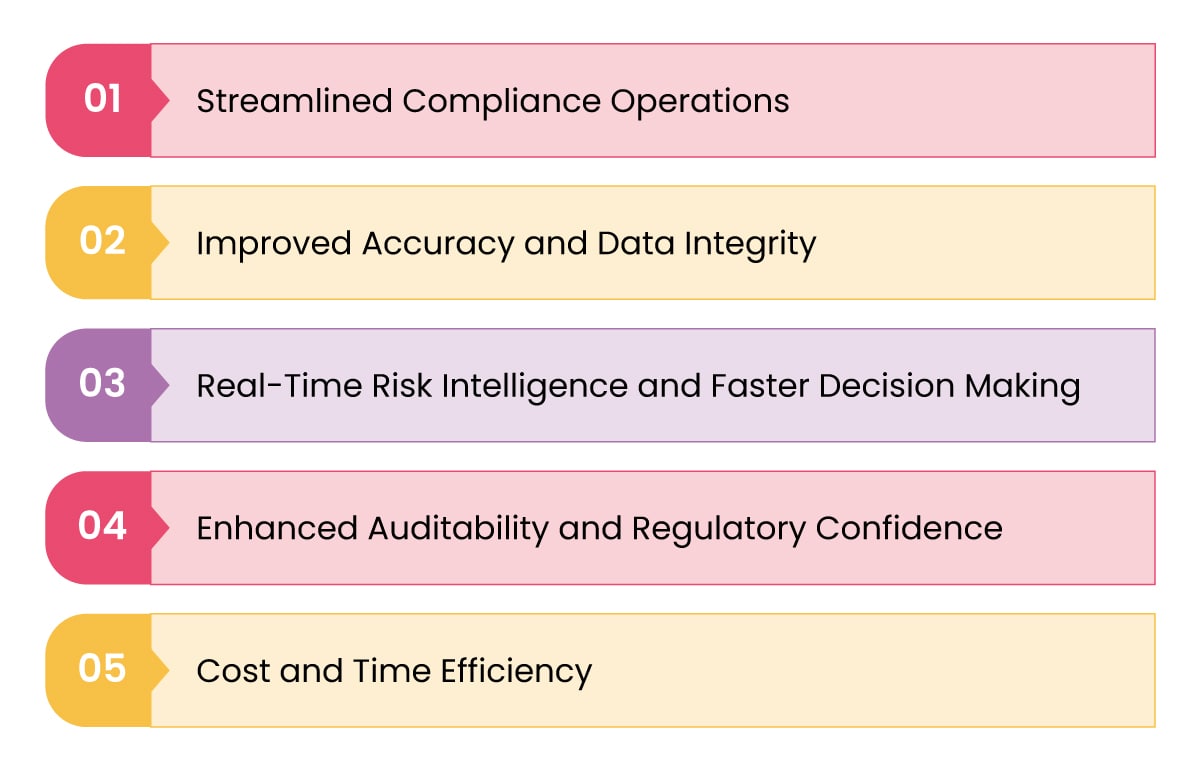
Streamlined Compliance Operations
The Regulatory Reporting Software connects with the core KYC, Transactions Monitoring systems that automate the collection, validation and submission of regulatory data.
This streamlines the compliance operations and ensures that Compliance Officers focus on ML/TF risk mitigation rather than administrative tasks.
Improved Accuracy and Data Integrity
A robust Regulatory Reporting Software for Regulated Entities ensures that every piece of data submitted to the regulatory team is complete, consistent and verified against pre-determined validation rules.
Moreover, it pulls data from secure internal sources which ensure quality checks, accuracy and data reliability.
Real-Time Risk Intelligence and Faster Decision Making
The Regulatory Reporting Software is equipped with analytics driven detection system that enables early identification of suspicious activity, transactions, potential name matches or reporting triggers.
This ensures that Regulated Entities gain real-time visibility of emerging risks and can act swiftly to escalate the case for investigation before regulatory deadlines are missed.
Enhanced Auditability and Regulatory Confidence
The Regulatory Reporting Software provides for the complete audit trail of the reporting workflow. From trigger detection to report generation and report submission to regulatory follow-ups, every action is thoroughly logged and recorded.
This ensures that Regulated Entities are always audit-ready and gains confidence of regulators during inspections.
Cost and Time Efficiency
The Regulatory Reporting Software virtualizes core reporting compliance functions such as report generation and submission. This saves significant time for the Regulated Entities and reduces dependency on large manual teams.
It culminates in less compliance costs and decreases the work caused by report rejections, ultimately saving time and efficiency for the compliance teams.
Detect. Report. Submit. Repeat: with zero stress.
The Smart Way to Meet Your Reporting Duties.
Best Practices for Regulated Entities to Implement Productive Regulatory Reporting Software
With increasing financial crimes, it is of utmost importance for Regulated Entities to integrate Regulatory Reporting Software that is unmatchable, advanced and offers absolute accuracy.
Regulated Entities should adopt certain best practices such as conducting regulatory gap-data readiness assessments, aligning software configuration with risk-based approach while selecting Regulatory Reporting Software and ensure it provides data security, continuous testing, review, data analysis, dashboards, case management features for efficiency.
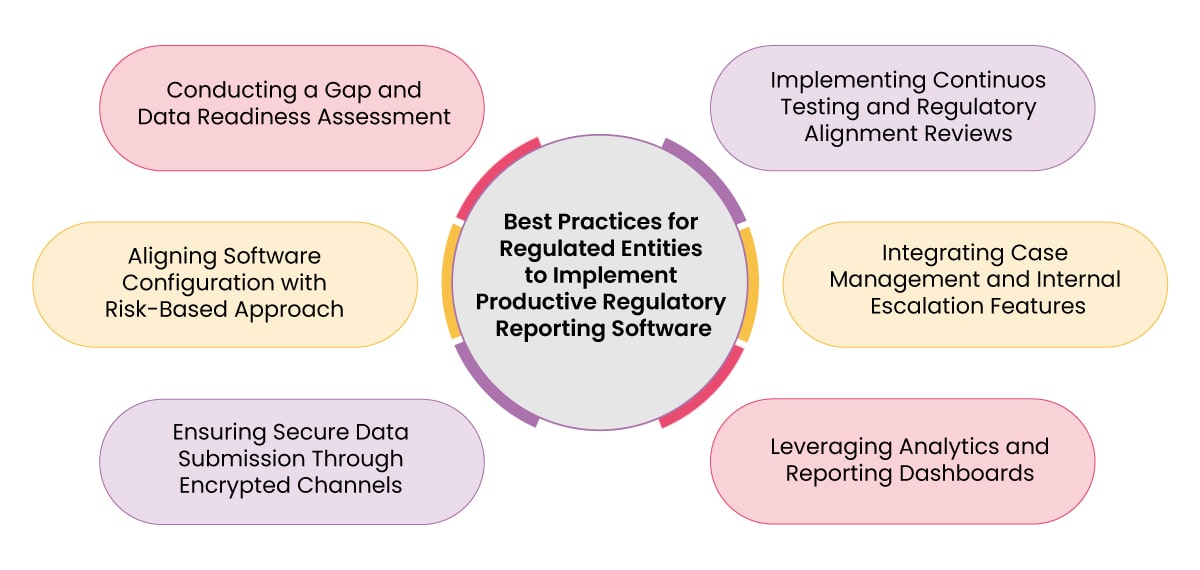
Conducting a Gap and Data Readiness Assessment
Before implementing a robust Regulatory Reporting Software, Regulatory Entities must assess their existing reporting processes, data structures and compliance workflows to identify critical gaps that may hinder automation.
A thorough assessment ensures that new Regulatory Reporting Software is correctly mapped to regulatory reporting requirements under UAE’s federal AML/CFT laws and regulations.
Aligning Software Configuration with Risk-Based Approach
While implementing efficient Regulatory Reporting Software, Regulated Entities should ensure that it reflects the Risk-Based Approach commensurate with the nature and size of their business. This denotes configuring rule engines, detection parameters and alert thresholds as per customer risk profiles, transaction patterns, product types and requirements of relevant supervisory authority.
Aligning the Regulatory Reporting Software’s logic with the AML/CFT risk framework enhances accuracy in identifying reportable events and reduces false positives in alerts.
Ensuring Secure Data Submission Through Encrypted Channels
Regulated Entities should implement Regulatory Reporting Software that provides robust data security, including encrypted transmissions, multi-factor authentication and secure storage to protect the sensitive customer data from unauthorized access.
Secure APIs and digital signatures feature in advanced Regulatory Reporting Software ensures that every report submitted to goAML remains confidential.
Implementing Continuous Testing and Regulatory Alignment Review
Regulated Entities must select Regulatory Reporting Software that offers continuous testing and review features because regulators frequently update formats, fields, thresholds and reporting requirements.
Hence, periodic testing of the software’s output is essential to ensure that all generated reports are in alignment with the latest goAML format and UAE’s latest AML/CFT regulatory obligations.
Integrating Case Management and Internal Escalations Features
Regulated Entities must integrate Regulatory Reporting Software that is equipped with case management features and provide automation for internal escalation once the trigger is identified.
It should offer platform which automatically generates a case file containing all relevant customer, transaction and risk details immediately after the suspicion of filing the report is established. This ensures that compliance workflow across the organization is not compromised.
Leveraging Analytics and Reporting Dashboards
Regulated Entities must leverage Regulatory Reporting Software that dishes out analytical capabilities and reporting dashboard features to track report submissions, timeliness, recurring errors and team performance.
This also helps compliance teams to monitor key metrices like reporting turnaround time, data validation accuracy and FIU feedback rates, fostering culture of continuous compliance enhancements.
From Headaches to Handled: How a Regulatory Reporting Solves Reporting Nightmares
Compliance Officers often face sleepless nights juggling tight deadlines, unclear processes, and high stakes reporting requirements. Here is how a robust Regulatory Reporting Software transforms these pain points into a smooth, secure, and streamlined compliance experience:
|
What Keeps Compliance Officers Up at Night |
How A Robust Regulatory Reporting Software Turns It into a Smooth Ride |
|
“Playing detective with no clues” during internal reviews and investigations |
A customizable Regulatory Reporting Software helps Regulated Entities to implement built-in case generation and investigation tools, complete with alerts, evidence capture, and escalation to MLRO. |
|
“Racing against the clock with no alarm” when deadlines are approaching unnoticed |
Responsive Regulatory Reporting Software generates real-time regulatory alerts and reminders to ensure no Reporting obligation or submission date is missed. |
|
“Submitting forms that bounce back like a bad cheque” due to format errors in goAML |
A High-performing Regulatory Reporting Software simplifies compliance by integrating one-click goAML report generation with built-in validation checks, minimising rejections and accelerating the submission process. |
|
“Hunting for red flags with a flashlight in a fog” |
A streamlined Regulatory Reporting Software automates red flag detection by scanning transactions, clients, and patterns using UAE-defined risk indicators. |
|
“Like handwriting a 50-page report during a storm” Preparing STRs/SARs manually under pressure |
An accessible Regulatory Reporting Software auto-generates STRs, SARs, and other reports using pre-filled customer and transaction data in goAML-ready format. |
|
"Submitting fragmented reports instead of a complete, regulator-ready picture” |
An encrypted Regulatory Reporting Software generates complete, validated XML reports for goAML with structured templates, reducing rejections. |
|
“Submitting reports like tossing paper planes in a windstorm” – Uncertainty over FIU receipt or rejection |
Automated Regulatory Reporting Software enables direct, encrypted goAML submission with submission confirmation receipts and tamper-proof logs. |
|
"Building a house with leaking bricks" due to scattered data |
Auditable Regulatory Reporting Software maintains tamper-proof, auditable records with timestamps, linked documents, and internal notes for every report. |

Turning Reporting Compliance into Competitive Advantage
In a cutthroat, competitive world, accurate and timely compliance helps smart Regulated Entities stand out. When reporting is done correctly, on time with the right data and in the right format, it builds trust with both client and regulatory authorities.
Using reliable Regulatory Reporting Software equipped with advanced solutions for regulatory reporting enables Regulated Entities to stay organized, reduces errors and increases productivity. Over time this efficiency and transparency become more than just compliance, they reflect the organization’s credibility in the market.
FAQs on Regulatory Reporting Software
What is Regulatory Reporting Software?
Regulatory Reporting Software is a compliance tool that automates the collection, verification and submission of regulatory reports to relevant authorities.
Why do businesses need Regulatory Reporting Software?
Businesses or institutions need Regulatory Reporting Software to ensure alignment and compliance with regulatory obligations and to avoid penalties and reputational harm.
How does Regulatory Reporting Software help with compliance?
Regulatory Reporting Software helps Reporting Entities fulfil compliance obligations by automating the regulatory reporting filing process as it reduces manual errors, ensures timely report escalation and submission while maintaining report accuracy and meeting report submission timeframe prescribed by the regulators.
What are the key features of Regulatory Reporting Software?
Regulatory Reporting Software offers key features such as automated data integration, an intelligent trigger detection system, an internal escalation module, and regulatory deadline alerts and audit-ready traceability.
How can Regulatory Reporting Software reduce the risk of non-compliance?
Regulated Reporting Software helps reduce instances of non-compliance by automating reporting workflows, reducing manual errors, and ensuring timely report submissions. It adapts to regulatory updates in real-time and provides validation checks, ensuring reports meet the latest compliance obligations while creating audit trails that are traceable and explainable to regulators.