



Customer Onboarding Software
Customer onboarding is the first and most critical AML/CFT control point for Regulated Entities, where compliance failures are either prevented or introduced. Explore how Customer Onboarding Software supports AML/CFT compliance, outline its key features, and break down the onboarding journey step-by-step.
Whether you’re just getting started or refining your current system, this guide will help you build a smarter, more secure, and regulation-ready customer onboarding process.
Customer Onboarding Software for AML/CFT Compliance
In today’s fast-moving digital world, first impressions matter more than ever, especially for regulated businesses. Whether you’re an accounting firm, a real estate agency, or a virtual asset provider, the way you bring new customers on board can directly affect trust, compliance and long-term success.
Customer Onboarding Software simplifies the process of onboarding customers as per the regulatory requirements. From identity verification to screening to assessing risks, it automates essential compliance measures to onboard any new customer.
How Customer Onboarding Software Helps Regulated Entities Navigate AML/CFT Compliance Landscape?
For REs, keeping up with Anti Money Laundering and Combating the Financing of Terrorism (AML/CFT) laws isn’t just a legal obligation; it’s a constant challenge. With the growing risks of Money Laundering, Terrorism Financing, Proliferation Financing and other financial crimes, ensuring full compliance with evolving rules is more important than ever. That’s where Customer Onboarding Software steps in.
The Customer Onboarding module helps streamline the entire onboarding process, from automated data collection to securely maintaining records and conducting due diligence, in alignment with key UAE laws such as Federal Decree Law No. (10) of 2025 and Cabinet Decision No. (134) of 2025.
Designed to adapt to each business’s operational needs and branding, the customer onboarding system delivers a smooth and consistent customer experience while automating complex compliance tasks in the background.
In essence, the Customer Onboarding Software, by combining regulatory precision with operational ease, empowers entities to build trusted customer relationships while staying firmly aligned with their AML/CFT obligations.
Additionally, for Designated Non-Financial Businesses and Professions (DNFBPs), Virtual Asset Service Providers (VASPs) and the Regulated Entities (REs) under the Capital Market Authority (CMA), this software can also serve as a gatekeeper, helping them to screen, assess, and approve customers in a way that aligns with legal obligations as well as the institutional risk policies.
For businesses looking to scale responsibly, reduce risk, and deliver a seamless customer experience, Customer Onboarding Software is no longer a nice-to-have; it’s an essential.
Who Uses Customer Onboarding Software?
Customer Onboarding Software is used by Regulated Entities in UAE, such as Financial Institutions (FIs), Designated Non-Financial Businesses and Professions (DNFBPs) and Virtual Assets Service Providers (VASPs).
It enables Regulated Entities to onboard customers efficiently through advanced identity checks, sanctions, PEP, and adverse media checks that leave no room for error.
AML/CFT Obligations Enforced at the Customer Onboarding Stage
Customer Onboarding Software helps Regulated Entities comply with the UAE’s AML/CFT laws that mandate thorough checks at the onboarding stage. These laws and regulations are as follows:
- Federal Decree Law No. (10) of 2025
- Cabinet Decision No. (134) of 2025
Why Onboarding Is a High-Risk Compliance Stage
Customer Onboarding is a high-risk compliance stage because this is the primary checkpoint where Regulated Entities decide whether to establish a business relationship or not.
In case any suspicious activity or high-risk factor is missed due to weak controls at this stage, then it can expose the business to greater financial crime risks along with regulatory penalties.
Thus, it is of utmost importance that the checks and verification tools implemented at the onboarding stage are advanced, robust and sharp enough to detect any anomalies at the initial stage only. This is where Customer Onboarding Software comes as a saviour.
It is equipped with advanced tools that efficiently onboard customers after thoroughly verifying their identity and accurately assigning risk ratings based on each customer’s identified ML/TF/PF risk.


“Effective Customer Onboarding Software must enforce a Risk-Based Approach, trigger appropriate due diligence at the right stage and generate a clear, auditable compliance trail. This ensures businesses not only meet regulatory expectations but also establish a strong compliance foundation from the very start of the customer relationship”

What is Customer Onboarding Software?
Customer onboarding software is an AML compliance-driven system designed to control ML/TF and PF risks at the entry point.
Customer Onboarding Software helps REs, such as DNFBPs and VASPs, simplify and digitise the process of Onboarding and welcoming new customers while staying compliant with AML/CFT obligations. It automates essential steps, ensuring each customer is screened and onboarded accurately.
Customer Onboarding software makes compliance more efficient by aligning the onboarding journey with regulatory requirements such as Know Your Customer (KYC) and Customer Due Diligence (CDD).
Instead of relying on manual checks and paperwork, businesses can use automated systems to speed up approvals, maintain clear records, and reduce human error.
In short, it’s a measure that helps businesses reduce risk, meet legal requirements, and build customer trust, while still offering a seamless, secure and compliant onboarding experience.

Common Problems Faced During Customer Onboarding
Customer Onboarding can be challenging for Regulated Entities, especially when dealing with AML/CFT/CPF regulations. Whether done manually or through software, the process may involve compliance gaps or even technical hurdles. Even digital tools can fall short if not tailored well, impacting efficiency and risk control.
Manual or poorly configured customer onboarding is the main source of AML compliance failures as they increase the probability of human errors, inconsistent checks and missed risk indicators.
Here are some common challenges you might face during Customer Onboarding:
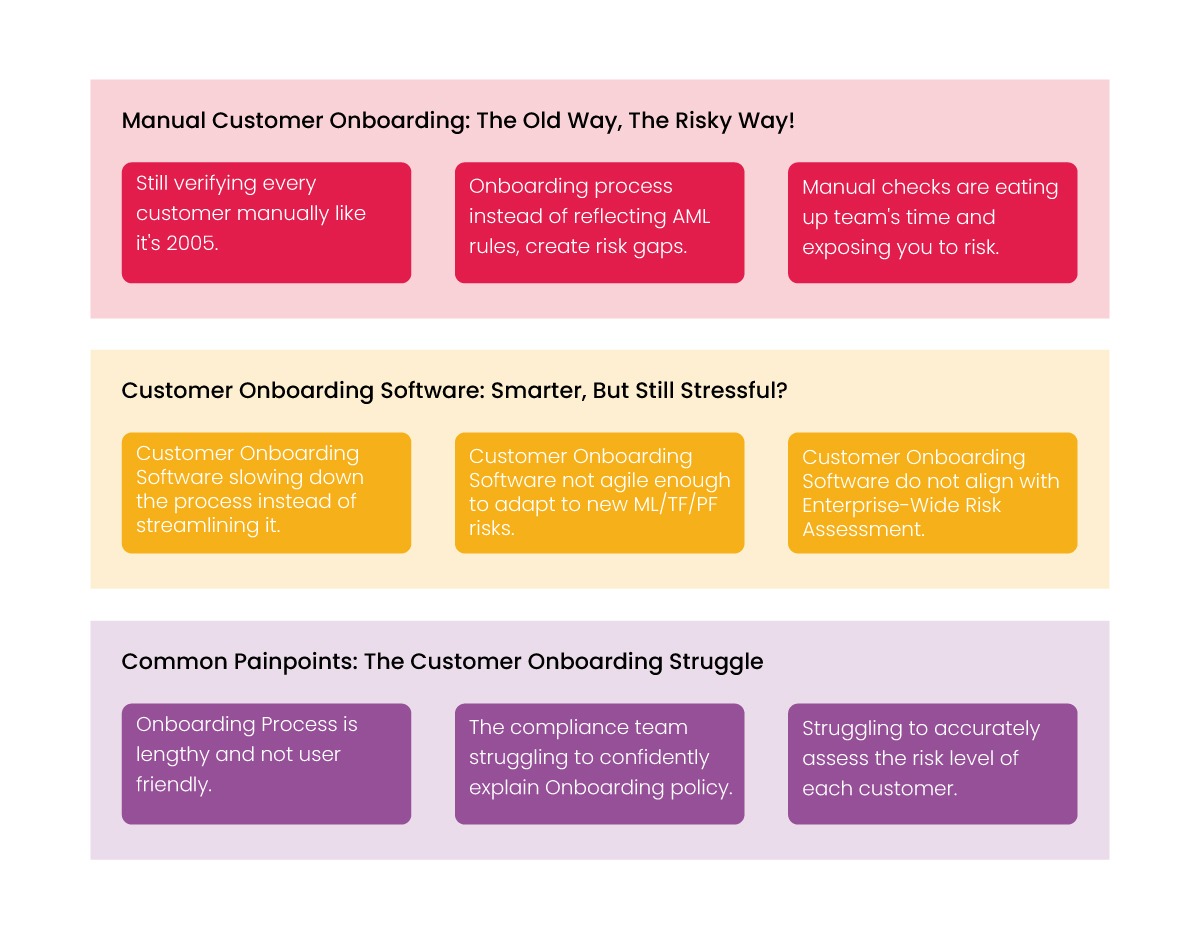
Don’t worry, you’re at the right place!
Manual customer onboarding processes can often be slow, inconsistent and vulnerable to errors. They make it harder to meet growing regulatory expectations, especially under strict AML/CFT frameworks. That’s where Customer Onboarding Software comes in.
It doesn’t just speed things up, it ensures each step, from data collection to identity verification to risk profiling, is done accurately, securely and in line with the evolving AML regulatory framework.
Your struggle with these challenges can be minimised with a personalised Customer Onboarding Software. However, a comprehensive understanding of this automated tool is necessary, as provided through this page.
Get ready to overcome Customer Onboarding challenges
When Strategy Sleeps, Financial Crime Creeps In
How does Customer Onboarding Software Simplify Compliance with AML Obligations?
A Customer Onboarding journey through effective software allows REs to perform the onboarding process with ease. The Customer Onboarding Software not only facilitates client automation but also helps in satisfying the AML regulatory requirements. It follows a systematic approach to perform compliance, which is discussed in the points below.
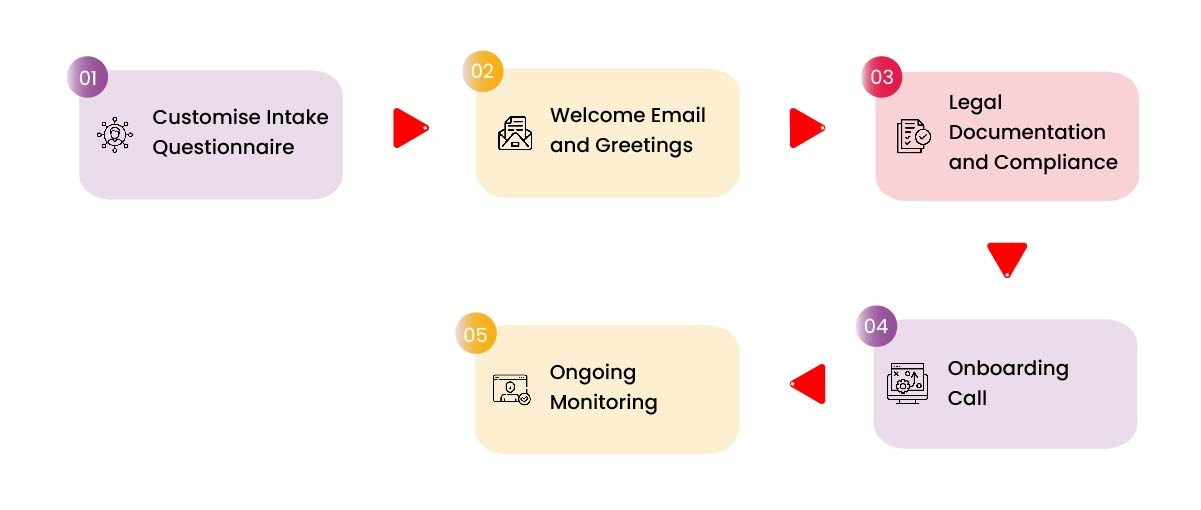
Step 1: Customise Intake Questionnaire
Customer Onboarding Software begins its operations by customising and developing the customer intake form that is commensurate with the Regulated Entities’ nature and size of the business.
It enhances the very first interaction that Regulated Entities have with their potential customers. The Customer Onboarding Software facilitates the fulfilment of AML/CFT Compliance requirements by collecting mandatory KYC and KYB information.
It autonomously fulfils customer intake formalities while obtaining prospective clients’ information and details, along with general questions about the nature of their activities.
KYC questionnaire aids in collecting the following mandatory information from potential clients at the time of their Onboarding.
Step 2: Welcome Email and Greetings
Once the customer’s details are received, Customer Onboarding Software automatically sends a welcome greeting to customers.
It provides a short overview of the onboarding procedure, explains what the customer can expect next and confirms that customer experience and AML Compliance goals are being followed.
Most importantly, it’s a chance to position your business as a trusted expert. Therefore, a warm thank-you note is included, appreciating the customer’s trust and encouraging them to move forward with clarity and confidence.
Step 3: Legal Documentation and Compliance
The software automatically conducts due diligence by screening clients against Sanctions List, PEP databases, and Adverse Media sources. It then initiates KYC/KYB processes, ensuring that identity is verified accurately.
This helps determine the customer’s risk level and aligns with AML/CFT requirements from FATF’s latest tech integration standards.
Step 4: Onboarding Call
To ensure every customer understands the process, the software allows the scheduling of an onboarding call.
This call guides users through timelines, deliverables, and any compliance hurdles. If Enhanced Due Diligence (EDD) is required, additional documents will be requested during this stage.
Step 5: Ongoing Monitoring
Once the client is onboarded, the customer onboarding software keeps an ongoing check on the business relationship and customer profile. Red flags, if any, are highlighted, and cases are generated for the compliance team to investigate and take appropriate actions.
| Details Collected from Individual Customers | Details Collected from Corporate Customers |
|---|---|
| Name | Registered Name of Business |
| Address | Business Address |
| Date of Birth | Ownership Structure |
| Nationality | UBO Details |
| Occupation | Business License Status |
| Documents Collected from Individual Customers | Documents Collected from Corporate Customers |
|---|---|
| Password | Certificate of Incorporation |
| Emirates ID | Business/Trade License |
| Driver’s License, any other Government issued identity documents | Articles of Association and Memorandum of Association |
Want to fulfil AML Compliance obligations faster and error-free?
Importance of Customer Onboarding Software
Customer Onboarding Software is significant to REs and their customers in numerous ways:
It automates onboarding activities, making the process simpler and more efficient. This, in turn, saves time and effort for Regulated Entities and their customers.
The software adheres to AML/CFT/CPF laws and regulations, establishing a clear procedure for collecting customer data. It eliminates confusion and ensures transparency, as customers are aware of what documents are being collected and why.
Customers seek assurance regarding the safety of their personal information. A reliable Customer Onboarding Software provides built-in security features like encryption and controlled access that safeguard customer data.
An effective Customer Onboarding Software is inclusive of AML compliance features, including Ongoing Monitoring and periodic checks. This strengthens trust between Regulated Entities and their customers.
The software includes an interactive dashboard that enhances the user experience. It helps both REs and their customers feel supported, as the process involves meaningful steps rather than just ticking compliance boxes.
The Customer Onboarding Software, by bringing all information and tasks into one place, makes it easier to track progress, avoid miscommunication, and deliver a smoother, more professional experience to every new client.
Knowledge. Expertise. RegTech
Find the perfect Name Screening Software for your Sanctions, PEP, and Adverse Media Screening Requirements
Must Have Features and Functionalities in Customer Onboarding Software
In order to ensure regulatory compliance, Customer Onboarding Software must support effective AML/CFT/CPF controls along with fulfilling customer experience. It must come up with features that strike the right balance between rigorous due diligence and a smooth, user-friendly onboarding journey.
For a thorough AML/CFT/CPF compliance, it must have features such as a digitised self-onboarding process, dashboards, customised risk scoring, automation for repetitive tasks and real-time awareness of onboarding progress.
For a fulfilling customer experience, it must have features such as interactive walkthroughs, automated task management, resource hubs, feedback surveys, case segments, personalised dashboards, auto translations, automated alerts and notifications.
An effective Customer Onboarding Software is not just about automated data collection and verification; it’s about making compliance seamless while enhancing the customer journey.
The right software should help attract new clients, introduce them to the business environment, and offer a platform for building lasting, trust-based relationships. To achieve this, Customer Onboarding Software must include a set of essential features and functionalities, as outlined below:
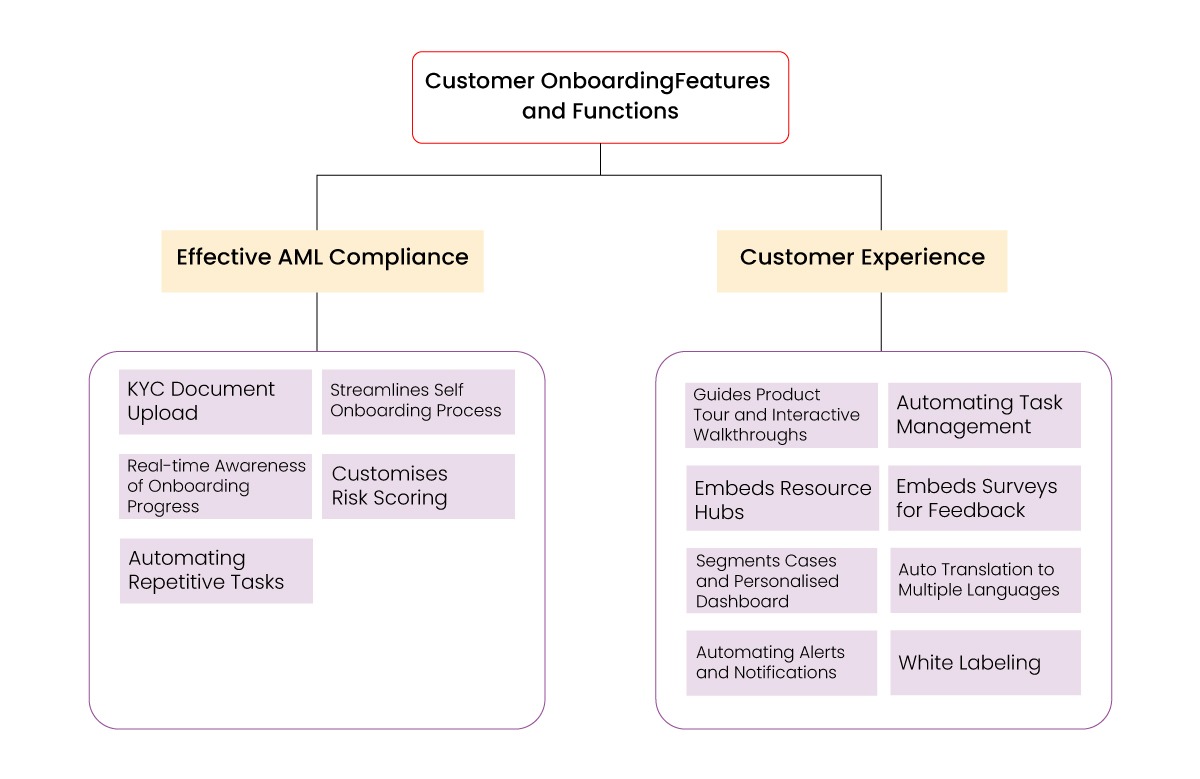
KYC Document Upload
A reliable Customer Onboarding Software must allow customers to upload required documents effortlessly, as required under the AML/CFT regulatory regime.
Whether it’s KYC forms, trade licenses, or UBO identification details, the software should securely upload and store these files and data in one place. This ensures early compliance, helping reduce delays and build trust through secure data handling.
Streamlines Self-Onboarding Process
A smooth self-onboarding process empowers customers to begin without confusion, while still meeting compliance needs.
Smart forms and clear instructions help clients complete KYC-related inputs at their own pace, ensuring adherence to risk-based due diligence principles.
Real-time Awareness of Onboarding Progres
A Customer Onboarding Software that shows live updates allows both compliance teams and customers to track progress clearly.
In line with AML compliance expectations, real-time status indicators help detect delays or missing documents early, enabling timely intervention, especially for high-risk clients or PEPs.
Automating Repetitive Tasks
An effective Customer Onboarding Software uses advanced machine learning and artificial intelligence to perform repetitive tasks.
From sending KYC reminders to screening against Sanctions Lists, automation reduces manual work and strengthens consistency. This ensures ongoing compliance with AML regulations and supports internal oversight and audit readiness.
Customises Risk Scoring
Not all customers require the same level of focus. An effective Customer Onboarding Software must have an in-built feature that allows prioritising tasks based on their risk level.
For instance, focusing more on high-risk customers and taking appropriate Enhanced Due Diligence (EDD) measures accordingly. This allows the regulated entities to tweak risk parameters and flag high-risk customers early.
Guides Product Tour and Interactive Walkthroughs
An effective Customer Onboarding Software should have an in-app walkthrough that gently introduces users to the platform.
It should guide users through key features step-by-step, allowing them to skip or revisit modules. This builds user confidence and fast-tracks product adoption from day one.
Automating Task Management
Checklists, deadlines, and team assignments, all in one place. A Customer Onboarding Software should allow users to assign tasks, track their completion, and notify relevant stakeholders automatically.
It keeps the workflow smooth, avoids duplication, and holds everyone accountable to timelines.
Embeds Resource Hubs
A built-in knowledge base should just be a click away. Customer Onboarding Software should also function as a resourceful library.
It should provide for blogs, articles, FAQs, demo videos and policy documents that help users to find everything they need without leaving the website. It empowers users to resolve simple queries instantly.
Embed Surveys for Feedback
Feedback loops are crucial for refinement. An effective Customer Onboarding Software should prompt users for insights, either mid-process or after key milestones.
Their inputs can help the software teams understand bottlenecks, update flows, and deliver a smoother experience for future clients.
Segments, Cases and Personalised Dashboard
The software should consist of segmentation tools to help tailor dashboards for different user groups, whether enterprise clients or SMEs.
Personalised views based on customer type, status, or risk level enable teams to act quickly and contextually.
Auto Translation to Multiple Languages
A software to be used globally should speak every language your client does. Onboarding tools must support multilingual interfaces so that clients from different regions can navigate the process comfortably.
It removes language barriers and enhances trust.
Automating Alerts and Notifications
A Customer Onboarding Software must provide for timely updates, like task reminders or document approvals, which should trigger automatically.
These nudges keep customers informed, teams aligned, and the whole process moving forward smoothly, without manual follow-ups.
White Labelling
A Customer Onboarding Software that allows White Labelling helps entities to deliver a seamless, branded experience.
White Labelling lets firms customise the portal with logos, colours and language, so clients feel like they’re interacting with your business directly, not a third-party tool. This reinforces professionalism and consistency.
Benefits of Customer Onboarding Software
Customer Onboarding Software offers more than just automation; it lays the foundation for compliance, efficiency, and lasting client relationships.
Unlike CRM or customer experience tools, AML-ready Customer Onboarding Software embeds compliance measures such as identity verification, screening, risk assessment and appropriate due diligence directly into the customer journey.
For REs, it simplifies compliance, improves operational efficiency, and enhances customer satisfaction from the very first interaction. The following points highlight its key advantages:
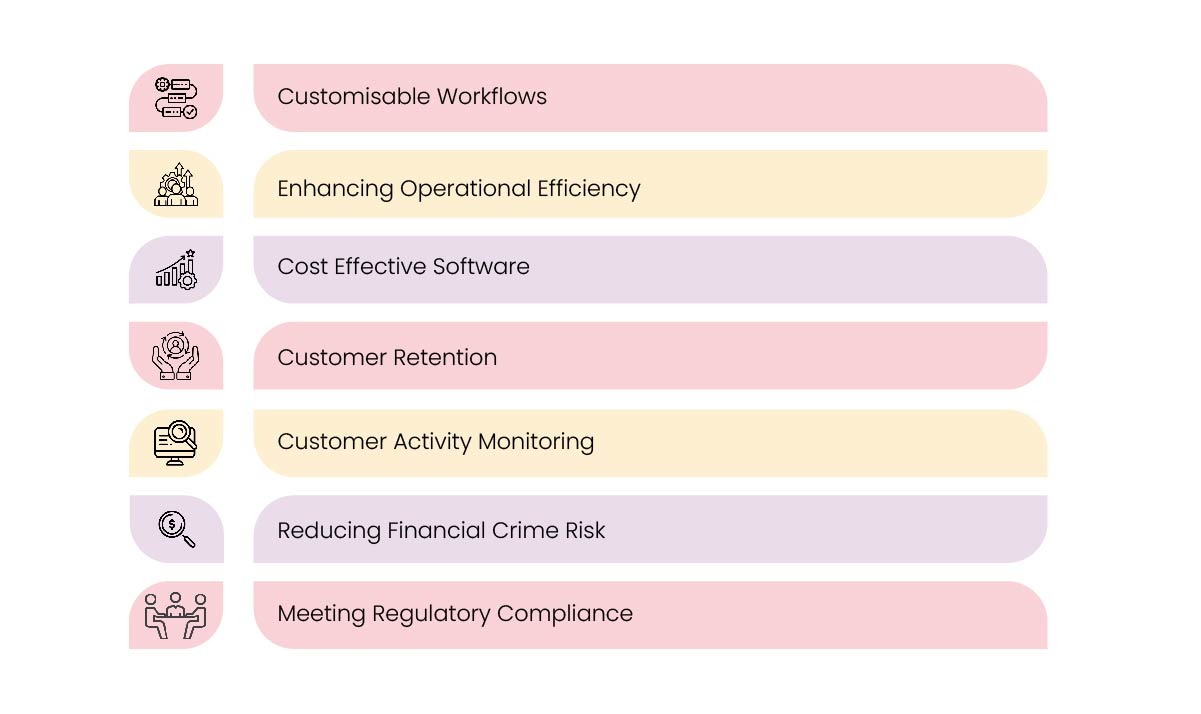
Customisable Workflows
Different customers require different levels of checks. Customer Onboarding Software allows entities to create flexible workflows, for example, performing Enhanced Due Diligence for high-risk customers like PEPs, and a simplified form of diligence for low-risk ones.
This ensures efficiency in compliance with AML/CFT regulations that demand a Risk-Based Approach.
Enhancing Operational Efficiency
Manual Onboarding is often slow and error-prone. Automating tasks such as document collection, ID checks, and reminders saves time and reduces mistakes.
It assists DNFBPs, VASPs and other REs to focus on higher value tasks, enhances internal coordination, which in turn results in enhancing operational efficiency.
Cost-Effective Software
Every hour saved during Onboarding translates to low operational costs. As the number of customers increases, an onboarding software is capable of handling larger volumes without requiring an increase in staff.
Automated systems can handle hundreds of onboarding journeys simultaneously without compromising accuracy or speed. This makes digital transformation affordable and scalable.
Customer Retention
Onboarding is often a customer’s first real interaction with a business, and how convenient it is matters. A slow or clunky onboarding process can frustrate customers and drive them away.
A Customer Onboarding Software provides for a welcome message, transparent data usage policies, multilingual support and progress tracking, which makes customers feel confident and cared for. A positive start builds trust, which eventually leads to loyalty.
Customer Activity Monitoring
An Onboarding Software extends into Ongoing Monitoring and ensures that any sudden change in customer behaviour is flagged early.
For instance, if a client is onboarded as a low-risk individual and suddenly initiates high-value transactions for a sanctioned country, the system can raise alerts instantly. This supports REs in staying compliant with their AML/CFT obligations.
Reducing Financial Crime Risk
An effective onboarding is a powerful defence against Money Laundering, fraud, and Terrorist Financing.
When the Customer Onboarding Software integrates features like risk scoring, PEPs Screening, and Adverse Media checks, it creates a strong foundation for detecting red flags before a customer enters your system.
Especially in high-risk sectors such as crypto, real estate, or gold trading, the software with real-time checks against watchlists identifies suspicious activities and helps in performing an effective CDD that reduces financial crime risks. It isn’t just a tool; it’s an early warning system.
Meeting Regulatory Compliance
A Customer Onboarding System helps REs demonstrate accountability. By ensuring that each customer follows a documented, auditable process, businesses can easily produce documents and data during inspection.
Whether it’s verifying Source of Funds or tracking risk reviews, the software creates a transparent compliance trail. This protects firms from regulatory penalties and helps them align with the AML/CFT regulatory mechanism.
A right Customer Onboarding Software helps you experience AML Compliance with Customer Retention.
How to Select and Implement Customer Onboarding Software: Best Practices for DNFBPs, VASP & SCA-Regulated Entities
Choosing the right Customer Onboarding is a strategic step for REs aiming to strengthen compliance, enhance user experience, and streamline onboarding operations.
With increasing regulatory expectations and customer demands, it’s essential to align software features with AML/CTF obligations and business goals.
The following are a few best practices to guide a sound selection and implementation process:
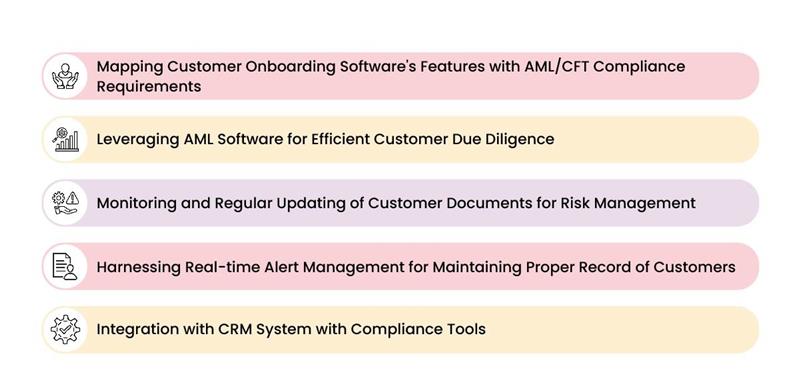
Mapping Customer Onboarding Software’s Features with AML/CFT Compliance Requirements
The software you choose must actively support AML/CFT compliance, right from the first point of contact. Features like document uploading, real-time tracking and automated alerts aren’t just operational tools; they’re part of your legal risk management framework.
Leveraging AML Software for Efficient Customer Due Diligence
Customer onboarding software must support background screening, identity checks, and the assignment of risk levels.
These functions ensure that your business can promptly spot unusual patterns and fulfil reporting duties. Essentially, it turns due diligence from a burden to a built-in advantage.
Monitoring and Regular Updating of Customer Documents for Risk Management
As customer risks evolve, your software should help you stay ahead. Regular monitoring of uploaded documents, UBO changes, and expiry dates is crucial.
A reliable onboarding system will send alerts whenever a re-verification is required, making sure your data isn’t collected, but always updated and useful.
Harnessing Real-time Alert Management for Maintaining a Proper Record of Customers
If your onboarding platform can flag risks the moment they arise, whether it’s suspicious activity or outdated information, it becomes a critical line of defence.
Timely alerts about anomalies or red flags help ensure you don’t miss key compliance triggers. With it in place, your team can intervene at the right time, avoiding costly oversights.
Integration with CRM System with Compliance Tools
A well-integrated onboarding tool should speak directly with your CRM and other internal systems. That integration improves information flow across departments, including sales, legal, compliance, and support.
This not only boosts transparency but also helps in keeping both customer experience and compliance up to standards.
Combining these best practices together, Customer Onboarding Software automates Customer Due Diligence, enables real-time monitoring, keeps up-to-date records and integrates smoothly with internal systems to offer robust compliance with UAE’s AML/CFT/CPF laws and a seamless customer onboarding experience to users.
Final Thoughts on Customer Onboarding Software in UAE
For REs, a good Onboarding Software isn’t just helpful, it’s essential. It ensures AML Compliance while simplifying onboarding activities like document collection, ID verification, and risk monitoring.
Think of it as both a gatekeeper and a security checkpoint. It lets in genuine customers while helping block those that pose threats. As an entity grows, having a solution in place builds confidence, protects your reputation, and satisfies the strict expectations of regulators.
In a regulatory landscape that demands both vigilance and agility, choosing the right Customer Onboarding Software is no longer optional; it’s a strategic investment in trust, compliance and long-term growth.
Frequently Asked Questions
What is customer onboarding software?
Customer Onboarding Software is an advanced tool that simplifies and digitises the customer onboarding process for Regulated Entities.
How does customer Onboarding software work?
Customer Onboarding Software collects customer information digitally, verifies identity using automated checks, and validates documents in real time. It integrates with databases and compliance systems to assess risk and approve customers quickly and securely.
What features should customer onboarding software include?
Customer Onboarding Software must be integrated with advanced features like automation, customisation, real-time alerts and notifications, personalised dashboard, inbuilt resource hubs and simplified onboarding processes.
How does Customer Onboarding Software improve customer experience and reduce onboarding time?
Customer Onboarding Software facilitates digital, paperless Onboarding with automated verification and instant approvals. This reduces waiting time, minimises repeated documentation, and provides customers with a fast, convenient, and seamless onboarding journey.
Is customer onboarding software mandatory for AML compliance?
Customer Onboarding Software itself is not explicitly required by law; however, the law does require Regulated Entities to perform thorough identity verification, robust screening, accurate Customer Risk Assessment and Customer Due Diligence for AML/CFT/CPF compliance.
These complex compliance measures require a tool that streamlines this process, and that’s where Customer Onboarding Software becomes mandatory for Regulated Entities.
How does onboarding software support AML obligations?
Customer Onboarding Software supports AML obligations by automating identity verification, Sanctions/PEP/Adverse Media Screening, assessing risks, assigning appropriate risk rating, applying required due diligence, flagging anomalies and keeping up to date records.