


Enterprise-Wide Risk Assessment Software
Enterprise-Wide Risk Assessment (EWRA) Software is a trailblazer in recognising, assessing, and mitigating internal and external risks prevalent across all functions of Organisation.
It supports Regulated Entities in UAE such as DNFBPs, VASPs, to understand their gross risk, net risk and effectiveness of their existing controls to improve the efficiency of their risk mitigation measures. This facilitates effortless journey of Anti Money Laundering (AML), Counter-Terrorism Financing (CTF), and Counter-Proliferation Financing (CPF) Compliance for REs in the UAE mainland and other Free Zones.
What is Enterprise-Wide Risk Assessment Software?
EWRA Software is a powerful, compliance-driven solution designed for Regulated Entities such as DNFBPs, VASPs and Financial Institutions to derive a complete perception about their risk from conducting business. It facilitates evaluation of a wide range of risk factors, such as customers, products, services, location, transactions, delivery channels, enabling Regulated Entities to categorise, prioritise, and address each risk scenario through a structured risk-based approach.
Additionally, EWRA Software facilitates Regulated Entities to analyse possible financial crime exposure within or through their operations and assess their potential impact on the business. It offers tailored control measures that can be customised based on the Regulated Entity’s size, industry, product and services and geographical exposure. This ensures a robust risk mitigation framework aligned with regulatory obligations and the unique profile of each Regulated Entity.

How Does EWRA Software Help Regulated Entities Ensure AML/CFT Compliance?
In UAE, Enterprise-Wide Risk Assessment is not just a step to identify and assess business wide risk but a mandatory step for the AML/CFT Framework to ensure the safety of Regulated Entities. It must do more than just assess risks. It must align with the AML/CFT framework of the nation to mitigate risks.
Federal Decree by Law No. (10) of 2025
calls for Enterprise-Wide Risk Assessment for Regulated Entities such as DNFBPs and VASPs, to identify, assess, and mitigate risks related to ML/TF and PF.
Cabinet Resolution No. (134) of 2025
mandates Regulated Entities to apply a Risk-Based Approach and assess wide range of risk factors to determine the totality of actual risk affecting the business, implying Enterprise-Wide Risk Assessment.
Financial Action Task Force (FATF )
requires Financial Institutions (FIs) and DNFBPs to identify, assess, and mitigate ML, TF and PF risks and take appropriate measures, including conducting an Enterprise-Wide Risk Assessment.
Additionally, the Guidelines issued by the Ministry of Economy for DNFBPs also obligates an extensive Enterprise-Wide Risk Assessment for Regulated Entities to ascertain the ML/TF risks affecting their own business as a whole.
Common Challenges Faced While Conducting Enterprise-Wide Risk Assessment
DNFBPs, while conducting Enterprise-Wide Risk Assessment, often encounter several challenges that can impact the effectiveness. Here are some difficulties shown below:

How an EWRA Software Enables Regulated Entities to Meet Their Regulatory Obligations
An effective EWRA is not a one-time exercise, it is a continuous process that helps Regulated Entities, such as FIs, DNFBPs and VASPs, to identify, assess, mitigate, and monitor ML/TF risks affecting their business. EWRA Software simplifies the process through automation and a data-driven workflow to guide REs through key EWRA steps by identifying risks, analysing inherent risk, gauging the impact of the control measures, calculating residual risk, aligning AML/CFT policies and procedures and assessing implementation of outcomes.


Identifying Risks
The EWRA Software, driven by advanced analytics, aggregates and analyses data related to factors which affect the organisation as a whole. It takes into consideration various risk factors such as customer base, products, services, transactions, delivery channels and geographical exposure.
By cumulating the relevant information through customised questionnaires, it assists Regulated Entities to understand the dynamic risk landscape of the organisation. Through covering these wide range of risk factors, the EWRA Software automates identification and quantification of the inherent ML/TF risk which are naturally present in the enterprise before applying any of the mitigating controls.

Analysing Inherent Risk
EWRA Software provides an automated Risk Assessment support once inherent risks have been identified. It uses qualitative and quantitative methodologies to streamline risk categorisation for Regulated Entities. By using advanced scoring models, risk matrix and weighing risk criteria, EWRA Software assists Regulated Entities to evaluate the likelihood of occurrence or materialisation of identified inherent risk and the impact of that risk on the entity.
Moreover, it relies on numerical data and statistics to offer predictive insights into the severity and consequences of these inherent ML/TF risks on the RE. EWRA Software simplifies the understanding of inherent risk for Regulated Entities by highlighting high-priority areas that require more resources.

Gauging Impact of the Control Measures
After identifying and assessing the inherent risk of the organisation, EWRA Software assists Regulated Entities to have deeper insights into the impact of the already implemented controls by mapping their efficacy. It automates the process to measure the effectiveness of deployed controls and their adequacy to manage the identified inherent ML/TF risks. It categorises control measures into Extreme, Strong, Effective, Ineffective, Non-Existent tiers to simplify the understanding of the control environment for Regulated Entities.

Calculating Residual Risk
Post assessing the effectiveness of the control environment of the organisation, EWRA Software facilitates Regulated Entities to calculate the remaining risk which is left after implementing the control measures. EWRA Software uses a predetermined scoring methodology to estimate the residual risk. It automates the quantification of inherent risk and control measures to recognise the residual risk that the Regulated Entity is still exposed to.
EWRA Software helps Regulated Entities to decipher residual risk by visually presenting high-risk exposures through dashboards and heat maps. Moreover, EWRA Software helps visualise whether residual risk falls within the organisation’s overall risk appetite for each risk parameter.

Aligning AML/CFT Policies and Procedures
After determining the gross risk and the net risk of various ML/TF risk parameters, the EWRA Software facilitates aligning or revising the Regulated Entity’s existing AML/CFT policies and internal control measures.
It helps assess whether the current policies of the Regulated Entity align with the regulatory requirements and the risk appetite of the organisation. Further, it assists in generating an action plan for risk parameters with high residual risk that falls outside the risk appetite of the enterprise, improving the efficiency of the AML/CFT control measures of the Regulated Entities.

Assessing Post-Implementation Outcomes
In this step, EWRA Software reassesses the Regulated Entity’s remaining risks to determine the efficiency of control measures and identify weaknesses. The EWRA Software measures whether new controls are in place with the RE’s needs and recognises any lingering weaknesses, and its dashboard helps compliance personnel to identify if the implemented policies align with evolving risk factors.
Moreover, EWRA Software continuously monitors key risk indicators for any anomalies and provides for the commensurate updates in the EWRA, facilitating real-time assessment. In concert, the EWRA Software initiates real–time tracking of risk factors, enabling Regulated Entities to get feedback where risks need to be controlled and managed continuously.
Must-Have Features of Enterprise-Wide Risk Assessment Software
Regulated Entities are supposed to implement an Enterprise-Wide Risk Assessment Software that complies with AML/CFT regulations and integrates features such as standardised risk assessment engine, advanced analytics and risk insights, key risk framework, flexible configuration capabilities, workflow automation, control testing modules, audit trails etc.
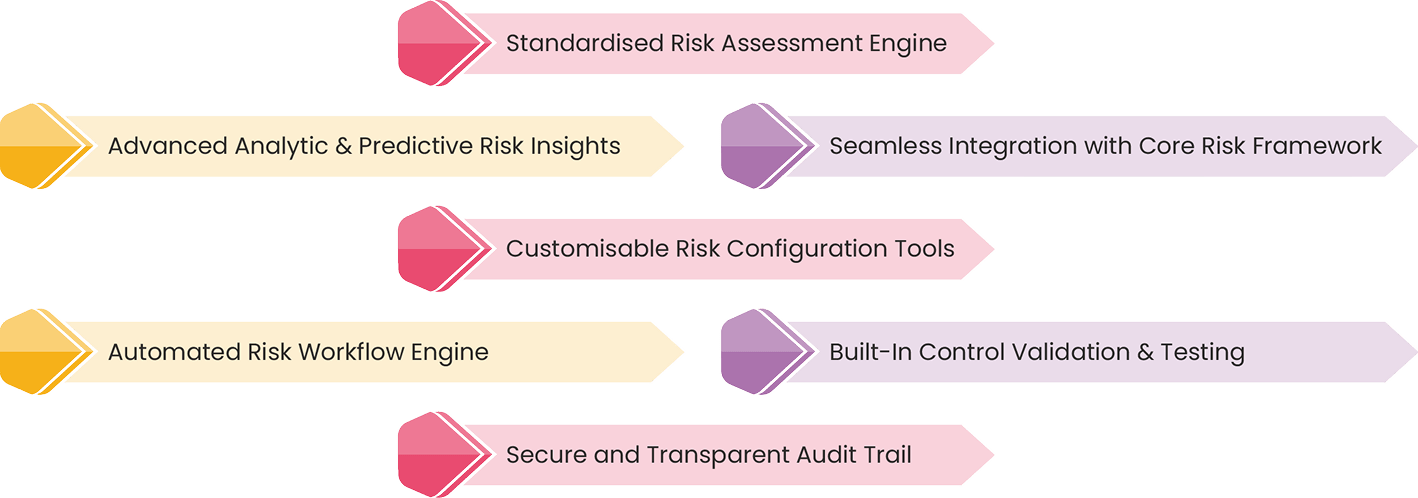
Standardised Risk Assessment Engine
A robust EWRA Software must deploy a standardised risk assessment engine for an integrated and uniform approach to assessing enterprise risk. Applying an established scoring framework and risk criteria helps in decision-making. An automated engine ensures the development of customisable templates for the identification and classification of risks, ensuring flexibility and accuracy in risk assessment.
Advanced Analytic & Predictive Risk Insights
EWRA Software must incorporate an advanced data analytics suite that converts raw data into actionable risk intelligence. Real-time risk monitoring enables early threat detection and control deficiency. By associating data across risk segments, the EWRA Software identifies hidden patterns and provides automated insights on errors.
Seamless Integration with Core Risk Framework
EWRA Software must ensure seamless integration with other AML compliance systems to implement a sustainable risk management framework that supports detailed supervision and a connected strategy. It enhances strategic decision-making through coordination with regulatory requirements and alignment with the evolving risk matrix, allowing for a harmonious flow of risk and compliance data across the enterprise.
Customisable Risk Configuration Tools
EWRA Software must incorporate role-based access, tailored templates and easily deployable dashboards to represent the Regulated Entity’s unique risk profile. This allows for conveying risk findings effectively for better allocation of AML/CFT resources. The EWRA Software ensures alignment with regulatory obligations and internal structure, delivering flexibility and suitability across Regulated Entity’s needs.
Automated Risk Workflow Engine
EWRA Software must implement a task distribution engine to automate risk assessment adaptation, as this mitigates manual interventions, speeds up response time, increases process accuracy, boosts productivity and ensures immediate risk mitigation responses.
Built-In Control Validation & Testing
EWRA Software must offer strong capabilities for control testing to assess and corroborate operational safeguards. This enables Regulated Entities to identify anomalies, monitor actions and ensure compliance with control measures, encouraging a culture of responsible risk management.
Secure and Transparent Audit Trail
Regulated Entity must ensure the EWRA Software comes with a reliable audit trail that records every stage of the EWRA process, every action, change and decision of it. The record maintenance functionality ensures accountability, streamlines reviews, supports compliance and empowers internal audit processes.
Clarity within Your Reach
Tap into Predictive Analytics to Spot Red Flags before They Escalate
Benefits of Implementing Enterprise-Wide Risk Assessment Software
Enterprise-Wide Risk Assessment (EWRA) Software expands beyond just digitising manual compliance tasks. It plays a pivotal role in shaping a proactive and intelligence-driven risk culture within Regulated Entities by providing fruitful benefits such as centralising risk knowledge, enabling real-time monitoring, providing actionable data-driven insights, optimising compliance resources, ensuring continuous monitoring, delivering efficient automated reports and strengthening overall AML/CFT compliance.
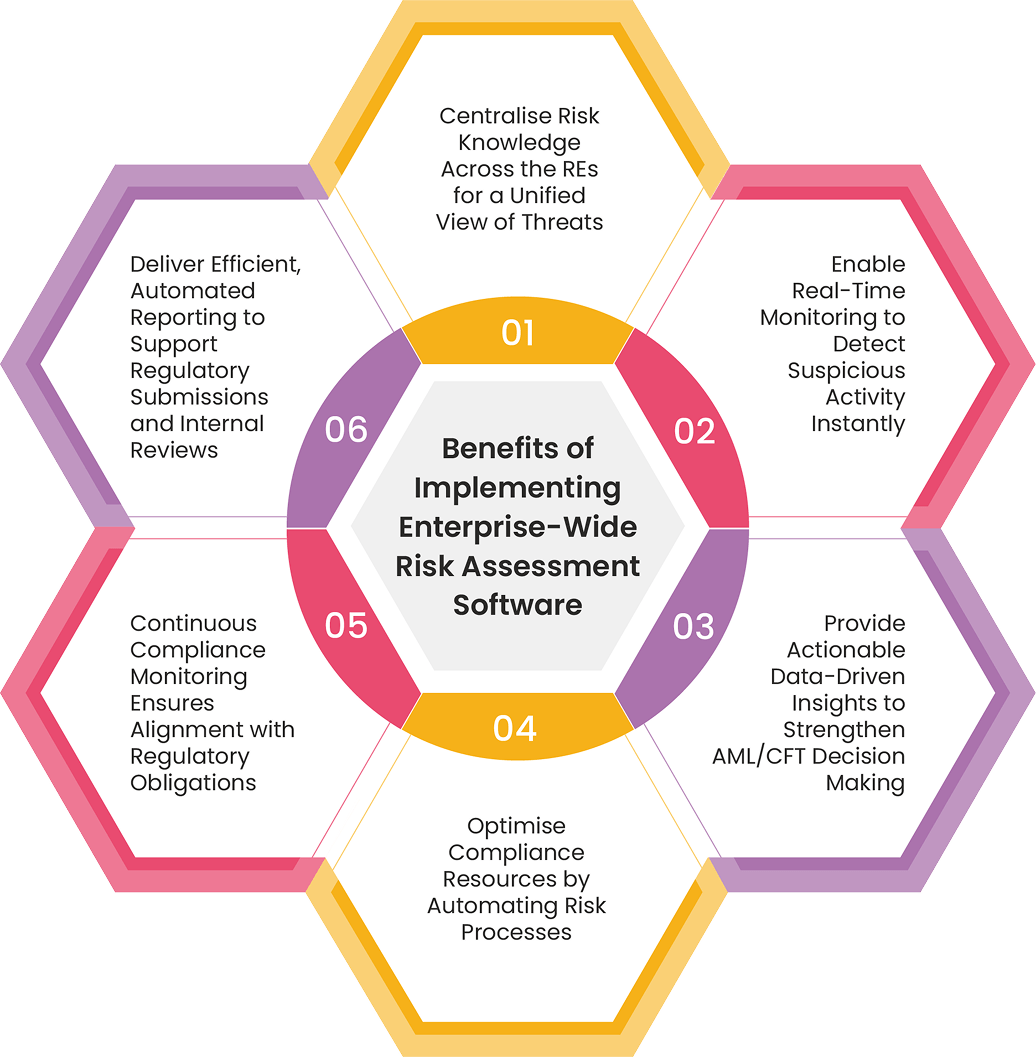
Centralise Risk Knowledge Across the REs for a Unified View of Threats
EWRA Software incorporates risk-based intelligence from various factors, giving Regulated Entities a unified view of threats and vulnerabilities. By integrating data sources, the EWRA Software enhances transparency and fosters multifunctional alignment. This enables REs with more accurate and efficient risk categorisation. With this implementation, the EWRA Software establishes a solid foundation for conducting due diligence that is timely, risk-based, and compliant. Ensuring that Regulated Entities are enabled to respond effectively to evolving compliance.
Enable Real-Time Monitoring to Detect Suspicious Activity Instantly
EWRA Software benefits Regulated Entities with real-time monitoring of customer behaviour, transactions, and other risk indicators through an intuitive dashboard. This provides REs with immediate visibility, allowing compliance to identify unusual or suspicious activities. This transparency ensures quick assistance in reducing potential exposure to ML/TF/PF risks when a suspicious pattern emerges. Real-time alerts provide rapid decision-making, enabling REs to be future-ready. Such quick adaptability is valuable in a regulatory landscape where timeliness and audit readiness are crucial. By maintaining continuous insight, REs uphold alignment with AML/CFT framework and respond effectively to emerging threats.
Provide Actionable Data-Driven Insights to Strengthen AML/CFT Decision Making
EWRA Software provides timely, verified data that improves risk scoring accuracy and benefits Regulated Entities to make informed decisions. With its inbuilt analytics, it facilitates Regulated Entities to gain deeper insight into activities and potential red flags, contributing to reliable anticipation of ML/FT risks. The EWRA Software’s smart algorithm prioritises relevant data, helping Regulated Entities to detect risk patterns that may go unnoticed through manual analysis. These insights focus on more targeted due diligence and accountability-driven culture, in alignment with the AML/CFT obligations. Furthermore, the EWRA Software enhances internal analytics with external datasets such as sanctions, watchlists, and adverse media.
Optimise Compliance Resources by Automating Risk Processes
EWRA Software empowers REs to identify and prioritise high-risk customers and sectors, to use the resources where they are most needed. This targeted approach reduces waste, enhances efficiency, and ensures that compliance teams focus on impactful areas. The EWRA Software minimises repetitive actions by automating the process of checks and freeing up space for decision-making. Especially in complex businesses, resource optimisation through EWRA Software brings better efficiency while maintaining a guard against ML/TF/PF risks. The EWRA Software supports efficient reporting and record keeping, which enables system stability.
Continuous Compliance Monitoring Ensures Alignment with Regulatory Obligations
EWRA Software continuously monitors compliance with AML/CFT requirements, FATF recommendations, and regional financial free zones such as Dubai International Financial Centre (DIFC) and Abu Dhabi Global Market (ADGM). The EWRA Software generates automated alerts and audit logs for any errors or changes that have happened from established standards, providing timely corrective actions. This built-in compliance engine ensures alignment with evolving regulatory requirements. Regulated Entities benefit from continuous monitoring and real-time reporting, empowering process reliability and minimising the risk of errors and penalties.
Deliver Efficient, Automated Reporting to Support Regulatory Submissions and Internal Reviews
EWRA Software speeds up the creation of detailed risk and compliance reports, customised according to UAE’s AML/CFT framework. Standardised templates and customisable dashboards make reporting cycles easier and smoother, ensuring accuracy and efficiency. This enhances alertness for audits and supervisory reviews by generating comprehensively documented data with minimal manual intervention. Regulated Entities can easily track risk movements, monitor risk exposure trends, and deliver insights that empower good management and decision-making. EWRA Software enables Regulated Entities to demonstrate compliance and transparency effortlessly.


“Your business faces risks from customers, delivery channels, geographics, payment modes and others. This proposes the need for an effective EWRA Software, which can act like a capable captain walking through uncharted waters, strategically standing upright in prioritising risk mitigation, aligned with the organisation’s risk appetite. Choosing an effective EWRA Software that smoothens the pathways to develop constructive policies and procedures for an organisation will be the right practice.”

How to Select and Implement Enterprise-Wide Risk Assessment Software: Best Practices for DNFBPs, VASPs -Regulated Entities
Regulated Entities should opt for an EWRA Software that aligns with AML/CFT obligations to detect and mitigate ML/TF/PF risks and offers an intelligent, risk-based approach that streamlines the Risk Assessment process. While selecting and implementing EWRA Software, Regulated Entities must ensure that it assists in defining risk appetite, strengthens risk visibility, provides for real-time monitoring, automates reporting, enables auditable risk frameworks and simplifies AML oversight.

Establishing Risk Appetite and Enhancing Compliance Timeline through Automated Workflow
Regulated Entities should opt for EWRA Software equipped with automated assessment tools that help them in defining risk appetite and risk management requirements by understanding their risk tolerance through structured data gathered from several risk factors. Further, it must assist in the adoption of a risk-based approach customised to the RE’s nature, size, and business complexity, ensuring identification and assessment of ML, TF and PF risks. Audit-ready reports and customisable dashboards ensure smooth communications and transparency, enhancing the timely compliance
Strengthening Risk Visibility and Evidence-Based Reporting with Compliance Tools
While selecting and implementing EWRA Software, Regulated Entities must ensure that it has structured risk categorisation with an established framework incorporating qualitative and quantitative metrics. The EWRA Software generates clear, actionable documents that meet internal and external standards. By eliminating the need for guesswork with comprehensive data, EWRA Software delivers consistency, prioritisation, and accountability. It transforms complicated compliance into organised processes, making risk management efficient and impactful.
Monitoring Risks in Real-Time and Smart Reporting
Regulated Entities should choose EWRA Software, which provides continuous monitoring and prioritisation of risks that trigger alerts to new and emerging threats. It should provide REs with a comprehensive report generation and simplify coordination with supervisory authorities. Every action is logged to ensure audit transparency and accountability. EWRA Software must be flexible enough to address different situations, enhancing the flexibility and transparency of the entity.
Converting Risk Inputs into Actionable Intelligence with Data-Backed Assessment Engine
Regulated Entities must implement a EWRA Software that automates large-scale data, uses configurable methodologies to automatically identify inherent risks and give dynamic view of the organisation’s overall risk landscape. Further, EWRA Software must support continuous monitoring of risks across customer segments, geographies, and product lines, using an integrated compliance framework to have insight into evolving risk sectors. The EWRA Software must enable quick, evidence-based decision-making with integrated analytics. Documented scoring methodologies are essential to ensure transparency, consistency, and traceability across risk intelligence processes.
Automating Compliance Reporting & Embedding Risk Thresholds
Regulated Entities should integrate EWRA Software that enables the integration of measurable risk thresholds into strategic planning processes. It should simplify repetitive compliance activities to reduce workload. Built-in controls and audit features must support flexible governance, while ensuring transparency and consistency in risk oversight.
Enabling Auditable Risk Frameworks & Simplified AML Oversight Through Centralised Risk Intelligence
Regulated Entities should integrate EWRA Software that enables to create structured, audit-ready documentation and accurate risk scores. The EWRA Software must support alignment with national and sectoral risk indicators, while enforcing consistent risk tolerance thresholds across business units. It must automate control testing to boost compliance confidence and improve REs’ readiness in accordance with AML/CFT requirements.
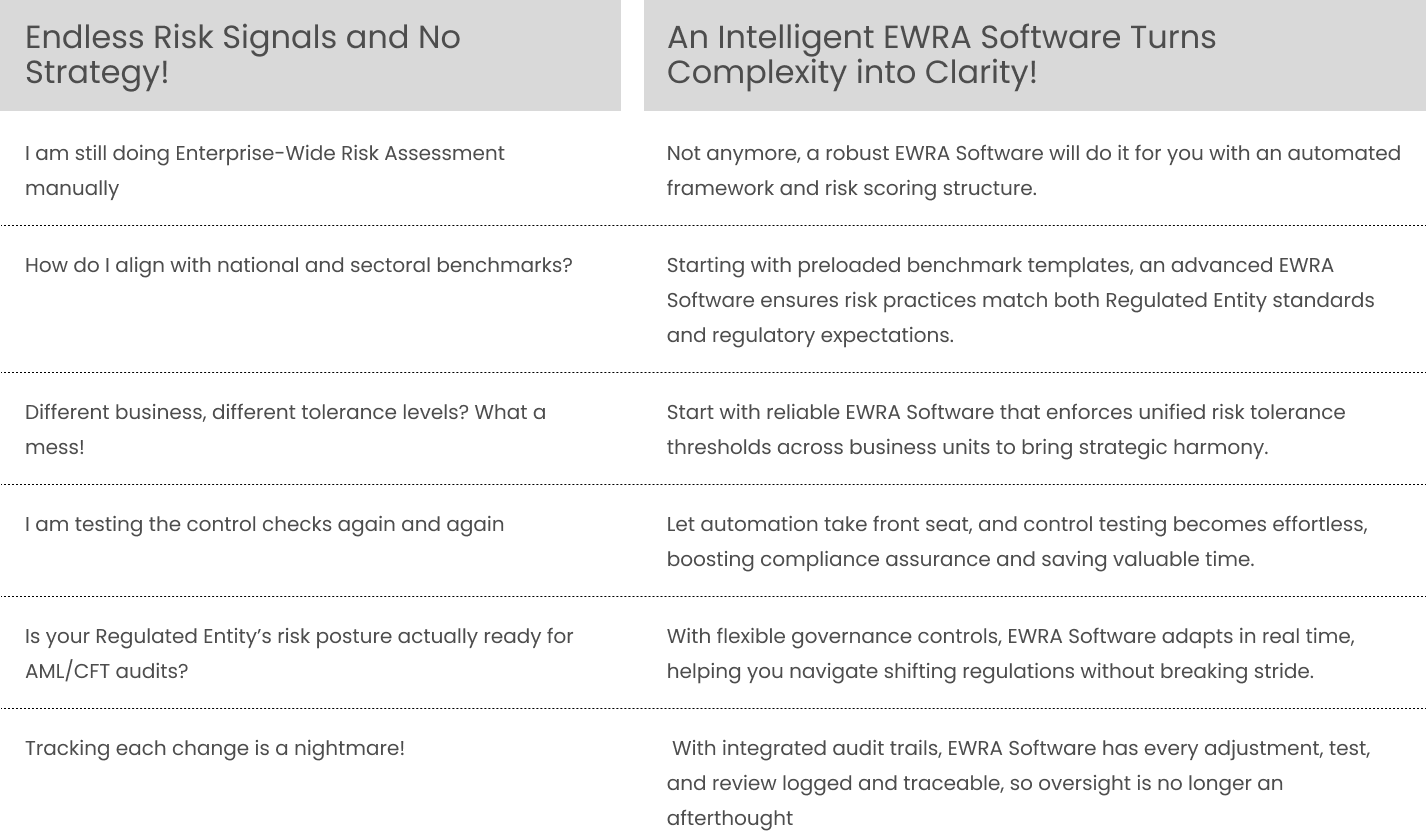
Endless Risk Signals? An Intelligent EWRA Software Turns Complexity into Clarity!
In a world where risk evolves as fast as opportunity, EWRA Software empowers Regulated Entities to adapt swiftly, translating complexity into strategy by pinpointing risk exposure and automating compliance intelligence.

Smarter Risk Management Through Dynamic EWRA Intelligence
In order to assess the risks and maintain compliance across financial and non-financial sectors, EWRA Software enables Regulated Entities to implement risk scoring and oversight into Customer Risk Assessment, product risk review, and expansion due diligence. It ensures risk-based compliance framework aligned with the UAE Central Bank, the Ministry of Economy, and the FIU.
Components Loaded, Ready to Deploy
Select an EWRA Software to Level up our Compliance engine