


Sanctions Screening
Sanctions Screening is an integral part of Customer Due Diligence (CDD) measures and Targeted Financial Sanctions (TFS) obligations. It provides Regulated Entities in UAE to have comprehensive outlook towards anticipated risks by accurately identifying matches with Sanctioned Individuals under UAE Local Terrorist List and UNSC Consolidated list.
What is Sanctions?
Sanctions is a restrictive measure imposed by the UAE government, United Nations Security Council (UNSC), or other international bodies to prevent activities that may pose a threat to national security, foreign relations, or the global financial system. It forms a critical part of AML/CFT framework of a nation. Sanctions list issued by relevant authorities identifies designated terrorists, terrorist organizations as well as Entities having terrorist links.
The UAE maintains a UAE Local Terrorist List, which must be regularly checked by all businesses, especially Designated Non-Financial Businesses and Professions (DNFBPs), financial institutions, and compliance personnel, to ensure they do not engage with people/entities that fall in the sanctions list.

Operational Pain Points in Sanctions Screening
A Regulated Entity (RE) might already have internal policies in place for conducting Sanctions Screening by just matching names against watchlists using automated tools. But are they truly sufficient for effective AML/CFT Compliance? Some of the frequent challenges encountered during Sanctions Screening are highlighted below:
Are your Sanctions Screening tools aligned with the latest and most comprehensive watchlists, including the UAE Local Terrorist List, UNSC Consolidated List, and other relevant international lists based on your risk exposure?
Are your Sanctions Screening records fully documented, with detailed, timestamped logs that can be easily retrieved and presented during regulatory audits, inspections, or internal reviews?
Do you have a robust mechanism in place for ongoing /real-time Sanctions Screening to ensure that newly sanctioned individuals or entities are detected promptly even after onboarding?
Is your screening tool fully UAE-compliant, integrated with your KYC, CRM, or onboarding platforms, and capable of producing regulator-ready reports for audits, inspections, or investigations with minimal manual effort or delay?
Does your Sanctions Screening Engine support fuzzy logic, handle multilingual names and aliases, and effectively manage partial matches and false positives to minimize risk without overloading your compliance team?
Does your Screening Software provide an intuitive dashboard with real-time alerts and reports, while ensuring UAE-compliant data security through encryption, secure hosting, and role-based access to sensitive data?
Regulatory Obligations for TFS Compliance in UAE
Sanctions Screening is a regulatory compliance requirement for Regulated Entities in UAE. Sanctions restrictions, including TFS measures, must be implemented by any person (both natural and legal entities), including government authorities and Regulated Entities such as FIs, DNFBPs, and VASPs located in the UAE and operating within the UAE’s jurisdiction.
In UAE, The Cabinet Resolution No. 74 of 2020 sets the procedure to implement the Targeted Financial Sanctions consisting of UAE local terrorist list and consolidated sanctions lists of UNSC, in particular those related to the Combating of Terrorism, Terrorists Financing & Financing Proliferation of Weapons of Mass Destruction. As such, DNFBPs and other Regulated Entities must adopt robust and effective sanctions screening solutions to ensure full compliance with UAE regulations.
Which Data Sources must be Screened in the UAE?
TFS framework requires Regulated Entities in the UAE (including free zones) to constantly screen their customers, potential customers, beneficial owners, and transactions to identify possible matches to the-
- UAE Local Terrorist List or
- UN Consolidated List
Other than these lists, screening solutions must also include other International Sanctions lists (such as The European Union list, The UK HM Treasury list, etc.) depending on the risk exposure.
Step by Step Guide for Effective Sanctions Screening Compliance
Regulated Entities in the UAE are required to establish and maintain effective Sanctions Screening Mechanisms. These obligations are closely aligned with FATF Recommendations, particularly those related to Targeted Financial Sanctions, and apply not only at the onboarding stage, but throughout the customer lifecycle.
There are four main obligations for Regulated Entities in the UAE to implement Targeted Financial Sanctions (TFS):


Subscribe
All Regulated Entities (REs), including Financial Institutions and DNFBPs, are required to register with the Executive Office for Control and Non-Proliferation (EOCN) to ensure they receive official notifications regarding updates to the UAE Local Terrorist List, and UN Consolidated Sanctions List.

Screen
FIs, DNFBPs, and VASPs across mainland and free zones must screen the following:
Existing Customers
Map all customer & transaction systems to Sanctions Screening tools. Manual screening must follow key identifiers if automation is not used.
Frequency: Ongoing & on list updates.
Potential Customers
Screen all customers before onboarding or starting any business relationship.
Frequency: At onboarding.
Previous Customers
Screen former customers with no active accounts for up to 5 years.
Frequency: On list updates.
Parties to Transaction
Screen buyers, sellers, agents, freight forwarders, and any other parties in a transaction.
Frequency: Per transaction.
Ultimate Beneficial Owners (UBOs)
Screen all Ultimate Beneficial Owners (UBOs) linked to the customer.
Frequency: At onboarding & ongoing.
Connected Persons
Screen any persons or entities connected to sanctioned individuals or groups.
Frequency: On list updates & ongoing.
Directors & Agents
Screen directors and individuals holding power of attorney for customers. Frequency: At onboarding & ongoing in nature.
To remain compliant with UAE’s Targeted Financial Sanctions (TFS) regime, Regulated Entities must ensure Sanctions Screening is conducted at key touchpoints, including:
- Immediately after any updates to the UAE Local Terrorist List or the UN Consolidated Sanctions List, Screening must be performed without delay to meet freezing obligations.
- Prior to onboarding new customers, to prevent the entry of sanctioned individuals or entities.
- During periodic KYC updates or reviews to capture any changes in customer risk profiles.
- Daily screening of customers’ databases.
- Before processing any transaction, ensure that no prohibited parties are involved.

Apply TFS Measures
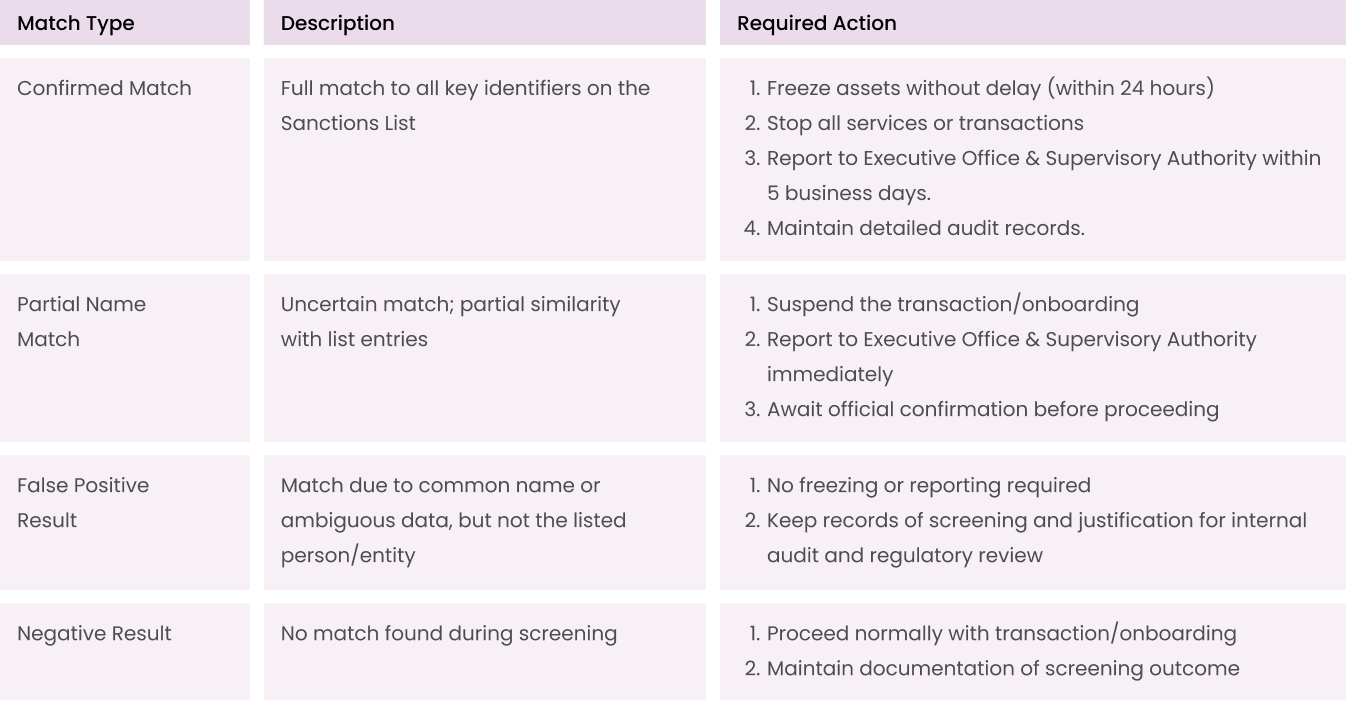
Based on the degree of match between the customer’s information and the identifiers listed in the Local Terrorist List or UN Consolidated List, screening outcomes can be categorized into four distinct types. There are four possible results following the screening process, as listed below:
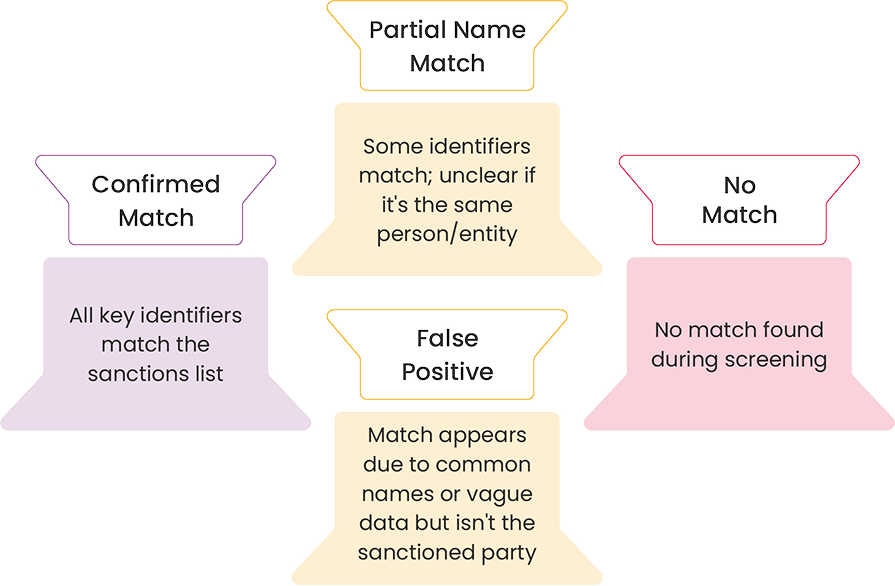
Upon Detecting a Potential Match (“Hit”), Regulated Entities must proceed with caution. Timely and accurate implementation of TFS measures is essential for ensuring national security, compliance with regulatory requirements, and avoiding severe penalties. The following steps are mandatory and must be taken promptly.
- When all key identifiers match with the designated entity in Sanctions List then REs should consider it as a “Confirmed Match” and freeze assets without delay and report to Executive Office and Supervisory Authority within 5 business days.
- When there is an uncertain match and partial similarity with the designated entity in Sanctions List then REs should disambiguate whether it is confirmed match or false positive. In cases unable to derive the conclusion then suspend the transaction if it is existing customer and reject the business relationship if it is potential customer. REs should report to Executive office and Supervisory Authority within 5 business days.
- If there is a False Positive result or no match with the Sanctions List, then no freezing or reporting is required.
Certain payments like interest or contractual dues may be allowed only with prior written approval from the Executive Office or under specific Cabinet Decisions, but must be immediately frozen and reported.

Report
Regulated Entities must file a relevant report to the UAE FIU through the goAML portal as simplified below:
Confirmed Match:
Existing Customer: If a confirmed match is identified on the existing customer, then Regulated Entities must freeze the assets without any delay and prohibit making any kinds of funds or services available. Further, submit the Confirmed Match Report (CNMR) via goAML within 5 business days.
Potential Customer: If a confirmed match is identified on the potential customer, then Regulated Entities must reject the business relationship and submit Confirmed Name Match Report (CNMR) via goAML within 5 business days.
Partial Name Match:
Existing Customer: If a partial name match is identified on the existing customer and Regulated Entities are unable to conclude whether it is confirmed match or false positive, then suspend the transactions and submit Partial Name Match Report (PNMR) via goAML within 5 business days.
Potential Customer: If a partial name match is identified on the potential customer, then Regulated Entities must obtain ID documents within 10 days. If ID documents are received in 10 days, then Regulated Entities are required to conduct screening and apply the TFS measures as per screening result. If ID documents are not received within the 10 days, then reject the business relationship and submit Partial Name Match Report (PNMR) via goAML within 5 business days. If ID documents are received after period of 10 days, then consider as a completely new business relationship and submit a new report as per the screening result.
False Positive:
If false positive is identified on any customer whether existing or potential, then Regulated Entities should take no further action and continue the business relationship as per its normal course of business. Moreover, in such circumstances Regulated Entities are not required to file any of the report but ensure to maintain internal documentation of false positive results.
No Match:
If there is no match identified on any existing or potential customer, then Regulated Entities should continue the business relationship and maintain the screening outcome records.
Reporting Entities are required to maintain records of all screening results (Confirmed Name Match, Partial Name Match, and False Positives) for at least five years.
Common Sanctions Screening Challenges Faced by Regulated Entities
Despite clear compliance framework in place, Regulated Entities often face significant challenges in conducting accurate Sanctions Screening due to lack of staff awareness, poor data quality, outdated systems and resource constraints. These challenges are creating risks of regulatory non-compliance and reputational damage.
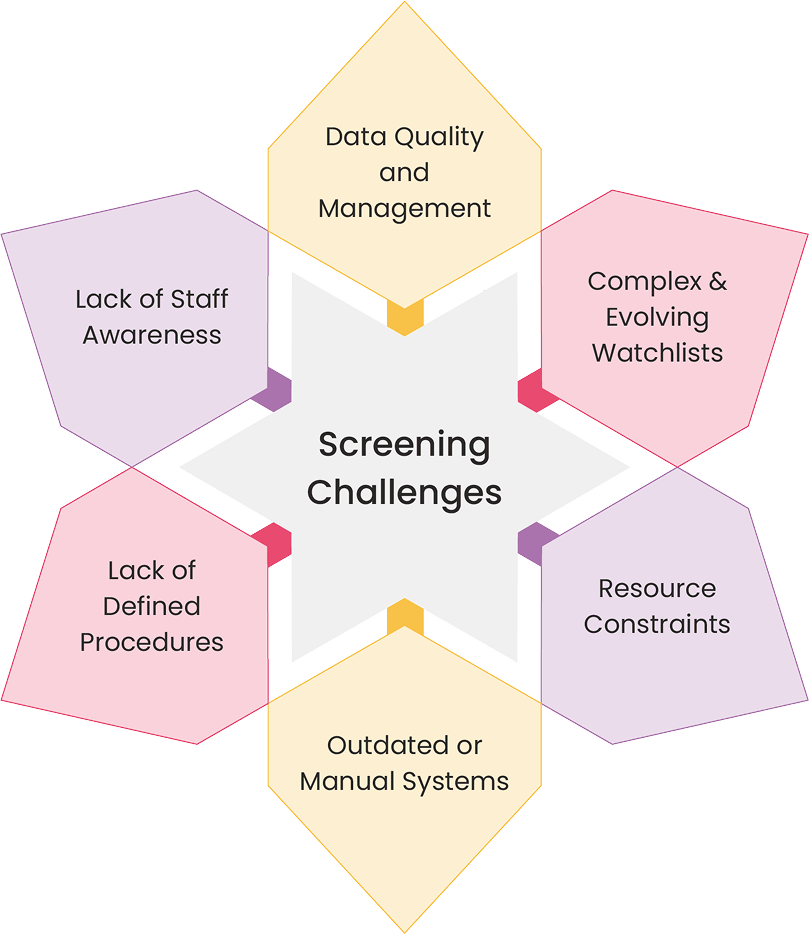

Data Quality and Management
Inaccurate, incomplete, or inconsistent customer data (e.g., misspelt names, missing IDs, or varied data formats) leads to false positives or false negatives. Data stored in incompatible systems or unmanaged formats reduces the reliability of automated screening tools and weakens compliance effectiveness.

Complex and Evolving Watchlists
Sanctions lists (e.g., UN Consolidated List, UAE Local Terrorist List) are very frequently updated. This can create challenges in maintaining accuracy, harmonising the data, and timely and continuous screening.

Resource Constraints
Effective and real time screening not only requires skilled compliance personnel but also a robust and advanced Sanctions Screening Software. Many entities lack skilled staff, modern technology, or processes to manage ongoing sanctions compliance effectively.
Outdated or Manual Systems
Manual or outdated systems often lack scalability, accuracy and may suffer from high false-positive rates, leading to compliance delays, and increased operational burden.
Lack of Defined Procedures
Without clear procedures or internal policies for identifying and handling matches/ false matches, staff may delay or mishandle responses. This increases the risk of non-compliance with TFS obligations. Defined workflows and having a defined risk-based framework in place help ensure timely and accurate action.
Lack of Staff Awareness
Inadequate training or awareness among compliance teams can lead to missed or mishandled matches. Staff must understand TFS obligations, how to identify potential matches, and the steps to take when one is hit.
Struggling with these challenges?
Let us simplify your sanctions screening journey. Talk to our experts today.
Best Practices for Regulated Entities to Stay on Top of Sanctions Screening Game
In ever-changing compliance landscape, Sanctions Screening isn’t just a compliance tick-box, but a powerful safeguard against threats of ML/TF activities. Adopting best practices such as establishing clear internal procedures, automating screening process, training employees, leveraging risk-based screening framework, helps Regulated Entities in UAE to identify hidden risks.
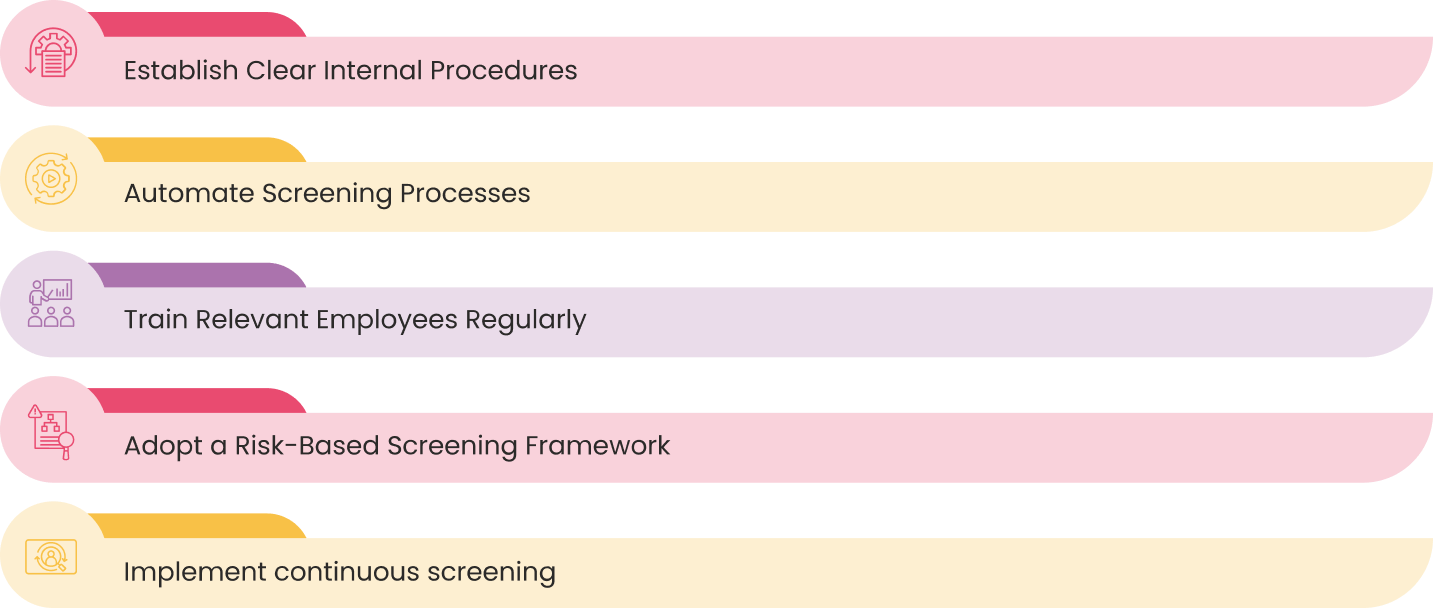
Establish Clear Internal Policies
Regulated Entities must have documented protocols for identifying, escalating, and responding to matches, including handling partial, confirmed, and false positives. Additionally, REs should create well-defined sanctions compliance policies detailing screening procedures, list update frequency, escalation steps, and client exit strategies for high-risk or non-compliant customers.
Automate Screening Processes
Regulated Entities should use advanced AML Sanctions Screening Software that supports real-time updates, fuzzy logic, name matching algorithms, batch screening and multi-language capabilities to improve efficiency and accuracy.
Train Relevant Employees Regularly
For holistic Sanctions Screening Obligations, Regulated Entities must conduct frequent training of their employees to ensure compliance team understand how to identify matches and act according to UAE TFS obligations. Moreover, REs should train compliance teams on updated regulations, tools, and match-handling procedures to build competency in managing sanctions risks effectively.
Adopt a Risk-Based Screening Framework
Regulated Entities should tailor their Sanctions Screening protocols by adopting risk-based approach, based on their business nature, operational requirements, risk appetite, customer profiles, transaction volume, and geographical exposure. Further, REs must align their approach with FATF guidelines and UAE-specific compliance requirements to ensure efficient monitoring, improving the efficiency of their risk mitigation measures.
Implement continuous screening
Regulated Entities must conduct ongoing monitoring and screening at onboarding, during KYC reviews, on customer data changes, and upon list updates. Further, REs should periodically test and audit systems to confirm effectiveness and compliance with AML/CFT and TFS obligations.


Sanctions Screening serves as the frontline guardian of compliance, ensuring your business remains aligned with both local and global obligation. Like a vigilant lighthouse, it acts as a guide through the fog of Sanctions Lists, preventing any drift towards unprohibited waters. Effective Sanctions Screening strategy anchored within AML/CFT framework and TFS Obligations, strengthens the path towards compliance excellence.

Mitigate Sanctions Screening Challenges: How AML UAE Becomes Compliance Wingman
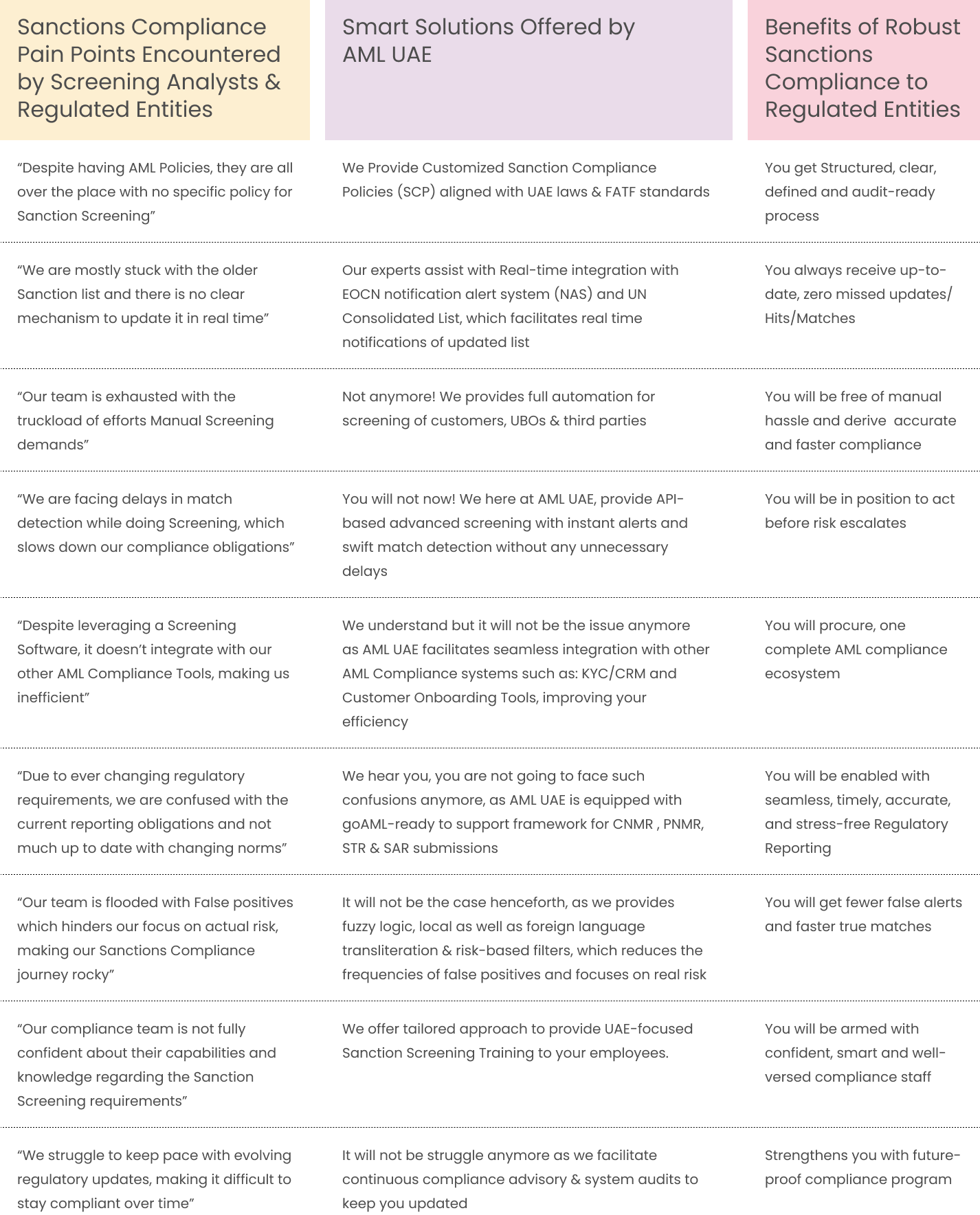
At AML UAE, we help businesses comply with Cabinet Decision No. 74 of 2020 by implementing robust Sanctions Screening Policies, automated tools, and effective internal controls. Our goal is to help Regulated Entities overcome operational challenges and ensure full compliance with UAE’s Targeted Financial Sanctions (TFS) obligations.
Daily sanctions rescreening operations
Operate daily sanctions rescreening with exception control
Regular sanctions rescreening needs a complete population, current lists and a process for resolving the results. We support an agreed daily operating cycle alongside event-driven screening, with clear escalation for urgent matches and failed runs.
Track the full screening cycle
We reconcile the population submitted, confirm the list version used and track alerts through review. The scope can include customers and relevant connected parties according to your framework. Missing records, failed jobs and unreviewed alerts are treated as exceptions with named owners.
Evidence of completion
You receive run records, alert status and an exception summary for the authorised compliance team. Daily batch processing must not delay measures required without delay following a list update or match. We agree system access, coverage, support hours and escalation responsibilities before the service starts.
Sanctions match investigation
Investigate sanctions screening matches
A screening alert needs prompt assessment against the identifiers available. We help your team distinguish a false positive from a confirmed or unresolved potential match, with a documented rationale and escalation trail.
Compare more than the name
Our review considers dates of birth, nationality, identification numbers, addresses, aliases and relevant entity details. We record conflicting or missing information and avoid clearing a match solely because one identifier differs. Corporate matches may need further ownership and control analysis.
Support the response decision
You receive an evidence-backed disposition and the issues requiring authorised action. The workflow separates investigation from freezing, suspension and reporting responsibilities. Urgent protective measures must not wait for a routine review cycle or for our written report to be completed.
Sanctions ownership and control assessment
Assess sanctions exposure through ownership and control
An entity may present sanctions exposure through its owners or controllers even when its own name does not appear on a list. We investigate relevant ownership chains and control arrangements against the applicable sanctions framework.
Follow the structure to the people and entities behind it
We review direct and indirect holdings, voting arrangements and other evidence of control, identifying gaps in registry or client information. The applicable sanctions test is assessed separately from the beneficial ownership threshold used for routine CDD.
A clear basis for escalation
You receive an ownership and control map, supporting evidence and a reasoned assessment of unresolved exposure. We identify where legal or authority clarification is required. Provide the ownership structure, available corporate records and the match details so the review can focus on the relevant connections.
TFS freeze and suspension simulation
Rehearse sanctions freezing and suspension procedures
A sanctions procedure should tell each team what to do when a confirmed or unresolved potential match arises. We run a controlled simulation to test escalation, protective measures, reporting preparation and evidence capture.
Test the handover between teams
The exercise follows a fictional case through compliance, operations, management and relevant system owners. We examine who can restrict activity, how asset information is gathered and how instructions are communicated without tipping off the customer. Scenarios distinguish freezing from suspension and routine screening investigation.
A practical improvement record
You receive an exercise log, observed delays and an action plan with owners. The simulation uses test data and agreed boundaries so it does not trigger an unauthorised live freeze or report. We tailor the scenario to your products, systems and supervisory framework.
VASP sanctions exposure and freeze simulation
Test a VASP sanctions response across wallets and systems
A VASP needs to understand what it can restrict, what information it holds and when it must escalate a sanctions concern. We assess exposure and run a controlled simulation across the relevant customer, wallet and asset systems.
Test the operational response
The exercise considers customer and connected-party screening, wallet exposure, custody arrangements and available controls over assets. We distinguish assets within the firm’s control from activity it can only observe, and test how relevant teams preserve evidence and prepare reports.
A realistic response plan
You receive an exercise record, control gaps and proposed actions. A blockchain analytics result is assessed with its attribution limits rather than treated automatically as a confirmed designated-party match. The simulation uses authorised test conditions and does not initiate live restrictions or filings.
TFS notification subscription and response workflow
Connect sanctions notifications to a working response process
A subscription to sanctions notifications needs a monitored inbox and an action route. We help define how relevant notices are received, checked, assigned and translated into screening or other required action.
Test receipt and escalation
The workflow identifies the official sources, primary owner, backup cover and evidence of review. We assess what happens outside normal working hours and how failures or missed notifications are escalated.
A traceable response record
You receive a notification register, responsibility map and test procedure. Notices are linked to the relevant list update, rescreening result and compliance action. Subscription alone is not treated as proof that affected customers or transactions have been assessed.
Sanctions rescreening after ownership or list change
- Rescreen after ownership changes or sanctions list updates
A change in a customer’s owners or a sanctions designation can create exposure after onboarding. We help define the affected screening population and ensure that event-driven reviews are completed and recorded.
- Identify everyone affected by the change
The process covers new or changed owners, controllers and other relevant connected parties, as well as customers or records affected by a list update. We reconcile the population and track alerts through authorised review.
- Evidence completion and exceptions
You receive the event record, screening results and unresolved items requiring escalation. Required protective measures are handled without waiting for the next routine batch. The workflow complements daily rescreening by showing how specific changes are identified and acted upon.
Frozen-asset register and reporting reconciliation
Reconcile frozen asset records and sanctions reports
A frozen-asset register should agree with operational restrictions, account or asset records and the information reported to the authorities. We help reconcile these records and investigate material differences.
Check the asset and the restriction
The review covers identifiers, quantities or balances, relevant valuation dates, freeze instructions and subsequent permitted changes. We examine whether restrictions remain effective and whether updates require reporting under the applicable instructions.
A controlled reconciliation record
You receive a reconciled schedule, exception log and proposed corrective actions. Access is restricted to authorised staff, and no release or transfer is made merely to clear a reconciliation difference. Share the relevant instructions, system records and reporting history for the agreed review period.
Unfreezing or delisting request support
- Support unfreezing and delisting related requests
A customer request or changed list entry needs careful assessment before any restriction is lifted. We help your team identify the applicable procedure and organise evidence for the competent authority or authorised decision process.
- Establish the basis for the request
The review distinguishes mistaken identity, delisting, access to funds and other grounds that may follow different routes. We compare the request with designation details, existing instructions and the firm’s records, identifying where specialist legal advice is needed.
- Maintain control until release is authorised
You receive an evidence pack, draft supporting explanation and a tracker for correspondence and instructions. We document the authority and conditions for any subsequent action. Our assistance does not determine a delisting outcome or authorise unfreezing while the required approval remains outstanding.

Let Substantive Sanctions Screening Go All Out to Fortify Compliance Shield
Despite leveraging basic measures for Sanctions Screening, Regulated Entities in UAE often miss hitting the nail due to inaccurate matches, resource constraints and untrained staff. Therefore, Regulated Entities in UAE should count on customized solutions, tailored approaches and methodologies to conduct extensive Sanctions Screening. This facilitates building of a comprehensive framework for Sanctions Screening with UAE Local Terrorist List and UNSC Consolidated list for smooth navigation of TFS and AML/CFT obligations.
Your next hit alert shouldn’t be a surprise.
Eliminate false positives and missed hits. screen smarter, not harder.