


AML Regulations for CMA-Regulated Advisors and Promoters in UAE
Adverse Media Screening
Adverse Media Screening
Adverse Media Screening is a critical component of Customer Due Diligence measures. It helps Regulated Entities cast their net wider by spotting the risks before the risk spots them. Through comprehensive news databases available locally and globally, it traces alleged criminal links of counterparties and conducts reputational checks with an aim to assess potential risk.
What is Adverse Media Screening?
Adverse Media Screening is the process of searching public databases and information available across various media sources to identify individuals or entities linked to suspicious, illegal, or unethical activities, often connected to predicate offences, leading to Money Laundering (ML).
Adverse Media Screening forms an important part of AML/CTF compliance. It is a crucial element of Customer Due Diligence (CDD) and KYC for Regulated Entities in the UAE that goes beyond official watchlists, focusing on publicly available, credible, and up-to-date information to catch risks before they become a problem.

Common Pain Points Faced by Compliance Professionals During Adverse Media Screening
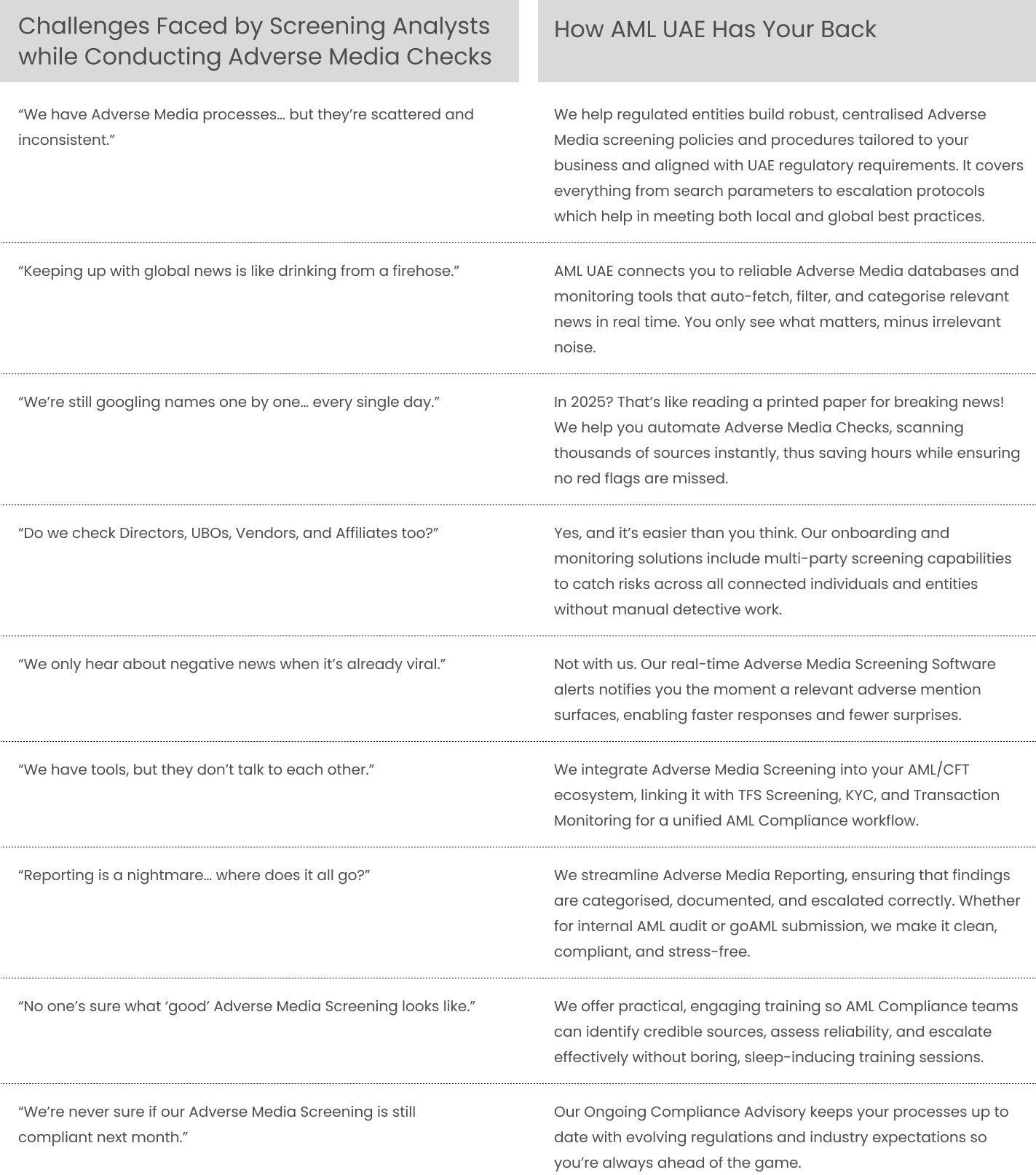
Most Regulated Entities (REs) have internal policies for screening customers and counterparties. But Adverse Media Screening goes beyond headlines. It helps uncover hidden risks through credible public sources, news reports, and regulatory disclosures. The common operational pain points faced by AML compliance professionals, such as Screening Analysts, KYC Analysts, or AML Compliance Officers while carrying out Adverse Media screening, are as follows:

Don’t Let Screening Gaps Put You at Risk
Transform Complex Media Checks into Trusted Compliance Intelligence
Regulatory Obligations for Adverse Media Screening in the UAE
The Financial Action Task Force (FATF) recommends Adverse Media Screening as a key component of the AML/CFT framework. In UAE, Regulated Entities are required to actively monitor reliable and independent sources for negative news, particularly when dealing with high-risk customers. The Primary Regulations, which implicitly include Adverse Media Checks as part of Customer Due Diligence measures, are:
Federal Decree Law No. (10) of 2025 on Anti Money Laundering and Combating the Financing of Terrorism
Cabinet Resolution No. 134 of 2025 on the implementation of Federal Decree Law No. (10) OF 2025.
It is a non-negotiable safeguard for a business’s integrity and compliance. Implementing a powerful and reliable screening solution is essential to detect risks early, mitigate them, meet legal obligations, and protect against financial crime.
Which Data Sources Must be Screened in the UAE?
Adverse Media Screening is effective only if it covers the right sources—both locally and globally. Screening is required across a broad spectrum of credible, updated, and comprehensive databases to detect potential risks. Businesses must ensure their Adverse Media Screening methodology captures data sources such as:
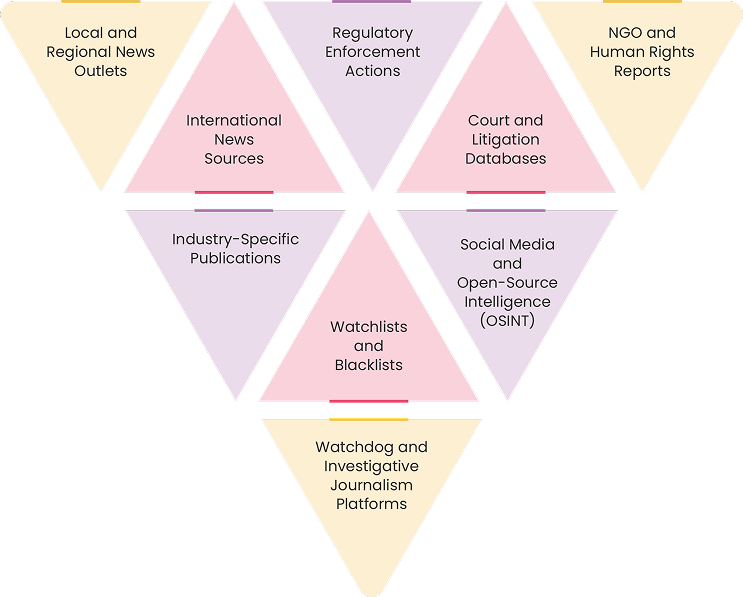
Local and Regional News Outlets
Regulated Entities should foremost search UAE-based and regional news sources to identify reputational risks. These local news outlets often report on fraud, corruption, financial crimes or regulatory violations.
International News Sources
The other reliable sources to extract Adverse Media information are international news reports. It provides wider coverage of international financial crimes, sanction breaches and ML/TF/PF cases.
Regulatory Enforcement Actions
Adverse Media screening should include regulatory announcements and enforcement actions from authorities such as CBUAE, ADGM, DFSA etc. These sources give insights into official sanction penalties and compliance breaches.
Court and Litigation Databases
Regulated Entities should also rely on public litigation databases to extract any negative news related to the customer. It provides coverage of past legal disputes, bankruptcy cases or criminal proceedings involving the subject.
NGO and Human Rights Reports
Regulated Entities should also search NGO and human rights reports to find any unfavorable news. Reports from reputed human rights institutions and NGOs highlight involvement in human rights violation, corruption or unethical business practices.
Industry Specific Publications
Regulated Entities should also search their industry specific publications for any adverse news. It can reveal controversies, regulatory warnings or compliance breaches within particular industries such as DPMS, real estate, legal or TCSPs.
Watchlists and
Blacklists
One of the major reliable sources for Adverse Media is global and regional watchlists such as UN, EU, OFAC and local UAE terrorist list. These are crucial for identifying entities engaged in Terrorism Financing, fraud or other white-collar crimes.
Social Media and Open-Source Intelligence
Regulated Entities can also utilize social media platforms to find negative news reports. Moreover, open-source intelligence techniques help in uncovering emerging allegations, detect misinformation or fraudulent activities.
Watchdog and Investigative Journalism Platforms
Regulated Entities can also rely on watchdog and investigative journalism platforms to find Adverse Media.
Who Needs to Be Screened and How?
In UAE, Regulated Entities need to conduct Adverse Media Screening for all potential customers before entering the business relationship. If it is corporate customer then their Ultimate Beneficial Owners (UBOs), Directors, Authorized Signatories and Person holding Senior Management positions are also screened for any Adverse Media. Regulated Entities are required to utilize reliable sources and platforms to check for Adverse Media.
Potential & Existing Customers
Who to screen?
- Individual customers (natural persons)
- Corporates (legal persons)
How to Screen (Sources)
- Reliable news portals (local & global)
- Investigative journalism sites [e.g., International Consortium of Investigative Journalists (ICIJ), Organized Crime and Corruption Reporting Project (OCCRP) and the likes]
- Subscription-based Adverse Media Databases
- Court judgment repositories
Business Partners & Suppliers
Who to screen?
- Domestic & international suppliers
- Joint venture partners
- Outsourcing vendors
How to Screen (Sources)
- Trade & industry news publications
- Procurement blacklists
- Sector-specific regulatory guidelines
Ultimate Beneficial Owners (UBOs)
Who to screen?
- Individuals holding ≥25% ownership
- Those with significant influence/control
How to Screen (Sources)
- Corporate registry filings
- Leaked document repositories (e.g., Panama Papers)
- Adverse Media search via global & regional databases
Directors & Authorized Signatories
Who to screen?
- Current directors
- Key signatories on behalf of the entity
How to Screen (Sources)
- Business news archives
- Governance breach reports
- Adverse legal proceedings coverage
Legal Guardians or Parents (Minors)
Who to screen?
- Guardians/parents linked to minor accounts
How to Screen (Sources)
- Family-related news coverage
- Public records databases
- Social media-based media monitoring (where allowed)
When Should Adverse Media Screening be Conducted?
Adverse Media Screening should be carried out at multiple points in the customer lifecycle to ensure ongoing compliance and effective risk management:
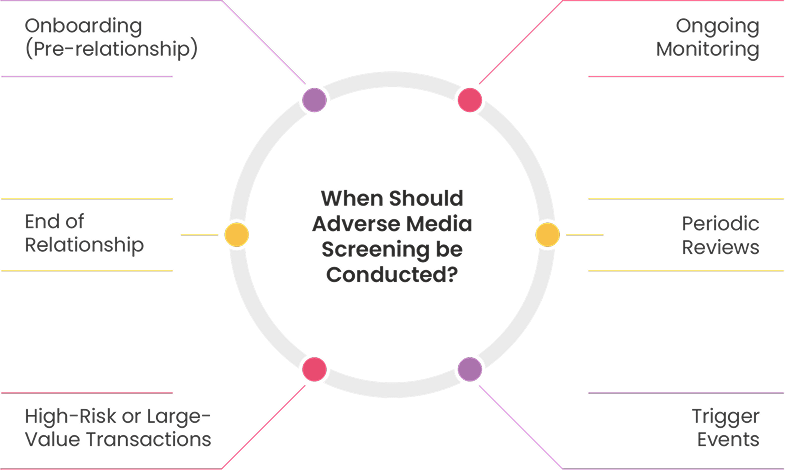
1. Onboarding (Pre-relationship)
Screen all potential customers, UBOs, directors, business partners, agents and relevant third parties for negative news before establishing a business relationship and entering a transaction. This helps in identifying potential reputational and financial crime risks early.
2. Onboarding Monitoring
Periodically re-screen existing customers and related parties to capture newly emerged adverse news. The frequency should be based on the customer’s risk profile.
3. Periodic Reviews
Conduct full screening during scheduled KYC/CDD reviews annually for high-risk relationships and every 2–3 years for medium or low-risk relationships, or as aligned with the Regulated Entity’s risk-based due diligence criteria.
4. Trigger Events
Re-screen when there’s a change in ownership, management, key control persons, transaction patterns, or after fresh negative media reports surface.
5. High-Risk or Large-Value Transactions
In the context of high-risk or unusual transactions, carry out event-based Adverse Media checks on counterparties before execution as prescribed by risk-based policies and procedures.
6. End of Relationship
Before ending a relationship, ensure there is no pending adverse news that could lead to post-exit liabilities or regulatory queries.
Common Adverse Media Screening Challenges Faced by Regulated Entities
Adverse Media Screening process comes with many operational, technological, and regulatory challenges that, if not addressed, can compromise the effectiveness, accuracy and timeliness of risk detection and regulatory reporting.
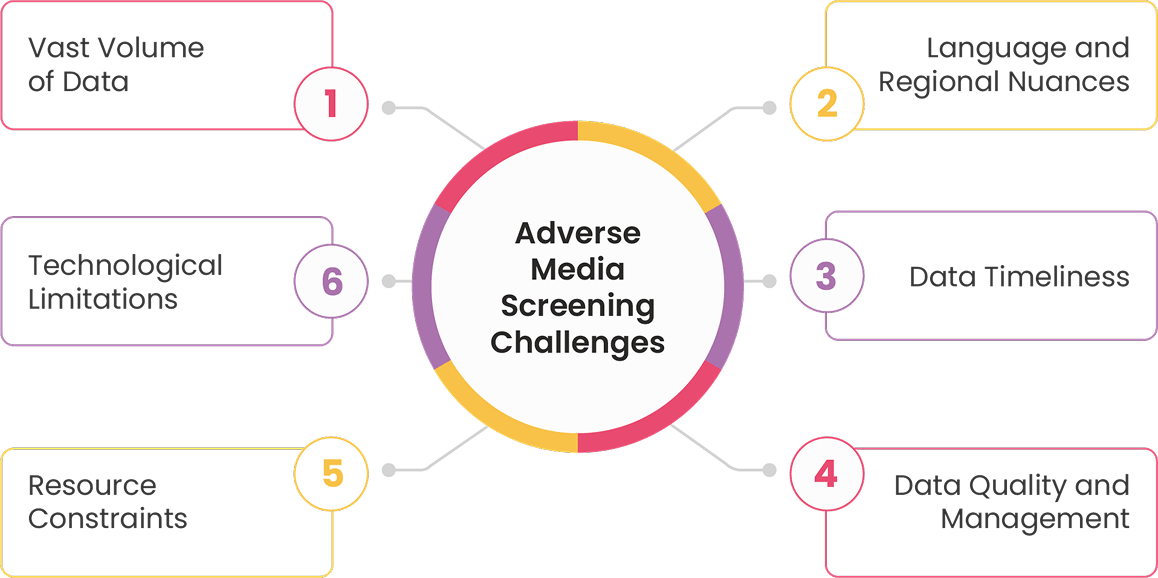
Vast Volume of Data
Adverse Media Screening requires processing of huge datasets from global and local news outlets, regulatory announcements, and online sources. This can overwhelm compliance teams, consume more time and resources, and thus lead to missed ML risks.
Language and Regional Nuances
News articles may be in multiple languages or carry cultural nuances that automated systems may misinterpret, increasing the risk of overlooking critical red flags.
Data Timeliness
Outdated or delayed news or data may cause organisations to act on stale information, thus weakening the Adverse Media Screening process and risk management efforts.
Data Quality and Management
Poor-quality, inconsistent, or mismanaged data, which is stored in multiple formats, increases the likelihood of false positives or missed matches, reducing the effectiveness of Adverse Media Screening process.
Resource Constraints
SMEs and smaller compliance teams often lack the skilled manpower, budget, and advanced software to implement and maintain robust Adverse Media Screening systems.
Technological Limitations
Manual Adverse Media Screening processes are slow, error-prone, time-consuming, and generate high false-positive rates. Without automation, keeping up with global news and media becomes resource-intensive and inefficient.
Struggling with Adverse Media Screening challenges?
We’ll Help You Turn Them into Solutions—Connect With Our Experts Today.
Step-by-Step Guide for Regulated Entities to Conduct Adverse Media Checks
Regulated Entities should tailor their Adverse Media Screening process in accordance with their organization’s operational requirements and overall risk appetite. Here’s a step-by-step guide for REs to conduct thorough Adverse Media Screening.
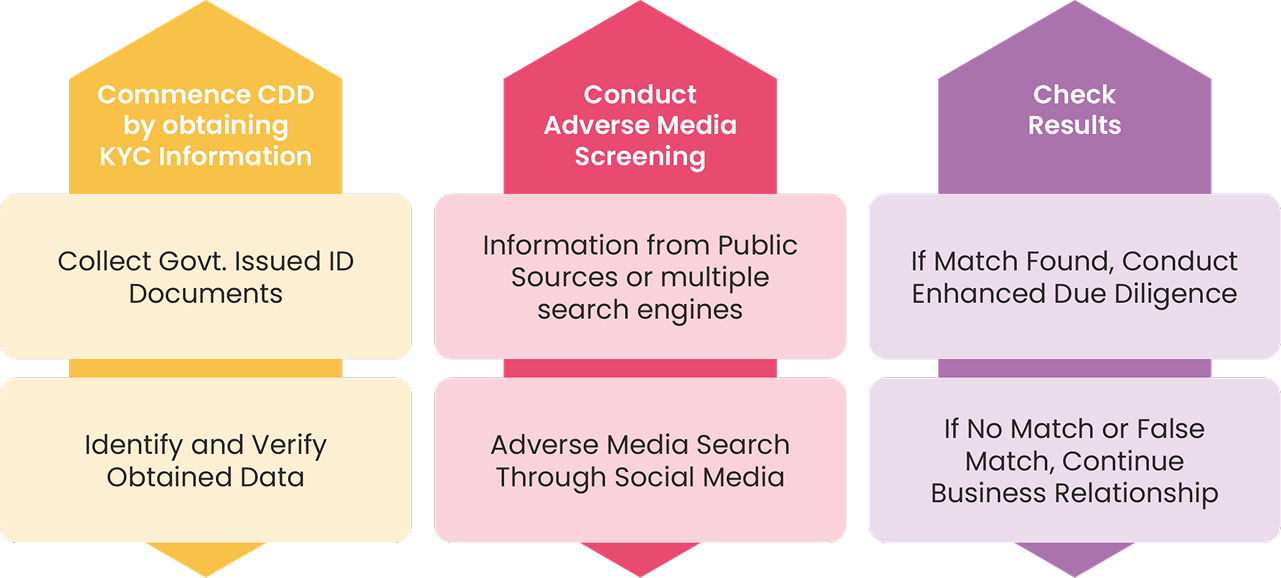
Commence CDD by Obtaining KYC Information
Before entering a business relationship, Regulated Entities should obtain key identifiers from customers such as their name, occupational and jurisdictional details, nature of their business, address, govt. issued ID proofs or passport, aliases and other relevant details through a customised KYC questionnaire. This helps Regulated Entities to establish the identity of customer for thorough Adverse Media searches.
Conduct Adverse Media Screening
Once the customer’s identity is established, conduct a comprehensive Adverse Media screening for the customer to ascertain customer’s links to any negative activities. Regulated Entities can perform Adverse Media search through various ways such as using multiple search engines (google, bing), through public sources, software or social media platforms. Entering Customer’s name with key words such as fraud, bribery, corruption, Money Laundering, Terrorist Financing gives desirable results in search engines. Regulated Entities can also use software applications for conducting Adverse Media screening.
While using software, put the name, and it will provide Adverse Media details related to the person and associated sources. Then, one can check these details and conclude the customer’s identity and the involvement or connection with financial crimes. Another way is to conduct research through social media websites such as LinkedIn, Facebook, and Instagram.
Regulated Entities can search for the name of the person and verify the profile details based on the key identifiers of the customer and the social profile popped up. Then, check if the person is tagged in any negative posts.
Check Results
Once thorough research is conducted through various sources, if Regulated Entities find involvement of the customer is any negative news, then apply Enhanced Due Diligence or appropriate measures as per the severity of the involvement and risk appetite of the organization. And if there are no results found of Adverse Media related to the customer then Regulated Entities should continue the business relationship without taking any further measures.
After establishing the business relationship, Regulated Entities are required to continue ongoing monitoring for the customer’s appearance in any Adverse Media news later.
Unsure if your Adverse Media Screening Process is accurate?
Opt for our customized and risk-based Adverse Media Health Check
Best Practices for Regulated Entities for Adverse Media Screening Game
Some of best practices every Regulated Entity should follow to keep their compliance processes sharp and aligned with UAE’s evolving AML/CTF landscape are as follows:
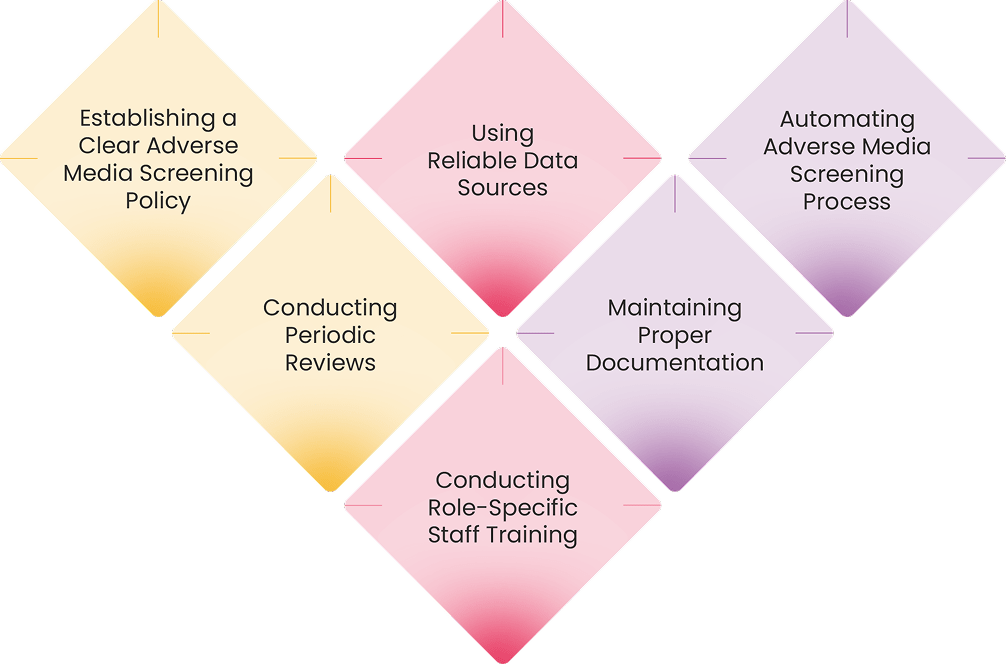
Establishing a Clear Adverse Media Screening Policy
Regulated Entities must define and document their Adverse Media Screening process clearly, which outlines frequency, sources, escalation protocols, and decision-making criteria for Adverse Media Screening.
Using Reliable Data Sources
Regulated Entities must rely on credible global databases, reputable news outlets, and local media sources to ensure broad coverage and accuracy of results obtained while conducting Adverse Media Screening.
Automating Adverse Media Screening Process
Regulated Entities must implement automated Adverse Media Screening tools, Adverse Media Software, or Adverse Media APIs that can continuously monitor and update screening results, reducing manual workload and human error.
Conducting Periodic Reviews
Regulated Entities must regularly review and audit their Adverse Media Screening process and assess its accuracy to ensure that their methodology and tools remain effective and compliant with regulatory requirements.
Maintaining Proper Documentation
Regulated Entities must keep thorough records of Adverse Media Screening activities, screening matches, decisions, and follow-up actions for regulatory reporting and AML audit purposes.
Conducting Role-Specific Staff Training
Regulated Entities must provide role-specific ongoing training on Adverse Media Screening tools, red flag indicators, various Adverse Media screening methodologies, local and international sources and journals, and regulatory changes to ensure the AML Compliance team stays skilled and alert.
Require help integrating Adverse Media Screening best practices into your AML Compliance Framework?
AML UAE helps you implement compliance the smart, customised, and effective way.
Tackle Adverse Media Screening Challenges with AML UAE: Your Trusted Compliance Wingman
At AML UAE, we offer comprehensive solutions designed for businesses operating in mainland UAE and other free zones for conducting accurate Adverse Media checks. Our customized approach integrates government approved methods and ensures not a single detail is missed regarding the customer.
Adverse-media investigation and disposition
Investigate and resolve adverse media findings
A news result needs context before it can inform a customer risk decision. AML UAE investigates whether the subject is the same person or business, what the report alleges and how the information relates to your relationship.
Separate identity and relevance
We compare identifiers, assess the source and date, and distinguish allegations, proceedings and reported outcomes. Where available, we check primary records and later developments. Duplicate stories are grouped so repeated publication does not appear to be several separate events.
A reasoned disposition
You receive the research trail, identity assessment and a summary of the financial crime relevance, including uncertainties and recommended escalation. Your compliance officer decides how the finding affects risk, due diligence or reporting. A search with no relevant result is documented with its scope and limitations, without treating it as proof that no adverse information exists.

Let Comprehensive Adverse Media Checks Keep You Wary of Negative News
Despite fulfilling basic regulatory requirements, Regulated Entities often miss detecting potentially risky customers due to inaccurate results and reliance on manual efforts. Regulated Entities must rely on customised solutions to conduct extensive Adverse Media Screening to uncover potential links to financial crimes or any other antagonistic activities. This ensures a Regulator-friendly compliance framework.
One Missed Hit Can Cost You Millions.
Fortify Your Adverse Media Screening and Eliminate Risks with AML UAE