



AFC Software
The right Anti-Financial Crime (AFC) Software is a sturdy platform for Regulated Entities (REs) in UAE to combat rising financial crimes and meet Anti Money Laundering (AML), Counter Financing of Terrorism (CFT) and Counter Proliferation of Financing (CPF) regulations.
The rising financial crimes, such as Money Laundering (ML), Terrorism Financing (TF), and Proliferation Financing (PF), has made it a necessity for REs to begin implementing technology during customers’ onboarding to assess risk and improve business operations.
The right Anti Financial Crime Software with advanced Artificial Intelligence and Machine Learning capabilities help in improving the Customer Due Diligence (CDD) processes and implementing Customer Lifecycle Management (CLM).
What is AFC Software?
An AFC Software facilitates Regulated Entities to detect and safeguard against numerous financial crimes, including, but not limited to ML, fraud, corruption, bribery, embezzlement, tax-evasion, insider trading, human trafficking, drug trafficking, and the likes of it.
These financial crime risks are identified by using AFC Software by taking into consideration the customer profiles, geographies, and transactions, to mitigate risks while complying with relevant AML/CFT Regulations.

How AFC Software Helps Businesses Navigate AML/CFT Compliance Landscape
An AFC Software, apart from safeguarding from various financial crimes, also helps REs to ensure compliance with applicable AML/CFT laws in UAE.
It helps ensure AML/CFT compliance by identifying factors or risks which indicate potential involvement of ML/FT or PF activities routed through seemingly normal-looking business transactions.
This in turn helps Regulated Entities ensure AML/CFT compliance under the larger umbrella of AFC Software’s capabilities.
An AFC Software’s capabilities go beyond navigating AML Compliance obligations, as it is developed not only to comply with AML/CFT obligations but to identify, flag and mitigate every threat to the business using it, covering a larger ambit of financial crimes, including predicate offences.
Legal and Regulatory Requirement of AFC Software in UAE
With the surge of financial crimes, it is imperative for Regulated Entities in UAE to implement an efficient Anti Financial Crime solution that complies with the rigorous framework of national and international AML/CFT regulations, these include:
Regarding Anti-Money Laundering and Combating the Financing of Terrorism and Proliferation Financing.
on the Implementing Regulation of Federal Decree-Law No. (10) of 2025 on Combating Money Laundering, Counter-Terrorism Financing, and Countering the Financing of the Proliferation of Weapons.
Concerning the UAE List of Terrorists and the Implementation of UN Security Council Decisions Relating to Preventing and Countering Financing Terrorism and Leveraging Non-Proliferation of Weapons of Mass Destruction, and the Relevant Resolutions.
on Regulating the Beneficial Owner Procedures.
Along with this, AFC Software aligns it’s solutions as per the universal AML/CFT recommendations by FATF.
Facing Troubles Navigating the AML/CFT Compliance Landscape
We’ll Act as Your Compass Leading You to the Right Direction
Common Roadblocks in AFC Compliance
The rise in financial crime proves to be a serious threat to REs, which ends up hindering their business operations and their ability to stay compliant with AML regulations. The problems REs face is not limited to this and correspond to many other roadblocks discussed below:
Customer Onboarding, Sanctions, Financial Crime Mitigation modules not working in cohesion is big operational issue for REs.
Integrating AFC Software with existing KYC, Sanctions Screening and Transaction Monitoring modules to create a unified risk view is a big hurdle for Regulated Entities.
Implemented AFC tools not maintaining data integrity and not having measures to protect customers’ personal information is major challenge for REs to comply with Data Privacy Laws.
Poorly calibrated tools often fails to expeditiously generate UAE Compliant reports like SAR/STRs, or CNMR/PNMR.
Compliance teams not equipped enough to ensure adequate record-keeping and managing large volumes of data poses barrier for REs.
Unpreparedness to respond to cyber threats like ransomware, phishing, malware, etc. is a major hurdle for REs.
Not having effective System in place to detect synthetic ID threats is a big challenge for REs.
Outdated Solutions not able to protect business from Artificial Intelligence (AI) related fraud throws a big obstacle for REs.
Manual AFC Compliance Processes increasing operational costs is quite a big hurdle for REs.
Do Not Let a Roadblock Put an End to Your Compliance Journey
Fortify your Compliance Journey with AML UAE
Step-by-Step Guide for Regulated Entities for Using Smart AFC Software
AFC Software helps REs in combating financial crime and applying risk mitigation strategies to create a risk-free atmosphere in business operations.
AFC Software helps by integrating with existing software and tools, configuring thresholds and alerts, conducting ongoing monitoring of business relationships, facilitating case management, simplifying regulatory reporting, enabling record-keeping, and ensuring regular system upgrades and updates.
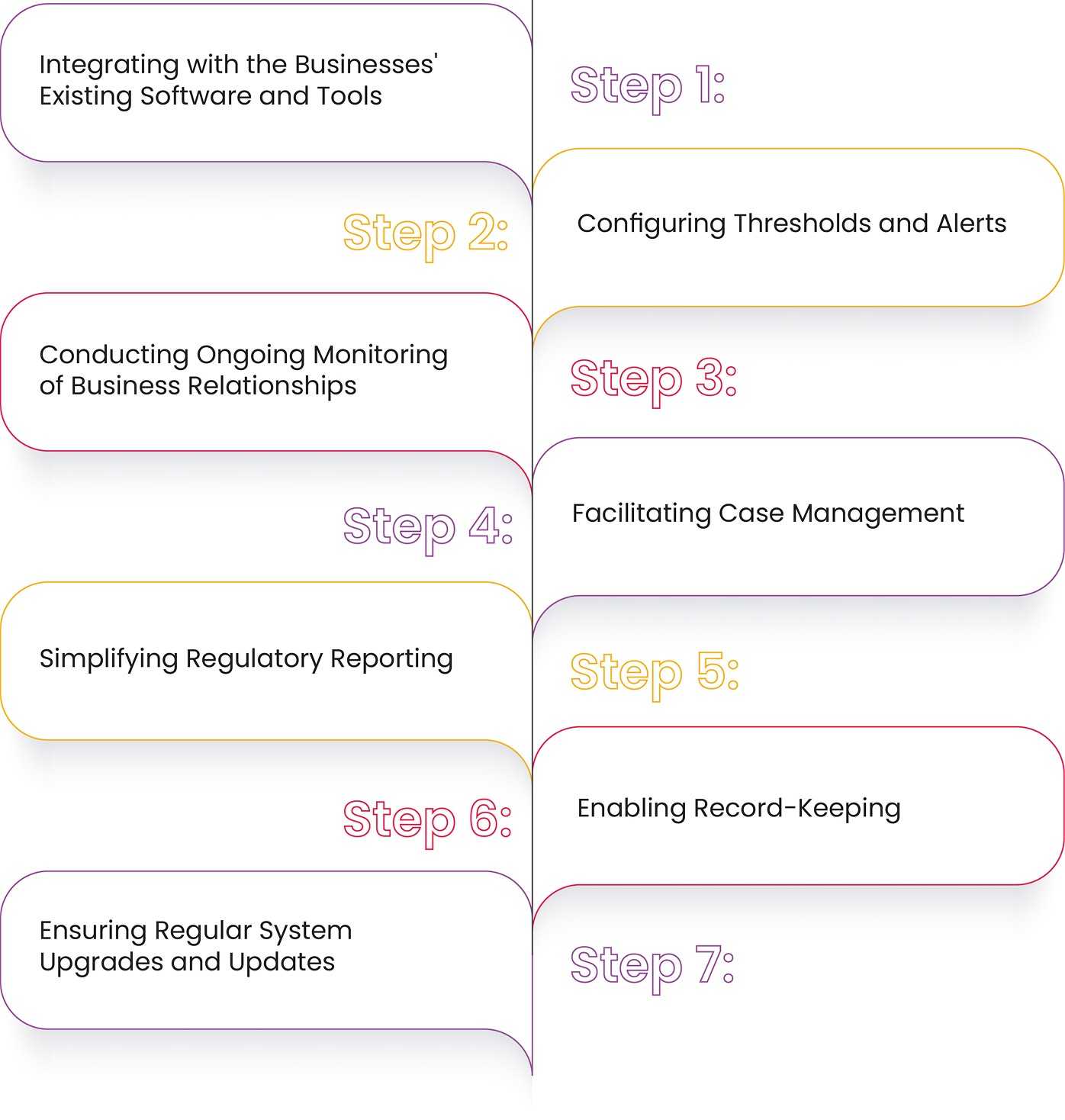
Step 1: Integrating with the Business's Existing Software and Tools
An AFC Software’s use can commence by integrating it with a business’s existing AML/CFT solutions, such as:
- KYC or Customer Onboarding Software or CRM Tools
- Sanctions Screening, Adverse Media Screening, and Politically Exposed Persons (PEP) Screening Tools
- Regulatory Reporting Tools
Integration with the business’s existing AML/CFT tools, such as KYC, customer onboarding and other tools, helps the AFC Software to collect information about customers the business deals with alongside their details such as geography, transactions.
Step 2: Configuring Thresholds and Alerts
The integration with the existing software is followed by establishing clear thresholds which help in triggering alerts once these threshold limits are crossed.
The threshold should be tuned in such a manner that allows it to precisely identify suspicious activities which help support the work of the compliance teams without bogging them down.
Step 3: Conducting Ongoing Monitoring of Business Relationships
The AFC Software has to be configured with thresholds and alerts after which it can catch any prospective issues that may arise during the process of ongoing monitoring of business relationships before they develop into major problems.
The AFC Software has to also be properly integrated so that it can respond appropriately to the dynamic risk environment and help in mitigating risk and ensuring compliance throughout.
Step 4: Facilitating Case Management
AFC Software, after being well equipped to oversee ongoing monitoring, also has to meet the requirement to manage cases in its system. This includes maintaining a unified database for cases so that they can easily access aspects such as documents, notes, transaction details, alerts etc.
It also includes automating the workflow so that approvals flow easily, tracking is simplified and the process of evidence collection and audit trails is effortless.
Step 5: Simplifying Regulatory Reporting
The AFC Software, which is now integrated with case management, would simultaneously help in assisting with Regulatory Reporting which involves several reports such as Suspicious Transaction Report (STR), Suspicious Activity Report (SAR), High Risk Country Transaction Report (HRC), Confirmed Name Match Report (CNMR) etc.
These reports require several details to be furnished, making regulatory reporting a complex process. AFC bridges this gap by simplifying this complex process.
Step 6: Enabling Record-Keeping
The AFC Software simplifies regulatory reporting after which it should help with record-keeping by complying with the record keeping obligations, in UAE mainland, it happens to be 5 years, from the date of completing the transaction or terminating the business relationship.
The AFC Software aids reconstructing the business relationship or transactions from scratch, which proves to be robust evidence during prosecution.
Step 7: Ensuring Regular System Upgrades and Updates
The step that follows record-keeping requires AFC Software to employ regular upgrades and updates to its system. This includes bug fixes, security updates, and latest updates.
These upgrades and updates ensure that the systems are implementing improvements, and the capabilities of the software are not compromised. It becomes essential to conduct regular upgrades and updates to ensure compliance and prevent financial crimes.
Prioritise the Essential, rather than Focusing Merely on Important.
AFC Software automates repetitive tasks to make timely decisions.
Must Have Features and Functionalities in AFC Software
An effective AFC Software supports REs to combat financial crime and meet AML compliance rules and regulations.
The features for an effective AFC Software include having a unified compliance platform, unique AI and human collaboration, data standardisation for speed and accuracy, customised case management and alert generation, regulatory reporting and audit preparedness.
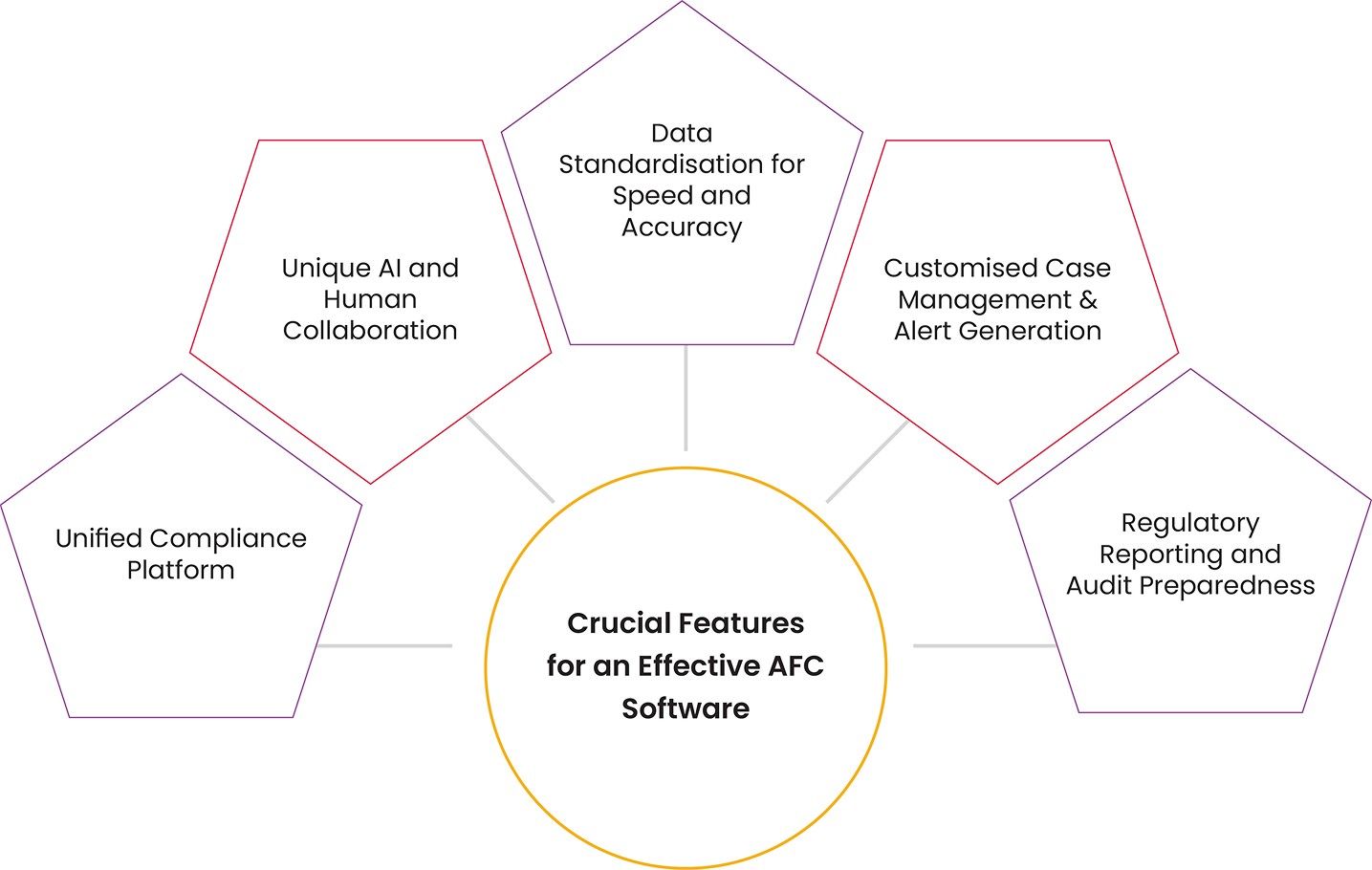
Unified Compliance Platform
The AFC Software has to provide REs a common platform to perform all financial crime prevention and AML Compliance functions from KYC, Screening, to transaction monitoring, fraud detection, record keeping, and reporting.
It has to enable financial crime prevention processes according to Regulated Entity’s risk-based approach and their unique needs, which involve AML Compliance and Customer Lifecycle Management.
Unique AI and Human Collaboration
The AFC Software has to include cutting-edge AI technology along with scope for human input to perform AML Compliance processes.
Automation eases the repetitive compliance procedures, human analysts are required to assess risk, make decisions and perform complex investigations. This hybrid approach enhances accuracy, optimises efficiency and combats financial crime.
Data Standardisation for Speed and Accuracy
Customer data is truly significant for AML Compliance processes. The customer data is raw, inconsistent, inaccurate and in diverse formats, it may lead to false compliance reports.
AFC Software should facilitate data standardisation that ensures a consistent, coherent and reliable datasets for effective Anti-Financial Crime Compliance. It enables quick decision making, reduces operational costs, risk management and avoids repercussions of non-compliance.
Customised Case Management & Alert Generation
AFC Software has to provide a customised case management tool that streamlines AFC Compliance by consolidating customer information on a single screen.
The AFC Software has to allow generating alerts to REs to detect red flags or suspicious activities relating to financial crime. It has to also provide alerts for changes in customer documents and risk levels, resulting in a thorough customer check for Anti-Financial Crime compliance.
Regulatory Reporting and Audit Preparedness
Regulated Entities has to report to regulators regarding any identified suspected activity. AFC Software has to also generate accurate, timely and audit-proof details for filling SAR/STR reports that directly integrate with goAML portal and reduce submission delays.
The AFC Software has to maintain log records and version history to streamline complex investigations and ensure transparency.
Don’t Just Work Harder but Work Smarter.
AFC Software will help you achieve compliance with speed and accuracy.
Benefits Integrating Advanced AFC Software for Regulated Entities
AFC Software is a game-changer as it facilitates AML Compliance for REs, detects financial crime risks and shapes compliance operations to help businesses run smoothly.
AFC Software provides plentiful benefits such as increased operational efficiency, improved data accuracy, enhanced transparency, early fraud detection and minimized reputational risks.
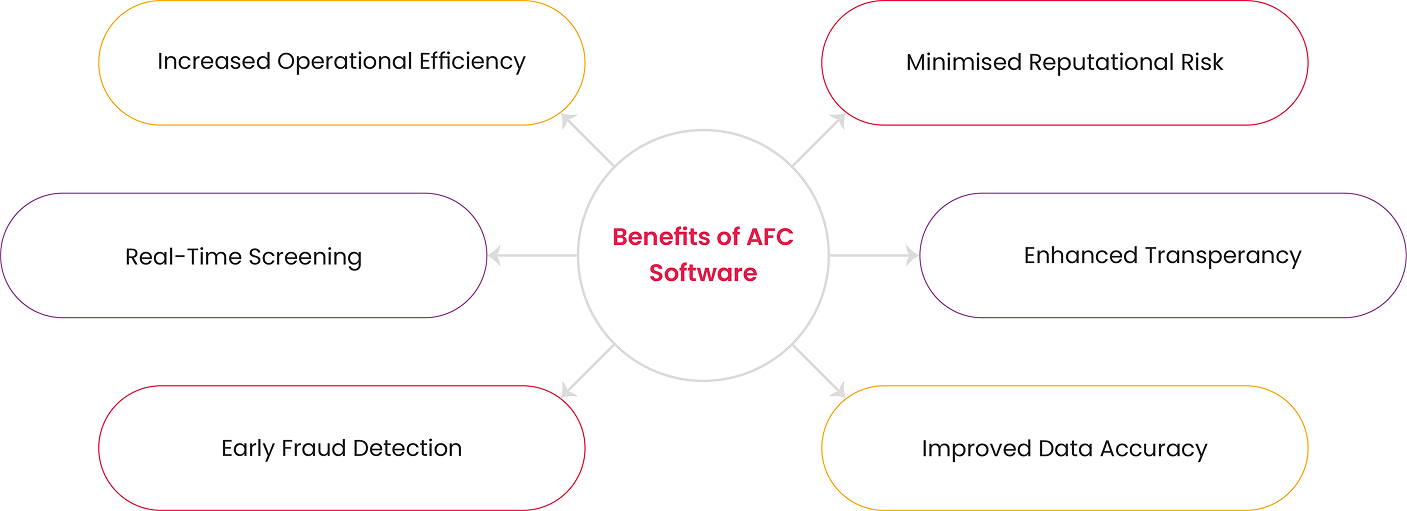
Increased Operational Efficiency
Problem: Feeling frustrated with overloaded customer data and lengthy onboarding processes?
Solution: AFC Software automates customer onboarding and smoothly run the KYC processes, allowing for thorough Customer Lifecycle Management.
Benefit: An effective AFC Software provides support to REs with accurate and error-free customer profiles, ease with lengthy onboarding processes, resulting in operational efficiency and enhanced customer experience.
Real-Time Screening
Problem: Finding it difficult to keep updated with changes in watchlists and adverse media individuals?
Solution: AFC Software with real-time screening allows identifying individuals as Sanctioned, PEP or Adverse Media at the time of onboarding and understanding changes in existing customer profiles, keeping REs ahead of financial crime and AML Compliant.
Benefit: The real-time screening through AFC Software allows safeguarding REs from not establishing business relationships with sanctioned individuals, understanding risky customers and implementing risk mitigation approaches like performing EDD for high-risk customers.
Early Fraud Detection
Problem: Need help in monitoring transactions to detect suspicious activity and prevent AML fraud?
Solution: AFC Software utilises automation, cutting-edge AI and Machine Learning to monitor and analyse massive data in real time, manage risk and comply with AML regulations.
Benefit: The automated AFC Software solution simplifies an overwhelming monitoring task, facilitates early detection of suspicious activities, and prevents financial loss.
Minimised Reputational Risk
Problem: Keeping track of real-time information seems a challenge.
Solution: AFC Software with a real-time alert generation feature keeps REs updated with changing customer data, AML regulations, and watchlists.
Benefit: REs can now navigate complexities in implementing AML Compliance, respond to emerging financial crimes, and safeguard themselves from reputational harm or regulatory penalties.
Enhanced Transparency
Problem: Complying with AML regulations isn’t easy, as there is enough struggle in accomplishing safe international trade.
Solution: AFC Software with AI-driven automation, regular screening checks, ongoing monitoring features, and predictive analytics helps detect and combat Trade-Based Money Laundering (TBML).
Benefit: REs can seamlessly develop customer risk profiles, keep up with changing TBML scams, and mitigate TBML risks. Other benefits include transparency in trade and other business operations, reduction in manual processes and cost-saving.
Improved Data Accuracy
Problem: There’s a lot of customer data, some of which is outdated, and a few may have a recent expiry. It seems impossible to store, update and manage data.
Solution: AFC Software has a proper case management tool that stores massive data in systematic cases, manages every case for further processes and even generates alerts for outdated and expired customer documents. The encrypted software also protects data from unauthorised access and cyber threats.
Benefit: REs can have real-time customer information, relief from maintaining a large volume of data manually. Also, these entities can reassure customers about the safety of their data and help build trust.
You Cannot Manually Track Every Financial Crime, but an Effective AFC Software Does.
Best Practices for Regulated Entities for Implementing Robust AFC Software
The REs needs to comprehensively understand their business and customers. In order to choose an effective AFC Software, REs must adopt certain best practices.
These best practices include mapping AFC Software’s features and functionalities with Anti Financial Crime compliance requirements, carrying out a gap analysis, optimising alert management, ensuring data privacy and aligning CDD procedures with Risk-Based Approach.
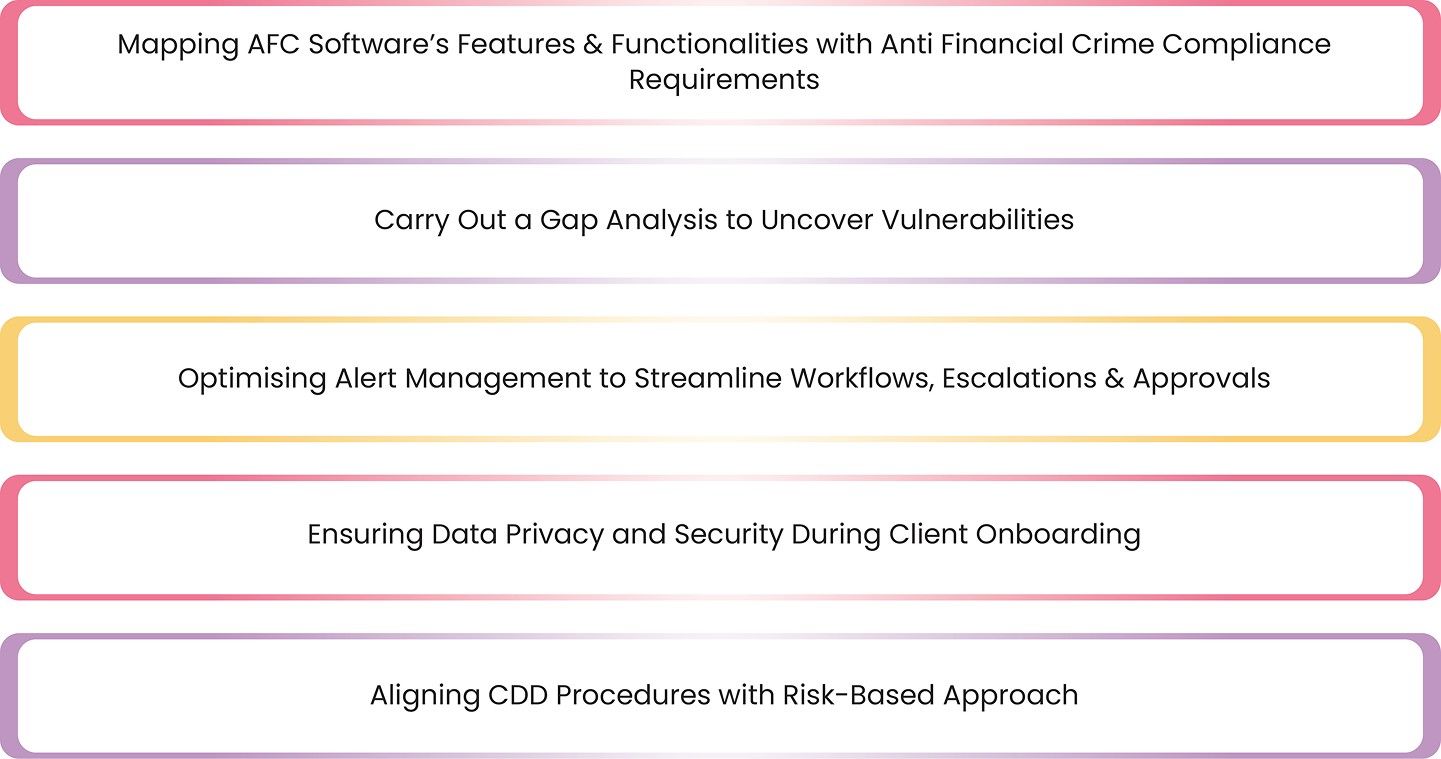
Mapping AFC Software’s Features & Functionalities with Anti Financial Crime Compliance Requirements
Regulated Entities must perform every action concerning AML/CFT rules and regulations and select AFC Software which helps them with the same.
REs must ensure that the chosen AFC Software has features like customised case management, efficient data standardisation, and real-time automation that help them align with the AML compliance requirements.
The selected solution should help DNFBPs, VASPs and SCA entities in the UAE identify suspicious activities and report timely to adhere to AML/CFT laws.
Carry Out a Gap Analysis to Uncover Vulnerabilities
Regulated Entities must accomplish appointment of a Compliance Officer, formulation of policies & procedures, and establishment of governance structures.
Regulated Entities must meet AML obligations and perform the CDD process to identify risks. The REs must decide which tasks are automatable and which are to be performed manually before selecting an AFC Software.
It helps them make better decisions on implementing and choosing an effective AFC Software to prevent financial crime.
Optimising Alert Management to Streamline Workflows, Escalations & Approvals
Regulated Entities must select AFC Software that provides real-time alerts about the customer’s document expiry, changes in watchlists, suspicious transactions & behaviours, and more.
Regulated Entities must implement these measures like the real-time alert management to reduce delays, make timely decisions, keep customer profiles updated, and optimise Anti-Financial Crime processes.
Regulated Entities must ensure seamless communication and collaboration among teams so they can focus more on genuine risks, which ultimately leads to effective compliance.
Ensuring Data Privacy and Security During Client Onboarding
Regulated Entities must choose an AFC Software solution that helps them protect sensitive customer information from breaches, fraud and scams.
Regulated Entities must often transmit and store customers’ sensitive information online, so it is necessary that the selected AFC Software is secure, updated, and has adequate firewalls in place for enhanced cybersecurity.
Regulated Entities must choose AFC Software that uses Multi-factor Authentication (MFA), encryption technology, and perform regular monitoring to remain effective against rising threats and vulnerabilities.
Aligning CDD Procedures with Risk-Based Approach
Regulated Entities must strategies a Risk-Based Approach to mitigate financial crime risks and ensure that proper resources are allocated to high-risk areas.
Regulated Entities must adopt an effective AFC Software that tailors to the level of scrutiny and helps perform CDD processes, matching it with the organisation’s Risk-Based Approach.
Regulated Entities must ensure that the selected solution should have a clear focus on high-risk customers to perform Enhanced Due Diligence (EDD) while simply performing Simplified or Standard Due Diligence (SDD) for the low and medium risk customers.
Does your chosen AFC software perform regular checks?
Let advanced AI and Machine Learning support your compliance needs.
Allow AFC Software to Transform Your Compliance Journey
Technology has always brought ease to operations in every field, and AFC Software supports compliance teams to speed up their work and perform compliance accurately. By leveraging advanced AI and Machine Learning tools, Regulated Entities can stay ahead of rising threats and ensure a safer financial future.
The REs must ensure that the chosen AFC Software adheres to AML/CFT regulatory requirements. The selected AFC Software should help perform KYC, screening, risk assessment, risk-based profiling, regular monitoring, record-keeping and reporting financial crime.
The REs must choose an AFC Software that helps perform every compliance task, so they do not purchase different software for performing different compliance activities.
Frequently Asked Questions about AFC Software
Anti-Financial Crime Software is advanced technological solution that helps businesses to detect, prevent and manage financial crimes.
AFC Software automates compliance obligations such as Ongoing Monitoring of business relationships, Screening, Customer Risk Assessment, Customer Lifecycle Management, Regulatory Reporting and Record-Keeping requirements. This reduces manual efforts and enhances accuracy and speed.
AFC Software facilitates businesses to detect financial crime risks in the earliest possible way. This increases operational productivity, minimizes reputational risk, protects integrity of financial ecosystem and enhances overall efficacy of Anti Financial Crime Programs for businesses.
AFC Software detects financial crimes such as fraud, Money Laundering, Terrorism Financing, Sanctions Evasions, corruption related activities etc. It also identifies unusual transaction patterns and high-risk customers.
AFC Software supports sanctions compliance through screening customers against global Sanctions List. In UAE, it particularly screens customers against UAE Local Terrorist List and UNSC Consolidated List to meet the TFS obligations. Further, it autonomously generates alerts for potential matches and escalates it to Compliance Officer for further evaluation.
Does your chosen AFC software perform regular checks?
Let advanced AI and Machine Learning support your compliance needs.