


Name Screening
Name Screening for AML/CFT and TFS Compliance in the UAE
Name Screening is a mandatory AML/CFT and TFS control that requires Regulated Entities in UAE to check their customers across sanctions lists, PEP databases, and adverse media sources to prevent sanctioned entities and individuals from entering legitimate financial system.
In UAE, Name Screening is a regulatory control, not a best practice and forms a core component of Customer Due Diligence and Targeted Financial Sanctions compliance.
Screening of customers before onboarding is a mandatory factor of Customer Due Diligence (CDD) and Targeted Financial Sanctions Compliance (TFS) in UAE for Regulated Entities. It facilitates Regulated Entities to recognise any anomalies in customer’s identification at the earlier stage and helps in preventing risks of financial crimes.

What is Screening?
Screening also known as Name Screening, is a critical component of Anti-Money Laundering and Counter-Terrorism Financing (AML/CTF) framework.
Who Must Perform Name Screening in the UAE?
Regulated Entities in UAE such as Financial Institutions, Designated Non-Financial Businesses and Professions (DNFBPs) and Virtual Assets Service Providers (VASPs) must perform Name Screening in UAE as part of their AML/CFT and TFS compliance measures.
Legal Basis for Name Screening in the UAE
All the Designated Non-Financial Businesses and Professions (DNFBPs), Virtual Asset Service Providers (VASPs) and Financial Institutions operating in UAE must comply with Cabinet Decision No. 74 of 2020, which mandates screening customers, suppliers, and partners against UNSC consolidated list and UAE local terrorist lists.
Additionally, identifying Politically Exposed Persons (PEP) and Adverse Media references against the customers is an essential requirement of the AML/CFT compliance programme in UAE under Federal Decree Law No. (10) of 2025 and Cabinet Decision No. (134) of 2025.
This screening process involves comparing or matching the name of customers, suppliers, or business associates, including their key attributes against global and local watchlists, including those associated with Politically Exposed Persons (PEPs), and adverse media references. By conducting these checks, Regulated Entities can identify and mitigate risks related to Money Laundering, Terrorist Financing, and other illicit activities, ensuring regulatory compliance and safeguarding their operations.
Why Name Screening Is an Ongoing Obligation?
Name Screening is an ongoing obligation for Regulated Entities in UAE. The Targeted Financial Sanctions (TFS) guidance laying down the obligations to comply with Cabinet Decision No. (74) of 2020 mandates performing regular and ongoing screening of the customers against UAE Local Terrorist List and UNSC Consolidated List.
Moreover, DNFBPs are required to keep checking PEP status and Adverse Media of a customer at onboarding and throughout the business relationship. This makes the Name Screening process an ongoing obligation.
Operational Pain Points in Screening
Compliance failures often occur not because screening is absent, but because it is faulty, fragmented, poorly calibrated, or operationally misunderstood.
A Regulated Entity (RE) might already have internal policies in place and may be doing Screening, by matching names against Watchlists and using Screening tools. But is that much sufficient for efficient AML/CTF compliance?
Is this really, how effective and compliant Name Screening is supposed to be performed?
Ask yourself are you acing any of the operational challenges when carrying out Name Screening?
Are you aware about difference in Screening for TFS Compliance and Screening for Multilateral and Unilateral Sanctions?
Are your Screening tools and methodologies aligned with TFS Screening Requirements?
Are you aware of the “key-identifier” details required to conduct TFS Screening?
Are you Screening against comprehensive and up-to-date watchlists (UN, OFAC, EU, UAE local lists, etc.) as well as global PEP and adverse media databases?
Are you conducting one-time checks or ongoing Screening that captures updates to sanctions lists and changes in customer status?
Are you encountering difficulties in selecting optimal screening software that delivers robust, high-fidelity results, ensuring both sensitivity and specificity are maximized while minimizing false positives and false negatives?
Do you have a documented process to review, clear, and escalate false positives efficiently, without missing genuine hits?
Is your Screening engine capable of handling name variations, aliases, and using advanced matching algorithms?
Are your alert decisions being logged with rationale, timestamp, and reviewer details to support internal audits or regulatory inspections?
If you are facing about even one of these pain points.
That’s exactly where AML UAE comes in to help you.
Regulatory Obligations for AML/CTF and TFS Screening in the UAE
UAE regulators treat Name Screening as preventive control designed to recognise sanctioned individuals or entities, PEPs and clients with adverse media at early stage, enabling Regulated Entities to take preventive measures before ML/TF/PF risks escalates.
Regulated Entities operating in the UAE mainland are required to comply with the federal AML/CFT laws. In contrast, entities operating within financial free zones such as the Abu Dhabi Global Market (ADGM) and Dubai International Financial Centre (DIFC) must adhere not only to the UAE federal AML/CFT framework but also to the zone-specific regulatory requirements.
Screening isn’t optional, it’s a regulatory must-have operation that safeguards your business. Therefore, DNFBPs and other Regulated Entities, must implement a robust and effective Name Screening solutions to ensure full compliance. It is essential that they understand:

Which Data Sources Must be Screened in the UAE?
Regulated Entities should screen names against the up to date, reliable data sources. At a minimum, your screening solution should include:
- UAE Local Terrorist Lists
- UN Security Council Consolidated Lists
- Other International Sanctions lists (such as The European Union list, The UK HM Treasury list, etc) depending on the risk exposure
- Politically Exposed Persons (PEP) Databases
- Adverse Media and Social Media Platforms
All these sources must be integrated into the screening solution and updated regularly to capture changes in designation status or emerging risks.

Who Needs to Be Screened?
Name Screening obligations extend beyond direct customers and includes anyone who can influence, benefit from or control business relationships, which include intermediaries, business associates, suppliers, etc.
Screening isn’t limited to just your direct customer. It must be conducted for all relevant natural and legal persons associated with a business relationship or transaction, including:
- Potential and existing customers (natural or legal persons)
- Business partners and suppliers
- Ultimate Beneficial Owners (UBOs)
- Directors and authorized signatories
- Legal guardians or parents (in case of Minor)
- Former Customers for a duration of five (5) years.

At What Stages Should Name Screening Be Conducted?
Screening is not a “one-and-done” exercise. Regulated Entities must ensure continuous Screening Compliance by conducting Screening at key stages:
- During onboarding (establishing business relationships)
- Before executing transactions
- When there is a material change in ownership or control
- Upon updates to sanction or PEP lists
- At periodic KYC reviews (based on customer risk category)
- As part of ongoing due diligence
Re-screening is necessary (when KYC information is updated).
Types of Name Screening Regulated Entities Must Conduct
Effective Name Screening program combines Sanctions, PEP and Adverse Media Screening to provide an intricate risk detection framework that enables Regulated Entities to identify prohibited parties or high-risk individuals.
With that Regulated Entities can prevent foreboding ML/TF/PF risks swiftly and efficiently comply with UAE’s AML/CFT Laws and TFS measures.
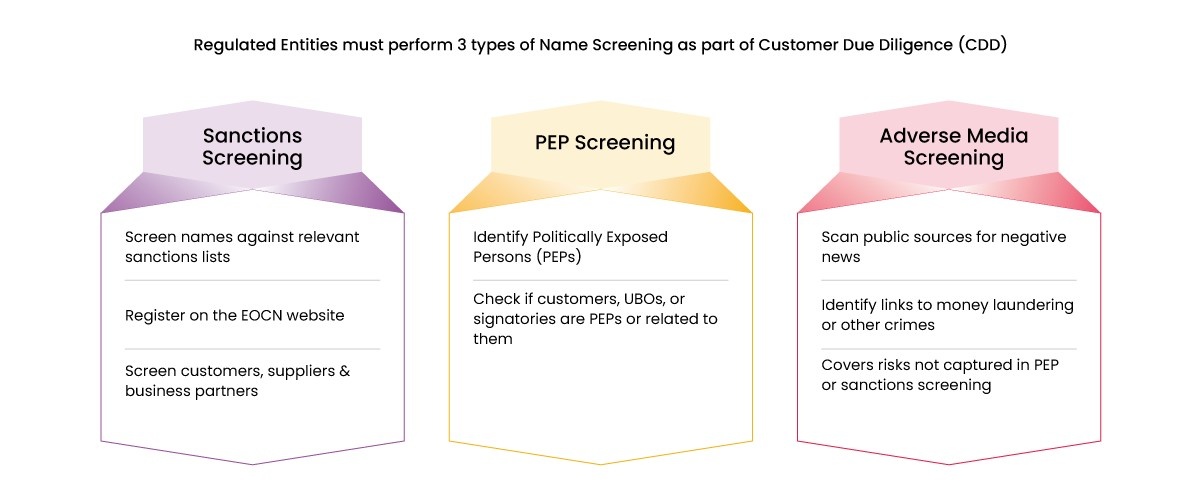
Name Screening can be broadly classified into three categories:
- Sanctions Screening,
- PEP Screening,
- Adverse Media Screening.
Regulated Entities Operating in UAE are required to perform all three Screening effectively as part of comprehensive Screening Compliance Program. Here’s what each involves:
Sanctions Screening
Regulated Entities operating in the UAE are required to conduct adequate and commensurate Customer Due Diligence (CDD) of their prospective and existing customers. Screening against relevant and prescribed sanctions lists is a part of this CDD obligation.
In accordance with Cabinet Decision No. 74 of 2020, businesses are required to comply with Targeted Financial Sanctions (TFS) by registering on the UAE Executive Office for Control and Non-Proliferation (EOCN) platform and conducting ongoing screening of customers, suppliers, and associates.
Politically Exposed Persons (PEP) Screening
UAE’s AML/CFT Laws require Regulated Entities in UAE to identify PEPs and conduct screening of their customers or any of the UBOs/ persons with controlling positions or authorised signatories of legal entities are themselves a domestic or a foreign PEP or are related closely either through familial ties or business association or employment with a domestic or a foreign PEP.
Adverse Media Screening
The purpose of Adverse Media Screening is to comb out the details of prospective/ existing customers from the public domain to rule out their potential involvement in money laundering and other illicit activities or predicate offences which would not be covered under sanctions screening across relevant and applicable sanctions lists or PEP watchlists.
Clarity within Your Reach
Tap into Predictive Analytics to Spot Red Flags before They Escalate
Implementing Effective Screening Compliance Across UAE’s Free Zones & Mainland
Regulated Entities in UAE are required to establish and maintain effective Name Screening mechanisms. These obligations are closely aligned with FATF Recommendations and are applicable to both onboarding and ongoing customer relationships.
Each jurisdiction in UAE may have specific AML/CFT requirements. The Regulated Entities must follow a structured and efficient Sanctions Screening process to help regulated entities comply with international and local regulations.
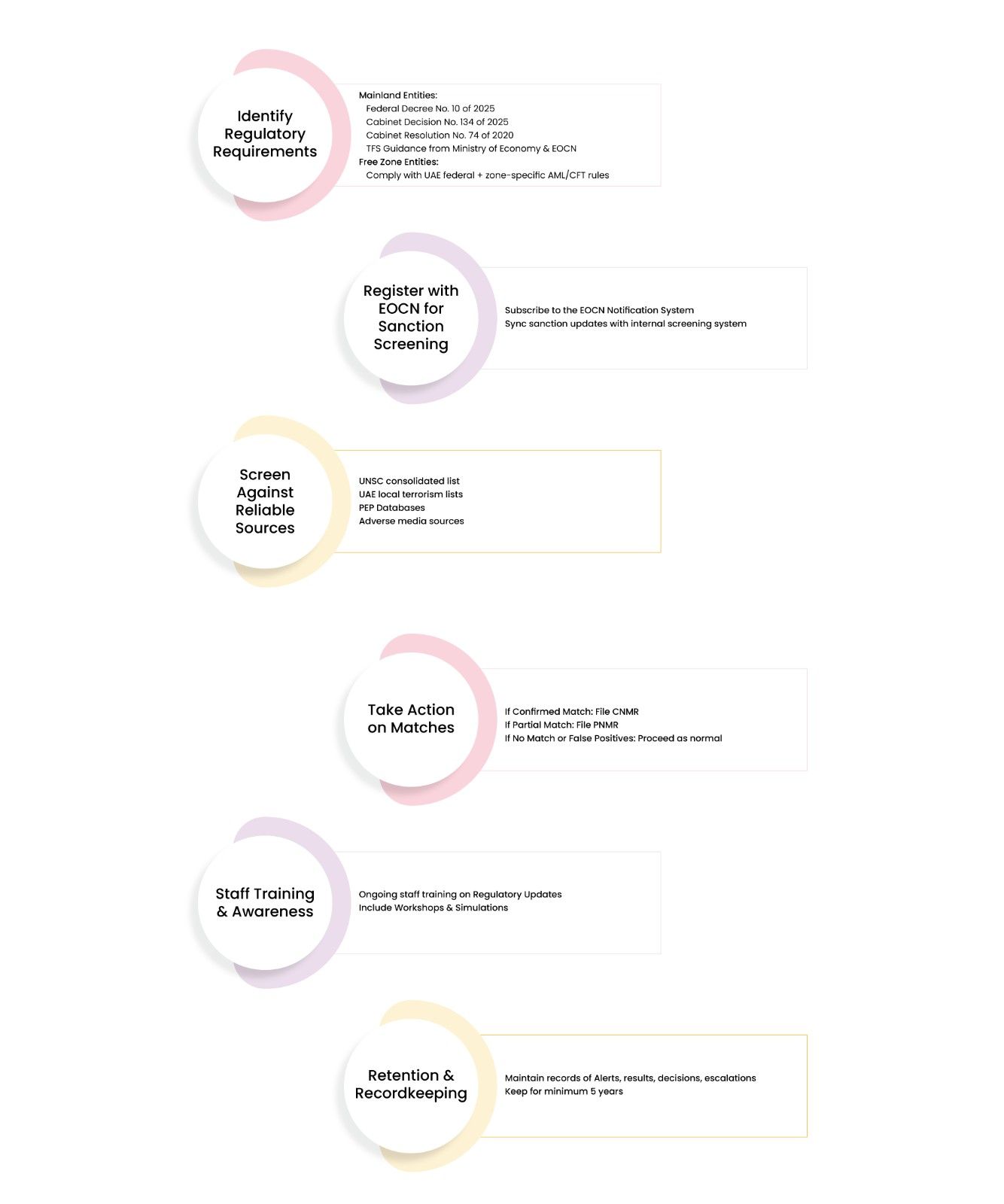
Step-by-Step Sanctions Screening Process
Identification of Screening Regulatory Requirements
Identification of regulatory requirements for Screening is the first step for Regulated Entities to conduct Name Screening.
Before starting a business, Regulated Entities in UAE must first identify the applicable AML/CFT regulatory obligations specific to freezone regulator or mainland.
- For Mainland Entities: Must Comply with Federal Decree No. (10) of 2025, Cabinet Decision No. (134) of 2025, Cabinet Resolution No. 74 of 2020, and its implementing guidelines, including those issued by the Ministry of Economy and the EOCN.
- For Free Zone Entities: Must comply with both UAE federal regulations and zone-specific AML/CFT frameworks.
Registration with EOCN for Sanctions Screening
The second step for conducting Screening is registration with Executive Office for Control of Non-Proliferation (EOCN) to get the notifications for updated Sanctions List. This pathway is specifically for Sanctions Screening.
Regulated Entities must subscribe to the EOCN Notification System to receive timely action on sanction list updates, including freezing and unfreezing entities. The lists must be integrated into REs screening solution on a near-real-time basis.
Screening Against Reliable Data Sources
The following step for conducting Name Screening is to screen relevant parties against reliable data sources.
Regulated Entities must check customers, suppliers, or business associates’ names against relevant sanctions lists, including the UNSC consolidated list and UAE local terrorist lists, PEP list and Adverse Media.
Regulated Entities should ensure that they are using advanced screening software and manual cross-referencing to effectively comply with the Screening Compliance.
Reliable Lists that UAE Regulated Entities must screen their customers against:
- UAE Local Terrorist List
- UNSC Consolidated List
Actions Upon a Match
The next step is to take relevant actions upon an identified match.
Different reporting obligations apply depending on whether a match relates to UAE Local Terrorist List or UNSC Consolidated List, other Sanctions List or any suspicious activity is identified.
When a potential match (“hit”) is detected, in that case Regulated Entities must be very careful and compliant to next course of action. Regulated Entities are obliged to take the following steps:
- Triage and escalate the case internally based on its severity.
- Conduct a false positive analysis or initiate Enhanced Due Diligence (EDD).
- Document every step whether the match is confirmed or ruled out.
For a Confirmed or Partial Match with UAE Local Terrorist List or UNSC Consolidated List:
- Apply TFS measures.
- Article 21 of Cabinet Decision No. (74) of 2020 mandates to freeze the assets or funds in case of confirmed match and suspend the assets or funds in case of partial match.
- Prohibit making any services or funds available.
- File Confirmed Name Match Report (CNMR) or Partial Name Match Report (PNMR) with the UAE FIU via goAML portal within 5 business days as per the screening result.
For a Confirmed or Partial Match with Unilateral or Multilateral Sanctions Lists:
- If a match is identified with any other unilateral or multilateral sanctions lists except UAE Local Terrorist List or UNSC Consolidated List, file SAR/STR with UAE FIU after consulting relevant Supervisory Authority.
For a match with Politically Exposed Person (PEP):
- If a match is identified with a PEP then as per the Article 16 of Cabinet Decision No. (134) OF 2025, apply Enhanced Due Diligence.
- However, MOET’s Guidelines for DNFBPs specifies that for domestic PEPs and former PEPs who do not have prominent influence at present, DNFBPs are not mandatorily required to apply EDD, in such instances they may take Risk-Based Approch.
- Apply Enhanced Due Diligence (EDD) or reject the business relationship as per the policy of the organisation with respect to the dealing with customers that are PEP.
For a match with Adverse Media:
- If a match with adverse media is identified then undertake Risk Based Approch as per the severity of it.
- Apply Enhanced Due Diligence (EDD) or reject the business relationship as it may deem fit.
If there is no match in any of cateogry, in such instances proceed with the normal course of business relationship.
Training and Awareness Program
The next step to conduct efficient Name Screening is to provide training and conducting awareness programs for employees on Name Screening requirements.
Regulated Entities should regularly train their staff on how the screening system of their organisation works. Staff should be aware of red flags and typologies and should be updated on the regulatory changes or new lists. Training is not one-time; it must be ongoing and documented. Regular refresher sessions, expert-led workshops, and practical simulations are expected to ensure effective fraud detection and compliance.
Retention & Recordkeeping
The next step of effective Name Screening is to retain all data pertaining to Screening and maintain thorough record-keeping.
Compliance Officer of the Regulated Entities is under obligation to keep all the evidence of screening results, alerts, decisions, and escalations as a part of AML/CTF Program. These must be documented and stored as part of compliance file for at least 5 years.
Execution of AML/CFT Screening Process: Understanding Roles and Responsibilities through RACI Matrix
To maintain robust compliance with UAE AML/CFT regulations, it is essential to define clear roles across the Name screening and Sanctions monitoring process. The matrix below outlines the operational responsibilities of each stakeholder involved.
Clear outlining and allocation of responsibilities ensures screening decisions are taken in a timely manner, making them auditable and defensible at the time of regulatory inspections.
| Screening Process | Frontline Team | Screening Analyst | Transaction Monitoring Analyst | Compliance Officer | Senior Management |
|---|---|---|---|---|---|
| Identifying Screening Regulatory Requirements | I | C | I | R | A |
| Registering with EOCN Notification System | I | I | I | R | A |
| Integrating Sanction lists into Screening System | I | R | I | A | C |
| Conducting Screening (Sanctions, PEP, Adverse Media) | C | R | C | A | I |
| Detection and flagging potential matches | I | R | C | A | I |
| Confirming match and freeze transactions (within 24 hours) | I | R | C | A | I |
| Filing Reports on goAML | I | C | I | R/A | I |
| Staff Training on Screening & Red Flags | C | C | C | R/A | C |
| Retention of Screening Records | I | R | I | A | I |
Common Screening Challenges Faced by Regulated Entities
When it comes to implementing Screening Processes, it’s not always straightforward. Whether you’re a Financial Institution, DNFBP, or a VASP, ensuring compliance while managing day-to-day operations can bring along several hurdles. Here are some of the key challenges we’ve seen Regulated Entities face:

Data Quality and Management:
If the data quality is inaccurate, inadequate, incorrect, or is kept in a format that is inconsistent, mismanaged, or across different types of formats can lead to false positives or negatives, undermining the effectiveness of your screening efforts.
Complexity of Watchlists:
The dynamic nature of sanctions and watchlists, with frequent updates and variations across jurisdictions, adds complexity to the screening process.
Resource Constraints:
Conducting Screening, either manually or through automation, requires skilled staff and name screening software. Many Small and medium-sized enterprises (SMEs) may lack the necessary resources or expertise to implement and maintain robust screening systems.
Technological Limitations:
Traditional Name Screening methods often involve manual processes that are time-consuming and prone to errors. These methods can result in high false-positive rates, leading to operational inefficiencies and potential compliance breaches. Additionally, the dynamic nature of global watchlists requires continuous updates, which can be challenging to manage without automated systems.
These challenges often result in delayed reporting, false positives, or regulatory findings leading to fines and penalties.
Struggling with these challenges?
Let us simplify your screening journey. Talk to our experts today.
Best Practices to Stay on Top of Your Screening Game
Regulators expect screening to be documented, tested, and continuously updated and improved. To keep your compliance processes sharp and aligned with UAE’s evolving AML/CTF landscape, here are some best practices every Regulated Entity should follow:

Adopt a Risk-Based Screening Framework:
Not all risks are equal. Regulated Entities should tailor their screening protocols based on the nature of their business, customer profile, transaction volume, and geographical exposure. By incorporating screening parameters according to assessed risk levels, businesses can ensure effective monitoring aligned with FATF guidelines and UAE-specific compliance requirements.
Draft Clear Internal Policies and Protocols:
Regulated Entities must develop well-documented internal procedures that define how to conduct name screening and handle potential matches. These policies should include a structured sanctions compliance program, outline the frequency of sanctions list updates, and incorporate a defined client exit strategy to manage high-risk or non-compliant relationships appropriately.
Leverage Technology and API Integration:
Using advanced technology solutions like sanctions screening software and APIs can significantly enhance accuracy and efficiency. These tools help Regulated Entities to maintain updated sanctions databases, reduce manual errors, and ensure faster identification of potential risks through automated fuzzy matching and real-time alerts.
Conduct Ongoing Monitoring and Regular Testing:
Screening should not be a one-time task. Regulated entities must implement ongoing monitoring processes to detect any changes in the risk profile of clients, such as their addition to a watchlist. Additionally, periodic testing and auditing of the screening systems should be carried out to ensure effectiveness and adherence to regulatory standards.
Invest in Regular Staff Training:
Employees responsible for compliance and risk functions should undergo periodic training on the latest screening techniques, regulatory changes, and software use. This ensures they remain competent in identifying and managing AML/CFT risks and can act promptly in case of non-compliance issues.
Need help building any of these best practices into your current framework?
AML UAE help you implement compliance in the smart and Customised way.
Mitigate Screening Challenges: How AML UAE Becomes Your Compliance Wingman
Regulated Entities often require external support to strengthen screening governance, technology and improve reporting accuracy.
At AML UAE, we help businesses comply with UAE’s AML/CFT legislations by implementing effective policies, procedures, and internal controls to meet regulatory obligations. To assist entities in overcoming the operational challenges and ensuring compliance with UAE AML regulations, we offer a suite of tailored services:
Daily Grinds of Screening Analysts & Compliance Officers | Magic Mantras from AML UAE |
“We have Sanctions Screening policies… but they’re all over the place.” | We assist Regulated Entities to establish robust AML Screening Policies and Procedures which is tailored to their business need and aligned with UAE regulatory requirements. Our experts work closely with clients to develop and implement AML policies and procedures that align with both UAE regulations and international best practices. This includes establishing clear protocols for name screening, risk assessment, and reporting. |
“Keeping up with Sanctions lists is like chasing a moving train.” | AML UAE has got you covered. We help our Screening Software User to integrate with official EOCN and UN watchlists and auto-updates on a regular basis to ensure your database is always aligned with current risks. |
“We are doing Screening manually… every single day.” | Really? Manual Screening in this online world? It’s like living in stone age. AML UAE helps you automate background screening of your customer base daily with no manual hassle and no missed alerts. |
“What about UBOs, Directors, Third Parties? Do we screen them too?” | Yes, absolutely!! Does it seem to be exhausting? No worries, AML UAE helps you to make your Multi-Party Screening easier. Our KYC onboarding forms come pre-loaded with UBO/director screening features, so you catch all connections without hunting through organisation charts. |
“We only find out about hits after it’s too late.” | AML UAE can sort this out. You might be thinking how? We fix that with real-time automated API-based screening that instantly alerts the moment a match shows up. No lag, no missed risks. Just fast, Reliable and Compliance. |
“Worried about the Smart Tech That Just Fits In” | We provide state-of-the-art screening software that integrates with existing systems, enabling real-time screening against updated global watchlists, including local UAE sanctions lists UN, OFAC, etc. |
“Reporting is all over the place. What goes where? What’s urgent?”
| We support businesses in preparing and submitting relevant regulatory reports via the goAML portal, including:
So, you don’t have to stress. No second guessing- just clean submission.
|
“Too many false positives… our team is drowning.” | Our Advanced Screening tools reduce false positives by well calibrated system configuration attuned to your entity’s risk appetite. Our solutions are designed to minimize false positives and ensure efficient identification of potential risks. In that way You get fewer false positives and faster real matches. |
“The Screening Compliance team is on a wild goose chase! What exactly counts as good screening?” | Training That Doesn’t Bore You to Sleep!! We train your Screening Compliance team to get screening right. We offer comprehensive training programs for staff at all levels, focusing on the importance of name screening, understanding regulatory obligations, and effectively using screening tools. Our training ensures that your team is equipped to maintain compliance and respond to potential risks appropriately. |
“We don’t know if we’re still compliant next month.” | We offer Ongoing Compliance Services and Advisory so are never left guessing. We offer continuous support to ensure that your name screening processes remain effective and compliant with evolving regulations. Our advisory services include regular updates on regulatory changes, assistance with regulatory reporting, and strategic guidance on AML compliance. |

AML UAE= Your Trusted Partner for Name Screening
Regulated Entities often fall short in complying with the clearly defined Name Screening requirements of AML/CFT Program. The factors contributing to these shortcomings are technological limitations, resource constraints, poor data quality and over reliance on manual workflow.
To overcomes these deficiencies, Regulated Entities must rely on tailored solutions and methodologies to conduct accurate Name Screening. This facilitates in uncovering the hidden risks associated with customer’s identify and pull the charade away from any unusual activities associated with customer.
Name Screening is foundational AML/CFT and TFS control in UAE enables Regulated Entities to identify sanctioned individuals or organisations, PEPs and other high-risk customers with Adverse Media. This helps in preventing prohibited business relationships and supports efficient decision-making.
Frequently Asked Questions on Name Screening Obligations in UAE
What is Name Screening in AML compliance?
Name Screening in AML Compliance is a process to check customers, beneficial owners, beneficiaries and related parties against Sanctions List, PEP databases and Adverse Media sources, in order to identify any potential ML/TF/PF risks arising out of them.
Is Name Screening mandatory in the UAE?
Yes, Name Screening is mandatory in the UAE under UAE’s AML/CFT laws and TFS measures. The rationale behind this obligation is to ensure that Regulated Entities do not deal with the sanctioned individuals and have robust mechanisms in place to deal with PEPs and other high-risk customers to manage the financial crimes risks arising out of them.
Who must be screened under UAE AML laws?
Under UAE’s AML/CFT laws existing and potential customers, Ultimate Beneficial Owners (UBOs), directors, suppliers, business partners, authorised signatories and former customers (for 5 years under TFS obligations) are required to be screened.
When must Name Screening be performed?
Name Screening must be performed at the time of onboarding, during the course of business relationship, before executing transactions, upon material changes in control or ownership structure, upon updates in sanctions or PEP lists, during Re-KYC and as part of ongoing due diligence.
What happens if a Sanctions match is found?
If a Sanctions match is found with UAE Local Terrorist List and UNSC Consolidated List, then Regulated Entities are required to reject the business relationship, freeze the assets, prohibit from providing any services and file a Confirmed Name Match Report (CNMR) or Partial Name Match Report (PNMR) via goAML portal.
In case if a Sanctions Match is found against any other unilateral or multilateral Sanctions Lists, then Regulated Entities must inform their relevant Supervisory Authority and may consider raising an SAR or STR.