


Customer Risk Assessment Software
One of the leading AML software solutions aligned with UAE AML/CFT regulations is Customer Risk Assessment Software, which empowers Regulated Entities, including Financial Institutions, Designated Non-Financial Businesses and Professions (DNFBPs), and Virtual Asset Service Providers (VASPs) to apply a risk-based approach in identifying, assessing and mitigating ML, TF and PF risks pertaining to their customers.
What is Customer Risk Assessment Software?
CRA Software assesses potential Money Laundering (ML), Terrorist Financing (TF) risk s and Proliferation Risks (PF) that customers may pose to businesses. According to this assessment, it determines the appropriate level of due diligence and control measures to mitigate identified risks.
The main purpose of CRA Software is to identify and assess the ML/TF and PF risks associated with customers, whether as part of an ongoing business or one-time business relationship. The more complex the interaction, the more careful and detailed the assessment needs to be.
CRA Software assists in adopting a risk-based approach, allowing Regulated Entities to allocate resources efficiently while managing financial crimes more effectively.

How Customer Risk Assessment Software Helps Regulated Entities to Meet their AML/CFT Requirements
In UAE, Regulated Entities, including Financial Institutions, DBFBPs, and Virtual Asset Service Providers (VASPs) are required to adopt a risk-based approach to Customer Risk Assessment to comply with AML/CFT framework.
Federal Decree-Law No. 10 of 2025
speaks about Anti-Money Laundering and Combating the Financing of Terrorism and Financing of Illegal Organisations
Cabinet Resolution No. 134 of 2025
Speaks about the implementation of Federal Decree-Law No. 10 of 2025 On Anti-Money Laundering and Combating the Financing of Terrorism and Illegal Organisations
Common Challenges Faced During Customer Risk Assessment (CRA)
Implementing an effective Customer Risk Assessment framework presents several issues for many Regulated Entities. These issues can be widespread but often include the following:

How does Customer Risk Assessment Software Facilitate Regulated Entities
The Ministry of Economy serves as the supervisory authority for Designated Non-Financial Businesses and Professions (DNFBPs) in UAE. It has published a guide to help DNFBPs stay aligned with its AML/CFT requirements. CRA Software is designed to simplify and optimise the entire Customer Risk Assessment process by integrating key functions such as incorporating risk factors, defining and assessing risk levels and risk scores, and creating risk matrix to represent the risk categories.
The CRA Software supports the acquisition of customer identification and verification, continuous monitoring and automated alerts for control measures. Additionally, it enables automated classification of customers into risk categories and maintains the thorough documentation of CRA methodology and the audit trail of CRA process.


Incorporating Regulated Entity's Customer Risk Factors into CRA Software
CRA Software integrates risk factors customised to the REs framework, ensuring synchronisation with their risk appetite and internal governance.
The CRA Software incorporates customer risk factors specific to the Regulated Entities. The overall customer attributes, such as geography, products or services opted, transaction value, transaction patterns and delivery channels are taken into consideration while configuring the CRA software. This helps in the customisation of the CRA Software framework according to the Regulated Entities’ risk appetite, regulatory obligations, and internal governance.

Defining Risk Levels and Establishing Risk Scales and Risk Scores
CRA Software evaluates customer risk levels for ML, TF and PF risk factors using standardised scores and weightage set by the Regulated entity to ensure consistent classification.
The CRA Software provides visual representation of risk level posed by each customer by evaluating each customer’s individual ML, FT, PF risk factors using a standardised scoring algorithm and methodology. Each risk factor is assessed by CRA Software on the basis of the risk scores or risk weightage defined by the Regulated Entity, which helps with deriving consistent and objective customer risk classification.

Creation of an Adaptive Risk Matrix Representing the Risk Levels
CRA Software creates risk matrix to present the risk factors, levels, scales and scores in this step.
The CRA Software generates an adaptive risk matrix using customisable templates that align with the Regulated Entity’s risk appetite. This matrix presents the key components of Customer Risk Assessment, including risk factors, their associated risk levels and predefined scoring scales. Based on this matrix, customers are automatically categorised into risk levels.

Acquisition of Customer Identification and Verification Details
CRA Software join hands with other software, collects the relevant information and documents of customers. This includes information about individual and corporate entities’ identification documents, business activities, sources of funds, information related to transactions, etc.
The CRA Software, when integrated with KYC Software, Customer Onboarding Software or CRM, derives and processes the customer information and documents. This integration helps CRA Software to assess ML/TF and PF risks based on information collected through other platforms. The CRA software requires the following documentation for individual and corporate entities, as outlined below:
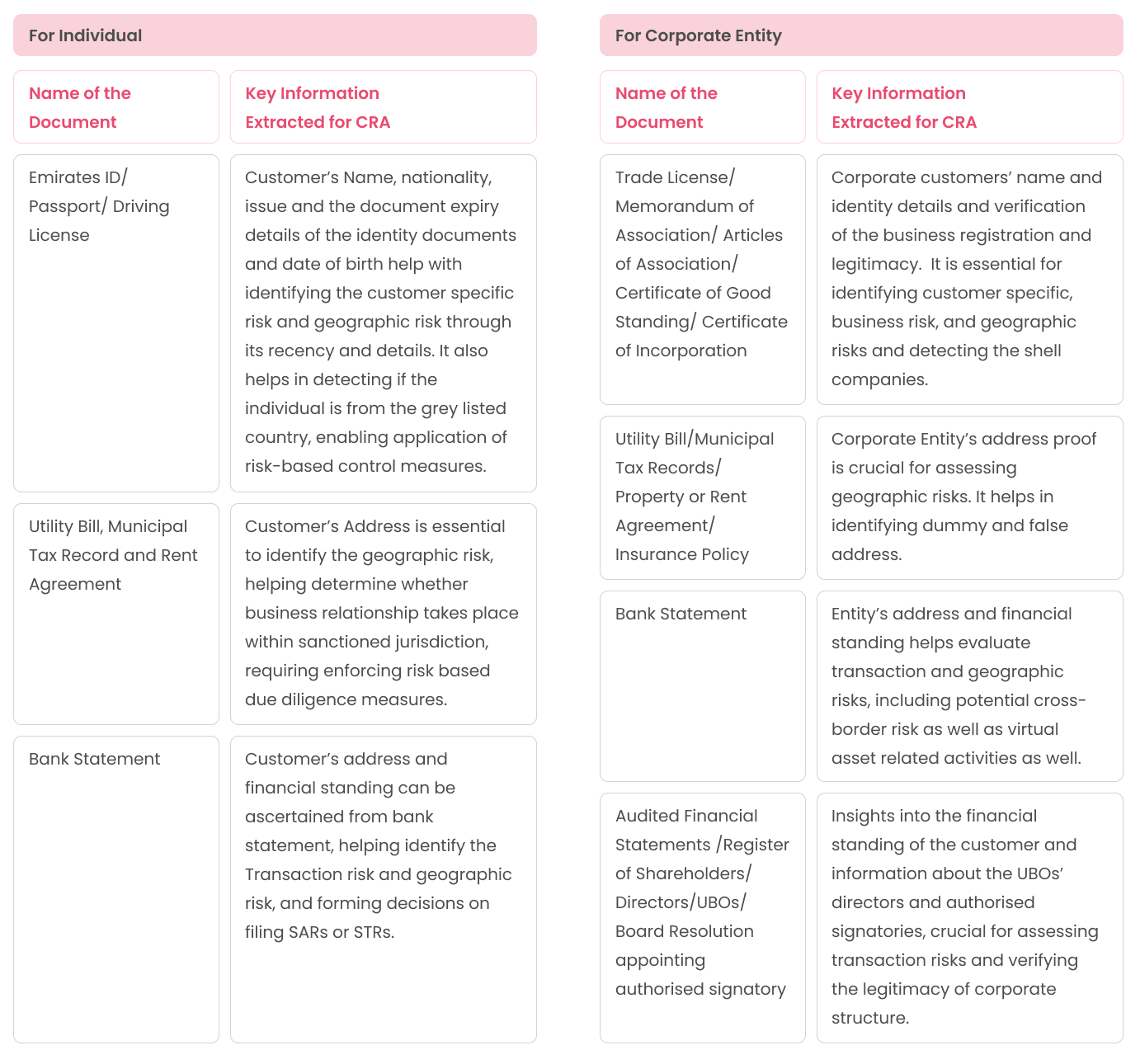
By automatically fetching the information and processing the documents outlined above, CRA Software establishes the authenticity and legitimacy of customer profiles.

Automated Classification of Customers into Risk Categories
CRA Software gathers information through a risk matrix and categorises customers into risk categories.
Once the data is collected, the CRA Software analyses the collected risk scores using the risk matrix. It assigns each customer an accurate risk category: low risk, medium risk and high risk, enabling an accurate and efficient onboarding process and compliance monitoring.

Calculation of Customer Risk Scores
CRA Software calculates the overall risk scores assigned to customers in this step.
The CRA Software helps Regulated Entities calculate overall risk scores by averaging the risk scores assigned to each risk factor. The CRA Software assigns risk weightage to each factor based on the importance of the factor to the specific Regulated Entity.

System Driven Alerts & Activation of AML/CFT Risk Controls
CRA Software triggers control measures that are in proportion to the levels of the customers present.
The CRA Software automatically triggers alerts for implementing control measures from the conclusion of customer risk scores, for high-risk customers, measures like Enhanced Due Diligence (EDD), Ongoing Monitoring, and escalation to Senior Management for approval of high-risk business relationships.

Continuous Calibration of CRA Software to Align with Evolving Risks, Regulatory & Policy Updates
CRA Software continuously monitors the Customer Risk Assessment process to incorporate any changes that are updated.
The CRA Software continuously reviews and updates its risk models in response to changes in regulations, risk factors, customer behaviour, and emerging risks. Through alerting mechanisms, the CRA Software automatically triggers the system and updates the risk matrix accordingly without disrupting compliance.

Documentation of CRA Methodology and Scoring Logic
CRA Software preserves detailed documentation of the Customer Risk Assessment process.
The CRA Software keeps detailed documentation of the Customer Risk Assessment process. This built in feature supports compliance by maintaining records of risk methodologies, scoring logic, and business scale. This provides transparency and consistency in the process.

Cloud-Based CRA Audit Trail
CRA Software ensures full and accurate retention of audit trail of all customer information, interactions, control measures, etc.
The CRA Software maintains the complete audit trail of all customer interactions. This includes all the risk scoring decisions, any updates, control measures activated and their reasoning and any decisions regarding CRA conducted. These logs are securely stored and accessible to support internal and regulatory reporting.
Struggling to Assess Customer Risk Accurately and Efficiently
CRA Software Simplifies it
Must-Have Features of Customer Risk Assessment Software
Regulated Entities are strongly advised to adopt Customer Risk Assessment Software that is integrated with risk classification engine, advanced data analytics, AI powered risk intelligence, risk visualisation matrix, case and workflow management and enhanced reporting and analytics, etc.

Risk Classification Engine
The CRA Software must be integrated with a highly intelligent engine that automatically detects and categorises risk factors associated with ML/TF and PF risks posed by customers. This engine analyses input using advanced rule-based logic, machine learning models to ensure accurate risk profiling.
Advanced Data Analytics
The CRA Software must be equipped with advanced data analytics to analyse the customer information in real time. This flags the anomalies and generates alerts for emerging risks.
AI Powered Risk Intelligence
The CRA Software must deploy an AI based engine to evaluate the customer profile, transaction patterns, and geographic exposure. This improves accuracy and efficiency by reducing manual errors and enabling immediate intervention when ML, TF and PF risks are suspected.
Risk Visualisation Matrix
The CRA Software must leverage built in visualisation matrix to provide a clear view over the levels of risks involved, their scoring and the risk rating, which is customised to RE’s risk appetite. This enables Regulated Entities to examine the matrix of Customer Risk Assessment to prioritise EDD of high-risk customers.
Case and Workflow Management
The CRA Software must support seamless integration of a dashboard that creates cases, assigns tasks to related teams, and auto generates SARs and STRs to alert senior management for further process. This ensures uniform application of the whole procedure.
Enhanced Reporting and Audit Trail
The CRA Software must provide audit proof tailored reports and downloadable registers that are in alignment with AML/CFT regulatory obligations. This provides Regulated Entities with full traceability and accountability.
Smart Features, Confident Decisions
Explore What Strengthens Your Customer Risk Assessment Approach
Benefits of CRA Software
The CRA Software goes beyond merely identifying and assessing risks. By offering practical benefits such as smart controlling, unifying risk indicators, accurate and adaptive risk profiling, continuous monitoring, reducing costs and human errors and adapting to regulatory changes and operational changes. This helps REs to preemptively manage risks with efficiency and accuracy.

Smart Risk Controlling with Advanced Intelligence
CRA Software helps Regulated Entities in assessing risk with an advanced intelligence that goes far beyond basic identity verification. It automates the detection of customer-related, transaction based, behavioural, geographic, and delivery channel risk factors, which are crucial for understanding the likelihood of ML, TF and PF risk materialisation. CRA Software simplifies this by automatically gathering all the customer information, calculating risk scores, and updating the risk levels.
Unifying Risk Indicators into Every Customer Profile
CRA Software facilitates Regulated Entities with one unified data-driven profile by optimising diverse customer risk factors, including jurisdictional exposure, product type and customer profile. This comprehensive view allows Regulated Entities to take proper compliance actions such as applying Enhanced Due Diligence (EDD), setting transaction threshold limits for alert generation, or initiating review workflows. CRA Software with its built-in scoring model accurately categorises customers into low, medium, and high risk, making due diligence prioritisation of high risk customers easy and efficient.
Delivering Continuous Monitoring and Risk Reassessment
One of the key benefits of CRA Software is its ability to continuously monitor customer behaviour and have easily accessible real-time risk assessments. By integrating advanced monitoring tools such as Artificial Intelligence and Machine Learning , that automatically detect suspicious patterns, old documents, or potential risk exposure, such as a change in ownership or negative media. This ensures that any change in the customer’s risk profile is immediately flagged, allowing Regulated Entities to take immediate action and apply appropriate due diligence.
Reducing Operational Costs and Human Errors
Manual Customer Risk Assessment is often slow, incompatible, and prone to human errors. CRA Software significantly reduces operational costs by automating time-consuming tasks like data collection, risk scoring, and reporting. It enables the Regulated Entities to focus on high-value activities like critical analysis and decision-making instead of paperwork and data entry. Thus, CRA Software boosts compliance efficiency, reduces oversight risks, and strengthens the REs’ overall risk posture.
Adapting to Regulatory Shifts and Operational Changes
CRA Software benefits Regulated Entities by keeping up with evolving regulatory changes and organisational needs. This helps Regulated Entities to update risk models, scoring thresholds, and factor weightings to remain aligned with the latest AML/CFT regulations. As the operation scales, the CRA Software ensures that the compliance process remains effective and accurate. It also enables REs to stay on the same page, promoting cohesive risk management across the entire organisation.


“Your customers are primary suspects and require proper interrogation. A Customer Risk Assessment Software works as a prosecutor who cross-examines the customer to identify the risk associated with them. The effective CRA Software verifies if the customer has connections with ML/TF and PF activities to secure a resolution.”

How to Select and Implement Customer Risk Assessment Software: Best Practices
Regulated Entities should select a CRA Software that seamlessly synchronises with AML/CFT regulations, provides a robust customer information foundation, adopts risk responsive CRA methodology and automates risk factors to analyse and aggregate the data. The CRA Software should help with customer risk surveillance, flag suspicious behaviour and patterns and automate the risk case management and review process, ensuring accuracy and efficiency for REs.
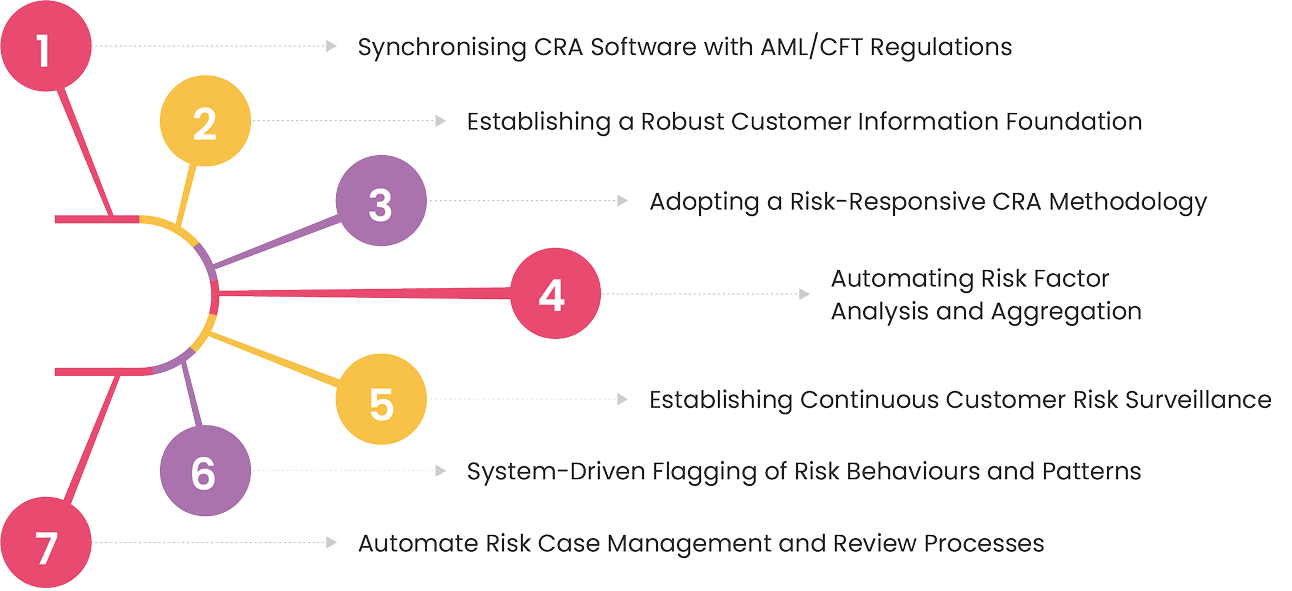
Synchronising CRA Software with AML/CFT Regulations
While selecting and implementing the CRA Software, Regulated Entities should ensure that the CRA Software is fully aligned with their AML/CFT regulatory obligations under UAE Federal Decree-Law No. 10 of 2025 and Cabinet Resolution No. 134 of 2025. The CRA Software should support risk-based AML/CFT compliance requirements by automating customer risk assessment, ongoing monitoring, and reporting workflow.
Establishing a Robust Customer Information Foundation
Regulated Entities should select the CRA Software that collects and verifies customer information through numerous checks and documents to ensure accurate risk classification. This includes verifying Identity Documents for individuals (such as passports or any other government issued IDs) and for corporate documents (certificates of incorporation or trade license). Additionally, the CRA Software should assess other business activities, Source of Funds, transaction behavior, PEP Status, and Adverse Media Screening results to categorise the customer into appropriate risk categories.
Adopting a Risk-Responsive CRA Methodology
Regulated Entities should opt for the CRA Software that enables implementing risk assessment methodologies based on the customer’s risk profile. The CRA Software must be capable of analysing customer risk indicators and triggering the appropriate level of due diligence, be it Standard Due Diligence (SDD), Customer Due Diligence (CDD), or Enhanced Due Diligence (EDD) in accordance with recommendations from the FATF and UAE AML/CFT guidelines.
Automating Risk Factor Analysis and Aggregation
Regulated Entities should adopt a compliant CRA Software that implements an automated algorithm to analyse and categorise risk factors such as customer behaviour, transaction patterns, and delivery channels into distinct risk domains. This categorisation informs the downstream process, enabling dynamic risk scoring, system flagging for anomalies, and tailored mitigation workflows. The CRA Software should also support continuous monitoring and real time updates to maintain robustness against evolving threats.
Establishing Continuous Customer Risk Surveillance
While selecting a CRA Software, Regulated Entities should select a CRA Software that has automated continuous surveillance, and it keeps up with updates made in lists and alert the system if any changes is made in customer profile or if any customer’s profile has escalated to high risk and then puts them in process of managing high risk profiles and keep up with changes on its own.
System-Driven Flagging of Risk Behaviours and Patterns
Regulated Entities should implement CRA Software that provides continuous monitoring of customer profiles and associated risk indicators. The CRA Software must auto-sync updates from regulatory lists like sanctions lists, and publicly available information for finding adverse media and PEPs status and alert the system user when a customer’s risk status changes, such as escalation to high risk. Upon detection, the CRA Software must initiate an appropriate workflow for managing elevated risk profiles, maintain audit trails of changes, and ensure real-time integration across compliance.
Automate Risk Case Management and Review Processes
Regulated Entities should implement CRA Software that automates case management and reviews the process to ensure swift and reliable handling of customer risk profiles. The CRA Software must be implemented by incorporating infrastructure monitoring to detect errors and trigger case creation when the risk threshold is breached. These cases should be routed intelligently to relevant teams, supported by workflow automation, audit-ready documentation, and integration with external data sources.
Still Confused about Which CRA Software to Opt?
Let AML UAE Help you in CRA Software Selection that Works the Way You do
Smart Customer Risk Assessment (CRA) Strategies: A Must-Have for Regulated Entities
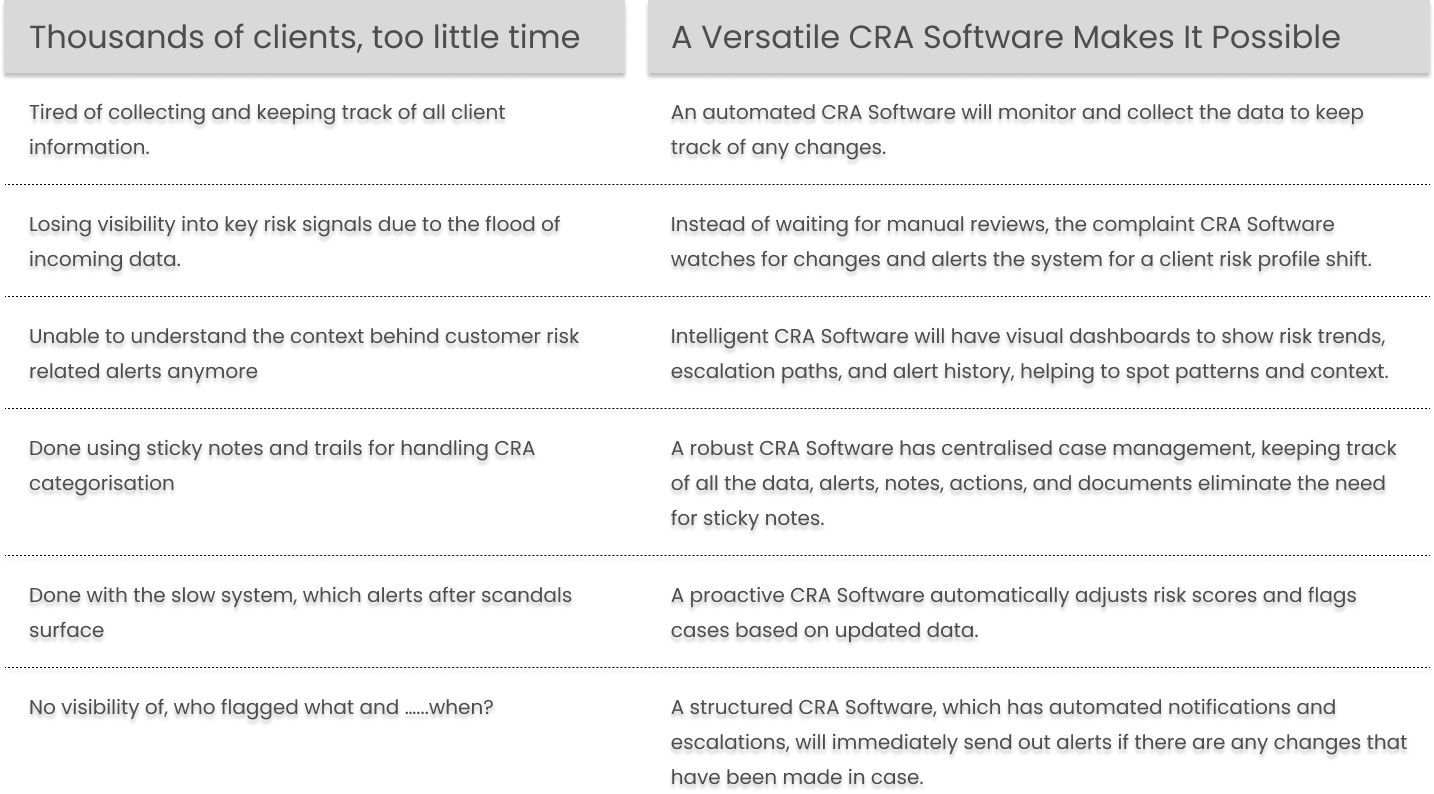
In a world where risk signals are buried under a pile of data, alerts arrive a little too late, and case tracking feels like a scavenger hunt, a proactive CRA Software emerges as game-changer.
Simplify Complexity, Amplify Security
Transform Risk Challenges into Insightful, Actionable Strategies with Intuitive CRA Software