


Adverse Media Screening Software
Adverse Media Screening Software is an essential part of Name Screening Software, which is a crucial component of AML Software. This page highlights the importance of Adverse Media Screening Software in enhancing Anti-Money Laundering (AML), Counter-Terrorism Financing (CTF), and Counter-Proliferation Financing (CPF) compliance framework.
It equips Regulated Entities (RE), in UAE, including Designated Non-Financial Businesses and Professions (DNFBPs) and Virtual Asset Service Providers (VASPs), whether operating in the mainland or within the Free Zones like DFSA, SOTI, with intelligent, scalable tools to proactively detect, asses, and mitigate reputational and financial crime risks.
Adverse Media Screening Obligations for Regulated Entities in UAE
Adverse Media Screening Software helps Regulated Entities (REs) to uncover negative news and reputational threats tied to individuals or organisations. By continuously scanning global news outlets, sanctions databases and regulatory filings, it flags potential financial crime, fraud and other risks, empowering businesses to strengthen compliance, Enhance Due Diligence (EDD), and improve overall risk management.
Adverse Media refers to any publicly available negative information or news related to an individual or entity. In AML context, it specifically highlights materially significant Adverse Media Reports that suggest a customer may be involved in activities such as Money Laundering, or other forms of financial crimes or predicate offences.
From the standpoint of AML compliance, Adverse Media Screening involves examining trustworthy and independent public sources to uncover any negative information that could link a customer to Money Laundering.
Adverse Media Screening Obligations for Regulated Entities in UAE
In the UAE, Adverse Media Screening isn’t optional, it’s a mandate woven into the fabric of every Regulated Entity’s compliance obligation. With heightened scrutiny and evolving expectations, AML Software for Adverse Media Screening must do more than just scan headlines. It must align seamlessly with the nation’s robust AML/CFT framework to efficiently mitigate the risks of Money Laundering and Terrorism Financing (ML/TF).
To meet these expectations, Adverse Media Screening Software must be in step with
the UAE’s Regulations:
Article 19.1. (a) of Federal Decision-Law No. (10) of 2025 implicitly requires Adverse Media checks by directing FIs and DNFBPs to assess and update crime risks using various risk factors, including reputational risks detectable through Adverse Media.
Cabinet Resolution No. (134) of 2025 requires entities to apply CDD measures, including the use of reliable, independent sources, implicitly covering Adverse Media checks, which outlines implementing regulations for AML/CFT compliance.
.

DNFBPs in UAE are required to conduct Adverse Media Checks as part of risk-based CDD to identify potentially negative information such as criminal history or reputational risks, especially in higher-risk customer scenarios, as guided by the Ministry of Economy.
Regulated Entities must also ensure that the Adverse Media Screening software helps it to adhere with the FATF Recommendations, which emphasize the importance of Adverse Media checks as part of customer onboarding and ongoing monitoring
Challenges in Conducting Adverse Media Screening
Whether you’re a Compliance Professional or DNFBP or more, anyone tasked with Customer Due Diligence (CDD), you might be facing issues with missing real threats, false positives, outdated processes, language barriers and others. The following are pain points that you might suffer concerning Adverse Media Screening:
Manual Adverse Media Screening: The Old Way, The Hard Way!
- Can your team confidently separate false alarms from true risks or are they drowning in alerts?
- Still searching every client like it’s 2005?
- Is your Adverse Media Screening process a guessing game or governance strategy?
Adverse Media Screening Software: Fast But Flawed!
- Is your Adverse Media Screening Software casting a wide net but missing the real threats?
- Is your Adverse Media Screening Software alerting you to risks or just crying wolf with every common name?
- Can your Adverse Media Screening Solution adapt when your risk thresholds evolve?
Common Pain Points: The Adverse Media Screening Struggle!
- How do you stay ahead of risk when the headlines rewrite themselves every hour?
- How do you spot a red flag when it’s written in a language your system can’t read?
- When the rules shift overnight, does your Adverse Media Screening Methodology keep pace or hit pause?
Launderers Lurk in Plain Sight
When Strategy Sleeps, Financial Crime Creeps In
How Adverse Media Screening Software Empowers Regulated Entities to Meet Adverse Media Screening Obligations
An effective Adverse Media Screening Software supports Regulated Entities, DNFBPs and VASPs by streamlining each stage of the Adverse Media Screening process from verifying identity details to uncovering red flags and interpreting results with clarity and accuracy. The following steps denote how Adverse Media Screening Software works:

Step:1 Collection and Dissemination of Key Identifier Information
Adverse Media Screening Software captures key identifier information from government-authorised documents such as Passports, National IDs, or Trade Licenses to accurately determine a customer’s official or registered name. By integrating with authorised government databases, the Adverse Media Screening Software enables seamless retrieval and verification of these documents, streamlining client onboarding and improving the precision of Adverse Media Screening results.
Step:2 Adverse Media Screening Across Public Sources
The Adverse Media Screening Software automatically searches public sources using the customer’s name and risk-related keywords. Public sources include new websites, regulatory databases, watchlists, and social media.
The Adverse Media Screening Software dynamically combines the customer’s name with keywords such as ‘fraud’, ‘arrest’, etc. and applies intelligent filters to extract only relevant and risk-indicative results, significantly reducing false positives and manual effort.
Step:3 Disambiguation and Categorisation of Adverse Media Screening Results
The Adverse Media Screening Software automatically analyses the Adverse Media Screening results and contextual matching algorithms to determine the outcome. It cross-checks details like the customer’s Full Name, Date of Birth (DOB), Nationality, and Associated Entities to distinguish between similarly named individuals or businesses.
Adverse Media Screening Software, upon searching for adverse or negative news for key identifier details entered about a prospective client generates screening outcomes which help the Screening Analyst to disambiguate Adverse Media Screening outcomes and categorise each result as:
True Match
In a True Match scenario, all the key identifier details of the customer profile are compared with the Adverse Media Screening outcomes. The conclusion of such a comparison is that both the customer profile and Adverse Media Screening outcome have been found to match exactly with one another. When a True Match is identified, the Adverse Media Screening Software automatically triggers the Enhanced Due Diligence (EDD) workflow.
A well-calibrated Adverse Media Screening Software alerts both the Compliance Officer and Senior Management, initiating a structured EDD process. This includes automated requests to the customer for supporting documents such as Source of Funds (SoF), and Source of Wealth (SoW), while simultaneously logging the case for internal review and approval.
If the residual risk post EDD falls within the business’s risk appetite, the Adverse Media Screening Software facilitates documentation and approval to proceed with onboarding or continuing the business relationship. However, if, upon analysis it is found that Adverse Media Screening outcomes showcase materially relevant red flags, the Compliance Officer is required to file a Suspicious Activity Report (SAR) with the UAE Financial Intelligence Unit (FIU), ensuring complete alignment with the UAE’s AML/CFT obligations.
False Match
In a False Match scenario, all key identifier parameters of the customer profile and Adverse Media Screening outcomes initially appear similar, but upon deeper scrutiny, prove to be unrelated. The other possibility also exists where Adverse Media Screening Software has generated a false Adverse Media Screening outcome due to the following factors:
- Variations in name spellings, missing identifiers, or non-standardised formats can lead to False Matches.
- When fuzzy matching is faulty, or match percentage parameters are set loosely, the Adverse Media Screening Software may flag articles based on superficial similarities, increasing false positives.
In such cases, the Adverse Media Screening Software automatically flags the alert for review and assists the Compliance Officer in documenting the resolution. Once verified, the Adverse Media Screening Software logs the case as a False Match and updates the customer profile accordingly to proceed business relationship.
No Match
In a No Match scenario, upon entering all key identifier parameters of the customer profile in Adverse Media Screening software, no result is generated. The conclusion is that there is no alignment between the customer’s details, and the Adverse Media screening generates no outcomes, confirming that there is no negative news related to the specific prospective customer. In such a scenario, Adverse Media Screening Software updates the customer profile to reflect a clean Adverse Media Screening result and allows the business relationship to proceed automatically, when other screening requirements, such as sanctions screening and PEP screening, do not have outcomes requiring further due diligence.
Each determination is supported with a risk rating and an auditable trail for compliance teams to review and act upon. Adverse Media Screening Software maintains a centralised case file that logs the Adverse Media findings, EDD actions taken and risk assessments. The automated workflow not only reduces manual effort but also ensures traceability and audit-readiness in line with expectations from the UAE Financial Intelligence Unit (FIU) and Ministry of Economy.
Do you find Searching News About Customers Cumbersome?
Adverse Media Screening Software is here to rescue!
Before and After: Transforming Compliance with Adverse Media Screening Software
Managing compliance through Manual Adverse Media Screening, collecting documents, verifying information, and assessing matches can be slow, unreliable and inefficient. Legacy Software improved the process by automating some steps, but the modern environment demands more advanced solutions.
Today’s Adverse Media Screening Software goes beyond basic automation, offering real-time media monitoring, AI-powered match resolution, configurable screening parameters, and user-friendly interfaces. These features help Regulated Entities to reduce risk, improve accuracy and simplify operations.

Do you find Searching News About Customers Cumbersome?
Adverse Media Screening Software is here to rescue!
Must Have Features of Adverse Media Screening Software in UAE
Regulated Entities in UAE should implement Adverse Media Screening Software, which is integrated with features such as real-time alerts & risk scoring, media intelligence, workflow management, batch screening, audit trail and AI-powered media monitoring. These features are explained below in detail:
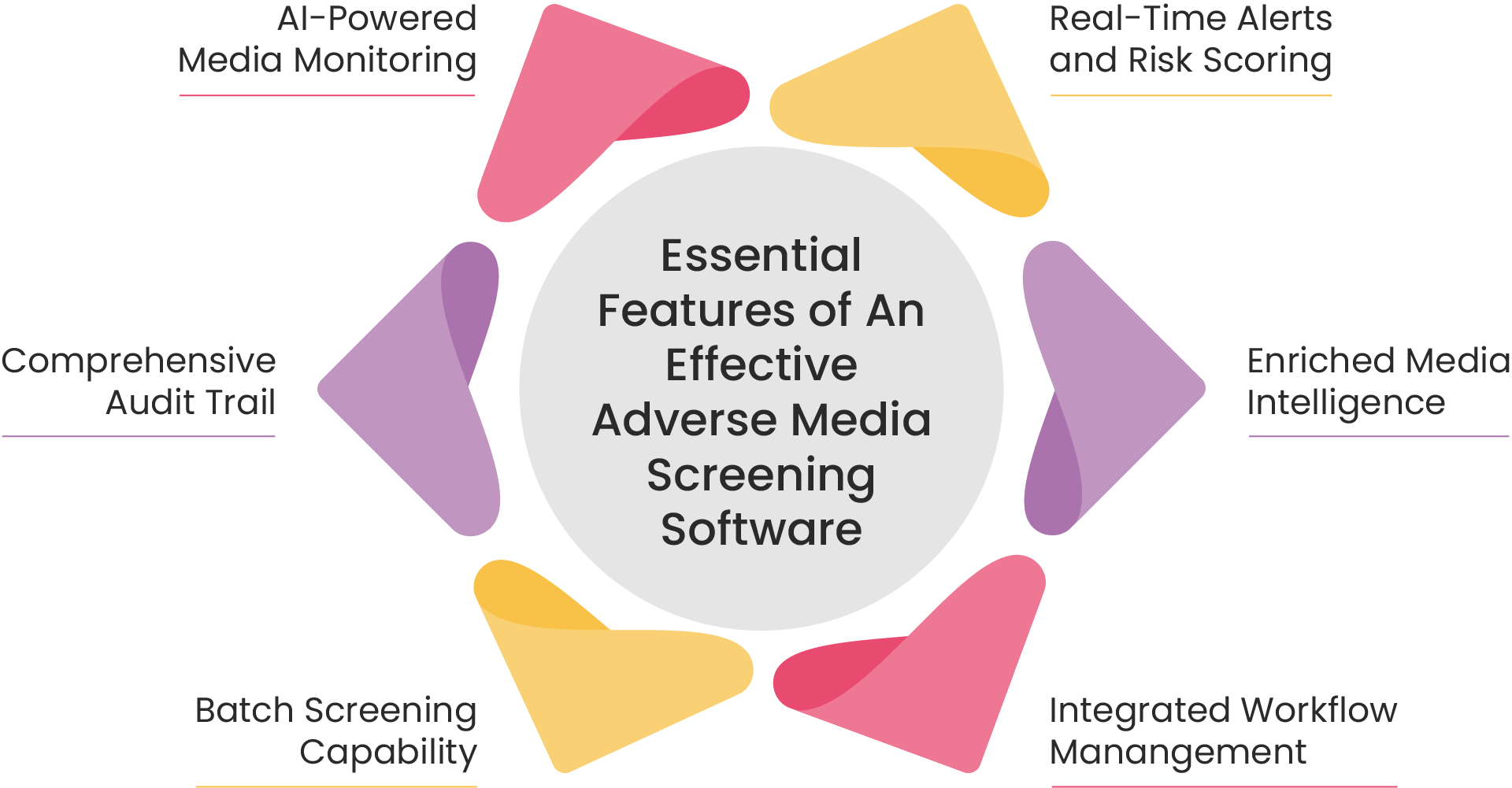
AI-Powered
Media Monitoring
An effective Adverse Media Screening Software must deploy AI to continuously monitor global news outlets, legal records, and regulatory bulletins in real time. By promptly identifying Adverse Media linked to customers, beneficial owners, or associated entities, it enables Regulated Entities to mitigate emerging risks and strengthen AML/CFT compliance.
Real-Time Alerts
and Risk Scoring
The Adverse Media Screening Software must promptly alert compliance team upon detecting new Adverse Media information. By integrating with dynamic risk scoring engines, it continuously recalibrates customer risk profiles bases on evolving negative information empowering proactive risk mitigation, improved case prioritization, and stronger regulatory alignment.
Enriched Media Intelligence
The Adverse Media Screening Software must contextualise media insights by mapping Adverse Media hits to FATF-aligned risk categories, such as fraud, Money Laundering, and other financial crimes. This strategic linkage enhances interpretability, enables faster triage by compliance teams, and supports consistent risk-based decision making.
Integrated Workflow Manangement
The Adverse Media Screening Software must enable seamless case assignment, escalation, and resolution tracking within a unified platform, ensuring streamlined collaboration and faster compliance outcomes.
Batch Screening Capability
The Adverse Media Screening Software must support bulk screening of customer databases, beneficial owners, or third parties, enabling efficient onboarding and periodic reviews at scale.
Comprehensive
Audit Trail
The Adverse Media Screening Software maintain a secure, tamper-proof log of all screening activities, enabling transparent reporting and effective internal oversight.
An effective Adverse Media Screening Software for RE in UAE is one that is integrated with UAE-specific regulatory expectations, such as those outlined by the Ministry of Economy, UAE Financial Intelligence Unit (FIU), and the Central Bank of the UAE.
Benefits of Leveraging Adverse Media Software
The benefits of using an Adverse Media Screening Software go beyond automating the manual task of meeting compliance requirements through screening of customer names across a list of string-words denoting involvement with financial crime.
Adverse Media Screening Software benefits include risk identification, improved risk categorisation, building customer CRA profiles, regulatory compliance, and analysis of matches. The points below make them clearer:

Identifying Risks Beyond Sanctions and PEP Screening
An Adverse Media Screening Software facilitates Regulated Entities to identify customers involved in illicit activities, predicate offences, and resultant Money Laundering, which do not form a part of official sanctions screening lists and Politically Exposed Persons (PEP) lists. In simple terms, Sanctions Screening and PEP Screening cover only the names of individuals and entities who are sanctioned or politically involved, leaving out the identification of money laundering actors and ML risk. Adverse Media Software mitigates this exact problem by identifying the underlying financial crime risk involved with an existing or potential customer by running searches through the public domain for combing any information that could tie the customer with a predicate offence or Money Laundering.
Helps Build an Accurate Customer Profile for CRA
An Adverse Media Screening Software benefits Regulated Entities by way of contributing towards a holistic customer risk profiling that includes consideration of adverse news, if any, about the customer found while conducting Adverse Media searches. The latest implementation guide for DNFBPs on CRA lays emphasis on analysing customer attributes such as behaviour, geographic, transaction patterns, characteristics, etc., to decide the degree of due diligence required and the Ongoing Monitoring periodicity to be determined. In simple terms, Adverse Media Screening Software helps Regulated Entities apply appropriate and proportionate due diligence measures.
Improved Customer Risk Categorisation
An accurate customer profile further helps in assigning an appropriate and accurate risk rating to the customer based on the risk appetite and customer ML, FT, and PF risk scoring methodology contained in a Regulated Entity’s AML/CFT policies and procedures. An accurate customer risk categorisation helps Regulated Entities align with risk-based Customer Due Diligence requirements, thus ensuring compliance with UAE local and global Customer Due Diligence standards, including FATF recommendations. It further helps Regulated Entities to understand the impact of Adverse Media findings on the overall customer profile visible in the Adverse Media Software and derive the overall customer risk score for conducting further due diligence, if required.
Expedited Analysis of Matches’ Materiality & Relevance
Adverse Media Screening Software helps Regulated Entities efficiently determine the real significance, materiality, and relevance of Adverse Media Screening results pertaining to potential and existing customers. The matches disambiguation dashboard helps segregate and organise materially relevant and insignificant or unrelated information so that the Screening Analyst’s observations, findings, and notes during matches disambiguation can be recorded and collated in an organised manner. These observations and notes by Screening Analysts help Risk Analysts assess and assign appropriate risk ratings to the customer for risk-based due diligence and maintain records of the same to fulfil record-keeping requirements.
Enhanced and Robust Regulatory Compliance
With expedited analysis of matches’ materiality and relevance, accurate CRA and pinpointed identification of ML risks, the Regulated Entity using Adverse Media Screening Software is bound to benefit in terms of attaining enhanced and robust regulatory compliance. Achieving AML/CFT compliance excellence is only possible when there is accurate identification of customer risks and effective deployment of ML, FT, and PF risk mitigation measures such as Enhanced Due Diligence (EDD), Ongoing Monitoring, robust Record Keeping, developing and implementing risk-centric AML/CFT policies customised to suit regulated entity’s unique institutional risks, technology integration which is accessible and in alignment with UAE’s regulatory requirements.

How to Select and Implement Adverse Media Screening Software: Best Practices for DNFBPs, VASPs & SCA-Regulated Entities
To effectively detect and mitigate reputational and financial crime risks, Regulated Entities in the UAE must carefully select Adverse Media Screening Software that aligns with AML/CFT compliance obligations. The software should offer intelligent, risk-based features that not only streamline the screening process but also enhance the accuracy, relevance, and actionability of results.

Aligning Adverse Media Screening Software with AML/CFT Risk Mitigation Objectives
While selecting and implementing Adverse Media Screening Software, REs must ensure that the solution directly supports their AML/CFT risk mitigation framework as required under Federal Decree Law and related Cabinet Decisions. Integrating Adverse Media Screening into the broader compliance framework enables REs to apply appropriate levels of Customer Due Diligence, trigger timely risk reviews, and strengthen ongoing monitoring.
Customising Relevance Filters and Media Categories
Regulated Entities should select Adverse Media Screening Software that allows customisation of relevance filters and media categories. The software must enable users to prioritise specific risk-related categories such as fraud, terrorism, while filtering out non-relevant content. This ensures the Adverse Media Screening results are accurate, focused, and aligned with the entity’s AML/CFT risk exposure.
Establishing Risk Scoring & Relevance Ranking for Adverse Media Matches
Regulated Entities should opt for Adverse Media Screening Software that supports risk scoring and relevance ranking of media matches. The software must be capable of assigning risk levels to each alert based on severity, context, and source credibility, allowing compliance teams to prioritise truly significant threats. By automatically ranking results from high to low relevance, REs can manage alerts more efficiently and focus attention on cases that require immediate escalation.
Automating Case Management, Escalation & Disposition Workflows
Regulated Entities should implement Adverse Media Screening Software that automates case management, escalation, and disposition workflows. The software must streamline how alerts are handles, from initial detection to review, investigation and closure by assigning tasks, setting deadlines, and routing cases to the appropriate compliance personnel. Automation ensures that no critical alert is overlooked and enables faster, more consistent decision making.
Implementing Risk-Based Approach to Adverse Media Alerts
Regulated Entities should ensure that their Adverse Media Screening Software supports the implementation of a risk-based approach to handling alerts. The software must allow alerts to be categorised and acted upon based on the customer’s risk profile, type of activity, and the nature of the media source. This ensures that high-risk clients or red flags are reviewed with greater scrutiny, while low-risk cases are managed proportionately.
Integrating Adverse Media Results into Customer Risk Profiling
Regulated Entities should adopt Adverse Media Screening Software that enables seamless integration of Adverse Media Screening results into overall customer risk profiling. The software must be able to feed relevant Adverse Media findings directly into customer’s risk score, allowing for real-time updates to their risk category. This integration supports a more comprehensive and dynamic understanding of each client’s risk level, enabling timely application of EDD where necessary.


“The most boring compliance task is manually checking names against adverse media. The duty of the compliance team isn’t limited to checking for a lot of clients, but also to reading a lot of news articles to find an actual threat. Adverse Media Screening Software has really solved many of the compliance problems.”

Adverse Media Screening Software Selection Confusing You?
Let AML UAE help you with building RFP and Adverse Media Software Selection
Messy Media Matches?
An Effective Adverse Media Software Brings Clarity to Chaos
In the world where one name can trigger a hundred false hits, an advanced Adverse Media Screening software cuts through the noise with precision.
Data Overload and Zero Insights!? | An Efficient Adverse Media Screening Software Makes It Easy!! |
“I’m still collecting documents manually!” | Not anymore, with Digital Document upload and OCR verification, an intuitive Adverse Media Screening Software extracts names and identifiers securely and accurately. |
“I don’t have time to read 100 articles to find one actual threat!” | You don’t have to, with AI-powered filtering and sentiment analysis, an insightful Adverse Media Screening Software highlights only the content with real negative implications. So, Goodbye False Alarms! |
“I have 1,000 clients to screen. Manually? Seriously!!” | Nope, with Batch Screening, a scalable Adverse Media Screening Software helps to run large-scale checks on customers, UBOs, and third parties. You’ll get it done without breaking a sweat. |
“I can’t tell how serious a match is!!” | Relax now with Risk scoring and tiering ranks matches, an insightful Adverse Media Screening Software helps by severity and confidence level, so you know which cases need your attention first. |
“I’m drowning in cases and sticky notes. How do I track who’s doing what?” | Drop the spreadsheet, with integrated workflow management, a responsive Adverse Media Screening Software helps your team assign, escalate, and resolve cases. All in one sleek platform. |
“Oops, my team gets alerted two weeks after a scandal hits!” | Relax, with Real-Time Alerts and Risk scoring, a proactive Adverse Media Screening Software ensure you’re instantly notified when risk-relevant media is detected. |
“Wait, who flagged that client and when? I can’t dig through emails!!” | Not happening, with Comprehensive Audit Trail, a robust Adverse Media Screening Software every search, click, and compliance call is logged and timestamped. |

Smarter Adverse Media Screening Through Real-Time Media Intelligence
Effective detection of potential links to financial crimes like Money Laundering it’s essential to conduct regular Adverse Media checks not only at the onboarding stage but throughout the customer lifecycle. With a robust Adverse Media Screening Software Regulated Entities across UAE can integrate Adverse Media Screening in their Customer Due Diligence (CDD), Ongoing Monitoring, and event-driven reviews. This ensures a Risk-Based, and Regulator-ready Compliance framework that meets evolving expectations of the UAE Central Bank, Ministry of Economy, and Financial Intelligence Unit (FIU).
Not Every Threat Comes with a Criminal Record
Adverse Media Screening Software uncovers what Sanctions and PEP Screening Misses
FAQs on Adverse Media Screening Software
Yes, AML/CFT laws mandate the Regulated Entities to conduct Adverse Media checks.
Yes, an effective Adverse Media Screening Software integrated with automated data processing and logging can support batch screening and maintain audit trails.
Adverse Media Screening Software is a critical tool that enables Regulated Entities to identify the negative news and reputational risks tied to businesses or organisations.
Generic rules and standards increase false positives. REs should choose for adverse media screening software tailored to their specific needs, incorporating AI, machine learning and fuzzy matching logic. This allows risk scoring and filtering by jurisdiction, reducing false positives.
Yes, Adverse Media Screening Software provide real-time alerts by using an integrated AI tool to continuously monitor global news and regulatory updates.
Regulated Entities should opt for an Adverse Media Screening Software that aligns with regulatory obligations, offers Risk-based Approach features to enhance the accuracy, and offers tailored filters & media categories to meet their expectations.