



Ongoing Monitoring Software
This page highlights the crucial role of Ongoing Monitoring Software in fortifying compliance with Anti-Money Laundering (AML), Counter-Terrorist Financing (CTF), and Counter-Proliferation Financing (CPF) obligations across the UAE’s regulatory framework. Whether you're a Designated Non-Financial Business or Profession (DNFBP), a Virtual Asset Service Provider (VASP), implementing intelligent Ongoing Monitoring Solutions is essential.
What is Ongoing Monitoring Software?
An Ongoing Monitoring Software helps organisations to proactively detect suspicious behaviour, update customer risk profiles, and ensure that all activities remain consistent with legal and regulatory expectations.
By streamlining Ongoing Monitoring processes, the Ongoing Monitoring Software enhances a Compliance Officer’s ability to identify, assess, and mitigate potential financial crime risks in real time. This helps the AML Compliance Officer to carry out risk-based supervision, timely Suspicious Transaction Report (STR) filings, and Ongoing Customer Due Diligence obligations. This ensures that REs in the UAE stay fully compliant throughout the course of the business relationship.

Ongoing Monitoring Obligations for Regulated Entities in the UAE
In the UAE, Ongoing Monitoring is a mandatory AML/CFT obligation for all Regulated Entities, including DNFBPs, VASPs, and Financial Institutions. Amid increasing regulatory expectations and evolving financial crime risks, Ongoing Monitoring Software must function as a real-time compliance backbone, seamlessly integrated with the UAE’s AML/CFT regime.
Ongoing Monitoring Software helps Regulated Entities to ensure compliance with UAE’s Ongoing Monitoring requirements prescribed under AML laws such as:
Federal Decree-Law No. 10 of 2025:
Which requires DNFBPs and Financial Institutions to establish a continuous risk assessment process of identifying, documenting, and regularly updating crime risk in line with regulatory factors, with analysis readily available for supervisory review.
Cabinet Resolution No. 134 of 2025 :
Which mandates Ongoing Monitoring through continuous transaction audits and regular updates of CDD information throughout the business relationship.
AML/CFT Guidance for DNFBPs:
Which states that DNFBPs must implement Automated or Manual Ongoing Monitoring mechanism to detect suspicious activity, reassess client risk levels over time, ensures timely updates for KYC information, and trigger EDD when required.
FATF
Recommendations
requires Ongoing Monitoring as part of the four key elements of CDD, especially to detect changes in customers’ behaviour that may indicate elevated risk.
Challenges Faced While Conducting Ongoing Monitoring
Ongoing Monitoring is the silent guardian of AML compliance – always alert, rarely acknowledged, and occasionally a workflow wrecking ball. It is the backbone of proactive AML risk management, tracking evolving customer behaviour, detecting red flags, and keeping risk profiles fresh. However, Ongoing Monitoring often limps under the weight of overcomplicated tech, disorganised data, and alerts that generate more confusion than clarity.

Drowning in Alerts or Drifting Past Risk?
Cut through the chaos with calibrated, continuous surveillance
How Ongoing Monitoring Software Helps REs to Meet Ongoing Monitoring Obligations
A robust Ongoing Monitoring Software is not merely a regulatory checkbox; it is a central pillar of risk-based AML compliance. For Regulated Entities in the UAE, especially DNFBPs and VASPs, the Ongoing Monitoring Software automates and enhances all core elements of the Ongoing Monitoring process, ensuring alignment with Cabinet Resolution No. (134) of 2025 and the FATF’s Recommendation of applying risk-based approach.

Step 1- Automating Risk-Based CDD Scheduling and Trigger-Based Reviews
The Ongoing Monitoring Software enables the compliance team to automate Customer Due Diligence (CDD) review cycles based on the customer’s assigned risk rating and the institution’s AML/CFT policies. Low and medium-risk customers can be scheduled for periodic reviews once a year, while high-risk customers can be scheduled for more frequent reviews, like twice a year. This risk-based scheduling ensures proportional oversight and optimal resource allocation.
Additionally, the Ongoing Monitoring Software continuously scans for red flags that may trigger immediate, unscheduled CDD reviews, such as inclusion on a sanctions list, sudden spikes in transaction volume, or a change in geographic exposure. Such real-time alerts help prevent risk escalation between scheduled reviews.
Step 2- Refreshing and Verifying CDD Data
The Ongoing Monitoring Software automatically refreshes and validates CDD information to maintain accurate and current customer profiles. It synchronises the client’s active status, legal structure, and ownership information. It helps to check whether the beneficial owners remain unchanged, if the customer still operates from the same jurisdiction, and whether declared business activities align with actual behaviour.
These updates are cross-checked using external databases and open-source intelligence, confirming the integrity of onboarding declarations and ongoing compliance with AML/CFT requirements.
Step 3- Analysing Transaction Behaviour for Risk Alignment
Unlike static KYC systems, Ongoing Monitoring Software uses behavioural analytics to track whether a customer’s transaction activity aligns with their known business profile. AI-driven risk engines analyse historical patterns to establish a behavioural baseline and flag deviations in transaction volume, frequency, size, or destination.
For instance, if a retail client suddenly initiates large transfers to high-risk jurisdictions, the software flags this as an anomaly, prompting a review. For high-risk or high-volume customers, the Ongoing Monitoring Software offers deeper analytics through filters, pattern recognition, and real-time dashboards.
Step 4- Reassessing Customer Risk and Flagging EDD Needs
Once updated, CDD and transaction behaviour are analysed, and the Ongoing Monitoring Software dynamically recalculates the customer’s risk score. It considers emerging risk factors such as Adverse Media, changes in control or ownership, or exposure to high-risk jurisdictions. If elevated risk is detected, the ongoing monitoring software automatically flags the customer for Enhanced Due Diligence (EDD), as required under the UAE’s AML/CFT laws.
REs need to perform EDD typically for a Politically Exposed Person (PEP), legal entities having opaque ownership structures and customers operating from a FATF-listed jurisdiction.
Step 5- Executing Enhanced Due Diligence Workflows
When EDD is triggered, the Ongoing Monitoring Software activates a pre-configured EDD workflow that includes the collection of additional documentation such as Source of Wealth (SoW) or Source of Funds (SoF). It also increases CDD update frequency, intensifies transaction surveillance, and imposes stricter approval protocols for account activity.
This workflow also includes real-time transaction screening and deeper scrutiny of ownership chains, helping compliance officers meet enhanced regulatory expectations for high-risk clients without delays or oversight gaps.
Step 6- Maintaining Records and Enabling goAML Reporting
All actions performed by the Ongoing Monitoring Software including CDD reviews, EDD measures, monitoring outcomes, and risk scoring changes are automatically logged with timestamps, analyst remarks, and supporting evidence. This automated audit trail simplifies regulatory inspections and strengthens the entity’s record-keeping obligations under Article 16.1 (f) of Federal Decree Law No. 10 of 2025.
Where suspicious activity is confirmed or suspected, the Ongoing Monitoring Software integrates with the UAE FIU’s goAML platform, supporting the preparation and electronic submission of Suspicious Transaction Reports (STRs) with required attachments and compliance notes.
Step 7- Ensuring Continuous Compliance Through Intelligence and Automation
The Ongoing Monitoring Software maintains compliance by automatically syncing with updated watchlists and by scanning external intelligence sources. It issues alerts for changes in risk levels or regulatory guidance, ensuring the compliance team is always informed and proactive.
The Ongoing Monitoring Software reminds Regulated Entities of scheduled CDD reviews and compliance tasks to keep the team on track. Afterwards, the customisable dashboards of Ongoing Monitoring Software provide Regulated Entities a unified view of the risk exposure, customer risk ratings, and review statuses. This process is effective for outstanding compliance actions, enabling faster decision-making and stronger internal controls.
Compliance Bottlenecks Slowing You Down?
Free your team from manual reviews with Ongoing Monitoring Software!
Must-Have Features of Ongoing Monitoring Software
In UAE, DNFBPs and VASPs are required to continuously monitor customer relationships and screen against updated Sanctions, PEP and Adverse Media Lists. To ensure real-time responsiveness, regulatory alignment, and operational efficiency, Regulated Entities must ensure their Ongoing Monitoring Software includes the following must-have features:
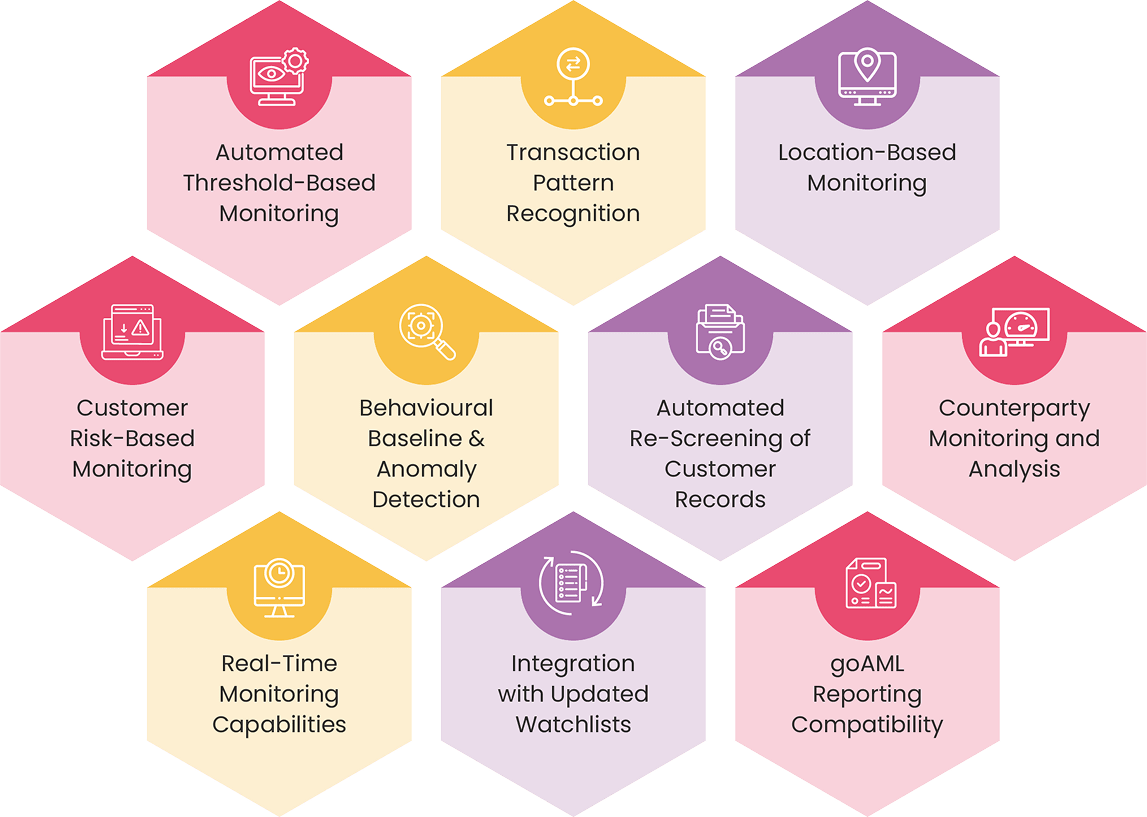
Automated Threshold-Based Monitoring
The Ongoing Monitoring Software must automatically flag transactions that exceed predefined thresholds, reducing manual intervention and enabling real-time detection of potentially suspicious activities, in line with the UAE AML regulatory expectations.
Transaction Pattern Recognition
The Ongoing Monitoring Software must identify unusual transactions by type, which helps to detect deviations from the customer’s typical behaviour. For example: frequent large cash deposits, wire transfers to risky sectors, sudden account activity changes.
Location-Based Monitoring
The Ongoing Monitoring Software must generate real-time alerts for transactions involving high-risk or sanctioned jurisdictions, ensuring compliance with the UAE AML regulations and supporting timely identification of geographically linked financial crime risks.
Customer Risk-Based Monitoring
The Ongoing Monitoring Software must dynamically adjust monitoring levels based on each customer’s risk profile, aligning with the UAE’s risk-based approach and ensuring enhanced scrutiny of high-risk clients in real time.
Behavioural Baseline & Anomaly Detection
The Ongoing Monitoring Software must establish a customer’s normal transaction pattern and flag deviations from it, which ensures consistent tracking of “typical” activity as per the Ministry of Economy AML Guideline for DNFBPs.
Automated Re-Screening of Customer Records
The Ongoing Monitoring Software must offer automated re-screening of customer records to ensure that any changes in Sanctions, PEP, or Adverse Media lists trigger immediate checks against existing customer data.
Counterparty Monitoring and Analysis
The Ongoing Monitoring Software must capture and analyse information on counterparties (senders/receivers), even third parties, by pulling data through internet and watchlist sources. This helps to assess whether the transaction is “normal”, “reasonable”, and “legitimate”.
Real-Time Monitoring Capabilities
The Ongoing Monitoring Software must be equipped with real-time monitoring capabilities to detect and respond to emerging risks. It should also instantly trigger alerts the moment a new match or risk indicator is detected, enabling swift escalation, review, and action.
Integration with Updated Watchlists
The Ongoing Monitoring Software must integrate seamlessly with updated and authoritative watchlists, including the UAE’s Local Terrorist List, the UN Security Council Consolidated List, and support integration with PEP and Adverse Media sources.
goAML Reporting Compatibility
The Ongoing Monitoring Software must offer seamless goAML Reporting compatibility to help DNFBPs meet their mandatory AML/CFT reporting obligations efficiently, like filing Suspicious Transaction Report (STR), Confirmed Name Match Report (CNMR) , and Partial Name Match Report (PNMR).


“One of the most crucial tasks for AML Compliance is appointing a detective who performs real-time check, give alerts when anomalies arise and ensure risk mitigation with reputational safeguards. An effective Ongoing Monitoring Software thankfully never let red flags missed out.”

Benefits of Leveraging Ongoing Monitoring Software
REs in the UAE can automate risk detection, ensure timely compliance with evolving AML/CFT obligations, and maintain a proactive stance against financial crime by leveraging Ongoing Monitoring Software.


Early Detection of Suspicious Activities
Ongoing Monitoring Software helps Regulated Entities detect suspicious activity by comparing customer transactions with unusual behaviour patterns. It flags anomalies like unusual frequency or volumes in real-time, enabling quick investigations and timely filing of STRs. This proactive detection reduces regulatory risk, prevents reputational fallout, and ensures stronger internal controls in line with AML/CFT compliance standards.
Dynamic Customer Risk Reassessment
Customer risk is dynamic, shaped by evolving activities, geographies, and associations. Ongoing Monitoring Software enables real-time syncing of transactional behaviour with updated CDD profiles. It promptly flags risk elevation, such as a low-risk customer conducting high-value international transfers, and triggers EDD. This continuous risk reassessment ensures compliance with the UAE’s risk-based AML/CFT monitoring framework and supports proactive decision-making.
Real-Time Compliance with Regulatory Updates
AML/CFT frameworks are constantly evolving in response to global and regional threats. Ongoing Monitoring Software automatically integrates updates to sanctions lists, PEP registries, and Adverse Media sources, triggering instant re-screening when applicable. This capability ensures continuous compliance throughout the customer lifecycle and guarantees alignment with the UAE regulatory requirements, beyond the onboarding stage.
Operational Efficiency and Audit Readiness
Manual Ongoing Monitoring is fragmented, labour-intensive, and error-prone. Ongoing Monitoring Software improves efficiency by executing rule-based and risk-based scenarios while centralising alert tracking, review actions, and documentation. It ensures seamless retrieval of activity logs during audits and inspections, reinforcing institutional transparency and internal accountability while optimising compliance team productivity.
Enhanced Customer Trust and Relationship Management
Ongoing Monitoring Software enhances trust by ensuring strong, transparent AML controls without interrupting service delivery. It balances compliance obligations with user experience, assuring clients of secure, ethical operations. Continuous monitoring demonstrates an institution’s commitment to regulatory integrity, reinforcing relationships with customers who value reliability, consistency, and robust financial safeguards.
How to Select and Implement Ongoing Monitoring Software: Best Practices for DNFBPs, VASPs, & SCA-Regulated Entities
Regulated Entities in the UAE must choose Ongoing Monitoring Software that does more than just tick compliance boxes; it should think, adapt, and act in real time to stay one step ahead of emerging financial crime risks.
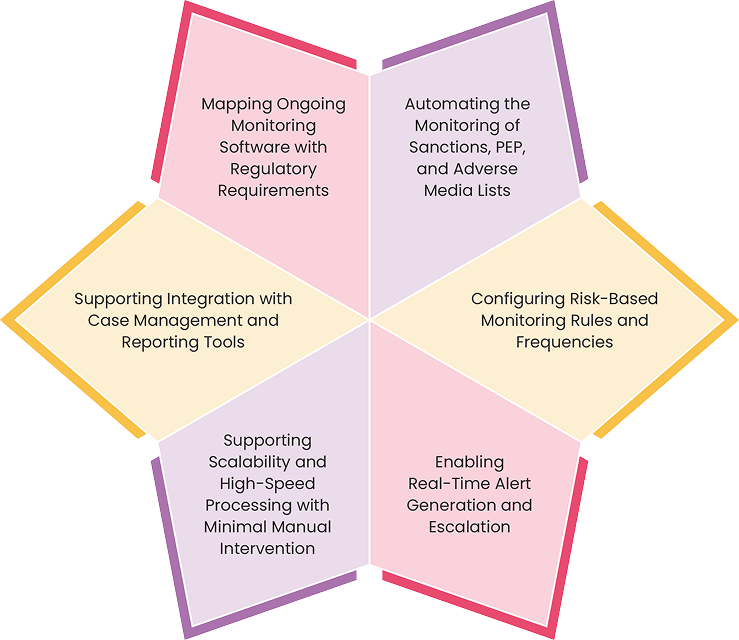

Mapping Ongoing Monitoring Software with Regulatory Requirements
Regulated Entities should select Ongoing Monitoring Software that effectively maps and aligns with the UAE’s regulatory requirements for continuous Customer Due Diligence, particularly under Cabinet Resolution No. (134) of 2025 and Cabinet Resolution No. 74 of 2020. The selected Ongoing Monitoring Software should be capable enough to flag suspicious transactions, detect unusual patterns, and adjust the monitoring level according to customer risk for AML Compliance.

Automating Monitoring of Sanctions, PEP, and Adverse Media Lists
Regulated Entities should ensure that their Ongoing Monitoring Software automates the screening of customers against updated Sanctions, PEP, and Adverse Media lists. This automation eliminates manual tracking, ensures continuous compliance with the UAE AML/CFT obligations, and enables the timely identification of high-risk individuals or entities as new threats emerge. Further, this automation enables refreshing customer risk profiles and helping REs avoid penalties.

Configuring Risk-Based Monitoring Rules and Frequencies
Regulated Entities should choose Ongoing Monitoring Software that allows configuration of risk-based monitoring rules and screening frequencies. This ensures that higher-risk customers are monitored more frequently, while lower-risk profiles follow proportionate schedules, aligning with the UAE’s risk-based AML/CFT approach and optimising compliance resources effectively. This enables Regulated Entities to identify potential risk, apply measures to mitigate risk and improve overall business accuracy and reliability.
Enabling Real-Time Alert Generation and Escalation
Ongoing Monitoring Software should enable real-time alert generation and escalation workflows, allowing Regulated Entities to respond instantly to potential risks. Regulated Entities should prefer implementing a system that escalates alerts to designated personnel pertaining to pre-defined rules & thresholds. This ensures timely detection, review, and resolution of Sanctions, PEP, and Adverse Media matches, supporting swift compliance action in line with UAE regulatory expectations.
Supporting Scalability and High-Speed Processing with Minimal Manual Intervention
Ongoing Monitoring Software must be capable of handling large volumes of customer and transaction data without compromising speed or accuracy. Regulated Entities in the UAE should ensure that the Ongoing Monitoring Software supports scalable infrastructure with automated workflows. It helps these entities minimise manual reviews, ensure growth with efficient monitoring, maintain real-time responsiveness and lead to better AML Compliance.
Supporting Integration with Case Management and Reporting Tools
Regulated Entities should select Ongoing Monitoring Software that seamlessly integrates with internal case management systems and regulatory reporting tools. This ensures that alerts can be escalated, investigated, and documented efficiently, while enabling direct reporting of STR, CNMR, or PNMR through the goAML platform. Such integration streamlines compliance workflows, improves audit readiness, and ensures timely reporting in line with UAE AML/CFT obligations.
Say Goodbye to Manual Risk Tracking.
Let Ongoing Monitoring Software algorithms catch what spreadsheets miss.
Still Chasing Risk Manually? An Effective Ongoing Monitoring Software Keeps You Ahead
As risks evolve in real time, Regulated Entities need Ongoing Monitoring Software that evolves faster, flagging threats before they escalate.
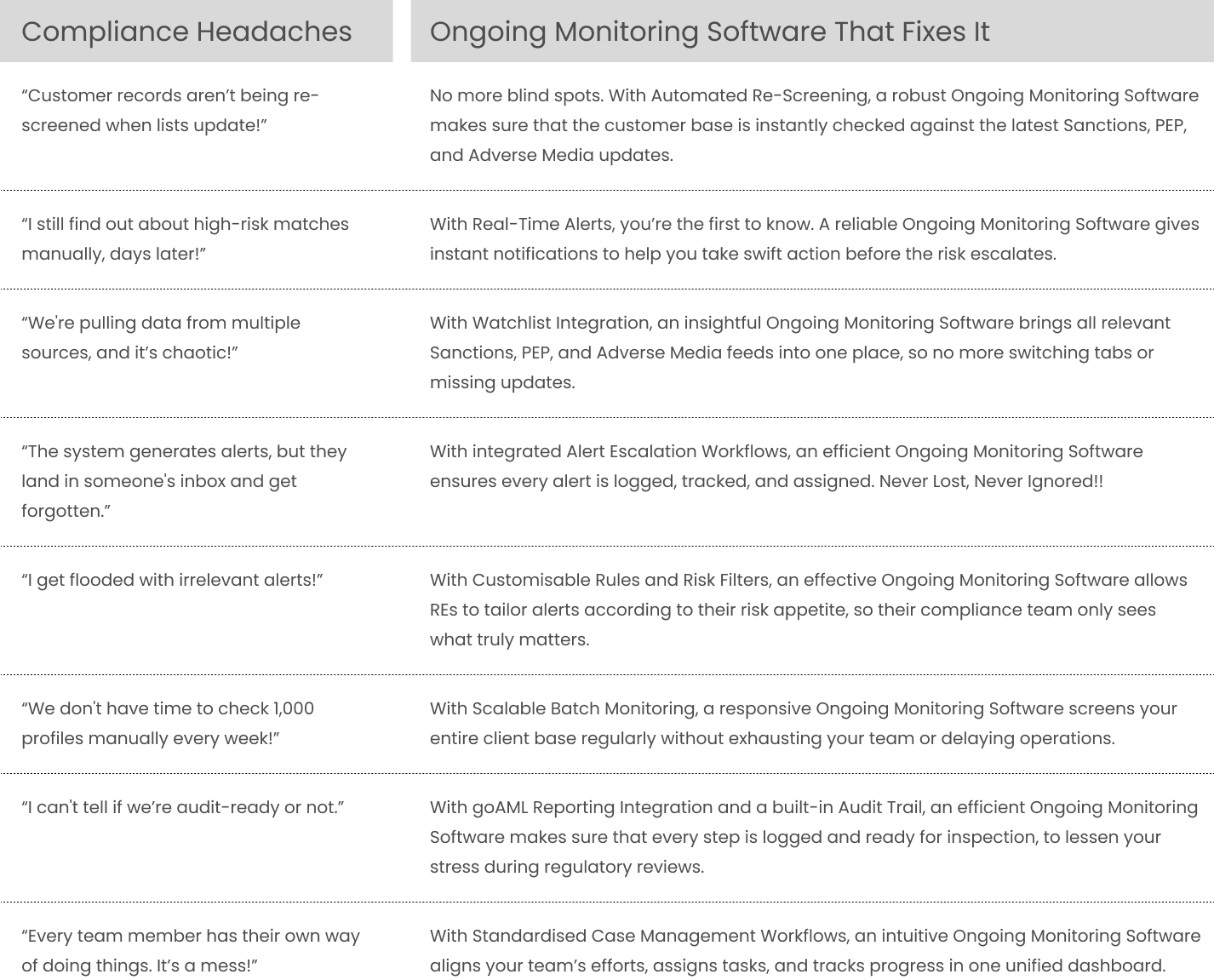

Smarter Ongoing Monitoring for Seamless Regulatory Alignment
In today’s evolving regulatory landscape, AML/CFT compliance isn’t a one-time effort; it’s a continuous commitment. For DNFBPs and VASPs operating in the UAE, implementing intelligent Ongoing Monitoring Software is not just best practice; it’s essential for meeting the expectations of the UAE Central Bank, Ministry of Economy, and Financial Intelligence Unit (FIU). By automating re-screening across updated Sanctions, PEP, and Adverse Media lists, and enabling risk-based alerting and reporting, Regulated Entities can transform monitoring from a manual burden into a proactive shield. With the right Ongoing Monitoring Software, ongoing vigilance becomes seamless, keeping RE’s AML/CFT compliance sharp and reputation intact.
Your Risk Doesn’t Sleep, Why Should Your Monitoring?
Stay one step ahead with Real-Time Risk Signals