



Vulnerability Assessment
Published On: 01/23/2026
Protect your business with reliable and effective AML strategies with AML UAE.
Last Reviewed On: 07/31/2026 | Last Updated On: 07/31/2026
What’s in Store
Vulnerability Assessment in AML identifies weaknesses within an organisation’s AML program that could be exploited for ML/TF/PF activities.
It evaluates the efficacy of existing AML measures to mitigate the identified inherent risk.
It facilitates an opportunity for Regulated Entities to work on their internal deficiencies before regulatory eyes reach them.
An effective Vulnerability Assessment must be regularly updated with a clear rationale and should be aligned with the expectations of Regulatory Authorities.
Introduction to Vulnerability Assessment in AML
Vulnerability Assessment in Anti-Money Laundering (AML) program refers to the structured identification of weaknesses within a Regulated Entity’s AML/CFT controls, processes, system and governance that could be exploited for Money Laundering (ML), Terrorism Financing (TF) or Proliferation Financing (PF).
Vulnerability Assessment primarily focuses on AML/CFT failures that may occur internally even when the inherent risk of the organization appears low.
It differs from the traditional AML/CFT Risk Assessment. The ML/TF risk in Risk Assessment is understood with simple formula of Risk= Threat x Vulnerability x Impact. This denotes that vulnerabilities, if not detected can act as a multiplier that can notably elevate overall ML/TF risk exposure of an organization.
In simpler terms, it means that even if gross risk appears low, weak controls can impact the outcome of the net ML/TF/PF risk negatively. This is why Vulnerability Assessment plays a critical role in understanding the residual risk of an organization.
Therefore, UAE Regulators such as MoET, MOJ, CBUAE, SCA, VARA, FSRA, and DFSA expect Regulated Entities in UAE to focus on identifying and fixing internal vulnerabilities and not just the documented inherent risk.
Why Vulnerability Assessment is Critical for UAE AML Compliance
In UAE’s AML/CFT Compliance landscape, AML/CFT control effectiveness is as important as ML/TF risk identification.
A business may operate in inherently low ML/TF risk sector, yet still present high residual risk if AML/CFT controls are not properly applied. Many a times, controls just exist in policies, however their execution is completely failed. Most regulatory enforcement actions often stem from the failed execution rather than policy gaps.
Therefore, Regulators in UAE desire Regulated Entities to focus on the successful implementation of their AML/CFT controls, and work on the deficiencies if any. Vulnerability Assessment proves to be a critical tool to evaluate those lacking.
Assessing internal vulnerabilities facilitates Regulated Entities to accurately defend the conclusions of their Enterprise-Wide Risk Assessment (EWRA) and Customer Risk Assessment (CRA) with clear rationale and logic.
Most importantly, identifying vulnerabilities early help prevent common regulatory findings such as ineffective transaction monitoring, screening gaps, weak governance or documentation failures.
Key Areas of Vulnerability in AML Frameworks
There are multiple areas in an AML/CFT framework that are prone to vulnerabilities, these key areas include governance, process, system, people and third parties.
Governance Vulnerabilities in AML/CFT framework arise from unclear accountabilities, weak oversight, and ineffective escalation channels. Without clearly implemented hierarchy and accountability structure, the issues remain unresolved.
Process Vulnerabilities appear from gaps in onboarding channel, inconsistency in Customer Due Diligence (CDD) /Enhanced Due Diligence (EDD) application, delays in updating customer information etc.
System Vulnerabilities in AML/CFT framework surface from poorly calibrated screening rules, inadequate tools, outdated software implementation, weak data quality issues etc. These system weaknesses lead to a high rate of false positives or false negatives and missed alerts.
People Vulnerabilities stem from inadequate training, understaffing of compliance team or a lack of subject matter expertise in employees. This leads to failure in execution.
Third-Party Vulnerabilities occur when Regulated Entities rely on vendors, agents or outsourced service providers with weak AML/CFT controls and insufficient oversight for AML/CFT compliance obligations.
Vulnerability Assessment Within EWRA/BRA
In an EWRA/BRA, Vulnerability Assessment is to identify systematic weaknesses that affect the organization as a whole. This includes evaluation of Regulated Entities’ AML/CFT/CPF program and whether it is concrete enough to manage ML/TF/PF risks across various categories such as customer, products, services, geographies and delivery channels.
Regulated Entities assess whether implemented AML/CFT/CPF controls are adequate to restrain the identified inherent risks.
An efficient Vulnerability Assessment also includes reviewing former audit findings, inspection history and previous remediation actions to estimate the effectiveness of the deployed controls.
Moreover, Regulatory Authorities in UAE expect Regulated Entities to be transparent regarding the effectiveness of their control environment by thoroughly documenting and articulating the identified control gaps and corresponding mitigation actions in their EWRA/BRA.
Vulnerability Assessment Within CRA
Within a Customer Risk Assessment (CRA), Vulnerability Assessment majorly focuses on recognizing the control weaknesses at customer level. These vulnerabilities basically can be related to the reliance on outdated KYC, incomplete UBO identification in layered ownership structures, insufficient verification of Source of Funds or Source of Wealth, underestimating PEP or high-risk individual that may impact overall risk scoring of a customer.
In simpler terms, it recognizes gaps in system that may impact the risk scoring of a customer negatively. For example, due to weak controls, a high-risk customer is scored as low risk.
Another major component of a robust Vulnerability Assessment in CRA is that it scrutinizes the efficacy of present Screening tools, Ongoing Monitoring and Transaction Monitoring systems.
Through validated control testing, it measures the effectiveness of these tools to gauge whether they provide accurate Screening results, whether these Screening tools are calibrated with updated PEP databases and Sanctions List, whether real-time monitoring of complex or high-risk customers is provided, whether the tools are accurate to give alerts for any anomalies in customer profiles.
Additionally, the effective Vulnerability Assessment provides understanding of the instances where the probability of customer behavior outpacing the existing controls is strong. For that it actively compares current compliance capabilities to manage evolving customer tactics such as use of cryptocurrencies, third-party wire transfers etc. to ensure existing controls are not outdated to deal with new and complex methodologies.
Evaluation of these controls at customer level provides real insights into the gaps and helps in forming an informed risk mitigation strategy. A high level of identified vulnerabilities in CRA provides the justification to implement Enhanced Due Diligence (EDD), increased monitoring frequency or necessary account restrictions.
Common AML Vulnerabilities Identified by UAE Regulators
In UAE, during inspections Regulatory Authorities such as MoET, SCA, MOJ, CBUAE, VARA, DFSA, and FSRA often come across AML/CFT vulnerabilities that are recurrent and consistent across Regulated Entities.
These common vulnerabilities are both system based and structure based.
One of the persistent gaps is in managing the Sanctions List updates. Regulated Entities often fall short in adopting practices that provide up to date alignment with UAE Local Terrorist List, UNSC Consolidated List and other relevant International Sanctions Lists. This mismanagement causes REs to onboard prohibited parties.
Another common gap is recognized at system level. Regulated Entities implement Screening and Transaction Monitoring tools with poor calibration that results in generation of excessive false negatives and failure in flagging actual suspicious activity or customer.
It has been observed that lack of oversight on complex trade finance activities by Regulated Entities pave the easy way for miscreants to conduct Trade-Based Money Laundering (TBML).
Another major compliance failure on part of Regulated Entities is insufficient and scattered documentation without any systematic approach to maintain and retain it.
Moreover, Regulated Entities often overly rely on automated solutions without any proper validation and testing. The misconception that software alone guarantees thorough compliance led to critical control error.
Methodology for Conducting an Effective AML Vulnerability Assessment
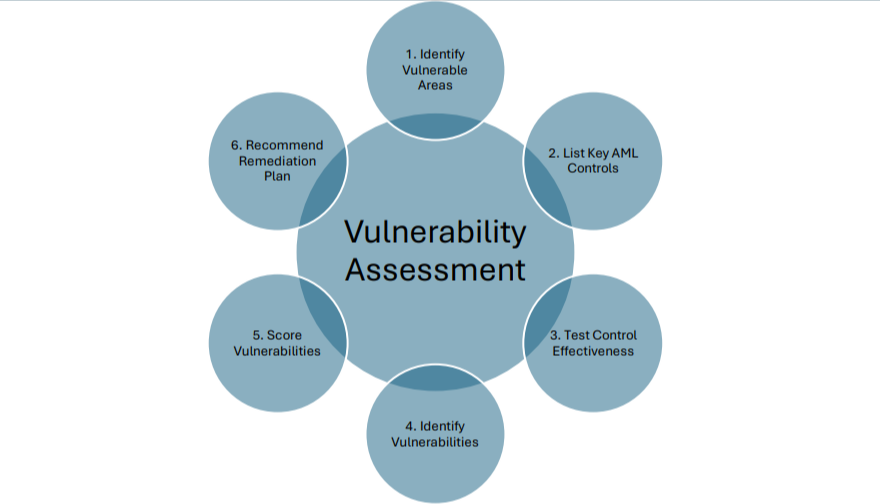
The effectiveness of Vulnerability Assessment in AML depends on the structured methodologies that facilitate evidence based dynamic review of the AML/CFT program to bridge the gap between policy and execution.
It begins with mapping existing AML/CFT controls against the inherent risk identified in EWRA/BRA and CRA. Subsequently, control testing, walkthroughs and scenario reviews are conducted to determine the operationality of the controls as intended.
Post control testing, data-driven analysis is conducted, where alert metrices, STR trends, backlog data and audit findings are analyzed to identify patterns of failure or inefficiency.
The process of Vulnerability Assessment is continued with an operational review through staff interviews and systematic audits of procedures to verify the efficacy of frontline compliance team.
After this, the identified vulnerabilities are given appropriate ratings based on the likelihood of occurrence and the impact they can have on the business.
The Vulnerability Assessment ends with the clear documentation of all findings and a formal remediation plan to overcome vulnerabilities with defined ownership and timeframe for the same.
Role of AML UAE Services in Vulnerability Assessment
It is critical for Regulated Entities in UAE to periodically evaluate the effectiveness of their AML/CFT controls and recognize gaps that may expose them to ML/TF/PF risks.
Vulnerability Assessment is vital in ensuring that deficiencies in governance, systems, processes and staffing are discovered in the earliest possible way before it reaches the eyes of Regulatory Authorities.
AML UAE supports Regulated Entities in UAE to conduct independent Vulnerability Assessment that identify practical weaknesses. AML/CFT Health Check provides a comprehensive review of control effectiveness. AML/CFT Policy, Controls and Procedures Documentation service ensures that internal framework is aligned with Risk-Based Approach and regulatory expectations.
Through AML Screening Software Testing and Validation Services, system level vulnerabilities are addressed. It facilitates recognizing gaps in Transaction Monitoring and Screening configurations.
These services help Regulated Entities to prioritize remediation plan, strengthen EWRA/BRA and CRA outcomes and maintain Vulnerability Assessment rationale recorded as per the expectations of Supervisory Authorities.
Strengthening AML Resilience Through Vulnerability Assessment
It is of utmost importance for Regulated Entities to understand the weak links in their control programs and Vulnerability Assessment can provide that third eye perspective for it. Deficiencies in control left unchecked can easily pave way for threats to become risks.
AML UAE comes here as savior to make the complex process of Vulnerability Assessment smooth and accurate for Regulated Entities. Through its efficient services it aids in salvaging the weak controls before the wrongdoers can exploit it for illicit activities. Moreover, a structured Vulnerability Assessment displays a sheer commitment to Supervisory Authorities, enhancing the goodwill of Regulated Entities.
Frequently Asked Questions
Vulnerability Assessment in AML is the process to understand inherent vulnerabilities and identify gaps in an organization’s AML/CFT controls, processes, systems and governance that can be exploited for financial crimes such as ML/TF/PF.
AML Risk Assessment is a broad concept that encompasses identification of ML/TF/PF risk exposure through customers, products, geographies, delivery channels and other risk factors. In contrast, Vulnerability Assessment in AML is a subdivision of AML Risk Assessment, where the internal AML/CFT controls of an organization is examined to determine the effectiveness of these controls to curb the financial crime risks.
Regulators in UAE, such as MoET, MOJ, SCA, FSRA, DFSA, VARA, and CBUAE, focus on the AML Vulnerabilities because AML breaches arise from the incapable controls rather than unidentified risks. Thus, they expect Regulated Entities to identify, document and remediate gaps to ensure controls work adequately.
Common AML Control weaknesses consist of poor management of Sanction Lists, ineffective transaction monitoring tools, poorly calibrated screening rules, insufficient documentation, overreliance on automated tools etc.
Mostly, Regulated Entities should consider performing the Vulnerability Assessment at least annually, assessments that are more frequent or less frequent may be justified as per the circumstances.
Vulnerability Assessments impact the EWRA and CRA by recognizing weaknesses in AML/CFT control program. It helps to determine residual risk by assessing whether existing controls mitigate inherent risk effectively.
Unsure if your watchlist screening meets UAE AML requirements?
Partner with us to strengthen your sanctions and watchlist compliance framework.
Share via :
About the Author

Pathik Shah
FCA, CAMS, CISA, CS, DISA (ICAI), FAFP (ICAI)
Pathik is an ACAMS-certified AML consultant specialising in governance, risk, and compliance for regulated entities in the UAE. He brings over 28 years of experience, with 1,000+ hours of AML training and 200+ advisory engagements across DNFBPs, VASPs, and FIs. He supports businesses in aligning with AML/CFT requirements from the CBUAE, DFSA, MoET, MoJ, VARA, CMA, FSRA, and FATF. Known for translating complex regulations into audit-ready procedures, Pathik enables operational clarity and compliance readiness.

Reach Out to Pathik