
Following the Money Trail: Transaction Monitoring in the War Against Money Laundering

The Complete Guide to AML Transaction Monitoring

The Complete Guide to AML Transaction Monitoring

Tracking the transactions to spot anomalies or suspicions is called transaction monitoring. Transaction monitoring can help detect patterns of suspicious behavior and financial crimes to and from customers.

That is why it is a significant measure of the overall AML/CFT compliance program. Transaction monitoring helps in developing the trends and predicting the risk, allowing you to detect financial crime attempts before their occurrence or in their early stages.

Timely detection of risk indicators saves you from the repercussions.

For that reason, we have come up with this comprehensive eBook that explains the following:

  • What is AML transaction monitoring?
  • Significance of AML Transaction Monitoring
  • Steps to an Effective Transaction Monitoring Program
  • AML Transaction Monitoring Program Best Practices

This guide is an effort to empower your existing AML/CFT compliance program with the support of robust transaction monitoring measures. Delve into the guide, explore more about transaction monitoring, and take another step forward to mitigate AML/CFT risks.

Our timely and accurate AML consulting services

For your smooth journey towards your goals

Share via :

Share via :

The importance of unified AML software in meeting compliance requirements

The importance of unified AML software in meeting compliance requirements

The importance of Unified AML Software in meeting compliance requirements

Be it lawyers, accountants, auditors, TCSPs, DPMS, VASP, real estate brokers, financial institutions, money exchange businesses, or insurance companies, a unified AML software goes a long way in meeting the regulatory obligations of the reporting entities.

A unified AML software helps perform Enterprise-Wide Risk Assessment, Maintain AML/CFT Policy and Procedures, maintain KYC records, perform sanctions screening, carry out customer risk assessment, submit regulatory reports like SAR, STR, PNMR, CNMR, DPMSR, REAR, HRC, HRCA, and maintain a complete audit trail of events.

Since there’s only a single source of truth, duplication is avoided, significantly saving time and effort. Moreover, the ML/FT risks can be mitigated, and the organisation always remains compliant and audit-ready.

The regulatory requirements for semi-annual or annual returns can be met, and timely submission of survey responses can be ensured.

The mandatory record-keeping requirements can be effectively met, and paper-based inefficient processes can be avoided. The company can adopt a risk-based approach and utilise the resources most effectively to fight against financial crimes.  

Related Posts

Webinar on Mastering Regulatory Reporting: A Deep Dive into SAR/STR Compliance

Pathik Shah

Webinar on Mastering Regulatory Reporting: A Deep Dive into SAR/STR Compliance

Details

Exclusive Webinar on Mastering Regulatory Reporting: A Deep Dive into SAR/STR Compliance

Date: 7th January 2024

Time: 11:00 AM to 12 Noon (GST)

Venue: Online

We are delighted to present a unique opportunity for you to gain invaluable insights about Suspicious Activity Report/Suspicious Transaction Report (SAR/STR) Compliance under UAE AML Laws from our esteemed AML expert, CS Dipali Vora

Join us for a compelling webinar where she will guide you through AML framework in UAE, different types of reports under UAE AML Laws, and in-depth details of SAR/STR reporting.

Key Highlights:

Types of Reports under UAE AML Laws: Explanation regarding various types of reports and different instances for filing these reports.

Understanding Suspicious Transaction: Delve into the definition of suspicious transaction and difference between suspicious transactions and suspicious activities.

Recognition of Red Flags: Learn how to identify potential indicators of suspicious transactions and suspicious activities.

Understanding SAR and STR: Delve into the definitions and significance of suspicious activity report and suspicious transaction report, its reporting mechanism, and consequences of non-compliance.

Actionable post filing SAR/STR with FIU: How to manage business relationship with customer post filing an SAR or STR with FIU.

Best Practices: Learn the best practices of reporting suspicions and maintaining an effective compliance culture.

Why Attend?

By participating you will:

  • Enhance your understanding of reporting obligations.
  • Stay updated on regulatory requirements.
  • Learn practical strategies for identifying and addressing suspicious activities.

Register now to secure your spot for this exclusive event! Don’t miss this chance to learn from an industry expert and ensure the compliance requirements related to SAR/STR.

Stay ahead in the fight against financial crime. Join us for this insightful webinar and empower yourself with the knowledge to recognize and report suspicious activities or suspicious transactions effectively. Register now!

What action should be taken if any match is identified against the OFAC List?

The UAE regulations require the regulated entities to perform sanctions checks against the UNSC Consolidated List and the UAE Local List. In case of any matches identified against other international sanctions lists, the controls are to be applied considering the business’s risk appetite and the risk-based approach adopted by the entity. It is important to note that for entities dealing with customers and suppliers from the USA, it is advised to reject the business relationship when identified as a match with the OFAC List and submit a SAR/STR on the goAML Portal.

Further, entities operating in jurisdictions like ADGM & DIFC must conduct screening against international sanctions lists like OFAC and EU, depending on the business profile, reject the customer and furnish SAR/STR with the FIU in case of matches.

The UAE AML regulations provide that the DNFBPs must report the identified ML/FT suspicions to the FIU, without any delay. Thus, it is suggested that the alerts be attended to and addressed as soon as possible and that the SAR/STR be immediately submitted to the goAML portal once the suspicion is confirmed and the decision to report the same is made.

The entity must submit a Suspicious Activity Report (SAR) when any ML/FT risk indicators are observed at the initial stage of customer interaction. The reporting of ML/FT suspicions should be done irrespective of the status of the transactions – whether the transaction is completed, in progress or not yet initiated (attempted transaction by the proposed customer relationship).

It is suggested to seek additional details, independently or from customers (without tipping off), to determine whether it is a confirmed or false match. Yet, if it cannot be concluded, then this would be treated as a Partial Name Match where the decision cannot be made due to lack of key identifiers, and you should file a Partial Name Match Report (PNMR) on the goAML portal. Here, the business relationship with such a person must be suspended until you receive instructions from the authorities.

To successfully register on the goAML portal, you can refer to our YouTube video on the subject https://www.youtube.com/watch?v=H84kv3R6njs or refer to our eBook – https://amluae.com/goaml-registration-guide-ebook/, which provides the step-wise process to be followed, the documents to be furnished, etc.

Share via :

About the Author

Pathik Shah

FCA, CAMS, CISA, CS, DISA (ICAI), FAFP (ICAI)

Pathik is an ACAMS-certified AML consultant specialising in governance, risk, and compliance for regulated entities in the UAE. He brings over 28 years of experience, with 1,000+ hours of AML training and 200+ advisory engagements across DNFBPs, VASPs, and FIs. He supports businesses in aligning with AML/CFT requirements from the CBUAE, DFSA, MoET, MoJ, VARA, CMA, FSRA, and FATF. Known for translating complex regulations into audit-ready procedures, Pathik enables operational clarity and compliance readiness.

Reach Out to Pathik

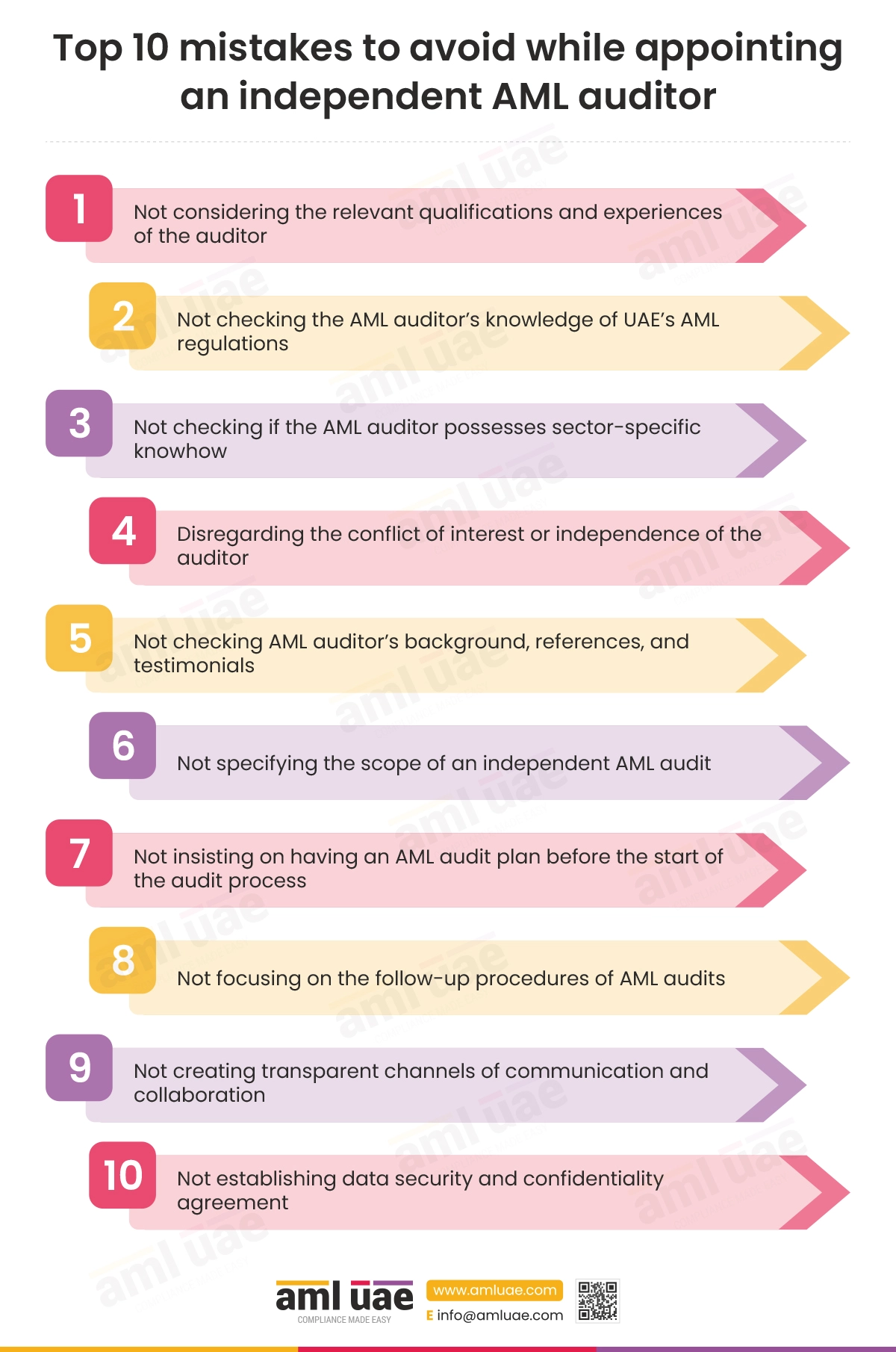
Top 10 mistakes to avoid while appointing an independent AML auditor

Pathik Shah

Table of Contents

Protect your business with reliable and effective AML strategies with AML UAE.

Appointing an independent AML auditor

Appointing an independent AML auditor is one of the crucial functions of the senior management. Anti-Money Laundering audits are necessary to inspect the quality and adequacy of AML policies, procedures, and controls. If these are enough, good; but if not, the authorities recommend corrective actions. Make auditing of the AML framework and the implementation thereof a regular activity.

To conduct such independent audits, you must appoint AML auditors. Some firms also prefer to outsource this task to an independent third party. If you prefer to appoint an internal person, ensure they are unrelated to the AML/CFT team to ensure their independence.

Entities make some common mistakes while appointing an independent AML auditor. You must avoid these mistakes to ensure top-quality audit results. You must include all the critical aspects in your AML auditor appointment process.

What is an independent AML audit?

An independent AML audit means a review of an entity’s AML framework. It evaluates whether the entity’s AML program is enough for the level of risks it faces. It also checks the quality of AML initiatives to prevent money laundering threats. Auditors check whether the entity is doing what is written in the framework.

Thus, an independent AML audit checks the following:

With all these assessments, the AML auditor can identify loopholes in your AML framework and implementation thereof. You can improve them to prevent and mitigate ML/FT threats effectively. Thus, independent AML audits aim to strengthen your AML framework and initiatives. You can check its importance and benefits in our blog, “Why is an Independent AML Audit Necessary?

What is the need for an independent AML auditor?

The auditors help you identify gaps in your AML/CFT framework and the practical implementation thereof. This helps you fight ML/FT better and comply with legal requirements.

If you want to understand the role of an independent AML auditor in UAE, you can check our blog, “Role of an Auditor Under UAE AML Compliance”.

Worried about the adequacy and efficiency
of your AML framework?

Partner with us to strengthen your defences against ML and FT threats.

Top 10 mistakes to avoid while appointing an independent AML auditor

While appointing an independent AML auditor, you must avoid the following mistakes:

1. Not considering the relevant qualifications and experiences of the auditor

The first factor entities look for in any candidate for any job is relevant qualifications and experience. The same is the case here.

An auditor needs to have relevant qualifications for the job. With no education in auditing, it is nearly impossible to work on the main tasks of the job. So, if you need an independent AML auditor, you must check the applicant’s qualifications.

Also, auditing experience is a must. Relevant auditing experience ensures that the auditor performs his job well.

2. Not checking the AML auditor’s knowledge of UAE’s AML regulations

The AML auditor must have complete knowledge of the UAE’s AML regulations. They must know the key provisions and implications for an entity. Also, knowledge of the chief aspects to look for in an entity’s AML framework is crucial. The auditor must know the global best practices and the relevant standards issued by the FATF.

They must also have the zest to stay up-to-date on these regulations and changes. Because as laws change, you must tweak your auditing process and criteria. So, keep an eye on this aspect.

3. Not checking if the AML auditor possesses sector-specific knowhow

An AML auditor’s job is a specialised skill job. The auditor must understand the industry risks and possible ML/FT threats. The absence of industry expertise can lead to inadequate or ineffective audit reports. It will not serve your purpose.

So, select an AML auditor who knows the industry risks, trends, and regulations. The regulatory nuances and guidelines differ for each industry. The red flags, reports to submit, and risk types are distinct. The auditor must be familiar with such industry specificities and relevant risks.

So, ensure checking the auditor’s expertise in industry aspects before appointing them.

4. Disregarding the conflict of interest or independence of the auditor

What are your expectations from the AML audit?

An accurate picture of where your AML framework stands and what improvements it needs.

An AML auditor can only show you such an accurate picture if there is no conflict of interest. For example, the audit might be partial if the auditor has close relations with your senior management or any other stakeholder. They might not speak about the real issues with your AML framework.

Such biased, good reviews are pleasing to the eyes and ears. But they are detrimental to your AML compliance. The audit’s effectiveness is questionable. So, stay cautious of such audits and auditors. Check the auditor’s independence to save your AML audit’s objectivity.

5. Not checking AML auditor’s background, references, and testimonials

It always helps to check an AML auditor’s background, references and testimonials. Conduct reference checks by contacting past clients who received their AML auditing services. Check their satisfaction with the auditor’s AML auditing quality and accuracy.

Background check is also essential to see the AML auditor’s relation with any ML and FT activities. Even if not ML/FT, any association with corruption, bribery, trafficking, or other illicit financial activities makes an auditor questionable; their close relation with people involved in such financial crimes is also a concern. So, check all these aspects before deciding on an AML auditor.

Ensure checking the track record of the AML auditor in the appointment process.

Appointing an independent AML Auditor

6. Not specifying the scope of an independent AML audit

Before shortlisting auditors for an independent audit of your AML framework, understand your requirements. You must enlist your requirements and expectations and define the scope of an independent AML audit.

So, define the objectives of your AML audit process. Mention the scope and expected deliverables from the auditor. Also, mention the areas or risks you want the auditor to focus on. All these must be set before the appointment process starts. Such clarity on your AML requirements lets you express it to auditors to know their take.

7. Not insisting on having an AML audit plan before the start of the audit process

Before appointing an independent AML auditor, check the auditor’s auditing plan. If it is not customised to your needs, think about it again.

So, check with the auditor about their plan for your entity’s AML audit. It would be best if you had answers to the following questions:

  • Does it address industry-specific AML issues?
  • Is it a complete plan enough to audit your AML initiatives?
  • Does the auditor have the necessary resources to conduct an audit?

Answers to these questions are essential for an AML audit unique to your organisation. You have unique risks, risk appetite and tolerance, and AML controls. Also, the audit would not be successful if the essential resources were missing.

So, try to get a customised auditing approach from the AML auditor, including timelines, budget, and resources.

8. Not focusing on the follow-up procedures of AML audits

While appointing an AML auditor, you must also prepare for the audit process. Once the auditor starts auditing your AML initiatives, you must be ready to implement corrective actions. So, start preparing yourself for the follow-up.

The auditor will give you a list of weaknesses or loopholes in your AML frameworks. They will also provide the necessary corrective actions to take. So, at the end moment, you cannot just say no to executing these corrective measures. You must prepare your employees, finances, and projects to take care of the AML issue resolution.

If you ignore these follow-up procedures, you cannot resolve the loopholes. The result is high vulnerability to money laundering and other financial crimes.

9. Not creating transparent channels of communication and collaboration

Communication is vital for any business relationship. You have to communicate your requirements and expectations. Moreover, the AML auditor will communicate the results – loopholes and recommendations. To facilitate this, you must have smooth channels of communication.

Like this, collaboration is also crucial to making the AML auditing exercise successful. Collaboration is possible when you communicate frequently with the auditor on all aspects of the project. So, adopt the following practices to cooperate better with the AML auditor:

  • Set a single point of contact in your team
  • Mention the mediums of communication – mail, call, etc.
  • Allocate persons handling different aspects of the AML audit project
  • Have frequent meetings to discuss all the findings

All these collaborative exercises will help you address issues and achieve desired outcomes.

10. Not establishing data security and confidentiality agreement

When appointing an independent AML auditor, signing an agreement is crucial. The agreement will have terms and conditions on pricing, timelines, and allocated resources. Another important constituent of this agreement must be data security provisions.

The auditor will have access to all your AML processes and data during the auditing process. So, they must have solid measures in place to protect data confidentiality. They must use secure systems for auditing and permit accessibility to relevant persons.

Key takeaways

Avoid the above mistakes while appointing an independent AML auditor. You can appoint such a person internally or externally. If internal, they must not be from the AML compliance or customer-facing team. But if you do not have internal expertise, getting external help is a better solution.

By appointing an external AML auditor, you can get faster and more accurate audits. You have access to the expertise and specialisation of an experienced AML auditor. You can enjoy detailed, efficient audit reports with positive repercussions for your business. These efficient audits ensure no questions from the regulators on your AML compliance.

AML UAE’s pivotal role in your AML compliance

AML UAE is a leading provider of AML compliance services in the UAE. We help you in your journey of creating and implementing initiatives and practices to comply with AML laws in the UAE. We develop, execute, review, and improve AML policies and procedures for your business.

Our professionals have relevant expertise in risk management and AML consulting services. We help you have systems and controls in adherence to the latest AML regulations of UAE. We commit to AML initiatives and ensure your commitment to the same. These initiatives help you prevent, manage, and mitigate money laundering threats. We help entities with AML health checks and independent AML audits.

Get a new, external perspective on your AML initiatives from an independent AML auditor.

Schedule a consultation with our AML experts.

Share via :

About the Author

Pathik Shah

FCA, CAMS, CISA, CS, DISA (ICAI), FAFP (ICAI)

Pathik is an ACAMS-certified AML consultant specialising in governance, risk, and compliance for regulated entities in the UAE. He brings over 28 years of experience, with 1,000+ hours of AML training and 200+ advisory engagements across DNFBPs, VASPs, and FIs. He supports businesses in aligning with AML/CFT requirements from the CBUAE, DFSA, MoET, MoJ, VARA, CMA, FSRA, and FATF. Known for translating complex regulations into audit-ready procedures, Pathik enables operational clarity and compliance readiness.

Reach Out to Pathik

Securing the NFT Ecosystem Complete Guide

Securing the NFT Ecosystem Complete Guide

Securing the NFT Ecosystem Complete Guide

NFTs are blockchain-based tokens depicting various art forms – painting, music, games, and many more. This technological advancement provided new room for money launderers to develop new typologies to exploit the same and transfer illegally obtained funds through misuse of NFTs.

In an effort to prevent NFT money laundering, we have introduced this comprehensive guide that covers the following:

  • A basic understanding of NFTs and how they are different from cryptocurrencies
  • The reasons why NFTs attract money launderers, such as instant transfer of ownership, no geographical restrictions, and smart contracts in the NFT market.
  • Methods used for conducting NFT money laundering: Wash Trading and Standard Money Laundering
  • Key AML measures and responsibilities to curb NFT money laundering

After going through this guide, you’ll learn about implementing the right measures in your AML program to prevent money laundering through the NFT ecosystem. Check out the booklet now!

Our timely and accurate AML consulting services

For your smooth journey towards your goals

Share via :

Share via :

Tax Evasion red flags, typologies, and control measures

Tax Evasion red flags, typologies, and control measures

Tax Evasion red flags, typologies, and control measures

Tax evasion is a global issue that is closely associated with money laundering. Tax evasion has been criminalized globally, and the undisclosed proceeds are considered the proceeds of crime. The criminals try to legitimize such illicit money, and such attempts are nothing but money laundering. Tax evasion typologies are techniques employed by criminals to legitimize money. Red flags are warning signals indicating the possibility of money laundering or terrorist financing. Regulated entities are required to implement various measures to counter tax evasion and potential money laundering or terrorist financing.

Tax evasion definition

Tax evasion is a financial crime involving misrepresentation of the taxpayer’s financial position with a motive to avoid taxation.

Tax evasion red flags: Indicators for tax evasion and potential ML/TF

  • Unreasonable business expenses
  • Frequent amendments in tax returns
  • Formation of an offshore company without a sound business rationale
  • Inconsistent information – different accounting information in VAT, customs, and corporate tax returns
  • Sustained business losses
  • Consistently late submission of regulatory requirements
  • Multiple Tax Identification Numbers
  • Transactions inconsistent with customer profile
  • Overly complex business structure without justification
  • International bank account with no local footprint
  • Cash-intensive business
  • Transactions with high-risk jurisdictions
  • Customers demanding a high level of secrecy and confidentiality
  • The customer does not cooperate with the KYC and CDD requirements
  • Sudden closure of a business after completing a few high-value transactions
  • Frequent changes in auditors, lawyers, and business advisors
  • A sudden increase in revenues of a company
  • Bearer shares
  • Source of Wealth and Source of Fund documents cannot be obtained
  • Frequent deposits from unknown and unexplained sources
  • Use of common address by several companies
  • Purchase or sales invoices not available for verification
  • Adverse media matches for tax crimes
  • A large number of people on payroll without business justification
  • Huge amount of liquid cash and cash equivalents with no clear explanation as to why

Typologies: Techniques used for tax evasion and potential ML/TF

  • Structuring/Smurfing
  • The intermingling of cash with legitimate business income
  • Under/overvaluation of goods and services
  • Circular/round-tripping transactions
  • Crypto transactions
  • Personal expenses charges to the business account
  • Frequent cash withdrawals
  • High level of cash expenses and transactions
  • Use of third-party accounts for business transactions
  • Operating two different companies with the same name in two different jurisdictions
  • False invoices, statements, and documents
  • Dual citizenship or tax residence
  • Wire transfers to multiple jurisdictions
  • Rubber stamping = the company is operated with the direction of an unknown beneficial owner
  • Usage of false identities (identity fraud) to make business transactions
  • Use of stolen identity to commit VAT/corporate tax fraud
  • Use of false identity to open bank accounts
  • Creation of shell companies
  • Bogus claims
  • Underreporting of business income
  • Use of offshore tax havens for billing purposes
  • Transfer pricing abuse
  • Claiming false tax deductions
  • Drug trafficking
  • Purchase of multiple properties/luxury items to place the proceeds of crime
  • Bribery

Control measures to counter tax evasion and potential ML/TF

  • Enterprise-Wide Risk Assessment
  • AML/CFT program
  • Robust KYC and CDD mechanisms
  • Enhanced Due Diligence (EDD) for high-risk customers
  • Transaction Monitoring
  • Submission of SAR/STR in case of a suspicion
  • Accepting only bank payments and avoiding cash and cryptocurrencies
  • Top management oversight

Related Posts

Why is AML training critical for your employees?

AML training critical for your employees

Pathik Shah

Table of Contents

Protect your business with reliable and effective AML strategies with AML UAE.

Why is AML training critical for your employees?

Awareness of money laundering threats and mitigating measures is essential for any company to safeguard the business from being exploited by financial criminals. Awareness of threats allows people to use the right action plans to combat the same.  

AML Compliance Officer cannot single-handedly identify and fight the money laundering threats. He needs support from every single employee of the company. And here comes the need to train the employees. If you train your employees on money laundering threats, they can take steps to manage or reduce ML/FT risks. AML training is crucial to any organization’s overall AM/CFT framework.

Role of AML Compliance Officer in UAE Preview

The legal requirement of AML training under UAE regulations 

The primary AML law of UAE is Federal Decree by Law No. (10) of 2025 Regarding Anti-Money Laundering, and Combating the Financing of Terrorism and Proliferation Financing. The Cabinet Resolution No. (134) of 2025 makes several provisions for implementing the AML law. Article 21 of this Decision lists the requirement of conducting training programs for employees as one of the responsibilities of the AML Compliance Officer.  

AML training critical for your employees

Significance of AML training 

Organized criminals launder dirty money into the financial system, using legit business organizations as their means. Without well-trained employees, business organizations could not detect such crimes being executed through them. An AML-trained employee would act as a line of defense and contribute towards making the company a hostile setting for laundering money.  

Some companies say they know all their clients and do not expect any threat from them. Some say that they are too small to conduct training for employees. Whatever the case is, AML training is vital to keep money laundering risks at bay.  

Financial criminals do not attack a business based on size or business-client relationship. They keep looking for new tactics to launder small or significant amounts of money through any method, with the only intention of not getting caught. So, every firm to whom AML regulations are applicable must conduct AML training for its employees, making employees capable enough to identify suspicious activities and report the same promptly.  

AML training is essential for the following reasons: 

To comply with regulatory requirements 

It is mandatory for Financial Institutions, Designated Non-Financial Businesses and Professions (DNFBP), and Virtual Asset Service Providers (VASP) to comply with AML regulations and their requirements. As one of the requirements is to conduct ongoing AML training for the staff, all the obligated entities shall comply with the same to avoid non-compliance penalties and ensure a better AML framework to fight money laundering (ML) and financing of terrorism (FT).  

With all these requirements, employees need to know their role in fighting ML/FT and how to do their duties. They must know the trending anti-money laundering typologies to identify the threats in routine business operations quickly.

Consequences for Non-compliance with UAE AML Regulations

To prevent the occurrence of financial crimes in the country 

When financial criminals launder money, they use it for another set of illegal activities. Drug traffickers, human traffickers, terrorists, etc., use this dirty money to expand their activities. Thus, it affects the social structure of the country. It requires the government to take more effective steps to combat this crime. Unless every business organization contributes to the government’s plan to combat these crimes, the country cannot be saved from these crimes. And for every organization to join this effort, employees must be well-trained and well-equipped to fight ML/FT. 

Training on AML develops employees’ knowledge about money laundering and the measures required to fight against it. They learn about the working of international, national, and corporate AML compliance strategies. The organization and its staff understand how they can contribute better to prevent financial crimes. 

A guide to Anti Money Laundering AML Laws in UAE

To safeguard the business and its reputation

Companies need skillful and knowledgeable employees to implement a robust AML framework to safeguard the business from being exploited by money launderers.  

AML training brings a consistent understanding, across all levels, of the importance of AML compliance and their role in identifying ML/FT threats to save the company and its reputation. All the employees, including the senior management, stay more aligned with AML-related organizational objectives, resulting in the more successful adoption of the AML/CFT compliance program.  

To ensure proper AML compliance-related role allocation 

AML training for employees helps you determine proper AML roles for employees. With focused training, the organization can identify what role a particular employee is suitable for. If someone is good at identifying ML/FT red flags, you can allocate the task of customer onboarding and ongoing customer/transaction monitoring. If someone is good at documentation and administrative role, you can assign them the task of overall AML record-keeping and reporting requirements. 

Through the extensive AML training programs, employees develop skills that help them ensure AML compliance and protect their business organization from being vulnerable to money laundering or terrorism financing.

Participants in AML training 

All the relevant employees handling customers, transactions, and delivery channels must receive adequate AML training, whether a full-time employee or a part-time or contractual one. If they, in any way, are involved in activities related to customer-servicing or business partner interactions, they must receive the necessary training around AML and CFT.  

As the AML Compliance Officer is the person running the show, he must be well-trained, well-qualified, and well-aware of the basic AML concepts, regulatory obligations, roles, and responsibilities to handle the AML/CFT framework of the company, etc. 

Responsibilities of Senior Management around AML program under UAE AML Laws

AML Training requirement is not just limited to front-line employees; AML training is also critical for senior management. Senior management is responsible for implementing an effective and comprehensive AML compliance program. They need to understand the basic concepts and regulatory requirements to efficiently manage the AML framework across the organization. Thus, senior management shall also be included in training programs and lead by example. 

AML UAE – your partner for AML training
requirements

Contact us now, and let's get started.

Topics of AML training 

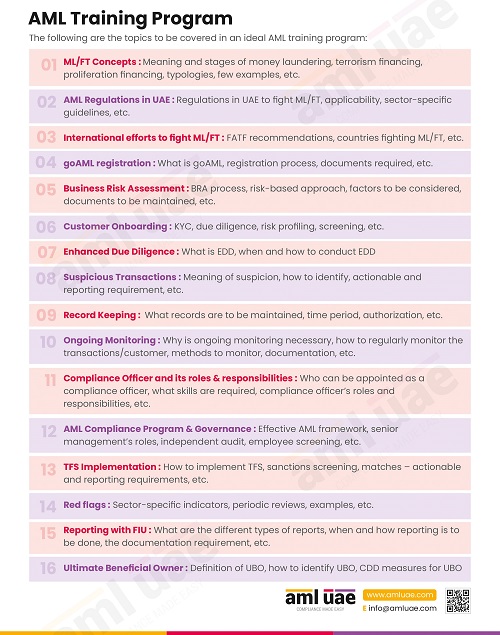
Employees must understand that AML training is essential to tackle financial crime. A solid AML training module shall consist of a basic understanding of ML/FT and sector-specific typologies, the company’s internal AML policy and procedures, regulatory requirements, employee roles and responsibilities, etc.  

Ideally, it is recommended to impart training on the following aspects to every core-business employee: 

One of the best practices of AML training includes teaching real-life cases of money laundering transactions. Through such cases, you can teach them: 

  • How to detect a threat 
  • Impact of the threat on business 
  • What steps to take after the detection 
  • Reporting and recording of the case 

After providing the relevant training, you must conduct a test to check if employees have understood whatever is taught. Along with theoretical understanding, you can check their knowledge by giving some practical examples.  

Designing a comprehensive AML Training Program

Methods of imparting AML training 

You can conduct either offline or online training for your employees.   

You must also consider whether you will train them in all aspects in one go. Another option is to design short training modules and spread them over a month to ensure work does not suffer.  

Internal or external training is another choice you need to make. You can choose the AML Compliance Officer as the trainer or hire an outside AML expert to conduct these training sessions for your employees. 

Frequency of AML training 

The AML regulation provides for ongoing AML training programs for the employees. You must impart training to refresh some of the most important concepts. You can organize it on an ongoing basis to ensure your employees are up-to-date. But if you are operating in an industry with high risks of money laundering, you must increase the training frequency.  

You can impart training as and when there are updates in AML regulations or the development of new money laundering techniques. Even with a new AML technology or solution, you must train employees on how to use it.  

Whenever new employees join positions requiring AML training, you must impart relevant training to the earliest.  

Generally, organizations conduct frequent and detailed training for their front-line employees and the Compliance Officer, as they serve as a primary line of AML defense. 

All-encompassing AML training for your
business just a call away.

Contact us now, and let's get started.

AML training-related record-keeping 

Maintaining the AML training logs is one of the AML documentation requirements, which includes the following information: 

  • Training topics covered 
  • Nature of training 
  • Duration, along with start and end date and time 
  • Names, designation, roles, and responsibilities of participants  
  • Results of the assessment test, if any, conducted post training 
  • A detailed description of the material discussed 

You must also maintain the materials used for AML training of employees for further reference.

AML Record Keeping

Support from AML UAE 

With the best quality AML training, you can save your business from being exposed to money laundering and terrorism financing threats. To meet this AML requirement, you must take the help of an expert AML consultant. The AML consultant will ensure that you comply with all the requirements to avoid non-compliance penalties and safeguard your business.  

AML UAE is a leading provider of AML compliance services to its clients in the UAE. We help you understand the importance of AML training and impart training on relevant courses. We help clients: 

  • Identify the training requirements as per the business size and industry 
  • Design and develop customized AML training programs  
  • Execute them with the help of our AML experts 
  • Provide relevant training materials as resources for future use 
  • Assess employees’ knowledge post-training with suitable tests and quizzes 

So, let’s design a suitable training program for your AML needs.  

Besides AML training, we also support you in documenting and implementing an effective AML framework, conducting AML business risk assessment, and managing your customer onboarding process.  

FAQs on AML Training

Why is AML training important?

AML Training is very important for employees to ensure that employees understand AML compliance requirements and implement necessary AML measures in course of routine business operations to adhere to laws and safeguard the business. Likewise, AML training is crucial for senior management to set the right AML tone at the top, promote strong compliance culture and make management aware of their roles and responsibilities towards AML program, like approval for AML Program, appointing AML Compliance Officer, approving onboarding of high-risk clients, etc.

The following are the main components of AML training:

  • Basic understanding of AML/CFT
  • Applicable AML/CFT regulations
  • Enterprise-Wide Risk Assessment and Risk-Based Approach
  • Internal AML/CFT policies and procedures
  • Customer Due Diligence, including Enhanced Due Diligence
  • Red flags (ML/FT/PF) – identifying and reporting suspicious transactions
  • goAML reporting
  • AML governance
  • Targeted Financial Sanctions compliance
  • Measures to counter proliferation financing
  • AML Record Keeping

Generally, the frequency of the AML training depends on the entity’s risk assessment. However, annual AML training for all employees is a must. Further, the new employees must be trained in AML at the time of joining.

The key objectives of the AML training are:

  • AML awareness amongst employees
  • Promoting employee engagement and contribution around AML

AML training program should typically include understanding of AML regulatory obligations, entity’s internal AML program, discussion on red flags and internal reporting mechanism when any risk indicator is identified. Training program must include job-specific AML courses as well.

AML Compliance Officer is entrusted the function of developing a robust AML training and development program for the employees. The Compliance Officer must evaluate the training needs and ensure adequate learning sessions are conducted.

All-encompassing AML training for your
business just a call away.

Contact us now, and let's get started.

Share via :

About the Author

Jyoti Maheshwari

CAMS, ACA

Jyoti has over 11 years of hands-on experience in regulatory compliance, policymaking, risk management, technology consultancy, and implementation. She holds vast experience with Anti-Money Laundering rules and regulations and helps companies deploy adequate mitigation measures and comply with legal requirements. Jyoti has been instrumental in optimizing business processes, documenting business requirements, preparing FRD, BRD, and SRS, and implementing IT solutions.

Reach Out to Jyoti

Video on Factors for AML Enterprise Wide Risk Assessment

Video on Factors for AML Enterprise Wide Risk Assessment

Video on Factors for AML Enterprise Wide Risk Assessment

Video on Factors for AML Enterprise-Wide Risk Assessment

The Enterprise Risk Assessment (EWRA)/ Business Risk Assessment is vital in ensuring AML compliance.

The reporting entities (Financial Institutions, DNFBPs and VASPs) shall conduct ERWA considering the relevant risk factors, their likelihood of occurrence, and countermeasures deployed.

It should help determine the level of risk exposure of the company. Based on EWRA, the entity needs to design its AML/CFT policies and procedures and lay down controls to counter the risks of ML/TF and remain compliant with AML regulations. The EWRA takes into account qualitative and quantitative aspects.

This video helps in understanding various risk factors:

  • Customer risk
  • Geographic risk
  • Product/ Services risk
  • Transaction risk
  • Delivery channel risk
  • Technology risk
  • Other relevant risk factors depending on the nature and size of the business.

Share via :

Share via :

Video on Independent AML Audit

Video on Independent AML Audit

Video on Independent AML Audit

Video on Independent AML Audit

To safeguard the reporting entities (Financial Institutions, DNFBPs and VASPs) from financial crime risks and to remain compliant with AML requirements, an AML Audit must be conducted independently by competent personnel on a periodic basis to ensure that the AML Program of the entity is consistent with AML rules and regulations.

AML Audit is entirely different from a financial audit of the books of accounts. The Independent AML Audit verifies the entity’s AML/CFT compliance framework.

The audit helps to identify gaps in the existing AML Program, detect loopholes and recommend best practices to bridge the gaps. To bridge the gap, the AML Auditor may recommend the implementation of additional controls, developing or enhancing the AML training programs, and adopting new technological solutions to strengthen the AML capabilities. Further, the AML auditor must be aware of the latest regulatory amendments and understand the AML obligations of the particular entity. This video explains:

  • What is an Independent AML Audit?
  • Why is it needed?
  • Who can perform an independent AML audit?

Chapters:

  • 0:00 Introduction to Independent AML Audit
  • 0:47 What is an Independent AML Audit
  • 1:36 Why an Independent AML Audit is necessary
  • 1:54 Reasons to carry out Independent AML Audit
  • 3:09 Who can conduct AML Audits
  • 4:08 Conclusion and regards

Related Infographics

Share via :

Share via :

Video on Suspicious Activity vs. Suspicious Transaction

Video on Suspicious Activity vs. Suspicious Transaction

Video on Suspicious Activity vs. Suspicious Transaction

A Suspicious Activity Report (SAR) differs from Suspicious Transaction Report (STR) mainly due to elements of suspicious activity or transaction. SAR comes into picture where suspicious activity is identified, whereas STR comes into picure where suspicious transaction is identified.

According to AML UAE regulations, the reporting entities (Financial Institutions, DNFBPs and Virtual Asset Service Providers) must comply with reporting requirements with FIU on the goAML portal. Based on the red flags identified concerning any suspicious activity/ transaction, the entities must report the same to FIU on the goAML portal by filing a Suspicious Activity Report (SAR)/ Suspicious Transaction Report (STR).

SAR means to report any suspicious activity in case of attempted or unexecuted transactions before establishing a relationship with the customer. In contrast, STR means to report any suspicious transaction when the transaction has already been executed, or funds transfer has been initiated or concluded, even if the supply of goods/ services is pending.

Share via :

Share via :