
Decoding EWRA: Mastering Risk Weighting for Comprehensive Risk Assessment

Decoding EWRA: Mastering Risk Weighting for Comprehensive Risk Assessment

Decoding EWRA: Mastering Risk Weighting for Comprehensive Risk Assessment

Enterprise-Wide Risk Assessment helps a company adopt a risk-based approach and apply controls commensurate with the risks. While performing EWRA, one of the essential aspects to consider is the weightage to be provided to the variety of risks the company is exposed to. If the risk weightage isn’t adequately assigned, the resultant risk scoring wouldn’t be appropriate.

The above infographic highlights various considerations while determining the risk weightage for risk factors a company is exposed to. An objective methodology will help organizations customise risk assessment as different risk factors carry a different degree of risk.

Further, the risk weighting helps deploy the appropriate resources to counter the risks, as not all risks are equal. High-risk scenarios require Enhanced Due Diligence, and assigning appropriate risk weights ensures enhanced scrutiny is conducted for high-risk clients.

The assessment of risk weights helps document AML/CFT policies and procedures in line with the EWRA. Once the risks are appropriately weighted, they help management make informed business decisions.

Adopting a scientific methodology in assigning risk weights is pivotal for a robust AML/CFT framework. It helps comply with the legal framework and keep ML/FT risks at bay.

Related Posts

Video on Role of Senior Management towards AML

Video on Role of Senior Management towards AML

Video on Role of Senior Management towards AML

Video on Role of Senior Management towards AML

The reporting entities (financial institutions, DNFBPs, and VASPs) must have a robust program in place to ensure compliance with AML rules and regulations. Ensuring the same requires the support of senior management, which plays a vital role in AML compliance.

The reporting entities must design and implement AML Policies and Procedures to ensure compliance with all the mandatory requirements. One of Senior Management’s key responsibilities is appointing a Compliance Officer. The Senior Management has the following roles and responsibilities:

  • Appointment of Compliance Officer
  • Approving AML Policy
  • Approval to onboard high-risk customer
  • Appointment of an Independent AML Audit Auditor
  • Oversight of Third Parties
  • Reviewing AML Report
  • AML Issues fixing
  • Non-Tolerance and leading

Share via :

Share via :

Video on goAML Reporting requirement in UAE

Video on goAML Reporting requirement in UAE

Video on goAML Reporting requirement in UAE

Video on goAML Reporting requirement in UAE

Pursuant to UAE AML Rules and Regulations, Financial Institutions, DNFBPs, and Virtual Asset Service Providers must register on the goAML Portal to comply with timely reporting requirements with the FIU and the concerned supervisory authority.

The reporting entities are required to submit various reports on the goAML portal, depending upon the nature of the transaction. This video will help you understand various reports that must be filed under  UAE AML regulations.

  • Suspicious Transaction Report (STR)
  • Suspicious Activity Report (SAR)
  • Additional Information File without Transaction (AIF) 
  • Additional Information File with Transaction/s (AIFT) 
  • Request for Information without Transactions (RFI) 
  • Request for Information with Transaction/s (RFIT) 
  • High-Risk Country Transaction Report (HRC)
  • High-Risk Country Activity Report (HRCA)
  • Dealers in Precious Metals and Stones Report (DPMSR)
  • Real Estate Activity Report (REAR)
  • Confirmed Name Match Report (CNMR)
  • Partial Name Match Report (PNMR)

Chapters:

  • 0:00 Introduction on goAML Reporting Requirement in UAE
  • 0:24 Reports to be submitted by reporting entities
  • 1:12 Suspicious Transaction Reports (STR) and Suspicious Activity Report (SAR)
  • 1:54 High-Risk Country Transaction Report (HRC) and High-Risk Country Activity Report (HRCA)
  • 2:25 Dealers in Precious Metals and Stones Report (DPMSR)
  • 2:52 Real Estate Activity Report (REAR)
  • 3:15 Confirmed Name Match Report (CNMR) and Partial Name Match Report (PNMR)
  • 4:19 Short brief goAML Reporting Requirement

Related Infographics:

Related Templates:

Related Laws, Guidelines, Rules, and Regulations:

Share via :

Share via :

Determining the Customer’s Risk Profile

customer risk profile

Determining the Customer's Risk Profile

Determining the Customer's Risk Profile

Based on KYC/ KYB and screening, the reporting entities (Financial Institutions, DNFBPs and Virtual Asset Service Providers) must assess the risk associated and assign an appropriate risk rating to the customer.

The reporting entities shall assess the Customer Risk by classifying the customer risk profile depending upon the risks involved as unacceptable, high, medium, or low. The higher the risks, the more stringent controls must be in place to mitigate such risks.

In case customers are classified as “high-risk”, the reporting entities must apply Enhanced Due Diligence (EDD) measures. The following parameters can be considered while doing risk profiling:

  • Customer risk
  • Transaction risk
  • Customers Jurisdiction/ Geographical risk
  • Product/ Service risk
  • Delivery channel-related risk
  • Other relevant factors.

Share via :

Share via :

Essential Element of Sanctions Compliance in UAE – Filing Partial Name Match Report

Video on Filing Partial Name Match Report

Video on Filing Partial Name Match Report
Essential Element of Sanctions Compliance in UAE

Video on Filing Partial Name Match Report - Essential Element of Sanctions Compliance in UAE

The reporting entities (Financial Institutions, DNFBPs and Virtual Asset Service Providers) must comply with goAML reporting requirements with the Financial Intelligence Unit.

The reporting entities must screen their new/ existing customers based on the UNSC consolidated list and UAE local terrorist list before onboarding or carrying out any occasional transaction.

Based on sanction screening, if the entities find a potential match with the sanction list, then Reporting entities must suspend the transaction and file a Partial Name Match Report (PNMR) on the goAML portal.

Share via :

Share via :

Ultimate Beneficial Owners: Unveiling the real names

Video on Ultimate Beneficial Owners Unveiling the real names

Video on Ultimate Beneficial Owners: Unveiling the real names

Video on Ultimate Beneficial Owners: Unveiling the real names

The key element of Customer Due Diligence before onboarding corporate customers is to identify ultimate Beneficial Owners (UBO) and unveil their true identity to fight against money laundering and terrorist financing.

If UBO pertains to high risk, then the entity will also be treated as high risk, and Enhanced Due Diligence is to be conducted for both. UBO can only be a natural person. The following qualifies as UBO:

  • If a natural person has 25% or more ownership interest in an entity through direct or indirect shareholding
  • If a natural person holds 25% or more of the voting rights in an entity
  • If a natural person has the right to appoint or dismiss a majority of the managerial persons in the entity
  • If there is any other way by which a natural person exercises ultimate control over the entity
  • If UBO cannot be determined, then a natural person holding a senior managerial position in the entity would qualify as a UBO

Share via :

Share via :

Video on Upgrading AML Compliance with Employee Due Diligence

Upgrading AML Compliance with Employee Due Diligence

Video on Upgrading AML Compliance with Employee Due Diligence

Video on Upgrading AML Compliance with Employee Due Diligence

Before onboarding any employee, the organisation must conduct Employee Due Diligence to ensure that it does not pertain any risk to the organization. It is important to check the identity and background proof of employees before hiring them. By providing adequate training to employees, it would act as a line of defense, helps in keeping money laundering risks at bay and contribute towards making the organisation compliant with AML. This video highlights the importance of Employee Due Diligence.

  • Why to conduct Employee Due Diligence
  • Which Employees are to be screened
  • When to conduct Employee Due Diligence
  • How to conduct Employee Due Diligence

Chapters:

  • 0:00 Introduction on employee due diligence
  • 0:30 Procedure of employee due diligence
  • 1:04 WHY employee due diligence is essential
  • 1:39 WHICH employees are screened in employee due diligence
  • 2:11 WHEN to conduct employee due diligence
  • 2:32 HOW to conduct employee due diligence
  • 3:29 About the video

Related Infographics

Share via :

Share via :

AML Controls and Proactive Risk Management

AML Controls and Proactive Risk Management

AML Controls and Proactive Risk Management

To effectively combat financial crimes like money laundering and terrorism financing, the regulated entities must implement necessary controls and risk mitigation measures. Of all the AML controls, some could be general in nature, while some could be specific to target a particular type of risk.

Here is the infographic discussing the controls a regulated entity must develop and deploy as part of a financial risk management framework.

  • Establish baseline controls: Some controls are general in nature, yet important to implement to identify and manage the financial crime risk the business may face. These controls are important from adherence to the AML regulations perspective as well. This includes setting up an in-house AML compliance department and appointing a competent AML Compliance Officer to ensure an effective and comprehensive AML program. Developing an appropriate AML governance structure is also critical to baseline AML controls. All these controls work in tandem with the risk-specific controls, managing each task under the entire AML compliance framework.
  • Performing Enterprise-Wide Risk Assessment: To overcome the risk the regulated entity may be exposed to owing to the nature of its business operations, geographies, and the customers it is associated with, etc. it is essential to conduct the Enterprise-Wide Risk Assessment. EWRA empowers the entity to develop the business’s risk profile and determine the controls and resources for managing these assessed ML/FT risks. EWRA helps the regulated entity adopt a Risk-Based Approach. Based on the outcome of the EWRA, the regulated entity must develop an internal set of AML/CFT policies, procedures, and controls, targeting the timely identification of the risk indicators and efficiently managing the risks. These internally developed business-specific procedures and controls must be discussed with the staff, and necessary AML training must be imparted. EWRA, documented AML policies, and AML training is robust controls at the entity’s disposal, focusing on restricting the ML/FT attempts.
  • Establish Due Diligence Measures: It is the best process to identify the risks at the early stage and curb them before penetrating the business. For this, the regulated entity must establish and maintain robust Customer Due Diligence procedures that enable it to identify the customers and the risks they pose to the business before getting into a business relationship. As part of the AML Program, the entity must define the CDD process, including Know Your Customer (KYC), Screening, Customer Risk Profiling, etc. that shall be followed. Further, once the customer is onboard, the entity must monitor the customer’s profile and activities to ensure that the customer’s risk assessment is valid, and that the business relationship or transactions are not posing any newer risks to the business. This calls for maintaining accurate and complete data about the customer transaction and continuously monitoring the same to find any gaps or suspicions.
  • Perform Enhanced Due Diligence: Higher risk posing business relationships warrant stringent controls. For managing the customer identified as “high-risk”, the regulated entity must implement Enhanced Due Diligence measures, focusing on making more rigorous verification of the customer’s identity and overall profile, including understanding the customer’s source of funds and wealth. Such customers must be put to an increased ongoing monitoring program to make sure that the risk does not beyond the one assessed, and if required, additional checks and measures can be immediately implemented.

Developing a wholesome AML risk management framework is crucial to protect the business against vulnerabilities and comply with regulations.

Worried about defining the right AML controls and risk mitigation measures for your business? AML UAE is here to help you out. With years of experience and understanding of the AML regulations, we assist the regulated entities in developing the customized AML controls and risk mitigation measures, thriving to protect the business from any potential ML/FT threats.

Related Posts

Exclusive Webinar on Customer Risk Assessment

Customer risk Webinar

Pathik Shah

Exclusive Webinar on Customer Risk Assessment


PAST EVENT

🌟 Join Our Exclusive Webinar on Customer Risk Assessment! 🌟

📅 Date: 2nd December 2023

⏰ Time: 11:00 AM to 12 Noon (GST)

📍 Venue: Online

🌟 We are excited to bring you a unique opportunity to delve into the intricacies of Customer Risk Assessment with our esteemed AML expert, Dipali Vora. Join us for a compelling webinar where she will guide you through the critical aspects of assessing and categorizing customers based on their risk profiles.

🔍 Key Highlights:

✅ Expert Insights: Learn from industry leaders who have mastered the art of customer risk assessment. Gain invaluable insights into identifying, evaluating, and mitigating risks effectively.

✅ Best Practices: Discover the latest strategies and best practices to fortify your business against potential threats. Our experts will share actionable tips to implement robust risk assessment protocols.

✅ Case Studies: Benefit from real-world case studies illustrating successful customer risk assessment strategies and the consequences of inadequate assessments.

🔒 Why Attend?

By participating in this webinar, you will acquire practical insights to strengthen your Customer Risk Assessment processes, align with regulatory requirements, and mitigate risks effectively.

📝 Register now to secure your spot for this exclusive event! Don’t miss this chance to learn from an industry expert and ensure your customer risk assessment process aligns with international best practices.

📞 For inquiries, please drop us a mail: info@amluae.com

🌐 Stay ahead of evolving AML practices in the UAE. Join us for this enlightening webinar and empower your organization to effectively manage customer risks. Register now! 🌟

Share via :

About the Author

Pathik Shah

FCA, CAMS, CISA, CS, DISA (ICAI), FAFP (ICAI)

Pathik is an ACAMS-certified AML consultant specialising in governance, risk, and compliance for regulated entities in the UAE. He brings over 28 years of experience, with 1,000+ hours of AML training and 200+ advisory engagements across DNFBPs, VASPs, and FIs. He supports businesses in aligning with AML/CFT requirements from the CBUAE, DFSA, MoET, MoJ, VARA, CMA, FSRA, and FATF. Known for translating complex regulations into audit-ready procedures, Pathik enables operational clarity and compliance readiness.

Reach Out to Pathik

Comprehensive AML policies, procedures, and controls: Bolstering AML efforts

Comprehensive AML policies, procedures, and controls

Pathik Shah

Table of Contents

Protect your business with reliable and effective AML strategies with AML UAE.

Comprehensive AML policies, procedures, and controls: Bolstering AML efforts

Do you have a sound and robust plan to comply with the UAE AML regulations?

Are you well-prepared to prevent, mitigate, or manage money laundering and terrorism financing risks?

If you answer ‘YES’ to both these questions, you are doing it right. As a reporting entity in UAE, the AML/CFT laws and regulations mandate that you fulfil your legal obligations. To do this, you must create an appropriate AML compliance program. It must contain the policies, procedures, and controls to manage the threats of financial crimes.

Moreover, it is also crucial to document it. Once you document it, you are sincere in your approach. Also, all the employees, management, and executives know about the AML measures. People are more dedicated to following rules in a written format. So, write it down for earnest preparation and practice.

You must be cautious of common errors while writing the AML policies, procedures, and controls. These blunders can impact your measures’ efficiency or lead to imperfect compliance. So, to ensure effective AML compliance, follow the best practices.

We list the missteps that you need to be aware of. The missteps, in this case, are generally forgetting to include the necessary points and including the redundant items. If you are careful about them, you can have an impact-creating AML compliance journey.

Let’s look at the necessary inclusions first, followed by the exclusions.

AML Compliance Requirements in UAE

Essential inclusions in AML policies, procedures, and controls

You must follow UAE’s laws and FATF’s recommendations while writing your AML policies, procedures, and controls. This is how you can align with the global AML compliance best practices. The following are the inclusions you must have:

Checklist for implementing an effective AML Program

Mandatory regulations to follow

The first thing that needs your attention is the legislation you must follow. You must mention the UAE AML regulations and rules you must follow to achieve compliance.

Ensure that they are up-to-date and accurate for your industry vertical. Also, mention the same for all jurisdictions you operate your business from.

Moreover, you must include the primary provisions to be adhered to over the period – like your annual, semi-annual, quarterly, or monthly compliance requirements. It allows you to track your compliance status with the regulatory obligations.

Goals, objectives, and commitment to AML

Your AML policy must include the significant goals you aim to achieve. These can include achieving AML compliance and improving your business reputation, among others. Mentioning this helps you and your team stay aligned and focused. You can keep striving to achieve those goals.

Prove with words your commitment to this AML policy. Many companies create an AML policy. But not everyone can commit to following it. You must show the steps to follow it and achieve the objectives. Thus, you confirm your intent to detect money laundering risks and take corrective actions.

Risk assessment procedures and system

You must include the risk identification, assessment, and management procedures. This includes listing the potential risks emitting factors like customers, products/services you offer, the geographies to associate with, delivery channels used, etc.

Explain the procedure for identifying the risks under different scenarios. Enumerate the methods you’ll use to assess each risk and assign an appropriate score. Also, describe the possible measures to manage or mitigate these risks.

KYC and CDD measures – list and process

KYC (Know Your Customer) and CDD (Customer Due Diligence) are vital measures for protecting your firm from money laundering threats. It is a way to identify and verify your customers before engaging in business relationships. You must not onboard customers who do not fulfil these requirements.

So, for this, you must mention your business’s KYC and CDD program. You must include information on the following:

  • What are the documents you need from customers?
  • What are the criteria for customer acceptance?
  • When will you perform the necessary checks?
  • What is your process of due diligence?
  • How will you verify the information from existing and potential customers?
  • How the Customer Risk Assessment would be conducted?
  • What information and risk criteria would be considered for assessing customer risks?
  • When will you conduct Enhanced Due Diligence (EDD)?
  • What measures would be applied as part of the EDD process?
  • How onboarding of Politically Exposed Persons (PEP) would be handled?

All these information points are essential in KYC and CDD measures. You must answer these questions in the AML policy to clarify their execution.

Elements of the Customer Due Diligence Process

Transaction monitoring process and technology

One factor that enhances your AML compliance is the constant monitoring of transactions. You need it to identify suspicious transactions and prevent their occurrence to reduce your risks.

It would be best if you defined the red flags in your industry to detect suspicious transactions. You must also mention the technology systems or software used for transaction monitoring. Also, define the monitoring rules and threshold for monitoring transactions and its review.

The AML policy must list the actions to take – alerting, reporting, and managing – upon identifying a suspicious transaction. It must also mention the time duration for each action as a rule. In a way, it must clarify the Dos and Don’ts for the team handling transaction monitoring.

Reporting requirements under the law

Submitting reports to the FIU is a significant part of your AML compliance in the UAE. According to the AML regulations, you are required to submit the following reports:

You must list these reports, the relevant formats for each, and whom to report to. You must also mention the deadlines for each to avoid missing them. Specifying the person responsible, expected information to be captured, and the procedure for making reports is also crucial.

Record keeping

The AML policy, procedures, and internal controls must include your record-keeping procedures. It must have:

  • List of the records you must maintain
  • Copies of documents submitted to FIU
  • Format and templates
  • Mandatory information and data
  • Duration for maintaining each record
  • Person/team responsible

All this information is essential to ensuring the teams’ diligence in performing their duties. You might use them anytime in the future to revise AML plans or monitor the business relationship. Also, you can submit them to FIU or any other AML Supervisory Authority to provide necessary information when needed.

AML Record Keeping

Internal communication and reporting workflow

Communication workflow is an essential part of the AML policy but is often ignored. Companies forget to define this segment. But, it is crucial to enable smooth and on-time occurrence of AML activities and tasks.

So, you must define the following:

  • The reporting structure, specifically for the AML compliance team
  • The reports and actions that need approvals and from whom
  • The cycles of feedback and reviews a report will go through
  • Communication between AML compliance and customer-facing teams
  • Communication mediums used within the business

A clear definition of these aspects will help streamline the operations.

Details on the Compliance officer and dedicated team

One of your AML policy’s crucial points is the AML compliance team and the AML Compliance Officer. You must mention this in the policy. It must include information on the following:

  • Name of the Compliance Officer (CO)
  • Rights of the CO and the team
  • Responsibilities and duties of each team member and CO
  • The reporting structure of the team

A clear definition of these points makes it easier for the responsible persons to do their duties. Also, the top management is aware of what is happening in AML compliance in the company. It ensures the company as a whole that practical actions are being undertaken for AML compliance.

Role of AML Compliance Officer in UAE Preview

A list of the performance metrics

A plan without key performance indicators is incomplete. Since it mentions what you aim to achieve, you must have the metrics to measure its achievement. So, include the performance metrics for your AML policy, procedures, and controls.

It can be something along the lines of:

  • On-time submission of relevant reports
  • Accurate identification of suspicious transactions
  • Adequate completion of risk profiling of customers
  • Proper creation and maintenance of all records

Training needs of employees and execution plan

A crucial requirement for AML compliance is your employees’ alignment with it. AML can be a new concept for your employees, so their knowledge is vital. Also, AML compliance procedures will change internal operations, so employees must accept the changes.

Your AML policy must include information on all these points. You must list the following:

  • Different types of AML training programs
  • Methods of conducting them
  • Possible syllabus for each program
  • Duration and frequency of conducting such programs
  • Change management plans in the business

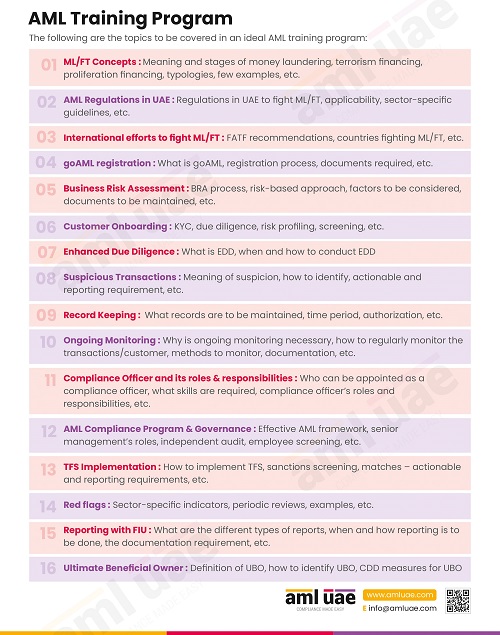
By mentioning these points, every new and existing employee is aware of the expectations from them. They will know what employee training programs they have to undertake. Also, you get an idea of the relevant execution plan and budget for such programs.

Designing a comprehensive AML Training Program

Audit and review strategy for AML policy

Another crucial ingredient of the AML policy is the audit and review strategy. It evaluates your existing AML policies, procedures, and internal controls.

You must have an audit strategy to determine your policy’s accuracy, quality, and completeness. It helps you to know whether the AML policy is sufficient to comply with the AML laws in UAE. This audit and review strategy assesses the following:

  • Risk assessment procedures
  • Transaction monitoring systems
  • KYC and CDD measures you have implemented
  • Training programs for your employees
  • Effectiveness and accuracy of reports generated and filed with FIU

Thus, you can know how efficiently your AML policy responds to money laundering threats.

Independent AML Audit

Exclusions in AML policies, procedures, and controls

Impractical expectations

You have your AML goals and objectives to achieve. The AML regulations are in place in the UAE. You know you have to follow them. But that does not mean you will set unrealistic prospects for your business. So, be careful while setting processes, procedures, measures, controls, responsibilities, and commitments.

Duplicate information

Ensure there is no duplicate information while writing AML policies, procedures, and controls. Already, it is a detailed document. If you repeat the same thing, your employees may lose interest. Specifically, don’t mention the detailed laws and regulations in your policy statements. Use them as a reference to explain your point.

Comprehensive AML policies, procedures, and controls

Ambiguous and complicated words

Using big, complicated words or jargon won’t help. Your employees will get confused. Ambiguous language might lead to errors, as your stakeholders might misinterpret it.

It’s better to keep it short and straightforward. Using clear language makes it easy for your employees to understand what the AML policy says.

Outdated data and information

Keeping yourself up-to-date with changes is the path to success. It is also the way you can enhance your AML compliance. So, review your policy frequently. Make changes and update it as and when needed to stay aligned with emerging risk typologies and recent regulatory amendments. Keeping outdated information will lead to gaps in your AML compliance.

Negative language

Using too many negative statements will demotivate your employees. Use more positive words. So, talk less about the penalties or legal actions in case of non-compliance. Focus more on how compliance with AML laws benefits you, your country, and the world. This is how you motivate your employees for ethical behaviour and AML compliance.

Your one-stop destination for AML compliance – AML UAE

So, now you know the significant inclusions and exclusions of your AML policy. Include these in your policies, procedures, and controls for effective AML compliance.

If you are unsure of your AML policy, let us do it for you.

AML UAE is a reliable AML compliance services provider to businesses operating in the UAE. We help you follow the relevant AML procedures on time. We also help you create a firm AML policy and control system to prevent the effects of money laundering threats. Our services strengthen your fight against the dynamic financial crime scenario. So, if you need any kind of support for complying with AML laws, you can trust us.

Make significant progress in your fight
against financial crimes

With the best consulting support from AML UAE.

Share via :

About the Author

Jyoti Maheshwari

CAMS, ACA

Jyoti has over 11 years of hands-on experience in regulatory compliance, policymaking, risk management, technology consultancy, and implementation. She holds vast experience with Anti-Money Laundering rules and regulations and helps companies deploy adequate mitigation measures and comply with legal requirements. Jyoti has been instrumental in optimizing business processes, documenting business requirements, preparing FRD, BRD, and SRS, and implementing IT solutions.

Reach Out to Jyoti