
Why is an Independent AML Audit Necessary

Why is an Independent AML Audit Necessary

Pathik Shah

Table of Contents

Protect your business with reliable and effective AML strategies with AML UAE.

Why is an Independent AML Audit Necessary?

The AML/CFT legal framework is constantly changing and evolving. It necessitates a continuous check and assessment of the AML policies and procedures. An independent body (not involved in any AML routine compliances) must keep a tab on the AML policies and procedures and check their effectiveness in line with the AML rules and regulations. Further, even the AML laws specifically mention that designated institutions must get their AML compliance and framework periodically reviewed by an independent auditor.

Thus, an independent AML audit is the need of an hour that can regularly monitor the relevance of the AML compliance programs and the effectiveness of their adoption in the organization. Please note that AML independent audit requirements are very much distinct from the regular statutory audit of the company’s books of accounts. In an AML audit, the company’s compliance policies and controls are reviewed, while in a traditional audit, books of accounts and the internal controls around business operations are verified.

Key benefits of external AML audit

  • Though companies set up an in-house AML compliance department, they need to get an unbiased opinion on the efficacy of their AML policies, controls, and overall framework. Such an independent audit reveals the areas in which the AML department needs to work to make the compliance process more robust and ensure its adherence to the AML rules laid down by the government and independent international bodies such as the FATF.  
  • Independent audits are equipped to take prompt action – they can identify the risks plaguing the company’s AML compliance strategy. The audit will help understand the measures a business must adapt to mitigate the risks and analyze a gap between the existing controls and those recommended.  
  • Moreover, with independent audits, a business can keep pace with the changing landscape of the AML compliance framework. It can align its AML framework with the new requirements and prevent the risk of non-compliance while protecting the organization against the recent ML/FT typologies and trends.  
  • It is vital to evaluate the AML practices regularly to ensure quality assurance in the AML compliance process. So, regular independent audits can bring much-needed consistency and reliability in quality to the AML compliance program.  
  • Regularly conducted AML audits will help accurately assess and implement the remedial measures. The audit will also review the firm’s progress in adopting and implementing them to eliminate the AML policies and procedures discrepancies. 
Why is an Independent AML Audit Necessary

Elements of an Independent AML Audit

Objective Opinion

External AML audits are beneficial as they offer an unbiased opinion of the AML compliance program. The audit team comprises professionals with technical expertise and proficiency in AML compliance, so they are the right people to judge your AML compliance framework. Further, the audit would be independent of the routine AML compliances and process to share their fair observations. So, it would be best to get an independent audit to evaluate the AML policies and procedures and get professional guidance to make the AML compliance process more wholesome. With practical and effective recommendations, businesses can improve the efficiency of compliance operations and achieve full AML compliance, protecting the business from being exploited simultaneously.  

Goodwill

External audits also help earn goodwill in the market. Investors, stakeholders, and customers appreciate the business’s strict compliance approach. It helps build a good image which also attracts potential investors as they know that with the independent AML practice, they will not have to face any legal issues or non-compliance penalties. The firm can always be ahead of the curve with preventive measures. Timely action is possible with the help of independent audits. The audits will help identify shortcomings and prevent non-compliance. It helps to stay compliant with AML rules and regulations, ultimately helping to boost your reputation and goodwill in the market amongst various stakeholders

Collaboration

A collaborative approach is the best way to get effective results in AML compliance. It will help as the results be shared with the employees, increasing their awareness and understanding of the gaps in the AML compliance program. With the guidance obtained, the staff can streamline their compliance operations. An independent review of the existing AML policies and procedures and communication with the compliance officer will let the business know the effectiveness of the AML compliance measures adopted per the AML laws. The audit will outline the recommendations for streamlining the current AML framework to achieve full AML compliance.

The Right Resources

Different resources are involved in the AML compliance procedure. The right mix of human resources and technological support aids in a highly effective AML audit leading to accurate results. The audit team with expertise in AML regulations, experience and reliability in conducting independent AML audits, and support of the best AML software will enhance the effectiveness of the AML audit and deliver the best results. Today, businesses are extensively using AML software to support AML audits to get better results. It helps access, collect, and organize the data and dispense the information to the concerned stakeholders. It will ensure that your AML compliance framework is implemented cost-effectively with the best internationally accepted standards. 

Communication

Clear and regular feedback is necessary to effectively improve and implement the AML audit suggestions. Businesses need feedback – a highly efficient tool to achieve full AML compliance. The company should implement the feedback to accomplish the purpose of the AML audit. Two-way communication will help achieve the best results from the AML compliance program.

When Should the Independent AML Audits be Conducted?

The best AML audit practice is to conduct the audits annually, which will provide a comprehensive view of the AML practices, evaluation of AML training programs and the AML procedures, and policies being adopted by the organization. Moreover, the audit will help check if the latest guidelines are followed. Annual audits are recommended to learn about the potential revision the current AML framework requires. The audit will reveal if the business involves modification in the existing AML compliance program or needs a complete overhaul of the entire AML framework. The AML audit findings will help companies keep track of their compliance efforts and make the necessary changes the AML auditor reveals.  

It is noteworthy that all businesses do not require an annual audit as it depends on the nature and size of the company. Suppose the company is too large or deals in products or services that might be prone to financial crimes-related risks, such as money laundering or financing of terrorism. In that case, it becomes a prerequisite to have an AML audit conducted annually. It helps to adopt a proactive approach and keep the business safe from money laundering and vulnerable to misuse of funds or financial crimes.  

Businesses should conduct audits per the requirements, focusing on evaluating the weak areas in compliance, such as the KYC process or EDD. The audit might suggest aligning the existing AML policies and procedures with the new rules and regulations. There might be cases where businesses need support in identifying PEPs or UBOs. They might need assistance in AML training or require help with the proper software selection. The AML audit will reveal the effectiveness of all these elements in the AML compliance program and guidance on the correct procedure the business needs to adopt.

How can AML UAE Help? 

AML UAE is a renowned AML consultant in the UAE, offering unparalleled services to several businesses. We have a vast pool of resources with proficiency in the AML/CFT legal and statutory framework, which allows us to conduct AML compliance procedures efficiently. Contact us for the effective implementation of the AML regulations and compliance with AML obligations, including independent audits. Get expert AML consultancy services and stay 100% AML compliant. 

Our timely and accurate AML consulting services

For your smooth journey towards your goals

Add a comment

Share via :

About the Author

Jyoti Maheshwari

CAMS, ACA

Jyoti has over 11 years of hands-on experience in regulatory compliance, policymaking, risk management, technology consultancy, and implementation. She holds vast experience with Anti-Money Laundering rules and regulations and helps companies deploy adequate mitigation measures and comply with legal requirements. Jyoti has been instrumental in optimizing business processes, documenting business requirements, preparing FRD, BRD, and SRS, and implementing IT solutions.

Reach Out to Jyoti

The Threat of Luxury Watches in Financial Crimes: A Growing Concern

The Threat of Luxury Watches in Financial Crimes A Growing Concern

Pathik Shah

Table of Contents

Protect your business with reliable and effective AML strategies with AML UAE.

The Threat of Luxury Watches in Financial Crimes: A Growing Concern

Luxury goods like gold jewellery, precious gems and stones, high-end watches, art and antiques, boats and yachts, and luxury cars pose a significant threat of money laundering and terrorist financing. The ownership of such goods is a status symbol in society.

Owners of these high-priced items take pride in their ownership and use them to show off their wealth. But, one more thing is common between them. These have also become the preferred vehicles for money laundering. This article will discuss the threat of luxury watches in financial crimes.

Criminals often target the luxury goods market. Luxury watches are the latest victim of money laundering activities. There is a growing threat of high-end watches in financial crimes because of their inherent traits. Not only high-end watches but bulk purchases of watches are also common money laundering transactions.

So, luxury watch sellers and buyers must be careful about their transactions. Sellers must develop policies to check customers’ identities and report suspicious activities to avoid financial crimes.

Let’s understand what characteristics of luxury watches make them highly vulnerable to financial crimes. We also see the ways criminals use luxury watches in money laundering activities. Finally, we explore various AML measures to help spot and reduce suspicious transactions.

Protect your business of luxury watches from financial crimes.

Contact us to learn more about our AML services.

Luxury Watches as Tools of Money Laundering and Financial Crimes

Money launderers use luxury watches in financial crimes, such as money laundering, bribery, fraud, drug trafficking, and tax evasion. The following are the characteristics of luxury watches that make them susceptible to money laundering:

Small size

High-end watches are collectible items that are highly expensive. They are so small and compact that they invite less attention. Also, they are easy to transport and can be used as currency for illegal transactions.

No tracking of ownership

No ownership tracking is a prominent trait that increases the threat of luxury watches in financial crimes. Authorities do not track the ownership of such watches. So, it is easy to buy and sell these expensive watches easily.

High and transparent value

The value of these watches matches gold or diamonds, but they can escape scrutiny from the airport or local authorities. Their price in the market is transparent. You know the price of a designer Rolex or any other high-value collectible luxury watch. This characteristic enables launderers to use a luxury watch in money laundering.

Worldwide acceptability

Luxury watches are valued everywhere. They are desirable items in every corner of the world. The branded, high-priced watches are tradable anywhere because people expect them to find a high resell value. So, you escape the eyes of customs, earn a profit, and use a luxury watch in money laundering.

High retained value

The value retention of such branded luxury watches is high and stays for a long time. It helps one resell it after some time has passed to its purchase to avoid suspicion. On top of that, its retained value is the same or higher in every corner of the world. Because of their exclusivity, one can sell some high-end watches at 2x or 3x value in the secondary market.

Use as currency

Organised criminals and drug traffickers use high-end watches as currency to sell drugs or smuggled goods. They are also using these watches to settle debts. This is because the value of luxury watches does not decline much. It is also a new form of running-away money. One can sell the watch when one needs immediate cash to escape a country. Thus, its use as a currency boosts the threat of luxury watches in financial crimes.

Multiple uses in different financial crimes

Criminals use them as means of payment in drug purchase transactions. Criminals may also be using luxury watches as collateral to get loans. It is also used in bribery transactions. Since it is small, can be worn on the hand, and does not invite much attention, criminals give it as a bribe to others.

When a new collectible item is introduced in the luxury watch market, an organised crime group buys it in huge numbers. It reduces the supply in the market. Then, this gang brings it back in circulation at higher prices to gain profits from its sale.

Easy movement

Watches are a commodity that can escape customs. One can move luxury watches easily from one place to another without any suspicion. Thus, its easy movement leads to the threat of luxury watches in financial crimes.

Unregulated market

Luxury watches are also a great money laundering avenue because of an unregulated and fragmented grey market. Money launderers always have the option to sell watches in this grey market to make money. Since there is no need for registration to participate in trading luxury watches and no authority supervises these transactions, one can buy and sell them easily.

No database

There is no reliable database on luxury watches noting every item with its specific details. So, it is easier to trade them many times at equal or higher values. No database means no records, lending a helping hand to the growing threat of luxury watches in financial crimes.

Use of luxury watches in money laundering: How?

The most common way criminals use a luxury watch in money laundering is in the integration stage.

Launderers can sell these high-value watches later to get legal money.

Or, they may exchange it with drug suppliers. Or, they may use the watch to get a loan, thereby reducing the tax liabilities with the deduction of interest payments. That is how the threat of luxury watches in financial crimes increases.

The thing is that financial criminals cannot take tons of money in cash across borders.

The Threat of Luxury Watches in Financial Crimes A Growing Concern

They cannot even transfer it to a bank without authorities suspecting its source. So, money launderers use it to buy expensive watches.

And then, they can fly to other countries to sell it in the grey market without raising suspicion.

Now, authorised watch dealers are unaware of the source of funds used in the watch purchase transaction. So, they are unaware if they are selling it to criminals. Money launderers use shell companies to make the purchase a legitimate transaction. They don’t buy in cash but use a cheque from the shell corporation to buy high-priced watches.

All these transactions occur through legitimate dealers. The client’s identity is kept a secret. These dealers may represent the buyer or seller in watch auctions. It is one of the biggest loopholes money launderers use for criminal activities.

Compliance best practices for financial crimes in luxury watches

Some of the key compliance measures that you must be aware of and adopt to counter money laundering in luxury watches are:

Compliance culture

It is necessary for firms in the luxury watch market to build a culture of AML compliance. The senior management must abide by the rules and motivate employees to do the same. Everyone must agree to live by AML compliance and integrate it into business decisions. It helps to reduce the threat of luxury watches in financial crimes.

Registration requirements

Countries must make it compulsory for dealers and sellers to be registered businesses. Not anyone and everyone can enter the market and start a business. They must register themselves with the relevant regulatory authorities.

It helps authorities to manage a database of registered sellers and dealers in the luxury watch market. Registration and licensing allow authorities to supervise their operations and record transactions. Such regular monitoring and supervision can deter criminals from conducting luxury watch money laundering activities.

Reporting requirements

A possible solution is extending AML reporting requirements to the luxury watch dealer market. Any financial transaction valuing more than a specific amount must have relevant documents to prove its legitimacy. This rule leads to businesses keeping and maintaining records of every transaction.

Also needed are regulations to control the trade of luxury items across borders. For this, international authorities and AML watchdogs need to introduce a law. Also, constant monitoring of local and cross-border transactions helps to eliminate luxury watch money laundering.

KYC and CDD

One of the most effective AML measures is KYC and due diligence of market participants. Sellers of luxury watches must know their customers. They must collect identification documents from customers and verify their identities. Names, addresses, ID proofs, business types, sources of funds, etc., are vital data points in customer identity verification.

One must follow the following best practices while carrying out Customer Due Diligence (CDD):

AML programs

Internal controls, policies, and monitoring systems are essential to control luxury watch money laundering. An AML program helps. Such a program can help you and your employees protect your business against such vulnerabilities. You can build well-defined procedures for monitoring transactions and screening sanctions.

Implementing high-end technologies helps to reduce luxury watch money laundering activities. Such technologies help you spot suspicious transactions and raise timely alerts. These technologies ‘ machine learning, predictive analytics, and artificial intelligence features boost your AML measures.

Such AML frameworks and policies should be proportionate to the identified risks. The threats to a luxury watch seller can be from customers, geography, product, and local and global supply and distribution chains. One must implement proportionate controls based on these risks and their occurrence probability.

AML training

AML training for sales staff and other employees is a key measure to reduce the use of luxury watches in financial crimes. All your employees, and specifically the sales executives, must be aware of money laundering, red flags of suspicious transactions, reporting procedures, and KYC and CDD procedures. They must know the significance of AML compliance for their firm and the economy.

Employees must also agree to adjust to the changes in processes because of integration with AML compliance needs. They must give due importance to money laundering issues and report them promptly.

Blockchain technology

Another way is to have the technology to track all luxury watches of different brands. Blockchain technology can work best to lessen the use of luxury watches in financial crimes. Each luxury item can have a unique registration number, which must be registered in such blockchain database. It must have information on the sale price, selling data, owner, price in the secondary market, etc.

Certification

Another way is to have a certificate attached to a luxury watch. The certificate confirms the ownership, originality, and price of the watch. The absence of a certificate can help you identify the threat of luxury watches in financial crimes.

The Role of AML UAE

Sellers of luxury watches must adopt these AML measures to reduce money laundering risks. If they unknowingly get involved in such transactions, their reputation goes for a toss. Also, non-compliance can lead to penalties, fines, or harm to the reputation. So, it’s essential to implement AML practices, sanctions laws, and advanced AML technology to fight financial crimes. Compliance improves your reputation and might increase your customers and sales.

One such company that can help you combat money laundering is AML UAE. We are a leading provider of AML consultancy and compliance services to clients in the UAE. We help you imbibe these best practices to reduce the threat of luxury watches in financial crimes. We take every possible step to discourage criminals from using luxury watches in money laundering.

Protect your business of luxury watches from financial crimes.

Contact us to learn more about our AML services.

Share via :

About the Author

Pathik Shah

FCA, CAMS, CISA, CS, DISA (ICAI), FAFP (ICAI)

Pathik is an ACAMS-certified AML consultant specialising in governance, risk, and compliance for regulated entities in the UAE. He brings over 28 years of experience, with 1,000+ hours of AML training and 200+ advisory engagements across DNFBPs, VASPs, and FIs. He supports businesses in aligning with AML/CFT requirements from the CBUAE, DFSA, MoET, MoJ, VARA, CMA, FSRA, and FATF. Known for translating complex regulations into audit-ready procedures, Pathik enables operational clarity and compliance readiness.

Reach Out to Pathik

Best practices when seeking third-party assistance in AML Compliance

Best practices when seeking third-party assistance in AML Compliance

Pathik Shah

Table of Contents

Protect your business with reliable and effective AML strategies with AML UAE.

Best practices when seeking third-party assistance in AML Compliance

The Financial Institutions, Designated Non-Financial Businesses and Professions (DNFBPs) and Virtual Asset Service Providers (VASPs) have been identified as regulated entities under the anti-money laundering (AML) regulations of the UAE. While designing and implementing the measures for combating money laundering and managing the regulatory compliance obligations under AML laws, these regulated entities may face challenges and seek professional assistance from third-party AML experts. 

With effective compliance and quality risk mitigation measures, the regulated entities can safeguard the business from financial crime vulnerabilities, non-compliance penalties and reputational damages.

Given the significance of AML compliance by the regulated entities in the UAE, regulated entities recognize its necessity. However, managing all compliance activities with the business operations may not be easy. It requires commitment towards AML compliance with an adequate investment of financial resources, time, and exceptional AML proficiency.

Thus, when struggling to manage compliance, the recommended solution is to seek professional assistance from third-party consultants specialized in the AML domain.

When relying on third parties to support the AML journey, the regulated entities must identify the appropriate service providers and assess their capabilities.

This blog discusses the best practices for choosing the right third-party professionals to complement the AML compliance function. Before that, let’s understand the merits of seeking third-party AML expertise for the compliance function.

Importance of seeking third-party professional help for managing AML compliance function

AML compliance is a complex, challenging, and time-consuming exercise. It requires the regulated entities to manage many tasks, documentation and reporting. Amid these complexities and routine business workload, the possibility of goofing up the accuracy and timeliness of AML compliance cannot be overruled. To avoid these errors, incompleteness, and delays, the regulated entities can seek assistance from AML consultants as advisory support or outsource some of the AML compliance exercises.

Relying on or seeking support from third-party professionals ensures that an expert AML compliance services provider works on the regulated entities’ AML obligations. This means fewer chances of errors, on-time submissions, and completeness. Thus, this can guarantee quality work, employing the proper AML measures to detect and prevent risks and successfully complying with AML regulations.

Another benefit of outsourcing AML compliance is a complete focus on strategic initiatives. Since the experts handle the AML compliance function, the regulated entities needn’t worry about it and can put all the energy, time, and effort into operational excellence. This empowers the entity’s focus on critical goals and core business operations.

Working with expert AML compliance consultants gives access to their skills and knowledge. Also, they use the latest technology solutions for managing the AML processes and procedures. They are aware of the ins and outs of the entire AML framework. Thus, third-party professionals can bring better results, more insights, and a complete AML compliance trail for the regulated entities to the table.

AML compliance services providers stay up-to-date on the latest regulations and guidelines. When trying to manage compliance on its own, there are possibilities that the regulated entities rely on out-of-date and non-trendy AML practices. Outsourcing or seeking professional assistance with the latest updates, advanced tools, and human expertise is always recommended.

By outsourcing some of the core AML compliance tasks, the regulated entities save hiring and recruiting money. If the entities do it internally, they will need to build a compliance team and hire specialists, which requires spending a lot of time and money on hiring, onboarding, and aml training. However, third-party consultants help the entities do away with this burden and costs while leveraging the benefit of experienced and trained professionals.

Another benefit of outsourcing or using AML professional’s support is an unbiased and fair view of compliance. They are experts and have been working on the AML landscape for years. So, their views are objective and independent of the entity’s business or customer relationships. Such transparent and independent views prevent money laundering threats to the business and ensure adequate compliance in the routine course of business.

So, consider using third-party expertise and outsourcing the AML compliance function for cost-effective services and AML-compliant business. Incorporate the best practices mentioned in the section below while identifying the right AML consultant for the business.

Make KYT an asset for your AML compliance efforts.

Give us a call to set up the transaction review process.

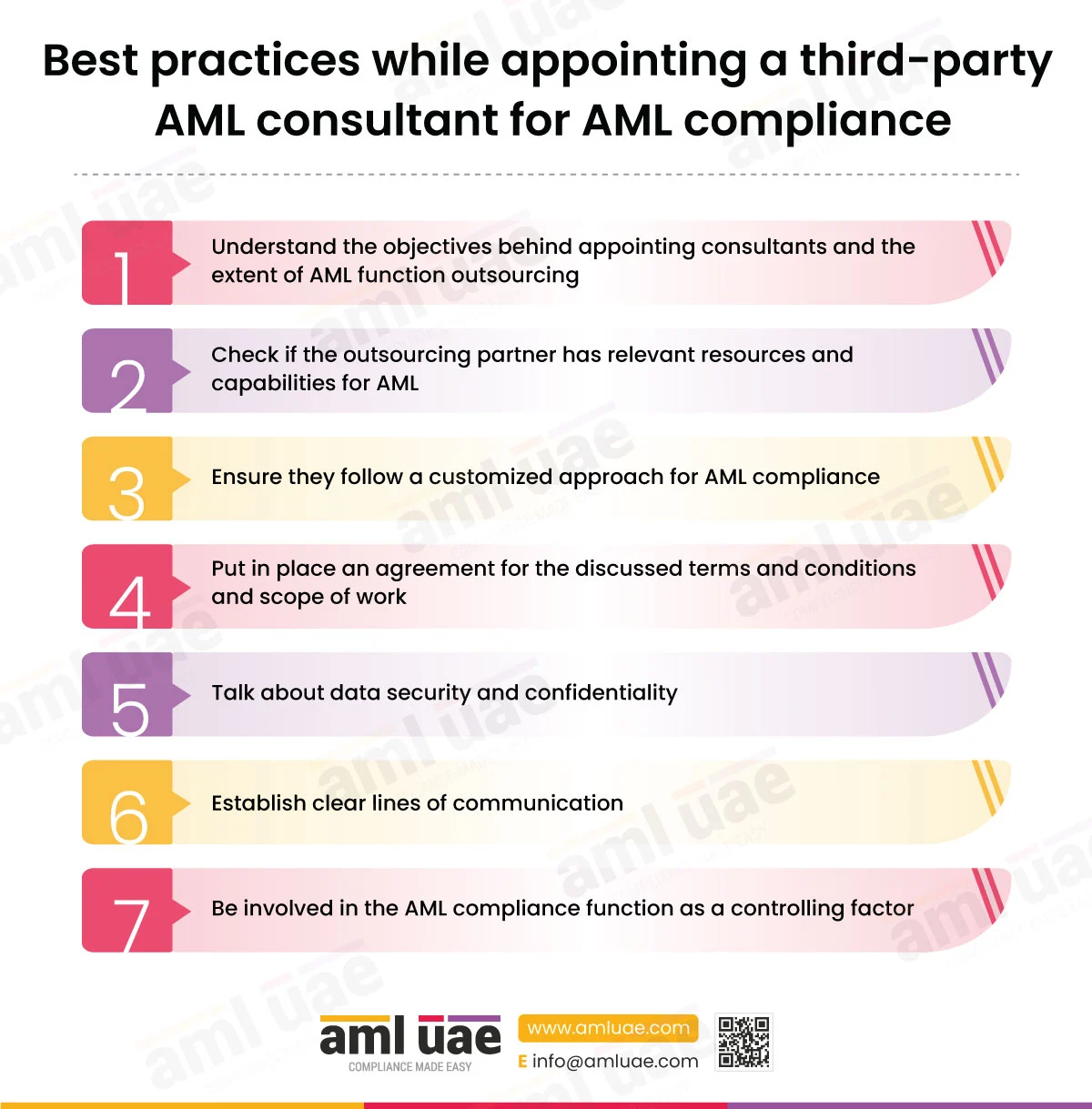
Best practices while appointing a third-party AML consultant for AML compliance

While outsourcing the AML compliance function, keep in mind the following best practices:

Understand the objectives behind appointing consultants and the extent of AML function outsourcing

If the regulated entities want outsourcing to add value to the business, understand the reasons for doing it. If the entities do not have well-defined objectives but are outsourcing or appointing a consultant only since their counterparts are doing it, they are in for doom. Engage in a prudent assessment of the AML and overall business objectives before outsourcing the compliance function.

List the activities under AML compliance requirements. Compare the pros and cons of outsourcing vs in-house for each. Consider the factors of skills, costs, time, and impact on operations for comparison. At the end of this analysis, the entities will understand what they want to outsource and what is to be managed in-house.

Such an assessment will give the entities a complete view of what tasks are to be outsourced to the consultants or the extent of reliance to be placed on managing AML functions. This may include:

Check if the outsourcing partner has relevant resources and capabilities for AML

The regulated entities must check the outsourcing partner’s capabilities in AML compliance. They must have relevant skills and competencies to help the business with all AML activities.

Their consultants and professionals must have AML knowledge and awareness of laws. They must have adequate experience performing such AML activities.

Besides human expertise, they must have the tools and technologies to bring efficiency and accuracy in compliance. Technological solutions can make risk assessments, CDD, and data management faster and easier.

Thus, check these attributes while outsourcing the compliance function to an expert AML service provider. Ensure the service provider has all these skills and case studies of successful AML compliance. Only once the entities get that trust in them can they have a successful outsourcing relationship, adding value to the AML compliance function.

Ensure they follow a customized approach for AML compliance

The outsourcing AML partner must understand the regulated entity’s business. They cannot come on board and start the AML activities unless they learn the entity’s business profile and existing compliance obligations. It needs a careful assessment followed by a customized approach.

The third-party consultants must study the business’s AML requirements. They must understand the industry-specific AML expectations in the UAE. It requires an assessment of the business’s exposure to financial crime. They must conduct a gap analysis to understand where the entity lacks AML compliance. These specifications of AML and deliverables give the service provider an idea of the compliance journey.

Based on these assessments, the consultant must prepare a customized plan detailing how to go about with AML compliance of the regulated entity. The customization is specific to the AML requirements, business model, and industry sector. A generalized AML compliance framework can increase the chances of incompleteness or inaccuracies in compliance.

Best practices when seeking third-party assistance in AML Compliance

Put in place an agreement for the discussed terms and conditions and scope of work

The dynamics of the outsourcing or AML consultancy relationship depend on how clear the contract is. The regulated must sign an agreement with the outsourcing services provider. The contract must mention the scope, inclusions, exclusions, cost, schedule, and terms and conditions. All these elements are essential for clarity purposes, including reference to the following critical aspects:

  • The communication flow between the regulated entity’s team and the consultant’s team,
  • List the areas where both teams will collaborate,
  • Explain the process flow for approvals and permissions (for AML-specific controls, etc.).

Talk about data security and confidentiality

How can the regulated entities ensure the safety and security of business-sensitive data?

The entities will share the customers’ personal data and company information with the AML consultant. If there are leakages of any of this data, it can harm the business’s reputation and customer trust.

The entities must talk about it with the outsourcer before signing the agreement. Discuss what the business expects from them and what security measures they have taken. The regulated entity must check its data security and business continuity strategies. Track the tools and techniques they are using to protect information.

Establish clear lines of communication

If the regulated entities do not have regular communication with the AML outsourcing service providers, it can affect the quality of the AML compliance efforts.

The regulated entity must identify and allocate a dedicated contact person to keep the communication channel open and live with the AML service provider. The person must communicate the entity’s expectations and changes with the service provider and be ready to help them with data based on their requests and requirements. Thus, establish transparent communication practices to foster collaborative work for AML compliance.

Clear communication facilitates planning during uncertain situations. Ensure to have effective communication, even with different time zones and languages.

Be involved in the AML compliance function as a controlling factor

After outsourcing the AML compliance function, what do the regulated entities do?

Do entities intervene? If yes, on a daily or weekly basis? If not, how to track work performance?

All these are crucial aspects the regulated entities must decide on with the third-party AML solution provider. At least the entity must stay involved as a controlling factor in each AML activity, as the ultimate compliance responsibility lies with the regulated entity itself. The regulated entity’s Compliance Officer must monitor the execution of each task and the outcome.

The entity must conduct regular meetings to see the work status and results.

The entity’s money is being spent on the outsourced AML functions, and reputation and regulatory compliance are at stake. The regulated entities must oversee how judicious the spending is. With such surface-level engagement, the entities know whether they can achieve AML goals.

The regulated entities must incorporate these best practices while outsourcing the AML compliance function or seeking professional assistance for managing the business risk. It will lead to more chances of success in the AML efforts, preventing the threats of money laundering and terrorism financing.

Many businesses fear outsourcing their AML compliance function. They dread loss of data confidentiality, control of processes, and accountability. But if due consideration is given to the essential elements, outsourcing and reliance on third parties is safe and offers value-addition.

If you are looking for a proficient and professional AML compliance services provider, we are here for you.

AML UAE’s expertise as an AML Consultancy Service Provider

AML UAE is a leading provider of AML compliance services for regulated entities in the UAE. Our spectrum of services helps you adhere to all the provisions of AML regulations. We help you build confidence in your AML policies, procedures, and controls for effective results.

You can partner with us for one-off service or regular support to the AML compliance function. Whatever way we engage with you, your business complies with regulatory obligations. You get recommendations for remediation actions based on your business’s AML requirements and the quality and efficacy of existing measures.

So, if you are searching for end-to-end AML support for managing your AML compliance functions, you are at the right destination.

Interested in learning about how AML UAE can help you with AML compliance?

Get on a consultation call with us.

Share via :

About the Author

Jyoti Maheshwari

CAMS, ACA

Jyoti has over 11 years of hands-on experience in regulatory compliance, policymaking, risk management, technology consultancy, and implementation. She holds vast experience with Anti-Money Laundering rules and regulations and helps companies deploy adequate mitigation measures and comply with legal requirements. Jyoti has been instrumental in optimizing business processes, documenting business requirements, preparing FRD, BRD, and SRS, and implementing IT solutions.

Reach Out to Jyoti

What are Virtual Asset Activities & who can carry out VA Activities in Dubai?

What are Virtual Asset Activities & who can carry out VA Activities in Dubai?

What are Virtual Asset Activities & who can carry out VA Activities in Dubai?

What are Virtual Asset Activities & who can carry out VA Activities in Dubai?

The Virtual Assets Regulatory Authority (VARA) enacted the Virtual Assets and Related Activities Regulations 2023 (Regulations), considering the ever-evolving scope of Virtual Assets and related services and the need for its effective regulation in Dubai.

Here is an infographic discussing the specific VA activities permitted to be carried out in Dubai by the licensed and duly VARA-authorised VASPs.

What are VA Activities?

The VARA has defined what “Virtual Asset (VA) Activities” mean, as detailed under Schedule 1 of the Regulations:

  • VA Advisory Services:- Offering, providing or agreeing to provide a personal recommendation to a client in respect of one or more actions or transactions relating to any virtual assets
  • Broker-Dealer Services:- Provision of any of the following services:
    • arranging orders for the purchase and sale of VAs between two entities,
    • soliciting or accepting orders for VAs and accepting fiat currency, or other VAs, for such orders,
    • facilitating the matching of transactions in VAs between buyers and sellers,
    • entering into VA transactions as a dealer on behalf of the entity for its own account,
    • making a market in virtual assets using client assets,
    • providing placement, distribution or other issuance-related services to clients issuing virtual assets.
  • Category 1 VA issuance:- Services in relation to the issuance of:
    • Fiat-Referenced Virtual Assets [FRVAs] that purport to maintain a stable value in relation to the value of one or more fiat currencies but do not have legal tender status in any jurisdiction,
    • Other VAs as may be determined by VARA.
  • Custody Services:- Safekeeping of VAs for or on behalf of another entity and acting only on instructions from or on behalf of such entity.
  • Exchange Services:- Provision of any of the following services:
    • conducting an exchange, trade or conversion between VAs and fiat currency,
    • conducting an exchange, trade or conversion between one or more VAs,
    • matching orders between buyers and sellers and conducting an exchange, trade or conversion between VA and fiat currency or one or more VAs,
    • maintaining an order book in relation to the above activities.
  • Lending and Borrowing Services:- Conducting transaction where VA shall be transferred or lent from one or more parties (known as the Lender) to one or more other parties (known as the Borrower) against the Borrower commitment to return the same upon the Lender’s request at any time before or at the end of the period agreed upon.
  • VA Management and Investment Services:- Acting on behalf of an entity as an agent or fiduciary or taking responsibility for the management, administration or disposition of that entity’s virtual assets.
  • VA Transfer and Settlement Services:- The transmission, transfer, or settlement of VAs from one entity to another entity or another VA wallet, address or location.

Who can carry out VA Activities in Dubai?

The entity carrying out or intending to carry out virtual asset activities or its employee carrying on or otherwise facilitating a virtual asset activity on behalf of the entity must ensure that it is authorised and licensed by VARA for the said activities.

VARA considers the following factors when granting a license.

Before authorising and licensing the VA activities, the VARA shall consider the following factors to determine whether an entity is carrying out VA Activities “by way of business”:

  1. Whether the entity holds itself out as conducting a VA Activity by way of business,
  2. The regularity, scale and continuity of the VA Activity carried out by the entity, and
  3. Whether there is any commercial element in how the VA Activity is being conducted, such as whether the entity receives remuneration or other commercial benefits or value for carrying out the VA Activity.

Related Posts

Overview of AML Obligations of VASPs under VARA Regulations

Overview of AML Obligations of VASPs under VARA Regulations

Overview of AML Obligations of VASPs under VARA Regulations

The Virtual Assets and Related Activities Regulations 2023 recognises the Federal AML/CFT Laws (Federal Decree by Law No. (10) of 2025 Regarding Anti-Money Laundering, and Combating the Financing of Terrorism and Proliferation Financing, and its implementing Cabinet Resolution No. (134) of 2025; and Federal Law No. [7] of 2014 on Combating Terrorism Offences).

Part VI of the Regulations contains AML/CFT obligations that VASPs must follow, in line with the Federal AML/CFT laws, Rulebooks and the FATF Recommendations in relation to virtual asset activities.

VARA: VASP’s AML Supervisory Authority

For Federal AML/CFT Laws, the Dubai Virtual Asset Law (Law No. [4] of 2022 Regulating Virtual Assets in the Emirate of Dubai), Virtual Asset Regulatory Authority (VARA) is –

  1. Designated as an AML Supervisory Authority for all Virtual Assets Service Providers (VASPs) operating in and Virtual Assets (VA) activities carried out in or from the Emirates of Dubai,
  2. Responsible for issuing regulations in relation to combating money laundering in Dubai concerning VA activities,
  3. Having powers to supervise the Dubai-based VASP’s compliance with Federal AML/CFT Laws.

In addition, VARA is also responsible for reporting any suspicious conduct to the relevant authorities functioning under the directives of Federal AML-CFT Laws.

Overview of AML/CFT obligations of VASPs

VASPs must fulfil AML/CFT-related compliance obligations prescribed under the Federal AML/CFT laws, Compliance and Risk Management Rulebook issued by VARA, and FATF Recommendations about virtual assets.

The essential AML/CFT obligations imposed upon VASPs under VARA’s Compliance and Risk Management Rulebook are as follows:

Part III of Compliance and Risk Management Rulebook

A. Appointment of MLRO

Appointing a Fit and Proper Person with 2+ years of experience handling AML/CFT compliance as the Money Laundering Reporting Officer (MLRO).

B. Policies and Procedures

Developing and implementing policies and procedures aligned with Federal AML/CFT laws, FATF standards, guidance, and recommendations for VASPs and virtual assets activities, EOCN Guidance on Counter Proliferation Financing.

C. AML/CFT Controls

Implement adequate controls to adequately address the money laundering, terrorism financing, and proliferation financing risks associated with virtual assets activities.

D. Risk Assessment

Performing ML/FT Business Risk Assessments to identify and assess the risk exposure arising from virtual asset activities and deploying the necessary resources to mitigate the identified risk.

E. Customer Due Diligence

Applying adequate CDD measures for all the customers, adopting a risk-based approach, which includes identifying and verifying the customer’s and ultimate beneficial owners’ identity, assessing the risk associated with each customer and performing ongoing CDD.

F. Suspicious Transaction Monitoring & Reporting

Monitoring the business relationships and the virtual asset transactions to identify the red flags and reporting the same to FIU through the goAML Portal.

G. FATF Travel Rule

Acquiring originator and beneficiary details concerning specified virtual asset transactions (exceeding AED 3,500) and exchanging the information with the corresponding VASP.

H. Record Keeping

Maintaining the AML records for a minimum period of eight [8] years.

Related Posts

Know Your Transaction: Boosting AML compliance with KYT

Know Your Transaction Boosting AML compliance with KYT

Pathik Shah

Table of Contents

Protect your business with reliable and effective AML strategies with AML UAE.

Know Your Transaction: Boosting AML compliance with KYT

We understand that KYC (Know Your Customer), the crucial aspect of AML compliance, identifies the customers with whom business transactions are executed. Similarly, there is a concept, “KYT” – Know Your Transaction, aimed at uncovering the details of the transaction proposed to be carried out with the customer, including assessing the risk associated with such transaction.

Once the regulated entities know the transactions and related details, they are better placed in their anti-money laundering efforts, detecting the potential red flags. So, let us understand what KYT (Know Your Transaction) is.

What is KYT?

Know Your Transaction is one of the risk mitigation measures, which involves collecting the critical details of the business transaction to understand it better, determine its consistency with the customer’s overall profile, and determine the involvement of money laundering (ML) or any other financial crime risk.

KYT completes the Customer Due Diligence process, helping the regulated entity establish the customer profile, including the customer risk assessment, as the transactional details do give information about the customer’s activities or at least validate the customer profile determined by the compliance team.

By analyzing the financial transactions, the regulated entity can determine suspicious activities and stop them. Based on the data points, the regulated entity can determine whether the transaction aligns with the customer’s usual activities or if something suspicious exists.

What is the need for KYT?

The regulated entities subject to the AML regime in UAE deploy KYC measures to identify the customers. This includes obtaining identification details like customers’ names, ultimate beneficial owners (UBOs) in case of corporate customers, addresses, contact details, and other relevant details to establish the customer’s identity. But merely with KYC, the regulated entity cannot develop a complete customer profile or assess the potential risk exposure until the entity understands the proposed transactions.

This is where KYT comes into action.

With KYC, the regulated entity can identify whether a customer is the one they claim to be or is a financial criminal with some negative background. If they are identified as a criminal or sanctioned, the regulated entity applies adequate controls or possibly does not transact with them. But where the customer’s identity has been established to be clear, the risk of such a person exploiting the business for money laundering or terrorism financing cannot be negated. Thus, it is crucial to assess the transaction and identify the transactional parameters and their consistency with the identification details furnished by the customer.

The significance of KYT has increased due to a rise in cryptocurrency transactions. Since these are anonymous and decentralized transactions, the ML threat is higher. So, knowing more about the transactions before undertaking them becomes critical. Besides, KYT is also necessary for electronic fund transfers, including cross-border transactions.

In this context and as mandated by UAE AML regulations, for financial institutions like banks and Virtual Asset Service Providers (VASPs), KYT is very crucial to decode the identity of the originator and the beneficiary involved in the fund transfer or the virtual asset transfer. Not just this, these regulated entities are required to transmit the message to the counterparty financial institution or the VASP, capturing the details of the originator (payer) or the beneficiary (payee), along with the fund or virtual asset transfer request (complying the requirement of FATF Travel Rule).

KYC helps identify the suspicion related to the person, but to spot the red flags in the proposed transaction, KYT is inevitable.

With adequately implemented KYT, the regulated entities can identify and assess the following aspects of a transaction:

  • All details on involved parties (originator, beneficiary, their account or virtual asset wallet details)
  • Geographies involved (including geo-location and IP address in case of electronic transfers)
  • Amount of the transaction
  • Date of transaction

Not restricted to one-time activity, KYT also refers to the ongoing monitoring of transactions. Thus, once the entity has all these details on a transaction, along with transaction history and the customer profile, it can identify patterns or trends in them. If something suspicious is detected, the regulated entity can investigate further for any ML/FT threat. Thus, KYT is essential to keep the business safe from financial crimes.

Now that we know why KYC is significant, let’s look at the tips that must be adopted to ensure a smooth KYT process.

Make KYT an asset for your AML compliance efforts.

Give us a call to set up the transaction review process.

Tips to improve the KYT process

Besides KYC processes, KYT is essential for achieving AML compliance. Pay attention to the following tips and tricks to remove inaccuracies in KYT and leverage the benefit of KYT to foster the ML/FT guards:

Give it as much importance as KYC

We all know that KYC is a critical pillar of AML compliance. KYC enables the regulated entities to know the customers better. It helps to find out if any of the existing or potential customers have any potential links to money laundering or other criminal activities. However, these measures are incomplete and do not give a complete picture of the customer’s risk profile without knowing the transactions. Thus, KYT is an equally critical measure for AML compliance.

Understanding and investigating the transactions enables the regulated entity to know if they facilitate illegal activity. If not, the entity is suitable to move ahead with the transaction. If yes, the regulated entity can terminate or cancel the transaction. Thus, the business is saved from reputational damage and non-compliance penalties.

Use all data on transactions to analyze them

When applying the KYT measures, collect all information pertaining to the transaction. It includes parties to the transaction (originator of the transfer and the beneficiary/(ies)), date, value involved, geographic location, and other relevant information (like unique transaction reference number or transaction hash in case of virtual asset transfer).

The regulated entity cannot determine whether the transaction is suspicious based only on one factor. It must consider all the details to know the ins and outs of the transaction. The regulated entity can find its linkages with illegal activities or criminals by analyzing various transactional parameters. Thus, the regulated entity must assess all the aspects of a transaction, considering the outcome of the KYC and overall customer profile, to determine if it is suspicious.

Define rules to detect unusual trends or patterns

To detect any red flags or suspicions, the regulated entity must define specific rules or parameters to gauge each transaction, considering all the relevant transactional parameters. These rules include transactional patterns, frequencies, time gaps, beneficiaries involved, geographies associated with the transaction and the value. And when anything goes against these rules, there must be an alert.

Further, the rules must also be defined, factoring in the customer’s identification details and the overall risk profile. Thus, the regulated entity is immediately notified if any inconsistencies are observed between KYC and KYT.

Regulated entities can determine unusual patterns or trends based on these rules and algorithms. It can identify if a transaction’s execution deviates from the established norms. Such deviation, unusual activity, or uncertain behaviour are the aspects that make a transaction suspicious. Therefore, defining rules, parameters, or criteria is essential to monitor transactions.

Ensure data quality to reduce false positives

When transactional data quality is ensured, accurate results can be expected, and risk indicators can be spotted promptly. Obtaining quality data and maintaining it securely is challenging.

The regulated entity can invest in quality data management systems to maintain data quality. The regulated entities can also use quality and reliable KYT solutions to investigate transactions. With well-defined algorithms and rules, the possibility of false positives can be reduced significantly.

Another aspect that needs to be taken care of is ensuring data consistency. The data may be obtained from different sources in different formats and languages. So, engaging in data cleansing and standardization is crucial before assessment and pattern detection.  

Align the KYT exercise with UAE AML regulations

The regulatory requirements for AML keep changing. As and when new risks erupt, authorities amend AML rules. Also, particular guidelines for different industry sectors exist under the AML regime, e.g., mandatory compliance with the FATF Travel Rule by the financial institutions and the VASPs.

So, the regulated entities must align the KYT process with these regulations. It must stay up-to-date with the latest amendments to incorporate them into the KYT rules. Such alignment ensures an effective KYT process and also smooth AML compliance.

Know Your Transaction Boosting AML compliance with KYT

Technology is the go-to place for KYT automation

Collecting many data points on each transaction is a daunting task. And then analyzing them to detect suspicious behaviour demands high-level analytical skills. Manual management of all these steps will lead the business to errors and misses.

So, the best option is to automate the KYT process. Select a suitable KYT solution from the market customized to the business goals and needs. Set up relevant rules and parameters in it. With such a customized solution, the regulated entity will not miss any data and ensure accuracy. Also, it will save time with the automated KYT process, driving efficiency and quality of results.

With the emergence of AI, the Internet of Things (IoT), Machine Learning, Natural Language Processing (NLP), and Robotic Process Automation (RPA), the future of KYT is bright. These technologies can make KYT processes faster, more accurate and more efficient. The regulated entity can quickly analyze vast volumes of data in real-time and identify patterns. Thus, it can improve the quality of results in less time and effort.

Train the employees on KYT processes

The employees must have the necessary skills in transactional data collection and assessment. Explain to them the importance of the KYT process for achieving AML compliance. Training the staff around the nitty-gritty of KYT is essential for an accurate and comprehensive process.

Only with proper training will they know how to review and examine transactional data. When using tools and technologies like AI or machine learning for the KYT process, the employees must be extensively trained and educated on using these systems.

Report the suspicious transactions to authorities

What if a transaction is identified as suspicious?

The same must be reported to the authorities – internal (Compliance Officer) and external (Financial Intelligence Unit). That is what KYT and transaction monitoring are for.

When a transaction is identified as illegitimate or facilitating money laundering, report it to the AML Compliance Officer. The Compliance Officer shall investigate it further or instruct the discontinuation of the business relationship with that customer. Also, make a report to the Financial Intelligence Unit.

Maintain data confidentiality and security

Like KYC, KYT involves collecting sensitive information on transactions. Using such sensitive data can lead to data protection and confidentiality concerns.

So, the entity must ensure data security and disallow its further use for other purposes. The customer and transactional information must be safeguarded in all possible ways. Data privacy regulations, data encryption, and secure technologies to keep data safe.

How can AML UAE help in nurturing your AML compliance efforts?

You know the best practices to adopt in your KYT process. If you do it yourself, adopt these tips to ensure quality and accurate results. AML UAE is here to design and help you deploy the best practices around KYT and manage the ML/FT risks.

We can assist you in detecting and configuring the right tools and systems to comply with KYT requirements.

Interested in learning about how AML UAE can help you with AML compliance?

Get on a consultation call with us.

Share via :

About the Author

Pathik Shah

FCA, CAMS, CISA, CS, DISA (ICAI), FAFP (ICAI)

Pathik is a Chartered Accountant with more than 25+ years of experience in compliance management, Anti-Money Laundering, tax consultancy, risk management, accounting, system audits, IT consultancy, and digital marketing.

He has extensive knowledge of local and international Anti-Money Laundering rules and regulations. He helps companies with end-to-end AML compliance services, from understanding the AML business-specific risk to implementing the robust AML Compliance framework.

STR/SAR Filing on goAML Portal: Common lapses and best practices

STR/SAR Filing on goAML Portal

Pathik Shah

Table of Contents

Protect your business with reliable and effective AML strategies with AML UAE.

STR/SAR Filing on goAML Portal: Common lapses and best practices

The UAE AML regulations mandate the reporting entities to identify the suspicion related to money laundering, terrorism financing or proliferation financing and report such suspicion by filing a Suspicious Activity Report (SAR) or Suspicious Transaction Report (STR). When you suspect a transaction or activity, the same warrants prompt STR/SAR filing on the goAML Portal, but beware of the common errors the regulated entities generally commit in the course of STR/SAR filing.

In this article, we have covered some of these lapses in submitting SAR/STR on the goAML Portal and the best practices to manage the same. Before that, let us understand what the UAE AML laws provide for STR/SAR filing.

What are STRs and SARs?

How will you safeguard the business against financial crime?

What actions will you undertake to prevent crimes like money laundering or terrorism financing from occurring?

The answer here is by timely detecting the transaction or activity attempted to carry out money laundering/terrorism financing or suspected to involve proceeds of crime. The laws in UAE need you to monitor your business relationship and transactions continuously, as the risk indicators can be observed at any stage – while onboarding the customer, while executing the transaction or after a transaction is completed. Whenever you detect any suspicious behaviour or unusual pattern, you must investigate further to assess the involvement of money laundering or terrorism financing activities.

After identifying such suspicious activities or transactions, it is important to bring these suspicions to the notice of regulatory authorities to take necessary actions to address these crimes. This is possible by submitting adequate details to the authorities and furnishing reports in the prescribed formats.

In UAE, when any regulated entity identifies a transaction or activity as suspicious, it must file a Suspicious Transaction Report (STR) or Suspicious Activity Report (SAR).

A suspicious transaction is one where the transfer, deposit, withdrawal, or flow of funds is doubtful. It occurs when you transact or form a business relationship with a customer to provide goods or services. For example, a customer making multiple purchases of gold using cash in a small denomination or payment for a transaction is being made from a high-risk country. In such cases, you must submit STR with the UAE’s Financial Intelligence Unit (FIU) via the goAML Portal.

Suspicious activity relates to any attempted or unexecuted transaction where the customer acts unusually, or the customer’s behavioural traits suggest any connection with money laundering or terrorism financing. For example, a customer refuses to submit identity documents or does not cooperate in the satisfactory completion of the Customer Due Diligence processes. The other example could be where the customer insists on involving many intermediaries to perform a transaction without any business logic. In such cases, you must report such suspicious activity by filing SAR on the goAML portal.

The main constituents of a STR or SAR are the following:

  • Parties involved in the transaction
  • The location of the occurrence of the transaction
  • Time and date of occurrence of suspicious transaction or activity
  • The red flags or warning signs detected
  • Action taken by the regulated entity

A critical question here is how you know a transaction is suspicious.

To ensure that your team understands the ML/FT/PF risk indicators and is alert to spot the same, it is important to have adequate knowledge and understanding of the general and industry-specific warning signs indicating connection with money laundering, terrorism financing or proliferation financing. You must maintain a comprehensive list of such red flags and implement necessary systems and tools, depending on the nature and size of the operations, to detect suspicious activities and transactions.

Let’s look into the common lapses by entities in STR/SAR filing on the goAML portal. We also explore the best practices for managing these gaps and errors for an accurate goAML reporting.

Make your reporting on goAML accurate, easier, and effective,

With our AML professionals’ expert guidance and handholding.

Common lapses in STR/SAR Filing on the goAML Portal

While submitting SARs and STRs on the goAML portal, please avoid these common lapses:

Failing to register on the goAML portal

You cannot submit SARs and STRs with the FIU without registering on the goAML Portal. You must complete the 2-stage goAML registration process to access the Portal to furnish any AML-related report to the FIU or other regulatory authority.

In the first stage, you must register with the SACM (Service Access Control Manager) system. Upon submitting the details, along with the relevant documents – a copy of the trade license, an authorisation letter for the appointment of the AML Compliance Officer, and identity proof of the Compliance Officer, you get a username and secret code. Now, you must install the Google Authenticator App and create an account. After this, you can access the goAML Portal and complete the register as an “Organization”.

Once approved by the supervisory authority, your goAML registration is successful, and you can complete the necessary reporting.

Forgetting to follow the regulatory policies and laws ​

Submitting accurate and on-time STRs and SARs is a regulatory obligation in the UAE. UAE has also specific guidelines of:

  • Details to fill in STR and SAR
  • Documents to submit
  • Step-by-step procedure

You must keep track of regulatory laws to stay up-to-date on all these points and adhere to requirements on time. If you fail to do so, it will make you non-compliant and hence vulnerable to ML/TF risks.

Providing inaccurate and incomplete information in STRs and SARs

Your SARs and STRs do not serve their purpose if filled out inaccurately. So, you must ensure that these reports are complete and accurate.

In STRs, fill out accurate details on the parties involved in the transaction, date, location, amount, and other relevant information. In SARs, mention the parties, observed risk indicators, and other relevant data points like the action you took to identify such a red flag. While providing these details, double-check the names of parties and other details populated. Also, mention the transaction or customer activity aspect you found suspicious.

Ensure that you attach the relevant documents – identification proof and transaction records. These serve as evidence to support your suspicion of the transaction or activity. Only comprehensive and precise details in SARs and STRs can make these reports useful to the authorities in combating financial crime, as investigation would be possible only when they have all the necessary details.

Also, be cautious while writing down the values in the report. Use simple and straightforward language in your reports. Don’t use jargon and ambiguous terms that confuse authorities using those reports. Be clear. Provide comprehensive information on your suspicion. And report all accurate details collected on the incident.

Delaying the submission of reports

The purpose of these reports – SARs and STRs – is to enable timely action by relevant authorities to prevent financial crime or reduce its impact on the national economy. If you do not submit these reports on time, this action will be delayed. So, you must ensure the prompt submission of these reports.

If you delay, the investigations are held up. Acting at that time would not generate the expected outcomes. Thus, the effectiveness of AML and CFT efforts suffers.

Lack of collaboration with regulatory authorities on STRs and SARs

Your work does not end there after you submit the STRs and SARs. The regulatory authorities might need more information on the reports. They might need more proof to support the reported activity. So, you must stay alert to such messages from authorities. Also, respond quickly to their queries to enable a better investigation. Ensure that no feedback or instructions received from the authorities remain unattended for longer.

STR/SAR Filing on goAML Portal

Not being accountable and precise in your suspicion

Just a tiny suspicion does not mean you submit the report on goAML. You must conduct your independent and thorough investigation of the related records and seek more information (without tipping off) to determine the existence of a suspicion with reasonable belief. Not all suspicious transactions or activities turn out to be true. But that does not mean you can include any or all suspicions in the STR/SAR.

Conduct sufficient investigation into your suspicions. Assess the transaction, origin and destination, parties involved, medium, and value. Analysing all these factors gives you a better understanding of its doubts. Have experts look into the transaction or activity to decide whether it is suspicious.

Absence of relevant training for staff

Do you have the human expertise to detect suspicious transactions and report them? If not, you are at a loss. You need employees who have the skills to detect suspicious transactions or activities.

These employees must know the general and industry-specific red alerts documented in the entity’s AML/CFT program. Knowledge of these warning signs is essential to detect suspicious transactions. Also, employees must know how to report these suspicions, including the knowledge of the internal STR/SAR forms designed and implemented for the purpose. They must know the data points to mention and the relevant documents to attach.

Employees can have skills in all these aspects only with proper training. You must conduct regular training programs on identifying and reporting suspicions. The identification must be correct, and reporting must be precise in the required format for effective action.

Neglecting data confidentiality and privacy concerns

The data added on suspicious transactions and activities in these reports is confidential. You must not share it with people other than your internal team members working on it.

You must keep the data in STRs and SARs confidential and private, ensuring adherence to the no “tipping off” requirements prescribed under the UAE AML laws.

Not sharing the reports with the senior management

For implementing AML measures, effective communication within the entity is essential. In particular, you must share all the reported suspicions and actions taken with senior management periodically (possibly in the semi-annual AML/CFT report prepared by the AML Compliance Officer).

Sharing information facilitates collaboration and coordination in AML efforts. It helps you combat money laundering and terrorism financing more effectively.

Missing the review of the reporting process

You have a well-defined reporting process on the goAML portal. You have been able to submit the STRs and SARs through this procedure.

But it does not remain the same always. You must conduct frequent reviews of the process, including the formats used for internal STR/SAR reporting, to check for errors or missing parts. You might identify gaps that need improvement. Also, the process must stay relevant to the UAE’s AML laws and align with your AML objectives.

To ensure that alignment and relevance are checked, you must assess the process periodically. Make improvements for effective reporting of suspicious transactions and activities.

Best practices around STR/SAR filing on the goAML Portal

These are the ten critical lapses that can occur during STR/SAR filing on the goAML Portal. Avoid them at all costs to reduce the chances of failure in this process. The likelihood of non-compliance is high if you commit any of these errors.

Some of the best practices you can implement to avert these deficits are:

  • Register on the goAML Portal and ensure the details furnished on the portal about the entity and Compliance Officer are up-to-date.
  • Documenting a detailed list of general red flags and industry-specific risk indicators in the AML/CFT policy itself.
  • Develop a clear reporting hierarchy and step-wise process to be followed by the frontline employees when any suspicion is observed.
  • Designing a comprehensive internal STR/SAR format, covering the fields to capture mandatory details and the staff’s understanding of the risk indicator involved in a specific activity or transaction.
  • Having a checklist to ensure accurate and complete details are furnished in the STR/SAR filed on the goAML Portal.
  • Keeping a log of the reports filed and copies thereof.
  • Periodically apprise the senior management of the STR/SAR filed, key red flags identified, and the action taken by the entity.
  • Creating awareness amongst the team around the “no tipping off” requirement.
  • Immediately adhere to the authorities’ feedback or instructions against the STR/SAR filed.
  • Mandatory training to the staff at the time of joining and at periodic intervals to keep them aligned with the emerging ML/FT typologies.

AML UAE’s support in ensuring timely compliance with STR/SAR filing on the goAML Portal

If you want a faultless process of submitting STR and SAR, you can connect with our team. We will help you at every step in identifying suspicious transactions and activities and reporting them to authorities. With our expertise, you can generate accurate, complete, and on-time reports and submit them on goAML.

AML UAE is a distinguished provider of AML compliance services in the UAE. We keep your business protected and compliant with the UAE’s AML regulations.

Want to enjoy a tailored AML compliance
strategy for your business?

Let’s connect and discuss your requirements.

Share via :

About the Author

Pathik Shah

FCA, CAMS, CISA, CS, DISA (ICAI), FAFP (ICAI)

Pathik is an ACAMS-certified AML consultant specialising in governance, risk, and compliance for regulated entities in the UAE. He brings over 28 years of experience, with 1,000+ hours of AML training and 200+ advisory engagements across DNFBPs, VASPs, and FIs. He supports businesses in aligning with AML/CFT requirements from the CBUAE, DFSA, MoET, MoJ, VARA, CMA, FSRA, and FATF. Known for translating complex regulations into audit-ready procedures, Pathik enables operational clarity and compliance readiness.

Reach Out to Pathik

Best Practices for Choosing a RegTech for AML Compliance Automation

Best Practices for Choosing a RegTech for AML Compliance Automation

Best Practices for Choosing a RegTech for AML Compliance Automation

Financial Institutions (Fis), Designated Non-Financial Businesses and Professions (DNFBPs), and Virtual Asset Service Providers would benefit immensely from technology adoption. It will help them automate their AML compliance and save costs. This infographic provides valuable insights into choosing a RegTech for automating AML Compliance.

There are a variety of compliance processes that regulated entities in the UAE look to automate. These may include the following:

While choosing the best RegTech solution and the solution vendor, the reporting entities must be very careful so that their essential requirements are automated and the RegTech Software can be easily implemented in the company.

It requires a thorough check on the RegTech solution and the solution vendor to ensure that compliance automation is ensured and the key objectives are achieved.

Best Practices for Choosing a RegTech for AML Compliance Automation

Understanding of the regulatory framework

Ensure that the RegTech provider understands the regulatory framework applicable to your company.

Automation of compliance obligations

Check what compliance obligations are automated by the RegTech solution

Understanding of your sector

Ensure that the RegTech vendor understands the unique aspects of your industry.

Integration with existing systems

Check if the RegTech solution can integrate your existing POS and back-office systems.

Alignment with UAE AML/CFT Regulatory Framework

Ensure that the RegTech software is aligned with the UAE AML/CFT regulatory framework

Testimonials

Ensure the vendor can provide client references and testimonials, and you talk to them to understand their experience with the RegTech provider.

Training

Ensure that the RegTech vendor commits to providing adequate staff training so they can effectively use it.

Related Posts

The Significance of Risk Appetite in a Risk-Based Approach (RBA)

The Significance of Risk Appetite in a Risk-Based Approach (RBA)

The Significance of Risk Appetite in a Risk-Based Approach (RBA)

Risk appetite is the amount of risk a firm will take to fulfil its strategic goals and objectives. When countering Money Laundering and Terrorist Financing, reporting entities are advised to take a Risk-Based Approach (RBA). One of the most important aspects to assess and document is the firm’s risk appetite under the RBA. The infographic provides the significance of risk appetite in effectively adopting the Risk-Based Approach.

1. Risk Appetite lays the foundation for adopting a Risk-Based Approach (RBA)

Risk Appetite lays the foundation for adopting a Risk-Based Approach. It helps identify the boundary around which the firm must operate and see that it is well-protected. Anything beyond the risk appetite will not help the firm meet its strategic objectives and may have a negative effect on its financials and reputation. The policies, procedures, controls and the overall AML/CFT framework are drafted considering the firm’s risk appetite. If the firm is willing to take risks, a more aggressive approach is taken and vice versa.

2. Risk Appetite helps carry out a tailored Risk Assessment

Risk Appetite helps carry out a tailored risk assessment of the firm. Every business has some inherent risks. It deploys policies, procedures, and controls to counter and keep them within a specific limit. Risk Appetite provides that limit and helps determine whether a firm has to deploy more controls to keep risks within an acceptable limit.

3. Risk Appetite ensures efficiency

Risk Appetite also ensures efficiency. Companies do not have the luxury of resources. They need to be prioritised and deployed where the risks are on the higher side. The risk appetite ensures that the company does not end up deploying all its resources where the risks are minimal. It helps optimise the utilisation of resources.

4. Risk Appetite brings dynamism to risk management

Risk Assessment without considering the risk appetite becomes a static document. It’s the risk appetite that requires the risks to be managed and hence adds the element of dynamism to the overall risk management of the entity.

5. Risk Appetite enables monitoring and review

Risk Appetite requires that the controls are deployed and monitored and their effectiveness is reviewed. It provides a measure against which the overall risk carried by the company is measured, and if there’s any change, it immediately gets reflected.

6. Risk Appetite demonstrates compliance culture

Having a formal Risk Appetite statement demonstrates the compliance culture of the company. The actual implementation of the same is reflected in the action taken by the company in terms of countering ML/TF.

7. Helps prioritise risks for resource allocation

Not all risks are equal. Risks have varying degrees of impact, and the impact differs from company to company and industry to industry. Risk Appetite helps define the acceptable levels for such risks, and hence, it helps determine the risks requiring more attention and effort on the part of the company. It helps prioritise resources and control costs.

8. Brings consistency to the governance mechanism

The overall governance of the compliance function will be wayward without the knowledge of the company’s risk appetite. It could differ from person to person and compliance officer to compliance officer, creating chaos. Without risk appetite, the firm couldn’t implement procedures, and everyone would decide what works best for them.

9. Risk Appetite reduces uncertainty

Risk Appetite enhances certainty in dealing with various risks. The uniform approach across the organisation provides assurance that identified risks will be countered and appropriately managed.

10. Risk Appetite supports informed decision-making

Risk Appetite supports informed decision-making. The top management knows what must be done to meet the company’s strategic objectives. It helps identify the relevant ML/TF risks and controls to keep risks in check and meet regulatory requirements.

Related Posts

12 best practices for setting up an AML compliance department

12 best practices for setting up an AML compliance

Pathik Shah

Table of Contents

Protect your business with reliable and effective AML strategies with AML UAE.

12 best practices for setting up an AML compliance department

Who forms the heart of AML compliance in a regulated entity? The AML compliance department. It is a department dedicated to ensuring compliance with the applicable AML laws. The compliance department and its people manage all the AML requirements per the UAE AML laws. It consists of an AML Compliance Officer and other team members. This article provides insights into the 12 best practices that FIs, DNFBPs, and VASPs must follow for setting up an AML compliance department.

Why set up an AML Compliance Department?

The AML Compliance Department takes care of the following compliance activities:

Thus, the AML compliance department spearheads all the necessary tasks for achieving AML compliance. It helps you navigate AML’s legal maze in the country and globally.

With such a critical role and responsibilities, you, as an entity, cannot go wrong while setting it up. Exercise caution while building such an in-house AML compliance department. A small error can mar all your attempts to set up a proper team that can manage all tasks. So, note the possible blunders, avoid them, and incorporate the best practices for effective results.

Foster consistency in your AML efforts by establishing

An in-house AML compliance department.

Best practices to adopt while setting up an AML compliance department

The AML compliance department is a principle of corporate conduct. It makes your operations possible within ethical and legal boundaries.

It enables the handling and management of critical compliance tasks in the entity. Only with the successful performance of these tasks can you move ahead in your AML journey. For this purpose, you must adopt the following best practices while setting up and operating an in-house AML compliance department:

1. Analyze your compliance needs

Before creating a new department in your entity, you must know that department’s objectives. You must know how it will help you reach your strategic goals.

So, before forming the AML compliance department, assess your compliance needs. List the fundamental laws, regulations, guidelines, and industry standards applicable to your business. Identify the potential ML/TF risks your business faces.

This research helps you better understand the objectives of the AML compliance department. You’ll be able to determine what the compliance function will do at a strategic and operational level. You will know the market expectations from you on ethical conduct and governance.

2. Onboard skilful professionals for the AML department

The first thing that a new department needs is the correct set of people to run it. After creating a department to handle AML, you must consider its human resources. Human assets are essential to do all the tasks for that department.

You can recruit new people externally for this team. Alternatively, you can internally hire from other departments to the AML team. However, ensure that these people have the necessary skills to perform AML tasks.

While onboarding people, check the following:

  • Skills
  • Educational background
  • Any experience in regulatory compliance activities
  • Relevant knowledge of AML requirements
  • Commitment to the entity’s AML goals
  • Criminal history/Adverse media

Human resources are essential to perform the various tasks under the AML regime. You need them to monitor transactions, conduct KYC and KYB, and build risk profiles. You can use technology to do these activities. But you need human skills to run systems, analyze results, and make decisions. So, pay attention to having the right team members for the AML compliance department.

3. Allow the use of technological systems for compliance processes

In the current times, technology is what can give you an edge over others. It is an excellent tool to ease your AML compliance requirements. Technological systems can make compliance easier, smoother, more accurate, and faster.

While setting up an AML compliance department, ensure it has relevant technological systems. You will need technology solutions for the following activities:

Technology is essential for the effective operations of these processes. You can achieve quick results with a higher probability of accuracy. You can set rules and generate alerts when a suspicious transaction is in process. So, having access to the best technological systems is necessary while building an AML compliance department.

4. Allocate adequate budget for the compliance department

An AML compliance department takes care of all your AML requirements. It needs to perform several activities to help you follow the AML rules. For this, it needs to have a sufficient budget.

You will need to spend on recruiting and hiring new people. Spending on salaries, incentives, and benefits is a significant cost. Also, you will be spending on buying technology solutions to expedite processes. The daily expenses of running the department are another cost element. So, having enough financial resources is vital to operate the AML compliance department without hiccups.

5. Make it independent from other business units but still integrated

Independent but still integrated?

Now, this sounds confusing!

You must create a dedicated AML compliance department. It must be separate from other business units and departments to keep the focus intact. By having a devoted department, you can stay committed to the AML goal.

The issue is if you keep it in silo form, it will just be a tick-box exercise. For compliance purposes, you will complete all the deliverables and submit reports. But you will forget aligning it with your strategic goals and objectives. So, it is necessary to integrate it well with other processes.

Integrating it with other processes can build a stronger AML culture in the entity. This, in the end, leads to higher commitment from all stakeholders. Thus, you can make AML compliance meaningful for the entity’s objectives by integrating it with other processes but still keeping it independent from other departments.

6. Define smooth lines of communication and collaboration

The previous point said you need a siloed AML department that is well-integrated with other functions. One way of integrating it well is through a smooth flow of communication. Communication lets you collaborate with other teams and departments. So, while building such a department, define the communication structure.

Smooth communication facilitates collaboration between teams. You can coordinate with other functions on a few processes for more efficiency. Also, communication with external stakeholders is necessary to enhance AML compliance efforts.

A lack of such collaborative efforts can lead to gaps in AML compliance activities. Like you will have the AML-side view, but no perspective on the business side. Or, you are unaware of the ground-level application of an AML procedure. So, do not let the lack of collaboration become a roadblock to your AML efforts. Invest enough thought into it and decide accordingly.

12 best practices for setting up an AML compliance

7. Provide access to data on customers, transactions, and other relevant information

Every process and procedure in your entity’s operations needs data. If you do not provide accurate data on time, processing them is next to impossible.

In the same way, AML compliance activities need appropriate data for processing. You need to have information on the following:

The AML department will need access to customer data to process it for further analysis. You must give ready access to this data to process it further and generate outcomes. Lack of such access will obstruct the AML compliance processes. Your AML compliance will suffer from delays, inaccuracies, or incompleteness.

8. Give direct reporting access to the senior management

The AML compliance department must have a dedicated AML compliance officer. This officer handles many critical tasks in AML. The officer will submit reports or ask for approvals for all these tasks. You must direct all this to the senior management.

So, while creating an AML compliance department, allocate an AML compliance officer. And give that officer direct access to the senior management.

Direct reporting access is essential because AML is critical for any entity. If you keep many hierarchy levels, you will lose time in several approvals and miss deadlines. The processing at several levels will harm the procedures or results and also affect the independence of the compliance officer.

Another vital point is that the officer must be able to execute AML measures without approvals. Thus, you must give the department enough leeway to make decisions and implement them. Also, they must be in direct contact with senior management for approvals and discussions.

9. Conduct training and awareness programs for the department

Remember, you are creating a department from scratch. You will be having some internal and some new employees join this department. And they will work on one of the most critical compliance requirements – AML.

So, AML training them enough for their responsibilities in the team is vital.

You must conduct awareness programs on AML compliance. They must know the significance of complying with AML laws in the UAE. They must be aware of the various regulations and requirements to comply with. You must train them on relevant processes that are specific to their job profile in the team.

In the absence of such training programs, your AML efforts will not be in the right direction. You might fail to follow some requirements, leading to penalties or reputational harm. It spoils the effectiveness of your AML framework. So, appropriate training and awareness programs are vital for successful AML compliance. 

10. Provide security of leadership buy-in for AML policies

What will happen if you do not implement the AML compliance department-recommended policies? What if you do not take any action on the suspicious transaction reports submitted by the team? What if the management does not allocate enough budget for AML compliance?

Many “what-if” questions. But it can have only one answer, and that is leadership buy-in.

You need support from the senior management and board of directors to move ahead in the compliance journey. Their support is essential to put proper AML measures in place. Their approval is vital for taking action against suspicious transactions or customers.

The leadership must commit to supporting AML compliance efforts and creating an AML culture in the entity. So, while creating the department, get the necessary leadership buy-in. This will enable you to make it a priority strategy.

11. Keep up with the regulatory authorities and their guidelines

The regulatory authorities have specific laws and regulations for industry verticals. They create guidelines for businesses to follow for the AML compliance journey. You must know about all these laws and guidelines.

Also, there are specific labour or employment laws. You must also be aware of them while building your AML compliance department and hiring team members.

These rules pertain to:

  • Payment rules
  • Privacy
  • Record keeping
  • Data sharing
  • Workplace safety and health

Also, you must ensure that the department follows these rules. Every member of the department must be aware of their rights and duties. They must know the hierarchy structure, company rules, and employment benefits. All these aspects ensure the smooth running of the department.

12. Prepare a code of conduct for the AML compliance department

When the department is ready for your entity, you must also define the code of conduct. It helps you align your team members’ behaviour with the expectations. The code of conduct must cover the following aspects:

  • How to comply with laws
  • Definition of ethical behavior
  • Rules of communication
  • Behavioral rules towards seniors, AML compliance officer, and other colleagues
  • Environmental, health, and safety rules
  • Protection of property and entity reputation
  • Job duties and authority rules

Conclusion

Remember these 12 best practices while establishing an in-house AML compliance department. Since it is a critical task, you cannot ignore these best practices. Adopting them allows you to achieve AML compliance and prevent ML/TF threats.

If you need help creating such a department in your entity, AML UAE is here. Alternatively, you are at the right destination if you want to outsource compliance tasks.

We are a leading provider of AML compliance services in the UAE. We can help you with transaction monitoring, risk assessments, and customer due diligence. We also support you in the selection of the right software and framing of the AML framework. Besides these services, we also aid in the setup of the AML compliance department. And if you want us to be your AML compliance function, we can also expertly play that role.

So, get on a call with our team and discuss your requirements.

Get a new, external perspective on your AML initiatives from an independent AML auditor.

Schedule a consultation with our AML experts.

Share via :

About the Author

Pathik Shah

FCA, CAMS, CISA, CS, DISA (ICAI), FAFP (ICAI)

Pathik is an ACAMS-certified AML consultant specialising in governance, risk, and compliance for regulated entities in the UAE. He brings over 28 years of experience, with 1,000+ hours of AML training and 200+ advisory engagements across DNFBPs, VASPs, and FIs. He supports businesses in aligning with AML/CFT requirements from the CBUAE, DFSA, MoET, MoJ, VARA, CMA, FSRA, and FATF. Known for translating complex regulations into audit-ready procedures, Pathik enables operational clarity and compliance readiness.

Reach Out to Pathik