
Jordan, Cayman Islands, Panama, and Albania removed from the FATF Grey List

Circular-no-08-aml-2021

Jordan, Cayman Islands, Panama, and Albania removed from the FATF Grey List

Circular-no-08-aml-2021

Jordan, Cayman Islands, Panama, and Albania removed from the FATF Grey List

On 23rd February 2024, UAE was removed from the FATF Grey List, a list also known as jurisdiction under increased monitoring list, which includes countries that are actively working with the FATF to address strategic deficiencies in their regimes to counter money laundering, terrorist financing and proliferation financing.

On 27th October 2023, Jordan, Cayman Islands, Panama, and Albania were removed from the FATF Grey List, a list also known as jurisdiction under increased monitoring list, which includes countries that are actively working with the FATF to address strategic deficiencies in their regimes to counter money laundering, terrorist financing and proliferation financing.

At the FATF plenary meeting ending on 27 October 2023, Jordan, Cayman Islands, Panama, and Albania were confirmed as having successfully shown that they had met the action points during the FATF onsite visit and have consequently been removed from the grey list.

Changes in FATF Grey List

Countries Removed from FATF's Grey List (Jurisdiction Under Increased Monitoring):

  • Jordan
  • Cayman Islands
  • Panama
  • Albania
  • UAE
  • Gibraltar
  • Barbados
  • Uganda

Country Added to FATF's Grey List (Jurisdictions under Increased Monitoring):

  • Bulgaria
  • Kenya
  • Namibia

FATF Grey List as of 27th October 2023

1. Bulgaria
2. Burkina Faso
3. Cameroon
4. Croatia
5. Democratic Republic of Congo
6. Haiti
7. Jamaica
8. Mali
9. Mozambique
10. Nigeria
11. Philippines
12. Senegal
13. South Africa
14. South Sudan
15. Syria
16. Tanzania
17. Türkiye
18. Vietnam
19. Yemen
20. Kenya
21. Namibia

Share via :

Share via :

Managing the AML Inspections under UAE AML Laws

Pathik Shah

Table of Contents

Protect your business with reliable and effective AML strategies with AML UAE.

Managing the AML Inspections under UAE AML Laws

The authorities are making various efforts to combat financial crimes – money laundering and terrorism financing and safeguard the stability and integrity of the national and international economy. To create awareness and enforce strict implementation of the AML measures by the regulated entities, the AML supervisory authorities in UAE (e.g., Ministry of Economy, Ministry of Justice, ADGM’s Financial Service Regulatory Authority, etc.) have started inspecting the quality and level of entities’ AML efforts and regulatory compliance status.

This article will discuss the significance of AML inspection and how to effectively respond to the AML inspection notices issued under the UAE AML regulations.

AML Compliance Requirements

All About AML Inspections

As mentioned above, AML inspection is one of the AML measures adopted by the regulatory authorities to assess the regulated entities’ compliance with the regulations. Not limited to this, the inspection is a powerful tool that assists the authorities in detecting any AML deficiencies in the government’s legislative framework to take immediate remediation measures and to identify any emerging ML/FT vulnerabilities rising in the country.

AML inspection demonstrates the government’s commitment to combating financial crimes. The same attitude towards AML compliance is expected from the regulated entities, and thus, these inspections serve as a signal to the entities that authorities are proactively keeping a watch on the business and their AML efforts.

As part of the AML inspection, the UAE authorities focus on the review of the following:

AML Inspections help regulatory authorities check the AML health of the businesses, guide them in improving the AML measures to protect the business and ensure the financial integrity of the entity as well as the country’s financial system.

Being AML Inspection Ready

The AML compliance is not a bridge-gap arrangement, where the Compliance Officer put stretched efforts to develop the AML program and create the documents and information on a post-facto basis, merely to manage the AML inspection.

Instead, the regulated entity must always be inspection-ready. This is possible when there is a well-crafted AML framework for the business, which is seamlessly followed every day by every employee during regular business operations to ensure that the business is protected against potential money laundering and terrorism financing threats and is adhering to the required legal obligations.

The regulated entities must consider the following points to stay compliant and without worrying about the AML inspection:

Maintaining the AML/CFT policies, procedures and controls

The entities must develop customized AML/CFT policies and controls to manage the assessed business exposure to financial crime. This framework must be aligned with the applicable laws and regulations.

This AML program must be periodically reviewed to check its effectiveness in identifying and mitigating the risks. This shall assist the entity in identifying the policies or procedures that need immediate attention.

Periodic review of the AML compliance

The AML Compliance Officer regularly checks the comprehensiveness and quality of the entity’s AML measures and controls deployed. This review should examine the Customer Due Diligence process, ongoing monitoring program, identifying and reporting suspicious transactions, etc.

This review shall allow the AML Compliance Officer to detect any compliance instances or AML loopholes, offering required guidance in enhancing the necessary measures, implementing new controls, or modifying/upgrading the systems.

Adequate AML Record Keeping

The time and resources put into AML compliance can be substantiated only when these documents are presented to the authorities in a legitimate and easy-to-understand way. Only when the information and records are maintained in an organized manner can the same be made available to the inspecting authorities as and when requested.

Immediate submission of the requested documents demonstrates the entity’s ongoing AML activities and dedication to combating financial crime.

AML Record Keeping

Support from employees and senior management

The contribution and support from the employees and the senior management is a must for the successful implementation of the AML Program. The employees, including management, must be trained on the AML policies of the business and made aware of their duties and AML responsibilities. This will ensure that the AML measures are diligently adopted in day-to-day business operations, help the Compliance Officer to strengthen the AML regime and be inspection ready.

's Report to Senior Management under UAE AML Regulations

Responding to an AML Inspection Notice

It has been observed that the UAE AML supervisory authorities issue an inspection notice over a registered email, generally addressed to the AML Compliance Officer of the regulated entity.

The notice captures the critical information about the inspection officer, the expected inspection date, the records and documents to be submitted for the authority’s desk review, the documents and information that must be made readily available when the inspecting officer visits the premise, etc. The team must respect and adhere to the timelines and data requests mentioned in the inspection notice.

The quality of the inspection notice and the level of clear and transparent communication with the authorities indicates the entity’s commitment to AML compliance.

The following steps must be followed to respond to the AML inspection notice effectively:

1. Nominating the team to handle the inspection

The regulated entity must identify the responsible person who shall manage this inspection – ideally an AML Compliance Officer and, if needed, any team member having adequate AML knowledge to assist the Compliance Officer. The senior management must be intimated about the proposed AML inspection.

If required, assistance from third-party AML professionals and consultants must be sought to avoid misinterpretation of the notice and respond to the notice to the authorities’ satisfaction.

2. Understanding the scope and requested information

The AML Compliance Officer must peruse the inspection notice thoroughly and map the same with the entity’s records. The inspection scope shall assist the Compliance Officer in understanding the areas authorities propose to review and the information to be furnished.

3. Collating the information and drafting the response

The AML Compliance Officer must begin collecting and organizing the requested information in one place. The documents and information must be arranged systemically, which assists the authorities’ review process.

The response to the questions in the inspection notice must be adequately captured, with explicit reference to any attachments.

Here are some of the best practices that must be followed to ensure a smooth AML inspection journey:

  • The documents to be made available to the authorities must be restricted to the ones requested. Dumping unnecessary files or information may confuse the authorities, creating hardships in concluding the inspection effectively.
  • There shall be cross-referenced with the serial numbers mentioned in the data request in the notice and the files submitted for review.
  • The naming of the files, folders and other records must be done appropriately, which enables the authorities to identify the required data set.
  • Unnecessary delays in submitting the reply or waiting for the deadline must be avoided. Once the requested details are all arranged, they must be promptly shared with the inspecting officers.

4. On-premise inspection

The authorities may choose to physically visit the regulated entity’s office and have first-hand experience with AML measures implemented by the entity. If requested, the Compliance Officer must demonstrate the systems and controls implemented in such cases.

The entity must also ensure that its employees are available and prepared to answer the AML questions posed by the inspecting officers during the interview.

Post-Inspection To-Do

Once the AML inspection is concluded, the authorities identify and document the findings and corresponding recommendations in a report submitted to the regulated entity. The regulated entities must comply with this inspection report to foster the AML program, maintain the reputation and authorities’ trust and avoid regulatory penalties.

The AML Compliance Officer must review the inspection report prepared by the inspecting authorities, understand the authorities’ observations and implement the remedial measures, considering the recommendations, if any, suggested by the officers. This can be related to updating the policy or deploying new AML tools and systems. The AML Compliance Officer must assess the need for AML training in specific areas and design a robust training program.

Managing the AML Inspections under UAE AML Laws

The senior management must also be involved in this finding resolution exercise. The management must set a deadline by which the gaps must be addressed. A periodic follow-up must be made with the AML Compliance Officer, and a progress report must be sought. If necessary, AML experts must be appointed to enhance the AML program and help implement the authorities’ feedback.

Designing a comprehensive AML Training Program

The regulated entity must not leave any stone unturned in ensuring that its AML compliance is absolutely in sync with the law, its business risk and there is no further AML non-compliance.

Consequences for Non-compliance with UAE AML Regulations

How can AML UAE be your legal guide to smoothly respond to the AML inspection notices?

With our years of experience and subject knowledge, we at AML UAE can offer valuable end-to-end support around AML regulatory compliance, starting from assessing the business, designing and hand-holding the implementation of the AML framework, periodically reviewing the status of the AML program implementation, imparting AML training to the team.

We help you identify gaps immediately, rectify compliance flaws, and assist in managing the required AML records in an organised manner. With this, we ensure that you stay 100% compliant, smoothly handling the AML inspection notices, building authorities’ trust and confidence in your AML efforts.

Let’s make our AML compliance ever-ready for inspection!

Make significant progress in your fight against financial crimes,

With the best consulting support from AML UAE.

Share via :

About the Author

Jyoti Maheshwari

CAMS, ACA

Jyoti has over 11 years of hands-on experience in regulatory compliance, policymaking, risk management, technology consultancy, and implementation. She holds vast experience with Anti-Money Laundering rules and regulations and helps companies deploy adequate mitigation measures and comply with legal requirements. Jyoti has been instrumental in optimizing business processes, documenting business requirements, preparing FRD, BRD, and SRS, and implementing IT solutions.

Reach Out to Jyoti

Common mistakes to avoid while submitting a Real Estate Activity Report

Common mistakes to avoid while submitting a Real Estate Activity Report

Pathik Shah

Table of Contents

Protect your business with reliable and effective AML strategies with AML UAE.

Common mistakes to avoid while submitting a Real Estate Activity Report

The UAE AML regulations mandate that real estate agents/brokers and lawyers/law firms furnish a Real Estate Activity Report (REAR) on the goAML Portal. REAR is to be filed for reporting the transactions involving the purchase and sale of freehold real estate, where the payment towards property is settled either in cash equal to or exceeding AED 55,000 or using virtual assets or funds converted from virtual assets.

This reporting requirement is the UAE AML authority’s step to track and prevent the exploitation of the real estate sector for money laundering activities – to route the illicit money and make it appear clean. Thus, to contribute towards these AML efforts, it is essential that the regulated entities timely and accurately furnish the required details in the Real Estate Activity Report.

The AML Compliance Officer is the person made responsible for adequate reporting of the specified transaction related to Freehold properties.

In this article, we shall discuss some of the common mistakes made by the entities while submitting REAR on the goAML Portal and best practices that may help avoid these errors, which can assist the AML Compliance Officer in discharging the REAR reporting duties satisfactorily.

Filing of Real Estate Activity Report (REAR) on goAML under UAE AML Law

Trusted AML Solutions for Real Estate Agents and Brokers

From AML/CFT Risk Assessment to filing REAR, ensure full compliance with AML UAE's expert services

What are common mistakes observed while filing a Real Estate Activity Report (REAR)?

Real Estate Activity Report assist the authorities in preventing the misuse of the real estate sector for conducting financial crimes. However, for optimal utilization of the REAR as an AML measure, it is necessary to furnish the details carefully, avoiding mistakes. Let’s understand what common mistakes are observed when submitting REAR on the goAML Portal and the best practices to address the same.

Incomplete or inaccurate details

Furnishing correct and complete details is very crucial to serve the purpose of submitting REAR. The regulated entities must include accurate details about the parties involved in the transaction, details of the transaction (date and time), the location of the property involved, transaction value (property value), mode of payment, etc. must be captured.

Capturing incomplete details and errors in the information furnished are the standard and most frequent mistakes observed in REAR.

Solution

The regulated entity may establish an internal reporting mechanism, developing the standard REAR form for internal reporting. The entity may design and implement a REAR template (as available on the goAML portal), wherein the client-serving team can create a draft REAR ready capturing the required details and submit the same to the AML Compliance Officer for review and final filing of the REAR on the goAML Portal. This will enable adequate workflow, bringing in a maker-checker role to ensure the details’ accuracy while ensuring no required details are missed.

Incorrect or insufficient documents are attached

While filing REAR, the regulated entities should attach the relevant documents like the identity document of the parties, the sale/purchase agreement, UBOs’ identification documents in case of a corporate buyer/seller, etc.

These documents can be helpful to the authorities to understand the transaction better, and if required, these can be used in the course of inquiry or be presented as evidence.

However, the mistake around documentation involves –

  • not uploading the necessary documents
  • uploading the incorrect or expired documents
  • the uploaded documents are not legible or clear
Identify UBOs to complete your AML Customer Due Diligence

Solution

The regulated entity must have an internal checklist listing the documents to be uploaded as part of REAR filing. These documents must be obtained from the customer (buyer/seller) if the entity is not privy to the same. The checklist can be used to ensure the completeness of the information and documents to be filed with REAR.

Further, before uploading the documents, the legibility of the documents must be verified.

As required on the goAML Portal, the entity should merge the documents into a single PDF file, meeting the size criteria defined on the portal, without impacting the document’s clarity or resolution.

Delayed filing

Currently, the AML regulations in UAE do not provide any timeline within which such REAR filing is to be concluded. In the absence of any specific deadline, the regulated entities generally are seen to delay the filing beyond a reasonable period of time. This may sometimes result in absolutely missing on reporting the specific transaction in REAR.

Only when the transaction is timely intimated to the authorities will the purpose of detecting suspicious activities and preventing attempted money laundering activities be served.

Solution

The regulated entity must understand the criticality of timely reporting of REAR and set an internal timeframe within which the reporting of the designated transactions would be completed on the goAML. For this, the entity may determine a certain reasonable timeframe – such as within two weeks from the trigger event (as prescribed for filing of Dealers in Precious Metals and Stones Report on the goAML report for submitting details of designated transactions involving precious metals and stones).

Additionally, the entity may explore the possibility of deploying necessary technology or tools to review the transactions that require REAR filing and trigger a reminder to the relevant personnel.

Robust Reporting with AML UAE!

Get seamless support in meeting your Real Estate Activity Report filing requirements

Other best practices for effective REAR filing

In addition to the above, the following practices may assist the regulated entity in boosting the AML compliance measures and authorities’ trust in the entity’s AML program when quality REAR are furnished:

Periodic Review of REAR-related processes

It is recommended that the regulated entity conduct a periodic review of the transactions and internal processes to determine whether all the transactions warranting REAR have been furnished. Further, a sample REAR filed during the past period must be verified independently to check the quality and adequacy of the information reported on the goAML Portal.

If any weakness or gaps have been identified in the REAR reporting process, the AML Compliance Officer must immediately address them.

Training on Real Estate Activity Report

The relevant team, engaging with a client or managing the business relationship, must be trained to REAR submission requirements and identify the activities where REAR filing is mandatory. The discussion on internal reporting mechanisms and best practices must be included in the session. The team must also be trained on the details obtained from the customer and maintain the same in an organized manner that assists the Compliance Officer in timely and accurate reporting of REAR.

Designing a comprehensive AML Training Program

REAR Documentation

The regulated entities must obtain and retain a copy of the REAR furnished on the goAML Portal and copies of the documents shared with the authorities.

How can AML UAE assist you in ensuring compliance with REAR filing?

The real estate agents and the law firms must ensure proper REAR submission, as it demonstrates the entity’s commitment towards AML compliance. Let AML UAE be your partner in REAR submission. We can assist you in developing an AML framework for the business, including the guidelines for identifying and reporting the transactions triggering REAR filing. These policies and procedures are customized to the entity’s ML/FT risk exposure and business activities, ensuring compliance with regulatory regimes and contribution to protecting the real estate sector against financial crime.

Common mistakes to avoid while submitting a Real Estate Activity Report

Effortless REAR Filing with AML UAE

Simplify your Real Estate Activity Report submission with expert support

Share via :

About the Author

Jyoti Maheshwari

CAMS, ACA

Jyoti has over 11 years of hands-on experience in regulatory compliance, policymaking, risk management, technology consultancy, and implementation. She holds vast experience with Anti-Money Laundering rules and regulations and helps companies deploy adequate mitigation measures and comply with legal requirements. Jyoti has been instrumental in optimizing business processes, documenting business requirements, preparing FRD, BRD, and SRS, and implementing IT solutions.

Reach Out to Jyoti

UAE Customs Declaration Form Submission while Carrying Cash and Valuables Exceeding AED 60,000 In or Out from UAE

UAE Customs Declaration Form Submission while Carrying Cash and Valuables Exceeding AED 60,000 In or Out from UAE

UAE Customs Declaration Form Submission while Carrying Cash and Valuables Exceeding AED 60,000 In or Out from UAE

UAE travel: Who must furnish a Customs Declaration about cash and valuables?

Travellers entering or leaving UAE carrying currencies, negotiable bearer financial instruments, precious metals, or precious stones of value exceeding AED 60,000 have to submit the declaration form.

Exception:

  • When such PMS is for commercial purposes
  • When a traveller is engaged in PMS trading activities
  • When PMS is transported as a profession by a person frequently visiting the Customs Ports

Note: For a traveller below the age of 18 years, the value of such precious metals and stones shall be counted towards the threshold value of the parent or guardian.

With Whom such a Customs Declaration around cash, precious metals and precious stones is to be filed?

The customs declaration needs to be filed with the Federal Authority for Identity, Citizenship, Customs and Ports Security (ICP)

What information is to be included in such a Customs Declaration?

Customs Declaration – Illustrative list of information to be provided:

  • Travel date
  • Destination of Arrival and Departure
  • Port type: sea, land or air
  • Person’s Traveller ID details
  • Nationality
  • First name, Second name, Family name
  • Occupation
  • Place of birth
  • Date of birth
  • Gender
  • Ticket number
  • Type of declaration (cash, personal goods, jewellery, precious metal, precious stones)
  • Amount

This declaration is an Anti-Money Laundering (AML) effort – to combat the attempts to move illicit money or assets (precious metals and stones) across the border.

Related Posts

Unraveling Predicate Offenses Guide – The Key to Preventing Money Laundering

Unraveling Predicate Offenses Guide

Unraveling Predicate Offenses Guide - The Key to Preventing Money Laundering

Unraveling Predicate Offenses Guide - The Key to Preventing Money Laundering

The concept of predicate offences is fundamental in understanding the intricate network of criminal activities that lead to more significant financial crimes, such as money laundering and terrorism financing.

Predicate offences serve as the foundational crimes that fuel subsequent illegal acts, forming a crucial link in the chain of criminal behaviour.

This eBook focuses on the meaning, significance, and types of predicate offences, particularly within the context of the UAE’s Anti-Money Laundering and Countering the Financing of Terrorism (AML/CFT) regulations.

The aim is to shed light on how predicate offences play their roles in driving major financial crimes. We have discussed the following points in detail:

  • Predicate offences: What it is per the UAE’s Anti-Money Laundering regulations
  • 21 predicate offences recognized by the Financial Action Task Force (FATF)
  • The Importance of Combating Predicate Offenses for preventing large-scale financial crimes like money laundering
  • How UAE’s AML/CFT regulations define and hold individuals accountable for predicate offences, treating them as independent crimes
  • The importance of  AML training for organizations to implement a robust AML framework and effectively combat predicate offences

Understanding and addressing predicate offences is pivotal in combating major financial crimes that undermine the integrity of financial systems and pose threats to society.

The UAE’s AML/CFT regulations guide the identification and penalization of predicate offences, ultimately contributing to a safer and more secure financial environment.

Our timely and accurate AML consulting services

For your smooth journey towards your goals

Share via :

Share via :

14 top videos on AML compliance: Anti-Money Laundering Training Videos

Top videos on AML compliance

Pathik Shah

14 top videos on AML compliance: Defending against financial crime

In this article, we will explore 14 top videos which will help you understand various concepts and legal requirements around AML/CFT compliance. Starting with the goAML registration requirements to submitting various regulatory reports, including REAR, FFR, PNMR, SAR, and STR, it will help you develop a sound understanding of the AML compliance requirements.

Table of Contents

Politically Exposed Person (PEP) and PEP screening requirements in UAE

This video will help you grasp the essential concepts around:

  • Who the politically exposed person is, the Definition of PEP
  • Who is covered within the definition of PEP, including the person himself and his associates
  • What action you should take once you know someone is a PEP or associated with a PEP
  • How to deal with domestic PEPs, foreign PEPs, and heads of international organizations.
  • Why PEPs are treated as high-risk customers
  • What are the deciding factors to conclude that a PEP carries high-risk
  • How to manage ML/TF risks around PEPs
  • What are the requirements for carrying out Enhanced Due Diligence (EDD) when working with Politically Exposed Persons
  • Ongoing monitoring of transactions with PEPs

Chapters:

  • 0:00 PEP Introduction
  • 0:25 Who is PEP?
  • 0:44 associated PEP
  • 0:54 3 categories of PEP
  • 1:06 Domestic PEP
  • 1:12 Foreign PEP
  • 1:18 Head of International Organization
  • 1:29 High risk
  • 1:38 Factors considered while determining PEP
  • 2:11 MLFT Risk with associated PEP
  • 2:34 KYC & EDD
  • 2:41 Treated as High risk
  • 3:15 Regarding PEP

AML Business Risk Assessment (BRA) and how to conduct BRA

This video will help you understand the key concepts around the AML Business Risk Assessment (BRA). The AML Business Risk Assessment is also known as the Enterpiese-Wide Risk Assessment, Firm-Wide Risk Assessment, Entity-Wide Risk Assessment, or simply, ML/TF Risk Assessment.

  • The need for AML Business Risk Assessment (BRA)
  • Risk-Based Approach
  • Risk appetite
  • Risk Factors to consider while performing EWRA
  • The concept of gross risk and how to arrive at it
  • Evaluation of controls and their effectiveness
  • The concept of net risk or residual risk and how to arrive at it

Chapters:

  • 0:00 Business risk assessment introduction
  • 0:13 Overview of Business risk assessment
  • 1:05 Evaluating risk scenario
  • 1:51 Likelihood of occurrence and impact on business
  • 2:34 Inherent Risk
  • 2:57 Risk parameters analysis
  • 3:15 Business risk assessment exercise

Related Videos

Role of AML Compliance Officer under UAE AML Regulations

The ultimate responsibility to comply with UAE AML regulations remains with the top management, but the AML Compliance Officer is responsible for implementing the AML/CFT program in the company, imparting training to the staff, submitting regulatory reports, and overseeing the compliance function. This video will help you understand the role of the AML Compliance Officer in the entity.

  • Key responsibilities of the AML Compliance Officer
  • AML/CFT program development and its implementation
  • Regular updates to the AML/CFT policies and procedures
  • AML training program
  • Suspicious Transactions Report (STR) and other regulatory reporting
  • AML/CFT Record Keeping

Know Your Customer Process under UAE AML Regulations

This video focuses on the Know Your Customer (KYC) requirements under the UAE AML Regulations. It helps you understand various concepts and requirements around customer identification and customer verification. The video highlights various important aspects of KYC:

  • What is Know Your Customer (KYC)
  • KYC requirements for individual customers
  • KYC requirements for corporates
  • Why maintain a standardized KYC form

Sanction Screening in UAE

This video will help you understand the basic concepts around sanctions screening, what it is, what sanctions list to include as per UAE AML requirements, how to conduct sanctions screening, and more:

  • What is sanctions screening
  • UAE Local List and UNSC List
  • When to conduct sanctions check
  • The requirements around the EOCN mailing list subscription
  • Sanctions screening process
  • What to while dealing with sanctioned individuals and entities
  • Partial Name Match and Fund Freeze Report Submission with the FIU goAML portal

Elements of an effective AML Policy and Procedures

This video will help you understand the elements of an effective AML policy and procedures. Regarding AML/CFT policy and procedures, it is important to get it approved by top management. The video touches upon the important aspects around risk identification, risk-based approach, customer onboarding, identification and reporting of suspicious transactions, other reporting requirements, record keeping, governance, and targeted financial sanctions (TFS).

Staying ahead in AML compliance: Understanding when to file STRs

This video highlights the importance of knowing red flags around suspicious activities and suspicious transactions. It will help you distinguish between suspicious activities and suspicious transactions. Further, it provides information about the regulatory reporting requirement in the form of a Suspicious Transaction Report. It will help you understand when you are supposed to file STR with the goAML portal maintained by the UAE, FIU.

  • What is STR
  • Who is obligated to submit STR with goAML portal maintained by the FIU, UAE
  • The distinction between a Suspicious Activity and a Suspicious Transaction (SAR vs STR)
  • Red flags indicating a suspicious transaction
  • STR submission

Compliance with AML Laws: Guide to Filing a Fund Freeze Report

This video highlights the important procedure around filing a Fund Freeze Report with the goAML portal. A fund Freeze Report must be filed with the FIU goAML portal when a regulated entity finds a match with the UNSC or UAE local list. It also highlights the importance of sanctions screening.

  • What is a Fund Freeze Report
  • When to file a Fund Freeze Report
  • Sanctions Screening
  • What to do when you find a confirmed match with the sanctions list
  • Timeline for filing Fund Freeze Report

Checklist for Filing STR and SAR on the goAML portal

This video will help you understand the importance of an AML/CFT program and how your policies and procedures should be defined to ensure reporting all suspicious activities and transactions to the UAE FIU.

  • Identification of suspicious activities and suspicious transactions
  • Procedures around Internal Suspicious Transactions Reoprt (STR) and Internal Suspicious Activity Report (SAR)
  • Preliminary investigation by the compliance officer
  • Decision to submit SAR or STR with the goAML portal
  • Supporting Documents around SAR or STR
  • Submission of SAR or STR on the goAML portal

Money Laundering 101: Three Stages of Money Laundering

Money laundering is a global concern, with an estimated 2-5% of global GDP being laundered every year. This video will help you understand the three stages of money laundering, viz., placement, layering, and integration:

  1. Three stages of money laundering
  2. Placement
  3. Layering
  4. Integration

Filing of Real Estate Activity Report (REAR) on goAML

Real estate agents, brokers, lawyers, and independent legal firms must report specified transactions related to real estate to FIU in the prescribed format called Real Estate Activity Report (REAR). This video will help you understand various requirements around REAR report submission.

  • REAR applicability to Real Estate Agents and Brokers
  • REAR applicability to lawyers and independent legal firms
  • Circumstances warranting submission of REAR on the goAML portal
  • REAR applies to buying and selling of freehold property only
  • Monetary threshold around REAR submission for cash and crypto transactions
  • Documents to be submitted along with REAR

goAML Registration in the UAE

Financial Institutions, Virtual Asset Service Providers, and Designated Non-Financial Businesses and Professions (DNFBPs) must register on the goAML portal to fulfill their regulatory reporting requirements. In this video, we will look at the process of registering on the goAML portal.

  • What is goAML portal
  • The objective behind UAE FIU’s goAML portal
  • Entities required to register on the goAML portal
  • The two-stage process of goAML Registration
  • SACM Registration – First Stage of goAML Registration
  • Second Stage of goAML Registration
  • Documents required for goAML Registration
  • Regulatory Reporting on goAML Portal

Chapters:

  • 0:00 Introduction to goAML Registration
  • 0:39 Objectives of goAML platform
  • 1:04 Entities to detect and report suspicious transactions
  • 1:26 SACM Registration on goAML portal
  • 1:48 goAML Registration using Google Authenticator
  • 2:23 Documents needed for goAML Registration
  • 3:00 AML-related reports to be Submitted after approval
  • 3:30 Conclusions

Related eBook

Related Infographics

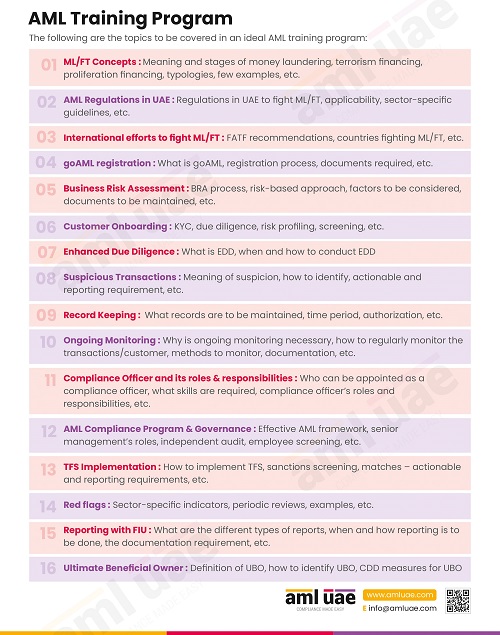
Defeating Financial Crime: Inside the AML Training Program

The video provides essential insights into the coverage of the AML training program. In order to succeed in fighting financial crimes, the reporting entity must get support from the top management and the employees. The employees must know various typologies and red flags to counter money laundering and terrorist financing. In this video, we will look at the critical topics that must be included in the AML training program of the entity.

  • What is ML/TF, typologies, red flags, case studies
  • AML/CFT laws and regulations in the UAE
  • International organisations – FATF, UNSC, MENAFATF, etc.
  • Enterprise-wide Risk Assessment
  • AML/CFT Policy, Procedures, and Controls
  • KYC, CDD, EDD, Customer Risk Assessment
  • Transaction Monitoring
  • Regulatory reporting requirements
  • Governance Structure
  • Sanctions compliance
  • Record-keeping requirements

Chapters:

  • 0:00 Introduction on Defeating Financial Crime
  • 0:43 Aspects of AML training program
  • 0:53 ML/FT Concepts
  • 1:01 AML regulations in UAE
  • 1:08 International efforts to fight ML/FT
  • 1:16 goAML Registration
  • 1:21 Business Risk Assessment
  • 1:30 Customer Onboarding
  • 1:40 Enhanced Due Diligence
  • 1:50 Ongoing Monitoring
  • 1:59 Suspicious transactions
  • 2:15 Record Keeping
  • 2:23 Roles and responsibility of the compliance officer
  • 2:30 AML Compliance program and governance
  • 2:45 TFS Implementation
  • 2:54 Reporting with FIU
  • 3:04 Ultimate Beneficial Owner
  • 3:14 Conclusion

Related Videos

Related Infographics

Related Articles

Related eBook

Mitigating high MLFT risk with Enhanced Due Diligence

This video focuses on the Enhanced Due Diligence (EDD) which is an advanced/ extended form of Customer Due Diligence, wherein additional checks are required to be done to manage the increased financial crime risks. The regulated entities (Financial Institutions, DNFBPs and Virtual Asset Service Providers) are required to undertake robust and rigorous version of CDD when it involves high risks customers. This video will help you understand what is EDD, situations when EDD is to be performed and measures to be applied. Following measures can be adopted to be performed as part of EDD.

  • Entities must increase the scrutiny around customer identities to ensure that customers are what they say they are.
  • Entities must get more information on the customer’s business, products, or services and conduct detailed inquiries about the purpose of the business relationship.
  • Entities must determine the legitimacy of the customer’s source of funds and wealth.
  • A thorough background search on the customers must be performed through public and private databases, internet research, social media, and adverse media checks to understand the customer’s connections with financial crimes.
  • The customer profile must be subject to increased monitoring.
  • The regulated entities must get senior management approval before establishing any business relationship or transaction with high-risk customers.
  • Asking the customer to make the first payment from the bank account in its name, ensuring the third-party funds are not used in the proposed business relationship or transaction.

Make significant progress in your fight against financial crimes,

With the best consulting support from AML UAE.

Share via :

About the Author

Pathik Shah

FCA, CAMS, CISA, CS, DISA (ICAI), FAFP (ICAI)

Pathik is an ACAMS-certified AML consultant specialising in governance, risk, and compliance for regulated entities in the UAE. He brings over 28 years of experience, with 1,000+ hours of AML training and 200+ advisory engagements across DNFBPs, VASPs, and FIs. He supports businesses in aligning with AML/CFT requirements from the CBUAE, DFSA, MoET, MoJ, VARA, CMA, FSRA, and FATF. Known for translating complex regulations into audit-ready procedures, Pathik enables operational clarity and compliance readiness.

Reach Out to Pathik

Sanctions Compliance Program: Step-by-Step Process to Manage the TFS Risk

Sanctions Compliance Program: Step-by-Step Process to Manage the TFS Risk

Sanctions Compliance Program: Step-by-Step Process to Manage the TFS Risk

The regulated entities in the UAE must implement adequate measures to comply with the Targeted Financial Sanctions (TFS) regime.

The following are the five core components of a robust TFS implementation program:

1. Sanctions Compliance Policy

The regulated entities must develop a Sanctions Compliance Policy in line with the applicable regulations and the assessed business exposure to TFS risks. During this step, the regulated entities must also subscribe to the EOCN’s Notification system to receive email alerts from EOCN when there is any update in the UAE Local Terrorist List or the UNSC Consolidated List.

2. Identifying the Sanctions Screening Solution

To ensure accuracy and speedy screening of the customers, beneficial owners and other concerned persons, it is crucial to implement the right AML screening tool. The regulated entities must evaluate the alternatives available in the market and identify the right fit for the entity’s Sanctions Compliance Policy. If possible, the solution must be integrated with the entity’s legacy system to ensure seamless data exchange.

3. Training

The Compliance Officer must ensure that the concerned staff in the organization is well trained around the entity’s Sanctions Compliance Program, use of the implemented screening tool, and understand their roles and responsibilities. Sanctions Training is crucial to effectively identify and manage the TFS risk across the business operations.

4. Sanctions Screening

All the customers, beneficial owners, etc., must be screened against the UAE Local Terrorist List, UNSC Consolidated List or any other relevant sanctions lists before establishing a business relationship and also on an ongoing basis. Further, in case of any matches identified with the sanctioned individual or organization, the regulated entity must apply required TFS measures like freezing the funds and terminating the business relationship. Further, depending on the nature of the match identified, the entity must file the Confirmed Name Match Report (CNMR) or Partial Name Match Report (PNMR) on the goAML Portal.

5. Review of Sanctions Compliance Program

To maintain the relevance and efficacy of the implemented sanctions compliance program, the regulated entity must periodically review the same to identify any gaps or deficiencies. These gaps must be addressed immediately, and necessary controls or enhanced measures must be deployed. Further, the Compliance Officer must also pay attention to Watchlist Management to ensure the comprehensiveness of the database for screening and reducing the number of false positive hits.

Here is an infographic discussing the stepwise process to implement an effective Targeted Financial Sanctions Program to detect and mitigate the TFS risk.

Let AML UAE, one of the leading AML consultancy firms, assist you with developing a customized TFS Compliance Policy for your business and identifying the proper sanctions screening solution. We can also impart training to the team to ensure compliance with TFS requirements, avoiding any non-compliance consequences.

Related Posts

Make significant progress in your fight against
financial crimes

With the best consulting support from AML UAE.

AML Case Management Software: Significant element of AML Compliance

aml-case-management-software

Pathik Shah

Table of Contents

Protect your business with reliable and effective AML strategies with AML UAE.

AML Case Management Software: Significant element of AML Compliance

With changing times where automation is impacting every aspect of business, anti-money laundering is no exception. The regulated entities in UAE – Financial Institutions, DNFBPs and Virtual Asset Service Providers (VASPs) must implement adequate financial crime risk mitigation framework to safeguard the business and comply with the applicable regulatory landscape. In this pursuit, the entities are moving towards AML Case Management solutions to bring efficiencies and effectiveness to their fight against money laundering and terrorist financing.

In this article, we will understand what AML Case Management software is and how it can revamp the face and quality of the entity’s AML efforts.

Understanding the AML Case Management Software

With emerging ML/FT trends and newer and more sophisticated methods, the timely identification of financial crime attempts is becoming challenging. In such situations, robust AML case management software can be a saviour for regulated entities to prevent financial crime vulnerabilities and avoid regulatory non-compliance consequences.

Consequences for Non-compliance with UAE AML Regulations

What is AML Case Management Software?

AML case management software is a platform offering automated capabilities to the regulated entities to efficiently manage the entire AML compliance cycle – from Customer Due Diligence to monitoring the transaction and identifying the potential suspicious transactions.

AML case management software is a comprehensive solution developed using advanced technologies, like artificial intelligence and machine learning, to facilitate regulated entities to navigate the AML compliance journey smoothly.

What are the Core Features of AML Case Management Software?

The following are the core features or functionalities of a robust AML case management software that fosters the AML compliance program of any regulated entity:

Customer Due Diligence:

Identification and identity verification of the customers and the beneficial owners, screening, and customer risk profiling to determine the nature and degree of the Customer Due Diligence (CDD) measures to be applied.

The CDD module of the AML case management solution is fundamental to identifying and preventing any potential financial criminals from sliding in and exploiting the business for laundering illicit funds. CDD functionality assists the regulated entities in determining the risk profile of each customer and business relationship and the CDD measures to be applied, considering the outcome of the customer identity verification and the screening against sanctions and other relevant databases. It will help in the optimal utilisation of resources, adopting the risk-based approach.

It is not a one-time activity. Instead, the AML case management solution comes in handy in KYC remediation and periodic review of the customer’s profile, including tracking the changes in the customer’s identification details.

Elements of the Customer Due Diligence Process

Transaction Monitoring and Alert Management:

Real-time processing of a huge volume of financial transactional records and generating alerts for potential suspicious transactions or any unusual trend.

The AML case management software supports continuous monitoring of the transactions to detect anomalies and suspicious trends in customer activities and promptly flag the same basis the predefined rules and logic. The power of technologies like machine learning and blockchain reduces false positive alerts, allowing more time for the compliance team to focus on genuine suspicious warnings. This can be used to prioritise the alerts generated based on the nature or count of deficiencies or suspicions observed and help the entity address these alerts efficiently.

AML Transaction Monitoring Rules

Managing the Alert Investigation Workflow:

Structured methodology and approach to investigate the flagged transactions, ensuring accuracy and consistency in the review process.

As the name suggests, the AML case management software enables the entity to manage the workflow of any alert as a “case”, starting from alert generation to its disposition, including thorough investigation capabilities. The software guides the compliance team to gather the flagged transaction-related data at one point and critically review the same. Case management software enables systematic analysis of the alerts, maintaining the audit trail and necessary records.

The standardization approach in investigation enables evaluation of all the critical information, ensuring that no ML/FT attempts go undetected and, simultaneously, no efforts are wasted on genuine transactions flagged as suspicious.

Collaboration amongst the team:

Facilitating smooth communication and coordination among various teams involved in AML compliance function.

For managing the AML compliance function effectively, collaboration and integration of various business functions are crucial – such as customer relationship manager, customer service executive, the finance and accounts team and, importantly, the AML compliance team. AML case management software enables a seamless exchange of information between the concerned teams, allowing the timely disposal of the case, be it a transaction monitoring alert or CDD process during customer onboarding.

Serves as Document Management System:

Maintenance of AML records in an organised manner, with utmost security and easy retrieval.

AML case management software is a document management system that retains the records and information in a tamper-proof system. The regulated entities can use this as an audit trail to check the progress and disposition of the alerts.

Further, it also acts as a single data repository of all AML-related documents and information, including CDD files and customer documents, transaction-related information, and records, including alerts generated and suspicions observed.

AML Record Keeping

AML Reporting and Analytics:

Capabilities to generate AML reports required for submission with the AML authorities or for internal management to draw insights around AML compliance.

AML case management software empowers the regulated entities to generate AML reports required to be filed on the goAML portal – such as Suspicious Activity Reports (SARs) or Suspicious Transaction Reports (STRs), transactional reports like Dealers in Precious Metals and Stones Report (DPMSR) or Real Estate Activity Report (REAR), sanctions related reports like Confirmed Name Match Report (CNMR) or Partial Name Match Report (PNMR).

Not limited to regulatory reporting, the AML case management solution can also offer capabilities to extract insights into an entity’s AML compliance. This may include information about the customers and their risk profile; the transaction flagged as suspicious and the outcome of the investigation; the number of reports filed with the Financial Intelligence Unit during the period; the ML/FT related trends and patterns, enabling Compliance Officer and the management to determine the actions to enhance the relevance and quality of AML efforts.

What factors should be considered while evaluating AML Case Management Software?

The selection of the right AML case management software is significant for advancing the AML compliance program of the entity. Thus, the entity must consider the various factors while identifying the right fit for the AML function, such as:

  • The solution must be feature-rich, aligned with the applicable AML regulations and offer necessary customization to work in tandem with the entity’s business operations. This requires the software to support the end-to-end AML compliance journey of the regulated entity, including AML reporting and analytics.
  • The module interface must be intuitive and user-friendly – easy to use and navigate. It is necessary to ensure that the software boosts compliance efficiency and productivity rather than attracting resistance from the users owning to its complex functioning mechanism.
  • Integration capabilities of the software, the integration between the existing system and the AML case management systems is essential for seamless transfer of data for ensuring completeness and accuracy of the data relied upon for AML compliance.
  • The software must be easy to scale as and when the volume and complexity of the customers and transactions increases. The solution must be capable of handling the evolving regulatory amendments and new AML compliance obligations.
  • The software must adhere to robust information security standards that can protect the entity’s sensitive and confidential information.

All the points mentioned above must be well considered while evaluating the AML case management software, including the pre- and post-implementation support for its successful deployment and implementation.

What are the benefits of AML Case Management Software?

aml-case-management-software

The following points highlight the significance of AML case management software:

  • It streamlines the AML compliance activities and automates the manual tasks, improving compliance efficiency and reducing human errors.
  • Timely detection of the red flags enables the entity to implement necessary risk mitigation procedures.
  • Structure planning and deployment of resources to manage the risk, using risk-based algorithms and reduced false positive alerts.
  • Compliance with the UAE AML regulations, avoiding non-compliance consequences like imposition of fines, damage to the business reputation and loss of customer trust.
  • Provide actionable insights on AML compliance to the AML Compliance Officer and the senior management, highlighting the areas that need immediate efforts for strengthening the AML controls.

How can AML UAE help you bring in the benefits of the AML Case Management Software?

AML case management software can be an excellent tool for regulated entities looking to upgrade their AML compliance structure. And AML UAE is here to help you select the right AML case management solution. We understand your business operations, identify the AML compliance obligations and map them to the required AML capabilities to ensure compliance and protection against ML/FT vulnerabilities.

Let’s leverage the power of AML case management solution to detect the ML/FT attempts and timely prevent them before they influence the economy.

Make significant progress in your fight against
financial crimes

With the best consulting support from AML UAE.

Share via :

About the Author

Jyoti Maheshwari

CAMS, ACA

Jyoti has over 11 years of hands-on experience in regulatory compliance, policymaking, risk management, technology consultancy, and implementation. She holds vast experience with Anti-Money Laundering rules and regulations and helps companies deploy adequate mitigation measures and comply with legal requirements. Jyoti has been instrumental in optimizing business processes, documenting business requirements, preparing FRD, BRD, and SRS, and implementing IT solutions.

Reach Out to Jyoti

Entities Subject to AML Compliance in Abu Dhabi Global Market (ADGM)

Entities Subject to AML Compliance in Abu Dhabi Global Market (ADGM)

Entities Subject to AML Compliance in Abu Dhabi Global Market (ADGM)

The ADGM’s Financial Service Regulatory Authority (FSRA) provides for a class of businesses, professions, and entities that must comply with the AML Rulebook or AML Module issued by FSRA to combat money laundering and terrorism financing, while protecting the integrity of the business and of the financial free zone.

Here is an infographic discussing the entities that are to be considered “Relevant Persons” subject to AML compliance in ADGM, which includes:

Authorised Person (including the Representative Office)

An entity engaged in Regulated Activities as specified under Financial Service Market Regulations 2015, such as Investment (Financial instrument and virtual assets) related activities, acceptance of deposits, providing credit, providing money services, etc. It also covers persons conducting insurance-related activities, managing Assets or Investment Funds on behalf of clients, or providing Trust Services or any other Shari’a-compliant Regulated Activities.

The list of Regulated Activities is captured as a separate infographic.

Recognized Body

A person operating a recognized Investment Exchange or a recognized Clearing House.

Designated Non-Financial Businesses and Professions (DNFBP)

The ADGM AML Rulebook considers the following persons or entities as DNFBPs:

Non-Profit Organization

NPOs are also subject to AML compliance, which is engaged in raising or disbursing funds for charitable, religious, cultural, educational, social, or fraternal purposes.

ADGM entities must comply with the FSRA-issued AML Rulebook and Federal AML/CFT laws and regulations and design a robust AML framework to identify and manage financial crime risks.

Let AML UAE assist you in navigating ADGM’s AML regulations and implementing the necessary AML policies and procedures to safeguard the business and stay compliant.

Related Posts

Make significant progress in your fight against
financial crimes

With the best consulting support from AML UAE.

Suspicious Transactions around Precious Metals and Stones: Timely Identification and Reporting

Red flags identification and reporting for DPMS

Pathik Shah

Table of Contents

Protect your business with reliable and effective AML strategies with AML UAE.

Suspicious Transactions around Precious Metals and Stones: Timely Identification and Reporting

To prevent the misuse of the precious metals and stones sector, the UAE authorities have brought the sector under anti-money laundering regulations. These AML regulations mandate the Dealers in Precious Metals and Stones (DPMS) implement necessary measures and controls to detect unusual transactions and activities appearing as an attempt to launder funds through the sector and immediately report the same to the Financial Intelligence Unit (FIU).

Precious metals like gold, platinum and precious stones such as diamonds and pearls have been common typologies exploited by money launderers to circulate illicit funds through the layers and make it look like they were generated from legitimate sources. Awareness of the anomalies and uncommon activities is critical for the DPMS to spot the red flags promptly and take necessary actions to prevent the laundering of funds through precious metals and stones.

In this article, let us discuss some unusual transactions that trigger an alert, internal and external reporting mechanism, and some of the best practices the dealers in precious metals and stones must adopt.

Identifying the Unusual Transactions involving precious metals and stones

Identifying suspicious transaction patterns is essential for the DPMS to protect their business from being misused for routing illicit money through the precious metals and stones mode. The UAE AML regulations mandate that dealers in precious metals and stones develop and implement a robust monitoring system to detect unusual transaction patterns and customer behaviour inconsistent with their risk profile.

One important aspect of detecting unusual transactions is knowledge of the common methods through which the launderers can exploit the industry. Only when the DPMS is aware of such trends and techniques can they be cautious towards the customer’s buying and selling activities to recognize the financial crime signals. Some of the commonly observed methods to be used by criminals to launder the funds are:

Structuring of transactions

The customer undertakes multiple weekly cash transactions, each valued between AED 50,000 and AED 53,000. This red flag indicates the customer’s intention to avoid the reporting threshold.

Involvement of high-risk jurisdictions

Frequent transactions where payment is released through a bank account located in high-risk jurisdictions.

Inconsistency with the nature of business activities

A corporate customer is making high-value purchases of precious metals with no logical connection with the business activities it is engaged in. For example, a non-profit organization buying diamonds.

Adequate Customer Due Diligence when Dealing with Non-Profit Organizations Min

Sudden change in the volume and value of transactions

A regular customer (in the case of a B2B business relationship) suddenly purchases double the value it has typically been undertaking without any economic rationale.

Abnormal customer requests for precious metal conversion

The customer makes an unusual request to convert precious metals like gold into ordinary objects to disguise the identification of gold.

Series of transactions in different names

The same person carrying out multiple transactions involving the purchase of precious metals furnishing different identity documents claimed to be close relatives. Though appearing genuine initially, it is a red flag suggesting an attempt to launder huge cash with forged IDs and fake names.

Mismatch in the transaction value and the customer’s financial profile

A customer makes transactions worth value beyond the ordinary means of the customer, as identified by a review of the customer’s financial document.

With awareness of the gaps comes the approach to staying vigilant to detect unusual transactions and prevent money laundering and terrorist financing.

Reporting of Suspicious Transactions involving precious metals and stones

The AML regulations in UAE provide that the regulated entities, including the dealer in precious metals and stones, must report the identified red flags to the Financial Intelligence Unit without any delay. To comply with this regulatory reporting requirement, the DPMS must adopt a thorough and systemic approach, following the below steps:

Dealer in Precious Metals and Stones Report

1. Preliminary inquiry to determine the nature of suspicion

Once the frontline employee, upon detection of any unusual activity or risk indicator, must make further inquiry into the matter. This inquiry may involve reviewing the customer’s profile, past transaction history, etc. If required, the employee may seek clarification or further details from the customer, but subject to compliance with the “non-tipping off” requirement.

The employees must evaluate the matter diligently to avoid sending unnecessary reports to the AML Compliance Officer, which, upon preliminary investigation, turns out to be genuine and legitimate activity.

2. Intimation to the AML Compliance Officer

If the employee has reasonable grounds to believe that the suspicion still prevails even after investigation and requires escalation to the AML Compliance Officer for further investigation, it must intimate the matter to the AML Compliance Officer.

Such reporting or intimation to the Compliance Officer must be in writing, capturing the necessary details about the transaction, why the employee considers the subject activity or transaction suspicious, parties involved, and other details and documents necessary for the Compliance Officer to investigate the suspicion further.

Role of AML Compliance Officer in UAE Preview

3. Independent investigation by the AML Compliance Officer

Upon receipt of the internal report on observed suspicion from the employees, the AML Compliance Officer must attend to the matter immediately and independently review the facts to determine the legitimacy of the suspicion and the suspected transaction/activity. The investigation’s basis and the review’s outcome must be well documented. If the Compliance Officer believes that the transaction or activity is suspected of involving money laundering or terrorism financing, the reporting shall be done with the FIU by filing the Suspicious Transaction Report (STR) or Suspicious Activity Report (SAR), as the case may be.

However, if the Compliance Officer is of the view that the transaction is genuine and does not involve any proceeds of crime, then such a decision must be recorded along with the rationale for the same.

4. Reporting the suspicion to the Financial Intelligence Unit (FIU)

Having determined the suspicion, the AML Compliance Officer, also known as the Money Laundering Reporting Officer, must immediately file the relevant report to the FIU, furnishing information about the parties suspected, the nature and value of the transaction, red flags observed, action taken by the authorities, etc.

Following a robust and systematic reporting mechanism, the DPMS can ensure timely and quality reporting of suspicious situations to the FIU.

Best Practices to avoid exploitation of precious metals and stones for financial crime

For effectively handling the identification and reporting of unusual transactions, here are a few best practices the dealers in precious metals and stones must adopt:

Adequately documenting the red flags

To assist the employees in understanding the unusual transaction patterns and detect the risk indicators, it is recommended that the DPMS have a list of red flags relevant to the business and circular amongst the team. With a list of potential risk indicators handy, identifying unusual transactions and evaluating the same to confirm the suspicion becomes quick and efficient.

Implementing tools and technology

When the number of customers visiting the jewellery showroom and the volume of transactions is too huge, deploying the right tools and software always proves to be the backbone of AML compliance. The emerging technologies, having data analytics capabilities, can review the transactions in real time, detect the patterns and trends that appear uncommon for the business, and generate alerts for the team to review further.

Red flags identification and reporting for DPMS

This will filter out the false positive alerts, allowing the team to focus more on the disposition of the genuine red flags.

Staying updated on the emerging trends and ML/FT typologies

The AML Compliance Officer of the DPMS must stay up-to-date on the evolving ways criminals could exploit the precious metals and stones industry. This knowledge would be crucial to proactively implement the necessary controls to detect such attempts and prevent business exploitation through innovative laundering methods.

Designing internal SAR/STR forms

To ensure accurate and comprehensive reporting, the DPMS must design internal STR/SAR forms. This shall ensure consistency in the details furnished by the frontline employees to the Compliance Officer without missing any critical information.

Furnishing complete and accurate details to the FIU

The AML Compliance Officer must ensure that the report filed with FIU has relevant, complete, and accurate information, which helps the FIU to analyze the possibility of money laundering or terrorism financing and make sure that necessary actions are initiated against the culprit.

Moreover, the Compliance Officer should avoid unnecessarily flooding the FIU with false alerts, reported just for the sake of reporting without diving into the actual nature of suspicion.

Conducting necessary training

Training is pivotal to imbibing a sense of awareness in the team toward identifying and handling unusual transactions. Adequate training on suspicion transactions promotes employee accountability, enabling them to detect and respond to the observed red flags effectively. Education around the internal reporting mechanism must be ensured to empower the team to manage the internal suspicious reporting requirement skillfully.

The above-mentioned best practices around identifying red flags and reporting thereof would offer a competitive edge to the DPMS to detect the red flag before it significantly impacts the business and stay AML compliant.

Let AML UAE assist the DPMS sector in timely detecting and reporting suspicious activities!

A thorough understanding of the red flags and awareness of its reporting process is fundamental in detecting and reporting suspicious transactions. With our team of professionals at AML UAE, we assist the dealers in precious metals and stones in UAE in designing the AML framework, including the list of sector and business-specific ML/FT typologies, and developing the standard reporting system to help the team in timely and accurately reporting the observed red flags to the AML Compliance Officer. We also impart training to the team on identifying and reporting suspicious transactions discussing case studies to bring a practical aspect to the learning.

Let’s unite to maintain the integrity of the precious metals and stones segment!

Make significant progress in your fight against financial crimes,

With the best consulting support from AML UAE.

Share via :

About the Author

Jyoti Maheshwari

CAMS, ACA

Jyoti has over 11 years of hands-on experience in regulatory compliance, policymaking, risk management, technology consultancy, and implementation. She holds vast experience with Anti-Money Laundering rules and regulations and helps companies deploy adequate mitigation measures and comply with legal requirements. Jyoti has been instrumental in optimizing business processes, documenting business requirements, preparing FRD, BRD, and SRS, and implementing IT solutions.

Reach Out to Jyoti