
Understand the types of CDD measures to effectively mitigate the ML/FT risks 

Understand the types of CDD measures to effectively mitigate the ML/FT risks 

Understand the types of CDD measures to effectively mitigate the ML/FT risks 

The UAE AML regulations provide for the application of a risk-based approach, i.e., the higher the money laundering or terrorism financing risk, the increased and more stringent AML/CFT checks to be applied. In line with this, if a particular customer’s ML/FT risk is assessed as HIGH, the regulated organizations must apply Enhanced Due Diligence Measures comprising additional risk mitigation measures. While adopting simplified or standard due diligence measures are sufficient in other cases (for customers identified as Low or Medium risk).

Thus, it is pertinent to understand the types of Customer Due Diligence (CDD) measures to adequately apply the same, depending on the nature of the customer’s risk profile. Here, an infographic presents the three types of CDD processes, the circumstances when a particular CDD process is to be followed, measures to be applied and its relationship with ongoing customer monitoring. Also, a few examples have been captured for each CDD type for better understanding.

AML UAE is AML Consultancy firm, assisting regulated organizations in designing and implementing a robust AML Compliance framework and imparting AML training. AML UAE also helps the clients develop the customer onboarding process, with clear AML policies and procedures around Customer Due Diligence to be followed.

Related Posts

AML Supervisory Authorities in UAE

AML Supervisory Authorities in UAE

AML Supervisory Authorities in UAE

AML Supervisory Authorities in UAE

The UAE’s Federal AML regulations entrust various local or federal authorities with the power to manage the AML compliance-related functioning of the Financial Institutions, Virtual Asset Service Providers (VASPs) and Designated Non-Financial Businesses and Professions (DNFBPs).

Here is an infographic to identify the relevant AML Supervisory Authority for your business – based on the nature of activities you are engaged in or the jurisdiction where your business is established.

AML UAE is one of the leading AML consultancy service providers in the UAE, assisting Financial Institutions, DNFBPs and VASPs to stay AML compliant by designing customized AML programs aligned with the federal AML regulations and the AML obligations imposed by the respective Supervisory Authority.

Related Posts

Know Your Customer (KYC) requirements under AML regulations in UAE

Know Your Customer (KYC) requirements under AML regulations in UAE

Know Your Customer (KYC) requirements under AML regulations in UAE

KYC is an integral part of the customer onboarding process and overall AML Compliance program, involving verification of the identity of the customer and suppliers.

It is essential to identify the person with whom the business is proposing to transact, including their background, so businesses do not end up exposing themselves to such criminals and are confident that the parties they are dealing with are genuine. Here is the infographic presenting the details and the documents that need to be sought from the customer as part of the KYC procedure.

AML UAE is one of the leading firms offering a comprehensive range of AML consultancy services, designing the KYC templates and managing your KYC.

Related Posts

Red flag indicators for AML/CFT

Red flag indicators for AMLCFT feature img

Red Flag Indicators For AML/CFT

Table of Contents

Protect your business with reliable and effective AML strategies with AML UAE.

Red flag indicators for AML/CFT​

AML UAE, with its vast experience and on the basis of the AML/CFT guidelines, has systematically prepared Red flag indicators for AML/CFT pertaining to different aspects such as customers, their source of funds, etc.

Money laundering can cause a lot of troubles in both qualitative and quantitative manner on the business organization. Money laundering primarily hides the income and the source of funds of the criminals or money launderers, as the same is illicit or unexplained. In addition to that, Red flag indicators for AML/CFT also harm the overall economy and poses several risks to the business enterprise.

Facilitating criminal activities like money laundering either directly or indirectly through one’s business may lead to dramatic challenges in managing the assets of the business organization. Furthermore, Red flag indicators for AML/CFT may add to high legal costs and penalties if any sort of money laundering activities is taking place involving one’s business organization or the organization is not abiding by the anti-money laundering compliance regulations.

Surprisingly, a humongous amount of money is being laundered every year. In order to avoid that, one has to be very mindful of the Red flag indicators for AML/CFT and constantly monitor the same where something unusual is observed. The Sooner the identification of the Red flag indicators for AML/CFT, the more efficient would be the measures to avoid/control the damage or restrict the intensity of the same.

What is the meaning of Red flag indicators for AML/CFT?

It is essential to be well aware of and act according to the red flags indications that pinpoint involvement of any fraud or suspicious activities in a financial transaction. In a few complex cases, one may experience the need to obtain more information from the customers. For example, suppose certain essential questions or details pertaining to the customers remain unaddressed or unanswered. In that case, the AML Compliance Officer should evaluate the reasonableness of suspicion involved and, if needed, filing a Suspicious Transaction Report with the Financial Intelligence Unit.

Red flags indicators also aid financial institutions in order to apply a risk-based approach to meet customer due diligence (CDD) requirements like knowing about the beneficial owners and understanding the legitimacy of the source of funds. If there is a red flag indication, the regulators might suspect the occurrence of either terrorist financing or money laundering, or any funding of illegal organizations. Law enforcement officers find these red-flag indicators helpful when monitoring the behavior of the professionals or even the customers. A report from Financial Action Task Force or FATF highlights the following red flags related to terrorist financing and money laundering:

Compliance. Trust. Transparancy

Customized and cost-effective AML compliance services to support your business always

Red flags about the customer

Here are a few red flags about the customers.

The customer is extraordinarily secretive or tries to evade information related to the following aspects.

  • Who the customer is
  • What precisely the bigger picture is, and is there anything that is lying under the table
  • What is the source of the enormous sum of money
  • Who exactly is the beneficial owner
  • Why are they carrying out a particular financial transaction in a different or unusual manner
Red flag image one
Red flag image two

Customers are looking up to these things

  • Customers are actively avoiding any sort of direct or personal contact​
  • Uses an email address that is not found on the internet
  • If the customer clearly refuse to provide information, necessary documents, or data
  • Upon asking, the customer offers irrelevant or fake documents
  • An associated partner, or any known or unknown person involved in any kind of suspected criminal activities like terrorist financing and money laundering

Red flags alerts for parties are generated when

  • When the parties or their representatives are situated in a country that is prone to high-risks
  • The parties involved in any financial transaction are tied for no apparent commercial reason
  • The links between the families, employment, institution of the parties may raise doubts about the legitimacy or authenticity of the parties
  • The individual who directs the operation is not amongst the official parties of the transaction or its representatives
  • A natural person working as a representative or a director is not appropriate in many terms, and even his behavior is not right
Red flag image three

Red flags in the source of funds

Here are a few red flags that should look forward to in order to minimize the intensity of the damage:

Red flags

1. The financial transactions are expressly inconsistent with the socio-economic profile of the individuals.

2. If one finds out that the actual source of funding is illicit

3. If the customer uses more than one national or foreign bank account under his name

4. The choice of payment mode or method has been postponed to a highly close time to the time of notarization without any explainable or logical reason.

5. If there is any unexplained or suspiciously short payback period

6. Mortgages are repaid quickly without any sustainable explanation, even before the first due date

7. If the assets are being purchased in cash and rapidly used as a guarantee for the loan

Compliance. Trust. Transparancy

Customized and cost-effective AML compliance services to support your business always

8. If any prompt request comes in order to moderate the previously agreed payment procedures without a good experience

9. Finance is provided by the lender without any logical explanation outside of the credit institution

10. The collateral provided for the transaction is located in a country that is categorized as high-risk.

11. If there has been an exponential increase or consecutive contributions to the same business enterprise without having any recent logical statement in favor of that same business unit.

12. If there is an unrelated increase in the capital from a company or from a foreign company.

13. If the business enterprise has received a relatively high sum of capital or fixed assets.

14. If there is an unnecessarily high or low price for the transfer of the securities.

15. If recently incorporated, companies are also making large financial transactions without any justification or logical reason.

Red flags related to behaviour

FAQs: Red flag indicators for AML/CFT​

What is a red flag in AML? 

Red flags in AML means a warning or an alert that there is an undesirable characteristic or threat in a transaction, customer, or entity.  

AML transaction monitoring red flags include sanctioned sources of money, owners belonging to high-risk countries, unusual bank transactions, inconsistencies in the identity verification process, the sudden withdrawal of high amounts, etc.  

Yes, there can be more than one AML red flag indicator in a transaction.  

Here are a few actions that must be taken immediately when multiple red flags are observed:

  • Receive internal reports from the employees of any kind of unusual or suspicious activities or transactions.
  • Assesses the reports thoroughly that helps determine the probability of any potential terrorist funding and money laundering.
  • If needed, a Suspicious Transaction Report shall be filed with the Financial Intelligence Unit.
  • Developing and coordinating proper reporting channels for issues pertaining to effective compliance
  • Building effective communication channels for the Company’s compliance with AML/CFT regulations
  • Coordinating and scheduling necessary compliance training for the concerned employees
– Corrupt business practices and Anti-bribery Misconduct or Compliance Risk
– Export Controls/Sanctions Misconduct And Legal Compliance Risk
– Anti-money Laundering/ Anti-terrorism Risk
– Anti-boycott Compliance Risk
Federal banking agencies of the respective country are responsible for ensuring OFAC compliance by its banking sector and identifying the OFAC red flags.
Red flags are used to timely identify any suspicious activities involving money laundering or terrorism financing and report the same to the FIU.

Share via :

Add a comment

About the Author

Pathik Shah

FCA, CAMS, CISA, CS, DISA (ICAI), FAFP (ICAI)

Pathik is an ACAMS-certified AML consultant specialising in governance, risk, and compliance for regulated entities in the UAE. He brings over 28 years of experience, with 1,000+ hours of AML training and 200+ advisory engagements across DNFBPs, VASPs, and FIs. He supports businesses in aligning with AML/CFT requirements from the CBUAE, DFSA, MoET, MoJ, VARA, CMA, FSRA, and FATF. Known for translating complex regulations into audit-ready procedures, Pathik enables operational clarity and compliance readiness.

Reach Out to Pathik

Know Your Transaction (KYT) and Know Your Virtual Asset Service Providers (KYV)

Know Your Transaction (KYT) and Know Your Virtual Asset Service Providers (KYV)

Know Your Transaction (KYT) and Know Your Virtual Asset Service Providers (KYV): Mitigating AML Risks for VASPs

Along with the Know Your Customer (KYC) process, the AML regulations in UAE require the Virtual Asset Service Providers (VASPs)  to implement the “Know Your Transactions” (KYT) measures to understand the transactional parameters involved while conducting a virtual asset transfer.

Similarly, the regulations mandate VASPs to identify and verify the identity of the corresponding VASP involved in the virtual asset transaction – whether as the originating VASP initiating the VA transfer or the beneficiary VASP – “Know Your Corresponding VASP” (KYV).

These KYT and the KYV requirements are aligned with the FATF recommendations for Virtual Asset transactions.

Here is an infographic discussing the “Know Your Transaction” and “Know Your Corresponding VASP” elements.

AML UAE offers end-to-end AML consultancy support to all the regulated entities, including VASPs operating in UAE, supporting designing and implementing the AML compliance framework, KYC, KYT and KYV process.

Related Posts

Check your AML Compliance with Independent AML Audit

Independent AML Audit

Check your AML Compliance with Independent AML Audit

Check your AML Compliance with Independent AML Audit

The UAE AML regulations mandate that the designated organizations – Financial Institutions, Virtual Asset Service Providers (VASPs) and Designated Non-Financial Businesses and Professions (DNFBPs) – get their AML compliance program tested by an independent AML auditor.

The independent AML audit program must focus on checking the quality, adequacy, and effectiveness of the implemented AML framework.

Know more about the independent AML audit required under the UAE AML laws, why it is significant, and who can be the independent AML auditor.

AML UAE offers comprehensive AML consultancy support to the regulated entities, ensuring that the AML policies, procedures, and controls align with the regulatory requirements and adequately mitigate the organization’s ML/FT risk exposure.

Related Posts

Differences in AML requirements under UAE Federal Law, DIFC and ADGM Rulebooks

Differences in AML requirements under UAE Federal Law, DIFC and ADGM Rulebooks

Pathik Shah

Table of Contents

Protect your business with reliable and effective AML strategies with AML UAE.

Differences in AML requirements under UAE Federal Law, DIFC and ADGM Rulebooks

The main point of difference in AML requirements under UAE Federal Law, DIFC, and ADGM rulebooks is the Supervisory Authority that governs, regulates, and administers fulfilment of AML Compliance requirements by Regulated Entities under the purview of each authority.

UAE’s battle against money laundering and other financial crimes is becoming stronger daily.  

Several robust federal and free zone regulations. Effective reporting of suspicious activities. Investigations. Prosecutions. Fines and penalties.  

The country has committed to implementing strategies and policies to reduce financial crimes. It also supports global efforts of FATF and other bodies for combatting money laundering and terrorism financing.  

Regarding this, the UAE has introduced regulations at a Federal AML regulation, and it’s implementing guidelines, laying down the measures regulated entities must take to combat money laundering and terrorism financing. Since Dubai International Financial Centre (DIFC) and Abu Dhabi Global Market (ADGM) are financial-free zones, they have different regulations for entities operating in these areas. But still, the basis of these regulations remains the two principal Federal AML regulations of the UAE: 

DIFC and ADGM apply the federal law as it is. Additionally, they have implemented AML-specific rules and guidance for the entities established in their respective free zones. A few differences exist between the AML compliance requirements as applicable to units in DIFC and ADGM vis-à-vis units operating in mainland UAE.  

Let’s have a look at each of the AML provisions and highlight the differences: 

Regulatory authority

Federal AML Regulations

Various Supervisory Authorities have been identified to regulate mainland UAE entities’ AML/CFT compliance.  


Units operating in Mainland UAE 


Supervisory Authority 


Financial Institutions (including insurance companies)  


Central Bank of UAE 


Lawyers & Legal Consultants 


Ministry of Justice 


Virtual Asset Service Providers (VASPs) in Dubai 


Virtual Assets Regulatory Authority of Dubai 


Capital Market & VASP (other than Dubai) 


Securities & Commodities Authority 


Other Designated Non-Financial Businesses and Professions (DNFBPs) 


Ministry of Economy 

DIFC

The Dubai Financial Services Authority (DFSA) regulates, controls, and administers AML requirements in DIFC. 

ADGM

The Financial Services Regulatory Authority (FSRA) enforces the rules and requirements of AML and CFT in ADGM.  

Definition of DNFBP

Federal UAE

The definition of DNFBP in UAE includes the following: 

DIFC

In the case of DIFC, the definition changes a bit. Besides the above, it includes:  

  • A real estate developer 
  • Insolvency firm 
  • A person who issues or provides services related to Non-Fungible Tokens (NFTs) or Utility Tokens.

A Registered Auditor is not a DNFBP but is subject to AML Regulations in DIFC. 

ADGM

In the case of ADGM, the definition of DNFBP includes a dealer trading any saleable item where the transaction amount equals or exceeds US$ 15,000 in cash through a single transaction or series of connected transactions. Further, it also includes taxation consulting firms explicitly.  

Risk-based approach & AML Enterprise-Wide Risk Assessment

Entities must assess the several risks their business is exposed to. These risks may relate to the following: 

  • Nature of the business 
  • Products and services 
  • Customers the entities deal with 
  • Delivery-channels 
  • Transactions 

Based on the risk levels, entities must implement measures to tackle those risks. Also, you must keep reviewing the risk assessment to update it with changes at regular intervals. You must also document the findings and results for future reference.  

The provisions for a risk-based approach are standard in all three – Federal AML regulations, DIFC, and ADGM, except that the DIFC units are also required to consider the tax-crime risks.  

Basis the overall AML risk assessment of its business, regulated entities must develop their AML controls, procedures, policies, and systems to mitigate or manage the AML risks.

How to conduct AML Business Risk Assessment Priv

Circumstances warranting performance of Customer Due Diligence

Entities must undertake customer due diligence: 

  • When it enters into a business relationship with the customer 
  • When it carries out an occasional transaction valuing more than a defined number with a customer 
  • When it suspects a customer or transaction of money laundering 
  • When it has doubts about the validity or adequacy of information or documents provided by the customer  

There are minor differences in the circumstances when CDD is to be performed under three regulations. 

Federal AML regulations

As per the UAE Federal AML Law, the threshold prescribed for conducting CDD in case of the occasional transaction is equal to or exceeding AED 55,000. This transaction can be a single transaction or several interlinked transactions.  

Understand the types of CDD measures to effectively mitigate the ML-FT risks 

DIFC

In the case of DIFC, there is no limit on the transaction amount with the customer to carry out CDD.  

Further, the entities in DIFC can delay the identity verification of customers and their beneficial owners if: 

  • The AML risk is low 
  • Carrying out verification interrupts or delays the normal course of business 

But verification must be completed within 30 business days of effecting the transaction.  

ADGM

In the case of ADGM, the defined number is USD 15,000.  

Also, entities can delay the identity verification of customers and their beneficial owners if: 

  • The AML risk is low 
  • Carrying out verification interrupts or delays the ordinary course of business 

But the entities must complete this verification within 20 business days of effecting the transaction.

Money laundering reporting officer

DIFC and ADGM entities must appoint a Compliance Officer or Money Laundering Reporting Officer who is a resident of the UAE. No such residency-related specific condition is mentioned under the UAE Federal AML Law.

Role of AML Compliance Officer in UAE Preview

Record keeping 

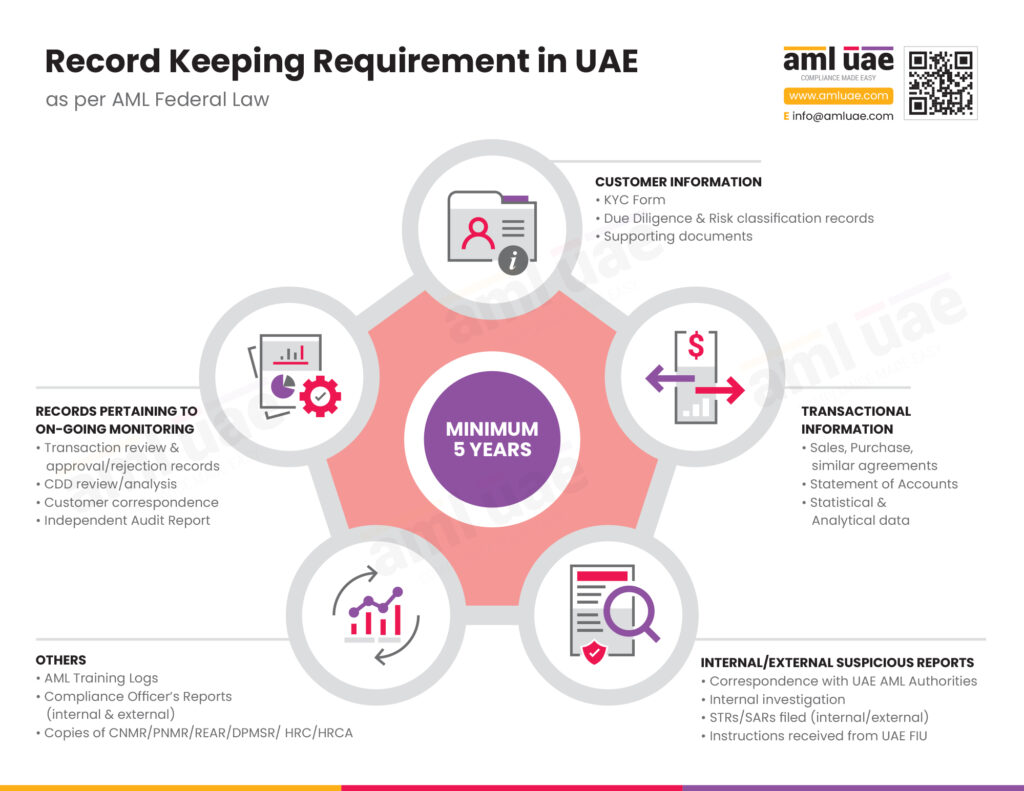
DIFC and ADGM entities must maintain the AML/CFT-related records for a minimum of six (6) years. At the same time, the minimum data retention period prescribed under the UAE Federal AML Law is five (5) years. 

Record Keeping Requirement in UAE

AML Annual Return

Units in DIFC and ADGM are required to furnish an AML Annual Return to the respective supervisory authorities.  

The entities in DIFC must submit the AML Annual Return to the DFSA by the end of September every year. It covers the reporting year from August 1 of the previous year to July 31 of the reporting year.  

While the ADGM units are required to furnish an AML Annual Return to FSRA by the end of April every year, covering the AML/CFT records and data about the previous year from January 1 to December 31.  

AML UAE

This blog clarifies the differences between AML requirements under the Federal AML regulations, DFSA Rulebook and the ADGM AML Rulebook. Generally, the provisions of the Federal AML regulations apply, with specific clauses of the AML and Sanctions Rulebooks issued by the regulatory authorities of the financial free zones – DIFC and ADGM. If you still have doubts, AML UAE will always help you. 

AML UAE is one of the leading AML consultancy service providers in the UAE. We ensure 100% AML compliance by our clients in the UAE by offering AML support related to the following: 

Make significant progress in your fight
against financial crimes

With the best consulting support from AML UAE.

Share via :

About the Author

Pathik Shah

FCA, CAMS, CISA, CS, DISA (ICAI), FAFP (ICAI)

Pathik is an ACAMS-certified AML consultant specialising in governance, risk, and compliance for regulated entities in the UAE. He brings over 28 years of experience, with 1,000+ hours of AML training and 200+ advisory engagements across DNFBPs, VASPs, and FIs. He supports businesses in aligning with AML/CFT requirements from the CBUAE, DFSA, MoET, MoJ, VARA, CMA, FSRA, and FATF. Known for translating complex regulations into audit-ready procedures, Pathik enables operational clarity and compliance readiness.

Reach Out to Pathik

A comprehensive AML Guide for ADGM companies 

A comprehensive AML Guide for ADGM companies 

Pathik Shah

Table of Contents

Protect your business with reliable and effective AML strategies with AML UAE.

A comprehensive AML Guide for ADGM companies 

The Financial Services Regulatory Authority (FSRA) supervises Abu Dhabi Global Market (ADGM) entities. 

FSRA has issued rules and guidelines for implementing AML and Sanctions by ADGM entities to mitigate financial crimes. Though the ADGM’s AML Rulebook considers the Federal AML rules, the regulated entities in ADGM must follow the Rulebook and the Federal AML Law requirements 

This article focuses on the critical AML compliance requirements of entities in ADGM.  

Business Risk Assessment and AML Policies, Procedures and Controls

The FSRA-issued AML rulebook mandates the ADGM entities to assess the ML/FT risks their business is exposed to.  

While conducting AML business risk assessment, the ADGM entities must identify and analyze the ML/FT risk associated with the below-mentioned risks parameters: 

  • Customers  
  • Products, services, and transactions  
  • Geographic risk  
  • Distribution channels 
  • Other risk factors such as technology 
How to conduct AML Business Risk Assessment Priv

Basis the results of the AML Business Risk Assessment, adopting the risk-based approach, the entities must establish AML controls, procedures, policies, and systems aligned with the AML regulations to help entities identify, manage, and mitigate the ML/FT risks.  

To ensure the effectiveness of the ML/FT mitigation measures, it is important to review ML/FT risk factors impacting the business and update the assessment to identify any new risk scenarios and design relevant controls to manage the increased level of risks.  

Customer Risk Assessment and Customer Due Diligence

The entities must assess the customers’ profile, transactions, and business relationships to identify the ML/FT risk such customers pose to the business. Considering various risk parameters, a risk rating should be assigned to the customer, and appropriate Customer Due Diligence measures should be applied before establishing a business relationship. 

For performing Customer Risk Assessment, the entities must consider various factors associated with the customer, a few of them illustrated hereunder: 

  • Ownership, control structure, and nature of customer 
  • Nature of the customer’s business 
  • Nature and purpose of the business relationship  
  • Nationality and residence of the customer 
  • Place of incorporation of the customer who is a legal person. 
Key factors for Customer Risk Assessment under AML regulations

Based on these factors, the risk rating is allocated to each customer – high, medium, or low. For low-risk customers, entities may conduct Simplified or Standard Due Diligence. While for customers identified as high-risk, Enhanced Due Diligence measures must be applied.  

Enhanced Due Diligence measures under UAE AML Regulations

Depending on the risk profiling or risk classification of the customer, the ADGM entities must carry out Customer Due Diligence under the following circumstances: 

  • Before onboarding a customer or establishing a business relationship 
  • Before executing a transaction with an occasional customer for an amount equal to or more than US$15,000 
  • When the customer or transaction is suspected to be related to money laundering or financing of terrorism. 
  • When there is doubt about the authenticity of documents provided by the customers 

As part of the Customer Due Diligence process, the ADGM entities must undertake the following: 

  • Identify the customers, their representatives, and beneficial owners and verify their identities, 
  • Screen the customer, beneficial owners, and senior managerial persons to check if any of these persons are sanctioned under the UAE local list, UNSC Consolidated List or any other relevant international sanctions list, 
Sanctions Screening - Actionable and Reporting under AML UAE
  • Understand the nature and purpose of the business relationship, 
  • Have systems and controls in place to determine whether the customer, beneficial owners, or senior managerial person is a Politically Exposed Person (PEP), 
  • Conduct ongoing monitoring of the business relationships and transactions conducted with the customer to check their consistency with the customer’s business and risk rating 
PEP and PEP Screening under UAE AML Regulations pre

However, when a customer is assigned a high-risk rating, Enhanced Due Diligence (EDD) measures must be applied before establishing a business relationship or executing a transaction with such a customer. Here, the EDD measures would include the following: 

  • Get more information to identify the customer and its beneficial owners,  
  • Identify and verify the source of wealth and funds of the customer and its beneficial owners, 
  • Establishing reasonableness of the purpose of the business relationship, 
  • Seek senior management’s approval to start a business relationship with a high-risk customer, 
  • Insist on getting the first payment through the customer’s account with the bank subject to similar AML standards,  
  • More frequent monitoring of the customer’s profile and transactions. 
A comprehensive AML Guide for ADGM companies 

Money Laundering Reporting Officer (MLRO)

Every ADGM entity must appoint an MLRO to ensure compliance with AML requirements as prescribed under the FSRA-issued AML Rulebook and the AML Federal laws. Such MLROs must be residents of the UAE. 

Further, the FSRA must approve the appointment of the MLRO. 

If an MLRO leaves the company immediately, a new MLRO must be appointed, or at least a Deputy MLRO must be appointed to manage the AML compliance function temporarily until the appointment of an MLRO. FSRA Rulebook allows the ADGM entities to outsource the MLRO position to a third party.  

AML Training and Awareness 

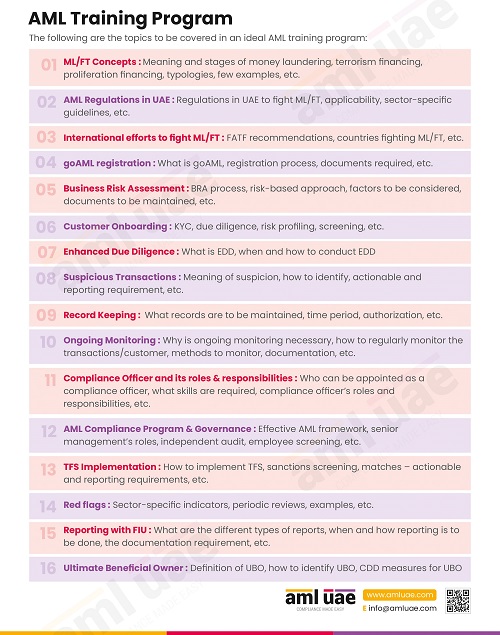
FSRA mandates entities to conduct regular training for its employees responsible for AML compliance. Such training and AML awareness sessions must customize be customized basis the entities’ business operations, products/services, transaction complexities, distribution channels, and customers.  

ADGM entities must conduct such AML training at least once a year and keep it up-to-date. Further, it is mandatory to record details of such training programs, including their dates, duration, nature, and list of participants.  

Designing a comprehensive AML Training Program

Reporting Suspicious Activities  

Every ADGM entity must have procedures, controls, policies, and systems to detect suspicious activities and report them immediately to the Financial Intelligence Unit (FIU) by filing SAR/STR on the goAML portal 

Frontline employees observing the suspicion must report it to the entity’s MLRO and submit all the details about the activity, customer or transaction involving money laundering or terrorist financing activity. When the MLRO receives an internal STR/SAR from an employee, they must investigate the activity. MLRO must submit an external STR/SAR with the FIU based on the evidence collected. 

ADGM entities must maintain a list of ML/FT risk indicators and keep reviewing and updating this list to identify and mitigate the risks effectively. 

AML Record Keeping  

ADGM entities must maintain AML-related records for a minimum period of six (6) years in electronic format. The records to be maintained include the following: 

  • Entities’ AML Business Risk Assessment and the AML framework implemented 
  • Documents and information received from customers during KYC and CDD 
  • Copies of business correspondence with customers, including transactional details 
  • Suspicious activity/transactions reports – internal and external, related investigation records, documents, etc. 
  • Records of communication and correspondence with the FIU 
AML Record Keeping

AML Annual Return

ADGM entities must fill in all the details in the AML Return Form and submit such AML Annual Return with the FSRA for the year starting from 1st January to 31st December every year. Such AML Annual Return is to be furnished with the authorities before the end of April of the following year. 

The key differences between Federal AML Law and the FSRA-issued ADGM AML Rules and Guidance

(a) FSRA AML Rulebook includes the following under the definition of the “Designated Non-Financial Businesses and Professions (DNFBPs), which is not the case under Federal AML Laws:  

  • Dealer engaged in trading of any saleable item where the transaction amount equals to or exceeds US$ 15,000 in cash through a single transaction or series of connected transactions.
  • Tax Consulting Firm

(b) FSRA-regulated entities must appoint a Compliance Officer or Money Laundering Reporting Officer who is a resident of the UAE. No such specific condition around residency is mentioned in the Federal AML Law.  

(c) The minimum period prescribed for maintaining the AML record is six (6) years for ADGM entities, as compared to five (5) years prescribed under the Federal AML Laws.  

(d) AML Annual Return is to be filed by the ADGM entities every year for the period 1st January to 31st December by the end of April of the following year. The AML Annual Return requirement is in addition to the semi-annual report requirement mentioned under Cabinet Decision No. (10) of 2019.  

Need expert assistance to comply with ADGM’s AML Rulebook? 

The companies in ADGM must follow all these requirements as per the ADGM AML Rulebook. Any non-compliance with these requirements calls for heavy administrative fines. The best way to avoid these fines and penalties is to take the help of a professional AML consultant.  

AML UAE is a leading AML consultant in the UAE. Our comprehensive services help you comply with the relevant AML/CFT requirements and mitigate the threats of money laundering and terrorism financing. 

We understand Federal AML laws and ADGM-specific rules to help clients identify and assess their business risk and develop solid and comprehensive AML/CFT policies, procedures, and controls. We can help you set up your in-house AML compliance department and impart AML training to your team, to manage ML/FT compliance competently. 

Our strength lies in our solid team of ADGM compliance specialists and experienced and knowledgeable AML professionals. So, leave your AML compliance worries to us, and focus on your core business operations.  

Avail comprehensive, expert, and efficient services for AML compliance matters

Contact our team at AML UAE.

Share via :

About the Author

Dipali Vora

CAMS, ACS

Dipali is an Associate member of ICSI and a Certified Anti-Money Laundering Specialist (CAMS). She has an overall experience of 8 years in the compliance domain, including Anti-Money Laundering, due diligence, secretarial audit, and managing scrutiniser functions. She currently assists clients by advising and helping them navigate through all the legal and regulatory challenges of Anti-Money Laundering Law. She helps companies to develop, implement, and maintain effective AML/CFT and sanctions programs.

Reach Out to Dipali

Annual Skilled Persons Reviews on AML programs of Licensed Financial Institutions in UAE

Annual Skilled Persons Review

Annual Skilled Persons Reviews on AML programs of Licensed Financial Institutions in UAE

Annual Skilled Persons Reviews on AML programs of Licensed Financial Institutions in UAE

The Central Bank of UAE, vide Notice No. CBUAE/BIS/2023/1532 has announced the implementation of the Annual Skilled Persons Reviews program as part of CBUAE’s supervisory strategy. The Annual Skilled Persons Review covers the review of Financial Crime Compliance programs implemented by Licensed Financial Institutions in the UAE, i.e., their anti-money laundering, combating the financing of terrorism (AML/CFT) frameworks, including policy for combating proliferation financing and implementing Targeted Financial Sanctions.

The Notice mandates all the LFIs operating in UAE to appoint a professional services firm for this review. This appointment of the professional services firm to conduct the Annual Skilled Person Review must be notified to the CBUAE by 10th May 2023.

Here is an infographic highlighting the critical element of this Annual Skilled Persons Review – who shall get their AML program reviewed, who can be appointed as a Reviewer and what shall be the scope of the review.

AML UAE is a leading AML Compliance Service Provider, offering comprehensive AML support – from designing the AML/CFT policies and procedures, assisting in implementing the same, imparting AML Training to the team, etc.

Related Posts

Personalised AML Compliance Services

from AML Specialists in UAE.

A deep dive into the AML compliance requirements for the real estate sector in the UAE

Pathik Shah

Table of Contents

Protect your business with reliable and effective AML strategies with AML UAE.

AML compliance requirements for the real estate sector in the UAE

The real estate sector is one of the main non-financial sectors that is highly vulnerable to money laundering activities. Large sums of money are involved in real estate transactions with limited regulatory scrutiny, so money laundering activities and terrorist financing transactions are quite common in the real estate sector.

As per the Central Bank of the UAE’s ‘Financial Stability Report, 2022’, the real estate sector (real estate and construction) contributed 18.5% of the UAE’s 2021 real non-oil GDP and 22% of UAE banking sector loans.

It becomes essential for the regulators to make the sector more regulated and controlled. It is also important to identify the possible suspicious transactions and conduct regular monitoring of real estate transactions. UAE has made special provisions for AML requirements in the real estate sector.

In the blog, we list down the situations that real estate businesses must be aware of to identify money laundering. We also cover the UAE regulations that govern AML/CFT provisions in the country. Lastly, we include the AML requirements that real estate agents and brokers must fulfill.
AML Compliance Requirements in UAE

Untangle the Web of AML Compliance with AMLUAE

Establish clear, relevant, and comprehensive AML Program with our expert assistance

Suspicious transactions in the real estate sector that raise a concern for money laundering

Following are the possible situations that raise suspicion regarding involvement of money laundering or any financial crime in the real estate sector:

In regards to these possibilities, the UAE government introduced AML/CFT regulations. Let us look at the key regulations and directives that control the real estate sector’s compliance with AML/CFT.

AML regulation for real estate sector in UAE

Do AML regulations apply to real estate brokers in the UAE?

Decree-Law No. 20 of 2018 on Anti-Money Laundering and Combating the Financing of Terrorism and Illegal Organizations is the primary law for AML in UAE. The Cabinet Decision No. 10 of 2019 concerning the Implementing Regulation of this Decree-Law makes real estate agents and brokers subject to the AML law. This means that the AML law applies to real estate agents and brokers in the UAE.

These regulations are necessary since the real estate sector has a lower level of awareness of possible suspicious ML/FT transactions. Also, the real estate sector is big with not many rules to invest or do business in it. This makes the sector highly exposed to ML/FT activities that disturb the economy and income distribution of the country.

The Cabinet Decision provides a list of Designated Non-Financial Businesses and Professions (DNFBPs) that includes real estate brokers and agents. These define the various CDD obligations of the real estate industry and ways to identify risk factors. Let us look at the AML/CFT compliance requirements for the real estate sector in the UAE.

AML/CFT compliance requirements for real estate brokers and agents in UAE

Real estate agents and brokers must comply with the following requirements under the AML regulations of UAE:

Understand possible ML/FT risk exposure

You must have a detailed understanding of how your real estate business can be exposed to ML and FT risks. For this:

  • You must adopt a risk-based approach to identify risks in your business transactions. These risks may be of different types based on business nature, type of service, the operational environment, and other factors. Accordingly, you must adopt risk mitigation measures. 
  • You must be aware of the source of ML/FT risks and the phase in which the money laundering risk is high. 
  • You must know the latest ML/FT trends and understand the various customer risks, channel risks, and geographic risks to the real estate industry.  You must be able to identify each type and strategize for their elimination. 
  • You must be aware of the type, size, complexity, transparency, geographic origins, or any unusual nature of financial arrangements or instruments related to the buying and selling of property.
  • Brokers and agents must have full information on a customer’s residence status, type of real estate transaction, and speed and frequency of transactions to gauge the risk. 
  • You must keep all this information related to risk profiling documented and saved. The information must include methods of risk identification used, models used, and overall risk score. 

Understand the Money Laundering Risk Exposure to Your Business

AML UAE provides expert assistance in conducting AML Enterprise-Wide Risk Assessment

Implement Customer Due Diligence measures

Real estate brokers and agents must apply the necessary customer due diligence (CDD) measures based on the category and profiling of the ML/FT risk. If there is any change in the risk category, they must update the due diligence measures as well. You must apply these measures during or before the transaction happens or the business relationship starts.

These due diligence measures include the following:

Sanctions Screening - Actionable and Reporting under AML UAE
  • You must have in place a defined process for screening customers and prospects against Sanctions Lists. You must conduct background checks on your customers and prospects to identify any association with financial crimes.
  • You must be vigilant of the identity of the beneficial owner of your client. You must obtain all relevant proofs for establishing their identity and the source of funding. 
  • You must check for the compatibility of the customer’s profile with the relevant real estate transaction to see if it suits their financial stature and professional circumstances.
  • You must track the legal arrangement or structure used in the transaction, as it may result in hiding the identity of the owner or source of funds. 
  • You must also keep an eye on any association with Political Exposed Persons (PEPs), specifically in the case of foreign buyers or sellers. 
PEP and PEP Screening under UAE AML Regulations pre
  • You must check for any previous business transaction or relationship between buyer and seller. 

Ongoing monitoring of transactions

Whenever you identify high-risk customers, you must conduct a regular check of their transactions. You must monitor the frequency and type of real estate transactions they have been involved in. You must check the status of the financial instrument during the lifecycle of the transaction or you must check the land registry details.

Put in place internal policies, controls, and procedures

What are the basic elements of AML Policy in UAE Pre

The real estate brokers and agents must implement necessary measures to manage and mitigate the ML/FT risks. One of the key measures is the implementation of strong and effective internal policies, controls, and procedures. You must assess these policies for effectiveness and update them accordingly as and when the need arises. 

These policies must relate to customer due diligence and suspicious transaction reporting. It must also include requirements for governance and record-keeping. Overall, such procedures must ensure management and mitigation of risks.

Report suspicious transactions to Financial Intelligence Unit (FIU)

You must report any kind of suspicious transactions to the Financial Intelligence Unit as and when you suspect it. You must add all the relevant information for the suspected transaction and keep it updated. You must be extra vigilant to identify any suspicion in any transaction or customer.

Some of the indicators for suspicious transactions include:

  • Unnecessary complex transactions whose purpose or beneficial owner is not known
  • Transactions that are inconsistent with the customer’s risk profiling
  • Large transactions (relatively large to a customer’s income or turnover)
  • Unexplained changes in the ownership of entities or unnecessary involvement of a third party
  • Transactions involving high-risk countries or third parties with no relationship with customers
  • Unclear or dubious sourcing of funds for a transaction
  • Refusal of customers to provide relevant information or proofs required for due diligence measures

Real Estate Activity Report Submission

Ministry of Economy has recently issued a Circular (No. 05/2022 dated 24th June 2022), requiring the real estate brokers to report the specified transactions pertaining to real estate in the new report named as – Real Estate Activity Report (‘REAR’). The reporting entities have to submit REAR with the FIU UAE.

Read more about REAR here.

Filing of Real Estate Activity Report (REAR) on goAML under UAE AML Law

Devise and implement a sound governance structure

You must formulate a governance structure to ensure your business complies with AML/CFT requirements. For this, you must appoint a fit and capable compliance officer. He/she must be capable of handling Ml/FT reporting, AML/CFT program management, and training and development of the team.

You must keep your employee up-to-date on AML/CFT laws, policies, and norms. You must design a training manual and impart it to relevant team members. You must also assess the effectiveness of these training programs to ensure the right knowledge development.

A well-functioning governance structure is tested by an independent audit frequently. This auditing procedure will check the risk profile of products and services, customers, and target markets. If it is not possible for you to keep an internal audit team, then you can hire a third-party auditing team.

Free Download AML Policy Template for Real Estate Agents and Brokers in UAE

Responsibilities of Senior Management around AML program under UAE AML Laws

Reliable and Robust AML Services for Real Estate Agents and Brokers

From EWRA to filing REAR, get end-to-end AML compliance services with AML UAE

Anti-money laundering regulations for real estate transactions

The real estate sector brings a huge difference to UAE’s economy. So, it is immensely critical to keep money laundering and terrorism financing in check in this sector. You must implement all the above-mentioned measures to comply with national and global AML regulations.

The compliance with the anti-money laundering regulations for real estate transactions will enable you to save yourself and your business from any fraudulent transaction or business relationship. This, in turn, helps you to minimize your exposure to money laundering and terrorism financing risks. These measures also help you to be in congruence with international AML/CFT regulations and best practices.

To plan and implement any of these measures, you can also take the support of AML consultants in the UAE. A professional, AML consultant will be better equipped to help real estate brokers and agents with the right, relevant measures against money laundering. The consultant will ensure that industry-specific steps are taken in the fight against money laundering and terrorism financing.

Role of AML UAE

AML UAE is a leading AML compliance services provider in UAE. We help you with fulfilling all the requirements for AML and CFT in UAE. Our spectrum of AML compliance services is not restricted to national boundaries, but we also make sure that you comply with the global regulations of AML.

We can help you with:

FAQs - AML Compliance Requirements for Real Estate

Here are a few frequently asked questions About AML For Real Estate Sector.

What is AML in real estate? 

There are AML regulations for estate agents in the UAE, including implementation of necessary CDD measures, identification of ML/TF risks and reporting, internal policies, and sound governance structure.  

Yes. The primary reasons for the high risks of money laundering in the real estate sector are transactions involving large sums of money and limited regulations and laws. Also, more cash transactions, undervaluation or overvaluation of property, and involvement of PEPs or unknown third parties as investors expose the industry to higher risks.  

It is essential to conduct customer due diligence in the real estate sector to comply with know your customer, know your business, and ultimate beneficial owner regulations. For this, collect clients’ information, verify them with identity documents, verify UBO, check against PEPs or Sanction lists, and prepare risk profiles.  

Anti-money laundering in the real estate sector is essential. So, estate agents must do AML checks to identify customers, transactions, and their links with any financial crimes.  

Estate agents must do AML checks to avoid the possibility of engaging in business transactions with financial criminals, drug traffickers, money launderers, or terrorism sponsors.  

The factors that contribute to the vulnerability of the real estate sector to money laundering and other financial criminal activities are:

  • It is possible to launder big amounts of money in buying, selling, and leasing property. 
  • The prices are subjective like some prime locations have high property prices, leading to no suspicion based on prices.
  • It is seen as one of the best investment options.
  • There is a lesser degree of regulatory oversight and regulations for the real estate sector.

In the case of undervaluation of a property, the seller agrees to sell the property to the buyer at a lesser price than the market value. The buyer pays the difference between the two amounts with illicit funds to the seller. 

In the case of overvaluation of a property, the buyer buys the property at a higher price than the market value. This allows the buyer to obtain a large loan from the bank. Then the buyer uses illicit money to repay debts, thereby laundering illicit money into the legal financial system. 

– Federal Decree-Law No. (20) of 2018 On Anti-Money Laundering and Combating the Financing of Terrorism and Financing of Illegal Organizations,
– Implementing regulation, Cabinet Decision No. (10) of 2019 Concerning the Implementing Regulation of Decree-Law No. (20) of 2018 On Anti-Money Laundering and Combating the Financing of Terrorism and Illegal Organizations,
– Cabinet Decision No. (20) of 2019 Regarding Terrorism Lists Regulation and Implementation of UN Security Council Resolutions On the Suppression and Combating of Terrorism, Terrorists Financing & Proliferation of Weapons of Mass Destruction, and Related Resolutions,
– AML/CFT Guidelines for Financial Institutions and Designated Non-Financial Businesses and Professions issued by supervisory authority (such as FSRA or DFSA),
– UAE Ministry of Economy’s Guidelines for Designated Non-Financial Businesses and Professions,
– UAE Ministry of Economy’s Supplemental Guidance for specific sector (such as Real Estate Sector, Dealers in Precious Metals and Stones, etc.)

Share via :

Add a comment

About the Author

Pathik Shah

FCA, CAMS, CISA, CS, DISA (ICAI), FAFP (ICAI)

Pathik is an ACAMS-certified AML consultant specialising in governance, risk, and compliance for regulated entities in the UAE. He brings over 28 years of experience, with 1,000+ hours of AML training and 200+ advisory engagements across DNFBPs, VASPs, and FIs. He supports businesses in aligning with AML/CFT requirements from the CBUAE, DFSA, MoET, MoJ, VARA, CMA, FSRA, and FATF. Known for translating complex regulations into audit-ready procedures, Pathik enables operational clarity and compliance readiness.

Reach Out to Pathik