Identify UBOs to complete your AML Customer Due Diligence process

Identify UBOs to complete your AML Customer Due Diligence

Identify UBOs to complete your AML Customer Due Diligence process

Identify UBOs to complete your AML Customer Due Diligence process

When dealing with corporate entities, it is pertinent to identify the Ultimate Beneficial Owner (UBO) to understand the real natural person controlling the entity’s operations. Identifying the beneficial ownership and verifying the identity of the UBOs is integral to the AML Compliance framework, specifically the Customer Due Diligence process, while establishing a business relationship with a legal or juridical person.

Here is an infographic discussing the unfolding of ownership or control structure to determine the true owner of the entity or the UBO.

AML UAE, with its diverse experience, assists the clients in laying down the AML policies and procedures, including the customer onboarding process and identifying beneficial ownership.

Related Posts

Reporting on goAML Portal under UAE AML Regulations

Reporting on goAML Portal under UAE AML Regulations

Reporting on goAML Portal under UAE AML Regulations

The UAE AML regulations impose various goAML reporting requirements on the regulated organizations – Financial Institutions, Virtual Asset Service Providers (VASPs) and Designated Non-Financial Businesses and Professions (DNFBPs).

The reports to be furnished on the FIU’s portal depend on the nature of the transaction, suspicions around money laundering or terrorism financing, the regulated organisation’s business activities, the geographies involved, etc.

To guide you on different reporting obligations on the goAML portal, here is an infographic – a ready reckoner to the AML reporting requirements in the UAE.

AML UAE is one of the leading AML consultancy service providers, committed to helping the regulated organizations in UAE stay 100% AML compliant by assisting in developing a robust AML framework and timely furnishing the regulatory reports and goAML registration on the goAML portal.

Related Posts

Significance of Employee Due Diligence under UAE AML regulations

Significance of Employee Due Diligence under UAE AML regulations

Significance of Employee Due Diligence under UAE AML regulations

A competent team dedicated to ensuring 100% AML Compliance is mandatory to implement the AML compliance framework across the organization effectively. To ensure onboarding for a motivated team, the process of Employee Due Diligence comes to the rescue. The regulated organization must perform Employee Due Diligence to understand the employee’s approach towards AML compliance and check if the employee has any criminal history, financial background, past employment references, etc.

Here is an infographic to guide you through the Employee Due Diligence process, covering all the critical staff screening and verification aspects.

AML UAE is a firm dedicated to guiding and assisting the regulated organizations in UAE in fighting financial crimes by offering end-to-end AML consultancy support starting from AML Policy documentation and implementation, staff screening and AML training, etc.

Related Posts

Consequences for Non-compliance with UAE AML Regulations

Consequences for Non-compliance with UAE AML Regulations

Consequences for Non-compliance with UAE AML Regulations

Consequences for Non-compliance with UAE AML Regulations

Non-compliance with the UAE AML regulations has severe consequences on the regulated entities subject to AML, i.e., Financial Institutions, Virtual Asset Service Providers (VASPs) and Designated Non-Financial Businesses and Professions (DNFBPs).

The penalties and consequences of violating the UAE AML regulations’ requirements vary depending on the nature of the violation, Supervisory Authority in charge, etc. However, these include administrative penalties of up to AED 5,000,000 and termination of business license. Further, it also causes reputational damage to the organization, including operational risks like losing clients and incurring commercial losses.

Here is an infographic highlighting the consequences of AML non-compliance in the UAE, motivating the regulated entities to stay 100% AML compliant.

AML UAE is an AML compliance service provider, offering end-to-end AML support to organizations, from drafting the AML/CFT framework and assisting in its effective implementation organizations, ensuring AML compliance, and safeguarding the business against it all non-compliance odds and reputational damage.

Related Posts

How Suspicious Transaction differs from Suspicious Activity under UAE AML regulations

Difference between suspicious activity and suspicious transaction

Difference between suspicious activity and suspicious transaction under UAE AML regulations

Difference between suspicious activity and suspicious transaction under UAE AML regulations

Depending on the nature of the red flags and the stage of the customer relationship when such red flags are observed, the reporting is done to the FIU either in Suspicious Transaction Report or Suspicious Activity Report. It is pertinent to understand the difference between Suspicious Transaction and Suspicious Activity.

When the suspicion is related to the flow of funds or an already executed transaction, the regulated entities must file a Suspicious Transaction Report (STR). However, when the potential customer is suspected of being involved in money laundering or financing of terrorism, basis their behaviour while applying the Customer Due Diligence process or any other factor, it warrants the Suspicious Activity Report (SAR) filing.

This infographic lets us understand how to distinguish between Suspicious Activity and Suspicious Transactions and a few illustrations of each of these potential red flags.

AML UAE is an AML consultancy service provider, offering comprehensive AML Consultancy support to clients in UAE around documenting tailor-made AML policies and procedures, importing AML training, and assisting in regulatory reporting, including filing Suspicious Transaction Reports and Suspicious Activity Reports on the goAML Portal.

Related Posts

An illustrative list of factors for conducting AML Business Risk Assessment

An illustrative list of factors for conducting AML Business Risk Assessment

An illustrative list of factors for conducting AML Business Risk Assessment

An illustrative list of factors for conducting AML Business Risk Assessment

Performing a comprehensive AML Business Risk Assessment is very important to identify the money laundering and terrorist financing risks that the business is exposed to and develop adequate mitigation measures.

The business risk assessment is conducted basis the factors such as the type of customers, their legal structure, the geographies of the company’s business operations and that of the customers, etc.

The above infographic presents an illustrative list of factors to consider while performing an AML business risk assessment.

AML UAE is part of the global AML Consultancy Firm, offering end-to-end AML support to the clients, starting from assessing the AML Business Risk, customising the AML/CFT policies, procedures and controls and importing adequate AML training for effective implementation of the AML framework across the organization.

Related Posts

Applying Enhanced Due Diligence measures under UAE AML Regulations

Enhanced Due Diligence measures under UAE AML Regulations

Applying Enhanced Due Diligence measures under UAE AML Regulations

Applying Enhanced Due Diligence measures under UAE AML Regulations

Enhanced Due Diligence (EDD) is a set of additional customer verification measures applied by the regulated entities (Financial institutions, DNFBPS and VASPs) while dealing with high-risk customers or transactions, posing increased money laundering or terrorist financing vulnerabilities.

EDD measures include seeking additional information about the customer’s identity, their controlling parties and beneficial owners, establishing the source of funds and source of wealth, more frequent monitoring of transactions, etc.

The infographic here presents a brief overview of circumstances warranting the performance of Enhanced Customer Due Diligence and measures to be applied as part of EDD to the enhanced ML/FT high risk, following UAE AML regulations.

AML UAE is a leading AML Compliance service provider, offering handholding support to Financial institutions, Designated Non-Financial Businesses and Professions and Virtual Asset Service Providers in their entire AML Compliance journey.

Related Posts

How employee engagement enhances AML compliance program

How employee engagement enhances AML compliance program

Pathik Shah

Table of Contents

Protect your business with reliable and effective AML strategies with AML UAE.

How employee engagement enhances AML compliance program

Compliance with AML rules is mandatory for Financial Institutions, Virtual Asset Service Providers (VASPs) and some Designated Non-Financial Businesses and Professions (DNFBPs). Achieving 100% compliance with the regulatory requirement is possible when your employees are with you. When their goals are the same as the business goals.  

Employee engagement in AML compliance is critical to safeguard the business from being exploited by financial criminals.  

Let’s look at how employee engagement helps in AML compliance.

What is the significance of AML compliance?

Money laundering and predicate offences are a threat to the global financial system. Efforts to curb these menaces are on, but criminals find new ways to launder money. Fighting these crimes with focused anti-money laundering efforts from all directions and sectors is possible.  

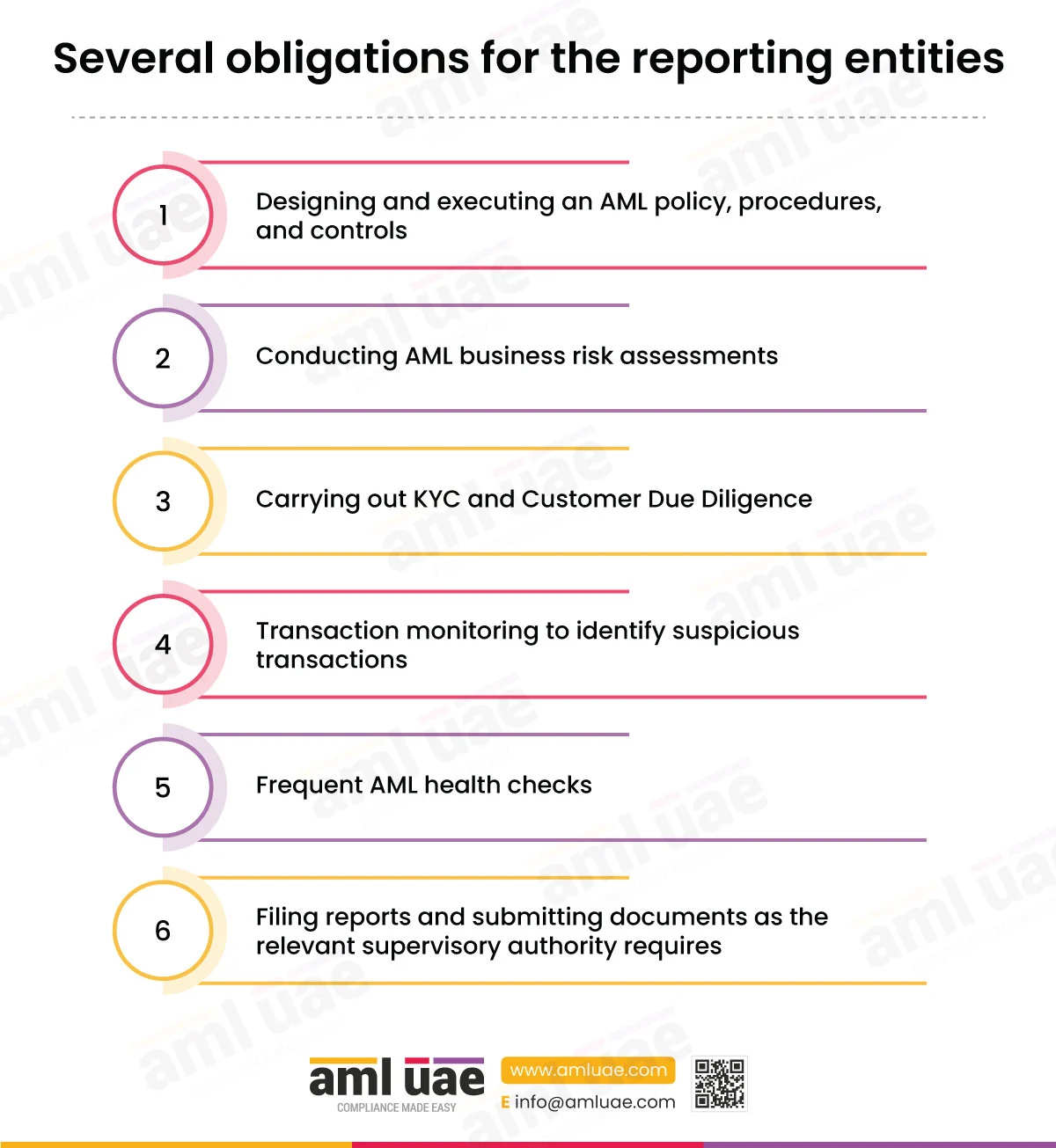
International authorities like FATF and others have defined guidelines and best practices for countries to adopt. National regulators have implemented strict AML regulations aligning with these guidelines. These rules include several obligations for the reporting entities, such as: 

Compliance with the above AML compliance requirements is essential due to the following reasons: 

  • Complying with AML regulations saves you from the fines and penalties of regulatory authorities owing to non-compliance or negligence. 
  • AML requirements call for monitoring your customers and transactions, helping you identify suspicious activities and safeguard your business. 
  • AML compliance helps you stay vigilant of financial crimes, reducing your future costs of money spent on recovering from such crimes. 
  • When you comply with AML regulations, your customers trust you more with their transactions, improving brand reputation and shareholder value. It also means brand security, business continuity, and long-term success.  
  • AML compliance builds a safer, more secure, and more stable financial system, contributing to the country’s economic development. 
  • AML provisions help countries tackle different types of financial crimes using KYC and due diligence measures, protecting the vulnerable sections of society from their impact.  

What is employee engagement?

Employee engagement means the connection employees feel toward their company, teams, and work. Employees are engaged when: 

  • They have a deep, long-term connection with the company. 
  • They are productive and make extra effort for the company or job. 
  • They connect to the company’s well-being and work toward its goals. 
  • They commit to the company’s mission and are happy to contribute to its achievement.  
  • They know that the company values their work, and so they do more than what’s expected from them.  
  • They are eager to help in any possible way to further the company’s goals. 

Engaged employees contribute more to generating better business outcomes by aligning with the company’s objectives. Employees support the company’s goals of reducing the threats of money laundering, terrorism financing, and other financial crimes. Supporting the execution of provisions helps companies fulfil AML regulations.  

Companies cannot just engage employees by increasing their well-being or keeping them happy with facilities, pay, and recognition. They need to do more. They must encourage employees’ professional development and support them in their individual goals.  

To engage employees, companies must: 

  • Inspire them by sharing vision, mission, and goals, 
  • Create a positive attitude and work culture at the top levels to inspire the lower levels to imbibe the same, 
  • Have an effective onboarding process to set the employees up for growth in their roles, 
  • Offer professional development opportunities, including mentorship programs, 
  • Appreciate employees’ efforts, acknowledge their contribution, and offer incentives based on performance, 
  • Outside-work plans and events create connections between employees, 
How employee engagement enhances AML compliance program

How does employee engagement help in AML compliance? 

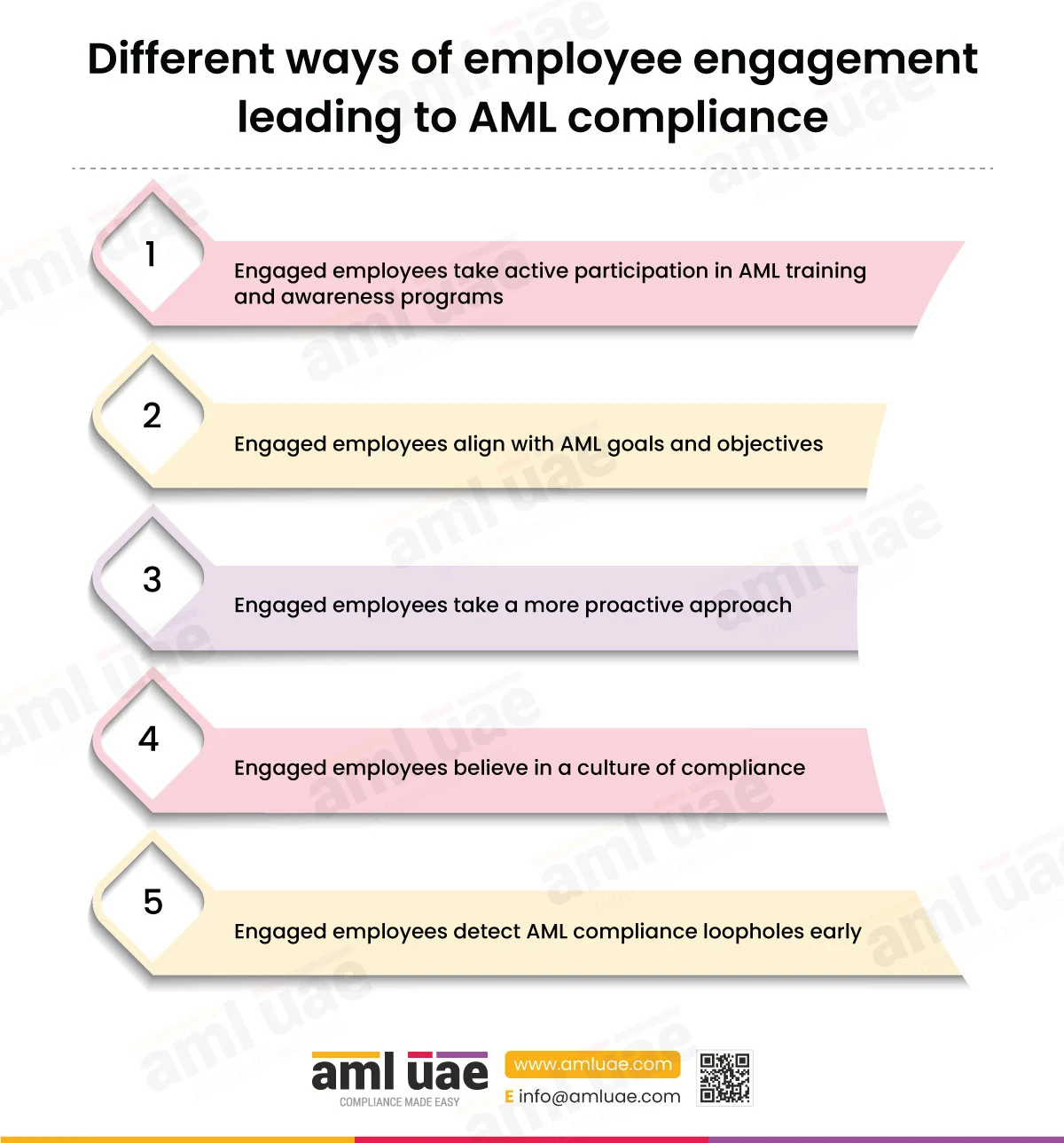
The various ways how employee engagement leads to AML compliance include: 

Engaged employees take active participation in AML training and awareness programs

Before implementing AML compliance programs, companies create awareness of AML and its importance. They need to create such awareness on: 

  • Money laundering and other financial crimes 
  • How AML regulations help combat these crimes 
  • How to conduct KYC and due diligence 
  • What are suspicious transactions, and how to identify them 
  • How to do continuous monitoring of transactions 
  • How to fulfil national AML regulations 
  • In what ways can technology help in AML and how to operate it 
  • Making and maintaining records for AML compliance 

Along with awareness, companies also train employees on these aspects to ease AML compliance.  

Engaged employees feel more motivated to contribute to AML compliance and take an active part in training programs. They understand the long-term, global impact of AML efforts and sincerely support them. With these efforts, you can reduce money laundering and other crime risks.

Engaged employees align with AML goals and objectives 

Engaged employees stay aligned with the company’s vision, mission, and values. That means they also align with the AML goals. Such alignment inspires employees and motivates them to do better at their jobs.  

Engaged employees take ownership of their work and contribute to AML measures. They consider their moral duty to take every possible step to save the company from threats of financial crimes.  Thus, their role in maintaining compliance increases. Employees are more committed to identifying and reporting suspicious activities.  

Engaged employees take a more proactive approach 

Engaged employees are more favourable toward doing more for the company. They want to do everything possible to save the company’s reputation and avoid fines and penalties. So, they stay committed to making the company compliant with applicable laws.  

This is how they also contribute to AML compliance. They spend more time, energy, and effort paying attention to every suspicious transaction. They also ensure that the KYC of customers is proper and up-to-date. They record all details of every transaction to check their relation to illicit activities. Thus, they protect the company against money laundering.  

Engaged employees believe in a culture of compliance 

To follow all AML requirements, you must create a culture of compliance in your business. All employees must be positive toward achieving AML compliance and contribute effectively. Such positive attitudes and cultures come from the top to lower levels.  

Since engaged employees understand the importance of compliance, they can help to create this culture. They can ensure that their colleagues also believe in achieving AML compliance.  

Engaged employees detect AML compliance loopholes early 

Since engaged employees commit to the company’s beliefs, they are more aligned with the AML compliance process and are keenly interested in its progress.  

That is why they are also aware when something is going wrong. They know when a process is not full-proof, someone is not performing their job diligently, or a decision needs to be changed. Thus, you can detect loopholes in AML compliance processes easily.  

What are employee engagement strategies to help AML compliance? 

Engaged employees aligned to create AML regulations and an internal AML compliance program. They help prevent and mitigate money laundering and other financial crimes. They understand that money laundering is a significant threat and try to stay compliant at every step.  

But you must use suitable initiatives to keep them engaged. Strategies you can use for employee engagement include: 

  • Create a culture of compliance across the business. 
  • Promote open communication between all employees to ensure faster reporting of suspicious transactions. 
  • Encourage collaboration between teams and departments to understand AML better and contribute better. 
  • Make the employees responsible for AML activities and tasks and measure their performance on these tasks.  
  • Provide incentives to employees performing their AML duties diligently and achieving measurable outcomes.  
  • Inspire and motivate them by sharing the international AML goals, national focus on AML compliance, and company-wide efforts to reduce money laundering risks.  
  • Train them on the necessary AML responsibilities and AML software to perform their duties better and faster.  
  • Before training them on achieving AML compliance, explain the significance of AML compliance for the company, country, and world. 
  • Show the employees the impact of the company’s AML measures on the outcomes – reduced risks, lesser suspicious transactions, more satisfied customers, etc.  

All these efforts can increase employee engagement and contribute to AML compliance.  

What is the role of AML UAE in AML compliance? 

AML UAE is a distinguished provider of AML consulting services to clients in the UAE. We have redefined the quality of AML services in the market with end-to-end AML consulting. You get customized AML compliance services based on your business needs.  

We help clients build a healthy culture of compliance in their business processes. We help create AML policies and impart AML training to the employees to perform their AML responsibilities. We conduct AML business risk assessment to check your money laundering risk exposure. 

Our AML consultants’ expertise in KYC and Customer Due Diligence processes enhances your AML compliance efforts and manages the risks. We conduct regular AML health checks of your business to improvise your AML compliance program and prevent money laundering cases. We help you at every step of your AML journey to make it obstacle-free.  

Stand apart from the pack by achieving complete
AML compliance with AML UAE’s services.

Call for a consultation.

Share via :

About the Author

Pathik Shah

FCA, CAMS, CISA, CS, DISA (ICAI), FAFP (ICAI)

Pathik is an ACAMS-certified AML consultant specialising in governance, risk, and compliance for regulated entities in the UAE. He brings over 28 years of experience, with 1,000+ hours of AML training and 200+ advisory engagements across DNFBPs, VASPs, and FIs. He supports businesses in aligning with AML/CFT requirements from the CBUAE, DFSA, MoET, MoJ, VARA, CMA, FSRA, and FATF. Known for translating complex regulations into audit-ready procedures, Pathik enables operational clarity and compliance readiness.

Reach Out to Pathik

Simplifying UAE FIU goAML Registration: A Visual Guide

Simplifying UAE FIU goAML Registration A Visual Guide

Simplifying UAE FIU goAML Registration: A Visual Guide

Simplifying UAE FIU goAML Registration: A Visual Guide

Financial Institutions (FIs), Designated Non-Financial Businesses and Professions (DNFBPs), and Virtual Asset Service Providers (VASPs) have to register with the UAE FIU goAML portal.

The goAML portal registration is a two-stage process:

Stage 1 – SACM Registration: Register in the protection system (SACM) of goAML portal and get a username.

Stage 2 – goAML Registration: Get the password from the Google Authenticator app and use it to access the goAML portal for main registration.

Once the reporting entity submits its application for goAML registration, it is approved by the relevant supervisory authority in the UAE.

goAML portal serves as the point of communication between the reporting entity and the UAE Financial Intelligence Unit (FIU). The reporting entities are supposed to submit various reports including:

Related Posts

Confused with how to mitigate ML, FT, and PF risks within your Regulated Entity?

What skills should an AML compliance officer possess?

What skills should an AML compliance officer possess feature img

What Skills Should an AML Compliance Officer Possess?

Table of Contents

Protect your business with reliable and effective AML strategies with AML UAE.

What skills should an AML Compliance Officer Possess?

Every profession and professional requires specific skills, knowledge, and accreditations to operate professionally, and an AML Compliance Officer is not an exception to that. This is quite apparent as professional mistakes can have severe consequences, especially when we are battling against brutal crimes like money laundering and financing terrorist groups or activities. Therefore, such designated officers should meet the fundamental requirements when an organization decides to recruit for this position.

Emphasising that such designated Compliance Officer should meet fundamental AML Compliance requirements and have important skills like Regulatory Expertise, Industry Knowledge, Risk Assessment, Ethical Judgment, Integrity, Critical and Analytical Thinking.

This article discusses the must-have skills for every professional anti-money laundering compliance officer.

What is an AML Officer/MLRO?

An AML Officer or Money Laundering Reporting Officer (MLRO) is responsible for establishing AML Compliance Program to prevent money laundering and assist the organization in complying with the relevant provisions of the Anti-Money Laundering Law. The AML Officer carries out the AML risk assessment, prepares AML policies, procedures and guidelines and implements the same. The MLRO monitors AML related issues on a day to day basis, evaluates and escalates the matter to the senior management and the legal authorities.

Essential skills of an AML Compliance Officer

AML Compliance Officers have critical role in ensuring that a business operates within the regulatory framwork. Therefore, a Compliance Officer must possess certain key attributes like Regulatory Expertise, Strong Ethical Judgment, Analytical and Risk Assessment skills and other relevant knowledge. Here are a few skills that are must for an AML Compliance Officer to manage his or her duties most effectively and efficiently.

Integrity

Integrity is a vital characteristic for all professionals across the globe. Trusting one’s employees is very crucial for any business organization if the business belongs to a high-risk quotient industry. Anti-money laundering Compliance Officers should be transparent with other employees of the Company, and there should be utmost trust among the employees within the same organization. All the employees must know each other in order to minimize the overall margin of error. It will keep any internal confusion, doubts, and identity biases at bay.

Integrity

Industry knowledge

This is the essential thing and goes even without saying. Without adequate industry knowledge, no professional will be able to perform their assigned responsibilities with utmost perfection and efficiency. Anti-money laundering Compliance Officers should also know and follow their own industry well so as to keep themselves updated on developing trends.

The Compliance Officer should also have prior experience and knowledge in developing robust Customer Due Diligence (CDD) processes and identification of risks. He / She shall also have a certain level of authority necessary to take AML/CFT-related decisions independently.

AML Compliance Officers must be aware of the latest developments in the money laundering segment revolving around the concerned industry. With the constantly evolving state of technology, money launderers might find a loophole in the system and apply a new method of executing their ill intentions. An efficient AML Compliance Officer should have an idea about whether the criminals are developing new and powerful tactics or not.

Attention to details

The technologies related to AML regulations are being renewed and upgraded frequently to trace the money laundering and financing of terrorism. Hence, it requires professionals in the industry to keep themselves updated with the latest changes in order to identify any unusual activity before it is implemented or has any destructive effect on the business or the economy. In addition to that, legal requirements also keep on changing every then and now.

Attention To Details
Therefore, to adhere to those rules and regulations, AML Compliance Officer must pay attention to recent updates or upgrades and understand such developments most effectively and efficiently. However, it is essential to note that both technological and legal requirements differ from one jurisdiction to another.
Risk Assessment

Risk assessment

Risk assessment is an integral part of the entire compliance process. A Compliance Officer is expected to be aware of the risks involved while dealing with finance-based crimes. Employees or professionals working around AML/CFT policy primarily focus on minimizing the risks involved in every possible or doable way.

Anti-money laundering Compliance Officers must consider all the factors that directly or indirectly contribute to risk scoring, as prescribed under their organization’s internal policies and procedures related to AML/CFT.

Considering all of these risk scores, the Compliance Officer will be able to make better and data-driven business decisions. This would also help in gauging the business impact or implications clearly.

Ability to interpret

Anti-money laundering Compliance Officers basically decide whether a particular customer or transaction can be construed as suspicious one the basis of the triggers generated. Data is the only essential element needed for making optimal business decisions. Therefore, the ability to interpret the behavior or indications becomes an integral part of the Compliance Officer’s responsibilities.

There may be plenty of data available to the business organization from different sources, making it challenging to analyze and interpret the data.

Ability To Interpret

However, the Compliance Officers should be adequately trained to determine value from such complex data. While the Compliance Officer is introspecting the voluminous data, extra attention should be accorded to the identification of any unusual transaction or activity, or customer. In addition to that, an AML Compliance Officer must be skilled in drawing logical conclusions from the observations made from the data.

Compliance. Trust. Transparancy

Customized and cost-effective AML compliance services to support your business always

Problem solving

Problem Solving

There are pretty high chances that an AML Compliance Officer encounters a lot of problems on a daily basis. Additionally, as the industry is quite volatile, and to keep pace with the same, the Compliance Officer should have a problem-solving approach, with a primary focus on arriving at the appropriate solutions. The financial sector has a high element of risk involved, and hence, the Compliance Officer must have an extravagant problem-solving approach in order to come up with remedial actions or competitive strategies.

It is important to note that practical problem-solving will come up naturally only with analytical and creative thinking, added with experience.

Moreover, Compliance Officers also need to tackle the hardships triggered due to uncertain regulatory changes.

Knowledge about vulnerability

Compliance officers must have knowledge of various policies released by the Government in relation to AML/CFT. This helps detect security vulnerabilities that might arise in the systems without much of hardships or challenges.

In addition, anti-money laundering Compliance Officers are expected to have a clear and better understanding of response regulations, ISO standards, abuse & controlling policies, evaluation & monitoring techniques, and safety standards like performance reporting.

Knowledge about vulnerability
IT Knowledge

IT knowledge

The use of Anti-money laundering software is quite common among Compliance Officers. Though the Compliance Officer may not be required to operate such software, yet having the basic knowledge is important. Being aware of the latest business technologies that offer an error-free session allows AML Compliance Officer to successfully perform his responsibilities towards AML/CFT regulations.

Critical thinking

Irrespective of the industries the professionals are indulged in, critical thinking is required by all. Analytical and critical thinking is a vital element for analyzing data and making some competitive strategic decisions. The fundamental principles required to inculcate creativity in one’s thinking include situational analysis, open-mindedness, brainstorming, providing contexts and conclusions.

Critical Thinking
Clear And Effective Communication

Clear and effective communication

Irrespective of the profession or the industry, in order to perform tasks and duties effectively and efficiently, one should have the skill of clear and effective communication. The financial industry is full of uncertainties and involves high levels of risk. Hence, it becomes incredibly crucial to communicate the details with the relevant stakeholders clearly. Even if one tiniest information is not communicated properly or missed out, there may be some irreversible repercussions on the business organization and economy as well.

In addition to that, clear and effective communication is a must for an anti-money laundering Compliance Officer because he is the one who is in touch with almost all the employees of the business enterprise and also has the responsibility to report suspicious transactions to the Financial Intelligence Unit of UAE on behalf of the organization. Therefore, a Compliance Officer is expected to share essential information with the Company’s staff at a specific time to ensure adherence to AML/CFT regulations.

Final words

All the ten skills mentioned above clearly establish the importance of a Compliance Officer in Financial Institutions(FIs), Designated Non-Financial Businesses and Professions (DNFBPs), and Virtual Assets Services Providers(VASPs). AML Compliance Officer must possess these skills to ensure the smooth and hassle-free working of the Company and safeguarding it against the vice of money laundering and financing of terrorism. However, it is very challenging to find a Compliance officer who possesses all such necessary skill sets. Here we may come to your assistance; we can assist you in recruiting such AML compliance officers from our wide range of databases.

AML UAE provides Anti-Money Laundering Consulting Services to help you remain compliant with UAE AML Laws. Get in touch with us for your Anti-Money Laundering Compliance requirements.​

Frequently Asked Questions (FAQs)

What is an AML officer? 

A UAE compliance officer is the one who implements the AML program for a company. Their AML roles and responsibilities include undertaking KYC, screening, and risk assessment, reporting suspicious transactions, implementing AML policy, providing AML training to employees, and maintaining records for a  period not less than 5 years.  

An AML Compliance officer is responsible for ensuring a company’s compliance with the AML policy. They must have the necessary compliance officer skills to manage the AML compliance requirements.  

An AML compliance officer or money laundering compliance officer ensures that the company complies with all the requirements and processes of AML regulations. 

Here are a few responsibilities of an AML compliance officer.

  • Creating, implementing, along with managing an organization’s compliance program
  • Coordinating with regulatory authorities
  • Planning, implementing, and overseeing the problems related to various types of AML/CFT risks
  • Developing and coordinating proper reporting channels for issues pertaining to effective compliance
  • Building effective communication channels for the Company’s compliance with AML/CFT regulations
  • Coordinating and scheduling necessary compliance training for the concerned employees

To become a Compliance Officer in AML, you need combination of following skills:

  • Proven experience of working as an AML Compliance Officer
  • Hands-on experience in risk management
  • Sufficient knowledge of legal controls and requirements
  • Familiarity with professional standards and industrial practices
  • Extravagant communication skills
  • Business acumen
  • Professional ethics
  • Teamwork skills and people management
  • Supporting educational degrees or professional certifications

The best possible practice for AML compliance can be the following:

  • Appointment of a designated competent Compliance Officer
  • Conducting AML Business Risk Assessments periodically
  • Developing a robust AML policy containing adequate procedures and controls and keeping them updated per new amendments.
  • Applying a risk-based approach while conducting CDD and KYC processes.
  • Proper Record-keeping measures and training of the staffs.

Share via :

Add a comment

About the Author

Pathik Shah

FCA, CAMS, CISA, CS, DISA (ICAI), FAFP (ICAI)

Pathik is an ACAMS-certified AML consultant specialising in governance, risk, and compliance for regulated entities in the UAE. He brings over 28 years of experience, with 1,000+ hours of AML training and 200+ advisory engagements across DNFBPs, VASPs, and FIs. He supports businesses in aligning with AML/CFT requirements from the CBUAE, DFSA, MoET, MoJ, VARA, CMA, FSRA, and FATF. Known for translating complex regulations into audit-ready procedures, Pathik enables operational clarity and compliance readiness.

Reach Out to Pathik