
How to ensure effective Suspicious Activity Reporting?

Employee training on effective suspicious activity reporting

Blogs

Table of Contents

Protect your business with reliable and effective AML strategies with AML UAE.

How to ensure effective Suspicious Activity Reporting?

In UAE, Anti-Money Laundering and Combating of Financing of Terrorism (AML/CFT) measures and regulations are critical to identifying potential risks and timely reporting these suspicious activities to ensure the financial stability and security of the economy.

When regulated organizations – whether Financial Institutions, Virtual Asset Service Providers (VASPs), or Designated Non-Financial Businesses and Professions (DNFBPs) – fail to implement the policies and procedures around suspicious activity reporting, the consequences are severe for the organization and the country. The employees must be trained on ML/FT risk indicators, identifying suspicious activities, and appropriately reporting to the Financial Intelligence Unit (FIU).

How to identify Suspicious Activity under AML regulations?

Employees engaging with customers and managing the business relationship are vital in identifying suspicious activity. For effective suspicious activity reporting, the employees must understand the red flags and the actions to be taken when such risk indicators are observed.

Once any ML/FT red flags are observed, the employees must collate adequate information about the suspicion and immediately report such suspicious activity to the AML Compliance Officer.

Role of AML Compliance Officer in UAE Preview

What are the common risk indicators suggesting Suspicious Activity?

Some common indicators of suspicious activity that the employees of the regulated organization must be aware of are:

  • Customer suddenly starts making large value transactions, contrary to the transaction history or not matching with the customer’s financial position
  • Customer coming from or is closely connected with the high-risk jurisdictions,
  • Customer having adverse media or criminal records for being involved in financial crime in past
  • Customer refusing to share the identity documents or reluctant to disclose the identity of the beneficial owners
  • Customer has no active connection with UAE, or the purpose of the transaction is not clear
  • Customer’s legal structure is excessively complex, without any business rationale
  • Customer hesitates in sharing information about the beneficial ownership
  • Customer engaging in multiple transactions with values exactly below the AML threshold
  • Identity document furnished by the customer is found to be fake or forged
  • Payment towards the transaction is being initiated from a third-party account not related to the business transaction
  • Unnecessary involvement of third-party agents or intermediaries, without any business sense, to conceal the identity of the customer.

The employees must be informed of the red flags suggesting a potential association with money laundering or terrorism financing. Further, employees should be aware of the list of high-risk countries.

Employees must be well-trained to look for unusual patterns of transactions, recognize these risk indicators, and immediately report such suspicious observations to the AML Compliance Officer.

Identify UBOs to complete your AML Customer Due Diligence

What is the Role of Employees in detecting ML/FT-related Suspicious Activity?

Under the AML Compliance program, employees are considered the first line of defense against money laundering and terrorism financing. Employees play a pivotal role in identifying suspicious activity related to financial crime. Therefore, creating awareness around AML measures and identifying suspicious activities amongst employees is essential.

In addition to identifying suspicious activity, employees should be trained on adequate reporting procedures to ensure accuracy and completeness in internal reporting. This includes knowing when reporting will be done, to whom, and what details will be captured in the report.

Employees should be encouraged to ask relevant questions to determine the nature of the suspicion, including escalating the observed red flags to the departmental head.

Training shall be conducted for the employees covering real-life scenarios and case studies around money laundering or terrorism financing indicators observed by the internal staff and what actions were taken by that employee.

Employee training on effective suspicious activity reporting

How to establish a robust Suspicious Activity Reporting System?

A strong system must be implemented within the regulated organization for internal reporting of suspicious activities to ensure that suspicions are reported on time and adequately addressed.

Establishing Clear Reporting Procedure

For timely reporting of suspicious activity, timely identification of the potential risk indicators is essential. To assist the employees with immediate detection of the ML/FT red flags and evaluate the possibility of suspicion, the organization must include a business-specific list of risk indicators in its policy. These red flags must be well communicated amongst the team, including imparting specific training to create better awareness.

Documenting Red flags and risk indicators

Clear reporting procedures should be designed and communicated with the relevant employees. This includes policies around who is responsible for reporting, the internal reporting shall be done to whom, how the reporting would be done (through email, physical internal Suspicious Transaction Report (STR) or Suspicious Activity Report (SAR) format, etc.), who should be included in the communication trail, etc.

The details of the AML Compliance Officer, including their contact information, must be available to every employee of the regulated organization.

Suspicious Transactions Report - STR

Ensuring Confidentiality and Employee Protection

Employees must feel comfortable reporting suspicious activity without any fear of retaliation. The information of the employee reporting the suspicious activity must be kept confidential. The regulated organization must develop adequate policies to protect employees from retaliation.

No “Tipping off”

The employees must be aware of the requirement not to disclose any information about the identified suspicion to the subject party or any third party, directly or indirectly. The employees should understand that “tipping off” is a criminal offense under UAE AML regulations and attract hefty penal penalties, including imprisonment for such contravention.

Imparting training to the employees

The employees – whether serving clients or managing client relationships – are the first to observe the potential suspicion in transactions or customer behaviour. Also, the back-office teams play a significant role in detecting the red flags while clearing the payments or generating account statements. Thus, all employees of the organization must be imparted adequate training and equipped with the necessary resources to identify the ML/FT suspicion and exercise sound judgment around the necessity to report the same to the Compliance Officer.

Imparting adequate employee training on identifying and reporting suspicious activity is very important to promote a compliance culture in the organization and receive the required contribution from the employee to prevent financial crime.

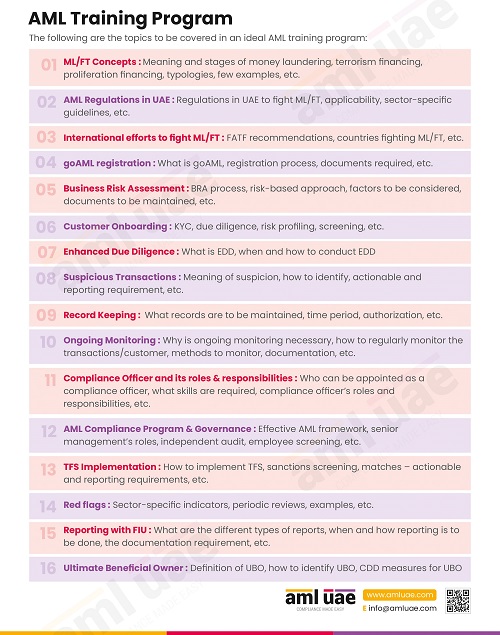
Designing a comprehensive AML Training Program

Periodically Reviewing and Updating the Suspicious Activity Reporting System

The regulated organization should regularly review the internal suspicious activity reporting procedures and system to check its effectiveness and update, if necessary, to stay compliant with UAE AML regulations.

What are suspicious activity reporting requirements under UAE AML Regulations?

The AML regulations mandate the regulated organizations to identify and report suspicious activities related to money laundering, terrorist financing, or financing of the proliferation of weapons for mass destruction.

The entire AML compliance framework revolves around effective suspicious activity reporting, including designing the AML policies and AML training the employees to identify and undertake timely reporting.

A regulated organization that fails to identify and report suspicious activities in accordance with UAE AML regulations faces severe consequences, including damage to its reputation and non-compliance penalties.

What are suspicious activity reporting requirements under UAE AML Regulations?

To stay AML compliant and safeguard the business against the exploitation of financial crimes, adequate systems and procedures to identify and report suspicious activities effectively are a must.

AML UAE is a leading AML consultancy service provider, assisting clients in developing a robust AML compliance framework, including establishing internal and external suspicious activity reporting policies. With a team of experienced professionals, AML UAE imparts comprehensive AML training to the employees, covering basic concepts of ML/FT, AML measures, the organization’s internal policies and procedures, and best practices for suspicious activity reporting.

Timely identify and report suspicious activities to complete your AML Compliance circle!

Make significant progress in your fight against
financial crimes

With the best consulting support from AML UAE.

Share via :

About the Author

Jyoti Maheshwari

CAMS, ACA

Jyoti has over 11 years of hands-on experience in regulatory compliance, policymaking, risk management, technology consultancy, and implementation. She holds vast experience with Anti-Money Laundering rules and regulations and helps companies deploy adequate mitigation measures and comply with legal requirements. Jyoti has been instrumental in optimizing business processes, documenting business requirements, preparing FRD, BRD, and SRS, and implementing IT solutions.

Reach Out to Jyoti

Shining the business conduct with LBMA’s Global Precious Metals Code, 2022

Shining the business conduct with LBMA’s Global Precious Metals Code, 2022

Blogs

Table of Contents

Protect your business with reliable and effective AML strategies with AML UAE.

Shining the business conduct with LBMA’s Global Precious Metals Code, 2022

London Bullion Market Association (LBMA) has issued LBMA’s Global Precious Metals Code, 2022, laying down the highest standards for business conduct expected from market participants engaged in the global Over-The-Counter (OTC) wholesale trade of precious metals.

Who is subject to LBMA’s Global Precious Metals Code?

Various participants are engaged in the Precious Metals Market, with different activities around precious metals –extraction, refining, storage, financing, transportation, storage, financing, trading, and marketing. The LBMA’s Global Precious Metals Code applies to all Precious Metals Market participants involved in global OTC wholesale trade, which include:

  • LBMA Members
  • Precious metals Refineries & Mining entities
  • Precious metals Logistics firms
  • Precious metals Fabricators
  • Jewellery entities
  • Financial institutions like Banks, Asset management companies, Exchange Traded Funds, Firms engaged in high-frequency trading strategies, Brokers, investment advisers, aggregators, etc.
  • Trading houses and Affirmation & settlement platforms
  • Sovereign wealth funds
  • Benchmark Administrators

All these market participants are required to implement this Code commensurate with the size and nature of the business activities.

What precious metals are governed under LBMA’s Global Precious Metals Code?

The Code sets out the standards for ensuring the highest quality conduct of the market participant engaged in activities related to the following precious metals:

  • Gold
  • Silver
  • Platinum
  • Palladium
Shining the business conduct with LBMA’s Global Precious Metals Code, 2022

What are the four (4) principles discussed in the LBMA's Global Precious Metals Code?

The following four principles are emphasized in the Code to ensure the global best practices in the Precious Metals Market:

A. Ethics:

All the precious metals organizations subject to this Code are expected to act professionally and ethically to maintain the integrity of the global precious metals market. It must deal with all its customers, suppliers, employees, and all other business associates in the utmost fair manner.

The companies are expected to implement appropriate internal policies to identify and address the conflict of interest that may comprise its code of ethics or professional standards.

The companies are expected to promote equality and avoid discrimination amongst customers, employees, etc.

The market participants are expected to impart adequate training to their employees to ensure that market obligations are discharged ethically and professionally.

B. Governance, Compliance, and Risk Management:

Market Participants are expected to identify the risks associated with their precious metals activities and implement appropriate governance and risk management frameworks to manage these risks, including a comprehensive compliance management program.

The companies are expected to evaluate the risk arising out of the following factors concerning their precious metals operations:

  • Market and credit-related risks
  • Operational and Settlement-related risk
  • Risks related to Technology & Cyber Security
  • Compliance and Legal risk
  • Business Continuity risk
  • Conduct and Reputational risk
  • Economic and Trade risk

As part of an adequate governance structure, the senior management is responsible for designing the business strategies and overseeing the business operations to ensure the company’s financial security.

Precious metals companies must comply with all the applicable rules and regulations, including the anti-money laundering framework. The internal policies must be well documented, highlighting the regulatory obligations, procedures & controls to ensure adequate compliance.

Further, the companies are expected to have well-defined lines of reporting, with clear roles and responsibilities for managing the precious metals operations. There shall be smart systems for the accurate and timely generation of MIS reports, which is necessary as part of the governance and risk management framework.

Through a well-designed whistle-blowing policy, employees must be encouraged to escalate any observed instances of inappropriate business practices or unethical behaviour of any market participants – internally and externally.

A periodic review of the governance, compliance, and risk management framework is suggested in the Code to ensure that the companies’ set operations mechanism is aligned with the highest professional standards and the applicable laws, including this LBMA’s Code. Any gaps identified by the independent reviewer must be highlighted to the senior management for their immediate action to rectify these breaches.

C. Information Sharing:

Precious metals market participants must communicate effectively and transparently within the business community. Market Participants are also expected to manage the confidentiality of critical market Information.

The companies shall not divulge confidential information that hampers standard market practices.

The communication must be fair and open, with clear language and with no or minimal use of technical jargon. Further, appropriate communication channels must be used to ensure the market’s integrity and maintain the required audit trails.

Companies are strictly prohibited from initiating or spreading rumours or circulating any misleading information which affects the best business practices of the precious metals market.

D. Business Conduct:

Precious metals companies are expected to effectively manage their pre-trade and post-trade business activities fairly and transparently.

As part of pre-trade business conduct, the market participants are expected to sign an agreement or similar document with the customers, suppliers, etc., with a clear scope of a business deal, terms of trade, and price points. Appropriate Know Your Customer and Customer Due Diligence measures must be applied before establishing any business relationship with other market participants. The companies must identify any risk associated with the customers and suppliers, including the supply-chain risk.

The precious metals trades must be executed fairly, with clear disclosure of the markups and the methods used for arriving at the markup. The markups must be determined professionally without misrepresenting any cost factors. The companies are prohibited from executing any trade against the LBMA’s precious metals benchmark (i.e., the prices determined by LBMA).

For post-trade business conduct, the company must initiate confirmation communication with the customer about the executed trade or deals that are amended or cancelled. Further, the market participants are expected to perform ongoing reviews and monitoring of the transactions, including periodic reconciliation of the customer’s accounts to identify gaps or delinquent payments.

The market participants are expected to design internal policies to ensure no trade payments are expected from unrelated third parties or cash payments exceeding a certain threshold.

How can AML UAE assist you with developing your Code of Business Practices aligned with the LBMA’s requirements?

The Dealers in Precious Metals in UAE, engaged in the wholesale trade of gold, silver, platinum, and palladium, are expected to adopt this Global Precious Metals Code, 2022, to promote transparency and integrity of the global precious metals market.

AML UAE is an AML consultancy firm supporting Dealers in Precious Metals and Stones to implement the AML framework and stay AML compliant. We help the DMPS develop tailor-made AML/CFT policies, procedures, and controls to identify and mitigate financial crime risks.

With our experience of dealing closely with dealers in precious metals, we understand the business operations and compliance requirements of the precious metals sector, such as the Responsible Gold Sourcing Code and the LBMA’s Global Precious Metals Code. With this, you design a comprehensive compliance framework to manage your business operations with highest of the ethical practice and professional standards while staying compliant with local and international regulatory frameworks (FATF, OECD, LBMA, etc.).

Make significant progress in your fight
against financial crimes,

With the best consulting support from AML UAE.

Share via :

About the Author

Jyoti Maheshwari

CAMS, ACA

Jyoti has over 11 years of hands-on experience in regulatory compliance, policymaking, risk management, technology consultancy, and implementation. She holds vast experience with Anti-Money Laundering rules and regulations and helps companies deploy adequate mitigation measures and comply with legal requirements. Jyoti has been instrumental in optimizing business processes, documenting business requirements, preparing FRD, BRD, and SRS, and implementing IT solutions.

Reach Out to Jyoti

Choosing an apt AML Software for DPMS

AML Software for DPMS

Blogs

Table of Contents

Protect your business with reliable and effective AML strategies with AML UAE.

Choosing an apt AML Software for DPMS

Dealers in precious metals and stones are one of the Designated Non-Financial Businesses and Professions (DNFBPs) required to comply with anti-money laundering and combating financing of terrorism (AML/CFT) regulations in the UAE. Non-compliance with AML requirements has severe consequences, including monetary fines, administrative penalties, and reputational damage. The importance of choosing an apt AML software for the DPMS sector cannot be overstated. Adopting an appropriate AML compliance software for Dealers in Precious Metals and Stones is very important to ensure compliance with the AML requirements and safeguard your precious metals and stones business against exploitation by financial criminals.  

This article discusses the critical consideration for selecting the right AML software for your AML compliance needs. 

Understanding the AML Compliance requirements for Dealers in Precious Metals and Stones in the UAE

Before selecting an AML screening solution, we must understand the AML compliance requirements in the UAE and why a dealer in precious metals and stones must comply with these AML requirements. 

Money laundering is concealing the source of the illegally obtained funds and disguising the same as proceeds from legitimate business activities. Financial criminals often use precious metals and stones to launder their dirty and illicit money without attracting the attention of the regulatory authorities. Precious metals and stones are commonly used for laundering funds, given their inherent characteristics – high in value, compact in size and easy to transport across borders. 

What are “Precious Metals and Stones” in UAE under the AML regulations?

Under UAE AML regulations, the following are considered “Precious Metals and Stones”: 

– Precious Metals 

  • Gold (minimum purity of 500 parts per 1,000) 
  • Silver (minimum purity of 800 parts per 1,000) 
  • Platinum (minimum purity of 850 parts per 1,000) 
  • Palladium (minimum purity of 500 parts per 1,000)

– Precious Stones 

  • Rough diamonds of any weight in carats 
  • Polished diamonds (minimum weight of 0.3 carats per stone if loose, or a minimum weight of 0.5 carats per any single stone mounted in a setting) 
  • Coloured Gemstones like Emeralds, Rubies, and Sapphires (minimum weight of 1 carat per stone if loose, or a minimum weight of 2 carats per any single stone mounted in a setting) 

– Pearls 

  1. Loose (minimum diameter of 3 millimetres per bead) 
  2. Strung or mounted in a setting (minimum diameter of 10 millimeters per any single bead)

– Other 

  • Any object with a minimum 50% value of the object is comprised of precious metals and stones. 

Who is Dealer in Precious Metals and Stones in UAE?

A person engaged in any of the following activities related to precious metals and stones would be treated as a dealer in precious metals and stones (DPMS) in UAE: 

  • Extraction, refining, cutting, polishing or fabrication 
  • Import or export 
  • Purchase, sale, re-purchase or re-sale, including scrap sale of precious metals and stones 
  • Barter, or exchange of precious metals and stones 
  • Loan or lease arrangements 
  • Possession of precious metals and stones, e.g., as a fiduciary, warehousing, or safekeeping arrangement 
  • Job work arrangement, e.g., cutting, polishing, refining, casting or fabrication services related to precious metals and stones. 
AML Software for DPMS

What is AML Compliance in UAE?

Anti-money laundering (AML) compliance is a set of regulations and governing frameworks focused on detecting and preventing the process of laundering illegal money from entering into a legitimate financial system. In UAE, the primary AML/CFT regulations are the Federal Decree-Law No. 20/2018, and its implementing guidelines in Cabinet Decision No. 10/2019. 

AML compliance is essential to safeguard the business from being vulnerable in the hands of money launderers. By developing a comprehensive AML compliance framework, businesses can detect and prevent suspicious activities on time without getting their business impacted by financial criminals for money laundering activities. 

The AML regulations in the UAE mandate that Financial Institutions, Virtual Assets Service Providers (VASP) and certain Designated Non-Financial Businesses and Professions (DNFBPs) comply with these regulations. Dealers in precious metals and stones are one of the DNFBPs, required to design and implement AML/CFT policies, procedures, and controls to identify, prevent, and report suspicious transactions and activities related to money laundering and terrorism financing. 

An AML Compliance Software helps meet KYC, Screening, and Reporting requirements and saves time and costs.  

Why is AML Compliance necessary for Dealers in Precious Metals and Stones in the UAE?

As precious metals and stones are considered as closely associated with money laundering typologies, the dealers in precious metals and stones are entrusted with the responsibility of iden

tifying any red flags intended towards using precious metals and stones for conducting the money laundering process. 

Following are a few ML/FT red flags for dealers in precious metals and stones: 

  • Customer requests reshaping of gold into ordinary-looking items to hide the nature of precious metals 
  • Customer frequently trades diamonds and gold jewellery for cash in small incremental amounts 
  • Transaction involving precious metals with unusual characteristics, not matching market standards 
  • Charitable organization requesting to buy gold worth AED 1 million, not aligned with the customer’s activities, etc. 

Complying with AML regulations helps the business from non-compliance penalties and protects the business from reputational damage. With your commitment towards complying with AML compliance requirements, you gain trust and respect from your customers, suppliers, and other stakeholders, achieving customer loyalty and long-term commercial benefits. 

AML compliance is a necessary part of the routine business operations of a dealer in precious metals and stones, ensuring the business does not aid any financial criminal in laundering the illegal proceeds of crime.  

An AML Screening Software will help you meet legal obligations and counter money laundering and terrorism financing.  

Key Features and Functionalities of an Ideal AML Software

AML compliance is integral to any business operation to maintain integrity and avoid non-compliance penalties. With increasing importance and awareness about AML compliances, new technological solutions are designed to detect, prevent, and report money laundering activities. To ensure the completeness and accuracy of the AML compliance requirements, the selection of the right AML software is necessary. While finalizing the AML software, the following key features must be emphasized. 

Customer Identification and Verification

The AML software must support the performance of customer due diligence, including Customer identification and identity verification of the customers and their beneficial owners. The customer identification process should be accurate and reliable to determine whether the customer is the one he claims to be. The software should also be able to verify the customer’s address, nationality, and date of birth. 

The software should support identifying the designated person or entity mentioned in the sanctions list, specifically in the UAE Local Terrorist and UNSC Consolidated lists. Further, the AML software should also allow screening of the customers and the ultimate beneficial owners against the global list of Politically Exposed Persons (PEP) and adverse media searches. 

PEP and PEP Screening under UAE AML Regulations pre

Risk Assessment and Management

The AML software should allow the Dealers in Precious Metals and Stones to assess the ML/FT risk for each of the customers and, thus, overall enterprise-wide risk assessment. The risk assessment process should be robust and accurate, considering all the relevant risk parameters such as the customer’s business activities, geographies involved, the transactional elements like mode of payment and the frequency of transactions, beneficial ownership, association with PEP, etc. 

The risk scoring methodology of the AML compliance software must be simple to understand but comprehensive, assisting the AML Compliance Officer in taking necessary due diligence measures depending on the risk rating to manage the money laundering risk. 

Ongoing Monitoring

The AML Compliance software should allow for maintaining and monitoring the customer’s profile and transactions executed with the customer. The transactions should be monitored against the customer’s information file to detect suspicious or unusual activity. Any unusual pattern or mismatch between the customer’s profile and the activities must be highlighted for further investigation by generating an alert. The flagging of the ML/FT red flags would ensure timely actions to prevent or mitigate the impact of the risks. 

Regulatory Reporting and Record-Keeping

The AML screening software should support the generation of intelligent and analytic reports to monitor the organisation’s compliance status. 

The retention of the necessary AML records and documents must be enabled in the AML software, as required under the UAE AML regulations. The software should maintain a complete audit trail and history of the compliance activities, including the customer screened, transactions monitored, alerts generated, etc. This AML recording-keeping functionality of the AML software should serve as documentary evidence to be furnished to the regulatory authorities as proof of AML compliance. 

Record Keeping Requirement in UAE

Integration with Existing Operational Systems

The AML software should integrate easily with the business’s existing systems, processes and databases to ensure efficient AML compliance management without hampering any routine business operations. The precious metals and stones dealers can easily integrate their CRM solution with the AML software and streamline the customer due diligence process. 

With comprehensive data around AML compliance available in one place, the AML Compliance Officer can review the organisation’s compliance level and ensure the quality of the AML compliance framework implemented across the organization. 

Selecting the right AML compliance software is of utmost importance to ensure that dealers in precious metals and stones comply with relevant AML compliance obligations and safeguard themselves from being used for money laundering activities. Right AML Software will equip you with the resources to effectively manage your 100% AML compliance requirements. 

Evaluating AML Software Providers

Selection of the right AML software vendor is equally important. You may have the best of the AML software, but you may not optimally use the features if the software provider is not professional and does not provide handholding support. Partnering with the wrong AML software provider can cost you non-compliance fines and reputational damage. Here are a few key factors to consider when evaluating AML software vendors: 

Reputation and Industry Experience

The AML software provider’s reputation and industry experience are among the most important factors. Look for an AML screening software provider with experience in the precious metals and stones industry. With the vendor’s understanding of the business operations and the industry, you will get customized AML software mapped with the AML compliance requirements of the dealers in the precious metals and stones sector.  

You can check the Name Screening Software vendor’s reputation and experience by referring to online reviews, customer feedback and testimonials from other dealers in precious metals and stones. It helps you make decisions, providing information about the vendor’s strengths and weaknesses and their commitment to customer satisfaction.   

Customer Support and Training

Another key factor to consider is the level of post-implementation customer support and training the AML compliance software vendor provides. Implementing AML software is a different task from buying one. The implementation requires support from the vendor in configuring the features as per business needs, training the employees to use the AML screening solution and extending post-implementation ongoing support to manage any issues while using the AML software, which may arise in future once the software is live. 

Designing a comprehensive AML Training Program

Pricing and Contract Terms

The budget and cost of the AML software are other crucial factors while the software providers. Look out for any additional hidden charges or costs, such as implementation or annual maintenance costs. The contractual arrangement with the vendor must be clear and transparent, laying down the scope of AML software. 

Scalability and Customization Options

One-size-fits-all is not a practical principle in business. The AML software must support customization, allowing the businesses to tailor-make the AML compliance software per the business needs and compliance obligations of the dealers in precious metals and stones. Further, the solution must be scalable, supporting the organisation’s growing business. The AML software, which allows scalability and customization, is always preferred over other AML software. 

Selection of the right AML software, supported by the right software vendor, is necessary for the long-term success of the investment in AML technology and for ensuring 100% AML compliance in your precious metals and stones business. 

Rightfully implementing the AML Software in the Jewellery Business

Managing AML compliance is necessary to keep financial criminals away from the precious metals and stones business and avoid regulatory fines for non-compliance and reputational damage. With effective implementation of the software, you can manage your AML compliance. Take care of the following aspects while going live with the AML software, and half of your AML compliance job is done:

Configuration of the AML Software

The AML software must be aligned with local and international regulatory developments and the latest data sources to ensure accurate and correct AML compliance by dealers in precious metals and stones.

Preparing the Team

The compliance team must be well-trained in the AML software’s features and functionalities to use the AML software efficiently. The training should discuss the AML compliance obligations and how the software will help achieve each AML compliance requirement. 

While deciding on the AML software, AML Compliance Officer, IT professionals and senior management must be involved. This will ensure that the Compliance Officer is satisfied with the solution’s functionalities, the IT team approves the technical configuration and data security, the management signs off the investment in AML software, and shows commitment towards compliance. 

How can AML UAE assist you in selecting the right AML Software for your precious metals and stones business?

The quality and effectiveness of AML compliance depend on the resources deployed, including AML Software. Appropriate AML compliance software will help your business achieve 100% compliance with AML regulations prevalent in the UAE.  

AML UAE is one of the leading AML consultancy service providers in the UAE, assisting clients in setting up and implementing the AML compliance framework. Our domain experts and AML professionals understand your business requirements and help you identify the most appropriate AML solution, including discussing the solution’s functionalities and negotiating prices with vendors. 

Stay Safe, Stay AML-Compliant! 

Make significant progress in your fight
against financial crimes,

With the best consulting support from AML UAE.

Share via :

About the Author

Pathik Shah

FCA, CAMS, CISA, CS, DISA (ICAI), FAFP (ICAI)

Pathik is an ACAMS-certified AML consultant specialising in governance, risk, and compliance for regulated entities in the UAE. He brings over 28 years of experience, with 1,000+ hours of AML training and 200+ advisory engagements across DNFBPs, VASPs, and FIs. He supports businesses in aligning with AML/CFT requirements from the CBUAE, DFSA, MoET, MoJ, VARA, CMA, FSRA, and FATF. Known for translating complex regulations into audit-ready procedures, Pathik enables operational clarity and compliance readiness.

Reach Out to Pathik

The Vital Role of an AML Compliance Officer in Safeguarding VASPs in the UAE

The Vital Role of an AML Compliance Officer in Safeguarding VASPs in the UAE

Blogs

Table of Contents

Protect your business with reliable and effective AML strategies with AML UAE.

The Vital Role of an AML Compliance Officer in Safeguarding VASPs in the UAE

With the increasing acceptance of virtual assets, Virtual Asset Service Providers (VASPs) also continue to grow around the globe, including in the UAE. However, given the nature of the virtual assets – anonymity involved and easy transferability – criminals misuse them for money laundering and terrorism financing activities.

To manage the exploitation of virtual assets, the countries have implemented stringent regulations and have entrusted VASPs with compliance obligations to identify and prevent the ML/FT risk. To effectively implement the AML compliance program and adhere to the regulatory requirements, the role of the anti-money laundering (AML) Compliance Officer is important for VASP. 

In this article, we will discuss the role of AML Compliance Officers in ensuring AML Compliance for VASPs in the UAE. 

Introduction to AML Compliance in the UAE

The UAE government intends to develop the country as an international virtual assets centre. To promote this, robust AML compliance regulations around mitigating the risk of money laundering and terrorism financing have been introduced.  

To manage the activities of the virtual asset in Dubai, the government has formed a supervisory authority – the Virtual Assets Regulatory Authority (VARA) of Dubai. At the same time, there are other authorities designated to supervise the activities of the virtual asset across the UAE, such as the Financial Services Regulatory Authority for VASPs registered in Abu Dhabi Global Market (ADGM), Dubai Financial Services Authority for VASPs operating from Dubai International Financial Centre (DIFC) and Securities and Commodities Authority of UAE for rest of the 6 Emirates and free zones. 

These authorities have developed and implemented comprehensive AML regulatory guidelines and rulebooks for VASPs, mandating VASPs to design solid AML frameworks and ensure compliance with international best practices and FATF recommendations around managing ML/FT risks associated with virtual assets. 

The Importance of AML Compliance

Compliance with AML regulations is mandatory for various regulated organizations, including Virtual Assets Services Providers in the UAE. A robust AML compliance program will safeguard virtual asset activities against being exploited for money laundering or terrorism financing activities. Further, non-compliance with any AML obligation will lead to severe adverse consequences for the VASP, such as substantial administrative fines, reputational damage and even termination of the license to conduct virtual asset activities. 

Adequate AML compliance will help VASP create customer loyalty and seek respect from various stakeholders and market players worldwide, looking at its efforts towards combating money laundering and financing terrorism.

UAE's Regulatory Framework for AML Compliance

The UAE has established a comprehensive AML regulatory framework for financial institutions, VASPs and other Designated Non-Financial Businesses and Professions (DNFBPs). The legislative framework includes the Federal Decree-Law and the implementing Cabinet Decision, specific guidance issued by the relevant supervisory authorities like the Central Bank of UAE, Securities and Commodities Authority of UAE, Ministry of Economy, Ministry of Law, etc. 

These AML regulations lay down comprehensive AML requirements for regulated entities operating in the UAE, including customer due diligence measures that must be adopted before establishing a business relationship, ongoing transaction monitoring requirements, procedures for identifying and reporting suspicious transactions, etc. 

The UAE government is committed to fighting financial crimes and developing UAE as a safe and secure internal financial centre. Violating the UAE’s AML regulations requires heavy penalties and a long-term impact on the reputation. 

Defining Virtual Asset Service Providers (VASPs) in UAE

In simple language, the business organization providing virtual assets-related services to its customer is a Virtual Asset Service Provider. For instance, the company operating a cryptocurrency exchange or services of converting eth fiat currency into virtual assets or vice versa.  

Virtual assets are digital representations of value that can be transferred or traded using distributed ledger technology. The virtual assets include cryptocurrencies like Bitcoin and Ethereum, Non-Fungible Tokens (NFTs) and other digital assets like stablecoins. VASPs are essential in facilitating virtual asset trade, transfer and use. 

Types of VASP in UAE

The different types of virtual assets-related services that qualify as VASP include: 

  • an exchange between virtual assets and fiat currencies or between one or more forms of virtual assets, 
  • transfer of virtual assets between wallets by way of virtual asset transactions on behalf of another person, 
  • safekeeping and administration of virtual assets owned by other persons or instruments, enabling control over virtual assets, 
  • Facilitating and providing financial services related to virtual assets issuer’s offer or sale of a virtual asset into the primary or secondary market. 

VASP Regulation in the UAE

To safeguard virtual assets from financial crime, the UAE has developed a robust AML regulatory framework for VASPs, including stringent licensing requirements and ongoing regulatory oversight of virtual asset activities. Along with Federal Decree-Law and the implementing guidelines, the regulatory authorities have also issued guidance and AML rulebooks for monitoring the VASP in their respective jurisdictions, such as ADGM’s FSRA, VARA, DIFC’s Dubai Financial Services Authority, etc. 

The UAE’s AML regulations for VASPs are based on international best practices and the FATF recommendations around virtual assets and VASPs. The regulatory framework mandates that VASPs in the UAE comply with customer due diligence processes and sanctions screening requirements, implement transaction monitoring systems and procedures, ensure timely reporting of suspicious transactions to the Financial Intelligence Unit (FIU) and the regulatory authority, etc. 

The Role of an AML Compliance Officer in VASP

To ensure effective compliance with AML obligations, the VASP must appoint a competent AML Compliance Officer or a Money Laundering Reporting Officer (MLRO). The AML compliance officer’s role is pivotal in ensuring 100% AML compliance by VASPs, including safeguarding the VASP against the evil of money laundering and terrorism financing and preventing these financial crimes. 

The overall responsibility of implementing and overseeing the effectiveness of the AML compliance framework lies with the AML Compliance Officer. 

Role of AML Compliance Officer in UAE Preview

Key roles and responsibilities of AML Compliance Officer

The AML compliance officer in VASP is entrusted with several key responsibilities around AML compliance, such as: 

1. Conducting overall business risk assessments or enterprise-wide risk assessments of the VASP, considering all the relevant risk factors posing a risk to the business  

2. Designing and implementing a robust AML compliance framework aligned with the overall business risks and regulatory requirements, including policies, procedures, and controls. 

3. Developing and implementing a comprehensive customer onboarding process, including Know Your Customer, Know Your Transactions, and sanctions screening. 

4. Implementing the systems and procedures for assessing customer risk and applying adequate customer due diligence measures, including enhanced due diligence. 

5. Defining the rules for ensuring ongoing monitoring of transactions to identify unusual patterns or suspicious activity and ensure relevance and effectiveness. 

6. Identifying the potential red flags and making them part of the AML policies. A few red flags related to virtual assets activities are: 

  • Structuring virtual asset transactions in small amounts, 
  • Making multiple high-value transactions within 24 hours, 
  • Transferring virtual assets immediately to multiple VASPs in another country where there are no AML/CFT regulations, 
  • Depositing virtual assets at an exchange and then immediately withdrawing the same without any further activity, 
  • Conducting a large deposit to open a new wallet with a VASP, which is inconsistent with the customer’s economic profile, 
  • Conducting VA-fiat currency exchange at a potential loss, 
  • The use of decentralized/un-hosted wallets. 

7. Receiving internal reports on observed suspicion, investigating the same and filing the Suspicious Transaction Reports (STR) or Suspicious Activity Reports (SARs) with FIU and regulatory authorities 

8. Designing and conducting AML training programs for the employees, including senior management. 

9. Conducting a periodic review of the AML program and submitting a report to the senior management. 

10. Ensuring AML-related records are adequately maintained and secured from unauthorized access. 

Required Skills and Qualifications

Given the importance of the AML compliance officer’s role in VASP, the designated person must have a strong understanding of AML regulations and industry knowledge and experience. 

Moreover, the AML compliance officer must possess excellent communication skills supported by problem-solving approaches. Officers must be competent and independent enough to effectively manage the AML compliance requirements and prevent misuse of virtual assets for money laundering or terrorism financing activities. 

Key Challenges Faced by AML Compliance Officers

AML compliance officers in VASP face various challenges in ensuring compliance with AML regulatory requirements. One of the significant challenges is keeping pace with the evolving ML/FT typologies related to virtual assets and amending AML regulations. The Compliance Officer must stay up-to-date with AML compliance obligations to avoid non-compliance penalties and safeguard the business from being exploited by criminals using new money laundering techniques. 

Another challenge the AML compliance officers faces is managing the large volume of data about customers and transactions. Such a colossal database makes monitoring and identifying suspicious activity difficult without sophisticated AML software. 

The role of the AML Compliance Officer in VASP must be independent of regular business operations and client relationship management. The Compliance Officer must balance the business and AML Compliance without comprising the AML regulatory obligations. 

The Vital Role of an AML Compliance Officer in Safeguarding VASPs in the UAE

Implementing AML Compliance Programs in VASP

The AML compliance program in VASP must be comprehensive, aligned with the VASP’s overall ML/FT risk and capable of identifying and mitigating the money laundering and terrorist financing risks effectively. The AML compliance framework should include the methodology of conducting enterprise-wide risk assessment, customer due diligence process, ongoing transaction monitoring, compliance with FATF travel rule, AML record keeping, and procedures for identifying and reporting suspicious transactions. 

Business Risk Assessment

The risk assessment process involves identifying and evaluating the money laundering and terrorist financing risks the VASP is exposed to. The Compliance Officer should consider various risk factors such as customer base, geographies, products and services, etc. 

How to conduct AML Business Risk Assessment Priv

Risk Mitigation Policies, Procedures and Controls (AML Framework)

Once the overall risk has been identified, it is the role of the AML Compliance Officer to design and implement adequate risk mitigation policies, procedures, and controls. The AML framework must be aligned with the size, nature and complexity of the business activities and must be approved by the management of the VASP. 

Customer Due Diligence (CDD), Know Your Customer (KYC) and Know Your Transaction (KYT) Procedures

KYC and KYT procedures are essential to identify and verify the customer’s identity and understand the transactional elements associated with the virtual asset transfer. Further, the framework should include adequate customer risk profiling procedures and implementing the Targeted Financial Sanctions (TFS) and screening requirements. 

Effective customer due diligence will ensure that VASPs deal with genuine customers and do not unintentionally aid in money laundering activities by onboarding financial criminals as their customers.

Understand the types of CDD measures to effectively mitigate the ML-FT risks 

Identifying and Reporting of Suspicious Activities 

Adequate procedures and systems must be implemented to monitor the transactions and customer profiles to detect and report suspicion. The Compliance Officer shall ensure that potential suspicious transactions are investigated internally and only reported to the FIU and the supervisory authority if the internal examination confirms the ML/FT suspicion warranting the external reporting. 

One of the important roles of the AML Compliance Officer is to ensure the timely filing of the Suspicious Transaction Report (STR) or Suspicious Activity Report on the goAML Portal. 

AML Governance

The Compliance Officer must assess the AML training needs of the employees and design a comprehensive AML training program. The AML training program must be included in the AML framework, highlighting the timing, course, and employees involved in this training. 

Further, periodic reviews must be conducted of implemented AML program, and a report must be submitted to the senior management of the VASP by the AML Compliance Officer, highlighting the AML compliance gaps and mitigation measures additionally required. 

Record Keeping 

AML-related records must be maintained adequately for the specified period and in an organised manner. 

Collaboration with Regulatory Authorities

AML Compliance Officer, or Money Laundering Reporting Officer (MLRO), is the key contact between the VASP and the regulatory authorities. One of the key roles of the AML Compliance Officer in VASP is to ensure effective correspondence with the authorities, including the following: 

Reporting of Suspicious Transactions and Activities

Identifying and reporting suspicious transactions is a crucial responsibility of AML Compliance Officers in VASP. If suspicious activities are observed, the front-line team must immediately intimate to the Compliance Officer, who would investigate the matter and, if reporting is required, should immediately file a SAR or STR with the FIU. 

Difference between suspicious activity and suspicious transaction

Ongoing Training and Education 

The AML Compliance Officer must attend AML training sessions and workshops conducted by the authorities to be updated with evolving AML regulations and practices. 

Designing a comprehensive AML Training Program

Ensuring Compliance with Evolving AML Regulations 

AML Compliance Officer must ensure that VASP’s AML/CFT framework, including policies, procedures, and controls, are up-to-date with the amended regulatory requirements.  

How can AML UAE assist AML Compliance Officers in fulfilling their roles in VASPs?

AML Compliance Officer must ensure that its Virtual Asset Service Provider (VASP) complies with UAE local AML regulations and the FATF recommendations around virtual assets transactions. The role of the AML Compliance Officer in VASP is critical to identify and mitigate the financial crimes risks by developing a robust AML compliance framework.  

AML UAE is a leading AML consultancy firm, assisting VASPs in assessing the overall risk, designing and implementing an AML compliance program, establishing a competent AML compliance department and imparting adequate AML training to ensure regulatory compliance and avoid administrative fines for AML violations. 

Make significant progress in your fight against financial crimes,

With the best consulting support from AML UAE.

Share via :

About the Author

Pathik Shah

FCA, CAMS, CISA, CS, DISA (ICAI), FAFP (ICAI)

Pathik is an ACAMS-certified AML consultant specialising in governance, risk, and compliance for regulated entities in the UAE. He brings over 28 years of experience, with 1,000+ hours of AML training and 200+ advisory engagements across DNFBPs, VASPs, and FIs. He supports businesses in aligning with AML/CFT requirements from the CBUAE, DFSA, MoET, MoJ, VARA, CMA, FSRA, and FATF. Known for translating complex regulations into audit-ready procedures, Pathik enables operational clarity and compliance readiness.

Reach Out to Pathik

Anti-Money Laundering For Dealers in Precious Metals and Stones (DPMS)

Anti-Money-Laundering-For-Dealers-in-Precious-Metals-and-Stones-(DPMS) feature image

Anti-Money Laundering For Dealers in Precious Metals and Stones (DPMS)

Table of Contents

Protect your business with reliable and effective AML strategies with AML UAE.

Anti-Money Laundering For Dealers in Precious Metals and Stones (DPMS)

Money laundering is a serious crime, and its scope is not merely restricted to financial institutions, small or medium-scale businesses. However, it has expanded its wings for Anti-Money Laundering For Dealers in Precious Metals and Stones (DPMS). Compliance related to Anti-Money Laundering for Dealers in Precious Metals and Stones (DPMS) requires thorough knowledge of AML regulations in the UAE.

The smuggling, stealing, and trading of precious metals, stones, or gems are pretty frequent and regular. The proceedings from such unlawful activities are later on used for Anti-Money Laundering For Dealers in Precious Metals and Stones.

Dealers of precious metals, stones, or gems can undoubtedly be drawn into money laundering schemes. For instance, criminals or money launderers use dirty money in order to buy gold, diamond, and other precious metals or stones. The money launderers or criminals then resell the precious metals or stones to bring the money into the financial markets again and tag it as legitimate or authentic.

It must be challenging to identify and understand Anti-Money Laundering For Dealers in Precious Metals and Stones and what are the ways in which you can avoid it. Here are a few indicators that might alarm you that the transaction (buying or selling of precious stones, metals, gems) might be a money laundering attempt.

Money Laundering for Dealers in Precious Metals and Stones - Key Indicators:

  • Payments are made in cash. Usually, in a transaction of precious stones or metals, massive amounts are involved. But if the payments are bifurcated in cash, multiple money orders, cashier’s cheque, or traveler’s cheque, or are being paid through a third-party account. Then you might suspect the probability of money laundering.
  • The customer is not willing to provide complete or accurate financial references, contact information, or any type of business affiliations
  • The supplier or customer attempts to maintain a high degree of secrecy about a transaction, like normal business records should not be maintained
  • Sales or purchases don’t conform to industry standards.
  • Sales or purchases are unusual for a particular supplier, customer, or a type of supplier or a customer

Dealers in precious metals and stones are expected to have a well-designed compliance program tailored as per their jewellery business. Anti-Money Laundering For Dealers in Precious Metals and Stones starts with the assessment of the overall risks involved, and as it progresses, it should include four-pillar requirements, which are as follows.

  • Written policies, procedures, and internal controls
  • Appointment of an anti-money laundering compliance officer
  • Provision of ongoing anti-money laundering training for appropriate personnel.
  • Independent testing at regular intervals.
Money Laundering for Dealers in Precious Metals and Stones image

Compliance. Trust. Transparancy

Customised and cost-effective AML compliance services to
support your business always

What Are The Various Problems Associated With Anti-Money Laundering For Dealers in Precious Metals and Stones?

Compliance for Anti-Money Laundering for Dealers in Precious Metals and Stones (DPMS) is quite challenging:

  • It is often challenging to understand and monitor Anti-Money Laundering For Dealers in Precious Metals and Stones. It is vital to have a completed risk assessment to keep up with anti-money laundering regulations and company or customer activities changes. A risk- based approach should always be built upon sound foundations. Developing a risk-based approach will facilitate the foundation for designing the compliance program.
  • Dealers of precious metals, stones, and jewels often face some kind of challenges in order to keep up with the regulatory changes. Designating an efficient anti-money laundering compliance officer who is familiar with all the regulatory requirements will leave no stone unturned in protecting you from regulatory risks.
  • The anti-money laundering programs fail to offer adequate training. An effective AML compliance program should have well-defined procedures, policies, internal controls, designation of an AML officer, training, and independent testing. Training is the key in order to find any kind of unusual activity.
  • Dealers in precious metals, gems, and jewellery might be confused as to whether they are subject to regulations.

Key Trends: Anti-Money Laundering For Dealers in Precious Metals and Stones (DPMS)

Here we discuss key trends related to Anti-Money Laundering for Dealers in Precious Metals and Stones (DPMS):

  • Technological advancements and innovations have increased the size and sophistication of criminal enterprises. If you are conducting business using advanced payment systems, you have to make sure that these processes are reflected in your risk assessment.
  • AML Compliance manual, which incorporates policies, procedures, and internal controls, designation of the compliance officer is the essential requirement.
  • Anti-money laundering training program materials and proof of training for the respective individuals must be kept for a period of 5 years.
  • Reports prepared from conducting independent audits and performed testing shall be maintained for a period of 5 years.
  • Reporting requirements as to DPMSR and STR should be fully taken care of.
  • Customer Due Diligence (CDD) and Enhanced Customer Due Diligence (EDD) should be carried out in the case of all customers.
  • Record keeping and any other type of documentation as required.
  • Transactions happening between the dealers are considered low-risk ones. It is simply because each dealer in precious metals and stones is required to have a reasonably designed anti-money laundering compliance program.

Compliance. Trust. Transparancy

Customised and cost-effective AML compliance services to
support your business always

AML Risks for Jewellers

Here are the risks and opportunities involved with AML policies for dealers in precious metals and jewels.

Risks

Here are a few risks:

  • Reputational and financial risks to the institution
  • Civil and criminal penalties for the individuals as well as institutions

Opportunities

Here are the opportunities that you can leverage if you are a dealer in precious metals and gems.
  • Protecting and maintaining the integrity of the financial system.
  • Protecting your clients from falling prey to any kind of criminal activities or assaults.
  • Aiding to protect your company from financial losses and reputational exposure.​
  • Harnessing efficiencies combining resources and IT systems to monitor for any kind of anti-money laundering and anti-fraud activities.

Skills

Here are a few skills that you require in order to meet all the requirements to abide by your AML compliance policies.
  • Regulatory experience
  • Valid certification from an authorized anti-money laundering association
  • Experience working in the compliance department of any financial institution.

FAQs - AML For Dealers in Precious Metals and Stones

Here are a few frequently asked questions about the Anti-Money Laundering For Dealers in Precious Metals and Stones (DPMS).

What is a dealer in precious metals? 

A legal or natural person involved in buying and selling precious metals, gems, jewellery, precious stones, etc., as a business is a dealer in precious metals.  

Yes, gold is used in money laundering because it is challenging to trace gold. Also, its value is universal in nature and can be readily determined. Also, most of the transactions happen in cash, which can be brought from any source, leading to chances of financial crime.  

Here are a few situations in which the AML/CFT obligations apply to DPMS.

  • Under the AML/CFT decisions and AML/CFT laws, DPMS is obliged to apply the required AML measures when they qualify as DNFBPs.
  • This occurs whenever they carry out either a single transaction or a series of multiple transactions that are related to each other and the total value of these transactions is equals to or exceeds more than AED 55,000,
Here is the process that you must follow in order to comply with your AML/CFT obligations for DPMS.

  • Define processes, policies, and internal controls
  • Carry out know your customer (KYC)
  • Screening
  • Risk profiling
  • Carry out enhanced due diligence (EDD), if required
  • Submit STR
  • Independent Audit
  • Record Maintenance for a period of 5 years
  • Repeat the process

Share via :

Add a comment

About the Author

Pathik Shah

FCA, CAMS, CISA, CS, DISA (ICAI), FAFP (ICAI)

Pathik is an ACAMS-certified AML consultant specialising in governance, risk, and compliance for regulated entities in the UAE. He brings over 28 years of experience, with 1,000+ hours of AML training and 200+ advisory engagements across DNFBPs, VASPs, and FIs. He supports businesses in aligning with AML/CFT requirements from the CBUAE, DFSA, MoET, MoJ, VARA, CMA, FSRA, and FATF. Known for translating complex regulations into audit-ready procedures, Pathik enables operational clarity and compliance readiness.

Reach Out to Pathik

Red flag indicators for AML/CFT

Red flag indicators for AMLCFT feature img

Red Flag Indicators For AML/CFT

Table of Contents

Protect your business with reliable and effective AML strategies with AML UAE.

Red flag indicators for AML/CFT​

AML UAE, with its vast experience and on the basis of the AML/CFT guidelines, has systematically prepared Red flag indicators for AML/CFT pertaining to different aspects such as customers, their source of funds, etc.

Money laundering can cause a lot of troubles in both qualitative and quantitative manner on the business organization. Money laundering primarily hides the income and the source of funds of the criminals or money launderers, as the same is illicit or unexplained. In addition to that, Red flag indicators for AML/CFT also harm the overall economy and poses several risks to the business enterprise.

Facilitating criminal activities like money laundering either directly or indirectly through one’s business may lead to dramatic challenges in managing the assets of the business organization. Furthermore, Red flag indicators for AML/CFT may add to high legal costs and penalties if any sort of money laundering activities is taking place involving one’s business organization or the organization is not abiding by the anti-money laundering compliance regulations.

Surprisingly, a humongous amount of money is being laundered every year. In order to avoid that, one has to be very mindful of the Red flag indicators for AML/CFT and constantly monitor the same where something unusual is observed. The Sooner the identification of the Red flag indicators for AML/CFT, the more efficient would be the measures to avoid/control the damage or restrict the intensity of the same.

What is the meaning of Red flag indicators for AML/CFT?

It is essential to be well aware of and act according to the red flags indications that pinpoint involvement of any fraud or suspicious activities in a financial transaction. In a few complex cases, one may experience the need to obtain more information from the customers. For example, suppose certain essential questions or details pertaining to the customers remain unaddressed or unanswered. In that case, the AML Compliance Officer should evaluate the reasonableness of suspicion involved and, if needed, filing a Suspicious Transaction Report with the Financial Intelligence Unit.

Red flags indicators also aid financial institutions in order to apply a risk-based approach to meet customer due diligence (CDD) requirements like knowing about the beneficial owners and understanding the legitimacy of the source of funds. If there is a red flag indication, the regulators might suspect the occurrence of either terrorist financing or money laundering, or any funding of illegal organizations. Law enforcement officers find these red-flag indicators helpful when monitoring the behavior of the professionals or even the customers. A report from Financial Action Task Force or FATF highlights the following red flags related to terrorist financing and money laundering:

Compliance. Trust. Transparancy

Customized and cost-effective AML compliance services to support your business always

Red flags about the customer

Here are a few red flags about the customers.

The customer is extraordinarily secretive or tries to evade information related to the following aspects.

  • Who the customer is
  • What precisely the bigger picture is, and is there anything that is lying under the table
  • What is the source of the enormous sum of money
  • Who exactly is the beneficial owner
  • Why are they carrying out a particular financial transaction in a different or unusual manner
Red flag image one
Red flag image two

Customers are looking up to these things

  • Customers are actively avoiding any sort of direct or personal contact​
  • Uses an email address that is not found on the internet
  • If the customer clearly refuse to provide information, necessary documents, or data
  • Upon asking, the customer offers irrelevant or fake documents
  • An associated partner, or any known or unknown person involved in any kind of suspected criminal activities like terrorist financing and money laundering

Red flags alerts for parties are generated when

  • When the parties or their representatives are situated in a country that is prone to high-risks
  • The parties involved in any financial transaction are tied for no apparent commercial reason
  • The links between the families, employment, institution of the parties may raise doubts about the legitimacy or authenticity of the parties
  • The individual who directs the operation is not amongst the official parties of the transaction or its representatives
  • A natural person working as a representative or a director is not appropriate in many terms, and even his behavior is not right
Red flag image three

Red flags in the source of funds

Here are a few red flags that should look forward to in order to minimize the intensity of the damage:

Red flags

1. The financial transactions are expressly inconsistent with the socio-economic profile of the individuals.

2. If one finds out that the actual source of funding is illicit

3. If the customer uses more than one national or foreign bank account under his name

4. The choice of payment mode or method has been postponed to a highly close time to the time of notarization without any explainable or logical reason.

5. If there is any unexplained or suspiciously short payback period

6. Mortgages are repaid quickly without any sustainable explanation, even before the first due date

7. If the assets are being purchased in cash and rapidly used as a guarantee for the loan

Compliance. Trust. Transparancy

Customized and cost-effective AML compliance services to support your business always

8. If any prompt request comes in order to moderate the previously agreed payment procedures without a good experience

9. Finance is provided by the lender without any logical explanation outside of the credit institution

10. The collateral provided for the transaction is located in a country that is categorized as high-risk.

11. If there has been an exponential increase or consecutive contributions to the same business enterprise without having any recent logical statement in favor of that same business unit.

12. If there is an unrelated increase in the capital from a company or from a foreign company.

13. If the business enterprise has received a relatively high sum of capital or fixed assets.

14. If there is an unnecessarily high or low price for the transfer of the securities.

15. If recently incorporated, companies are also making large financial transactions without any justification or logical reason.

Red flags related to behaviour

FAQs: Red flag indicators for AML/CFT​

What is a red flag in AML? 

Red flags in AML means a warning or an alert that there is an undesirable characteristic or threat in a transaction, customer, or entity.  

AML transaction monitoring red flags include sanctioned sources of money, owners belonging to high-risk countries, unusual bank transactions, inconsistencies in the identity verification process, the sudden withdrawal of high amounts, etc.  

Yes, there can be more than one AML red flag indicator in a transaction.  

Here are a few actions that must be taken immediately when multiple red flags are observed:

  • Receive internal reports from the employees of any kind of unusual or suspicious activities or transactions.
  • Assesses the reports thoroughly that helps determine the probability of any potential terrorist funding and money laundering.
  • If needed, a Suspicious Transaction Report shall be filed with the Financial Intelligence Unit.
  • Developing and coordinating proper reporting channels for issues pertaining to effective compliance
  • Building effective communication channels for the Company’s compliance with AML/CFT regulations
  • Coordinating and scheduling necessary compliance training for the concerned employees
– Corrupt business practices and Anti-bribery Misconduct or Compliance Risk
– Export Controls/Sanctions Misconduct And Legal Compliance Risk
– Anti-money Laundering/ Anti-terrorism Risk
– Anti-boycott Compliance Risk
Federal banking agencies of the respective country are responsible for ensuring OFAC compliance by its banking sector and identifying the OFAC red flags.
Red flags are used to timely identify any suspicious activities involving money laundering or terrorism financing and report the same to the FIU.

Share via :

Add a comment

About the Author

Pathik Shah

FCA, CAMS, CISA, CS, DISA (ICAI), FAFP (ICAI)

Pathik is an ACAMS-certified AML consultant specialising in governance, risk, and compliance for regulated entities in the UAE. He brings over 28 years of experience, with 1,000+ hours of AML training and 200+ advisory engagements across DNFBPs, VASPs, and FIs. He supports businesses in aligning with AML/CFT requirements from the CBUAE, DFSA, MoET, MoJ, VARA, CMA, FSRA, and FATF. Known for translating complex regulations into audit-ready procedures, Pathik enables operational clarity and compliance readiness.

Reach Out to Pathik

Differences in AML requirements under UAE Federal Law, DIFC and ADGM Rulebooks

Differences in AML requirements under UAE Federal Law, DIFC and ADGM Rulebooks

Blogs

Table of Contents

Protect your business with reliable and effective AML strategies with AML UAE.

Differences in AML requirements under UAE Federal Law, DIFC and ADGM Rulebooks

The main point of difference in AML requirements under UAE Federal Law, DIFC, and ADGM rulebooks is the Supervisory Authority that governs, regulates, and administers fulfilment of AML Compliance requirements by Regulated Entities under the purview of each authority.

UAE’s battle against money laundering and other financial crimes is becoming stronger daily.  

Several robust federal and free zone regulations. Effective reporting of suspicious activities. Investigations. Prosecutions. Fines and penalties.  

The country has committed to implementing strategies and policies to reduce financial crimes. It also supports global efforts of FATF and other bodies for combatting money laundering and terrorism financing.  

Regarding this, the UAE has introduced regulations at a Federal AML regulation, and it’s implementing guidelines, laying down the measures regulated entities must take to combat money laundering and terrorism financing. Since Dubai International Financial Centre (DIFC) and Abu Dhabi Global Market (ADGM) are financial-free zones, they have different regulations for entities operating in these areas. But still, the basis of these regulations remains the two principal Federal AML regulations of the UAE: 

DIFC and ADGM apply the federal law as it is. Additionally, they have implemented AML-specific rules and guidance for the entities established in their respective free zones. A few differences exist between the AML compliance requirements as applicable to units in DIFC and ADGM vis-à-vis units operating in mainland UAE.  

Let’s have a look at each of the AML provisions and highlight the differences: 

Regulatory authority

Federal AML Regulations

Various Supervisory Authorities have been identified to regulate mainland UAE entities’ AML/CFT compliance.  


Units operating in Mainland UAE 


Supervisory Authority 


Financial Institutions (including insurance companies)  


Central Bank of UAE 


Lawyers & Legal Consultants 


Ministry of Justice 


Virtual Asset Service Providers (VASPs) in Dubai 


Virtual Assets Regulatory Authority of Dubai 


Capital Market & VASP (other than Dubai) 


Securities & Commodities Authority 


Other Designated Non-Financial Businesses and Professions (DNFBPs) 


Ministry of Economy 

DIFC

The Dubai Financial Services Authority (DFSA) regulates, controls, and administers AML requirements in DIFC. 

ADGM

The Financial Services Regulatory Authority (FSRA) enforces the rules and requirements of AML and CFT in ADGM.  

Definition of DNFBP

Federal UAE

The definition of DNFBP in UAE includes the following: 

DIFC

In the case of DIFC, the definition changes a bit. Besides the above, it includes:  

  • A real estate developer 
  • Insolvency firm 
  • A person who issues or provides services related to Non-Fungible Tokens (NFTs) or Utility Tokens.

A Registered Auditor is not a DNFBP but is subject to AML Regulations in DIFC. 

ADGM

In the case of ADGM, the definition of DNFBP includes a dealer trading any saleable item where the transaction amount equals or exceeds US$ 15,000 in cash through a single transaction or series of connected transactions. Further, it also includes taxation consulting firms explicitly.  

Risk-based approach & AML Enterprise-Wide Risk Assessment

Entities must assess the several risks their business is exposed to. These risks may relate to the following: 

  • Nature of the business 
  • Products and services 
  • Customers the entities deal with 
  • Delivery-channels 
  • Transactions 

Based on the risk levels, entities must implement measures to tackle those risks. Also, you must keep reviewing the risk assessment to update it with changes at regular intervals. You must also document the findings and results for future reference.  

The provisions for a risk-based approach are standard in all three – Federal AML regulations, DIFC, and ADGM, except that the DIFC units are also required to consider the tax-crime risks.  

Basis the overall AML risk assessment of its business, regulated entities must develop their AML controls, procedures, policies, and systems to mitigate or manage the AML risks.

How to conduct AML Business Risk Assessment Priv

Circumstances warranting performance of Customer Due Diligence

Entities must undertake customer due diligence: 

  • When it enters into a business relationship with the customer 
  • When it carries out an occasional transaction valuing more than a defined number with a customer 
  • When it suspects a customer or transaction of money laundering 
  • When it has doubts about the validity or adequacy of information or documents provided by the customer  

There are minor differences in the circumstances when CDD is to be performed under three regulations. 

Federal AML regulations

As per the UAE Federal AML Law, the threshold prescribed for conducting CDD in case of the occasional transaction is equal to or exceeding AED 55,000. This transaction can be a single transaction or several interlinked transactions.  

Understand the types of CDD measures to effectively mitigate the ML-FT risks 

DIFC

In the case of DIFC, there is no limit on the transaction amount with the customer to carry out CDD.  

Further, the entities in DIFC can delay the identity verification of customers and their beneficial owners if: 

  • The AML risk is low 
  • Carrying out verification interrupts or delays the normal course of business 

But verification must be completed within 30 business days of effecting the transaction.  

ADGM

In the case of ADGM, the defined number is USD 15,000.  

Also, entities can delay the identity verification of customers and their beneficial owners if: 

  • The AML risk is low 
  • Carrying out verification interrupts or delays the ordinary course of business 

But the entities must complete this verification within 20 business days of effecting the transaction.

Money laundering reporting officer

DIFC and ADGM entities must appoint a Compliance Officer or Money Laundering Reporting Officer who is a resident of the UAE. No such residency-related specific condition is mentioned under the UAE Federal AML Law.

Role of AML Compliance Officer in UAE Preview

Record keeping 

DIFC and ADGM entities must maintain the AML/CFT-related records for a minimum of six (6) years. At the same time, the minimum data retention period prescribed under the UAE Federal AML Law is five (5) years. 

Record Keeping Requirement in UAE

AML Annual Return

Units in DIFC and ADGM are required to furnish an AML Annual Return to the respective supervisory authorities.  

The entities in DIFC must submit the AML Annual Return to the DFSA by the end of September every year. It covers the reporting year from August 1 of the previous year to July 31 of the reporting year.  

While the ADGM units are required to furnish an AML Annual Return to FSRA by the end of April every year, covering the AML/CFT records and data about the previous year from January 1 to December 31.  

AML UAE

This blog clarifies the differences between AML requirements under the Federal AML regulations, DFSA Rulebook and the ADGM AML Rulebook. Generally, the provisions of the Federal AML regulations apply, with specific clauses of the AML and Sanctions Rulebooks issued by the regulatory authorities of the financial free zones – DIFC and ADGM. If you still have doubts, AML UAE will always help you. 

AML UAE is one of the leading AML consultancy service providers in the UAE. We ensure 100% AML compliance by our clients in the UAE by offering AML support related to the following: 

Make significant progress in your fight
against financial crimes

With the best consulting support from AML UAE.

Share via :

About the Author

Pathik Shah

FCA, CAMS, CISA, CS, DISA (ICAI), FAFP (ICAI)

Pathik is an ACAMS-certified AML consultant specialising in governance, risk, and compliance for regulated entities in the UAE. He brings over 28 years of experience, with 1,000+ hours of AML training and 200+ advisory engagements across DNFBPs, VASPs, and FIs. He supports businesses in aligning with AML/CFT requirements from the CBUAE, DFSA, MoET, MoJ, VARA, CMA, FSRA, and FATF. Known for translating complex regulations into audit-ready procedures, Pathik enables operational clarity and compliance readiness.

Reach Out to Pathik

A comprehensive AML Guide for ADGM companies 

A comprehensive AML Guide for ADGM companies 

Blogs

Table of Contents

Protect your business with reliable and effective AML strategies with AML UAE.

A comprehensive AML Guide for ADGM companies 

The Financial Services Regulatory Authority (FSRA) supervises Abu Dhabi Global Market (ADGM) entities. 

FSRA has issued rules and guidelines for implementing AML and Sanctions by ADGM entities to mitigate financial crimes. Though the ADGM’s AML Rulebook considers the Federal AML rules, the regulated entities in ADGM must follow the Rulebook and the Federal AML Law requirements 

This article focuses on the critical AML compliance requirements of entities in ADGM.  

Business Risk Assessment and AML Policies, Procedures and Controls

The FSRA-issued AML rulebook mandates the ADGM entities to assess the ML/FT risks their business is exposed to.  

While conducting AML business risk assessment, the ADGM entities must identify and analyze the ML/FT risk associated with the below-mentioned risks parameters: 

  • Customers  
  • Products, services, and transactions  
  • Geographic risk  
  • Distribution channels 
  • Other risk factors such as technology 
How to conduct AML Business Risk Assessment Priv

Basis the results of the AML Business Risk Assessment, adopting the risk-based approach, the entities must establish AML controls, procedures, policies, and systems aligned with the AML regulations to help entities identify, manage, and mitigate the ML/FT risks.  

To ensure the effectiveness of the ML/FT mitigation measures, it is important to review ML/FT risk factors impacting the business and update the assessment to identify any new risk scenarios and design relevant controls to manage the increased level of risks.  

Customer Risk Assessment and Customer Due Diligence

The entities must assess the customers’ profile, transactions, and business relationships to identify the ML/FT risk such customers pose to the business. Considering various risk parameters, a risk rating should be assigned to the customer, and appropriate Customer Due Diligence measures should be applied before establishing a business relationship. 

For performing Customer Risk Assessment, the entities must consider various factors associated with the customer, a few of them illustrated hereunder: 

  • Ownership, control structure, and nature of customer 
  • Nature of the customer’s business 
  • Nature and purpose of the business relationship  
  • Nationality and residence of the customer 
  • Place of incorporation of the customer who is a legal person. 
Key factors for Customer Risk Assessment under AML regulations

Based on these factors, the risk rating is allocated to each customer – high, medium, or low. For low-risk customers, entities may conduct Simplified or Standard Due Diligence. While for customers identified as high-risk, Enhanced Due Diligence measures must be applied.  

Enhanced Due Diligence measures under UAE AML Regulations

Depending on the risk profiling or risk classification of the customer, the ADGM entities must carry out Customer Due Diligence under the following circumstances: 

  • Before onboarding a customer or establishing a business relationship 
  • Before executing a transaction with an occasional customer for an amount equal to or more than US$15,000 
  • When the customer or transaction is suspected to be related to money laundering or financing of terrorism. 
  • When there is doubt about the authenticity of documents provided by the customers 

As part of the Customer Due Diligence process, the ADGM entities must undertake the following: 

  • Identify the customers, their representatives, and beneficial owners and verify their identities, 
  • Screen the customer, beneficial owners, and senior managerial persons to check if any of these persons are sanctioned under the UAE local list, UNSC Consolidated List or any other relevant international sanctions list, 
Sanctions Screening - Actionable and Reporting under AML UAE
  • Understand the nature and purpose of the business relationship, 
  • Have systems and controls in place to determine whether the customer, beneficial owners, or senior managerial person is a Politically Exposed Person (PEP), 
  • Conduct ongoing monitoring of the business relationships and transactions conducted with the customer to check their consistency with the customer’s business and risk rating 
PEP and PEP Screening under UAE AML Regulations pre

However, when a customer is assigned a high-risk rating, Enhanced Due Diligence (EDD) measures must be applied before establishing a business relationship or executing a transaction with such a customer. Here, the EDD measures would include the following: 

  • Get more information to identify the customer and its beneficial owners,  
  • Identify and verify the source of wealth and funds of the customer and its beneficial owners, 
  • Establishing reasonableness of the purpose of the business relationship, 
  • Seek senior management’s approval to start a business relationship with a high-risk customer, 
  • Insist on getting the first payment through the customer’s account with the bank subject to similar AML standards,  
  • More frequent monitoring of the customer’s profile and transactions. 
A comprehensive AML Guide for ADGM companies 

Money Laundering Reporting Officer (MLRO)

Every ADGM entity must appoint an MLRO to ensure compliance with AML requirements as prescribed under the FSRA-issued AML Rulebook and the AML Federal laws. Such MLROs must be residents of the UAE. 

Further, the FSRA must approve the appointment of the MLRO. 

If an MLRO leaves the company immediately, a new MLRO must be appointed, or at least a Deputy MLRO must be appointed to manage the AML compliance function temporarily until the appointment of an MLRO. FSRA Rulebook allows the ADGM entities to outsource the MLRO position to a third party.  

AML Training and Awareness 

FSRA mandates entities to conduct regular training for its employees responsible for AML compliance. Such training and AML awareness sessions must customize be customized basis the entities’ business operations, products/services, transaction complexities, distribution channels, and customers.  

ADGM entities must conduct such AML training at least once a year and keep it up-to-date. Further, it is mandatory to record details of such training programs, including their dates, duration, nature, and list of participants.  

Designing a comprehensive AML Training Program

Reporting Suspicious Activities  

Every ADGM entity must have procedures, controls, policies, and systems to detect suspicious activities and report them immediately to the Financial Intelligence Unit (FIU) by filing SAR/STR on the goAML portal 

Frontline employees observing the suspicion must report it to the entity’s MLRO and submit all the details about the activity, customer or transaction involving money laundering or terrorist financing activity. When the MLRO receives an internal STR/SAR from an employee, they must investigate the activity. MLRO must submit an external STR/SAR with the FIU based on the evidence collected. 

ADGM entities must maintain a list of ML/FT risk indicators and keep reviewing and updating this list to identify and mitigate the risks effectively. 

AML Record Keeping  

ADGM entities must maintain AML-related records for a minimum period of six (6) years in electronic format. The records to be maintained include the following: 

  • Entities’ AML Business Risk Assessment and the AML framework implemented 
  • Documents and information received from customers during KYC and CDD 
  • Copies of business correspondence with customers, including transactional details 
  • Suspicious activity/transactions reports – internal and external, related investigation records, documents, etc. 
  • Records of communication and correspondence with the FIU 
AML Record Keeping

AML Annual Return

ADGM entities must fill in all the details in the AML Return Form and submit such AML Annual Return with the FSRA for the year starting from 1st January to 31st December every year. Such AML Annual Return is to be furnished with the authorities before the end of April of the following year. 

The key differences between Federal AML Law and the FSRA-issued ADGM AML Rules and Guidance

(a) FSRA AML Rulebook includes the following under the definition of the “Designated Non-Financial Businesses and Professions (DNFBPs), which is not the case under Federal AML Laws:  

  • Dealer engaged in trading of any saleable item where the transaction amount equals to or exceeds US$ 15,000 in cash through a single transaction or series of connected transactions.
  • Tax Consulting Firm

(b) FSRA-regulated entities must appoint a Compliance Officer or Money Laundering Reporting Officer who is a resident of the UAE. No such specific condition around residency is mentioned in the Federal AML Law.  

(c) The minimum period prescribed for maintaining the AML record is six (6) years for ADGM entities, as compared to five (5) years prescribed under the Federal AML Laws.  

(d) AML Annual Return is to be filed by the ADGM entities every year for the period 1st January to 31st December by the end of April of the following year. The AML Annual Return requirement is in addition to the semi-annual report requirement mentioned under Cabinet Decision No. (10) of 2019.  

Need expert assistance to comply with ADGM’s AML Rulebook? 

The companies in ADGM must follow all these requirements as per the ADGM AML Rulebook. Any non-compliance with these requirements calls for heavy administrative fines. The best way to avoid these fines and penalties is to take the help of a professional AML consultant.  

AML UAE is a leading AML consultant in the UAE. Our comprehensive services help you comply with the relevant AML/CFT requirements and mitigate the threats of money laundering and terrorism financing. 

We understand Federal AML laws and ADGM-specific rules to help clients identify and assess their business risk and develop solid and comprehensive AML/CFT policies, procedures, and controls. We can help you set up your in-house AML compliance department and impart AML training to your team, to manage ML/FT compliance competently. 

Our strength lies in our solid team of ADGM compliance specialists and experienced and knowledgeable AML professionals. So, leave your AML compliance worries to us, and focus on your core business operations.  

Avail comprehensive, expert, and efficient services for AML compliance matters

Contact our team at AML UAE.

Share via :

About the Author

Dipali Vora

CAMS, ACS

Dipali is an Associate member of ICSI and a Certified Anti-Money Laundering Specialist (CAMS). She has an overall experience of 8 years in the compliance domain, including Anti-Money Laundering, due diligence, secretarial audit, and managing scrutiniser functions. She currently assists clients by advising and helping them navigate through all the legal and regulatory challenges of Anti-Money Laundering Law. She helps companies to develop, implement, and maintain effective AML/CFT and sanctions programs.

Reach Out to Dipali

A deep dive into the AML compliance requirements for the real estate sector in the UAE

Blogs

Table of Contents

Protect your business with reliable and effective AML strategies with AML UAE.

AML compliance requirements for the real estate sector in the UAE

The real estate sector is one of the main non-financial sectors that is highly vulnerable to money laundering activities. Large sums of money are involved in real estate transactions with limited regulatory scrutiny, so money laundering activities and terrorist financing transactions are quite common in the real estate sector.

As per the Central Bank of the UAE’s ‘Financial Stability Report, 2022’, the real estate sector (real estate and construction) contributed 18.5% of the UAE’s 2021 real non-oil GDP and 22% of UAE banking sector loans.

It becomes essential for the regulators to make the sector more regulated and controlled. It is also important to identify the possible suspicious transactions and conduct regular monitoring of real estate transactions. UAE has made special provisions for AML requirements in the real estate sector.

In the blog, we list down the situations that real estate businesses must be aware of to identify money laundering. We also cover the UAE regulations that govern AML/CFT provisions in the country. Lastly, we include the AML requirements that real estate agents and brokers must fulfill.
AML Compliance Requirements in UAE

Untangle the Web of AML Compliance with AMLUAE

Establish clear, relevant, and comprehensive AML Program with our expert assistance

Suspicious transactions in the real estate sector that raise a concern for money laundering

Following are the possible situations that raise suspicion regarding involvement of money laundering or any financial crime in the real estate sector:

In regards to these possibilities, the UAE government introduced AML/CFT regulations. Let us look at the key regulations and directives that control the real estate sector’s compliance with AML/CFT.

AML regulation for real estate sector in UAE

Do AML regulations apply to real estate brokers in the UAE?

Decree-Law No. 20 of 2018 on Anti-Money Laundering and Combating the Financing of Terrorism and Illegal Organizations is the primary law for AML in UAE. The Cabinet Decision No. 10 of 2019 concerning the Implementing Regulation of this Decree-Law makes real estate agents and brokers subject to the AML law. This means that the AML law applies to real estate agents and brokers in the UAE.

These regulations are necessary since the real estate sector has a lower level of awareness of possible suspicious ML/FT transactions. Also, the real estate sector is big with not many rules to invest or do business in it. This makes the sector highly exposed to ML/FT activities that disturb the economy and income distribution of the country.

The Cabinet Decision provides a list of Designated Non-Financial Businesses and Professions (DNFBPs) that includes real estate brokers and agents. These define the various CDD obligations of the real estate industry and ways to identify risk factors. Let us look at the AML/CFT compliance requirements for the real estate sector in the UAE.

AML/CFT compliance requirements for real estate brokers and agents in UAE

Real estate agents and brokers must comply with the following requirements under the AML regulations of UAE:

Understand possible ML/FT risk exposure

You must have a detailed understanding of how your real estate business can be exposed to ML and FT risks. For this:

  • You must adopt a risk-based approach to identify risks in your business transactions. These risks may be of different types based on business nature, type of service, the operational environment, and other factors. Accordingly, you must adopt risk mitigation measures. 
  • You must be aware of the source of ML/FT risks and the phase in which the money laundering risk is high. 
  • You must know the latest ML/FT trends and understand the various customer risks, channel risks, and geographic risks to the real estate industry.  You must be able to identify each type and strategize for their elimination. 
  • You must be aware of the type, size, complexity, transparency, geographic origins, or any unusual nature of financial arrangements or instruments related to the buying and selling of property.
  • Brokers and agents must have full information on a customer’s residence status, type of real estate transaction, and speed and frequency of transactions to gauge the risk. 
  • You must keep all this information related to risk profiling documented and saved. The information must include methods of risk identification used, models used, and overall risk score. 

Understand the Money Laundering Risk Exposure to Your Business

AML UAE provides expert assistance in conducting AML Enterprise-Wide Risk Assessment

Implement Customer Due Diligence measures

Real estate brokers and agents must apply the necessary customer due diligence (CDD) measures based on the category and profiling of the ML/FT risk. If there is any change in the risk category, they must update the due diligence measures as well. You must apply these measures during or before the transaction happens or the business relationship starts.

These due diligence measures include the following:

Sanctions Screening - Actionable and Reporting under AML UAE
  • You must have in place a defined process for screening customers and prospects against Sanctions Lists. You must conduct background checks on your customers and prospects to identify any association with financial crimes.
  • You must be vigilant of the identity of the beneficial owner of your client. You must obtain all relevant proofs for establishing their identity and the source of funding. 
  • You must check for the compatibility of the customer’s profile with the relevant real estate transaction to see if it suits their financial stature and professional circumstances.
  • You must track the legal arrangement or structure used in the transaction, as it may result in hiding the identity of the owner or source of funds. 
  • You must also keep an eye on any association with Political Exposed Persons (PEPs), specifically in the case of foreign buyers or sellers. 
PEP and PEP Screening under UAE AML Regulations pre
  • You must check for any previous business transaction or relationship between buyer and seller. 

Ongoing monitoring of transactions

Whenever you identify high-risk customers, you must conduct a regular check of their transactions. You must monitor the frequency and type of real estate transactions they have been involved in. You must check the status of the financial instrument during the lifecycle of the transaction or you must check the land registry details.

Put in place internal policies, controls, and procedures

What are the basic elements of AML Policy in UAE Pre

The real estate brokers and agents must implement necessary measures to manage and mitigate the ML/FT risks. One of the key measures is the implementation of strong and effective internal policies, controls, and procedures. You must assess these policies for effectiveness and update them accordingly as and when the need arises. 

These policies must relate to customer due diligence and suspicious transaction reporting. It must also include requirements for governance and record-keeping. Overall, such procedures must ensure management and mitigation of risks.

Report suspicious transactions to Financial Intelligence Unit (FIU)

You must report any kind of suspicious transactions to the Financial Intelligence Unit as and when you suspect it. You must add all the relevant information for the suspected transaction and keep it updated. You must be extra vigilant to identify any suspicion in any transaction or customer.

Some of the indicators for suspicious transactions include:

  • Unnecessary complex transactions whose purpose or beneficial owner is not known
  • Transactions that are inconsistent with the customer’s risk profiling
  • Large transactions (relatively large to a customer’s income or turnover)
  • Unexplained changes in the ownership of entities or unnecessary involvement of a third party
  • Transactions involving high-risk countries or third parties with no relationship with customers
  • Unclear or dubious sourcing of funds for a transaction
  • Refusal of customers to provide relevant information or proofs required for due diligence measures

Real Estate Activity Report Submission

Ministry of Economy has recently issued a Circular (No. 05/2022 dated 24th June 2022), requiring the real estate brokers to report the specified transactions pertaining to real estate in the new report named as – Real Estate Activity Report (‘REAR’). The reporting entities have to submit REAR with the FIU UAE.

Read more about REAR here.

Filing of Real Estate Activity Report (REAR) on goAML under UAE AML Law

Devise and implement a sound governance structure

You must formulate a governance structure to ensure your business complies with AML/CFT requirements. For this, you must appoint a fit and capable compliance officer. He/she must be capable of handling Ml/FT reporting, AML/CFT program management, and training and development of the team.

You must keep your employee up-to-date on AML/CFT laws, policies, and norms. You must design a training manual and impart it to relevant team members. You must also assess the effectiveness of these training programs to ensure the right knowledge development.

A well-functioning governance structure is tested by an independent audit frequently. This auditing procedure will check the risk profile of products and services, customers, and target markets. If it is not possible for you to keep an internal audit team, then you can hire a third-party auditing team.

Free Download AML Policy Template for Real Estate Agents and Brokers in UAE

Responsibilities of Senior Management around AML program under UAE AML Laws

Reliable and Robust AML Services for Real Estate Agents and Brokers

From EWRA to filing REAR, get end-to-end AML compliance services with AML UAE

Anti-money laundering regulations for real estate transactions

The real estate sector brings a huge difference to UAE’s economy. So, it is immensely critical to keep money laundering and terrorism financing in check in this sector. You must implement all the above-mentioned measures to comply with national and global AML regulations.

The compliance with the anti-money laundering regulations for real estate transactions will enable you to save yourself and your business from any fraudulent transaction or business relationship. This, in turn, helps you to minimize your exposure to money laundering and terrorism financing risks. These measures also help you to be in congruence with international AML/CFT regulations and best practices.

To plan and implement any of these measures, you can also take the support of AML consultants in the UAE. A professional, AML consultant will be better equipped to help real estate brokers and agents with the right, relevant measures against money laundering. The consultant will ensure that industry-specific steps are taken in the fight against money laundering and terrorism financing.

Role of AML UAE

AML UAE is a leading AML compliance services provider in UAE. We help you with fulfilling all the requirements for AML and CFT in UAE. Our spectrum of AML compliance services is not restricted to national boundaries, but we also make sure that you comply with the global regulations of AML.

We can help you with:

FAQs - AML Compliance Requirements for Real Estate

Here are a few frequently asked questions About AML For Real Estate Sector.

What is AML in real estate? 

There are AML regulations for estate agents in the UAE, including implementation of necessary CDD measures, identification of ML/TF risks and reporting, internal policies, and sound governance structure.  

Yes. The primary reasons for the high risks of money laundering in the real estate sector are transactions involving large sums of money and limited regulations and laws. Also, more cash transactions, undervaluation or overvaluation of property, and involvement of PEPs or unknown third parties as investors expose the industry to higher risks.  

It is essential to conduct customer due diligence in the real estate sector to comply with know your customer, know your business, and ultimate beneficial owner regulations. For this, collect clients’ information, verify them with identity documents, verify UBO, check against PEPs or Sanction lists, and prepare risk profiles.  

Anti-money laundering in the real estate sector is essential. So, estate agents must do AML checks to identify customers, transactions, and their links with any financial crimes.  

Estate agents must do AML checks to avoid the possibility of engaging in business transactions with financial criminals, drug traffickers, money launderers, or terrorism sponsors.  

The factors that contribute to the vulnerability of the real estate sector to money laundering and other financial criminal activities are:

  • It is possible to launder big amounts of money in buying, selling, and leasing property. 
  • The prices are subjective like some prime locations have high property prices, leading to no suspicion based on prices.
  • It is seen as one of the best investment options.
  • There is a lesser degree of regulatory oversight and regulations for the real estate sector.

In the case of undervaluation of a property, the seller agrees to sell the property to the buyer at a lesser price than the market value. The buyer pays the difference between the two amounts with illicit funds to the seller. 

In the case of overvaluation of a property, the buyer buys the property at a higher price than the market value. This allows the buyer to obtain a large loan from the bank. Then the buyer uses illicit money to repay debts, thereby laundering illicit money into the legal financial system. 

– Federal Decree-Law No. (20) of 2018 On Anti-Money Laundering and Combating the Financing of Terrorism and Financing of Illegal Organizations,
– Implementing regulation, Cabinet Decision No. (10) of 2019 Concerning the Implementing Regulation of Decree-Law No. (20) of 2018 On Anti-Money Laundering and Combating the Financing of Terrorism and Illegal Organizations,
– Cabinet Decision No. (20) of 2019 Regarding Terrorism Lists Regulation and Implementation of UN Security Council Resolutions On the Suppression and Combating of Terrorism, Terrorists Financing & Proliferation of Weapons of Mass Destruction, and Related Resolutions,
– AML/CFT Guidelines for Financial Institutions and Designated Non-Financial Businesses and Professions issued by supervisory authority (such as FSRA or DFSA),
– UAE Ministry of Economy’s Guidelines for Designated Non-Financial Businesses and Professions,
– UAE Ministry of Economy’s Supplemental Guidance for specific sector (such as Real Estate Sector, Dealers in Precious Metals and Stones, etc.)

Share via :

Add a comment

About the Author

Pathik Shah

FCA, CAMS, CISA, CS, DISA (ICAI), FAFP (ICAI)

Pathik is an ACAMS-certified AML consultant specialising in governance, risk, and compliance for regulated entities in the UAE. He brings over 28 years of experience, with 1,000+ hours of AML training and 200+ advisory engagements across DNFBPs, VASPs, and FIs. He supports businesses in aligning with AML/CFT requirements from the CBUAE, DFSA, MoET, MoJ, VARA, CMA, FSRA, and FATF. Known for translating complex regulations into audit-ready procedures, Pathik enables operational clarity and compliance readiness.

Reach Out to Pathik

How employee engagement enhances AML compliance program

How employee engagement enhances AML compliance program

Blogs

Table of Contents

Protect your business with reliable and effective AML strategies with AML UAE.

How employee engagement enhances AML compliance program

Compliance with AML rules is mandatory for Financial Institutions, Virtual Asset Service Providers (VASPs) and some Designated Non-Financial Businesses and Professions (DNFBPs). Achieving 100% compliance with the regulatory requirement is possible when your employees are with you. When their goals are the same as the business goals.  

Employee engagement in AML compliance is critical to safeguard the business from being exploited by financial criminals.  

Let’s look at how employee engagement helps in AML compliance.

What is the significance of AML compliance?

Money laundering and predicate offences are a threat to the global financial system. Efforts to curb these menaces are on, but criminals find new ways to launder money. Fighting these crimes with focused anti-money laundering efforts from all directions and sectors is possible.  

International authorities like FATF and others have defined guidelines and best practices for countries to adopt. National regulators have implemented strict AML regulations aligning with these guidelines. These rules include several obligations for the reporting entities, such as: 

Compliance with the above AML compliance requirements is essential due to the following reasons: 

  • Complying with AML regulations saves you from the fines and penalties of regulatory authorities owing to non-compliance or negligence. 
  • AML requirements call for monitoring your customers and transactions, helping you identify suspicious activities and safeguard your business. 
  • AML compliance helps you stay vigilant of financial crimes, reducing your future costs of money spent on recovering from such crimes. 
  • When you comply with AML regulations, your customers trust you more with their transactions, improving brand reputation and shareholder value. It also means brand security, business continuity, and long-term success.  
  • AML compliance builds a safer, more secure, and more stable financial system, contributing to the country’s economic development. 
  • AML provisions help countries tackle different types of financial crimes using KYC and due diligence measures, protecting the vulnerable sections of society from their impact.  

What is employee engagement?

Employee engagement means the connection employees feel toward their company, teams, and work. Employees are engaged when: 

  • They have a deep, long-term connection with the company. 
  • They are productive and make extra effort for the company or job. 
  • They connect to the company’s well-being and work toward its goals. 
  • They commit to the company’s mission and are happy to contribute to its achievement.  
  • They know that the company values their work, and so they do more than what’s expected from them.  
  • They are eager to help in any possible way to further the company’s goals. 

Engaged employees contribute more to generating better business outcomes by aligning with the company’s objectives. Employees support the company’s goals of reducing the threats of money laundering, terrorism financing, and other financial crimes. Supporting the execution of provisions helps companies fulfil AML regulations.  

Companies cannot just engage employees by increasing their well-being or keeping them happy with facilities, pay, and recognition. They need to do more. They must encourage employees’ professional development and support them in their individual goals.  

To engage employees, companies must: 

  • Inspire them by sharing vision, mission, and goals, 
  • Create a positive attitude and work culture at the top levels to inspire the lower levels to imbibe the same, 
  • Have an effective onboarding process to set the employees up for growth in their roles, 
  • Offer professional development opportunities, including mentorship programs, 
  • Appreciate employees’ efforts, acknowledge their contribution, and offer incentives based on performance, 
  • Outside-work plans and events create connections between employees, 
How employee engagement enhances AML compliance program

How does employee engagement help in AML compliance? 

The various ways how employee engagement leads to AML compliance include: 

Engaged employees take active participation in AML training and awareness programs

Before implementing AML compliance programs, companies create awareness of AML and its importance. They need to create such awareness on: 

  • Money laundering and other financial crimes 
  • How AML regulations help combat these crimes 
  • How to conduct KYC and due diligence 
  • What are suspicious transactions, and how to identify them 
  • How to do continuous monitoring of transactions 
  • How to fulfil national AML regulations 
  • In what ways can technology help in AML and how to operate it 
  • Making and maintaining records for AML compliance 

Along with awareness, companies also train employees on these aspects to ease AML compliance.  

Engaged employees feel more motivated to contribute to AML compliance and take an active part in training programs. They understand the long-term, global impact of AML efforts and sincerely support them. With these efforts, you can reduce money laundering and other crime risks.

Engaged employees align with AML goals and objectives 

Engaged employees stay aligned with the company’s vision, mission, and values. That means they also align with the AML goals. Such alignment inspires employees and motivates them to do better at their jobs.  

Engaged employees take ownership of their work and contribute to AML measures. They consider their moral duty to take every possible step to save the company from threats of financial crimes.  Thus, their role in maintaining compliance increases. Employees are more committed to identifying and reporting suspicious activities.  

Engaged employees take a more proactive approach 

Engaged employees are more favourable toward doing more for the company. They want to do everything possible to save the company’s reputation and avoid fines and penalties. So, they stay committed to making the company compliant with applicable laws.  

This is how they also contribute to AML compliance. They spend more time, energy, and effort paying attention to every suspicious transaction. They also ensure that the KYC of customers is proper and up-to-date. They record all details of every transaction to check their relation to illicit activities. Thus, they protect the company against money laundering.  

Engaged employees believe in a culture of compliance 

To follow all AML requirements, you must create a culture of compliance in your business. All employees must be positive toward achieving AML compliance and contribute effectively. Such positive attitudes and cultures come from the top to lower levels.  

Since engaged employees understand the importance of compliance, they can help to create this culture. They can ensure that their colleagues also believe in achieving AML compliance.  

Engaged employees detect AML compliance loopholes early 

Since engaged employees commit to the company’s beliefs, they are more aligned with the AML compliance process and are keenly interested in its progress.  

That is why they are also aware when something is going wrong. They know when a process is not full-proof, someone is not performing their job diligently, or a decision needs to be changed. Thus, you can detect loopholes in AML compliance processes easily.  

What are employee engagement strategies to help AML compliance? 

Engaged employees aligned to create AML regulations and an internal AML compliance program. They help prevent and mitigate money laundering and other financial crimes. They understand that money laundering is a significant threat and try to stay compliant at every step.  

But you must use suitable initiatives to keep them engaged. Strategies you can use for employee engagement include: 

  • Create a culture of compliance across the business. 
  • Promote open communication between all employees to ensure faster reporting of suspicious transactions. 
  • Encourage collaboration between teams and departments to understand AML better and contribute better. 
  • Make the employees responsible for AML activities and tasks and measure their performance on these tasks.  
  • Provide incentives to employees performing their AML duties diligently and achieving measurable outcomes.  
  • Inspire and motivate them by sharing the international AML goals, national focus on AML compliance, and company-wide efforts to reduce money laundering risks.  
  • Train them on the necessary AML responsibilities and AML software to perform their duties better and faster.  
  • Before training them on achieving AML compliance, explain the significance of AML compliance for the company, country, and world. 
  • Show the employees the impact of the company’s AML measures on the outcomes – reduced risks, lesser suspicious transactions, more satisfied customers, etc.  

All these efforts can increase employee engagement and contribute to AML compliance.  

What is the role of AML UAE in AML compliance? 

AML UAE is a distinguished provider of AML consulting services to clients in the UAE. We have redefined the quality of AML services in the market with end-to-end AML consulting. You get customized AML compliance services based on your business needs.  

We help clients build a healthy culture of compliance in their business processes. We help create AML policies and impart AML training to the employees to perform their AML responsibilities. We conduct AML business risk assessment to check your money laundering risk exposure. 

Our AML consultants’ expertise in KYC and Customer Due Diligence processes enhances your AML compliance efforts and manages the risks. We conduct regular AML health checks of your business to improvise your AML compliance program and prevent money laundering cases. We help you at every step of your AML journey to make it obstacle-free.  

Stand apart from the pack by achieving complete
AML compliance with AML UAE’s services.

Call for a consultation.

Share via :

About the Author

Pathik Shah

FCA, CAMS, CISA, CS, DISA (ICAI), FAFP (ICAI)

Pathik is an ACAMS-certified AML consultant specialising in governance, risk, and compliance for regulated entities in the UAE. He brings over 28 years of experience, with 1,000+ hours of AML training and 200+ advisory engagements across DNFBPs, VASPs, and FIs. He supports businesses in aligning with AML/CFT requirements from the CBUAE, DFSA, MoET, MoJ, VARA, CMA, FSRA, and FATF. Known for translating complex regulations into audit-ready procedures, Pathik enables operational clarity and compliance readiness.

Reach Out to Pathik