

Checklist for Identifying Inconsistencies in AML/CFT Policy Implementation

Checklist for Identifying Inconsistencies in AML/CFT Policy Implementation

Checklist for Identifying Inconsistencies in AML/CFT Policy Implementation

Checklist for Identifying Inconsistencies in AML/CFT Policy Implementation

Identifying inconsistencies while implementing AML/CFT policy framework includes conducting regular risk assessments, policy formations aligned to business risk, initiating proper controls, training the employees, performing audits, and reporting. Regulated Entities need to practice strategies that help to avoid inconsistencies, so no door is left open for money laundering and terrorist financing crimes to enter.

So, if you are a member of the customer onboarding team, a Compliance Officer, a KYC/Screening Analyst, a Transaction Monitoring Analyst, a Senior Board Member, or an Internal Audit Team, you must understand the necessity to identify and avoid inconsistencies while implementing AML/CFT policy frameworks.

Check out this ‘one-click-away’ and no-questions-asked downloadable “Checklist for Identifying Inconsistencies in AML/CFT Policy Implementation+ RACI Matrix to streamline your and your team’s responsibilities, such as:

  • Assessing the effectiveness of control measures surrounding documents, customers, transactions, and counterparties to identify or detect any red flags indicating risk from uneven AML application.
  • Identifying whether the regulatory reporting and AML training components are designed well enough to mitigate risks from AML policy fragmentation.
  • Identifying process efficiency for red-flag detection around the inconsistencies in implementing the AML/CFT policy framework, which might be indicators of underlying ML, TF, or PF activities.
  • Designing workflow, role clarity, task allocation, and task escalation for managing cases of uneven AML application.
  • Ensuring timely filing of CNMR, PNMR, SAR, or STR with UAE FIU through the goAML portal when red flags in AML policy fragmentation are detected.

Download this Checklist for Identifying Inconsistencies in AML/CFT Policy Implementation, whether you are in DMCC, DIFC, or ADGM, to align the AML/CFT policy framework to your business risk-based approach to combat ML/TF/PF risks.

Our Latest Checklists

Confused with how to mitigate ML, FT, and PF risks within your Regulated Entity?

Share via :

Share via :

Money Laundering Should Involve Money

You’ll Know When Someone is Laundering Money- It’s Easy to Detect

Money Laundering Should Involve Money

Money Laundering Should Involve Money

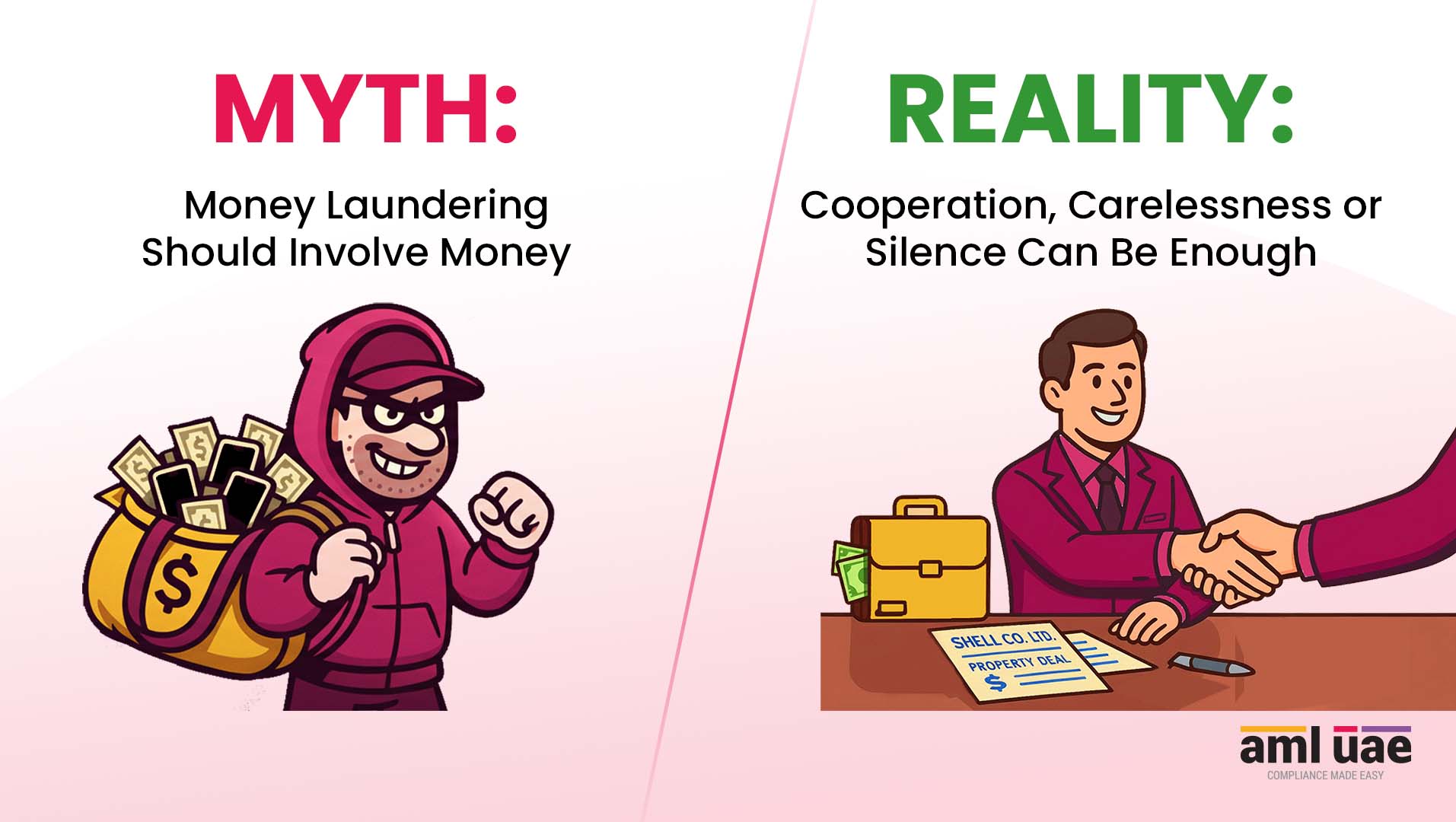
Myth: Money Laundering Should Involve Money

Reality: There need not be cash for there to be a crime. Just cooperation, carelessness, or silence.

When we hear ‘money laundering,’ the imagination leaps. Bundles of cash, Swiss accounts, a man in sunglasses at an airport, nervously glancing sideways as he wheels a suspicious heavy suitcase.

Very cinematic.

Money laundering is not always about having a lot of cash- it’s a myth. In reality, it can happen even without a single dollar exchanging hands.

Have you ever booked a cab for someone else? You didn’t drive it, and you didn’t ride in it, but you set the route and made the journey happen, all through your phone. This is exactly how money laundering works.

Let’s walk through the clearer side of it. Money laundering is not about a terrorist or a gangster wearing balaclavas and owning a suitcase full of cash. Sometimes, it’s as simple and subtle as:

  • Registering a shell company without fact-checking.
  • Letting a friend “borrow” your bank account without asking any questions.
  • A landlord renting an apartment and accepting a large amount of money in cash.

In these cases, none of them have touched the money, but they have created a path, they have become a helping hand, and this is exactly what laundering looks for.

These actions feel harmless and worthy of letting go, but they are not. Thinking “I am just doing a favour” or “that’s not a big deal,” this thought leads to laundering sneaking in. A circle of carelessness, loopholes, and lack of questions will make you play merry-go-round, which you might not enjoy.

Now laundering has become like filtered water- clear to the eye, yet full of invisible toxins unless tested. It’s not just drug lords or arms dealers; it could be any valued professional. People like you and me are unintentionally pulled into a system that feeds on low suspicion and high opportunity.

That’s why understanding this myth, that laundering always involves cash or a crime, which is obvious, is not just necessary but urgent as well.

Because money laundering is not about spotting the obvious, it’s about questioning the ordinary or a deal too clean to doubt.

As old wisdom says: ‘Prevention is better than the cure.’

Being alert won’t cost you anything, but being ignorant and hiding behind the pillars of innocence will cost you a lot.

Our Latest Publications

Prevention is Protection

Share via :

Share via :

Online Marketplace Fraud Risk Identification Checklist for AML/CFT

Online Marketplace Fraud Risk Identification Checklist for AML-CFT

Online Marketplace Fraud Risk Identification Checklist for AML/CFT

Online Marketplace Fraud Risk Identification Checklist for AML/CFT

Online Marketplace Fraud involves unlawful activities that may undermine the integrity of using such digital platforms. However, a clear awareness and use of best practices can safeguard Regulated Entities from e-commerce fraud risks.

Whether you are a member of the customer onboarding team, a Senior Board Member, an AML Compliance Officer, a Transaction Monitoring Analyst, a KYC Analyst, an MLRO, or an AML enthusiast, provided is a no-question-asked and hassle-free downloadable “Online Marketplace Fraud Risk Identification Checklist for AML/CFT” + RACI Matrix.

This checklist is precisely designed to streamline AML Compliance teams’ roles and responsibilities, such as:

  • Assessing the effectiveness of control measures surrounding documents, customers, transactions, and counterparties to identify or detect any red flags indicating online marketplace fraud.
  • Identifying whether the regulatory reporting and AML training components are designed well enough to mitigate online marketplace fraud risk.
  • Identifying process efficiency for red-flag detection around online marketplace, which might be indicators of underlying ML, FT, or PF activities.
  • Designing workflow, role clarity, task allocation, and task escalation for managing cases with online marketplace fraud risks.
  • Ensuring timely filing of CNMR, PNMR, STR, SAR with UAE FIU through goAML portal when red flags in the online marketplace are detected.

Download this Online Marketplace Fraud Risk Identification Checklist for AML/CFT whether you are in DIFC, DMCC, ADGM, or Jebel Ali Free Zone, to align your organisation with real-world fraud detection and assess your business’s readiness to mitigate online marketplace fraud risk to combat ML, TF, and PF risks.

Our Latest Checklists

Confused with how to mitigate ML, FT, and PF risks within your Regulated Entity?

Share via :

Share via :
AML/CFT Compliance Culture eBook

AML-CFT Compliance Culture eBook

AML/CFT Compliance Culture eBook

AML/CFT Compliance Culture eBook

Establishing a robust AML/CFT compliance culture is important for curbing the risk of Money Laundering, Terrorist Financing, and Proliferation Financing. A strong compliance culture acts both as a shield, i.e., protecting an entity from financial crimes and as a sword, i.e., countering illegal activities with policies and controls.

Our eBook provides a comprehensive overview of the key components necessary for establishing a strong AML/CFT compliance culture and offers practical insights for regulated entities looking to strengthen their defences against financial crime.

Inside this must-read resource, readers will find:

  • The Compliance Perspective: Understanding AML/CFT Culture
  • Pillars of Protection: Key Elements of AML/CFT Compliance Culture
  • Momentousness of Compliance Culture: Highlighting the crucial role of AML/CFT compliance in mitigating risks, enhancing financial integrity, and building trust with stakeholders.
  • Integrated Measures: Explaining the measures for establishing AML/CFT Compliance culture
  • Building the Foundation: What are the characteristics of a strong AML/CFT Compliance culture
  • Bridging the Gap: Identifying the challenges for filling the gap in establishing AML/CFT Compliance culture
  • Shaping Tomorrow: The road ahead for sustaining the AML/CFT Compliance Culture

Check out this eBook to explore the aspects for establishing a strong AML/CFT Compliance culture.

Our Latest Publications

Confused with how to mitigate ML, FT, and PF risks within your Regulated Entity?

Share via :

Share via :

Erin Brockovich and the AML Mindset: Movie Review

Erin Brockovich and the AML Mindset: Movie Review

Erin Brockovich and the AML Mindset: Movie Review

Erin Brockovich and the AML Mindset: Movie Review

“They’re called documents.”

And they’re called people.”

And that is the plot.

In AML, we spend our lives dissecting documents. IDs. Contracts. Ownership registries. But Erin Brockovich reminds us that somewhere behind those sanitised reports are real people, causing real harm, that hold real consequences.

This movie tells the story of the wilful concealment of toxic truth and about laundering liability. Picture this: California’s dust, corporate smiles, and water tainted with hexavalent chromium. The air is dry, the sun is warm, and the garden hose is ready for weekend barbecues. Until you notice the water tastes metallic and your neighbour’s medical histories read like a toxicology report.

The False Front When the Water Isn’t Clean

A small town, Hinkley, California. Sun-drenched, unsuspecting, and dying. Erin is jobless, brash, and wearing heels that are more ‘court’ than ‘courtroom’. Erin stumbles into a paralegal gig and uncovers something that smells off. A real estate case with too many medical records. A utility company too eager to settle. A corporate giant too clean to be true.

Pacific Gas and Electric Company (PG&E) plays it cool with polished reports, confident reassurances, and a trail that says, ‘nothing to see here.’ If that’s not classic layering, we don’t know what is. This is how cover-ups look in the real world.

Erin as a One-Woman AML Unit

Erin does confrontations. Doorsteps, box files, human stories. Even without knowing what ‘enhanced due diligence means, she does it instinctively. Where she sees patterns, she investigates. When most reports stop at ‘appears compliant,’ she digs deeper and asks: At what cost? Erin feels the anomalies that we are trained to see in AML. She connects contamination to compensation, land values to medical bills, and brings forth the kind of risk profile no automated system could have flagged.

Compliance Theatre vs. Compliance Impact

Talking about PG&E, a billion-dollar company with the right optics:

  • Documents in order
  • Permits filed
  • Technically compliant reports
  • Community outreach

But behind it lay a toxic asset. This isn’t so different from what we see in AML:

  • Banks onboarding shell entities with perfect paperwork and zero substance
  • High-risk clients hiding behind ‘clean’ directors and friendly jurisdictions
  • ‘Risk-based’ frameworks that mysteriously never escalate real risk.

PG&E was the ultimate box-tickers. They did the bare minimum and hoped no one would ask for the why behind the what. Until Erin came.

A Case Study

Let’s call this one a case study in non-financial misconduct with financial consequences. Because in the end, this was about money: settlements, hush payments, litigation avoidance. It’s just that instead of wires, the transactions were cancers, birth defects, and denial.

Here’s what Erin Brockovich teaches the AML world:

1. KYC is a fingerprint

PG&E knew their community. They just did not want the world to know what they knew. Know your customer and know what they are hiding.

2. Do no mistake documentation for truth

A compliance report can be weaponised just as easily as a shell company. If your controls don’t ask uncomfortable questions, they’re not controls.

3. Sometimes, the riskiest clients are the ones with nothing to hide because they’ve already buried it

Do not let the structure, size, or name lull you to sleep. Risk wears a suit, smiles politely, and files paperwork on time.

Final Word

As cinema, Erin Brockovich is a toast to persistence. As a compliance case study, it’s a tale of the importance of timely detection, transparent disclosure, and, for heaven, keeping proper records.

Erin Brockovich is many things: a courtroom symphony, a catwalk through legal landmines. But more than that, it’s a mirror held up to our own world of compliance. Erin’s legacy is a masterclass in why we exist. To chase the facts others avoid, to ask questions that ruin someone’s perfect narrative, to rip open the box that everyone is happy to tick.

In the end, our job is not to polish reports until they gleam. It is to make sure no one bleeds behind the shine.

Recommended Popcorn Rating : Burnt, over-salted, and slightly bitter. Just like PG&E’s quarterly ethics report.

Our Latest Publications

Don't let your operations tumble into trouble.

Share via :

Non-Resident Customer and Offshore Client Risk Assessment Checklist

Non-Resident Customer and Offshore Client Risk Assessment Checklist

Non-Resident Customer and Offshore Client Risk Assessment Checklist

Non-Resident Customer and Offshore Client Risk Assessment Checklist

Due to the rising financial crime associated with Non-Resident Customers, it is necessary to analyse their connection with high-risk jurisdictions. Even if you’re a member of the customer onboarding team, appointed as front-line staff, MLROs, Compliance Officer, or Transaction Monitoring Analysts, you need to assess, mitigate or report the risk linked to Non-Resident Customers. Here’s a “one-click-away” downloadable, “Non-Resident Customer & Offshore Client Risk Assessment Checklist ” + RACI Matrix to ease your compliance work.

This checklist is preferably designed to streamline AML Compliance teams’ roles and responsibilities, such as:

  • Assessing the effectiveness of control measures surrounding non-resident or offshore customers, transactions, and counterparties to identify or detect any red flags indicating risk from non-resident customers.
  • Identifying whether the Regulatory Reporting and AML training components are designed well enough to mitigate risks from offshore customers.
  • Identifying process efficiency for red-flag detection around misuse of non-resident accounts for illicit money transfers across different jurisdictions, which might be indicators of underlying ML, FT or PF activities.
  • Designing workflow, role clarity, task allocation, and task escalation for managing cases with risky cross-border clients.
  • Ensuring timely filing of CNMR, PNMR, SAR, or STRs with UAE FIU through the goAML portal when red flags are detected.

Download this “Non-Resident Customer & Offshore Client Risk Assessment Checklist ” + RACI Matrix, whether you are a Financial Institution or DNFBPs in Dubai, Abu Dhabi or Sharjah, to ensure tracking of high-risk individuals or customers living outside the UAE to implement EDD, or other risk mitigation strategies for effective AML Compliance.

Our Latest Checklists

Confused with how to mitigate ML, FT, and PF risks within your Regulated Entity?

Share via :

Share via :

Layering Lisa

Layering Lisa

Layering Lisa

Last time we met, Suspicious Sam, who tried to clean his dirty laundry (MONEY), and hoped no one noticed. He dazzled half the town with his lavish spending and awkward explanations (he wasn’t successful). Now let me introduce his cousin, Layering Lisa, the queen of cover-ups.

Lisa wasn’t as flashy as Sam. You wouldn’t spot her buying cars in cash or donating a suspiciously generous sum to the neighbourhood badminton club. No, Lisa was more subtle. Where Sam liked to burst through the door, Lisa preferred to slip in quietly through the back, wearing a smile.

You see, Lisa had a talent. Not for singing, or baking, or parallel parking, but for confusing people on purpose. If laundering money were a magic trick, she’d be the one shuffling cups faster than your eyes could follow.

Let’s say Lisa was called upon to confuse the money trail. She wouldn’t walk into a bank and deposit it with a wink. People might ask questions. Instead, she broke it into pieces, like someone tearing up a paper before tossing it into the wind. A little went to a friend’s account. Another chunk brought a painting from her cousin’s gallery. Some took a detour while the rest were paid to themselves as a ‘salary’ from a company that did absolutely nothing except exist politely on paper.

Lisa didn’t try to hide the money in one big move, that would be too obvious. Instead, she buried it under layer after layer until it looked like it had always belonged. If you asked Lisa where the money came from, she’d probably tilt her head, smile sweetly, and say, “It’s complicated.”

But here’s the thing. Complicated isn’t clever. In money laundering, it’s a camouflage, technically known as layering. You know how, in every family, there is that one person who tells a story with so many side-plots that halfway through, you forget what the story was about? That’s Lisa’s financial strategy. By the time someone tries to trace her money, they’re knee deep in fake invoices, shell companies, wire transfers across four countries, and a suspicious receipt for antique kitchen appliances.

And just like that, she’s made something questionable look completely normal, in fact, a part of the system.

That’s why brilliant AML compliance folks quietly keep an eye out. Because clean money doesn’t need a costume. But when it’s got layers and a forged passport? That’s when you know you’ve met a Lisa.

So next time you see money going on a world tour before arriving at its final destination, don’t be fooled. And our Lisa? She’s the choreographer of confusion, the artist of indirection, the queen of laundering’s second act.

But her story isn’t over yet. Because someone, somewhere, is asking, “Why did this money take the scenic route?”

And that, dear reader, is how the layer begins to follow the thread.

Our Latest Stories

Where did the money come from? Where is it going? Know and keep it flowing safely.

Share via :

AML Compliance Round Up – July 2025

AML Compliance Round Up: July 2025

AML Compliance Round Up: July 2025

Welcome to AML compliance round-up – July 2025.

If you thought summer was the season of vacation, July 2025 begged to differ. July marched in with full action. As the mercury soared, so did the pressure to comply. Today, we bring you the top stories from July 2025.

UAE Is No Longer Grey. It’s Giving Global Respectability

So, for anyone still living under a rock, UAE is officially out of the EU’s high-risk jurisdictions list. Do you know what that means? It means the entire continent of Europe has essentially said, ‘We appreciate the AML/CFT efforts made by you, and we are lifting the enhanced due diligence measure put on you.’

FFR is Out, CNMR is In

Meanwhile, in a move only compliance folks would cheer over, FFRs are officially rebranded. That’s right. The once-formidable Fund Freeze Report is now a Confirmed Name Match Report (CNMR). Same essence, sharper branding. Terminology got a facelift.

AML Must Work Overtime

Name screening continued over the holidays. Just when you thought you could rest during the weekends and holidays, guess who’s still screening? That’s right, the EOCN confirmed that TFS obligations do not take a holiday. All FIs, DNFBPs, and VASPs must screen names against UAE’s consolidated list even during holidays, and freeze assets immediately if it’s a match.

Enforcement Hits Hard: Fine, Finer, Fined

Florals for spring? Groundbreaking. But non-compliance in July? Career-ending. Millions in fines because poor compliance is simply unforgivable. The Central Bank of UAE made it very clear that mediocrity will no longer be tolerated, especially if it’s in your AML compliance report.

A foreign bank branch received a AED 5.9 million fine for failing to maintain proper AML/CFT controls. In what can only be described as a masterclass in ‘how not to comply with the Central Bank instructions’, another bank was handed a AED 3 million penalty.  Finally, the Central Bank also sanctioned three separate exchange houses, totalling AED 4.1 million. AML failures, again.

So, What’s the Forecast for August?

Compliance isn’t cooling down. If anything, we’re seeing a return to structured formal procedures, refined monitoring, and sharp documentation. July was about headline-making standards, and UAE setting the bar. This is AML compliance with posture.

As always, we expect tighter supervisory scrutiny, much-needed wardrobe changes for firms still stuck with off-the-rack frameworks..

Our Latest Publications

Don't let subtle transactions outsmart your compliance program

Share via :

Share via :

Money Laundering is a concern for big firms

Money Laundering is a concern for big firms

Money Laundering is a concern for big firms

Money Laundering is a concern for big firms

The idea is outdated. The reality is inconvenient. And ignoring it is risky. Let’s get one thing straight. This myth needs to retire. Permanently.  

Do you think only billionaires pay taxes? Adorable.  

Let’s dismantle this myth. Small and medium-sized businesses have clung to the comforting illusion that money laundering is a ‘big firm problem.’ That it’s something for multinational banks and global financial institutions to worry about, it is as if criminal networks check your balance sheet before exploiting you.  

They’re not interested in your annual turnover. They’re interested in your blind spots.  

The belief that money laundering is only the problem of banks, billion-dollar conglomerates, and multinational corporations is dangerously misleading. It gives smaller businesses a false sense of immunity and offers criminals exactly what they want: low-profile entry points with minimal resistance. 

Criminals aren’t flashy. They love businesses that think they’re too small to matter.  

The myth persists because it’s convenient. It’s easier to believe that ‘money laundering happens elsewhere.’ That’s a plot point in movies. That it’s someone else’s problem, but that thinking creates a blind spot. And blind spots are exactly where financial crime flourishes.  

Criminals, their creativity cares about your inattention. Your charming lack of paperwork. Your delightful habit of “not overcomplicating things.” Believing money laundering only happens to big firms is like thinking arson only happens to mansions. The fire doesn’t care what neighbourhood it’s in. It just wants fuel. 

And small businesses are flammable. Criminals select you because you are small. Launderers don’t fear your size. They fear your systems. And that’s exactly what you’re expected to have. It’s the bare minimum. You’re expected to: 

None of these is optional. There is no ‘small firm exemption.’ 

Old wisdom says, “Big door swings on small hinges.” 

It’s easy to watch skyscrapers and assume the storm only hits them. But sometimes the lightning strikes the tool shed. The one no one thought to lock. 

Our Latest Publications

Don't let subtle transactions outsmart your compliance program

Share via :

Share via :

Identifying Sanctions Evasion Through Name Alteration Checklist for TFS, CFT & CPF Compliance

Identifying Sanctions Evasion Through Name Alteration Checklist for TFS, CFT & CPF Compliance

Identifying Sanctions Evasion Through Name Alteration Checklist for TFS, CFT & CPF Compliance

Identifying Sanctions Evasion Through Name Alteration Checklist for TFS, CFT & CPF Compliance

With Regulated Entities upping their ante with best-in-class Sanctions Screening Software and Sanctions Screening APIs, criminals also find ways to escape this cat and mouse chase!

One method to escape deeper scrutiny is name alteration, name variation, or misuse of aliases to evade identification or matching names contained in sanctions lists. Name alteration or name manipulation is a Sanctions Evasion technique, that criminals use to disconnect their names with their true identities which tie them to prohibited activities that led to inclusion of their names in sanctions or designated persons lists. Name alteration preys on limited data linking capabilities of screening software and APIs. Identification of name manipulation is a must during CDD to ensure that criminals do not pass sanctions screening.

Here’s a “one-click-away” downloadable, “Identifying Sanctions Evasion Through Name Alteration Checklist for TFS, CFT & CPF Compliance + RACI Matrix.

Whether you are a part of the customer onboarding team, an AML Compliance Officer, a KYC Analyst, a Transaction Monitoring Analyst, or a Senior Board Member, or simply an AML enthusiast, this checklist is specifically designed to simplify your and your teams’ responsibilities such as:

  • Assessing the effectiveness of control measures surrounding documents, customers, transactions, and counterparties to identify or detect any red flags indicating sanctions evasion through name alteration
  • Identifying whether the regulatory reporting and AML training components are designed well enough to mitigate sanction evasion risks
  • Identifying process efficiency for red-flag detection around misuse of aliases to evade scrutiny, which might be indicators of underlying ML, FT, or PF activities
  • Designing workflow, role clarity, task allocation, and task escalation for managing cases with name variation monitoring
  • Ensuring timely filing of CNMR, PNMR, SAR, or STRs with UAE FIU through goAML portal when alias related sanction evasion red flags are detected.

Download this Identifying Sanctions Evasion Through Name Alteration Checklist for TFS, CFT & CPF Compliance, whether you are in Dubai, ADGM, or DMCC to align your regulated with realistic name alteration detection red-flags and assess your business’s readiness to mitigate sanctions evasion risk to combat TF and PF risks.

Our Publications

Confused with how to mitigate ML, FT, and PF risks within your Regulated Entity?

Share via :

Share via :