
The KYC Lesson: How Mr Mysterious Met Granny Compliance in the World of AML

The KYC Lesson - How Mr Mysterious Met Granny Compliance in the World of AML

The KYC Lesson: How Mr Mysterious Met Granny Compliance in the World of AML

The KYC Lesson: How Mr Mysterious Met Granny Compliance in the World of AML

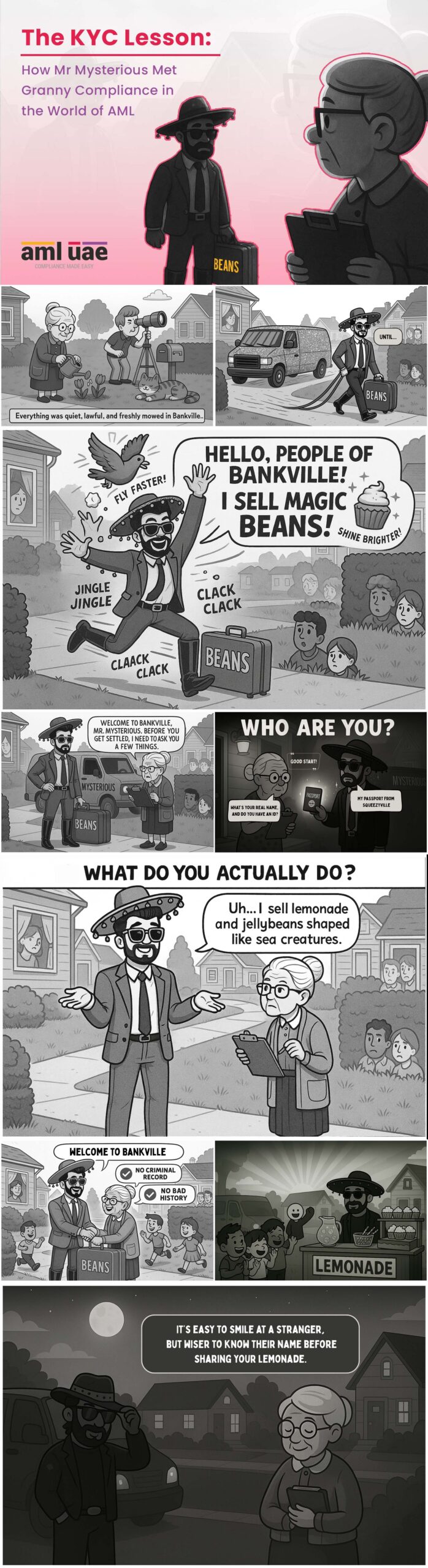
It was a sunny morning on Bankville Lane. The birds were chirping, the lawns were freshly mowed, and the neighbours were going about their usual routines. Mrs Whiskers was watering her tulips. Mr Potts was adjusting his telescope. Everything was peaceful and predictable, just as it should be.

That is, until a van covered in glitter rolled onto the street.

Out stepped a tall man wearing shiny purple boots, sunglasses, and a wide-brimmed hat covered in tiny bells. He dragged a suitcase behind him labelled: “BEANS”.

“Hello, good people of Bankville!” he called out in a grand voice. “You may call me Mr Mysterious.”

The neighbours peeked through the curtains.

“I sell magic beans,” he announced proudly. “They help pigeons fly faster and make cupcakes sparkle.”

A few neighbours smiled politely. Others were confused.

Now, Bankville was a friendly place, but not a careless one. They didn’t let anyone in without getting to know them first, not after the Great Lawn Flamingo Incident in 2018.

So, out came Granny Compliance.

She was small and slouched, wore glasses on a chain, and carried a clipboard wherever she went. No one really knew how old she was, but everyone knew this: if anyone new showed up in Bankville, Granny Compliance would find out who they really were.

“Welcome to Bankville, Mr Mysterious”, she said with a kind but serious tone. “Before you get settled, I need to ask you a few things.”

“Is this a quiz?” he asked.

“No,” she replied. “This is just a way we make sure we understand who we’re dealing with before we do business, bake sales, or block parties. This is KYC.”

Mr Mysterious blinked. “But I’m charming.”

“I’m sure you are,” Granny Compliance replied. “But charm isn’t an official form of identification.”

She clicked her pen. “Let’s begin.”

Step 1: Who Are You?

“First things first,” she said. “What’s your real name, and do you have any documents to prove it?”

Mr Mysterious handed her a business card that read:

Mr Mysterious, CEO of Beans & Dreams Co.

“Do you have an ID?” she asked.

He pulled out a passport. It was real. Issued in the town of Squeezyville.

“Good start,” she nodded.

Step 2: What Do You Actually Do?

“You said you sell magic beans. Do you have a license for that?”

“Well,” he said, suddenly a little sheepish. “I also sell lemonade on weekends. And jellybeans shaped like sea creatures. The magic part is more of a theme.”

Granny Compliance wrote that down.

“So, you’re not a wizard.”

“Only at birthday parties,” he admitted.

Step 3:

Granny Compliance called a few numbers, checked the records and even looked up his website. Sure enough, Mr Mysterious wasn’t hiding anything serious. His bean-selling was more sugar than sorcery, and his lemonade business was popular in the nearby towns. ‘No criminal record”, “No bad history”, she confirmed.

She gave him a smile. “Welcome to Bankville.”

From that day forward, Mr Mysterious became a regular fixture on the street. He sold lemonade with glittery straws and hosted puppet shows for the neighbourhood kids. He never tried to sell anyone magic beans again. Though he once brought cupcakes that changed colour. And everyone knew: thanks to KYC, they weren’t waving at a stranger anymore. They had got to know him properly.

The moral of the story is,

Know Your Customer is how banks and businesses (and sometimes cautious grandmothers) make sure people are who they say they are. It’s about asking:

  • Who are you really?
  • What do you do?
  • And can we trust that?

Because it’s fun to make new friends, but when money’s on the table, it’s wiser to know who’s sitting across from you first.

Where did the money come from? Where is it going? Know and keep it flowing safely.

Share via :

Layering Lisa

Layering Lisa

Layering Lisa

Last time we met, Suspicious Sam, who tried to clean his dirty laundry (MONEY), and hoped no one noticed. He dazzled half the town with his lavish spending and awkward explanations (he wasn’t successful). Now let me introduce his cousin, Layering Lisa, the queen of cover-ups.

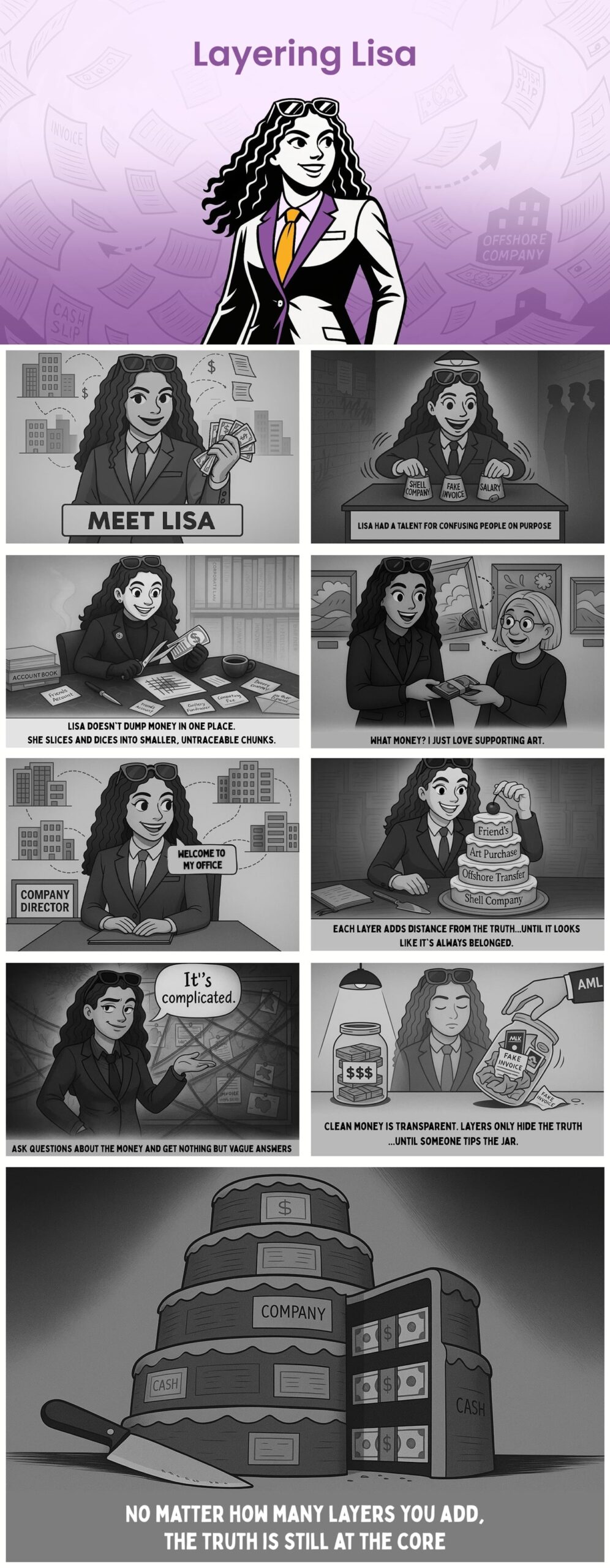
Lisa wasn’t as flashy as Sam. You wouldn’t spot her buying cars in cash or donating a suspiciously generous sum to the neighbourhood badminton club. No, Lisa was more subtle. Where Sam liked to burst through the door, Lisa preferred to slip in quietly through the back, wearing a smile.

You see, Lisa had a talent. Not for singing, or baking, or parallel parking, but for confusing people on purpose. If laundering money were a magic trick, she’d be the one shuffling cups faster than your eyes could follow.

Let’s say Lisa was called upon to confuse the money trail. She wouldn’t walk into a bank and deposit it with a wink. People might ask questions. Instead, she broke it into pieces, like someone tearing up a paper before tossing it into the wind. A little went to a friend’s account. Another chunk brought a painting from her cousin’s gallery. Some took a detour while the rest were paid to themselves as a ‘salary’ from a company that did absolutely nothing except exist politely on paper.

Lisa didn’t try to hide the money in one big move, that would be too obvious. Instead, she buried it under layer after layer until it looked like it had always belonged. If you asked Lisa where the money came from, she’d probably tilt her head, smile sweetly, and say, “It’s complicated.”

But here’s the thing. Complicated isn’t clever. In money laundering, it’s a camouflage, technically known as layering. You know how, in every family, there is that one person who tells a story with so many side-plots that halfway through, you forget what the story was about? That’s Lisa’s financial strategy. By the time someone tries to trace her money, they’re knee deep in fake invoices, shell companies, wire transfers across four countries, and a suspicious receipt for antique kitchen appliances.

And just like that, she’s made something questionable look completely normal, in fact, a part of the system.

That’s why brilliant AML compliance folks quietly keep an eye out. Because clean money doesn’t need a costume. But when it’s got layers and a forged passport? That’s when you know you’ve met a Lisa.

So next time you see money going on a world tour before arriving at its final destination, don’t be fooled. And our Lisa? She’s the choreographer of confusion, the artist of indirection, the queen of laundering’s second act.

But her story isn’t over yet. Because someone, somewhere, is asking, “Why did this money take the scenic route?”

And that, dear reader, is how the layer begins to follow the thread.

Where did the money come from? Where is it going? Know and keep it flowing safely.

Share via :

Don’t Throw Your Dirty Socks in Someone Else’s Laundry

Don’t Throw Your Dirty Socks in Someone Else’s Laundry

Don’t Throw Your Dirty Socks in Someone Else’s Laundry

Once upon a time in a town not too far from yours, there was a man named Sam. Most folks called him Suspicious Sam, but not to his face. Because Sam was always polite, smiling, dazzling in shiny shoes and crisp shirts. 

Now, Sam didn’t have a job. At least, not one that anyone could remember. He didn’t work at the bakery, the bookstore, or even the post office. But somehow, Sam always had money. Lots of it. Not the kind that shows up in your bank account from a salary. Oh no. This was cash. Stacks of it. The kind you’d expect a pirate to have after raiding a treasure chest. 

One sunny morning, Sam walked into the bank carrying a bag.  A big bag. It looked like it could hold gym clothes. But it didn’t jiggle like sweaty socks. No, it thudded when he placed it on the counter. The teller, Mrs. Fernandez, peeked inside and saw bundles of cash neatly wrapped, with no explanation. 

‘I’d like to deposit this,’ said Sam with a grin so wide, it almost needed its own bank account. 

Her left eyebrow arched just a little. ‘That’s quite a bit of cash,’ she said calmly. ‘Where’s it from?’ 

‘Lucky scratch card,’ Sam said. ‘Well, actually, a few. And maybe some birthday money. Also, I sold a rare comic book.’ 

Now, here’s where things get interesting. 

That is what the grown-ups call placement. It’s the first trick in the money laundering book (No, it doesn’t involve soap and bubbles). 

It’s when someone tries to take dirty money (that’s money earned from something illegal, predicate offences like stealing, corruption, bribery, piracy, smuggling, or selling false Pokémon cards) and bring it into the clean, official financial system.  

It’s kind of like when your little brother eats the cookies before dinner, then pretends he found them on the floor and was just ‘cleaning up.’ 

See, Sam couldn’t just use that money openly. People might ask questions. Like: ‘Where did this come from?’ or ‘Why do these notes smell like mischief?’ So instead, he tried to act like everything was perfectly normal.  

But the banks aren’t silly. And Mrs. Fernandes? She knew that money doesn’t fall from the sky or grow on trees. She followed the AML compliance measures that help keep the money world safe and fair.  

While Sam thought he was being clever, the truth is: you can’t just throw dirty socks into someone else’s laundry and hope they come out clean. Like glitter on your socks or broccoli hidden under mashed potatoes, someone always notices. 

Where did the money come from? Where is it going? Know and keep it flowing safely.

Share via :

Share via :

The Town that Forgot to Ask Questions

The Town That Forgot To Ask Questions

The Town That Forgot To Ask Questions

A story about what happens when no one checks where the money came from.

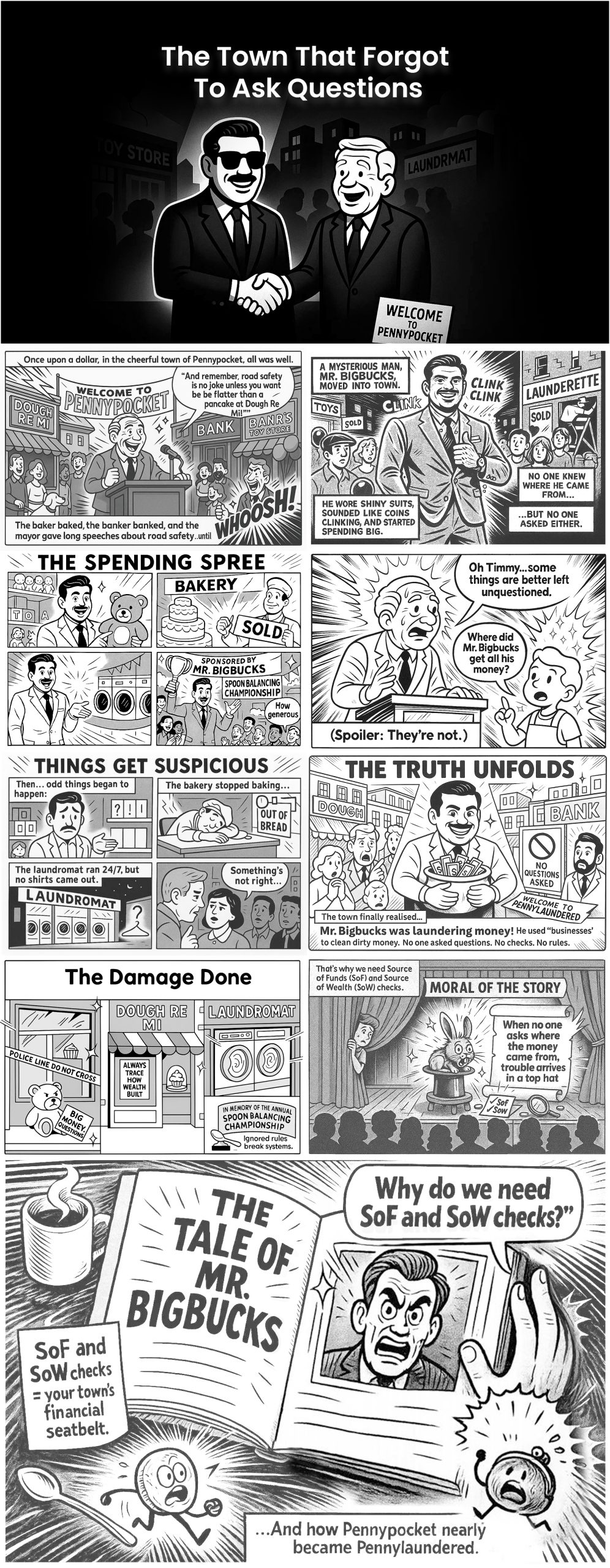
Once upon a dollar, in the cheerful town of Pennypocket, everything ran in fine shape. The baker baked, the banker banked, and the mayor gave overly long speeches about road safety. Everyone was happy until one day, strange things began to happen.

A mysterious man named Mr. Bigbucks moved into the town. No one knew where he came from, but he wore shiny suits, had a laugh that sounded like coins clinking, and he started spending big. Really big.

He brought the toy store, the bakery, the laundromat (ironically), and even sponsored the town’s annual ‘Spoon Balancing Championship’. “How generous,” said the townspeople. “He must really love spoons.”

But little Timmy raised an eyebrow.

“Where did Mr. Bigbucks get all his money?” he asked.

“Oh, Timmy,” said the mayor, chuckling, “Some things are better left unquestioned.”

(Spoiler alert: They’re not)

Soon things took a turn. The toy store stopped selling toys and only stored locked boxes. The bakery stopped selling cakes. The laundromat? It was running 24/7, but not a single shirt came out of it. Suspicious, right?

That’s when the town realised: Mr. Bigbucks wasn’t a hero, he was laundering money!

His fancy investments were a clever disguise to make the illegal money look clean. Without checks, rules, or questions, dirty money had walked right into town and brought everything.

By the time the truth came out, it was too late. The bakery was bankrupt, the toy story was under investigation, and the Spoon Balancing Championship was permanently cancelled (a national tragedy).

Moral of the story

If you don’t ask where the money comes from, you might accidentally invite trouble with top hats and gold watches into your home. And that’s exactly what Source of Funds (SoF) and Source of Wealth (SoW) checks are for. It’s the AML/CFT control that checks, double-checks, and sometimes triple-checks the money in the system, so people like Mr. Bigbucks don’t enter with sacks of shady coins.

AML compliance is like the town guard with a magnifying glass. It’s the reason your bank asks for KYC documents. It’s the reason financial institutions investigate suspicious behaviour. It’s to protect the town.

So, the next time someone asks, “Why do we need SoF and SoW checks?”

Tell them the tale of Mr. Bigbucks and how Pennypocket almost became Pennylaundered.

Where did the money come from? Where is it going? Know and keep it flowing safely.

Share via :

Share via :