



The Town That Forgot To Ask Questions
Published On: 06/16/2025
Last Reviewed On: 08/11/2026 | Last Updated On: 08/11/2026
The Town That Forgot To Ask Questions
A story about what happens when no one checks where the money came from.
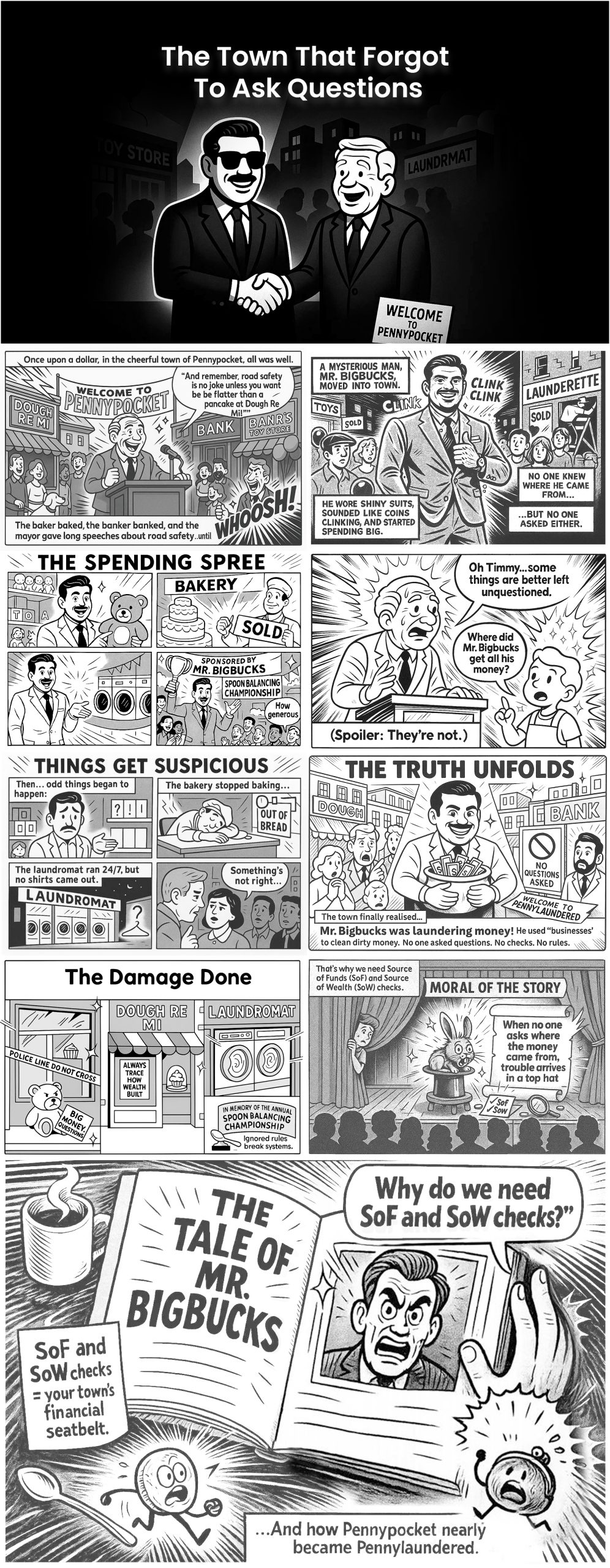
Once upon a dollar, in the cheerful town of Pennypocket, everything ran in fine shape. The baker baked, the banker banked, and the mayor gave overly long speeches about road safety. Everyone was happy until one day, strange things began to happen.
A mysterious man named Mr. Bigbucks moved into the town. No one knew where he came from, but he wore shiny suits, had a laugh that sounded like coins clinking, and he started spending big. Really big.
He brought the toy store, the bakery, the laundromat (ironically), and even sponsored the town’s annual ‘Spoon Balancing Championship’. “How generous,” said the townspeople. “He must really love spoons.”
But little Timmy raised an eyebrow.
“Where did Mr. Bigbucks get all his money?” he asked.
“Oh, Timmy,” said the mayor, chuckling, “Some things are better left unquestioned.”
(Spoiler alert: They’re not)
Soon things took a turn. The toy store stopped selling toys and only stored locked boxes. The bakery stopped selling cakes. The laundromat? It was running 24/7, but not a single shirt came out of it. Suspicious, right?
That’s when the town realised: Mr. Bigbucks wasn’t a hero, he was laundering money!
His fancy investments were a clever disguise to make the illegal money look clean. Without checks, rules, or questions, dirty money had walked right into town and brought everything.
By the time the truth came out, it was too late. The bakery was bankrupt, the toy story was under investigation, and the Spoon Balancing Championship was permanently cancelled (a national tragedy).
Moral of the story
If you don’t ask where the money comes from, you might accidentally invite trouble with top hats and gold watches into your home. And that’s exactly what Source of Funds (SoF) and Source of Wealth (SoW) checks are for. It’s the AML/CFT control that checks, double-checks, and sometimes triple-checks the money in the system, so people like Mr. Bigbucks don’t enter with sacks of shady coins.
AML compliance is like the town guard with a magnifying glass. It’s the reason your bank asks for KYC documents. It’s the reason financial institutions investigate suspicious behaviour. It’s to protect the town.
So, the next time someone asks, “Why do we need SoF and SoW checks?”
Tell them the tale of Mr. Bigbucks and how Pennypocket almost became Pennylaundered.
Where did the money come from? Where is it going? Know and keep it flowing safely.
Share via :