Free Webinar on PEP screening requirements in UAE

Free Webinar on PEP screening requirements in UAE

Pathik Shah

Free Webinar on PEP screening requirements in UAE

AML UAE and Castellum.AI are organizing a free webinar on the PEP screening requirements in the UAE.

Webinar Registration Link: https://zoom.us/webinar/register/WN_Iwsuy7yEQnS6fB0XugX_xg

14th December 2022 – 5:00 pm to 5:30 pm (GST)

Politically Exposed Person - PEP Screening Requirements in UAE

The webinar aims to create awareness of the importance of screening “Politically Exposed Persons” and how to comply with the PEP screening requirement effectively.

Not only the financial institutions but VASPs and non-financial businesses, such as dealers in precious metals and stones, real estate agents, legal and accounting professionals, etc., are also obligated to comply with PEP screening requirements.

The expert panel for the webinar includes AML screening platform – Castellum.AI’s team – Peter Piatetsky, the co-founder & the former US Treasury advisor, and Spencer Vuksic, director of the solution and Dipali Vora, Senior AML Consultant from AML UAE.

A Global Compliance Screening Solution

To make your AML compliance simple, efficient, and effective.

Share via :

About the Author

Pathik Shah

FCA, CAMS, CISA, CS, DISA (ICAI), FAFP (ICAI)

Pathik is an ACAMS-certified AML consultant specialising in governance, risk, and compliance for regulated entities in the UAE. He brings over 28 years of experience, with 1,000+ hours of AML training and 200+ advisory engagements across DNFBPs, VASPs, and FIs. He supports businesses in aligning with AML/CFT requirements from the CBUAE, DFSA, MoET, MoJ, VARA, CMA, FSRA, and FATF. Known for translating complex regulations into audit-ready procedures, Pathik enables operational clarity and compliance readiness.

Reach Out to Pathik

AML Business Risk Assessment Template for DNFBPs in UAE

AML Business Risk Assessment Template

AML Business Risk Assessment Template for DNFBPs in UAE

AML Business Risk Assessment Template

AML Business Risk Assessment Template for DNFBPs in UAE

Without assessing the inherent ML/FT risk your business is exposed to, it is challenging to deploy the necessary controls to mitigate the money laundering and terrorism financing risk.

To assist you in assessing your business’s exposure to ML risk, we present the AML Business Risk Assessment template, capturing the critical parameters on which such assessment should be based and the recommended methodology. AML Business Risk Assessment is also called Anti-Money Laundering Entity-wide Risk Assessment or Enterprise-wide Risk Assessment.

AML Business Risk Assessment Process

Download Excel-based Entity-wide Risk Assessment Template 

AML UAE is committed to helping the designated entities comply with AML regulations and implement the robust AML compliance framework to mitigate the financial crime risk effectively. As the first step to this journey, we help companies in Entity-wide Risk Assessment, design the appropriate control measures to mitigate Enterprise-wide risk, and customize AML policies.

Our Timely and Accurate AML consulting Services

For your smooth journey towards your goals

Share via :

Share via :

High-Risk Country Reporting: HRC and HRCA

High-Risk Country Reporting – HRC and HRCA

Pathik Shah

Table of Contents

Protect your business with reliable and effective AML strategies with AML UAE.

High-Risk Country Reporting – HRC and HRCA

With increased monitoring emphasized on transactions with persons or entities hailing from high-risk countries, the Ministry of Economy provides for filing of a separate report capturing details about such transactions. These reports are: 

  • High-Risk Country Report or High-Risk Country Transaction Report (HRC) 
  • High-Risk Country Activity Report (HRCA) 

The reports mentioned above are to be filed by both – Financial Institutions and Designated Non-Financial Businesses and Professions (DNFBPs).

When is HRC/HRCA to be filed?

High-Risk Country Transaction Report: If at the time of establishing or in the course of the customer relationship or when conducting transactions on behalf of a customer, a reporting entity observes transactions related to high-risk countries subject to a Call for Action (access the list of jurisdictions here), then the entity is required to submit an HRC. 

High-Risk Country Activity Report: If during the establishment or course of the customer relationship or when conducting an activity on behalf of a customer, a reporting entity identifies activities related to high-risk countries subject to a Call for Action (access the list of jurisdictions here), then the entity should submit an HRCA. 

What activities or transactions are to be reported in HRC/HRCA?

Any cross-border transaction involving the transfer of funds through a banking channel or any remittances, either originating from, destined to, or passing through a high-risk country, would be subject to reporting in HRC/HRCA. 

It does not necessarily require the physical presence of the person (transferor or transferee of funds) in the high-risk country at the time of remittance or receipt of funds. Instead, association by nationality or place of residence in high-risk countries would also be considered in the case of a natural person. While in the case of a corporate entity, the company’s place of incorporation or operation, as well as the association of the UBOs or authorized signatory or senior management with high-risk jurisdictions, must be considered. 

Accordingly, any transaction or activity about transferring funds into or from high-risk countries would be subject to reporting to FIU. Please note that such reporting is irrespective of the amount involved or the currency. 

How and to whom is HRC/HRCA to be filed?

As the Financial Intelligence Unit (FIU) is the reporting authority for all AML matters in the UAE, the HRC and HRCA must also be filed with FIU. 

Like all other AML reports (such as STR, SAR, DPMSR), HRC and HRCA are also reported through the goAML Portal. While submitting the reports on goAML, the appropriate report type must be selected by the reporting entity. FIU does not accept any report either through physical mode, via email, or as a message on the Message Board available on the goAML Portal. 

In the case of a transaction with a person from a high-risk country, if the reporting entity does not have the necessary details related to the transactional attributes mandatory to be captured on goAML, then the reporting entity may choose to file an HRCA. Here, the reporting entity must ensure that all the adequate details of parties, value involved, etc., are adequately captured. 

Simplifying UAE FIU goAML Registration A Visual Guide

What is the Financial Institution’s and DNFBP’s obligation post-filing HRC/HRCA?

Once HRC or HRCA has been filed with FIU, reporting entity must withhold the execution of the transaction for three (3) days from the date of reporting to FIU, as the FIU is expected to respond to such HRC/HRCA during these days. If, during these three (3) days, FIU does not object to or respond to filed HRC/HRCA, then reporting entity can conduct the transaction basis the due diligence performed for the subject party and the transaction. Such transaction execution will be at the judgment of the reporting entity only. 

If the FIU issues any instructions concerning filed HRC/HRCA within the prescribed time, the same needs to be adhered to by the reporting entity. 

Transactions and the parties reported in HRC/HRCA should be subject to frequent ongoing monitoring by the reporting entity

High-Risk Country Reporting – HRC and HRCA

Is there any exemption from filing HRC/HRCA?

HRC/HRCA reporting requirement is applicable only in cases of cross-border transfers. 

Accordingly, transactions like domestic cheques, payment of domestic utility bills using a card issued in UAE or cash by a person hailing from a high-risk country, etc. are exempted from HRC/HRCA reporting requirements, as no banking or remittance channels have been used for the international transfer of funds.

Illustration:

A. Assume you are a TCSP and a corporate entity with a place of incorporation in the high-risk jurisdiction approaches you for assistance in setting up a branch in UAE. For such a transaction, the person has traveled to UAE from another country. The payment for the said services would be remitted to your account from the company’s account with a bank in another high-risk country.  

Since there is cross-border movement of funds by bank transfer, the proposed transaction must be reported in HRC/HRCA. Here, DNFBP shall ensure that the reported transaction shall only be executed if the FIU does not object to the transaction and after three working days after filing an HRC. 

B. An individual from high-risk jurisdiction has visited a non-banking financial institution in UAE to get the US Dollars converted to AED. Here, the currency exchange transaction occurs in UAE without any funds transferred through banks. Accordingly, the financial institution would be exempt from reporting this transaction with FIU. 

AML UAE

With every increasing reporting requirement and risk of money laundering to businesses, it is always good to have a team of professionals at your resort to safeguard your business from being vulnerable in the hands of launderers and stay compliant with regulatory requirements. If you are looking for such assistance, AML UAE is there for you – your trusted partner for AML Compliance. 

FAQs About High-Risk Country Reporting

Is HRC reporting obligation applicable to DNFBPs?

Yes, DNFBPs and Financial Institutions are required to file HRC with FIU. 

The DNFBPs and the Financial Institutions must file HRC or HRCA using their goAML registration credentials. Third parties can assist you in filing these reports with FIU, using the reporting entity’s credentials for the goAML portal. 

While establishing business relationships or conducting business activities, if you identify any activity or transaction with a person or entity having an association with high-risk countries, then as DNFBP, you are required to submit the HRC or HRCA with FIU UAE via the goAML Portal. 

HRC or HRCA reporting requirement is for high-risk countries classified as “High-risk jurisdictions subject to a Call for Action” by FATF. 

FATF has classified the below-mentioned countries as high-risk jurisdictions subject to a “call for action”: 

  • Democratic People’s Republic of Korea (DPRK) 
  • Iran 

There is no threshold amount prescribed for filing HRC and HRCA. Every transaction involving high-risk countries must be reported in HRC and HRCA, irrespective of the transaction value. 

Transactions not involving any cross-border transfer of funds to or from the high-risk countries are exempted from HRC/HRCA reporting requirements, like domestic cheques, payment of domestic utility bills using a card issued in UAE, cash by a person from a high-risk country, etc. 

Once an HRC or HRCA has been filed with FIU, the reporting entity shall keep the execution of the subject transaction on hold for three days from the date of submission of HRC/HRCA. 

No, domestic transactions which do not involve any international transfer of funds to high-risk countries are not required to be reported. 

The transactions related to trading shares/stocks, forex, crypto assets, bonds, mutual funds, commodities, etc., would also be subject to HRC/HRCA if these transactions are cross-border.

Our timely and accurate AML consulting services

For your smooth journey towards your goals

Add a comment

Share via :

About the Author

Pathik Shah

FCA, CAMS, CISA, CS, DISA (ICAI), FAFP (ICAI)

Pathik is an ACAMS-certified AML consultant specialising in governance, risk, and compliance for regulated entities in the UAE. He brings over 28 years of experience, with 1,000+ hours of AML training and 200+ advisory engagements across DNFBPs, VASPs, and FIs. He supports businesses in aligning with AML/CFT requirements from the CBUAE, DFSA, MoET, MoJ, VARA, CMA, FSRA, and FATF. Known for translating complex regulations into audit-ready procedures, Pathik enables operational clarity and compliance readiness.

Reach Out to Pathik

Role of AML Compliance Officer in UAE

Role of AML Compliance Officer in UAE Preview

Role of AML Compliance Officer in UAE

Role of AML Compliance Officer in UAE

Effective implementation of the AML Compliance program is challenging without the oversight of an AML expert – an AML Compliance Officer.

The Compliance Officer is responsible for ensuring the effectiveness and quality of the AML framework within the company. Further, the AML Law also entrusts various functions to the Compliance Officer to support the fight against financial crimes. The present infographic enlists the various roles an AML Compliance Officer has to play in its organization.

AML UAE is an AML consultancy firm offering support in all your AML compliances, including the appointment of a Compliance Officer, imparting AML training to the officer, etc.

Risk indicators for DPMS – Strategic Analysis by UAE FIU

Risk indicators for DPMS - Strategic Analysis by UAE FIU

Pathik Shah

Table of Contents

Protect your business with reliable and effective AML strategies with AML UAE.

Table of Contents

Why did UAE FIU perform the strategic analysis of DPMS?

Given the fact that precious metals and stones are being highly exploited by criminals to launder money given their size and high liquidity, and the fact that UAE is one of the biggest marketplaces for precious metals and stones trading, the UAE Financial Intelligence Unit (UAE FIU) has recently conducted a strategic analysis of data about Dealers in Precious Metals and Stones (DPMS). 

The Strategic Analysis Report lays down the UAE FIU’s objective for conducting this analysis of the DPMS sector as under: 

  • To enhance the understanding of ML/FT vulnerabilities associated with precious metals and stones, 
  • Developing ML/FT trends, typologies, and red flags indicating exploitation of precious metals and stones and the DPMS sector. 

The methodology adopted by the UAE FIU for the strategic analysis of the DPMS sector

The UAE FIU’s strategic analysis is conducted based on the information gathered from the reporting entities operating as DPMS and other relevant stakeholders for January 2021 to June 2022. 

The UAE FIU reviewed the below-mentioned data to analyze the ML/FT trends prevalent in the DPMS sector: 

  1. Dealers in Precious Metals and Stones Report (DPMSR) filed on the goAML portal  indicating cash and wire transfer transactions above the prescribed threshold, 
  2. Suspicious Transaction/Activity Report (STR/SAR), filed either by the DPMS entities or with a “Reason for Reporting” indicating the abuse of precious metals and stones,  
  3. Information exchanged between UAE FIU and counterparty FIUs around gold smuggling, illegal mining of precious metals, gold theft, etc.), 
  4. Information received from domestic authorities – Public Prosecutions, Police Departments, and the Ministry of Interior (MOI) related to an investigation of money laundering and terrorism financing offenses, 
  5. Ministry of Economy’s (MOE) information about DPMS registered in the UAE and MOE imposed sanctions, fines, and warnings to DPMS entities, 
  6. Information received from the Federal Customs Authority around ‘Cash declarations’ wherein the purpose mentioned is related to precious metals and stones. 
Risk indicators for DPMS - Strategic Analysis by UAE FIU

Conclusions of the UAE FIU’s strategic analysis of the DPMS sector

The Strategic Analysis Report addresses the ML/FT typologies and red flags associated with the DPMS sector in the UAE. As per the UAE FIU’s analysis, the following are the major ML/FT typologies or patterns abused to launder money through the DPMS sector: 

Trade-based money laundering

  • Using DPMS entities as “front” to launder the illegal money using trade-based money laundering methods like incorrect invoicing, phantom shipment, or fictitious supply transactions. 
  • Use of multiple DPMS entities as a ‘Corporate Vehicle’ to disguise the source of funds by creating multiple layers by way of transferring a large sum of money amongst the entities without any business rationale. 

The trade-based money laundering is widely used in the DPMS sector to launder money, wherein the transaction is manipulated to transfer the funds from one person to another and from one country to another. 

Other widely exploited trade-based money laundering techniques are: 

  1. To move a large sum of illicit funds from one country (importer) to another (exporter) by over-pricing the commodity supplied compared to its market value. 
  2. Raising multiple invoices on the importer for the same set of products and receiving the payment using different methods to avoid the attention of the authorities. 
  3. Representing the duplicate or fake stones as original and precious stones to bag transfer of large amount from buyer to seller. 
  4. Trade-based money laundering often involves tax evasion, either by short declaring the import quantities or under-pricing the imported goods to avoid paying a large sum of taxes on the import of precious metals. 

Money laundering through “foreign currency exchange” 

  • Indulging employees or third parties into the conversion of foreign currency exchanges without getting the name of the DPMS entity involved anywhere. Here, multiple individuals are involved to avoid reporting threshold and justify the source of funds and purpose as under: 
  • Source of funds used for currency conversion: salary income or savings 
  • Purpose of currency conversion: travel or family upkeep 
  • DPMS is undertaking many foreign currency transactions, mainly in cash, without any logical business transaction or for a quoted reason like foreign suppliers only accepting cash, etc. 

Generally, it has been seen that one currency can be converted into another currency without any involvement of a regulatory authority. Moreover, the conversion of cash currency legitimizes the source of such converted currency, as generally, the party offers receipt of such conversion.  

Moreover, with the increased volume of global trades, the cross-border movement of funds has also risen, leading to increased cases of terrorism financing and laundering funds to invest in unregulated financial centers. 

Gold/cash smuggling 

  • Smuggling gold or illegally transferring the gold from the conflict-affected or high-risk jurisdiction. This smuggled gold or illegally transported gold is sold in smaller quantities to local DPMS entities against cash or is processed and re-exported illegally to different countries, 
  • Sourcing of gold from miners without adequate due diligence of the miner, 
  • Individuals smuggle cash (importing and exporting) on behalf of DPMS entities. 

Using the network of people, gold and other precious metals are increasingly smuggled from illegal miners, wherein quantities of gold are distributed amongst many individuals to avoid the attention of and reporting threshold before the Customs Authority. 

ML/FT risk indicators for DPMS sector suggested in the Strategic Analysis Report 

The risk indicators or the ML/FT red flags captured in this report can be used by the DPMS and financial institutions to identify and report any suspicious activities involving precious metals and stones. The following is an illustrative list of ML/FT risk indicators captured in the report involving the abuse of precious metals and stones:  

  • DPMS entities with complex legal structures, created either to hide the UBO or disguise the transfer of funds, 
  • DPMS entity formed as a front company to mix the legally obtained funds with the illicit funds, 
  • Unreasonable behavior of or large complex transactions by newly formed DPMS entities, 
  • DPMS entities extensively transact in cash, 
  • Irregular shipping methods inconsistent with the standard business practice of DPMS, 
  • Inconsistent documentation or forged documents to disguise the transaction, 
  • DPMS frequently enters into transactions of an abnormally large amount, 
  • DPMS having multiple bank accounts without any business sense or DPMS entities operating bank accounts in the employee’s name, 
  • Adverse news about the DPMS’ UBO or senior management, 
  • DPMS or its UBO or management having close association with high-risk countries, 
  • Receipt or payment of money to third parties having no connection with the sanctions, 
  • Transaction structuring into smaller value deposits to avoid reporting threshold, 
  • DPMS entities extensively involved in cross-border cash movement, 
  • Frequent deposit of cash amounts into banks or exchange of foreign currencies by DPMS, 
  • DPMS entities importing precious metals from conflict-affected jurisdictions, or the volume of import is inconsistent with the country of import (having limited mining capacity or no mines), 
  • Failure to furnish ‘Customs Declaration’ concerning cash deposit related to precious metals/stones transaction, 
  • DPMS transacting in gold instead of cash/bank transfer, 
  • Transfer of funds amongst unrelated companies, having no business nexus, 
  • DPMS or its employees engaging in frequent foreign currency conversions without any business logic, 
  • Frequent travel to high-risk areas or illegal mining jurisdictions, 
  • DPMS operates on loans and credit facilities, generally settled before due dates through cash. 

The primary reason for exploiting the DPMS sector 

Given the peculiar nature of precious metals and stones, the same is most vulnerable in the hands of money laundering, using various methods. We have tried to map the main reason for exploitation against the money laundering technique as under: 

Characteristic of precious metals and stones 
Money laundering method 
Global currency – Precious metals and stones are widely accepted as a medium of exchange across the globe
  • Gold smuggling, wherein gold from illegal mines is smuggled or illegally transferred to other countries to supply it in the local market against cash
  • Trade-based money laundering, wherein gold is imported and exported at a manipulated price
High liquidity – Precious metals and stones can easily be converted into cash
  • DPMS entities purchase smuggled gold without any adequate KYC and due diligence process
  • Terrorists convert their illegal funds into gold, which can be easily transported and encashed in the country of operations
Over-the-Counter – Precious metals and stones trading in not regulated over an exchange platform
  • Smuggled gold is sold to the DPMS entities without any adequate KYC and due diligence process
  • Inadequate documentation of the precious metal and stone transaction
Easy transportation – Compact size makes its movement easy
  • Easy movement of gold without much hassle makes it lucrative for terrorism financing and money laundering
  • Terrorists store their illegal funds in gold and transport the same to the country of operations

How AML UAE can help 

AML UAE can help you understand the risk indicators and ML/FT red flags specific to the DPMS sector to identify suspicious transactions and take necessary actions to combat the same (i.e., timely reporting to the FIU).  

AML UAE also helps DPMS entities (including other DNFPBs) set up an in-house AML compliance department and impart AML training to the employees. We are committed to ensuring your compliance with applicable AML regulations and safeguarding DPMS entities against money laundering and terrorism financing threats.  

AML UAE helps you safeguard your DPMS business from ML/FT threats.

Get in touch to know the best preventive and corrective actions.

Share via :

About the Author

Jyoti Maheshwari

CAMS, ACA

Jyoti has over 11 years of hands-on experience in regulatory compliance, policymaking, risk management, technology consultancy, and implementation. She holds vast experience with Anti-Money Laundering rules and regulations and helps companies deploy adequate mitigation measures and comply with legal requirements. Jyoti has been instrumental in optimizing business processes, documenting business requirements, preparing FRD, BRD, and SRS, and implementing IT solutions.

Reach Out to Jyoti

Decentralized Finance (DeFi) and AML implications in UAE

Decentralized Finance (DeFi) and AML implications in UAE

Pathik Shah

Table of Contents

Protect your business with reliable and effective AML strategies with AML UAE.

Decentralized Finance (DeFi) and AML implications in UAE

The scope of Decentralised Finance is growing rapidly as the concept of virtual assets is being widely accepted across the globe. Decentralized finance, popularly known as DeFi, is an emerging finance domain that operates very distinctly from the traditional centralized financial system regulated and controlled by a country’s government.

With anonymity and lack of centralized governing authority, the money laundering risk around the same is also very grave. In this context, let us understand what DeFi is and what AML implications are around DeFi.

What is DeFi? 

DeFi is a blockchain technology-based borderless and independent financial network. 

Unlike a centralized financial system, there is no central authority governing DeFi, but it is owned by the users who operate and build it. DeFi is an independent system that works autonomously. People trade on the virtual platform, using technology to borrow, lend, invest, or trade without any central authority/intermediary regulating their finances. 

DeFi works on blockchain technology in which the financial services are distributed in a series over the blockchain structure. It is monitored using smart contract programs without the involvement of any intermediary. Protocols are created using open-source software managed by a community of developers of DeFi.  

With DeFi, financial transactions such as lending or borrowing can be done from any place with internet connectivity. A distributed financial database collates and aggregates data from all users and verifies the same using a consensus mechanism (a mechanism used to obtain agreement, trust, and security over a single value or parameter across a decentralized network). 

DeFi is all about peer-to-peer transactions, where two parties come together to exchange cryptocurrency against any supply of goods or services without the involvement of any third parties like banks. Let’s take an example of a loan, where generally you would go to a bank or lending institution and get the money on interest. In the case of DeFi, once you input your loan requirement into the DeFi systems, an algorithm will run to find you a match. Of all the potential peer matches shown, you would agree to the lending terms of one of the peers and get the money on loan. This lending transaction is then recorded in the blockchain. Everything happens at a click of a mouse, and that too in a few seconds. 

Decentralized Finance (DeFi) and AML implications in UAE

What are the benefits of DeFi? 

  • It reduces the cost of financial services, which generally the banks and other financial institutions levy for obtaining their services. 
  • Eliminates the intermediaries and establishes direct connections between the parties. 
  • The money is kept in a digital wallet rather than placing it in a bank account. 
  • Transferring funds becomes easy and quick. 

What is Virtual Asset Service Provider? 

Here, reference should be made to the definition of VASP as given by FATF, which is as under: 

"A business which conducts one or more of the following activities or operations for or on behalf of another natural or legal person:  

  • an exchange between virtual assets and fiat currencies, 
  • exchange between one or more forms of virtual assets, 
  • transfer of virtual assets; (transfer means to conduct a transaction on behalf of another natural or legal person that moves a virtual asset from one virtual asset address or account to another), 
  • safekeeping and administration of virtual assets or instruments, enabling control over virtual assets, 
  • participating in and provision of financial services related to an issuer’s offer or sale of a virtual asset. 

Can DeFi be construed as VASP or the person controlling it? 

As apparent from the definition above and in the context of DeFi, the DeFi arrangement may fit in the definition of VASP as this technology-based network enables the users to enter if smart contract related to financial services using virtual assets. Thus, DeFi provides a platform to transfer virtual assets between parties by way of a transaction executed between the involved parties. 

As mentioned above, though DeFi qualifies for VASP per se, it cannot be subjected to AML regulations as it is a technology solution or an application. It is essential to understand that even though the name suggests that such software operates on a decentralized ledger, these applications have an authoritative structure where any person or group of a few individuals influence or control DeFi. This control or influence may be related to enhancing the functionalities of the application, aspects related to user interfaces, say, over the governing protocols, or even earning profits out of this network.  

In line with the FATF’s intent to apply the AML regulations to a natural or legal person, the person who is exercising control or has sufficient influence over the DeFi shall be construed as VASP for the purpose of implementing the AML provisions. Accordingly, the owners, developers, or the application operators have to ensure that they undertake due ML/FT risk assessment prior to operating the application as DeFi. This shall also include the implementation of adequate routine AML/CFT procedures and ongoing monitoring measures. 

For details on AML/CFT obligation on owners, developers, and operators controlling the DeFi, please refer to our article on Virtual Assets and VASP. 

Our timely and accurate AML consulting services

For your smooth journey towards your goals

Share via :

About the Author

Jyoti Maheshwari

CAMS, ACA

Jyoti has over 11 years of hands-on experience in regulatory compliance, policymaking, risk management, technology consultancy, and implementation. She holds vast experience with Anti-Money Laundering rules and regulations and helps companies deploy adequate mitigation measures and comply with legal requirements. Jyoti has been instrumental in optimizing business processes, documenting business requirements, preparing FRD, BRD, and SRS, and implementing IT solutions.

Reach Out to Jyoti

Risk-Based Approach For Dealers in Precious Metals and Stones (DPMS)

important aml cft feature image

Risk-Based Approach For Dealers in Precious Metals and Stones (DPMS)

Table of Contents

Protect your business with reliable and effective AML strategies with AML UAE.

Risk-Based approach for Dealers in Precious Metals and Stones (DPMS)

The importance of the Risk-based approach for Dealers in Precious Metals and Stones (DPMS) is understood from the nature of the business itself. Jewellers deal in precious metals, stones, jewellery, and by their nature, these items carry high value, and can be easily transported.

Unless a risk-based approach is applied in the jewelry business, it becomes too difficult for the DPMS to comply with the legal requirements of anti-money laundering law in the UAE.

How should DPMS assess the risks involved?

As a part of the risk-assessment process, you must identify specific areas of your business that are more likely to be used by criminals in order to conduct any terrorist financing or money laundering activities.

Therefore, you must assess the risks associated with all your business activities and services. Here are the four primary areas that you need to address while performing while determining your risk.
  • Geography of the potential clients.
  • Business relationships and the clients of your potential customer.
  • Products, services, and delivery channels.
  • Other relevant factors.

In order to do so, you must consider the nature and behavior of your clients, the products or services you deliver, and the ways or mediums in which you provide your offerings. However, if you identify any of the
situations that suspect unusual or illicit activities, you should instantly control these risks by implementing all the probable mitigation measures.

Read more about AML Compliance Requirements for jewellery business in UAE

What is a risk-based approach cycle?

Here are the crucial steps of the risk-based approach for the Dealers in Precious Metals and Stones:
  • Identifying the inherent risks of your company
  • Creating risk-reduction or mitigation measures and critical controls
  • Efficient implementation of your risk-based approach
  • Reviewing your applied risk-based approach
In order to effectively assess your inherent risks, you can divide the process of risk assessment into two parts.
  • Business-Based Risk Assessment
  • Relationship-Based Risk Assessment
It is crucial for you to note that there is no documented methodology for assessing the risks of your business. Therefore, let us understand both of these processes in detail.

Business-based risk approach

In order to assess the risk associated with your business, you have to analyze your products, services, delivery channels, and the geographical location of the company. So let us learn about the same in brief.

1- Product and delivery channel

As a dealer in precious stones, metals, jewellery, and stones, you have to assess your products as well as delivery channels in order to ascertain any high risk associated with the same. This may include the following.
  • Buying precious metals, stones, and precious jewels
  • Sale of precious metals, stones, and precious jewels
  • Indirect transactions with unknown clients. These could take place through the internet, mail, or a telephone.
Product-And-Delivery-Channel
Here are a few things that you might want to consider while assessing your product and delivery channels.
  • Assess your products as per the type of market you are operating into, along with the kind of clients they are curated for.
  • Assessing the physical characteristics of your jewellery items is also a critical aspect that you must watch out for. Portability, value, storage options, etc., are considered as the physical characteristics of the products.
  • The jewellery products which are lesser in value usually aren’t subject to significant risks.
  • Determining the modes of communication with your client also has a role to play: face-to-face communication or any form of virtual communication that occurs through the mail, telephone, or video conferencing.
  • Considering the mode of delivering your jewellery items is also crucial and should be thoroughly monitored. Needless to say, the mode of the transaction should also be observed.

Here are a few examples of potentially high-risk products if you are a DPMS.

Gold

Gold is undoubtedly a high-risk product because it is transformable, exchangeable, and potentially provides secrecy in the transactions. In addition to that, gold has a universal price standard, and it can be used as a currency.

Here are a few red flags associated with the trading of gold.

  • An existing customer buying substantial quantities of gold bullion without any legitimate or explainable reason, or a potentially new customer asking for converting vast amounts of gold into bullion.
  • An existing or potential buyer purchases a massive quality of gold and makes the payment in cash.
  • Any known or unknown foreign national buying vast quantities of gold bullion in a relatively short span.
  • The purity, weight, value, and origin of gold are misclassified misleading on the custom declaration forms.
  • Unlicensed individuals or companies producing and commercializing gold.
  • Gold bullion does not meet the industry quality standards.
  • Higher gold prices as compared to the local markets.

Diamonds

Diamonds also possess high trading risks because they are easily concealed, transportable, carry enormous financial value, facilitates secrecy and ease of transacting, and are highly challenging to trace.

Here are a few red flags associated with the trading of Diamonds.
  • A customer is buying diamonds in bulk without having logically explainable or reasonable reasons. The trading of diamonds could be illogical both economically and from a business point of view.
  • Trading of diamonds whose origin is quite suspicious. This is particularly the case with raw diamonds, which are not accompanied by legitimate Kimberley process certificates.
  • A Kimberley process certificate that comes with an exceptionally long validity or is forged.
  • A supplier or customer who is known for trafficking conflict diamonds.
  • A customer or a supplier who is unaware of the best trade practices or the one who seeks help from third parties before finalizing a transaction.
  • Bulk trading of diamonds and the payment is made in cash from the geographical locations where such transactions are unusual.
  • Any customer who requests to purchase polished diamonds in bulk without any logical reasons.

Compliance. Trust. Transparancy

Customized and cost-effective AML compliance services to support your business always

Behavior of counter parties in some transaction

Here are a few behavioral traits that you must watch out for.
  • Any counterparty that proposes any unusual transaction which is entirely insensible and baseless or the transactions that are pretty high veiled or include high potential profits.
  • Any counterparty who leverages the power of non-banking financial institutions and money service business for no logical and legitimate business reason.
  • Any counterparty that frequently changes bank accounts, especially when on foreign land.
  • Any counterparty seeks secrecy by conducting ordinary business transactions with the help of lawyers, accountants, or any other intermediary.

Various other indicators of High Risk

Here are a few other factors that indicate high risk.
  • A supplier who is not willing to provide accurate or complete contact information, business affiliations, and financial references.
  • Offering loose diamonds in bulk which retains their wholesale value because they can be easily liquidated.
  • Offering risky stones like diamonds through indirect means and to clients whom you haven’t been in direct touch with. These types of transactions are hazardous.

2- Geography

Assess the risk associated with either your own business or the location in which it is located. For example, the movement of money or goods to and from the client company might include high-risk or severe financial crimes like money laundering or terrorist financing.

When you assess your geography, you have to consider whether the geographic locations in which you operate or your clients are based out possess high risks of money laundering activities or terrorist financing. Depending upon the operations of your business, this can range from your immediate surrounding to a province or a territory.

Here are a few examples of geographic elements that are required in your risk assessment.

  • Locations that experience a considerably higher crime rate may lead to the enhanced potential risk of money laundering or terrorist financing.
Geography
  • A rural area where the customers are known to you could present a lesser risk as compared to an urban area where new and anonymous clients are more likely to bring significant risks involved with them.
  • Is your company closely located near a border crossing? If yes, it could elevate the risks involved because your company can be the first entry into the enormous financial systems.
  • If your potential clients are located in countries subject to sanctions or embargoes, you must consider their high risks.

Compliance. Trust. Transparancy

Customized and cost-effective AML compliance services to support your business always

Various other factors relevant to your company, if applicable

Assessing all the other factors related to your business but that does not fall under any of the previously mentioned headings is also crucial to mitigate or eliminate any potential risks. For instance, the size, structure, employees, and number of branches of your business are a few aspects that also need to be assessed for the availability of any risks.
As a dealer in precious stones, metals, or jewels, you enter a professional relationship when a customer conducts a transaction with you that requires you to determine their identity irrespective of whether the transactions are related to each other or not. If you have a professional relationship with your clients, you need to conduct a risk assessment based on the inherent characteristics of your customers. It can be done on the basis of the following factors.
  • The product you are offering and the channel of delivering you are opting for.
  • The geographical location of either your existing or potential client.
  • The characteristics of your clients.
  • The financial activities and transactional patterns of your clients.
In addition to that, it is quite a possibility that your business deals with clients out of a professional relationship. These types of interactions might be sporadic. As a result, there would not be sufficient information available for your business and the legitimacy of the clients. The risk assessment of these clients is more likely to focus on monitoring transactions than having a file under the name of your client. Monitoring such clients is nothing but an obligation to report any suspicious activities like money laundering or terrorist financing.

Here are a few examples of the characteristics of your clients that you might consider as high-risk.
  • A client who is not at all disturbed or concerned about the price.
  • A client who makes the payment for expensive jewelry in cash.
  • A client who tries to use a third-party credit card or a cheque.
  • A client buying precious metals or stones without having any legitimate interest in the value, size, or color.
  • A client who has unexplainable distance from the offerer or you in this case. A client who orders precious items in bulk makes payment in cash, cancels the order, and gets the refund, preferably through cheque.
  • A client who is not willing to share adequate and accurate amounts of information.
Here are a few examples of transactions that you might consider that you might feel as high-risk.
  • Transactions that look structured in order to avoid reporting requirements.
  • Any transactions that involve third parties, either as payers, or recipients of payment, without apparent logical purpose.
  • Use non-bank financial mechanisms, like currency exchange or money remitters, instead of a legitimate banking system.
  • Any kind of unusual payment methods, like large amounts of cash, multiple numbers of money orders, cashier’s cheque, traveler’s cheque, or any type of payment from third parties.
  • Funds that come from an offshore financial center instead of a local bank.
  • There are multiple affiliated entities in the payments chain.

Final words

Frequently Asked Questions (FAQs)

Here are a few frequently asked questions.

Which all types of risks should be assessed in order to carry out risk profiling for DPMS?

Here are a few risks that you need to assess in order to carry out an adequate risk profiling for dealers in precious metals, stones, and jewels.

  • Product, service, and transaction-related risk
  • Supply channel-related risks
  • Geographical risk
  • Client-based risk

The entire industry is prone to high risks. In order to keep yourself safe from reputational losses and regulatory penalties, you have to follow a few things deliberately.

  • Ask your clients to fill up a KYC form and submit legally authorized documents to verify the details provided.
  • You must also check the name of the purchaser in sanction lists, PEPs list, or adverse media reports details.
  • Verify the details, and if any suspicious activity is diagnosed, you must immediately follow an enhanced due diligence process.
  • If you suspect any type of money laundering or terrorist financing, you
    must immediately file a STR.

The entire process can be pretty time-consuming, and your clients might
feel frustrated. However, there are a few things you can do in order to engage with them while all other essential aspects are being carried out.

  • Offer some refreshments
  • Engage the client by showing a video of your warehouse where the jewelry masterpieces are being designed and curated.
  • Ask the client whether they would like some loyalty cards for future purchases.

Annex A: Business-based Risk Assessment
Here are the instructions in order to complete the business based risk-assessment which includes products, geography, delivery channels, and many other relevant factors.

AList of FactorsEffectively describe your products, factors
related to geographic locations, and delivery
channelsBRisk RatingThere are multiple risk factors, and all you have
to do is to rate all of your risk factors. Risk
factors include delivery channels, nature of
products & services, geographic locations, and many other relevant factors. It is important to note that you can have either a low or high-risk category or to have a legitimate complex rating scale. Moreover, the scale you develop should be established, tailored as per the size and
nature of your business.CRationaleWhenever you assign a risk rating to all the risk factors, it is important to provide a reason for that. Furthermore, if required, you can even
make a reference to a website, a report, or a
published paper.DDescribe Mitigation
Measures For High-Risk
FactorsAll the factors identified as high-risks should be
addressed with documented mitigation
measures. Written policies and procedures will make it easy for you to explain how you will reduce or control these risks in your daily activities.

Here are a few examples of mitigation
measures you might want to consider.

  • Enhance your awareness of high-risk
    situations in your company line across
    your enterprise.
  • Facilitate targeted training to staff regarding probable red flags and indicators of high-value, high-risk products such as diamonds or gold.
  • Facilitate adequate controls for relatively higher-risk products like management
    approvals.
  • Enhance the overall frequency of
    monitoring transactions that are associated with relatively high risks.

Annex B: Client relationship-based risk
assessment

Here are the instructions in order to complete the client relationship-based risk assessment:

AHigh-Risk Clients
or Business RelationshipsDetermine all your high-risk business
relationships and clients. You might want to assess risk each business relationship
individually or maybe in groups that share
almost the same characteristics.BRisk RatingYou must rate each of your business
relationships. You might use a scale of the
low, medium, or high in order to risk rate your
business relationships.CRationaleMention a reason why you assigned a
particular risk rating to each of your clients or business relationship.DDescribe Enhanced
Measures In Order To Determine The Identity of or Existence of High-
Risk ClientsDescribe how the identity was determined or how the existence of a high-risk entity for
each high-risk client or business relationship
was identified.

Here are a few examples.

  • Seeking some additional information
    beyond even the minimum requirements in order to ascertain the identity of the client.
  • Get the independent verification of the gathered information.
  • Establishing more strict and rigid
    thresholds for ascertaining identification.

EDescribe Mitigation
Measures For High-Risk FactorsYou have to mitigate and control the risks of
each high-risk client or business relationship
you have identified.

Here are a few examples of mitigation
measures you might want to consider.

  • Set limits to transaction amount in
    specific situations.
    • Ask about the source of funds in case of


    any cash payment.
  • Conduct a few transactions only in
    person.

FDescribe How Will
You Keep Client
Information Updated For High- Risks Business
Relationship And
ClientsYou are required to build policies on how and often you will update the information of the high-risk clients or business relationships. The
information that usually needs to be constantly updated includes the following.

  • If the client is an individual, name,
    address, contact number, and the occupation of that individual.
  • If the client is a corporation, name,
    address, and the name & address of the
    directors of the corporation.
  • If the client is an entity or something
    more than a corporation, name, address, and the principal place of the
    business.


Methods to keep client identification updated include asking the client to provide
information to confirm or update information
related to your identification.

GDescribe Enhanced
Monitoring For High-Risk Clients And Business
RelationshipsFor high-risk clients and business
relationships, you require to conduct
enhanced monitoring.

Here are the things that you need to keep in
mind when it comes to the enhanced monitoring process.

  • What should be the frequency of the
    enhanced monitoring?
  • How is it conducted?
  • How will it be reviewed?

Here are a few examples of how enhanced
monitoring is conducted and reviewed for
high-risk clients and business relationships.

  • Ask for additional information like volume of assets, occupation, and
    information available through public
    databases.
  • Review transactions on the basis of an approved schedule that includes
    management sign-offs.
  • Set business parameters or limits
    related to transactions that would figure
    out early warning signs.
  • Try to review transactions more
    frequently against any type of suspicious activities related to high-risk clients or business relationships.
From an AML perspective, precious metals are considered high-risk and associated with ML/FT typologies. Precious metals, owing to their size and value, offer a lucrative market to the money launderers – as they are easy to hide, transport, and hold as investments of their huge illegal funds in small volumes.
Ghost shipping under AML indicates a bogus or fictitious transaction, wherein buyer and seller come together to prepare fake documents for the fictitious transaction indicating that the goods were supplied and payments were made, where neither there has been any goods movement nor any payments transferred. Ghost shipping is one of the Trade-based money laundering methods.
Precious metals can be traded over the counter with dealers in precious metals (not being regulated on exchanges), wherein the prices of the precious metals are speculated and impacted by demand and supply.

Share via :

Add a comment

Related Blogs

About the Author

Pathik Shah

FCA, CAMS, CISA, CS, DISA (ICAI), FAFP (ICAI)

Pathik is an ACAMS-certified AML consultant specialising in governance, risk, and compliance for regulated entities in the UAE. He brings over 28 years of experience, with 1,000+ hours of AML training and 200+ advisory engagements across DNFBPs, VASPs, and FIs. He supports businesses in aligning with AML/CFT requirements from the CBUAE, DFSA, MoET, MoJ, VARA, CMA, FSRA, and FATF. Known for translating complex regulations into audit-ready procedures, Pathik enables operational clarity and compliance readiness.

Reach Out to Pathik

What is terrorist financing?

What is terrorist financing feature img

What is terrorist financing?

Table of Contents

Protect your business with reliable and effective AML strategies with AML UAE.

What is Terrorist Financing?

Terrorist financing is one of the most complex and troublesome financial crimes across the world. The potential and level of impact of terrorist funding have increased dramatically in the last few decades. Terrorists require a considerable amount of money in order to execute their ill intentions. As per the current state of terrorism across the world, terrorist financing makes available for non-state actors or individual terrorist accommodation, training & development, funds to buy or test weapons and to cater to other financial needs for observing terrorism in the world.

How are funds for terrorism provided?

The funds for terrorism are provided through several means; a few of them are listed hereunder:
Terrorism Provided

Anti-money laundering or AML regulations are a key measure to counter-terrorist financing. Financial institutions (FIs) and Designated Non-Financial Businesses and Professions (DNFBPs) play a vital role in combatting the financing of terrorism simply because criminals or terrorists mostly rely on them, especially banks, in order to transfer illicitly occupied funds.

Therefore, many regulations and laws have been enacted in order to prevent terrorist financing, primarily known as counter-terrorist policies. As per the counter-terrorist policies, financial institutions should know their customers closely.

Therefore, they should monitor and keep records of the transactions of the customers or clients. In this manner, business enterprises can have sufficient information related to their customers and ensure that their customers or clients are not involved with any financial crimes or illicit financial activities.

Suppose a massive sum of money is found with an intention to support terrorist activities. In that case, law enforcement agencies will come into the picture to combat some of these crimes or illicit financial activities.

Financial Action Task Force (FATF)

FATF is an abbreviated form of Financial Action Task Force established in 1989 by G-7 countries to prevent money laundering activities from the economy as a whole. The FATF comprises 35 governments and two regional organizations. The FATF is working in order to combat terrorism financing and money laundering by developing standardized procedures to stop the threats to the international financial system.

Criminals like terrorists can infiltrate the economic system of several countries with weak controls. Therefore, it is pretty challenging to check the financing of terrorism by establishing standard procedures. The FATF standards require governments to take several legal measures to ensure that the serious crime of terrorism financing, covering most of the elements stipulated by the convention of terrorism financing, be punished as a separate crime altogether.

Furthermore, the FATF reflects the measures created to counteract money laundering activities and make sure that the implementation of the private sector’s required preventive measures is being taken in the best possible manner.

The Terrorism Prevention Branch or the TPB of the United Nations (UN) office on Drugs and Crime (UNODC) sweats on the legal aspects of all the relevant universal legal documents that are proudly countering terrorist financing.

This law usually includes a review of internal legislation to counter terrorist financing and the appropriate punishment of crimes. It also provides for the implementation of all of these international standards and empowers law enforcement officials with specialized training.

Anti-money laundering compliance solutions

Terrorist financing is a serious criminal activity that can have severe consequences. These illegal activities are perceived as financial crimes like money laundering, which involve obtaining vast amounts of money through several illicit methods. Therefore, all financial institutions and DNFBPs at the risk of terrorist financing should comply with the home country and global regulations such as FATF. Although compliance with these regulations appears complicated, complying with them has become much easier with the help of anti-money laundering-related technology-based solutions.

Anti-Money Laundering Compliance Solutions

How can AML or CFT tool help?

Here are a few ways in which AML/CFT tool can help:
In addition to that, clear and effective communication is a must for an anti-money laundering Compliance Officer because he is the one who is in touch with almost all the employees of the business enterprise and also has the responsibility to report the suspicious transactions to the Financial Intelligence Unit on behalf of the organization. Therefore, a Compliance Officer is expected to share an essential piece of information with the Company’s staff at a specific time to ensure adherence to AML/CFT regulations.

About AML UAE

The above information clarifies the meaning of terrorism financing and the negative impact it can have on the economy of the organization and the country as a whole. However, in order to combat this terrorism funding, any business entity has to follow a few steps and control their relevant internal legislation minutely. For that, one may need expert help like us, AML UAE.

AML UAE provides various services like drafting of AML Policies and implementation thereof, setting up on internal AML Compliance department, AML training, and assistance in the selection of AML Software. Get in Touch Now!

Frequently Asked Questions (FAQs)

What steps should be taken to close off the options for terrorist financing?

  • Strict enforcement of AML/CFT Laws
  • Customer Due Diligence (CDD) and Enhanced Due Diligence (EDD) measures
  • Fines and Penalties on violators
  • Filing of STR (Suspicious Transactions Report) with the FIU
Here are a few actions that must be taken to enhance the overall financial intelligence in the battle against terrorist financing:
  • By introducing whole new centralized banking and payment account registers
  • By aligning the rules of Financial Intelligence Units with the latest international trends
a. Intention or purpose of crime:
 
  • Money laundering: To hide the source of illegal funds and integrates such funds into the legit financial system
  • Terrorism financing: Collating funds to carry out terrorist activities to threaten the peace and integrity of the society
 
b. Source of funds involved:
 
  • Money laundering: As the definition suggests, the source of funds involved in laundering is always illegal
  • Terrorism financing: Funds collected for terrorist activities may not always be illegally obtained, as sometimes genuine profits are also diverted for terrorist activities
 
c. Driving force for conducting crime:
 
  • Money laundering: Generating more profits through illegal activities
  • Terrorism financing: Driven by ideologies and emotions to adversely affect the society
 
d. Stages & Process
 
  • Money laundering: This is a cyclical process, where profits generated through illegal activities are-invested back into illegal activities. Involving 3 stages – Placement, Layering, and Integration
  • Terrorism financing: This is a straight/linear process where funds are consumed for carrying out the terrorist activities
 
e. Stages
 
  • Money laundering: 3 stages – Placement, Layering, and Integration
  • Terrorism financing: 4 stages – Collecting, Storing, Moving, and Using
The following elements make the tracing of terrorism financing challenging:
 
  • Terrorism financing hardly follows any pre-determined pattern, and that too is not fixed all the time,
  • Terrorist groups are aware of countermeasures being deployed. They identify the loopholes to avoid the attention of authorities and evade these measures,
  • Terrorism financing involves other criminal activities like smuggling, narcotics, money laundering, etc., which complicates the terrorism funding process,
  • Involvement of multiple countries and high-profile individuals,
  • Counterfeiting and increased use of cash instead of digital/bank transfers do not leave any trail to identify the source of such funding

Share via :

Add a comment

About the Author

Pathik Shah

FCA, CAMS, CISA, CS, DISA (ICAI), FAFP (ICAI)

Pathik is an ACAMS-certified AML consultant specialising in governance, risk, and compliance for regulated entities in the UAE. He brings over 28 years of experience, with 1,000+ hours of AML training and 200+ advisory engagements across DNFBPs, VASPs, and FIs. He supports businesses in aligning with AML/CFT requirements from the CBUAE, DFSA, MoET, MoJ, VARA, CMA, FSRA, and FATF. Known for translating complex regulations into audit-ready procedures, Pathik enables operational clarity and compliance readiness.

Reach Out to Pathik

Why gold is still the second-best mode for money launderers

Why-gold-is-still-the-second-best-mode-for-money-launderers-feature-img

Why gold is still the second-best mode for money launderers

Table of Contents

Protect your business with reliable and effective AML strategies with AML UAE.

Why money launderers prefer using gold for money laundering

Other than using Gold for Money Laundering, the uses of gold are wide-ranging and well-documented. Since ancient times, gold has been used in various cultures as a medium for exchange or payment. Historically, governments minted coins out of a physical commodity such as Gold, Silver, Copper, and Bronze. In addition to its value as an investment, the physical appearance and properties of gold lend themselves to be used in jewelry and for various technological/manufacturing uses.

For example, in many developing countries, gold jewelry is not only perceived as an adornment but also as an effective savings vehicle. Even now, the Gold reserve of the country determines its creditworthiness. Gold stands tall as a status symbol and has a lot of cultural values too. Hence making Gold for Money Laundering as a perfect choice. It is also an instrument of investment.

As the financial regulators grow strong and robust, so do the Gold for Money Laundering methods. The inventions and discoveries on Gold for Money Laundering methods and trends never end. Precious metals like Gold, Platinum, and silver were not much on anyone’s radar. So when banks tightened the noose, the money launderers resorted to precious metals like gold and platinum, and real estate, etc., to use Gold for Money Laundering.

Using Gold for Money laundering is not a new trend. This comes from history. The BFSI industry is shutting its door one by one, so money launderers will find some new trends or retrofit the old trends. One does not need a tax identity to buy gold. This paves the way for using Gold for Money Laundering in all 3 layers of Money laundering. Gold seems to be lucrative for all sides of the transaction.

The regulatory authorities identified this trend, and it started monitoring the precious metals sector by bringing it under the preview of the AML law UAE by terming them as Designated Non-Financial Businesses and Professions (DNFBPs).

AML Compliance Requirements

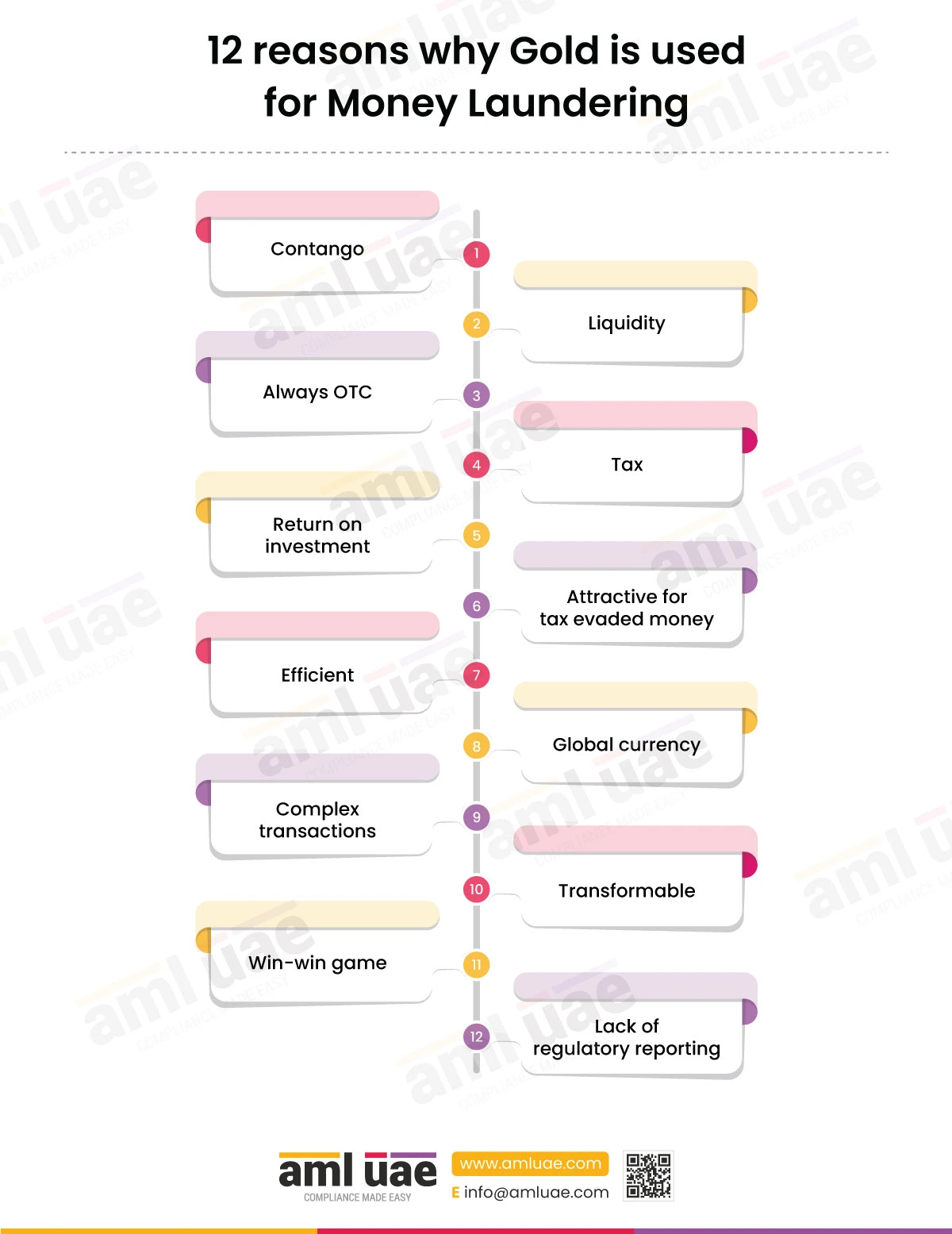
12 reasons why Gold for Money Laundering is used:

1. Contango:

The gold market is mostly in Contango. This means the Future price of gold is greater than the spot price. Even during the downtimes, gold has been the prime choice for commodity trading.

2. Liquidity:

The liquidity of gold is high when compared to other modes of investments like Bank FDs, Stocks & Mutual Funds. Unlike the other investment products, you don't need a bank account to buy or sell gold. Redemption from gold is instant & we can get ready-cash instantaneously.

3. Always OTC:

Gold can be sold anywhere Over the Counter & isn't controlled by any exchange. Unlike markets, you can even sell or buy on weekends too. It is easy to find buyers or sellers for gold rather than stock. Hence they use Gold for Money Laundering.

4. Tax:

There is no tax associated with gold when you go with an investment perspective. The sales tax or VAT is all that you pay.

5. Return on investment:

Unlike Stocks/Bonds, Gold will give reliable returns depending on the market rate.

6. Attractive for tax evaded money:

Money laundering need not necessarily be done for Terrorist financing or illicit proceeds. Sometimes people launder the money that was evaded from tax. This can be rental income, Benami transactions, money coming from Hawala transactions/remittances.

7. Efficient:

Gold can be used in all 3 layers of Money Laundering. Be it Placement or Layering, or Integration.

Stages of money laundering-01

8. Global currency:

Gold is considered a global currency. One can buy or sell gold anywhere around the globe. There is no currency conversion or loss there. One can buy it in the eastern part of the world and sell it in the west without losing the face value.

9. Complex transactions:

The transactions involving the gold or jeweller are too complex to drill down. There might be multiple persons involved on both sides of the transaction.

10. Transformable:

Gold can be changed into many forms (Jewelry) and denominations (Coins / Bars) without losing the face value. This helps money launderers to use gold for Smurfing or Smuggling and many such methods.

11. Win-win game:

The jewellers need gold for trading and manufacturing purposes. So there's always a demand for it. It's a win-win situation for dealers in precious metals and stones, and the money launderer as both of them get to trade for their benefit.

12. Lack of regulatory reporting:

Unlike Banks / FIs, they can keep their transactions under their control. In many countries, there is no periodic submission of Cash transaction report or Suspicious Transaction report. Such a multi-faceted commodity somehow missed the attention of the regulators. Even if it comes to a need for supervision, there will be a question of 'Who will regulate the gold?' Will it be the commodity market? Or the Central Bank? Or the Government?

Related Blogs

Share via :

FAQs on Gold for Money Laundering

Why are precious metals high-risk?

From an AML perspective, precious metals are considered high-risk and associated with ML/FT typologies. Precious metals, owing to their size and value, offer a lucrative market to the money launderers – as they are easy to hide, transport, and hold as investments of their huge illegal funds in small volumes.
Gold carries high value compared to its volume and is considered one of the best mediums to store funds and transport them easily across borders. Further, gold can be easily traded anywhere and anytime, with the realization of the optimal value.
Gold is easy to store and has its value (almost the same) across the globe. Investment in gold offers a higher rate of return than bank rates, as the value of gold is subject to speculation based on the demand and supply of this metal. Moreover, it is considered one of the best hedging tools against inflation.

Share via :

Add Your Heading Text Here

The uses of gold are wide-ranging and well-documented. Since ancient times, gold has been used in various cultures as a medium for exchange or payment. Historically, governments minted coins out of a physical commodity such as Gold, Silver, Copper, and Bronze. In addition to its value as an investment, the physical appearance and properties of gold lend themselves to be used in jewelry and for various technological/manufacturing uses. For example, in many developing countries, gold jewelry is not only perceived as an adornment but also as an effective savings vehicle. Even now, the Gold reserve of the country determines its creditworthiness. Gold stands tall as a status symbol and has a lot of cultural values too. It is also an instrument of investment.
As the financial regulators grow strong and robust, so do the money laundering methods. The inventions and discoveries on money laundering methods and trends never end. Precious metals like Gold, Platinum, and silver were not much on anyone’s radar. So when banks tightened the noose, the money launderers resorted to precious metals like gold and platinum, and real estate, etc., to launder the money.

Using Gold for Money laundering is not a new trend. This comes from history. The BFSI industry is shutting its door one by one, so money launderers will find some new trends or retrofit the old trends. One does not need a tax identity to buy gold. This paves the way for money launderers to use the gold in all 3 layers of Money laundering. Gold seems to be lucrative for all sides of the transaction.

The regulatory authorities identified this trend, and it started monitoring the precious metals sector by bringing it under the preview of the AML law by terming them as Designated Non-Financial Businesses and Professions (DNFBPs).

12 reasons why gold is used for money laundering purposes:

1. Contango:

The gold market is mostly in Contango. This means the Future price of gold is greater than the spot price. Even during the downtimes, gold has been the prime choice for commodity trading.

2. Liquidity:

The liquidity of gold is high when compared to other modes of investments like Bank FDs, Stocks & Mutual Funds. Unlike the other investment products, you don't need a bank account to buy or sell gold. Redemption from gold is instant & we can get ready-cash instantaneously.

3. Always OTC:

Gold can be sold anywhere Over the Counter & isn't controlled by any exchange. Unlike markets, you can even sell or buy on weekends too. It is easy to find buyers or sellers for gold rather than stock.

4. Tax:

There is no tax associated with gold when you go with an investment perspective. The sales tax or VAT is all that you pay.

5. Return on Investment:

Unlike Stocks/Bonds, Gold will give reliable returns depending on the market rate.

6. Attractive for tax evaded money:

Money laundering need not necessarily be done for Terrorist financing or illicit proceeds. Sometimes people launder the money that was evaded from tax. This can be rental income, Benami transactions, money coming from Hawala transactions/remittances.

7. Efficient:

Gold can be used in all 3 layers of Money Laundering. Be it Placement or Layering, or Integration.

8. Global Currency:

Gold is considered a global currency. One can buy or sell gold anywhere around the globe. There is no currency conversion or loss there. One can buy it in the eastern part of the world and sell it in the west without losing the face value.

9. Complex transactions:

The transactions involving the gold or jeweller are too complex to drill down. There might be multiple persons involved on both sides of the transaction.

10. Transformable:

Gold can be changed into many forms (Jewelry) and denominations (Coins / Bars) without losing the face value. This helps money launderers to use gold for Smurfing or Smuggling and many such methods.

The jewellers need gold for trading and manufacturing purposes. So there's always a demand for it. It's a win-win situation for dealers in precious metals and stones, and the money launderer as both of them get to trade for their benefit.

11. Win-win game:

12. Lack of Regulatory Reporting:

Unlike Banks / FIs, they can keep their transactions under their control. In many countries, there is no periodic submission of Cash transaction report or Suspicious Transaction report. Such a multi-faceted commodity somehow missed the attention of the regulators. Even if it comes to a need for supervision, there will be a question of 'Who will regulate the gold?' Will it be the commodity market? Or the Central Bank? Or the Government?

Add a comment

About the Author

Pathik Shah

FCA, CAMS, CISA, CS, DISA (ICAI), FAFP (ICAI)

Pathik is an ACAMS-certified AML consultant specialising in governance, risk, and compliance for regulated entities in the UAE. He brings over 28 years of experience, with 1,000+ hours of AML training and 200+ advisory engagements across DNFBPs, VASPs, and FIs. He supports businesses in aligning with AML/CFT requirements from the CBUAE, DFSA, MoET, MoJ, VARA, CMA, FSRA, and FATF. Known for translating complex regulations into audit-ready procedures, Pathik enables operational clarity and compliance readiness.

Reach Out to Pathik

Importance of AML/CFT measures

important aml cft feature image

Importance of AML/CFT measures

Table of Contents

Protect your business with reliable and effective AML strategies with AML UAE.

Importance of AML/CFT measures

As the world economy is growing and the entire globe is coming together as an integrated society, two vices are trying to take a toll on this society – Money Laundering and Terrorism. Money laundering has been a setback to the global financial system, pumping the illegally generated money into the economy, making it appear to have come from a legitimate source. Such funds generated from criminal activities are used again for multiplying the effect of illegal activities, such as terrorism, and impacting the security and integrity of the countries. The need of the hour is to be resilient against such evils of the society to make it a better place to live, and thus, various countries are coming up with the Importance of AML/CFT measures.

AML/CFT Measures undertaken by various countries

Due to sheer Importance of AML/CFT measures, Singapore Ministry of Law has developed a division under the name of “Anti Money Laundering / Countering Financing of Terrorism,” with whom Cash Transaction Report for suspicious transactions is furnished.

Similarly seeing the Importance of AML/CFT measures, the Australian Government has issued the Anti-Money Laundering and Counter-Terrorism Financing Act in the year 2006, which requires businesses to have a proper program in place to protect the company from financial crimes by timely identification/mitigation of these kinds of risks.

AML/CFT measures undertaken by UAE

The United Arab Emirates is also one such nation amongst the list who understands the Importance of AML/CFT measures, and is devoted to controlling the money laundering activities and financing of terrorism or other illegal activities from there. As a part of this strategy, the UAE government has introduced the regulation “Anti-money laundering and combating the financing of terrorism and illegal organization” and issued the guidelines to enforce the law better.

Compliance. Trust. Transparancy

Get in touch customized and cost-effective AML compliance services to support your business always Compliance. Trust. Transparency.

Designated Non-Financial Businesses and Professions (DNFBPs)

Designated Non-Financial Businesses and Professions (DNFBPs)

If one deep dives into the lawmakers’ intent, one would understand that DNFBPs have been categorized looking at the risk involved in the business or the vulnerability of business towards the criminal activities or the one having access to the suspect’s accounts/ finance details.

If we take the example of auditor, the federal laws regulating the audit profession anyway imposes specific obligations on auditors regarding the reporting of crimes detected during auditing the accounts of clients, as they have access to the books and internal controls.

When it comes to protecting the financial sector from such criminal exploitation, certain businesses and professions could serve as first aid to curb these. With the same thought, under UAE guidelines, class of people/businesses have been defined as Designated Non-Financial Businesses and Professions (“DNFBPs”).

They have been obligated under the law to perform the Due Diligence of their customers and risk profiling. These DNFBPs have been made responsible for reporting the transactions to the authorities, where any suspicion involving money laundering or illegal activities such as financing terrorism, drug trafficking, etc., is doubted.

It is pertinent to know the group of businesses and professions that have been identified as DNFBPs. This list includes the following:

Let’s talk about precious metals and stones. The high intrinsic value of the product vis-a-viz the compact form of the same and the value appreciative nature of such items (gold, silver, diamonds, etc.) make it easy for the money launderers to exploit the sector and fund the criminal activities.

Looking at the nature of business/professions obligated with tasks under anti-money laundering and combating of financing of terrorist activity, it is apparent that the purpose is to trace back such money launderers and check the illegal or criminal activities. For this, it is important to have in place a dependable source of information about the business relationships and transactions. This is pertinent as the money launderers and the persons involved in criminal activities try to hide their identity and camouflage the proposed transactions.

People. Process. Passion.

We ensure ethical, risk-free business growth for you. Hire us to make your journey fruitful.

Responsibilities of DNFBPs

In the context of the responsibilities shouldered on the DNFBPs, it would be treated as an offense if they do not report the suspected transactions (where they doubt the involvement of money laundering or any other criminal act) or tip-off about the transactions reported with the supervisory authorities.

For this, the regulations have suggested specific ways and means to assist the DNFBPs to comply with the guidelines and discharge their obligations of reporting the suspicious transaction in a fair method, such as:

Thus, the law revolves around adequate measures for identifying customers and risk assessment to evaluate the cause for concern and report the same to apt Governmental authorities for necessary proceedings against the felonious person.

FAQs On Importance of AML/CFT measures

What is the purpose of AML/CFT regulations?

AML/CFT regulations are essential to fight financial crimes – money laundering and terrorism financing – to ensure the integrity of the society and stability of the country’s financial system and the whole world, mitigating the adverse effect of such crimes on society. Having AML/CFT measures as regulations would mandate the country’s ordinary people to join this fight.
AML/CFT requires the designated entities to implement countermeasures to fight against money laundering and terrorism financing, such as implementing the robust AML/CFT compliance framework, verifying a person’s identity before transacting, staying alert to any red flags, timely reporting of suspicious activities, etc.
 
Combatting terrorism financing is critical as it facilitates funds to the terrorist group for their operations, propaganda, etc., which ultimately impacts global peace and threatens society. It also results in the rise of other criminal activities like human trafficking, the use of narcotics, etc. Thus, CFT becomes pertinent to prevent incidences of terrorism.
Having robust AML guidelines in place would leverage a country in fighting financial crime with the united support of fellow citizens. Further, predefined guidelines will clearly lay down the government’s intention, ensuring that the prescribed best practices to fight money laundering are followed consistently across the nation.

Add a comment

Share via :

About the Author

Pathik Shah

FCA, CAMS, CISA, CS, DISA (ICAI), FAFP (ICAI)

Pathik is an ACAMS-certified AML consultant specialising in governance, risk, and compliance for regulated entities in the UAE. He brings over 28 years of experience, with 1,000+ hours of AML training and 200+ advisory engagements across DNFBPs, VASPs, and FIs. He supports businesses in aligning with AML/CFT requirements from the CBUAE, DFSA, MoET, MoJ, VARA, CMA, FSRA, and FATF. Known for translating complex regulations into audit-ready procedures, Pathik enables operational clarity and compliance readiness.

Reach Out to Pathik