
Risk Radar: Spotting ML/TF Red Flags in Precious Metals and Stones Business

Risk Radar - Spotting MLTF Red Flags in Precious Metals and Stones Business pre

Risk Radar: Spotting ML/TF Red Flags in Precious Metals and Stones Business

Risk Radar: Spotting ML/TF Red Flags in Precious Metals and Stones Business

Precious metals (like gold, platinum, silver) and precious stones (such as diamonds, ruby, pearls, etc.) have been associated with money laundering, being exploited by financial criminals owing to their inherent characteristics like small in size, easy portability, global acceptance as a medium of exchange, etc.

Understanding the red flags connected with these precious metals and stones to spot the potential risks and prevent the same promptly. The Dealers in Precious Metals and Stones must watch out for the risk indicators while onboarding a customer or in the course of the ongoing business relationship and identify unusual trends or inconsistent customer behaviour suggesting suspicion.

Here is an infographic capturing some key ML/FT red flags that a Dealer in Precious Metals and Stones must be aware of and cautious about.

AML UAE is an AML consultancy service provider, offering end-to-end AML support to regulated entities, including Dealers in Precious Metals and Stones, in assessing the overall business risk, customizing the AML/CFT Program to identify and mitigate the risk and stay AML compliant.

Related Posts

Exploring unusual transaction trends for VASPs under UAE AML Regulations

Exploring unusual transaction trends for VASPs under UAE AML Regulations

Pathik Shah

Table of Contents

Protect your business with reliable and effective AML strategies with AML UAE.

Exploring unusual transaction trends for VASPs under UAE AML Regulations

With the growing acceptance of virtual assets (used to store the value, medium of exchange, for investment purposes, etc.), criminals have also started exploiting the sector for laundering illicit funds and financing terrorist activities. The launderers’ preference towards cryptocurrency and non-fungible tokens (NFTs) is owing to the nature of the product – easy to transfer across countries within a few seconds, and that too without disclosing the identity in most cases. This calls for the Virtual Asset Service Providers (VASPs) to stay alert to detect unusual trends or suspicious virtual asset transactions indicating the use of criminal proceeds or intended to conduct a financial crime.

For the same reason, the VASPs have been put under anti-money laundering (AML) regulatory regime, mandating the VASPs to develop and implement appropriate AML programs to curb the potential vulnerabilities.

This article will discuss the unusual activities involved in virtual assets, the financial crime red flags for VASPs, and the best practices that a VASP may adopt to detect and manage financial crime risk.

Identifying Unusual Transaction Patterns

Generally, the Virtual Asset Service Providers are entities conducting activities related to virtual assets in the course of routine business activities, which involve conversion of the virtual assets to fiat currencies or vice versa, transferring virtual assets from one wallet to another, providing virtual asset custodial services, etc.

The UAE AML regulations mandate the VASP to implement a comprehensive AML compliance program to combat money laundering and terrorist financing by deploying solid processes and systems to identify and prevent financial crime attempts involving crypto and NFTs. Given the vast volume and the pace of transactions, the VASPs must continuously monitor and report any unusual activities related to virtual asset transfers suggesting potential financial crime.

The VASPs must understand some common characteristics indicating the virtual asset transaction to be a potential risk of financial crime, and the monitoring rules and systems must be designed bearing these characteristics in mind to ensure timely identification and curbing of unusual transactions.

Some of the Common Characteristics of Unusual Transactions related to Virtual Assets

The following are some of the unusual transaction patterns related to virtual asset transfer that can serve as the key risk indicators for VASPs:

Persons attempting to avoid Customer Due Diligence requirements or providing false information

The person who tries to avoid the Customer Due Diligence process conducted by the VASP to evade the identification or the person who provides fake documents or false identification information is one of the biggest red flags that require the VASP to take immediate action.

Understand the types of CDD measures to effectively mitigate the ML-FT risks 

Large-value transactions without any apparent economic purpose

One of the risk indicators is that the person is making a large value transfer of virtual assets to one or multiple wallets without any logical or legal rationale. Such transactions require detailed inquiry from the VASPs to understand the actual intention and purpose of the transactions.

Person making multiple large-value virtual asset transfers in a short period

VASPs must stay alert when the person initiates multiple virtual asset transfers of large amounts within a short span of time. The investigation must be conducted to determine the source of funds for virtual assets and the beneficiaries to whom the transfers are made.

Frequent movement of funds between two virtual asset wallets

Rapid virtual asset movement from one wallet to another and vice versa can be construed as an unusual transaction intended to create multiple layers to disguise the origin of the funds and the owner.

Transactions with counterparties in high-risk countries or jurisdictions with weak AML controls over VASPs

Frequent transactions with counterparties in countries with no or weak AML regulations or countries known for money laundering can be treated as suspicious transactions, warranting examination by the VASP.

Virtual asset transfers to known criminals or involving the dark web

One of the critical risk indicators suggesting the transfer to be unusual is when the parties involved are known to have criminal connections or the transfers are routed using the dark web marketplaces.

Conversion of one type of cryptocurrency to multiple virtual assets

Frequent conversion of large amounts of one type of cryptocurrency into multiple virtual assets within a short period suggests a suspicious pattern of transactions.

Conversion of fiat currency to virtual asset and immediate withdrawal in another jurisdiction

With the easy conversion process of fiat to crypto, the launderers have started converting the illegal cash into virtual assets in one country, followed by immediate withdrawal of such virtual assets into fiat in some other jurisdiction. This is one of the nature of unusual activities, specifically when such other jurisdiction is under the “high-risk” category.

Exploring unusual transaction trends for VASPs under UAE AML Regulations

Managing the Unusual Transactions related to Virtual Asset transfer

The UAE AML regulatory regime requires the VASP to establish and maintain robust monitoring systems and controls that can effectively detect suspicious activities and generate timely alerts for the VASP to act and prevent.

Considering the volume and nature of virtual asset transactions, the VASP must consider deploying emerging technologies and tools like Artificial Intelligence, Machine Learning, or Blockchain that use advanced algorithms and data analytics techniques to identify inconsistencies and unusual patterns.

Best AML Practices for VASPs to Detect and Report Unusual Transactions Related to Virtual Assets

A. Adopting a Comprehensive AML Program

The primary AML responsibility of any VASP operating in the UAE is to assess the potential financial crime vulnerabilities it may face and accordingly design the AML Compliance Program. The AML framework must include the AML policies and procedures navigating and guiding the VASP to manage financial crime exposure and prevent money laundering, terrorist financing, and financial crimes damaging the virtual asset ecosystem.

These AML policies and procedures must include the following:

In addition to the above, the AML program must lay down the procedures and controls around continuous monitoring of the transactions to track the legitimacy, accuracy, accuracy, and consistency of the virtual asset transfer with the originators and the beneficiary’s risk profile. The monitoring program must consider factors like the nature of the customer, location, risk rating of the person, etc.

These AML frameworks – policies, procedures, and controls- serve as a foundation for the VASP’s AML compliance structure, shielding the virtual asset industry from being misused by money launderers and other financial criminals.

Checklist for implementing an effective AML Program

B. Leveraging the technology to reinforce the AML program

Ongoing and real-time transaction monitoring is essential to identify unusual transactions or customer behavior inconsistent with their profile. Managing large transfers, where millions of virtual assets are exchanged in a second, would not be possible without utilizing automated systems that support data analysis, detect anomalies, and highlight the same to the concerned person for due inquiry and resolution.

The solution for real-time monitoring must handle enormous amounts of data and be compatible with blockchain technology. This will allow the VASP to stay ahead of the criminals and possibly prevent the exploitation of the virtual assets before concluding the transfer.

The system must be configured to manage the VASP’s specific risks, using logical monitoring rules based on threshold amount, frequency of transactions, the wallets involved, detection of blacklisted wallets or restricted cryptocurrencies, high-risk jurisdictions, etc.

The tools should not be restricted to detecting red flags or inconsistencies, but the intelligent algorithms should help the VASP to predict the trends and risk vulnerabilities that may impact the operations in the near future. This will enable the VASP to adopt a proactive approach to get ready to fight financial crime.

Thus, the role of technology in monitoring transactions to identify unusual transactions and suspicious patterns cannot be overruled. Only by leveraging the automated tools and techniques supporting real-time monitoring can the VASPs strengthen the quality of their AML program to timely identify uncommon and suspicious activities and maintain integrity and transparency in the virtual asset domain.

With AML UAE, enhance your AML program to shoot down the suspicious activities

Awareness of the red flags and risk indicators related to virtual assets is essential to detect unusual transactions and suspicious patterns suggesting money laundering. Leverage the experience and knowledge of AML UAE’s professionals in building a robust AML program customized to VASP-specific risks. We help VASPs develop the AML controls ongoing monitoring rules, define the red flags that trigger prompt signals, and are backed by our support in identifying and implementing the right tools and software.

Let’s come together and safeguard the virtual assets industry.

Make significant progress in your fight against
financial crimes

With the best consulting support from AML UAE.

Share via :

About the Author

Jyoti Maheshwari

CAMS, ACA

Jyoti has over 11 years of hands-on experience in regulatory compliance, policymaking, risk management, technology consultancy, and implementation. She holds vast experience with Anti-Money Laundering rules and regulations and helps companies deploy adequate mitigation measures and comply with legal requirements. Jyoti has been instrumental in optimizing business processes, documenting business requirements, preparing FRD, BRD, and SRS, and implementing IT solutions.

Reach Out to Jyoti

AML Compliance Framework with adequate Transaction Monitoring Rules

AML Compliance with robust Transaction Monitoring Rules

AML Compliance with robust Transaction Monitoring Rules

The Transaction Monitoring program is one of the critical aspects of a practical AML Compliance framework, focused on continuous review of the financial transactions and the customer’s profile to identify any suspicious or unusual activities or customer behaviour. To enhance the efficiency of the transaction monitoring program, it is essential that the regulated organization design and implement the relevant monitoring rules aligned with the organization’s overall ML/FT business risk.

Transaction monitoring is essential to ensure that the transactions the customers are executing are normal and reasonable to the customer’s profile and the nature of business activities they are involved in, including the legitimacy of the transactions.

Monitoring rules must be defined considering the regulated organization’s customer base, the jurisdictions in which it operates, and its customers are hailing from, the peculiarities of the transactions, etc.

Here is an infographic highlighting the significance of the transaction monitoring program and some primary methods for developing the monitoring rules.

AML UAE is an AML consultancy firm providing a comprehensive range of AML services to clients in the UAE – whether Financial Institutions, VASPs, or DNFBPs. We assist the regulated entities in developing robust AML/CFT policies, procedures, and controls, including identifying the right AML Transaction Monitoring system and customizing the monitoring rules and logics to detect suspicious transactions and customer behaviours.

Related Posts

Dubai International Financial Centre (DIFC) Entities Subject to AML Compliance

Dubai International Financial Centre (DIFC) Entities Subject to AML Compliance

Dubai International Financial Centre (DIFC) Entities Subject to AML Compliance

Dubai International Financial Centre (DIFC) Entities Subject to AML Compliance

The Dubai International Financial Centre (DIFC) is the world’s one of the most popular financial centers, where thousands of international businesses, including banks and financial institutions, function. The designated entities operating in the DIFC are subject to AML compliance, including effective implementation of the proper measures as prescribed under DFSA issued AML Rulebook to fight money laundering and terrorist financing.

The below-added entities are subject to AML compliance:

  • Authorised Firm: When you are engaged in financial activities such as accepting deposits, providing credits, and managing assets, you fall under this category. Besides that, if the business carries out insurance contracts, operates a representative office, and provides trust-related services, they are also considered an authorised firm subject to AML compliance.
  • Authorised Market Institution (AMI): If you operate an exchange or clearing house or an alternative trading system, you are an AMI.
  • Designated Non-Financial Business and Professions (DNFBP): DNFBPs are subject to AML compliance owing to their connection with ML/TF typologies. To mitigate this risk, DNFBPs such as real estate developers and agents, dealers in precious metals or precious stones, people engaged in NFT-related services, lawyers and law firms, accounting firms, and company service providers must follow all AML compliance rules and regulations.
  • Registered Auditor: Registered auditors who conduct the audit of or prepare an opinion on financial statements and compliance with DFSA regulations of various people and entities are also subject to AML compliance.

DIFC entities are regulated by the Dubai Financial Services Authority (DFSA). DFSA has issued AML/CFT laws and regulations to guide the DIFC entities around identifying and mitigating financial crime risks. It is essential for all the entities and professionals mentioned above that they follow the AML rulebook issued by DFSA.

AML UAE is one of the top anti-money laundering consultants in the UAE. We have an in-depth understanding of DIFC AML laws and how to implement them for various entities. 

Related Posts

Exploring the ML/FT risk indicators associated with Real Estate Sector

The MLFT risk indicators associated with Real Estate Sector

Exploring the ML/FT risk indicators associated with Real Estate Sector

Exploring the ML/FT risk indicators associated with Real Estate Sector

The Real Estate sector has always been highly attractive amongst financial criminals to route their illegal proceeds, be it during the placement, layering, or integration stage of the money laundering process. Awareness of these risk indicators is essential to detect and prevent potential real estate vulnerabilities timely.

Here is an infographic capturing some of the common red flags suggesting the involvement of criminal proceeds.

AML UAE is an end-to-end AML consultancy service provider, assisting the AML regulated entities, including real estate brokers and agents, in assessing the ML/FT risks and customizing the AML/CFT policies and procedures to timely identify the red flags and report the same.

Stay aware, and stay compliant!

Related Posts

Sanctions Compliance by VASPs in UAE: Safeguarding the Virtual Asset segment against financial crimes

Sanctions Compliance by VASPs in UAE: Safeguarding the Virtual Asset segment against financial crimes

Pathik Shah

Table of Contents

Protect your business with reliable and effective AML strategies with AML UAE.

Sanctions Compliance by VASPs in UAE: Safeguarding the Virtual Asset segment against financial crimes

The overall Anti-Money Laundering compliance landscape covers implementing measures to comply with the Sanctions regime. Even the UAE AML regulations mandate the regulated entities to screen the customers, suppliers, and the Ultimate Beneficial Owners against the Sanctions List. This regulatory obligation applies to Virtual Asset Service Providers (VASPs) operating in UAE to manage the risk of sanctions violations through crypto transactions.

Let us explore the Sanctions compliance requirement under the UAE regulations, why is sanctions compliance by VASPs so significant, and how VASPs can ensure effective compliance with the Sanctions regime.

Sanctions Compliance under UAE AML framework

Sanctions are the restrictions or embargoes imposed upon known criminals engaged in terrorist activities or other serious crimes from accessing the financial systems or particular products or services. In this context, sanction compliance becomes pertinent to ensure that the businesses do not engage with the sanctioned entities or individuals, ensuring they safeguard themselves from financial misuse and avoid penalties for sanctions violations.

Under the UAE AML/CFT regulations, Sanctions compliance is integral to the AML/CFT program. The regulated entities are mandatorily required to screen the customers, suppliers, and Ultimate Beneficial Owners (UBOs) of the corporate customers/suppliers, employees, and any third party associated with the business against the following lists:

In addition, the regulated entities must conduct screening against the relevant international lists when a foreign country or global economy is involved.

Basis the screening outcome, the regulated entities must take specific actions and file an appropriate report on the goAML portal.

With this basic idea about the Sanctions regime prevalent in the UAE, let us explore the sanctions compliance obligations of a VASP in the UAE.

Sanctions compliance by VASP in UAE

As the VASPs are subject to AML compliance in the UAE, they must also implement an effective sanctions compliance program. Sanctions compliance is necessary for the VASPs to ensure the virtual assets are not exploited by the sanctioned or designated persons to conduit terrorist financing or money laundering activities.

Subscribing to EOCN Notification System:

The regulated entities, including the VASPs, are required to subscribe to the Executive Office for Control & Non-Proliferation (EOCN) to receive regular updates on the modification in the UAE Local Terrorist List and the UNSC Consolidated Sanctions List, i.e., intimation when any person is added in the lists, or de-listing of any individual, entity, or group on the lists.

Screening:

Given the fact that virtual assets transfer sees no geographical boundaries, the VASPs must not only screen the originator and the beneficiaries against the local sanctions list but also consider the country-specific and all other international sanctions.

The VASP must screen the originator’s and beneficiary’s virtual asset wallet ID to identify if any sanctioned or blacklisted wallets are involved in the proposed transfer.

The screening is not a one-time affair; instead, it must be carried out on an ongoing basis to timely identify any update to the sanction status of an existing customer or virtual asset wallet. This will ensure timely action against the designated person or wallets.

Basis the hits found in the sanctions screening, the UAE Targeted Financial Sanctions (TFS) regime mandates the regulated entities, including VASP, to undertake specific actions.

Actions:

  • In the case of a “Confirmed Match,” all the identifying information about the person, entity, or group matches with the key identifiers (name, date of birth, nationality/country of incorporation, etc.) of the designated person mentioned in the sanctions list. For confirmed match cases, the VASP must freeze the virtual assets available in the designated person’s wallet with VASP and shall terminate the business relationship. While in a confirmed match for a potential customer, the VASP must reject the virtual asset transaction. These freezing or rejection measures must be taken within 24 hours of identifying the persons as sanctioned.
  • However, in cases where all the key identifiers are not matching, or some of the information is missing but indicates a possibility of a matching basis, the partial name match, which the VASP cannot decide whether it is a confirmed match or false match, then in such cases, the VASP must suspend the transactions and the business relationships with such partial name match person. The VASP must continue such suspension unless any specific instructions are received from the EOCN.
  • In cases where VASPs cannot decide whether it is Confirmed Match or False Positive and the said customer is existing one then VASPs must Suspend the transactions and services without any delay, and submit a PNMR through goAML within Five calaneder days from the day of suspension measures.
  • However in cases where Partial Name Match is identified on Potential Customer, then VASPs must obtain additional ID Documents within 10 business days to ascertain whether the match is Confirmed Match or False Positive and then implement TFS measures based on the screening results. 
  • If VASPs is unable to obtain ID Documents within 10 business days from the potential customer then it must reject the business relationship and file a PNMR via goAML within Five calender days.
  • In case if VASPs receives the ID Documents after the 10 days timeframe and PNMR is already reported, then it must consider it as a new transation, undertake screening on newly obtained ID Documents and based on the screening result, take the requisite steps and file a new report.

Reporting:

Where the VASP identifies any confirmed or partial name match with the UAE Local Terrorist List or the UNSC Consolidated List, the VASP must report the same to the EOCN by filing the appropriate report on the goAML Portal. VASP must file a Confirmed Name Match Report (CNMR) in case of a ‘confirmed match’ giving the details of virtual assets frozen and a Partial Name Match Report (PNMR) for a ‘partial name match’ case within 5 days from taking the abovementioned actions.

The VASP must ensure compliance with all the above 4 points to effectively implement the Targeted Financial Sanctions regime and maintain the integrity of the virtual asset world.

Sanctions Compliance by VASPs in UAE: Safeguarding the Virtual Asset segment against financial crimes

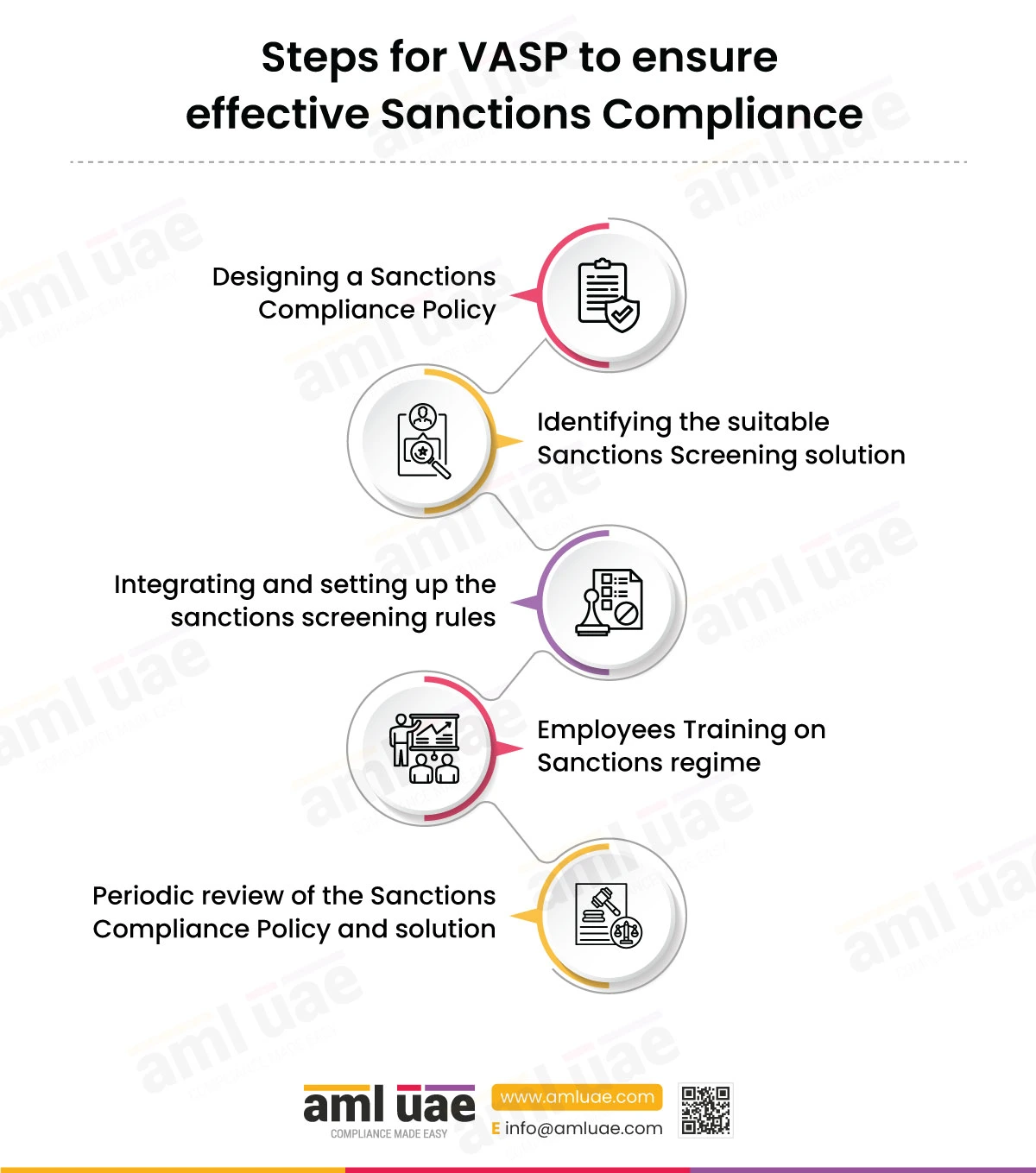
Step-by-Step Guide for VASP to ensure effective Sanctions Compliance

With the pace at which the virtual asset transfer occurs and the fact that the sanctions lists are updated regularly, the VASPs must follow a systematic approach to implement a robust Sanctions Compliance Program.

1. Designing a Sanctions Compliance Policy:

As a first step, the VASP’s management and the AML Compliance Officer must understand the sanctions compliance requirement to be adhered to and design a comprehensive Sanctions Compliance policy in accordance with the overall business risk and applicable regulations. The Sanctions Compliance Policy must clearly define the mandatory nature of undertaking sanctions screening, systems and controls required, actions to be taken by the team when matches are found (including review, freezing of funds, or termination/suspension of the business relationship, etc.) and the goAML reporting obligation.

Further, as part of the policy, the VASPs must also identify what sanctions lists would be screened.

2. Identifying the suitable Sanctions Screening solution:

Once the compliance requirements are identified, the VASP must look for an appropriate sanctions screening solution that supports the regulatory obligation and prevents the misuse of the crypto-assets.

While selecting the solution, the VASP must consider the following:

  • What all sanctions lists does the tool support
  • Form where is the sanctions database sourced (third-party data aggregator or directly from the official sources)
  • How frequently this database is updated
  • Can this system be integrated with the VASP’s online platform
  • Does the platform support continuous screening
  • Is the solution capable of supporting real-time screening
  • Does the screening tool capable of handling large volumes of data
  • Does the solution use AI or emerging technology to reduce the false positive hits
  • Is the solution compliant with the data privacy and security requirements

3. Integrating and setting up the sanctions screening rules:

Once the tool is finalized, the same must be integrated seamlessly with the VASP’s internal systems and platform to ensure that the screening is conducted on a real-time basis before the virtual asset transfer actually takes place so that transactions involving any potential hits or confirmed matches can be blocked.

The VASPs must define the screening criteria and rules basis which the screening would be conducted. This includes defining the parameters or identifiers for screening (such as originator/beneficiary name, virtual asset wallet ID, type of virtual asset transferred, location, etc.

The workflows for managing the screening results must also be configured, i.e., how the hit alerts would be generated, who would review the matches found, and conclude on the type – confirmed match, partial name match, or false hit.

4. Employees Training on Sanctions regime:

The strength of the technology deployed for screening is ineffective unless the VASP’s team is well-trained on sanctions compliance measures and how to implement the screening solution. The AML Compliance Officer must ensure that the relevant staff, specifically front-line employees, are educated on the significance of the sanctions regime, how to conduct sanctions screening, and what actions are expected from the particular role. The VASP must ensure the team stays updated with the evolving sanctions framework and emerging technologies deployed for sanctions compliance.

5. Periodic review of the Sanctions Compliance Policy and solution:

It is pertinent for VASP to ensure that the policy designed and the tools implemented are aligned with the ever-changing regulatory landscape and the emerging red flags and typologies. The overall sanctions program must be reviewed to identify gaps and enhance the procedures and controls for avoiding any unknowingly business dealings with sanctioned persons or sanctions non-compliance penalties.

With an organized approach to implementing sanctions compliance, the VASPs can mitigate the risk of facilitating sanctions violations, protect their reputation by demonstrating the commitment to AML/CFT and sanctions compliance.

Let AML UAE assist you with implementing the Sanctions Compliance Program

AML UAE is a leading AML consultancy firm assisting AML-regulated entities, including Virtual Asset Service Providers, in establishing and maintaining a robust AML/CFT compliance program, including a comprehensive framework for implementing the Targeted Financial Sanctions regime. From assessing the sanctions violation risk to identifying the proper sanctions screening solution, we got your back.

Let’s stay compliant and fight back the financial crime!

Make significant progress in your fight against financial crimes,

With the best consulting support from AML UAE.

Share via :

About the Author

Pathik Shah

FCA, CAMS, CISA, CS, DISA (ICAI), FAFP (ICAI)

Pathik is an ACAMS-certified AML consultant specialising in governance, risk, and compliance for regulated entities in the UAE. He brings over 28 years of experience, with 1,000+ hours of AML training and 200+ advisory engagements across DNFBPs, VASPs, and FIs. He supports businesses in aligning with AML/CFT requirements from the CBUAE, DFSA, MoET, MoJ, VARA, CMA, FSRA, and FATF. Known for translating complex regulations into audit-ready procedures, Pathik enables operational clarity and compliance readiness.

Reach Out to Pathik

Countering the Proliferation Financing: Concept and Mitigation Measures

Countering the Proliferation Financing

Countering the Proliferation Financing: Concept and Mitigation Measures

Countering the Proliferation Financing: Concept and Mitigation Measures

In the segment of Financial Crime, Proliferation Financing is an emerging threat, adversely impacting the security of society and the economy.

The Proliferation of Weapons for Mass Destruction (WMD) covers any support for manufacturing, transporting, acquiring, etc., of any biological, nuclear, or chemical weapons or the associated dual-use goods intended for illegal purposes. Any financial aid about the WMD proliferation – whether by way of raising funds, storing or moving funds, including assistance around the delivery of the WMD-connected dual-use goods would be tantamount to Proliferation Financing.

The UAE AML regulations also cover measures to combat proliferation financing (PF). The regulated entities must assess the PF risk and deploy adequate procedures and controls to mitigate these risks. These measures should include the following:
– implementing the Target Financial Sanctions regime and complying with the sanctions screening requirement
– Inquiring about the customer’s business activities and understanding the end-users of the customer’s products/services
– If required, the regulated entities must also evaluate the customer’s compliance status with TFS requirements (for example, by reviewing the customer’s TFS policies)
– When any PF risk is observed, senior management approval must be sought before establishing a business relationship with such customer

The infographic here elaborates on the concept of the Proliferation of Weapons for Mass Destruction and PF, including the measures required to counter the proliferation financing.

AML UAE is a leading AML Consultancy firm, assisting businesses in developing and maintaining a robust program to identify and prevent financial crime risks, including the framework to manage the proliferation financing risks. With the customized AML/CFT/CPF policies and procedures, let’s effectively combat these risks and safeguard the integrity of the financial systems.

Related Posts

Enhanced Due Diligence by Dealers in Precious Metals and Stones: EDD for High-Risk Customers

Enhanced Due Diligence by Dealers in Precious Metals and Stones

Pathik Shah

Table of Contents

Protect your business with reliable and effective AML strategies with AML UAE.

Enhanced Due Diligence by Dealers in Precious Metals and Stones: EDD for High-Risk Customers

Precious metals like gold, silver, platinum, and precious stones such as diamonds, sapphires, pearls, etc., are highly vulnerable to money laundering and terrorism financing. The Dealers in Precious Metals and Stones (DPMS) must implement Enhanced Due Diligence (EDD) measures to manage the increased financial crime risks arising from high-risk countries or transactions.

Owing to the following inherent characteristics of the precious metals and stones, the products are closely associated with ML/FT typologies and bring the DPMS under the ambit of UAE AML regulations:

  • Small size, high value
  • Easy to transport
  • Used as a store of value
  • Can be used as a medium of exchange
  • Is acceptable in most parts of the world
  • Retains value and is subject to lesser value fluctuation

The UAE AML regulations mandate that Dealers in precious Metals and Stones adopt adequate Customer Due Diligence (CDD) measures to manage the ML/FT risks. The DPMS is required to implement enhanced customer due diligence measures when the customer is identified as high-risk.

In this article, we will navigate Enhanced Due Diligence under UAE AML regulations and how dealers in precious metals and stones can implement the EDD measures.

Enhanced Due Diligence measures under UAE AML Regulations

Understanding the concept of Enhanced Due Diligence as per UAE’s AML regulatory landscape?

Enhanced Due Diligence is essential to the overall AML Compliance Program in a Dealer in Precious Metals and Stones. EDD is a subsection of the Customer Due Diligence process, mandatory to be adhered to when dealing with high-risk customers.

Customer Due Diligence is implemented to identify the customer and its beneficial owners and verify their identity to ensure that the company, knowingly or unknowingly, does not expose itself to financial crime. In this CDD process, the customer’s risk is also assessed, and appropriate risk categorization is done (either as High, Medium, or Low) by performing Customer Risk Assessment. During such a process, if the customer’s risk is assessed to be high, the dealers in precious metals and stones need to deploy some additional checks and verification measures to mitigate the increased risk. This process of applying additional measures to the customer or business relationship is called “Enhanced Due Diligence.”

Understand the types of CDD measures to effectively mitigate the ML-FT risks 

What are the circumstances when EDD measures are to be applied?

EDD is adopted when the business relationship, customer, or transaction is identified as posing higher money laundering or terrorism financing risks to the business. Such situations may include:

  • Business relationship with a Politically Exposed Person (PEP)
  • When the customer is associated with a high-risk country
  • When the customer is coming from a jurisdiction having a weak or minimal AML/CFT regulatory framework
  • Transaction with a customer closely connected with a country notorious for money laundering or terrorist financing activities
  • When there is doubt about the accuracy or legitimacy of the information about the customer obtained earlier
  • When any ML/FT risk indicator or red flag is observed
PEP and PEP Screening under UAE AML Regulations pre

What measures must the Dealers in Precious Metals and Stone adopt as part of the Enhanced Due Diligence?

Enhanced Due Diligence is not just restricted to the basic identification of the customers and the beneficial ownership but goes one step ahead of the standard CDD process. Under EDD, the DPMS is expected to implement the following additional measures to manage the higher ML/FT risks:

Additional information and verification measures

Rigorous identity verification measures should be adopted, such as getting certified copies of the documents and verifying them against independent databases.

The dealers and precious metals and stones must make additional efforts to collect more information about the customer, such as looking out for adverse media or negative news about the person. An additional inquiry must be made around the customer’s intended purpose of the business relationship and the nature of the transaction.

Inquiry about the Customer’s Source of Funds and Wealth

Since precious metals and stones are high-value items, the DPMS must inquire about the customer’s source of funds for the proposed transaction. Further, to determine the customer’s financial position, the DPMS must seek information about the customer’s source of wealth to determine whether the value of transactions and the customer’s finances are aligned.

Obtaining the information is not sufficient. The dealer in precious metals and stones should also determine the legitimacy of the declared source of funds and wealth using reliable sources such as the customer’s bank statement, audited financial statement or Balance Sheet, Tax Return, Pay slips or employment contract, etc.

Obtaining senior management approval

Given the increased financial crime risk involved in the business relationship, the UAE AML regulations mandate the DPMS to seek approval from the senior management before establishing such a relationship. Further, management approval must also be obtained when executing a transaction with high-risk customers.

1st payment through customer’s own bank account

When engaging with high-risk customers, the DPMS must have the first payment processed through the customer’s bank account with a bank having similar Customer Due Diligence measures.

This implies that the dealers in precious metals and stones must not execute the first transaction in cash with high-risk customers.

Increased ongoing monitoring

Once high-risk customers are onboarded, it is the regulatory obligation of the DPMS to monitor the customer profile and the transactions pertaining to high-risk business relationships. Such customers must be subject to an increased frequency of CDD information updates (for example, once in six months). Further, the transaction must be closely monitored to ensure that the same is in accordance with the customer’s risk profile and financial information furnished earlier and consistent with the customer’s nature of business activities.

This will help the DPMS identify any suspicious activities or unusual transactions indicating the involvement of financial crime risks.

Undertaking these additional checks and measures during Enhanced Due Diligence will help the DPMS better understand the customers and effectively manage the risk, especially increased ML/FT risks.

Enhanced Due Diligence by Dealers in Precious Metals and Stones

What are the critical elements for implementing Enhanced Due Diligence in the DPMS sector?

For the quality implementation of the Enhanced Due Diligence process, the Dealers in Precious Metals and Stones need to adopt the following components, ensuring effective mitigation of the increased risk and AML regulatory compliance:

Customer Risk Assessment

The DPMS must clearly lay down the guidelines for when the customer shall be classified as high-risk, warranting the application of the EDD measures.

For this, the customer risk assessment methodology must be well-defined, allowing the company to detect the high-risk posing business relationships timely.

Key factors for Customer Risk Assessment under AML regulations

Well-crafted EDD Program

The company must design and maintain a comprehensive Enhanced Due Diligence Program, providing practical guidelines for the compliance team to manage the higher risk of money laundering or terrorism financing. The EDD policy must prescribe the additional information to be sought from the customer, the documents to be obtained, and the resources to be relied upon for independent verification.

The methods and frequency for performing ongoing monitoring of high-risk customers must be well-documented.

EDD Training to the Team

The circumstances requiring the application of the EDD process and the additional measures to be applied must be communicated with the team. Regular training must be conducted to ensure that the team understands the EDD program and can apply necessary checks on a timely basis.

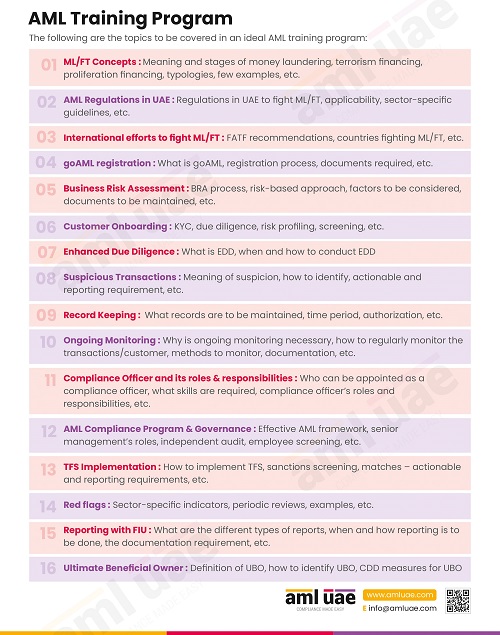
Designing a comprehensive AML Training Program

Potential red flags suggesting higher ML/FT risks when DPMS must apply EDD measures

Given the nature of the products and services involved, the following are some of the risk factors when the Dealers in Precious Metals and Stones must adopt the Enhanced Due Diligence process:

  • When the transaction appears to be complex, involving multiple parties across different locations
  • Customer is a Politically Exposed Person or a close associate
  • When the customer insists on making a payment using cash, even when the transaction value is high
  • Inconsistency between the nature of the customer’s activities and the purpose of the transaction (Non-Profit Organization buying 1 kilogram of gold)
  • When the customer is hailing from or conducting business in high-risk countries
  • Customer making unreasonable request of converting the form of precious metals to ordinary objects
  • Customer making series of small value transactions
  • Payment being routed through an unrelated third-party account

Let AML UAE assist you in implementing the robust Enhanced Due Diligence mechanism to safeguard your precious metals and stones business

Implementing EDD measures in the DPMS sector is pertinent to manage the risk associated with precious metals and stones. AML UAE can assist you in developing the EDD program for your jewellery business, ensuring that you rightly identify high-risk customers and manage these risks with suitable AML measures and controls. We assess your business exposure to financial crime risks and customize the easy-to-implement AML/CFT Compliance framework, focused on detecting and preventing the exploitation of precious metals and stones for financial crime and staying AML Compliant.

Enhance the quality of your AML Program with a comprehensive Enhanced Due Diligence Process!

Make significant progress in your fight against
financial crimes

With the best consulting support from AML UAE.

Share via :

About the Author

Pathik Shah

FCA, CAMS, CISA, CS, DISA (ICAI), FAFP (ICAI)

Pathik is an ACAMS-certified AML consultant specialising in governance, risk, and compliance for regulated entities in the UAE. He brings over 28 years of experience, with 1,000+ hours of AML training and 200+ advisory engagements across DNFBPs, VASPs, and FIs. He supports businesses in aligning with AML/CFT requirements from the CBUAE, DFSA, MoET, MoJ, VARA, CMA, FSRA, and FATF. Known for translating complex regulations into audit-ready procedures, Pathik enables operational clarity and compliance readiness.

Reach Out to Pathik

DNFBPs subject to AML Compliance in the UAE

DNFBPs subject to AML Compliance in the UAE

DNFBPs subject to AML Compliance in the UAE

DNFBPs subject to AML Compliance in the UAE

With increasing financial crime worldwide, the AML/CFT regulations are getting more stringent, bringing in more businesses and professions to identify and prevent money laundering and terrorism financing instances. The AML regulatory landscape in the UAE covers the Designated Non-Financial Businesses and Professions (DNFBPs) directly or indirectly associated with ML/FT typologies or whose professional assistance the criminals generally seek.

The following DNFBPs are covered under the purview of AML Compliance under the UAE AML regulations:
Real Estate Brokers and Agents
Dealers in Precious Metals and Stones (DPMS)
Trust and Company Service Providers (TCSP)
Lawyers, Notaries, and other legal professionals, and
Auditors and Independent Accountants
Gaming Sector

These DNFBPs must adopt a comprehensive AML/CFT framework to identify and manage financial crime risks. This includes developing and maintaining AML/CFT policies and procedures, appointing an AML Compliance Officer, conducting an adequate Customer Due Diligence process before establishing a business relationship with a customer, complying with Targeted Financial Sanctions regime, imparting AML training to the staff, and maintaining strong AML compliance culture in the organization.

The above infographic discusses the designated businesses and professionals qualifying as DNFBPs under UAE AML laws and subject to the AML compliance regime.

AML UAE is the one-stop solution for end-to-end AML consultancy services for DNFBPs in UAE. We assist the DNFBPs in conducting the Enterprise-Wide Risk Assessment and designing the customized AML Compliance Program to manage the assessed business risk. We impart comprehensive AML training to the AML Compliance Officer and the team to ensure the effective implementation of the AML measures.

Let’s fight financial crime!

Related Posts

Checklist for implementing an effective AML Program

Checklist for implementing an effective AML Program

Checklist for implementing an effective AML Program

Checklist for implementing an effective AML Program

The UAE AML regulations require the regulated entities – Financial Institutions, Virtual Asset Service Providers (VASPs), and Designated Non-Financial Businesses and Professions (DNFBPs) to establish and maintain a robust AML Program, focusing on the identification and mitigation of financial crime risks.

An ideal AML program must begin with adequate licensing and registration with the concerned authorities, including registration with the FIU’s goAML portal and appointing a competent AML Compliance Officer.

Further, the AML program should be aligned with the Enterprise-Wide Risk Assessment, and thus, the organization must ensure that its overall business risk assessment is up-to-date. The AML Program must include comprehensive AML Policies, Procedures, and Controls defined in accordance with the applicable AML regulations, adequate Customer Due Diligence processes, including methodology for conducting customer risk assessment, ensuring sanctions compliance, and applying Enhanced Due Diligence measures when dealing with high-risk customer or high-risk transactions.

Internal processes and systems for identification of the ML/FT red flags and their reporting (internal intimation to the AML Compliance Officer and the external reporting to FIU) must also form part of the overall AML Program.

AML governance structure should also be well-defined in the AML program – the AML Compliance Officer’s reporting to senior management, AML training program, implementation of independent AML audit function, etc.

With this checklist, assess the effectiveness of your AML Program and identify the area that needs immediate action to strengthen the same.

AML UAE, a leading AML Consultancy firm in UAE, is at your service to improvise your AML Program’s quality and relevance to identify and manage financial crime risks. We assist regulated entities in assessing the overall ML/FT risk exposure and customize the AML Program – Policies, Procedures, and Controls to mitigate these risks.

Related Posts