


Protect your business with reliable and effective AML strategies with AML UAE.
Last Reviewed On: 08/12/2026 | Last Updated On: 08/12/2026
The Middle East and North Africa (MENA) region has its dedicated and focused FATF-Style Regional Body (FSRB), known as MENAFATF. This blog embarks upon a journey to introduce its members and overserves while providing a glimpse at MENAFATF’s mission, structure, governance, members, observers, and their key role in strengthening the region’s financial integrity.
What is MENAFATF, and Who are its Members and Observers?
In a world highly interlinked with finance, trade, and technology, the risk associated with money laundering (ML) and the financing of terrorism (FT) has grown significantly. These activities pose a threat to economies, global security, and the integrity of financial systems. Recognising the threats posed by money laundering and terrorist financing operations to countries in the Middle East and North Africa Region, the Middle East and North Africa Financial Action Task Force (MENAFATF) stands out as a critical regional body dedicated to combating money laundering (ML) and financing of terrorism (FT).
The countries in the MENA region work conjointly to comply with MENAFATF’s standards that establish an effective system which countries need to implement in a way that does not contradict their cultural values, constitutional frameworks, and legal systems.
Establishment and Background of MENAFATF
MENAFATF was established in Manama, Bahrain, on 30th November 2004 at an inaugural Ministerial Meeting wherein the Governments of 14 countries decided to establish MENAFATF as a FATF Style Regional Body (FSRB).
MENAFATF operates as an independent body, distinct and separate from any other international body and regionally focused organisation which is designed to reflect the unique political, economic and social culture of the region, and follows the model of the Financial Action Task Force (FATF), the global organisation that sets standards for AML/CFT.
Objectives and Functions of MENAFATF
The primary function of MENAFATF is to combat money laundering (ML) and terrorism financing (TF) by promoting regional cooperation and ensuring that the member countries implement effective measures aligned with international standards, particularly the FATF 40 recommendations. MENAFATF Member countries strive towards achieving the following objectives:
- To encourage member nations to set up and implement a comprehensive AML/CFT structure, according to the FATF recommendations, and ensure implementation of relevant UN treaties and agreements and the UNSCRs (United Nations Security Council Resolutions).
- To conduct a mutual evaluation of member nations to assess their adherence to international AML/CFT standards and identify the gaps that need to be taken care of.
- To provide guidance, training, and support to member nations in developing, implementing, and enhancing their legal, regulatory, and institutional AML/CFT structure.
- To facilitate the sharing of information, typologies, and best practices among member nations and international partners.
- To take measures throughout the region to combat money laundering and terrorist financing in a manner that respects the cultural values, constitutional frameworks, and legal systems of the member countries.
MENAFATF Structure And Governance
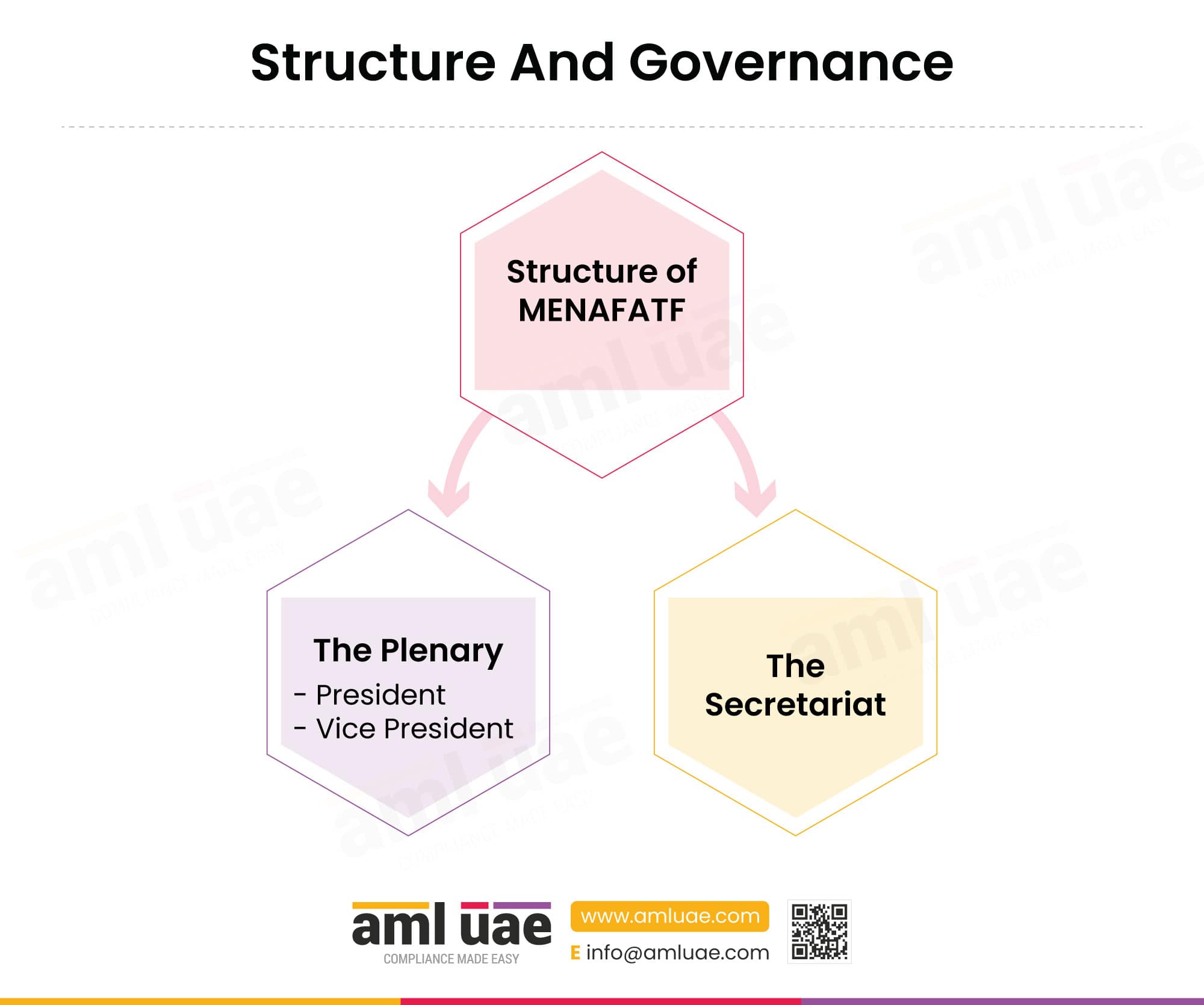
MENAFATF follows a well-defined governance structure that ensures both strategic and operational efficiency. Key components of this structure include two bodies, i.e., the Plenary Meeting of Representatives of member countries, also referred to as the Plenary for the sake of simplicity, and the Secretariat:
The Plenary
The plenary is the decision-making body consisting of the representatives from all member nations. The Plenary meets at least twice a year to discuss policies, approve evaluation reports, and oversee the organisation’s activities. It nominates the President and Vice President among the member countries.
- President and Vice President: The president and vice president are elected among the members for a term of one year. The president and vice president represent the MENAFATF at international forums.
More details about the plenary session are discussed in the following paragraphs.
Secretariat
The Secretariat is responsible for the day-to-day activities of MENAFATF. It is in Bahrain and supports the implementation of plenary decisions, coordinates evaluations, and manages communication with member nations and observers.
The Secretariat performs the following functions:
- Prepare the annual report, work plan, and estimated budget, and submit them to the Plenary.
- provide technical and administrative preparation for convening the plenary, working groups, and any established committees;
- implement and follow up on the work plan as approved by the Plenary;
- Submit regular reports on MENAFATF work to the Plenary and the President.
- manage the expenditure of the approved budget and carry out mutual evaluation exercises;
- Identify the training and technical assistance needs of member states and facilitate the provision of such needs in consultation with these countries.
- Monitor worldwide AML/CFT developments and provide appropriate information to the Plenary;
- carry out any other tasks assigned by the Plenary.
Working Groups
MENAFATF has different specialised working groups that work on areas such as mutual evaluation, typologies, research, technical assistance, and training. These groups help to bring together the experts from member nations to collaborate on specific projects.
Members of MENAFATF
MENAFATF comprises 21 countries from the region of the Middle East and North Africa. Each member is required to implement the FATF 40 recommendations and actively participate in MENAFATF’s activities. The member countries are-

1. Algeria
2. Bahrain
3. Djibouti
4. Egypt
5. Iraq
6. Jordan
7. Kuwait
8. Lebanon
9. Libya
10. Mauritania
11. Morocco
12. Oman
13. Qatar
14. Palestine
15. Saudi Arabia
16. Somalia
17. Sudan
18. Syria
19. Tunisia
20. United Arab Emirates
21. Yemen
Observers of MENAFATF
In addition to the member nations, MENAFATF associates with several observers, including international organisations as well as countries. They participate in MNAFATF’s meetings, provide technical expertise, and contribute to the overall mission of effective regional AML/CFT efforts. The international organisations that are members of MENAFATF are:

1. International Monetary Fund
2. World Bank
3. Co-operation council for the Arab states of Gulf
4. Financial Action Task Force
5. Egmont Group of Financial Intelligence units
6. Asia/Pacific Group on Money Laundering
7. World Customs Organization
8. Arab Monetary Fund
9. Eurasian Group on combating money laundering and financing of terrorism
10. United Nations
11. European Commission
12. Russian Federation
The countries that are the observers of MENAFATF are:
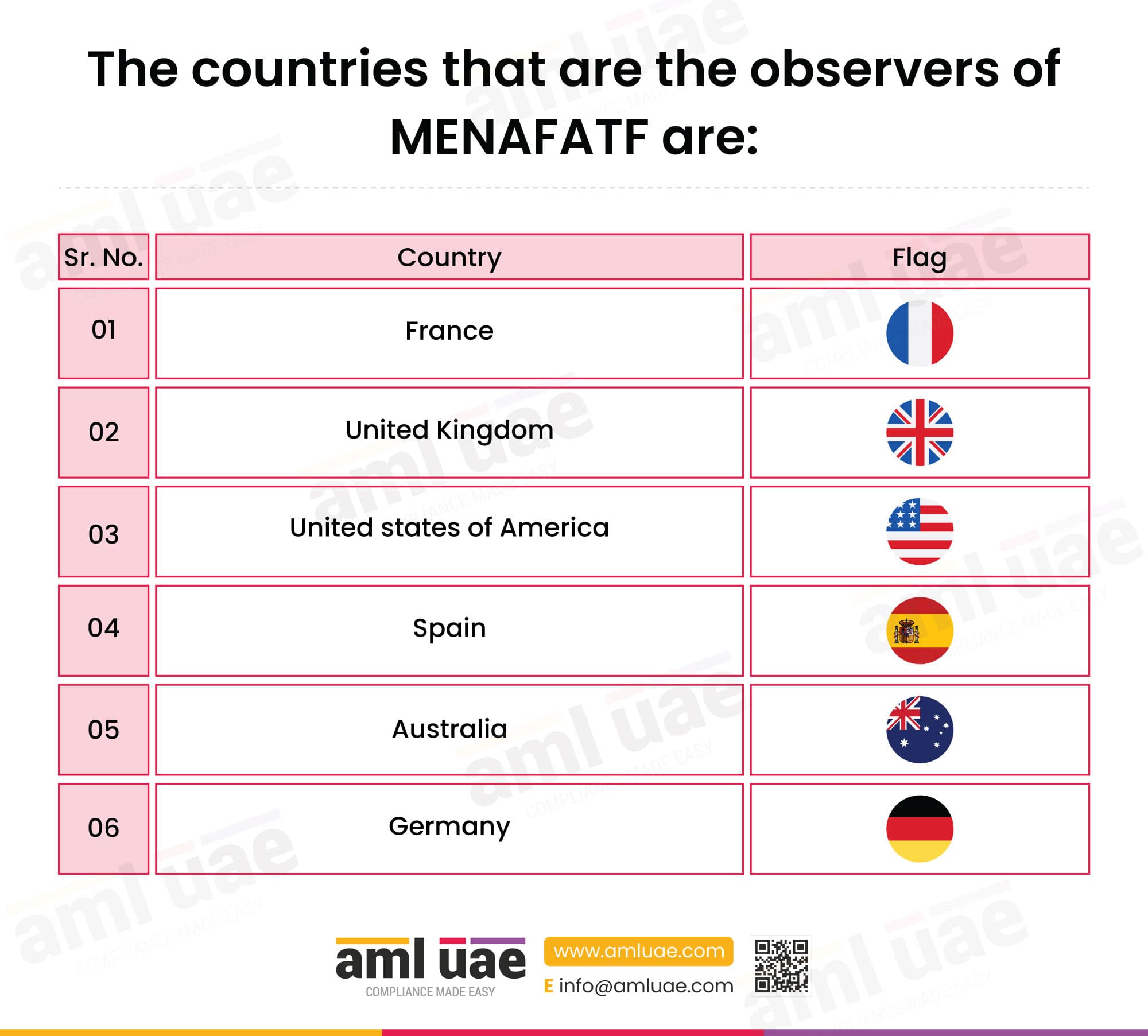
1. France
2. United Kingdom
3. United states of America
4. Spain
5. Australia
6. Germany
The countries listed above often have bilateral partnerships with MENAFATF members and play a significant role in international AML/CFT initiatives.
Key Activities and Achievements of MENAFATF
Over the past few years, MENAFATF has made key progress in enhancing the AML/CFT framework across the region. The key activities and achievements of MENAFATF are:
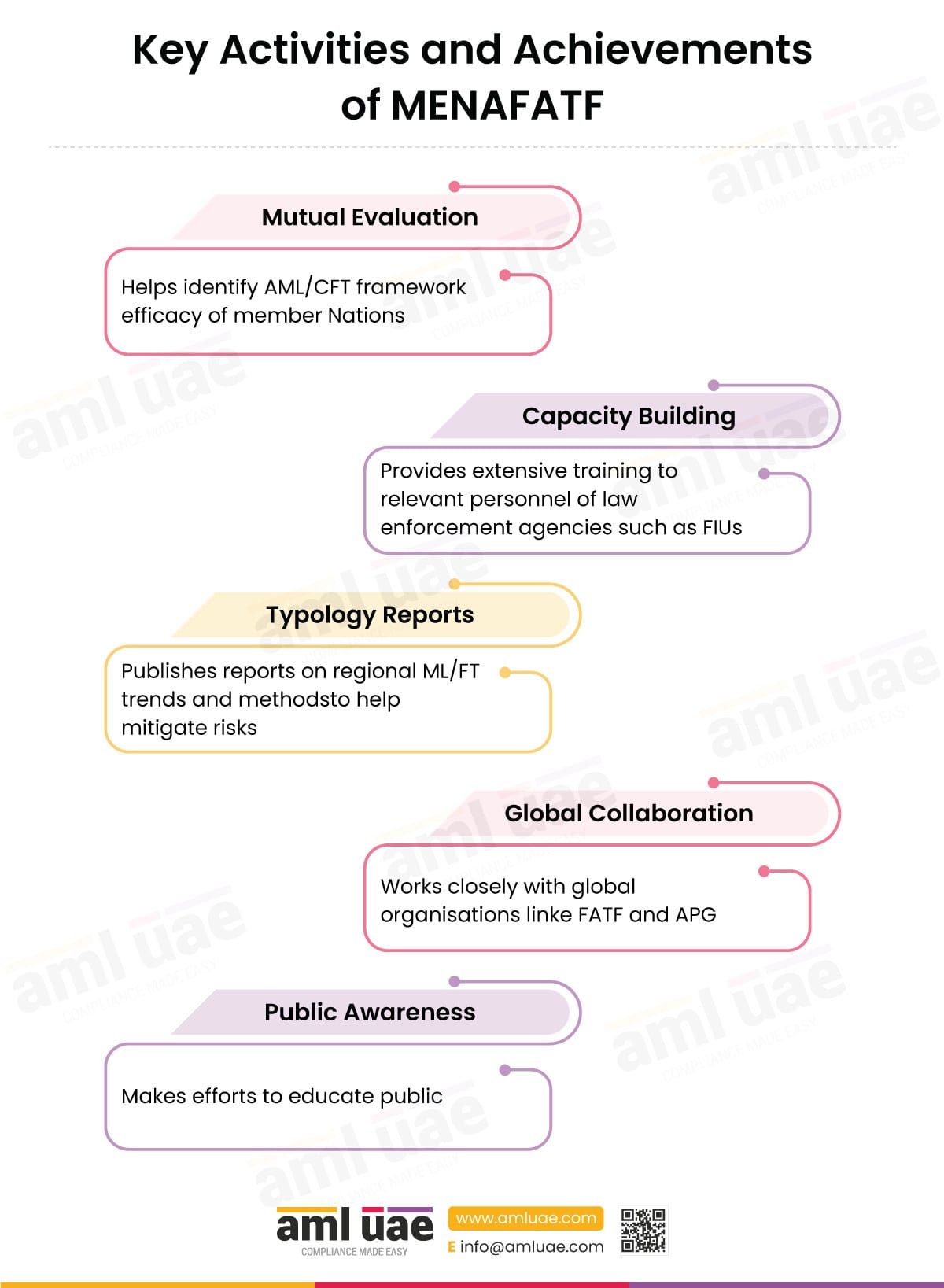
Mutual Evaluation
MENAFATF conducts several rounds of mutual evaluation of the member nations to assess their AML/CFT compliance with FATF standards. These rounds of mutual evaluation are discussed in further paragraphs. These evaluations help nations identify areas for improvement in their AML/CFT frameworks.
Capacity Building
MENAFATF provides extensive training to government officials, regulators, law enforcement agencies, and financial intelligence units through workshops, seminars, and technical missions.
Typology Reports
MENAFATF publishes reports on regional ML/TF trends and methods. These reports help member nations identify and mitigate emerging threats.
Global Collaboration
MENAFATF works closely with FATF and other organisations like the Asia-Pacific Group on Money laundering (APG).
Public Awareness
MENAFATF supports efforts to educate the public about AML/CFT obligations and the importance of these compliances.
The Role of MENAFATF Plenary

The Plenary in MENAFATF is the highest decision-making body and plays a significant role in contributing to MENAFATF’s mission. It comprises representatives from each member nation, typically experts in AML/CFT or senior officials from the Ministry of Finance, Central Banks, or Financial Intelligence agencies.
The Plenary assembles at least twice a year and may hold extraordinary meetings if necessary.
In a plenary meeting, a wide range of issues are discussed by the members as well as observers and decided upon, which includes:
- The approval of mutual evaluation reports
- Adoption of strategic plans
- Discussion of typology findings
- Endorsement of training programs
The Plenary approves the MENAFATF work program and performs the following functions:
- establish and approve the policies of MENAFATF;
- determine the rules and procedures of MENAFATF;
- approve annual report, work plan, and estimated budget, and ratify the financial report and auditor’s report of MENAFATF;
- appoint the Executive Secretary and independent auditor, and approve the Secretariat’s organisational structure and other functions;
- decide upon new member countries and observers;
- adopt any amendments to the Memorandum of Understanding (MOU) that may be significant in the future;
- identify technical assistance needs of member States and coordinate delivery of technical assistance in consultation with such nations and in co-operation with countries as well as international and regional organizations providing such assistance, particularly those holding observer status;
- consider and approve mutual evaluation reports of members’ compliance with FATF standards;
- establish working groups and committees when needed to undertake special tasks;
- consider any other subjects proposed by any of the member countries, the President, or the Secretariat.
The Plenary also elects president and vice-president, and annually reviews the organisation’s work plan and budget. The rules of the Plenary are designed to encourage transparency, inclusiveness, and effective decision-making.
Moreover, the Plenary provides a platform for observer organisations and countries to interact and participate in the discussions, although they do not have any voting rights. The Plenary is important for ensuring that MENAFATF remains dynamic, responsive, and aligned with the international AML/CFT framework.
Mutual Evaluation Working Group
The Mutual Evaluation Working Group (MEWG) is one of the important components of MENAFATF’s operational structure. It includes the task of managing and overseeing the process of mutual evaluation and follow-up reports of member nations. MEWG ensures that the evaluation is conducted in accordance with FATF standards, and the result reflects an accurate assessment of the country’s AML/CFT system.
MEWG focuses on two reports-

Mutual Evaluation Report
The mutual evaluation process involves an extensive peer review where a team of experts assesses the member country’s compliance with the FATF 40 recommendations. The evaluation includes both the technical and effectiveness compliance. Furthermore, this Evaluation Report is responsible for coordinating evaluations, selecting review teams, guiding on-site visits, and reviewing draft evaluation reports before they are submitted to the Plenary for approval. These reports highlight areas of strength, areas for improvement, and potential red flags. Once these reports are approved by the Plenary, the evaluation report will be accessible to the public.
Follow-up Report
Once a mutual evaluation is completed, the member nations initiate a follow-up process to ensure they take corrective measures. The MEWG monitors this progress by reviewing follow-up reports submitted by the nations.
These reports elaborate on the steps taken to address the areas of improvement identified in the mutual evaluation report. Depending on the level of progress, nations may be subject to enhanced follow-up or regular follow-up with the timelines for submitting these progress reports. MEWG reviews these reports and assesses whether the nation can exit the follow-up process or require further monitoring.
Therefore, MEWG plays a crucial role in maintaining accountability and promoting continuous improvement among its members. This rigorous evaluation and effective follow-up help strengthen the nation’s AML/CFT compliance in accordance with the FATF’s 40 recommendations.
Withdrawal and Suspension of Membership
MENAFATF includes the provision for the withdrawal or suspension of membership of a member nation.

A member, if voluntarily wants to withdraw, may submit a written notice of withdrawal to the Secretariat. This process takes effect after a stipulated period, generally six months from the date of notification, unless an earlier date is decided.
In certain cases where a member nation fails to fulfill its obligations, such as mutual evaluation, continuous non-compliance with the AML/CFT framework, or a lack of cooperation, that member may be subject to suspension by MENAFATF. The Plenary, with a two-thirds majority vote, makes the decision regarding suspension. The decision to suspend results in the loss of voting rights and the ability to influence decisions within the organisation until the issues leading to the suspension are resolved.
The withdrawal and suspension of membership provision of MENAFATF enables better accountability and engagement among members, and facilitates a hassle-free exit process or disciplinary actions in cases of persistent non-cooperation.
Challenges and Future Outlook
Challenges faced by MENAFATF
MENAFATF has achieved notable success in recent times, but even today, it faces several challenges:

- Political Instability: The member nations can be affected by ongoing political conflicts and governance, which can hinder their AML/CFT framework.
- Resource Constraints: Not all member nations have enough resources; some may face resource constraints with respect to financial and human resources, which can impact their AML/CFT framework.
- Diverse Legal System: The varied legal system among different member nations can hinder the standard AML/CFT framework.
- Technological Evolution: The rise of advanced technology leads to the rise of digital currencies and fintech, which requires constant updates to regulatory approaches that can hinder their AML/CFT standards.
The challenges listed above need to be addressed, and MENAFATF must continue to strengthen its partnerships, enhance technical assistance, and promote the adoption of new technologies.
Outlook for MENAFATF
MENAFATF is expected to

- Enhance their research and typology to be aware of emerging threats.
- Boost the Mutual Evaluation processes to ensure efficient ongoing compliance.
- Deeper integration with the international financial system and standards.
- Boost greater private sector engagement in the AML/CFT framework.
MENAFATF: The Watch Continues
MENAFATF plays a significant role in ensuring financial transparency and security in the Middle East and North Africa (MENA) region. It stands as a cornerstone of regional cooperation in the fight against Money laundering and financing of terrorism.
By aligning their efforts with international standards and tailoring them to address the challenges of the MENA region, organisations play a significant role in strengthening financial systems, enhancing legal frameworks, and promoting transparency. As financial crime continues to evolve, the MENAFATF’s role remains important not only as a monitor and advisor but also as a driver of sustainable reform. Through continued commitment and innovation, MENAFATF can further empower its members to build more resilient and secure economies.
Join the Fight against Financial Crimes!
Protect your business with reliable and effective
AML strategies with AML UAE.
Share via :
About the Author

Pathik Shah
FCA, CAMS, CISA, CS, DISA (ICAI), FAFP (ICAI)
Pathik is an ACAMS-certified AML consultant specialising in governance, risk, and compliance for regulated entities in the UAE. He brings over 28 years of experience, with 1,000+ hours of AML training and 200+ advisory engagements across DNFBPs, VASPs, and FIs. He supports businesses in aligning with AML/CFT requirements from the CBUAE, DFSA, MoET, MoJ, VARA, CMA, FSRA, and FATF. Known for translating complex regulations into audit-ready procedures, Pathik enables operational clarity and compliance readiness.

Reach Out to Pathik