



Professional Intermediaries
Published On: 06/16/2026
Protect your business with reliable and effective AML strategies with AML UAE.
Last Reviewed On: 07/24/2026 | Last Updated On: 07/24/2026
Professional Intermediaries: Briefly
Professional intermediaries such as accountants, lawyers, and TCSPs can facilitate money laundering by introducing layers of professional privilege and corporate opacity between criminal proceeds and the financial system. The UAE FIU Strategic Analysis of May 2025 highlights lawyers, accountants, and corporate service providers within its terrorist-financing facilitator typologies, distinguishing witting from unwitting facilitators. Under Cabinet Resolution No. (134) of 2025, professional intermediaries such as lawyers, notaries, independent legal professionals, independent accountants, real estate brokers, and TCSPs are classified as DNFBPs when they conduct specified activities for clients, and are subject to AML/CFT obligations.
What are Professional Intermediaries?
Professional intermediaries are licensed professionals such as accountants, lawyers, real estate agents, trust and company service providers (TCSPs), and other licensed professionals who are intentionally or unintentionally used by criminals to facilitate money laundering. Their involvement creates a layer of separation between illicit funds and the financial system, making transactions appear legitimate and reducing the likelihood of scrutiny.
Professional intermediaries are categorised as a Typology because the use of a professional’s role, credibility, and infrastructure is itself used as a mechanism of concealment. Funds routed through a lawyer’s client account, a company established by a TCSP, or a property transaction facilitated by an agent can inherit the professional’s legitimacy and be supported by documentation that appears to reflect genuine commercial or legal activity. This enables illicit funds to blend into the financial system under the appearance of legitimate business transactions.
Professional intermediary involvement is not suspicious in itself. Lawyers, accountants, notaries, real estate professionals, and TCSPs perform legitimate and necessary functions, and most engagements have a genuine commercial or legal purpose.
Complex or cross-border structures often have sound reasons, including tax-neutral holding arrangements, succession and estate planning, investment pooling, regulatory licensing, asset ring-fencing, and cross-border joint ventures.
The money-laundering risk arises only where the professional relationship is misused to obscure beneficial ownership, disguise the source of funds, or lend legitimacy to an illicit transaction, particularly where the structure or instruction has no clear commercial rationale.
Enhanced scrutiny is therefore applied on a risk-based basis: enhanced due diligence is triggered by higher-risk indicators in the customer, transaction, structure, jurisdiction, ownership chain, or source of funds, not automatically for every professional firm.
What is professional intermediary risk in money laundering?
Professional intermediary risk arises when lawyers, accountants, TCSPs, real estate professionals, or other advisers are misused to conceal beneficial ownership, move client funds, establish opaque structures, or give illicit transactions the appearance of legitimacy. In the UAE, these professionals may be subject to AML/CFT obligations as DNFBPs when they conduct specified activities for or on behalf of clients.
Are professional intermediaries always suspicious?
No. Professional intermediaries provide legitimate and necessary services. The AML risk arises only when those services are used to conceal the source of funds, beneficial ownership, control, transaction purpose, or the identity of the true client.
Regulatory Framework Related to Professional Intermediaries
The UAE AML/CFT legislative framework imposes a range of compliance requirements on professional intermediaries.
The UAE has established a comprehensive DNFBP classification framework that captures professional intermediaries across multiple sectors. Article 3 of Cabinet Resolution No. (134) of 2025 defines DNFBP to include lawyers, notaries, legal professionals, Independent accountants, TCSPs and real estate agents when conducting various types of financial transactions on behalf of their customers. The framework further, in Articles 5 & 10, outlines the compliance requirements for verifying customer identity and beneficial ownership structure.
Federal Decree Law No. (10) of 2025, Article 18 (1) obligates Financial Institutions, DNFBPs and Virtual Asset Service Providers to file a Suspicious Transaction report when reasonable suspicion arises, regardless of the transaction value. However, Article 18(3) exempts lawyers, notaries, legal professionals, and independent auditors from this obligation only when the suspicious information is obtained under professional secrecy while determining a client’s legal position or representing a client in legal proceedings. This exemption is limited and does not apply when these professionals act in a financial transaction capacity rather than a purely legal advisory role.
Cabinet Resolution No. (71) of 2024 prescribes administrative penalties for DNFBP non-compliance, including maximum penalties of AED 500,000 for STR failures and AED 200,000 for CDD failures, directly applicable to professional intermediaries who fail their AML/CFT obligations.
Regulatory Reference
Federal Decree-Law No. (10) of 2025, Article 18 — STR Obligation and Professional Secrecy Exemption; Cabinet Resolution No. (134) of 2025, Article 3,5,10,17 — DNFBP Scope
Primary Authority in the UAE
The Ministry of Economy and Tourism (MOET) supervises AML/CFT compliance for DNFBPs, including accountants, real estate agents and TCSPs.
The Ministry of Justice (MoJ) supervises lawyers, notaries and legal professionals.
The UAE FIU, established under Federal Decree-Law No. (10) of 2025, Article 11, within the Central Bank of the UAE, receives all suspicious transaction reports via goAML from all DNFBPs, including professional intermediaries.
Reporting or Compliance Obligations and Channels of Professional Intermediaries
Professional intermediaries classified as DNFBPs must file STRs without delay via goAML, in accordance with Federal Decree-Law No. (10) of 2025, Article 18, whenever they carry out financial transactions and have reasonable grounds for suspicion. The professional secrecy exemption under clause 3 is limited purely to legal advisory and representation functions and does not apply to financial transaction activities.
Customer due diligence (CDD) as required under Cabinet Resolution No. (134) of 2025, Articles 6 – 9, must be conducted for all clients on whose behalf financial transactions are carried out. Beneficial ownership must be identified in accordance with Article 10, applying the 25% ownership threshold.
According to Article 25, Records must be retained for a minimum of five years. In addition, Entity-wide risk assessments must incorporate UAE FIU intelligence on professional intermediaries as terrorist-financing facilitator sectors under Cabinet Resolution No. (134) of 2025, Article 5.
Beyond reporting, professional intermediaries that are DNFBPs must register on the goAML portal and maintain a standing AML/CFT compliance programme. This includes appointing a qualified Compliance Officer, adopting internal policies, procedures, and controls, delivering ongoing staff training, and arranging an independent audit to test the programme, in line with Cabinet Resolution No. (134) of 2025, Articles 21 and 22.
Screening obligations also apply. Intermediaries must screen clients and beneficial owners against the UN Consolidated List and the UAE Local Terrorist List and apply targeted financial sanctions without delay under Federal Decree-Law No. (10) of 2025, Article 19, including freezing relevant funds and filing the required notifications. They must also identify politically exposed persons (PEPs) and apply enhanced due diligence, such as senior-management approval and source-of-wealth checks, to higher-risk PEP relationships.
Recent Developments, Enforcement Actions, or Supervisory Priorities
The UAEFIU Strategic Analysis on TF Typologies and Facilitators, published in May 2025, based on STR/SAR reporting analysis covering January 2021 to December 2024, recognises lawyers, accountants, and corporate service providers as relevant facilitators within TF risk frameworks, reinforcing the importance of their role in preventive controls.
This is one of the most significant recent regulatory developments for professional intermediaries in the UAE, as it establishes that these professionals are not merely a theoretical risk category but a documented supervisory and risk priority.
In parallel, the NAMLCFTC Joint Guidance on Satisfactory and Unsatisfactory AML Practice has provided clear expectations for professional intermediaries, particularly on improvement in source of wealth verification and beneficial ownership understanding as key areas for enhancement.
What does the term “Professional Intermediaries” Mean?
Think of the role a translator plays in a negotiation between two parties who speak different languages. The translator is necessary, is trusted by both sides, and owns no part of the deal. Professional intermediaries function similarly in money laundering: they sit between the criminal and the financial system, providing the technical capability to structure transactions, establish entities, or advise on ownership, while the professional’s involvement is used as evidence of legitimacy. The criminal benefits from the professional’s credibility; the professional may or may not know the true purpose of the work being commissioned.
Why Professional Intermediaries Matter
Professional intermediaries perform services that can be used to introduce an additional layer of complexity and perceived legitimacy into financial flow. Lawyers, accountants, and corporate service providers are identified as operational intelligence-based risk factors for every stage of the money laundering process based on the UAEFIU strategic analysis.
When funds move through a lawyer’s client account, a TCSP-established company, or an accountant-managed structure, the professional’s involvement may obscure the underlying source of funds. This creates an environment where standard transaction monitoring alone may not penetrate to identify the ultimate beneficial owner or to conclude the legitimacy of the transaction.
As a result, financial institutions and DNFBPs are obligated to question the source of funds and to assess whether the professional is acting in a transactional capacity rather than a purely advisory one, which is both a legal requirement and a compliance necessity.
The consequences of not fulfilling these obligations are significant under Cabinet Resolution No. (71) of 2024, failure to file an STR with the UAE FIU via goAML may attract a penalty of up to AED 500,000; failure to complete the CDD procedure, up to AED 200,000; and failure to perform EDD for high-risk clients, up to AED 500,000.
How Professional Intermediaries Work
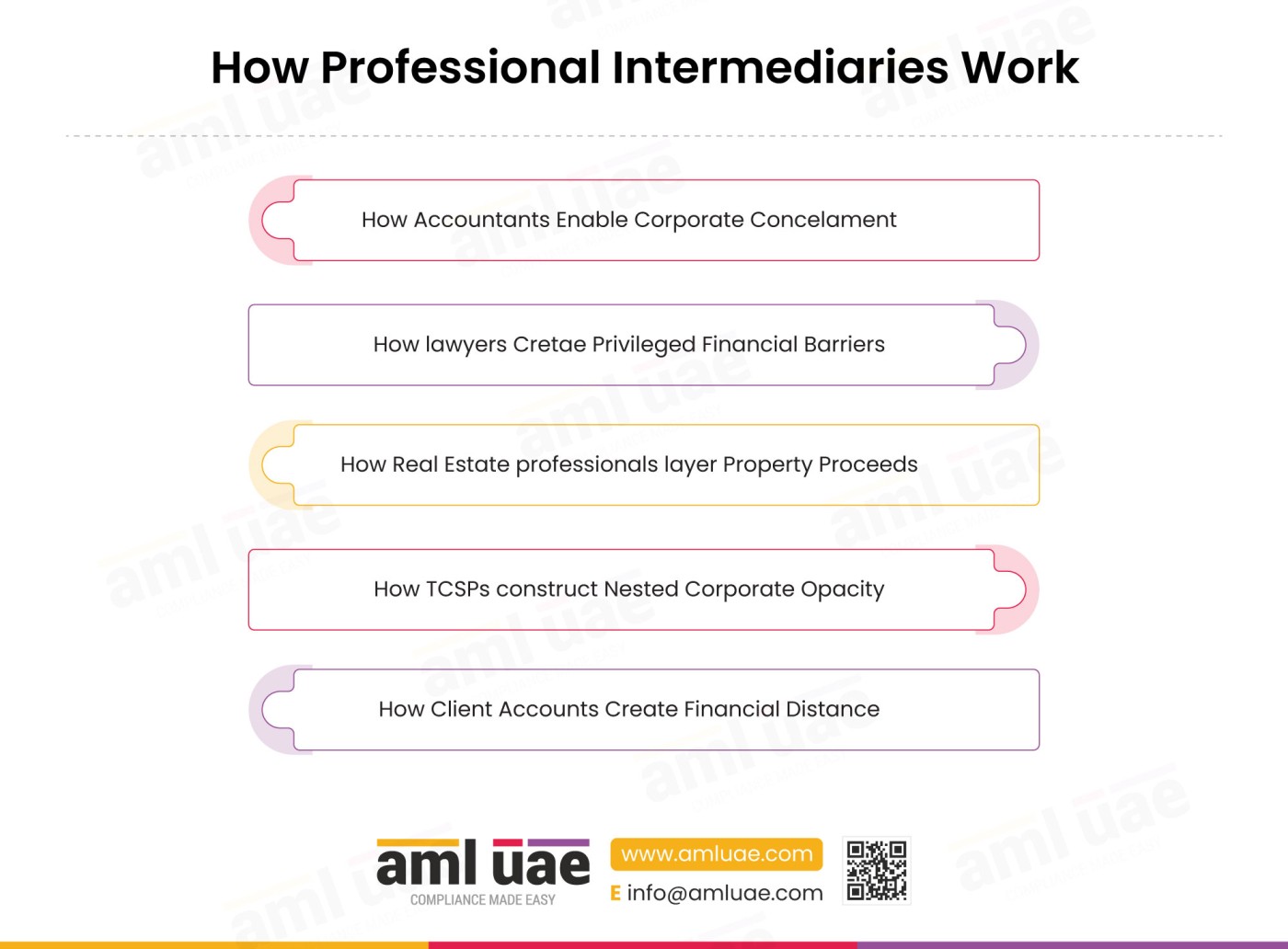
How Accountants May Be Misused for Corporate Concealment
Professional intermediaries providing accounting services perform several money-laundering functions beyond the obvious advisory role. They prepare financial statements that support a false revenue narrative for front companies and structure transactions to create the appearance of legitimate commercial income. They also advise on corporate arrangements that obscure beneficial ownership.
When an accountant prepares accounts for a front company without adequately verifying the source of funds, the resulting service product and the certified accounts can serve as evidence that investigators must rebut before the underlying illicit proceeds can be attributed to the company.
How Lawyers' Client Accounts May Be Misused
Lawyers who use client accounts to receive and transfer funds on behalf of clients can create a layer of separation between criminal proceeds and the financial system. Funds held in a lawyer’s client account are nominally maintained on behalf of the client for a legitimate purpose. However, if those funds consist of criminal proceeds, the use of a client account structure inserts the lawyer’s professional identity between the criminal proceeds and the financial system, making the traceability of the criminal origin more difficult.
Financial institutions that suspect funds are linked to illegal activity are required to report their suspicions to the FIU and not disclose the same to the client in accordance with the no-tipping-off obligation of Cabinet Resolution No. (134) of 2025, Article 19.
How Real Estate Professionals May Be Misused to Layer Property Proceeds
Real estate agents who facilitate property transactions for anonymous buyers or corporate entities enable the conversion of criminal proceeds into property assets. Their involvement in the transaction provides an appearance of legitimacy, suggesting that the transaction occurred at a fair market value and followed standard commercial procedures.
DNFBPs are mandated to perform CDD under Federal Decree Law (10) of 2025. Therefore, if the agent fails to conduct adequate CDD to identify the ultimate beneficial owner behind the purchasing entity, a transaction used to conceal the origin of illicit funds appears legitimate due to the agent’s involvement in the transaction.
How TCSP Structures May Be Used to Create Opacity
Trust and company service providers establish legal entities, trusts, and nominee arrangements that allow beneficial owners to hold and control assets without appearing in any public register.
A criminal who instructs a TCSP to establish a series of nested companies across multiple jurisdictions creates a corporate structure whose ultimate ownership is effectively invisible to standard due diligence enquiries.
Each layer of the structure is technically valid; each entity is properly registered; each directorship is properly documented, but the aggregate structure conceals the beneficial owner behind multiple legal barriers.
How Client Accounts Create Financial Distance
The most straightforward professional intermediary money laundering mechanism is the routing of illicit funds through the client account of a professional firm.
The firm receives funds, records them as held on behalf of a client for a specified purpose, and disburses them as instructed. The firm’s account statement shows a transfer from a professional firm, not from the ultimate source of the funds.
Financial institutions that see only the professional firm’s account as the fund source, without looking through to the underlying client, are unable to identify the true beneficial origin of the funds.
Real-World Examples of Professional Intermediaries
The Advisory Fee Layering Scheme
A compliance officer at a private bank reviews an account held by a management consulting firm. The account regularly receives large inbound wire transfers described as “advisory fees” from a foreign company. The consulting firm’s registered address is a shared office, and its declared activities are not consistent with the scale of fees received. The onboarding documentation is minimal.
Further, the investigation reveals that the consulting firm’s accounts have been used to receive proceeds from a commercial fraud scheme conducted in another jurisdiction, with the funds redescribed as “advisory fees” to provide a commercially plausible explanation for large cross-border transfers. The consulting firm is registered by a TCSP on behalf of a beneficial owner who does not appear in any public record.
The detection lesson is that advisory fee payments from offshore companies to professional service firm accounts, particularly where the firm has no verifiable client base or service delivery record, are a documented intermediary layering pattern.
The Nested Corporate Structure
A TCSP client requests the establishment of a holding structure comprising three companies across two jurisdictions, each with a nominee director. The ultimate beneficial owner provides identification to the TCSP but instructs that beneficial ownership information should not be shared with third parties.
The TCSP establishes the structure without adequately assessing whether the request for ownership opacity is commercially justified or is itself a risk indicator. The structure is subsequently used to hold real estate assets purchased with illegal proceeds.
The detection lesson is that requests for nominee director arrangements and confidentiality instructions that extend beyond standard professional privilege may indicate that the structure is being designed for concealment rather than legitimate commercial purposes.
The Real Estate Intermediary
A real estate agent facilitates the sale of a commercial property to a company whose beneficial ownership is held through two offshore holding companies, each administered by a different TCSP.
The agent completes the transaction and receives commission but does not conduct adequate CDD on the beneficial owner behind the purchasing structure, as the purchasing entity presents legal documentation confirming its good standing.
Post-transaction investigation by law enforcement reveals that the funds used to acquire the property were derived from organised crime proceeds. The agent did not file a suspicious transaction report.
The detection lesson is that real estate transactions involving purchasing entities with multi-layer offshore beneficial ownership structures require the agent to look through the corporate veil to identify the ultimate beneficial owner, regardless of the documentation quality at the corporate level.
How Do Criminals Exploit Professional Intermediaries?
Accountants, real estate professionals, and trust and company service providers are the three service provider categories that most frequently appear in professional intermediary money laundering operations.
Accountants are exploited for their ability to certify financial statements and provide the appearance of legitimate revenue.
Real estate professionals are exploited for their access to high-value asset transactions that can absorb large amounts of illicit proceeds in a single deal.
TCSPs are exploited for their ability to establish legal entity structures that conceal beneficial ownership.
The tactic is concealment. Professional intermediaries do not generate illicit proceeds; instead, they provide the services and structures that make already generated proceeds appear legitimate. Their role in the money laundering process is primarily at the layering and integration stages, where they help disguise the origin of illicit funds and facilitate their entry into the legitimate economy.
How Do Professional Intermediaries Facilitate Money Laundering?
Professional intermediaries enable the concealment mechanisms that make illicit proceeds undetectable once they have been placed into the financial system. At the layering stage, client accounts, advisory fee payments, and multi-entity corporate structures create documentary trails that appear legitimate. At the integration stage, the professional’s certification, whether through audited accounts, legal documentation, or property transfer deeds, provides the evidential basis on which the proceeds appear to be clean. The professional’s involvement is not incidental; it is the mechanism of concealment. This is why the UAEFIU identifies professional intermediaries as facilitators rather than merely as passive service providers.
What Are the Red Flags That Identify Professional Intermediaries?
| Category | Red Flag Observation |
| Customer | Professional intermediary advises or instructs clients to structure or conceal transactions to circumvent AML obligations. |
| Customer | Adverse media reports or public records link the professional or firm to alleged criminal or regulatory violations. |
| Customer | Professional service provider consistently refuses or fails to provide requested details about the origin or destination of funds. |
| Customer | Professional intermediary provides minimal due diligence documentation despite routing all transactions through professional accounts. |
| Transaction | Large advisory, legal, or consultancy fees significantly above industry norms with no evidence of actual services rendered. |
| Transaction | Multiple or repeated fund transfers through client accounts managed by a professional service provider that lack a legitimate commercial explanation. |
| Transaction | Rapid in-and-out movement of funds through accounts controlled by a professional intermediary, without any corresponding commercial activity. |
| Transaction | Rapid succession of fund transfers among accounts linked to the same professional intermediary, accompanied by minimal or absent documentation of the underlying commercial purpose. |
| Product | Establishment or use of nested corporate entities or trusts with no apparent commercial or economic rationale. |
| Product | Detected alterations, irregularities, or signs of forgery in documentation prepared by professional intermediaries, such as invoices, contracts, or corporate records. |
| Channel | All transactions are routed exclusively through professional intermediary channels, preventing direct access to the ultimate beneficial owner. |
| Customer | Professional intermediary instructs clients to use specific financial institutions or accounts that are outside the client’s normal banking relationships without a legitimate commercial reason. |
Which Controls Counter Professional Intermediaries?
| Control | What It Disrupts | Detects / Prevents / Deters | Specific Limitation |
| Enhanced Due Diligence (EDD) | High-risk professional intermediary relationships | Detects source of funds and beneficial ownership inconsistencies during EDD review | EDD is sometimes applied at the professional firm level only, without looking through to the underlying client’s beneficial ownership |
| Third-Party Risk Management | Use of professional intermediaries as layering vehicles for third-party client funds | Detects intermediary accounts that route funds for multiple unrelated third parties | Professional privilege may limit information sharing between the intermediary and the institution |
| OSINT and External Source Verification | Adverse media connection between professionals and criminal proceedings | Detects court filings and regulatory actions linking the professional to money laundering facilitation | OSINT coverage of professional disciplinary proceedings and civil cases is inconsistent |
| Risk-Based Customer Profiling and Segmentation | Misclassification of professional intermediary accounts as low risk | Prevents correct risk classification triggers appropriate monitoring | Professional intermediaries are frequently misclassified as low risk due to their professional credentials |
| Staff AML Training and Awareness | Failure to apply enhanced scrutiny to professional service firm accounts | Deters — training builds recognition of professional intermediary red flags | Training may focus on end-customer indicators without addressing the specific characteristics of intermediary accounts |
| Targeted Financial Sanctions (TFS) Screening | Dealings with designated persons and terrorist-financing networks operating through intermediary accounts | Prevents — screening clients and beneficial owners against the UN Consolidated List and the UAE Local Terrorist List blocks prohibited dealings and triggers freezing without delay | Screening relies on accurate beneficial-ownership data; names held behind nominee or nested structures may evade list matching |
| PEP Screening and Source-of-Wealth Checks | Misuse of intermediary structures to move funds connected to politically exposed persons | Detects PEP involvement and unexplained wealth, triggering senior-management approval and enhanced ongoing monitoring | PEP status may be concealed where the intermediary is the named client and the underlying PEP is not disclosed |
How Do AI and RegTech Automate Detection of Professional Intermediaries?
Transaction monitoring platforms can be configured to apply specific alert rules to accounts identified as belonging to professional service firms, law firms, accountancy firms, and TCSPs. Accounts in these categories that exhibit fund-in-fund-out patterns, where inbound and outbound flows are of similar amounts and occur within a short timeframe, without corresponding client engagement documentation, should be flagged for enhanced review.
Network analytics tools are particularly effective in identifying professional intermediary structures because these schemes are often characterised by distinctive network patterns. A professional firm account that routes funds from multiple unrelated source parties to multiple unrelated destination parties is structurally identifiable through graph analysis, even when no individual transaction triggers a threshold-based alert.
Document verification tools can be applied to the contracts, invoices, and corporate records submitted by professional intermediary accounts. It helps identify alterations, inconsistencies, and forgery indicators that can be missed in manual review.
Natural Language Processing tools applied to the text of submitted documents can analyse boilerplate or template language that suggests documents have been generated to support a predetermined transaction narrative rather than to evidence genuine services.
Adverse media monitoring tools that maintain up-to-date feeds from legal regulatory bodies, court filing systems, and financial crime reporting sources can provide early warning of enforcement actions, disciplinary proceedings, or other risk indicators involving professional intermediaries that may hold accounts with the institution.
These tools should support, not replace, human judgment. Because legitimate professional firms routinely handle third-party funds and operate pooled client accounts, intermediary-focused rules tend to generate false positives, and alerts need analyst review before escalation. Firms should govern these systems deliberately, documenting rule logic and alert thresholds, testing and validating models, tuning to manage false positives, and recording escalation and decision rationale so the monitoring framework remains explainable to supervisors.
What Data Should Compliance Teams Collect to Detect Professional Intermediaries?
| Data Point | Source System | What It Reveals About Professional Intermediaries |
| Adverse media and court filings | OSINT platform / external data feed | Links professional firms and named professionals to regulatory actions, criminal proceedings, and disciplinary actions |
| Contractual and invoice documentation | Document management system | Identifies fabricated or altered commercial documentation submitted to justify advisory fee payments |
| Company and beneficial ownership registries | Company registry / KYC platform | Identifies beneficial ownership structures, nominee arrangements, and nested entity relationships |
| Communication records | CRM / secure messaging logs | Identifies patterns of instruction that suggest the professional is directing transactions rather than advising on them |
| Geographical transaction data | Core banking / geolocation | Maps fund flows to jurisdictions associated with TCSP-facilitated opacity and beneficial ownership concealment |
| Professional licensing and affiliation databases | External professional registry data | Confirms current registration status of professionals and identifies regulatory warnings or disciplinary actions |
| KYC and CDD records | KYC platform | Enables periodic reassessment of beneficial ownership consistency behind professional intermediary accounts |
| Trust information and accounts | Trust register / trust administration records | Identifies trust structures managed by TCSPs for anonymous ultimate beneficiaries |
| Transaction logs for client accounts | Core banking | Identifies fund-in-fund-out patterns in client accounts held by professional firms |
| Document verification results | Document verification platform | Identifies altered or forged commercial and corporate documents submitted by intermediary accounts |
How Do Professional Intermediaries Aggravate Customer Risk and Jurisdictional Risk?
Professional intermediaries aggravate Customer Risk by introducing a layer of professional privilege and corporate documentation between the service provider and the ultimate beneficial owner of the funds.
When a service provider deals with a professional firm’s client account rather than the end client directly, it becomes difficult to trace the true source of the funds through the standard CDD process.
The involvement of professionals can also create a false sense of reduced risk, as their credentials and registration status provide an apparent risk mitigation, even though the true beneficial ownership is masked.
Professional intermediaries aggravate Jurisdictional Risk by enabling the creation of complex cross-border corporate structures.
These structures involve multiple jurisdictions, with each layer of the structure subject to a different regulatory framework and BO disclosure standard.
As a result, tracing the ultimate beneficial owner becomes challenging, and no single authority or compliance team can fully assess the structure without international cooperation.
How Do Transaction Patterns Reveal Professional Intermediaries?
An account used by a professional intermediary in a money laundering operation exhibits a characteristic pattern: funds received from multiple sources with different stated commercial purposes, aggregated in the professional’s client account, and then distributed to multiple destinations based on the client’s instructions. Each inflow and outflow is accompanied by supporting documentation such as an invoice, a fee agreement, or a corporate resolution that provides a surface-level commercial explanation for the transaction.
The key Indicator is the aggregate pattern of activity rather than any individual transaction. The volume, geographic diversity, and transactional complexity reflected in the account show inconsistency with the legitimate business activities, size and scope of the declared professional.
Additionally, the documentation submitted in support of the transactions frequently contains inconsistencies, boilerplate language, or typographical anomalies that suggest the documents were produced to support the transactions rather than to evidence real commercial activity.
Sectors at Highest Exposure
| Sector | Risk Rating | Specific Reasoning |
| Trust and company service providers | Higher exposure | TCSPs are a primary vehicle for establishing beneficial ownership concealment structures; the UAE FIU highlights trust and company service providers within its TF facilitator typologies |
| Law firms and legal professionals | Higher exposure | Client accounts can create financial barriers; professional secrecy can create information-sharing obstacles; the UAE FIU highlights lawyers within its TF facilitator typologies |
| Accountants and audit firms | Elevated exposure | Corporate structure certification and financial statement preparation can support false revenue narratives; the UAE FIU highlights accountants within its TF facilitator typologies |
| Real estate professionals | Elevated exposure | Real estate transactions are a documented TF fund source in UAE intelligence; property transactions facilitate integration of large illicit proceeds |
| Notary services | Moderate exposure | Notarial certification of documents and transactions provides legitimacy to intermediary facilitated arrangements |
Geographies and Contexts of Concern
Corporate structure establishment as a method is used to move and conceal funds. Lawyers, accountants, and corporate service providers are used as facilitators based on the UAEFIU Strategic Analysis on TF Typologies and Facilitators (May 2025).
Attention should be given to the structures that involve multiple jurisdictions, especially in countries with weaker transparency standards or limited beneficial ownership disclosure requirements. Also, when the structures include entities located in the FATF increased monitoring jurisdictions, the risk increases and AML/CFT obligations are to be followed more severely.
The EOCN TFS Typologies Paper (2021) identifies TCSPs in UAE free zones and nominee director and shareholder arrangements as active TFS circumvention tools. While these structures have a legitimate commercial purpose, they warrant enhanced scrutiny, particularly when those structures serve UAE-based beneficial owners with no commercial rationale for the offshore element.
Best Practices for Professional Intermediaries Risk Management
- Apply enhanced due diligence to all accounts held by professional service firms acting in a financial transaction capacity. Cabinet Resolution No. (134) of 2025, Article 9, requires EDD measures for high-risk customers. Professional service firms whose accounts show fund-in-fund-out patterns, large advisory fees without documented evidence of service delivery, or multi-jurisdictional fund routing must be classified as high risk and subjected to EDD regardless of the professional’s regulatory registration status.
- Identify the ultimate natural person who owns the corporate entity. Article 10 of Cabinet Resolution No. (134) of 2025 requires the identification of the ultimate beneficial owner using the 25% ownership threshold. For accounts held by professional firms on behalf of clients, institutions must identify the ultimate beneficial owner behind the professional’s client, not merely the professional firm itself.
- Conduct OSINT verification of the professional firm and named professionals at onboarding and periodically thereafter. Adverse media screening for regulatory actions, disciplinary proceedings, and criminal investigations involving the professional firm or its named professionals should be conducted during onboarding and at least annually thereafter. The UAEFIU has identified these professionals as a named enforcement priority; therefore, this intelligence must be reflected in monitoring and risk assessment frameworks.
- Apply document verification tools to contracts, invoices, and corporate records submitted to justify professional fee payments. Document verification should include analysis of boilerplate language, formatting inconsistencies, and metadata anomalies that indicate documents were architected to support transactions rather than to evidence genuine services.
- Configure transaction monitoring systems to detect fund-in-fund-out patterns in professional service firm accounts. Professional intermediary accounts that show inbound and outbound flows of similar amounts within close timeframes, without corresponding commercial activity, should trigger enhanced monitoring alerts. This pattern is not captured by standard threshold-based monitoring rules.
- Assess whether the professional is acting in a financial transaction capacity or a purely advisory capacity before applying the professional secrecy exemption. Federal Decree-Law No. (10) of 2025, Article 18, limits the professional secrecy exemption to genuine legal advisory and representation functions. Professional intermediaries who manage client funds, establish companies, or execute property transactions are acting in a financial transaction capacity and are not exempt from STR obligations for those activities.
- Train compliance staff on the specific red flags regarding professional intermediary involvement. Staff training must specifically address the indicators that distinguish legitimate professional service firm accounts from intermediary layering accounts, including the advisory fee anomaly, the fund-in-fund-out pattern, and the nested corporate structure indicators. Generic AML training that does not address the professional intermediary context is insufficient.
- File suspicious transaction reports without delay when professional intermediary red flags are confirmed. Federal Decree-Law No. (10) of 2025, Article 18, requires immediate filing without delay. The professional registration of the account holder does not reduce the STR obligation. An account held by a registered law firm or accountancy practice is subject to the same STR threshold as any other account.
- Integrate the UAEFIU May 2025 intelligence finding into the entity-wide risk assessment. The UAE FIU’s identification of lawyers, accountants, and corporate service providers among its TF facilitator typologies is material intelligence that should be reflected in regulated entities’ risk assessments under Cabinet Resolution No. (134) of 2025, Article 5. Failure to integrate this intelligence into the EWRA is a separately penalised compliance failure.
- Retain all professional intermediary investigation records for a minimum of five years. Article 25 of Cabinet Resolution No. (134) of 2025 requires retention of all CDD, transaction, and STR records for a period of five years. In the context of professional intermediary investigations, all document verification results, OSINT reports, and internal escalation documentation must be preserved.
Related Terms and Concepts
Professional intermediaries connect to a wide range of AML typologies because their service offering navigates the full money laundering process. They are used in the placement stage to certify false business revenue, in the layering stage to create fund routing documentation, and in the integration stage to establish the corporate and property structures through which proceeds become assets.
Understanding the professional intermediary typology requires understanding the specific financial products and services each profession offers to criminals.
| Related Term | Connection |
| Shell Companies | Construction and management by TCSPs are the primary mechanism for beneficial ownership concealment |
| Beneficial Ownership | Professional intermediaries are the primary obstacle to effective beneficial ownership identification |
| Client Account Misuse | Lawyers and accountant’s route illicit funds through client accounts to create professional-privilege barriers |
| Real Estate Money Laundering | Real estate professionals are the transaction facilitators for property-based proceeds integration |
| Offshore Company Incorporation | TCSPs are the service providers for offshore structures used in professional intermediary concealment |
| Trust Structures | Trusts established and administered by TCSPs conceal beneficial ownership of criminal assets |
| Enhanced Due Diligence (EDD) | The mandatory compliance response for high-risk professional intermediary relationships |
| goAML | Reporting platform STRs by and against professional intermediaries are filed through goAML |
What Financial Instruments Do Criminals Use in Professional Intermediaries Schemes?
Professional firm client accounts are the primary financial instrument. Illicit funds are deposited into the lawyers’, accountants or other professional firms ‘ accounts from criminal clients, held on their behalf under the professional privilege shield, and then transferred elsewhere under the appearance of a legitimate professional transaction.
Bearer shares are used in corporate structures established by TCSPs, as they allow ownership to be transferred without any public registry record. A corporate structure that includes bearer shares enables the beneficial owner to transfer ownership of the entire structure without any DNFBP or financial institution being aware of the change.
Cash is used for direct payment of professional services where the criminal wants to avoid creating a traceable transaction record. Usually, the transaction amounts are paid through multiple transactions to avoid triggering CDD and reporting DNFBP’s obligations.
Equity interests in legal entities managed by TCSPs on behalf of anonymous beneficial owners, allowing criminal proceeds to be held in the form of company shares whose ultimate ownership is concealed behind nominee structures.
Real estate is often used during the integration stage of money laundering. Proceeds that have been layered through professional intermediary structures are used to purchase property by a TCSP-administered company on the instruction of an anonymous beneficial owner, integrating criminal proceeds into a registered, legally documented asset.
Trust accounts allow TCSPs to hold and manage assets on behalf of beneficiaries whose identities are not disclosed in any public register, making them a primary opacity tool for professional intermediary schemes.
Trust beneficial interests enable an individual to benefit from trust assets without appearing on any corporate register or property title, as all the formal legal documentation names the trustee.
| Variant / Synonym | Context or Jurisdiction | Distinction from Primary Term |
| Gatekeepers | FATF and international AML terminology | Emphasises the regulatory gatekeeping function that professionals are expected to perform |
| Enablers | Policy advocacy and enforcement discourse | Emphasises the active facilitation role; used particularly when discussing professional liability |
| DNFBPs (Designated Non-Financial Businesses and Professions) | UAE regulatory framework | The formal legal classification that determines which obligations apply to professional intermediaries |
| Professional money laundering | Enforcement terminology | Refers specifically to the use of professional services as a deliberate laundering mechanism |
What Products and Services Do Criminals Abuse in Professional Intermediaries Schemes?
Accounting, auditing, and bookkeeping are the services through which professional accountants help criminals integrate illicit funds into the financial system. When professionals prepare financial statements for front companies and present false revenue as legitimate business income, criminals gain the documentary foundation for the integration stage of money laundering.
Client accounts of lawyers and accountants are used when professionals allow illicit funds to be routed through their professional client accounts, creating a financial layer of separation between the criminal proceeds and the originating offence.
Legal advisory services provided by legal professionals for structured transactions, establishing entities, or advising on corporate arrangements that are used to conceal illicit proceeds, particularly where the professional fails to assess the ultimate purpose of the engagement.
Notary services, such as verifying affidavits, declarations, and real estate deeds, are applied to documents and transactions that are themselves part of a money laundering scheme, providing official certification to fraudulent or illicit arrangements.
Offshore company incorporation services are misused by TCSPs to establish structures that conceal the identity of the beneficial owner. The use of jurisdictions with limited BO disclosure requirements creates impenetrable ownership opacity.
Professional consultancy services are misused when advisory fee payments between related entities, particularly cross-border, are used to create seemingly legitimate commercial explanations for large financial transfers that are, in fact, movements of illegal funds.
Real estate services are misused when agents facilitate property transactions on behalf of anonymous corporate purchasers without conducting adequate CDD, allowing illicit proceeds to be converted into property assets under a professional’s transaction certification.
Trust and corporate services are the primary professional intermediary product category for beneficial ownership concealment. TCSPs that establish complex corporate and trust structures for clients without adequate ultimate beneficial owner identification are providing the core infrastructure for professional intermediary money laundering.
How AML UAE Helps
The detection of professional intermediary facilitated money laundering requires compliance frameworks that are specifically calibrated to the characteristics of professional service providers. The generic compliance framework is designed to assess the risk of individual customers and not professional service providers.
AML UAE helps regulated entities address the risk through Enterprise-Wide Risk Assessment, which would enable businesses to assess where professional intermediary involvement may create additional ownership, CDD or transaction monitoring challenges.
For compliance teams seeking to strengthen their controls, AML UAE provides transaction monitoring and AML framework review services to assess whether existing monitoring rules adequately identify professional intermediary risk indicators, including nominee arrangements and multi-layer corporate structures.
We also deliver AML/CFT training programmes that equip senior management and employees of the company with the practical skills needed to identify and assess professional intermediary red flags.
AML UAE also works directly with law firms, accountancy practices, real estate professionals and TCSPs that are classified as DNFBPs and are subject to AML/CFT obligations under the UAE regulatory framework. Through tailored compliance programmes, risk assessments, and staff training that enable professional firms to meet their obligations under Cabinet Resolution No. (134) of 2025 and to avoid the administrative penalties prescribed in Cabinet Resolution No. (71) of 2024.


Professional intermediaries provide legitimate business services, but those services may be misused to support complex financial arrangements. Regulated entities must look beyond professional involvement and assess the true purpose of each transaction or structure. The key compliance question is not whether the firm is registered, but what the account is actually doing. A strong risk-based approach and effective due diligence are essential to managing this risk and mitigating professional intermediary risk.

Frequently Asked Questions
Yes. Under Cabinet Resolution No. (134) of 2025, Article 3. Lawyers and legal professionals engaged in designated financial transaction activities are classified as DNFBPs. When conducting these activities, they are required to comply with all applicable UAE AML/CFT obligations and regulatory requirements.
The UAEFIU Strategic Analysis on TF Typologies and Facilitators, published in May 2025, highlights lawyers, accountants, and corporate service providers within its terrorist-financing facilitator typologies, based on STR/SAR reporting analysis from January 2021 to December 2024. The report distinguishes witting (complicit) from unwitting facilitators, so professional involvement is a risk indicator to assess rather than a finding of wrongdoing.
Federal Decree-Law No. (10) of 2025, Article 18 (3), exempts lawyers, notaries, legal professionals, and independent auditors from the STR filing obligation when the information raising suspicion is obtained under professional secrecy in connection with determining the client’s legal position or representing the client in legal proceedings. The exemption is limited and does not apply when the financial transaction capacity is exceeded.
Cabinet Resolution No. (71) of 2024 prescribes administrative penalties for DNFBPs. Failure to file a suspicious transaction report may result in a penalty of up to AED 500,000 (Serial Number 22). Failure to comply with CDD obligations may result in a penalty of up to AED 200,000 (Serial Numbers 9, 11-14). Failure to comply with EDD obligations may result in a penalty of up to AED 500,000 (Serial Numbers 15-17).
Cabinet Resolution No. (134) of 2025, Article 10, requires the identification of any natural person who owns or controls more than 25% of a legal person, directly or indirectly, as the beneficial owner. For professional intermediary accounts, the institution must look through the professional’s account to identify the ultimate beneficial owner of the funds being managed, not merely the professional firm itself.
A financial institution should apply a risk-based approach to lawyers’ client accounts. Cabinet Resolution No. (134) of 2025, Article 10, requires identification of the ultimate beneficial owner of funds, not merely the immediate account holder. Where a client account is used to hold or move third-party funds, the institution should understand the nature and purpose of the account, the expected activity and source of funds, and, where legally permissible and risk-appropriate, seek information on the underlying client or beneficial owner. Access to that information may be affected by legal privilege, account structure, and applicable law.
Yes. Trust and company service providers who carry out the specified activities listed in Cabinet Resolution No. (134) of 2025, Article 3, are classified as DNFBPs and are subject to the full UAE AML/CFT framework.
Advisory fee payments from offshore companies to professional service providers should trigger source of funds verification when the fees are significantly above industry norms, no verifiable evidence of services rendered, or when the paying entity has no identifiable commercial purpose. These are documented indicators of professional intermediary layering schemes.
Cabinet Resolution No. (134) of 2025, Article 25, requires a minimum five-year retention of all CDD records, transaction records, and documentation related to the professional’s AML/CFT obligations. This includes all due diligence obtained on clients for whom financial transactions are carried out.
goAML is the UNODC-developed platform through which the UAE FIU receives all suspicious transaction reports. Federal Decree-Law No. (10) of 2025, Article 11, confirms that the FIU exclusively receives STRs through this platform. All the regulated entities under the UAE AML framework that identify suspicious transactions must file their reports via goAML.
Closing Summary
Professional intermediaries have become a key focus area within the UAE AML/CFT framework. The UAEFIU Strategic Analysis (May 2025) establishes that lawyers, accountants, and corporate service providers can play a significant role in facilitating the movement and concealment of illicit funds in the UAE. This analysis changes the compliance obligation for every entity that interacts with professional service firm accounts.
The regulatory framework is clear, and the penalties are specific. Cabinet Resolution No. (134) of 2025 requires CDD at the beneficial owner level, EDD for high-risk clients, and immediate STR filing when suspicion arises. Cabinet Resolution No. (71) of 2024 prescribes penalties up to AED 500,000 for STR failures and AED 200,000 for CDD failures. Professional intermediaries who are classified as DNFBPs are subject to exactly the same obligations and the same penalty exposure as any other regulated entity.
Compliance teams that integrate the UAEFIU’s May 2025 intelligence into their entity-wide risk assessments, configure monitoring to detect professional intermediary-specific patterns, and apply EDD to high-risk professional firm accounts will be positioned to meet both the letter and the operational intent of UAE AML law in this risk area.
Need Better Intermediary Controls?
Strengthen due diligence for professional firms that handle client funds or establish corporate structures.
Share via :
About the Author

Pathik Shah
FCA, CAMS, CISA, CS, DISA (ICAI), FAFP (ICAI)
Pathik is an ACAMS-certified AML consultant specialising in governance, risk, and compliance for regulated entities in the UAE. He brings over 28 years of experience, with 1,000+ hours of AML training and 200+ advisory engagements across DNFBPs, VASPs, and FIs. He supports businesses in aligning with AML/CFT requirements from the CBUAE, DFSA, MoET, MoJ, VARA, CMA, FSRA, and FATF. Known for translating complex regulations into audit-ready procedures, Pathik enables operational clarity and compliance readiness.

Reach Out to Pathik