
AML Record-Keeping Requirement

AML Record Keeping

AML Record-Keeping Requirement In UAE

AML Record-Keeping Requirement In UAE

Maintaining adequate records is one of the key aspects of the effective implementation of the AML/CFT program. It allows Financial Institutions, DNFBPs, and VASPs to track financial transactions and regularly monitor the business relationship.

As part of AML documentation, the AML Law provides for the different types of records that are obligatory for any designated entity to maintain for a minimum period of 5 years. Please note that the minimum period for record-keeping is 6 years per ADGM and DIFC-specific regulations.

AML UAE offers a comprehensive range of AML Consultancy services, including guiding you around the AML documentation – What is to be maintained, how the data is to be maintained, its accessibility and archival, etc.

AML Compliance checklist for DNFBPs

AML Compliance checklist for DNFBPs

AML Compliance checklist for DNFBPs

AML Compliance checklist for DNFBPs

AML Compliance checklist for DNFBPs

DNFBP’s Compliance team is the torchbearer for detecting unlawful activities such as Money Laundering and Financing of Terrorism. This Infographic lists an AML compliance checklist for each step and discusses available tools to implement and monitor the AML program successfully. 

An ideal AML Compliance program must have implementation tools and processes to safeguard the organisation from High-risk transactions and customers. The key elements of AML Compliance program include AML policies/procedures, periodic training, the appointment of a Compliance officer, KYC, screening software, transaction monitoring, Risk profiling and reporting suspicious transactions. 

AML UAE offers AML compliance services such as AML/ CFT Policy, Controls and procedures documentation, Setting up of Compliance department, guidance on screening software selection AML/ CFT health check, and Annual AML/ CFT Risk assessment, etc.

Related Posts

Confused with how to mitigate ML, FT, and PF risks within your Regulated Entity?

Designing a successful Anti Money Laundering Program

successful anti money laundering program

Designing a successful anti money laundering program

successful anti money laundering program

Designing a successful anti money laundering program

Designing a successful AML Program involves a series of steps. It starts with risk identification, risk assessment and then their review and control. The AML compliance officer needs to define the procedures to counter the AML risks. Further, employees need to be trained on the AML compliance requirements and procedures.

Check our infographic on Enterprise Risk Assessment Program

FAQs About Successful Anti Money Laundering Program

How do you create an effective AML program? 

Use a risk-based approach to create an effective AML program. It means that entities will identify the risks they are exposed to, measure the intensity of these risks, and design the corrective measures based on the impact of these risks on the entity.  

The five pillars of an AML program are: 

  • Detection of suspicious transactions and reporting 
  • Risk assessment of customers 
  • Development of internal policies, procedures and controls 
  • AML training for team members 
  • Independent audits at frequent intervals 

The four key elements of the AML program are: 

  • Development and implementation of internal controls, policies, and procedures 
  • Appointment of a Compliance Officer 
  • A training program for the compliance team 
  • Independent review of the entity for compliance 

The first and foremost step in establishing an AML program is identifying the risks of the business. These risks may be in various forms and types, including customer risk, geographic risk, country risk, channel risk, product/services risk, transaction risk, etc.  

Related Posts

Confused with how to mitigate ML, FT, and PF risks within your Regulated Entity?

Enterprise Risk Assessment

Enterprise Risk Assessment Program

Enterprise Risk Assessment Program

Enterprise Risk Assessment Program

All the DNFBPs must have strong and effective Enterprise Risk Assessment policies, procedures and controls to improve the efficiency of the AML Program as it helps in the following: 

  • Detecting Risks faced by the Enterprise/Organisation as a whole  
  • Listing down the suggestive measures to mitigate the associated risks and residual risk 
  • Identifying the gaps  
  • Identifying opportunities for Improvement  
  • Taking cautious decisions about Risk appetite  
  • Allocating AML resources  

It is important that the DNFBPs choose an appropriate risk-based approach and prioritise action items based on the quantitative data.

Check out our article on the causes of failure of AML Program and also read important terms in AML/CFT Compliance Program. The infographic on designing a successful Anti-Money Laundering Program provides useful information about important activities to be performed. 

The policy as adopted by the Organization to deal with the Enterprise Risk should be reviewed periodically and should update new methods for risk mitigation based on the various factors. The same should be recorded and approved by the senior management and be circulated to the concerned departments for implementation. 

Related Posts

Confused with how to mitigate ML, FT, and PF risks within your Regulated Entity?

Customer Risk Assessment Program

Customer Risk Assesment-01

Customer Risk Assessment Program

Customer Risk Assesment-01

Customer Risk Assessment Program Detailed Illustration

All the DNFBPs must identify, review, and understand the Money Laundering/Terrorism Financing risks to which they are exposed. The Customer Risk-Based Assessment is carried out to ensure that adequate information is collected from the prospective customer before providing services/goods. It will help the organisation understand if the associated risks are within its appetite.  Read more about risk-based approach in AML Compliance.

Customer Risk Assessment is based on various factors like: 

  • Type of transaction/products/services
  • Delivery Channel
  • Place of Business 
  • Mode of payment
  • Source of Funds
  • Customer Profile

The customer risk assessment must be carried out periodically as per the policy set forth by the organisation.

Click Here To Checkout More Illustration on AML UAE

Related Posts

Confused with how to mitigate ML, FT, and PF risks within your Regulated Entity?

Terrorist financing process

Terrorist-financing-process-01

Terrorist Financing Process

Terrorist Financing Process

Terrorist Financing Process


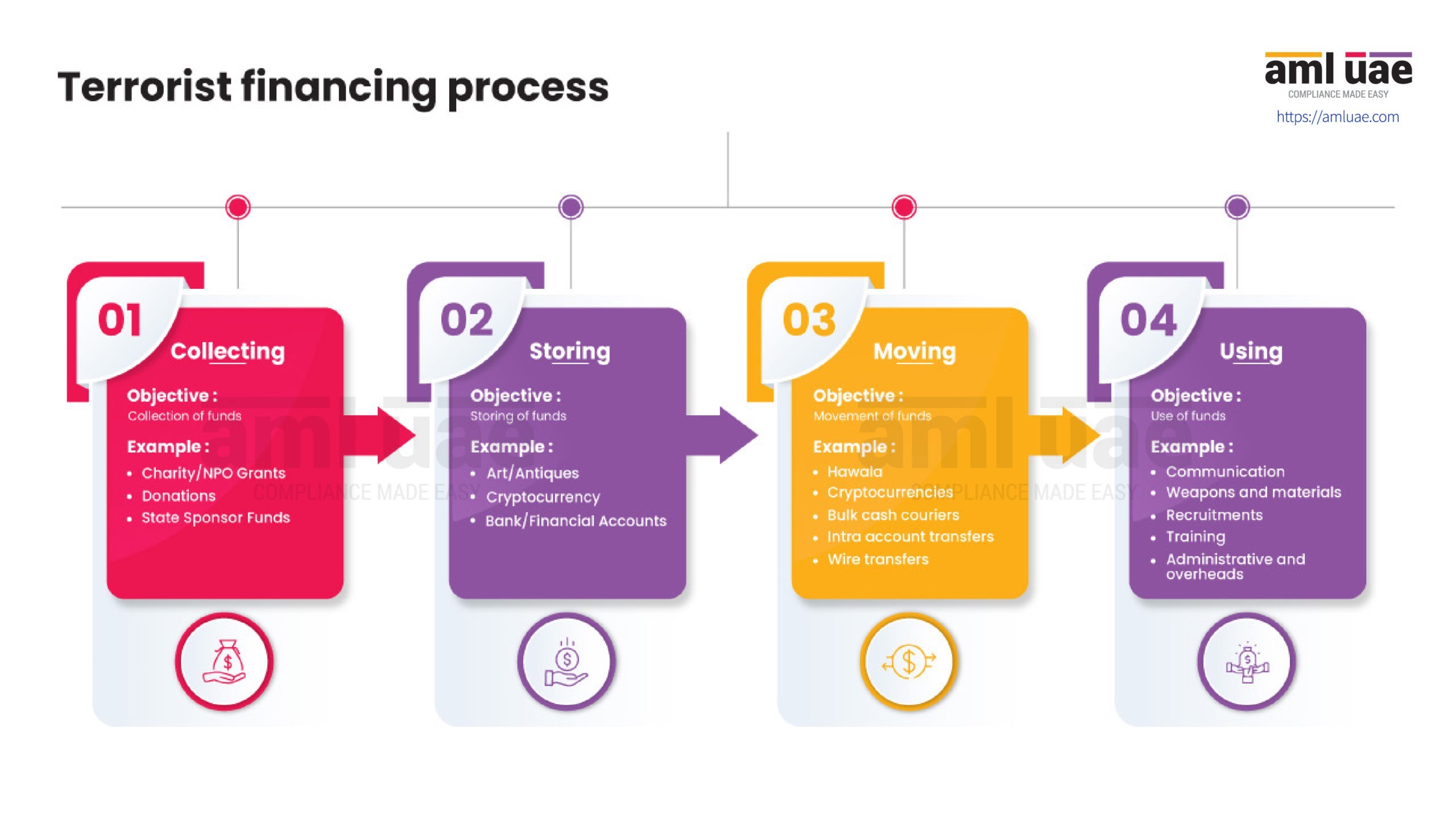
Terrorism Financing is the process of providing financial assistance to terrorists. Terrorists use various methods to avoid the vigilant eyes of law enforcement and crime prevention authorities.

They collect funds from charity/NPO grants and donations and then buy expensive items like antiques or crypto or store funds into bank accounts. They then try to transfer funds to the desired location and account by making hawala transactions, dealing with crypto, or wire transfers. Finally, they use the funds for terrorist activities.

The above infographic depicts the overall Terrorist Financing process. It is also available as a free download in pdf format.

FAQs - Terrorist Financing Process

How are terrorist organisations financed? 

Terrorist organisations are financed through legal or illegal sources. Illegal sources can range from trafficking, cybercrime, kidnapping, corruption, bribery, financial fraud, embezzlement, market abuse, forgery, etc. Legal sources include state sponsorship, microfinancing, donations, remittances, legal business activities, etc.  

The primary sources of terrorist financing can be legal or illegal. Legal sources include government funds, conducting legal business, cultural activities, etc. Illegal sources include corruption, financial fraud, bribery, embezzlement, drugs and human trafficking, cybercrime, kidnapping, etc.  

The three steps of terrorism financing are: 

  • Collecting funds through microloans, donations, charity/NPO grants, etc. 
  • Transferring these funds to terrorist organisations, networks, or cells 
  • Using these funds to fund the activities of terrorists such as buying weapons, bombs, paying for expenses, etc.  

Related Posts

Confused with how to mitigate ML, FT, and PF risks within your Regulated Entity?

How to effectively handle compliance risk

How to manage compliance risk copy (1)-02

7 Crucial steps to handle compliance risk

How to manage compliance risk copy (1)-02

7 Crucial steps to handle compliance risk

Risk assessment is the key to handling compliance risk. Knowing what risks your organization is exposed to and what control mechanisms are already there in place will help you identify the extra measures you need to take and the residual risk that you are willing to take. It is important that you manage your risks related to third parties and develop an ethical business culture. You also need to keep yourself abreast of the latest rules and regulations related to various laws applicable to your business. You will be better off if you harness the power of technology and automate some of the routine compliance work.

Related Posts

Confused with how to mitigate ML, FT, and PF risks within your Regulated Entity?

Customer Due Diligence Process Chart

Customer Due Diligence

Customer Due Diligence Process Chart

Customer Due Diligence Process Chart

KYC and Customer Due Diligence are the most critical part of the entire AML compliance framework. Designated businesses are required to collect the necessary details about their customers and carry out the risk categorization basis the same. If the risk rating indicates involvement of HIGH risk, then Enhanced Customer Due Diligence is called for, wherein specific additional details are sought from the customer. Once a customer relationship is established, the customer profile and transactions must be monitored regularly to be alert around the updates in customers’ profiles and the possibility of money laundering activities. If any suspicion is observed, the customer and the transaction/activity should be immediately reported to the FIU.

Related Posts

Confused with how to mitigate ML, FT, and PF risks within your Regulated Entity?

AML UAE PEP Screening Guide

PEP Screening Guide

PEP Screening Guide

PEP Screening Guide

PEP Screening Guide

Screening is integral to the customer onboarding process and AML Compliance framework. Screening is performed to identify whether any customer or business associate is sanctioned, has a criminal history, or is politically exposed (PEP). The idea to screen the PEP is because these people influence the country’s politics and economy. Further, being in a political position makes them more vulnerable to financial crimes like bribery or corruption. PEP screening has been made mandatory to check on these financial crimes, as such persons are subject to Enhanced Due Diligence, where the details around the source of funds are sought.

Related Posts

Confused with how to mitigate ML, FT, and PF risks within your Regulated Entity?