

Iraq and Bosnia and Herzegovina Added, Algeria and Namibia Removed from FATF Grey List Countries, 19th June 2026

Iraq and Bosnia and Herzegovina Added, Algeria and Namibia Removed from FATF Grey List Countries update 19th June 2026

Iraq and Bosnia and Herzegovina Added, Algeria and Namibia Removed from FATF Grey List Countries, 19th June 2026

Published On: 06/19/2026

Last Reviewed On: 07/24/2026   |   Last Updated On: 07/24/2026

Outcome of FATF Plenary, 19th June 2026

  • The FATF June 2026 Plenary added Iraq and Bosnia and Herzegovina to the grey list and removed Algeria and Namibia.
  • The grey list, formally Jurisdictions Under Increased Monitoring, now stands at 22 jurisdictions.
  • The black list, formally High-Risk Jurisdictions Subject to a Call for Action, is unchanged: Iran, North Korea and Myanmar.
  • The Plenary, held in Paris from 17 to 19 June, was the final one under Mexico’s Presidency. The United Kingdom takes over from 1 July 2026.
  • UAE FIs, DNFBPs and VASPs should feed the change into their country risk, EWRA, screening and due diligence using a risk-based approach, without indiscriminate de-risking.

On 19 June 2026, FATF added Iraq and Bosnia and Herzegovina to its grey list and removed Algeria and Namibia. The grey list now includes 22 jurisdictions under increased monitoring. The FATF black list remains unchanged, covering Iran, North Korea and Myanmar.
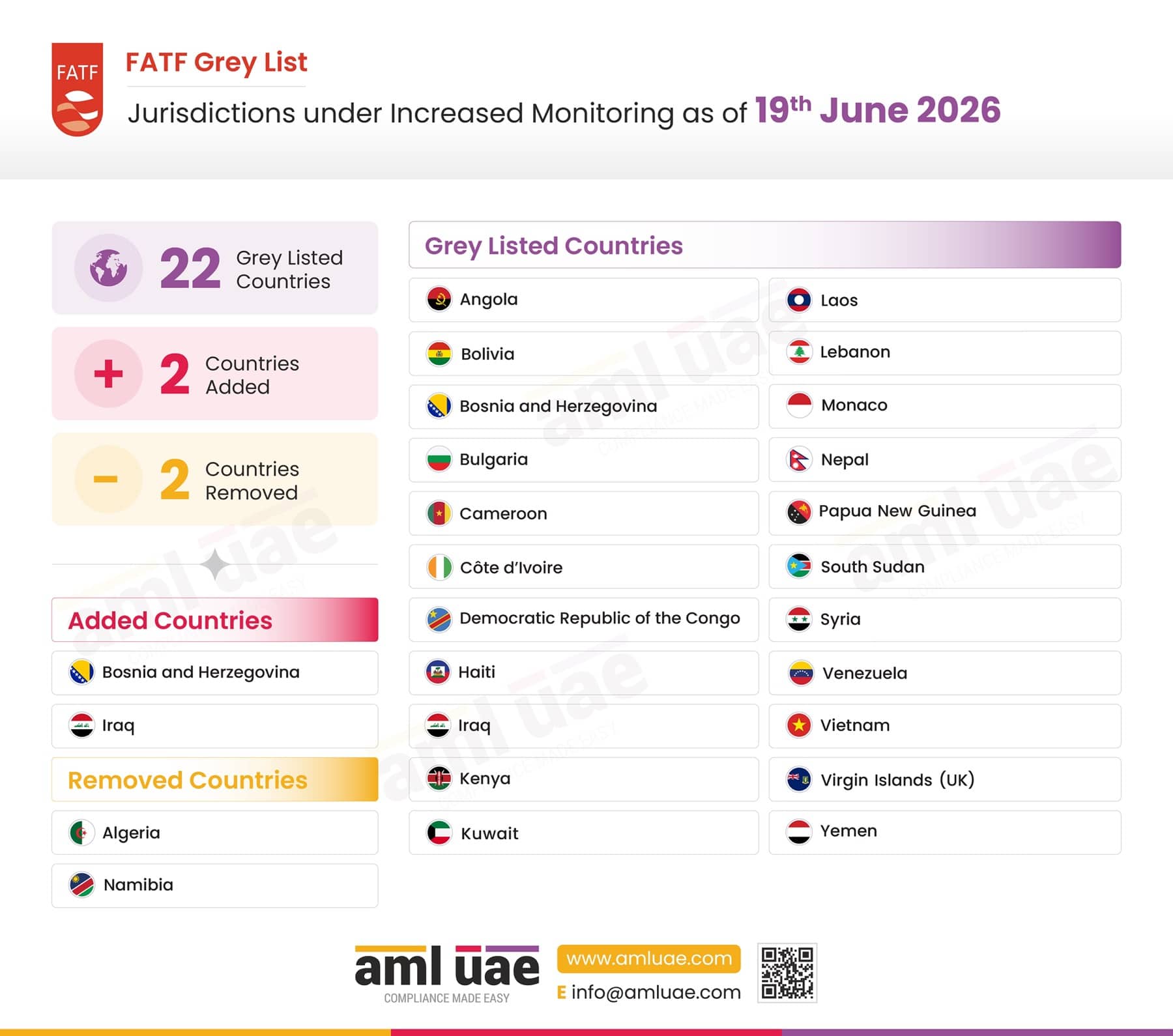
Key takeaways of the FATF Plenary June 2026

On 19 June 2026, the Financial Action Task Force (FATF) concluded its June Plenary and updated its lists of monitored and high-risk jurisdictions. This FATF grey list update for June 2026 is summarised below.

  • Added to the Grey List: Iraq; Bosnia and Herzegovina
  • Removed from the Grey List: Algeria; Namibia
  • Black List (Call for Action): No Change: Iran, North Korea, Myanmar

What changed on the FATF Grey List in June 2026

The FATF reviews its grey list of jurisdictions under increased monitoring at each Plenary, which meets three times a year, in February, June and October. At the June 2026 Plenary it made two additions and two removals.

Countries Added to Increased Monitoring on 19th June 2026

Bosnia and Herzegovina and Iraq were added to the list of jurisdictions under increased monitoring. Both have committed to action plans to address strategic deficiencies in their measures against money laundering, terrorist financing and proliferation financing, within agreed timeframes.

Countries Removed from FATF Grey List on 19th June 2026

Algeria and Namibia were removed after successful on-site visits confirmed they had completed their action plans. Algeria will continue working with its FATF-style regional body, MENAFATF, and Namibia with ESAAMLG, to sustain the improvements.

FATF Grey List countries in full, as of 19 June 2026

The following 22 jurisdictions are under increased monitoring after the June 2026 Plenary. Official FATF names are used, with the common name in brackets where helpful. The two newest additions are marked.

1. Angola
2. Bolivia
3. Bosnia and Herzegovina (Added 19th June 2026)
4. Bulgaria
5. Cameroon
6. Cote d’Ivoire
7. Democratic Republic of Congo
8. Haiti
9. Iraq (Added 19th June 2026)
10. Kenya
11. Kuwait

12. Laos
13. Lebanon
14. Monaco
15. Nepal
16. Papua New Guinea
17. South Sudan
18. Syria
19. Venezuela
20. Vietnam
21. Virgin Islands (UK)
22. Yemen

FATF Blacklist countries in full, as of 19 June 2026

The FATF blacklist for 2026, formally High-Risk Jurisdictions Subject to a Call for Action, was not changed at this Plenary. These three jurisdictions remain subject to enhanced due diligence and, in the most serious case, countermeasures.

  1. Iran: Call for action and countermeasures by FATF members.
  2. Democratic People’s Republic of Korea (North Korea): Call for action and countermeasures by FATF members.
  3. Myanmar: Call for enhanced due diligence proportionate to the risk.

What the grey list and black list actually mean

The grey list identifies jurisdictions that are actively working with the FATF to fix strategic AML/CFT/CPF deficiencies under an agreed action plan. Importantly, FATF does not call for enhanced due diligence to be applied to a jurisdiction solely because it is grey-listed, and it discourages indiscriminate de-risking. Grey-list status is an input into a firm’s risk assessment, not an automatic trigger for enhanced measures.

The black list identifies jurisdictions with serious deficiencies, where the FATF calls on members to apply enhanced due diligence and, for the highest risk, countermeasures.

Wider outcomes of the June 2026 Plenary

Beyond the list changes, the Plenary agreed several measures that shape the year ahead:

  • Presidency handover: This was the final Plenary under the Mexican Presidency of Elisa de Anda Madrazo. Giles Thomson of the United Kingdom becomes FATF President from 1 July 2026, with priorities on fraud, the risk-based approach and information sharing.
  • New Vice-President: Vivek Aggarwal of India was appointed incoming FATF Vice-President for July 2026 to June 2027.
  • Recommendation 6 updated: Targeted financial sanctions standards now carry the humanitarian exemption in UN Security Council Resolutions 2664 and 2761, so sanctions do not block humanitarian assistance and basic human needs.
  • Recommendation 16 consultation: A public consultation was approved on guidance to implement the strengthened cross-border payment transparency standard.
  • Mutual evaluations: The Plenary adopted the mutual evaluation reports of Canada and Turkiye, to be published in late 2026.

UAE AML compliance: What regulated entities should do now

UAE Financial Institutions, Designated Non-Financial Businesses and Professions (DNFBPs) and Virtual Asset Service Providers (VASPs) should treat this FATF grey list update as a trigger to reassess exposure, not as a reason to de-risk wholesale. Recommended actions:

  1. Refresh the country risk model and the Enterprise-Wide Risk Assessment (EWRA) to reflect Iraq and Bosnia and Herzegovina as higher risk, and to re-rate Algeria and Namibia.
  2. Update screening and risk metrics so country risk lists, customer risk assessment scoring and transaction monitoring rules carry the revised grey list.
  3. Apply a risk-based approach to due diligence. Apply enhanced due diligence or enhanced monitoring where the risk assessment warrants it, particularly for customers, beneficial owners, counterparties, transactions or delivery channels linked to higher-risk jurisdictions. For jurisdictions subject to a FATF call for action, apply enhanced due diligence and countermeasures, where required, in line with applicable UAE regulatory requirements and the firm’s risk-based framework.
  4. Refresh sanctions and name screening and confirm regulatory reporting workflows reflect the updated risk landscape.
  5. Update policies, procedures and controls to evidence the change, and record the rationale to demonstrate a risk-based approach.
  6. Brief and train staff so front-line and compliance teams handle affected relationships consistently.

Does the FATF grey list affect UAE customer onboarding?

Grey-list status should be used as an input into country risk scoring, customer risk rating, due diligence decisions, transaction monitoring and senior management escalation. It should not lead to automatic rejection or blanket de-risking of customers connected to a grey-listed country. A UAE firm should document how the listing feeds its risk-based approach, and reserve enhanced measures for relationships its own assessment rates as higher risk.

FAQs on FATF Greylist update June 2026

Which countries were added to the FATF grey list in June 2026?

Iraq and Bosnia and Herzegovina were added to the list of jurisdictions under increased monitoring at the 19 June 2026 Plenary.

Algeria and Namibia were removed after completing their action plans and passing on-site visits.

The following twenty-two jurisdictions are under increased monitoring after the June 2026 Plenary:

1. Angola
2. Bolivia
3. Bosnia and Herzegovina (Added 19th June 2026)
4. Bulgaria
5. Cameroon
6. Cote d’Ivoire
7. Democratic Republic of Congo
8. Haiti
9. Iraq (Added 19th June 2026)
10. Kenya
11. Kuwait
12. Laos
13. Lebanon
14. Monaco
15. Nepal
16. Papua New Guinea
17. South Sudan
18. Syria
19. Venezuela
20. Vietnam
21. Virgin Islands (UK)
22. Yemen


The black list, formally High-Risk Jurisdictions Subject to a Call for Action, is unchanged: Iran, North Korea and Myanmar.

No. Grey-listing is not a sanction, and FATF does not call for enhanced due diligence solely because a country is grey-listed. It signals that a risk-based approach should be applied, with enhanced measures reserved for relationships a firm’s own assessment rates as higher risk.

After each Plenary, which is held three times a year, in February, June and October.

Need Support Updating Compliance Framework with FATF List Updates?

We help you assess the impact of recent grey list changes on your business and update your risk assessment, policies, procedures, and controls accordingly.

Share via :

Share via :

UAE Removed from FATF Grey List

FATF Grey List February 2024

UAE removed from the FATF Grey List

FATF Grey List February 2024

UAE removed from the FATF Grey List

On 23rd February 2024, UAE was removed from the FATF Grey List, a list also known as jurisdiction under increased monitoring list, which includes countries that are actively working with the FATF to address strategic deficiencies in their regimes to counter money laundering, terrorist financing and proliferation financing.

At the FATF plenary meeting held from 21st to 23rd February 2024, UAE was confirmed to have successfully shown that it had met the action points and consequently been removed from the grey list. Similarly, Gibraltar, Barbados, and Uganda have also been removed from the Grey List.

Further, Kenya and Namibia are now added to the FATF grey list. 

The United Arab Emirates was added to the Grey List on 4th March 2022. The UAE was supposed to fully implement FATF recommendations set out in its action plan that was issued following the UAE’s 2020 Mutual Evaluation.

The FATF recognised the variety of reforms taken by the UAE since its inclusion in the grey list, including:
1. The establishment of an Executive Office to counter ML/TF
2. Establishment of a special court to combat financial crimes
3. Adoption of new AML/CFT guidelines for FIs and DNFBPs
4. Adoption of a new penal code strengthening UAE’s ML/TF, anti-bribery and corruption regulations

The EOCN (Executive Office for Control and Non-Proliferation) and its team worked tirelessly to ensure compliance with the FATF recommendations and to enforce the national AML/CFT action plan. It also developed an automated intelligence platform called FawriTick that integrates details of financial crimes.  Further, a reporting platform was specifically developed to address the AML/CFT compliance needs. 

Fines worth more than AED 115 million were issued for money laundering, and more than 8000 inspections were carried out. The authorities seized AED 925 million in breaches of AML practices and procedures. 

The United Arab Emirates signed various preliminary agreements for anti-financial crime and ratified extradition treaties with South Africa and Denmark. 

The authorities are now working on the UAE’s National Risk Assessment plan which should be ready by the end of 2024.

All of the above reforms and strong enforcement helped take UAE out of Grey List.

Changes in FATF Grey List

Countries Removed from FATF's Grey List (Jurisdiction Under Increased Monitoring):

  • UAE
  • Gibraltar
  • Barbados
  • Uganda

Country Added to FATF's Grey List (Jurisdictions under Increased Monitoring):

  • Kenya
  • Namibia

FATF Grey List as of 23rd February 2024 / Jurisdictions Under Increased Monitoring 23rd February 2024

1. Bulgaria
2. Burkina Faso
3. Cameroon
4. Croatia
5. Democratic Republic of Congo
6. Haiti
7. Jamaica
8. Mali
9. Mozambique
10. Nigeria
11. Philippines

12. Senegal
13. South Africa
14. South Sudan
15. Syria
16. Tanzania
17. Türkiye
18. Vietnam
19. Yemen
20. Kenya
21. Namibia

Our timely and accurate AML consulting services

For your smooth journey towards your goals

Implication of UAE's exit from FATF Grey List

The Financial Action Task Force’s decision to remove the UAE from the list of High-Risk Countries under Increased Monitoring (Grey List) is a welcome move and a recognition of the efforts put in by the country to strengthen its AML/CFT framework. The likely implications of UAE’s removal from Grey List are:

1. Less processing costs and time for international transactions involving foreign currency
2. Increased foreign trade and investments in the UAE
3. Lower bank charges
4. Enhanced credibility of the country’s financial system
5. Increased job opportunities due to an increase in international trade and investment

Action Items for FIs, DNFBPs, and VASPs consequent to changes in FATF Grey List

  1. Take a risk-based approach and conduct an Enterprise-Wide Risk Assessment (EWRA) if necessary.
  2. Align internal policies and procedures with EWRA.
  3. Assess the impact of FATF Grey List changes on Customer Risk Assessment procedures and conduct customer due diligence accordingly.
  4. Make changes to the High-Risk Countries list maintained by the entity.

Is it positive for the UAE to no longer be on the greylist?

The greylisting of a country by FATF affects a country adversely. Such countries are under increased monitoring, resulting in high costs associated with international trade, which eventually impacts its growth.It’s a huge advantage for UAE to come off the FATF Grey List. 

Save yourself from non-compliance penalties

By hiring AMLUAE for AML/CFT compliance

Share via :

Share via :

Jordan, Cayman Islands, Panama, and Albania removed from the FATF Grey List

Circular-no-08-aml-2021

Jordan, Cayman Islands, Panama, and Albania removed from the FATF Grey List

Circular-no-08-aml-2021

Jordan, Cayman Islands, Panama, and Albania removed from the FATF Grey List

On 23rd February 2024, UAE was removed from the FATF Grey List, a list also known as jurisdiction under increased monitoring list, which includes countries that are actively working with the FATF to address strategic deficiencies in their regimes to counter money laundering, terrorist financing and proliferation financing.

On 27th October 2023, Jordan, Cayman Islands, Panama, and Albania were removed from the FATF Grey List, a list also known as jurisdiction under increased monitoring list, which includes countries that are actively working with the FATF to address strategic deficiencies in their regimes to counter money laundering, terrorist financing and proliferation financing.

At the FATF plenary meeting ending on 27 October 2023, Jordan, Cayman Islands, Panama, and Albania were confirmed as having successfully shown that they had met the action points during the FATF onsite visit and have consequently been removed from the grey list.

Changes in FATF Grey List

Countries Removed from FATF's Grey List (Jurisdiction Under Increased Monitoring):

  • Jordan
  • Cayman Islands
  • Panama
  • Albania
  • UAE
  • Gibraltar
  • Barbados
  • Uganda

Country Added to FATF's Grey List (Jurisdictions under Increased Monitoring):

  • Bulgaria
  • Kenya
  • Namibia

FATF Grey List as of 27th October 2023

1. Bulgaria
2. Burkina Faso
3. Cameroon
4. Croatia
5. Democratic Republic of Congo
6. Haiti
7. Jamaica
8. Mali
9. Mozambique
10. Nigeria
11. Philippines
12. Senegal
13. South Africa
14. South Sudan
15. Syria
16. Tanzania
17. Türkiye
18. Vietnam
19. Yemen
20. Kenya
21. Namibia

Share via :

Share via :

Cameroon, Croatia, Vietnam put on FATF Grey List | 23rd June 2023

Cameroon, Croatia, Vietnam put on FATF Grey List | 23rd June 2023

Circular-no-08-aml-2021

Cameroon, Croatia, Vietnam put on FATF Grey List June 2023

On 23rd June 2023, the Financial Action Task Force (FATF), an international body combatting money laundering, revealed its latest update. Cameroon, Croatia, and Vietnam have been added to the list of jurisdictions under increased monitoring, known as the “grey list.”

These three nations now join the ranks of 23 others actively collaborating with the FATF to rectify strategic deficiencies within their systems. The focus of these efforts is to effectively combat money laundering, terrorist financing, and proliferation financing.

The updated list of Jurisdictions under Increased Monitoring – 23rd June 2023 – FATF Grey List – High Risk Countries

  1. Albania
  2. Barbados
  3. Burkina Faso
  4. Cameroon
  5. Cayman Islands
  6. Croatia
  7. Democratic Republic of Congo
  8. Gibraltar
  9. Haiti
  10. Jamaica
  11. Jordan
  12. Mali
  13. Mozambique
  14. Nigeria
  15. Panama
  16. Philippines
  17. Senegal
  18. South Africa
  19. South Sudan
  20. Syria
  21. Tanzania
  22. Türkiye
  23. Uganda
  24. United Arab Emirates
  25. Vietnam
  26. Yemen

Is Vietnam a grey listed country?

Yes, Vietnam is a grey listed country. The Financial Action Task Force, in its latest update on 23rd June 2023, put Vietnam into the list of jurisdictions under increased monitoring commonly referred to as FATF grey list. 

Is Cameroon a grey listed country?

Yes, Cameroon is a grey listed country. The Financial Action Task Force, in its latest update on 23rd June 2023, put Cameroon into the list of jurisdictions under increased monitoring commonly referred to as FATF grey list.

Is Croatia a grey listed country?

Yes, Croatia is a grey listed country. The Financial Action Task Force, in its latest update on 23rd June 2023, put Croatia into the list of jurisdictions under increased monitoring commonly referred to as FATF grey list.

Share via :

Share via :

Partnership with Castellum.AI-Global Compliance Screening Solution

Updates

Partnership with Castellum.AI - a Global Compliance Screening Solution

AML compliance made way more simple, efficient, and effective!

AML UAE is excited to announce that it has partnered with Castellum.AI.

Anti-Money Laundering SoftwareAML UAE is focused on assisting clients in complying with anti-money laundering regulations in UAE and the GCC countries. It has been offering a wide range of services on AML compliances in UAE, such as assistance in goAML registration, documenting the AML Policy, reporting suspicious transactions with FIU, selection of AML screening software, etc. On popular demand of our clients and to complete the offerings on AML, AML UAE has partnered with Castellum.AI, a global compliance screening solution.

The partnership with Castellum.AI adds a new dimension of world-class compliance capabilities to AML UAE’s offerings. Together, AML UAE and Castellum.AI will help DNFBPs, FIs, and VASPs comply with the sanctions screening requirements of the Cabinet Resolution No. 74 of 2020. Castellum.AI not only supports screening corporates and individuals against the sanctions but also a list of PEPs, law enforcement, export control, and other databases.

Pathik Shah, AML UAE’s Founder, said, “We are constantly looking for new ways to empower our clients in overcoming compliance hurdles and providing real-time protection against ML/TF risks. Sanctions compliance is crucial in the fight against financial crime, and technology plays a huge role in complying with the requirements of the law. Our partnership with Castellum.AI fills the gap we had in our service offering and makes AML UAE a one-stop solution for the compliance needs of our clients across various sectors.”

AML Software

“We strongly believe in Castellum.AI’s capabilities and patented technology enriched with 1000+ watch lists and global data on PEP as well as shelf companies. We are excited about our partnership with AML UAE and protecting businesses in UAE from compliance risks,” said Peter Piatetsky, CEO of Castellum.AI.

“Together, AML UAE and Castellum.AI make available the best of both worlds and bring a strong combination of expert advice and AML Software to help entities in UAE fight against money laundering, terrorist financing, and other financial crimes.”

On 3rd Nov. 2022, AML UAE conducted a webinar, jointly with Castellum.AI, on sanctions compliance requirements in the UAE. During the session, a brief walkthrough was given on a screening solution (Castellum.AI), discussing its features, capabilities, etc., necessary to stay compliant with sanctions requirements in the country. If you missed attending the webinar, you can watch the recording of the session below.

About AML UAE

AML UAE is an AML compliance services provider specifically focusing on the UAE market. It is dedicated to improving the compliance of businesses in UAE with all the relevant anti-money laundering and combating the financing of terrorism rules and regulations. AML UAE provides various services, including business risk assessment, AML/CFT policy documentation, in-house AML compliance department setup, AML training, AML/CFT health Check, regulatory reporting, and managed services for KYC and due diligence.

Contact: Pathik Shah – [email protected]

About Castellum.AI - A Global Compliance Screening Solution

Castellum.AI is a Public Benefit Corporation formed to organize the world’s compliance data and make it universally accessible, affordable, and useful. Today Castellum.AI empowers more than 1400 users and 400+ organizations to fight against the menace of financial crime. Its Investigator Platform supports more than 100 languages, and its watchlist database is updated every 5 minutes. It follows an AI-powered proprietary search algorithm providing relevant results without creating a flood of false positives.

Contact: Peter Piatetsky – [email protected]

A Global Compliance Screening Solution

To make your AML compliance simple, efficient, and effective.

Add a comment

Share via :

About the Author

Pathik Shah

FCA, CAMS, CISA, CS, DISA (ICAI), FAFP (ICAI)

Pathik is an ACAMS-certified AML consultant specialising in governance, risk, and compliance for regulated entities in the UAE. He brings over 28 years of experience, with 1,000+ hours of AML training and 200+ advisory engagements across DNFBPs, VASPs, and FIs. He supports businesses in aligning with AML/CFT requirements from the CBUAE, DFSA, MoET, MoJ, VARA, CMA, FSRA, and FATF. Known for translating complex regulations into audit-ready procedures, Pathik enables operational clarity and compliance readiness.

Reach Out to Pathik

goAML Reporting Requirements: Circular Number: 08/AML/2021

Circular-no-08-aml-2021

goAML Reporting Requirements : Circular Number: 08/AML/2021

Circular-no-08-aml-2021

goAML Reporting Requirements : Circular Number: 08/AML/2021​

goAML Reporting Requirements : Circular Number: 08/AML/2021​

For Dealers in Precious Metals & Stones licensed in the United Arab Emirates

Infographic By :- AML UAE 

goAML Circular Number 08

Share via :

Our recent downloads

Contact Form

side bar form

This field is for validation purposes and should be left unchanged.

Share via :

FAQs About goAML Reporting Requirements

What is goAML reporting? 

goAML is an integrated system used to fight against money laundering and terrorism financing. goAML reporting means submitting suspicious transactions reports (STRs) to the goAML system. Companies submit these STRs, which are analysed by this system and distributed further to other competent authorities.  

You must login to the goAML portal. If you have the report in XML format, you can upload them directly to the goAML database. If the report is not in XML format, you can upload it directly at goAML Web. Before logging in to the system, you need to create user credentials and fill in the profile details.