



AML Regulations for Dealers in Precious Metals and Stones (DPMS) in UAE
Published On: 04/28/2026
Protect your business with reliable and effective AML strategies with AML UAE.
Last Reviewed On: 07/21/2026 | Last Updated On: 07/21/2026
Key Highlights
- DPMS are brought into the AML/CFT perimeter at an AED 55,000 transaction threshold defined in Article 3(3) of Cabinet Resolution 134 of 2025.
- The Anti-Money Laundering Department of the Ministry of Economy and Tourism supervises DPMS operating in the mainland and commercial free zones.
- Every threshold-crossing transaction must be captured in a Dealers in Precious Metals and Stones Report (DPMSR) filed on goAML (MoE Circular 08/AML/2021).
- Gold refiners and supply-chain participants are subject to an additional 5-step responsible sourcing framework under Ministerial Decree 68 of 2024.
- Administrative fines for AML/CFT violations range from AED 50,000 to AED 1,000,000 per violation under Cabinet Resolution 71 of 2024.
- The UAE’s 2024 National Risk Assessment rates the sector’s inherent ML/TF risk as medium-to-high.
AML Regulations for Dealers in Precious Metals and Stones (DPMS) in UAE
The AML Regulations for DPMS in UAE sit inside the wider Designated Non-Financial Businesses and Professions (DNFBP) framework explained in our parent guide, AML Regulations for DNFBPs in UAE. Precious metals and stones markets combine high intrinsic value, cross-border mobility and deep cash reliance, which is why Federal Decree Law 10 of 2025, Cabinet Resolution 134 of 2025 and a dedicated set of Ministry of Economy and Tourism (MoET) circulars bring dealers in precious metals and stones inside the UAE’s AML/CFT/CPF perimeter.
This page explains the legal framework, the supervisory architecture, the 5-step gold sourcing overlay and the obligations that every DPMS must meet when it crosses the AED 55,000 threshold set out in Article 3(3) of the Executive Regulations.
At a Glance
- Perimeter: Any dealer in precious metals or precious stones carrying out a single cash transaction, or linked cash transactions, equal to or above AED 55,000 (Cabinet Resolution 134/2025, Article 3(3)).
- Primary supervisor: Ministry of Economy and Tourism (MoET) for mainland and commercial free zone DPMS.
- Governing law: Federal Decree Law 10 of 2025 (AML/CFT/CPF); Cabinet Resolution 134 of 2025 (Executive Regulations).
- Reporting trigger: DPMSR filed on goAML for each cash or wire transaction at or above AED 55,000 (MoE Circular 08/AML/2021).
- Gold sourcing overlay: Gold refineries and supply chain entities must apply the 5-step Due Diligence Regulations for Responsible Sourcing of Gold (Ministerial Decree 68/2024; Circular 2/2024).
- Penalty range: AED 50,000 to AED 1,000,000 per violation (Cabinet Resolution 71 of 2024).
- Sector risk rating: Medium-to-high ML/TF risk (UAE National Risk Assessment 2024).
- Population on goAML: 8,191 DPMS registered as of 30 June 2025; 1,448,825 DPMSRs filed Jul 2021 – Jun 2025 (UAEFIU Strategic Analysis Report on DPMS, Sept 2025).
Scope note
This page explains AML regulations applicable to dealers in precious metals and stones (DPMS) in the UAE, with specific coverage of gold sourcing and the AED 55,000 reporting threshold. Broader AML obligations that apply across all DNFBPs are explained in AML Regulations for DNFBPs in UAE.
What this DPMS Guide Covers
Three substantive sections walk you through perimeter, supervisor and the layered AML regulations for DPMS in UAE.
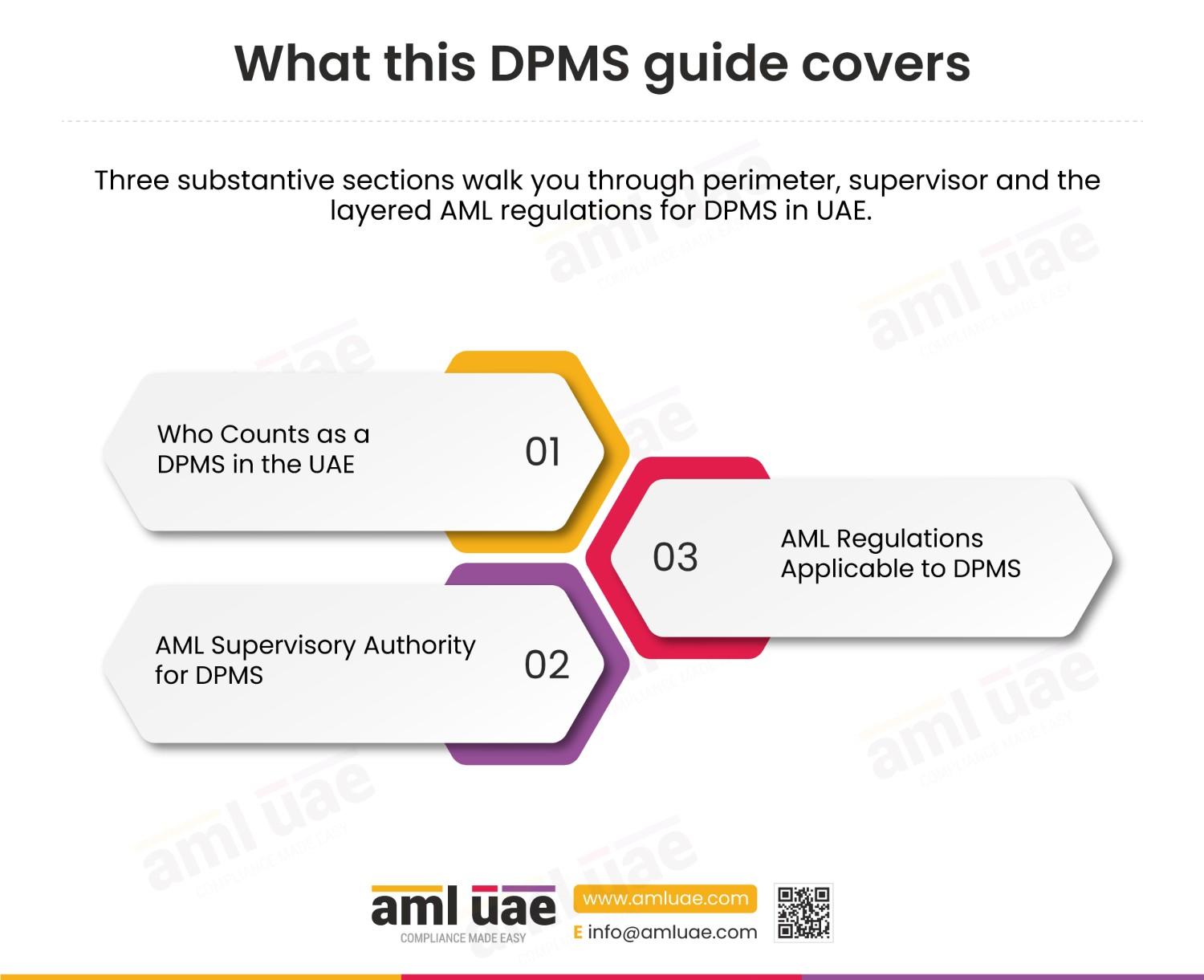
1. Who Counts as a DPMS in the UAE
2. AML Supervisory Authority for DPMS
3. AML Regulations Applicable to DPMS
Who Counts as a Dealer in Precious Metals and Stones (DPMS) in the UAE?
A dealer in precious metals and stones (DPMS) is any natural or legal person who, in the course of business, trades in precious metals or precious stones and who carries out a single cash transaction, or several linked cash transactions, at or above AED 55,000. This perimeter is set in Article 3(3) of Cabinet Resolution No. 134 of 2025 concerning the Executive Regulations of Federal Decree Law No. 10 of 2025.
The term covers gold retailers, jewellers, refineries, bullion wholesalers, diamond and coloured-stone traders, pearl traders and recycling operations within the Ministry of Economy and Tourism’s supervisory remit. The trigger is the AED 55,000 cash value; the rule applies equally to a single retail sale and to a string of related transactions that together cross the threshold. Transactions below AED 55,000 remain inside the AML system for record-keeping and suspicious transaction reporting, but they do not by themselves create DPMSR reporting exposure. The DPMSR reporting obligation and the applicability of the AML/CFT federal law are two different things. One should not confuse the applicability of the law with the DPMSR submission obligations.
Legal test
“Dealers in valuable metals and precious stones, when carrying out any single cash transaction or several transactions that appear to be linked and whose value equals or exceeds fifty-five thousand dirhams (AED 55,000).” — Article 3(3), Cabinet Resolution No. 134 of 2025.
Dealers established in the Abu Dhabi Global Market (ADGM) and the Dubai International Financial Centre (DIFC) are supervised by their own regulators (the ADGM RA and the DFSA, respectively) under rulebooks that mirror the federal AML/CFT regime; the substantive obligations and threshold logic track federal law, but the primary touchpoint is the financial free zone regulator rather than MoET.
AML Supervisory Authority for DPMS in the UAE
The Anti-Money Laundering Department within the Ministry of Economy and Tourism (MoET) is the federal supervisor for DPMS operating in the mainland and commercial free zones. This mandate is grounded in Cabinet decisions that assign DNFBP supervision to MoET and is reaffirmed in the DNFBP Guidelines issued by the Ministry in September 2025, which list DPMS among the four supervised categories alongside real estate agents and brokers, independent accountants and auditors, and trust and corporate service providers.
MoET enforces the AML/CFT obligations through on-site inspections, thematic reviews, administrative penalties imposed under Cabinet Resolution No. 71 of 2024, and circular-based guidance. It coordinates closely with the UAE Financial Intelligence Unit (UAEFIU), which operates the goAML reporting platform, and with the Executive Office for Control and Non-Proliferation (EOCN), which administers targeted financial sanctions. DPMS in ADGM and DIFC report to the ADGM RA and DFSA, respectively; DPMS in financial free zones follow the free zone’s AML framework, which cross-references to federal law.
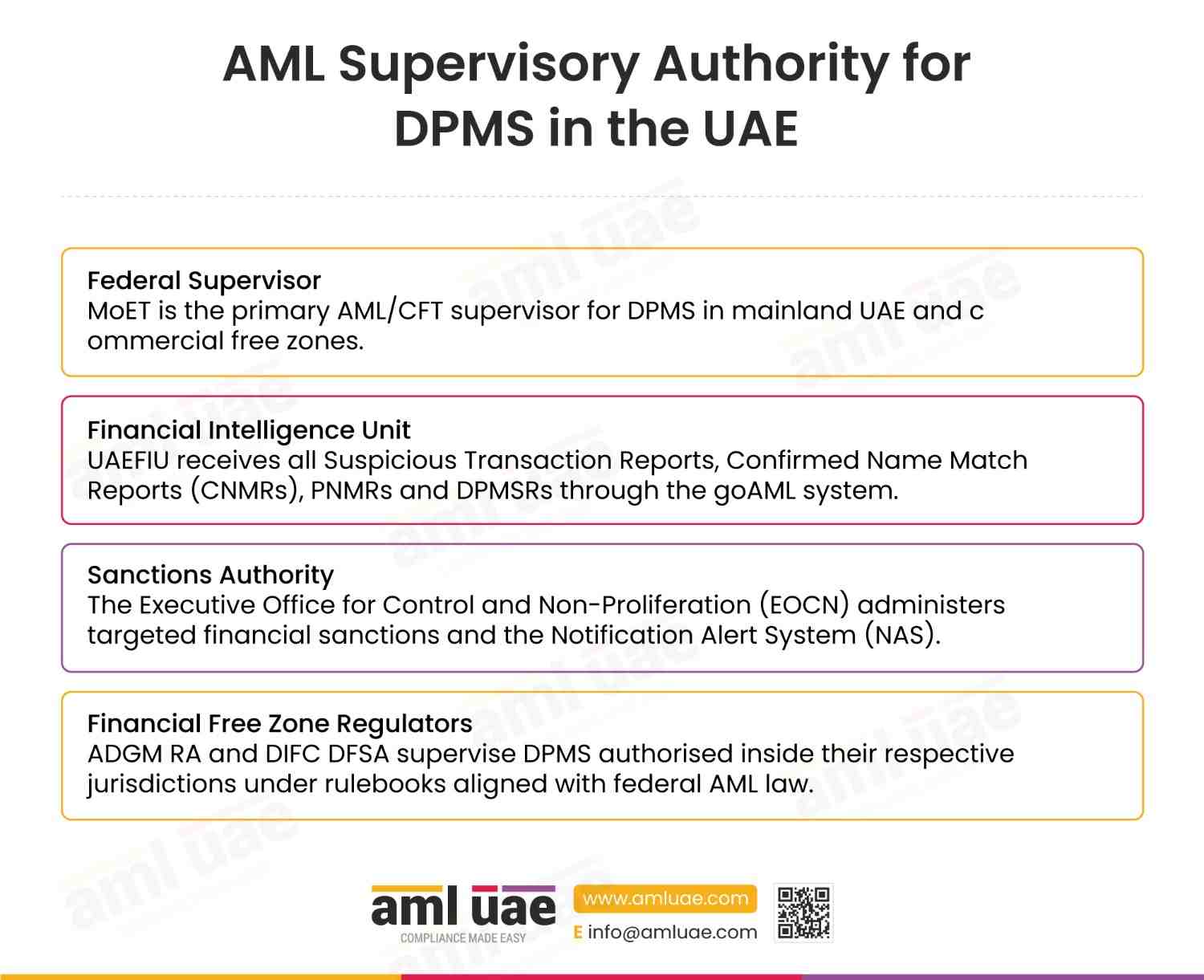
1. Federal Supervisor
MoET is the primary AML/CFT supervisor for DPMS in mainland UAE and commercial free zones.
2. Financial Intelligence Unit
UAEFIU receives all Suspicious Transaction Reports, Confirmed Name Match Reports (CNMRs), PNMRs and DPMSRs through the goAML system.
3. Sanctions Authority
The Executive Office for Control and Non-Proliferation (EOCN) administers targeted financial sanctions and the Notification Alert System (NAS).
4. Financial Free Zone Regulators
ADGM RA and DIFC DFSA supervise DPMS authorised inside their respective jurisdictions under rulebooks aligned with federal AML law.
AML Regulations Applicable to DPMS in the UAE
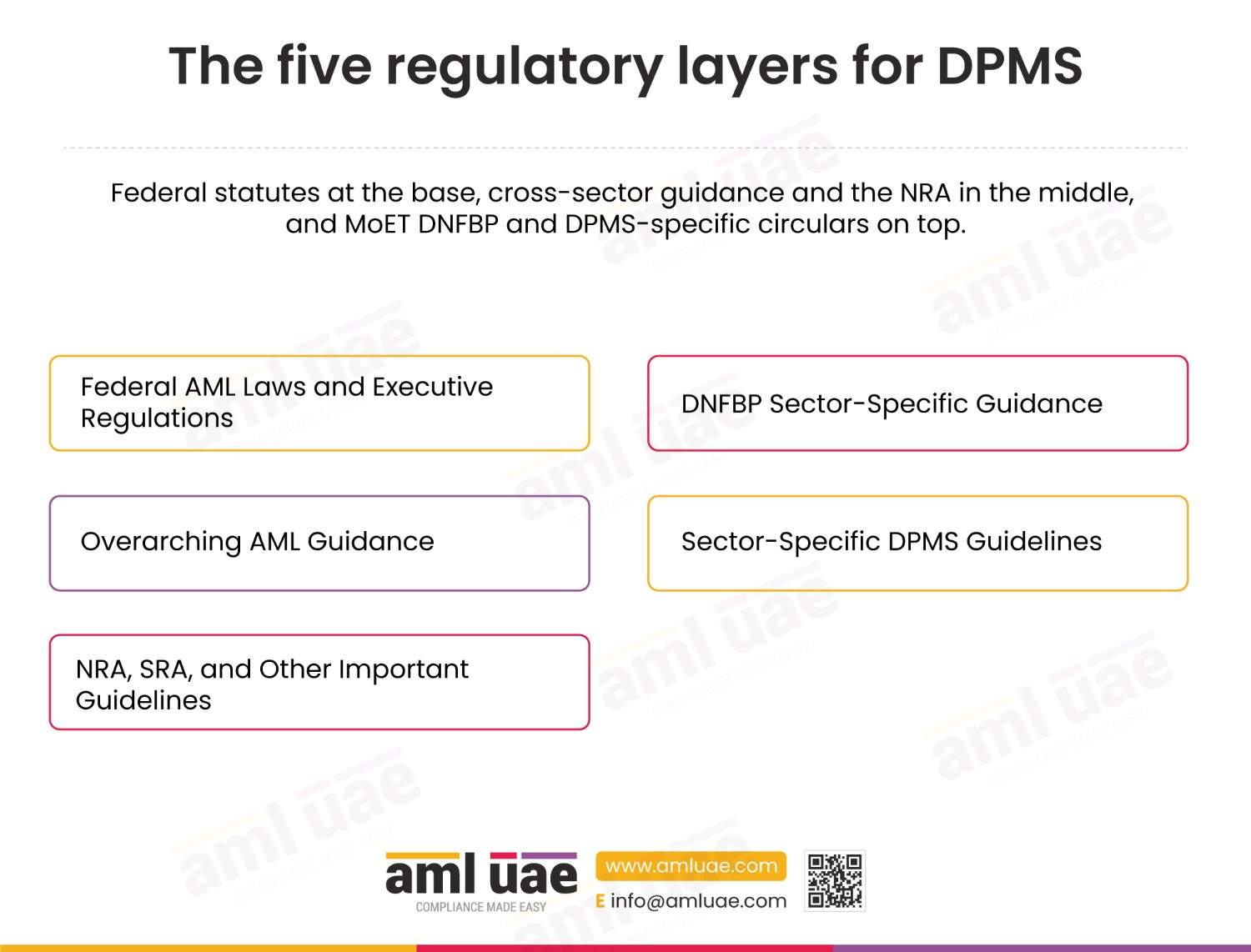
The AML regulations for DPMS in UAE are organised in five concentric layers: the federal AML statute and its executive and penalty regulations; cross-sector overarching guidance from the National Committee, the EOCN, the UAEFIU and other federal bodies; the National Risk Assessment; DNFBP sector-specific guidance and circulars issued by MoET; and sector-specific DPMS guidance addressing gold sourcing, goAML reporting and precious-metals typologies. The subsections below walk through each layer and cite the applicable instruments.
The Five Regulatory Layers for DPMS
Three substantive sections walk you through perimeter, supervisor and the layered AML regulations for DPMS in UAE.
Federal AML Laws and Executive Regulations Applicable to Dealers in Precious Metals and Stones
Federal primary and secondary legislation sets the baseline AML/CFT/CPF obligations that every DPMS must meet, regardless of whether it trades in gold bars, loose diamonds or polished jewellery. The federal layer is reinforced by two dedicated penalty resolutions and a beneficial-owner framework that every DPMS legal entity has to implement independently of its AML obligations.
Federal AML laws and executive regulations at a glance
Seven primary and secondary instruments that set the baseline AML/CFT/CPF obligations for every DPMS.
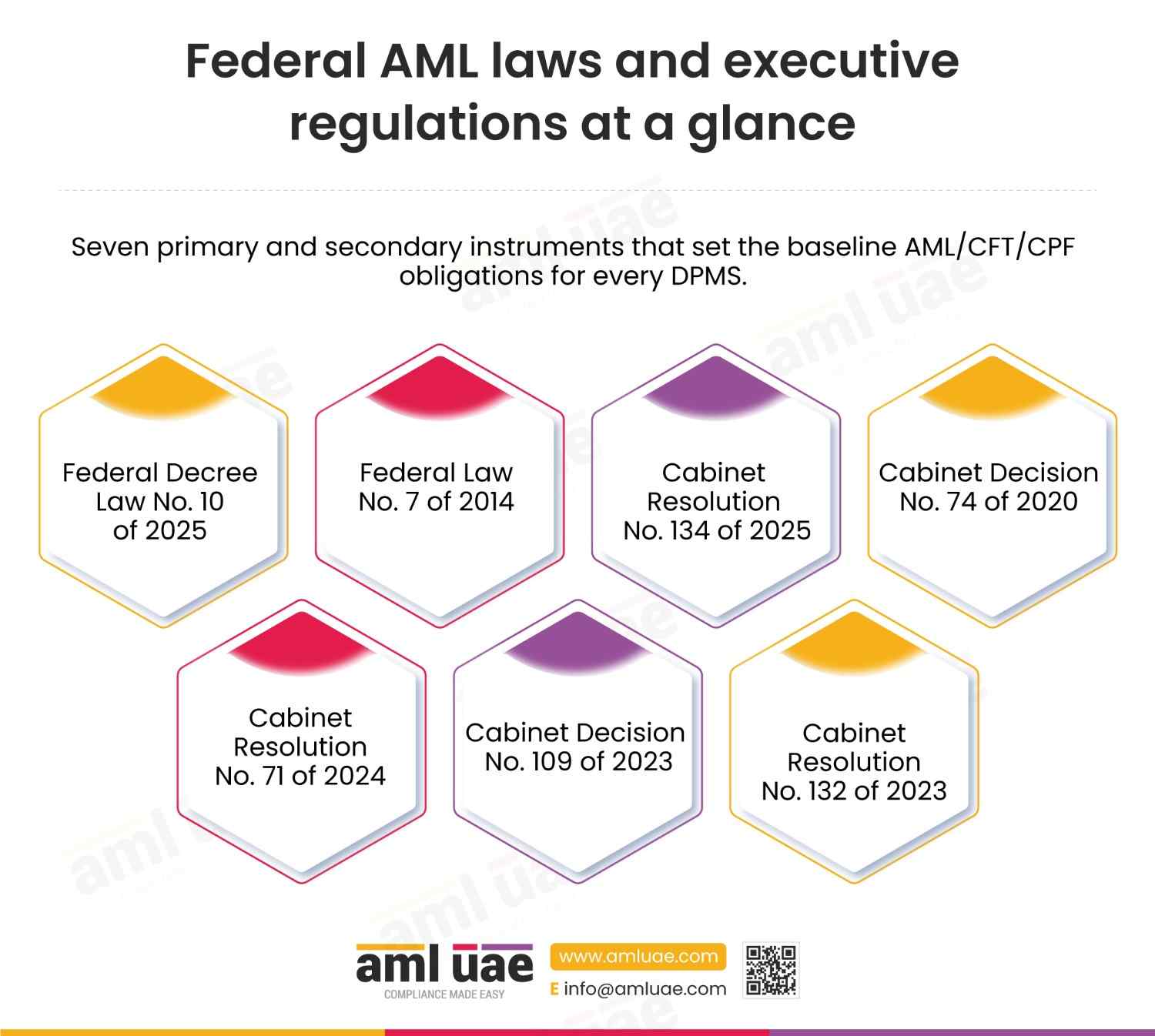
Federal Decree by Law No. (10) of 2025 Regarding Anti-Money Laundering, and Combating the Financing of Terrorism and Proliferation Financing
Federal Decree Law No. 10 of 2025 is the current primary AML/CFT/CPF statute in the UAE. It defines Designated Non-Financial Businesses and Professions as persons engaged in commercial or professional activities specified in the Executive Regulations, and makes those persons subject to the full suite of preventive obligations, including customer due diligence, record-keeping, suspicious transaction reporting, internal controls, training and cooperation with supervisory authorities.
Article 10 of the Decree Law (Chapter Four — Disclosure) confirms that every person entering or leaving the State must disclose the carriage of currencies, bearer negotiable instruments, precious metals or valuable stones in accordance with the disclosure system issued by the Federal Authority for Identity, Citizenship, Customs and Port Security in coordination with the Central Bank, which directly supports the precious-metals control environment within which DPMS operate.
The Decree Law establishes the UAEFIU, sets out criminal offences and sanctions, and empowers supervisory authorities to impose administrative penalties alongside judicial consequences. For the details of what each obligation means in practice, DPMS must read the Decree Law together with its Executive Regulations (Cabinet Resolution 134 of 2025) and the MoET DNFBP Guidelines.
Federal Law No. (7) of 2014 Combating Terrorism Crimes
Federal Law No. 7 of 2014 defines terrorism offences, terrorist organisations and the financing of terrorism. It is the criminal-law backbone behind the AML/CFT regime: when a DPMS identifies suspected terrorism-financing activity, the predicate offence is located in this Law and the related UNSC-implementing Cabinet Resolution 74 of 2020. Article 1 of Decree Law 10 of 2025 expressly refers to Federal Law 7 of 2014 in defining terrorist acts, thereby anchoring the AML statute within the criminal framework.
Cabinet Resolution No. (134) of 2025 Concerning the Executive Regulations of Federal Decree Law No. (10) of 2025
Cabinet Resolution 134 of 2025 is the executive regulation for Decree Law 10 of 2025 and contains the operational details that DPMS apply daily. Article 3(3) brings DPMS inside the perimeter at the AED 55,000 cash-transaction threshold. Article 7 sets out the triggers for customer due diligence, commencement of a business relationship, suspicion of a crime, doubts about previously obtained data, and occasional transactions at or above the thresholds. Article 8 requires ongoing monitoring, and subsequent articles set out enhanced due diligence, PEP handling, reliance on third parties, record-keeping and reporting obligations.
Where previous guidance, circulars or notifications refer to Federal Decree Law 20 of 2018 or Cabinet Resolution 10 of 2019, they continue to apply to the extent they are not repealed or inconsistent with Decree Law 10 of 2025 and Cabinet Resolution 134 of 2025. DPMS should therefore read every circular issued prior to 2025 through the lens of the new federal law.
Cabinet Decision No. 74 of 2020 Regarding Terrorism Lists Regulation and Implementation of UN Security Council Resolutions
Cabinet Decision No. 74 of 2020 regulates the UAE Local Terrorist List and the UAE’s implementation of United Nations Security Council resolutions on the suppression of terrorism, terrorism financing and the proliferation of weapons of mass destruction. It creates the legal basis on which DPMS must screen customers, beneficial owners and transaction counterparties against the UAE Local Terrorist List and the UN Consolidated List, apply freezing measures without delay, and report confirmed and partial name matches to the EOCN. The Cabinet Decision is enforced alongside circulars issued by MoET and EOCN that translate the obligations into reporting timelines.
Cabinet Resolution No. (71) of 2024 Regulating Violations and Administrative Penalties for DNFBPs Under the Ministry of Justice and the Ministry of Economy
Cabinet Resolution No. 71 of 2024 replaced Cabinet Resolution 16 of 2021 and sets out the unified list of AML/CFT violations and administrative fines for DNFBPs supervised by the Ministry of Economy (now MoET) and the Ministry of Justice (MoJ). Article 3 authorises the Ministry to impose one of the administrative penalties in Article 14 of the Decree Law, or the administrative fines in the annexed schedule, or both.
The annexed schedule covers more than forty categories of violations. Failure to adopt internal policies and controls is fined between AED 100,000 and AED 200,000. Failure to identify, assess and update crime risks is fined between AED 50,000 and AED 500,000. Failure to apply customer due diligence before or during a transaction at or above AED 55,000 is fined between AED 50,000 and AED 200,000. Failure to promptly file suspicious-transaction reports with the UAEFIU is fined between AED 100,000 and AED 500,000. Failure to implement UN Security Council sanctions decisions, directly relevant to DPMS given typology exposure, is fined between AED 100,000 and AED 1,000,000. Article 4 gives the violator thirty working days to grieve the penalty, and Article 5 permits the Ministry to amend, uphold or cancel the fine on review.
Cabinet Decision No. (109) of 2023 on Regulating the Beneficial Owner Procedures
Cabinet Decision No. 109 of 2023 regulates the identification, verification and continuous maintenance of the real (ultimate) beneficial owners of companies established in the UAE. A DPMS operating as a corporate licensee must maintain a register of beneficial owners, notify the licensing authority of changes within fifteen days and keep information current. Customer due diligence on corporate clients under Article 9 of the AML Executive Regulations draws on the same beneficial-owner concept, so the two frameworks operate in parallel: Decision 109 governs the DPMS’s own legal-person transparency, and the AML rules govern beneficial-owner identification of the DPMS’s customers.
Cabinet Resolution No. (132) of 2023 on Administrative Penalties for Beneficial Owner Violations
Cabinet Resolution No. 132 of 2023 sets out the administrative penalties for breaches of Cabinet Decision 109 of 2023. A DPMS that fails to disclose, update or maintain accurate beneficial-ownership data is exposed to written warnings to the legal person and financial penalties that escalate with repetition of the violation. Under Article 3(2) of Cabinet Resolution 132 of 2023, for violations committed for the third time, the Registrar has the right to suspend the commercial licence and close the commercial store of the violating legal person until the fine is paid and the breach is rectified. The penalty schedule is enforced by the Ministry of Economy and Tourism as the beneficial-owner registrar for most DPMS legal persons.
DPMS policy templates aligned to Decree Law 10/2025 and Cabinet 134/2025
AML UAE maintains up-to-date internal policies, customer due diligence procedures, DPMSR workflows and beneficial-owner registers engineered for the precious metals and stones sector.
Overarching AML Guidance Applicable to DPMS in the UAE
Alongside the federal statute, a catalogue of cross-sector guidance binds DPMS into the national AML/CFT/CPF architecture. These instruments explain how to implement targeted financial sanctions, counter proliferation finance, file reports on goAML and grieve sanctions-related decisions. Where a circular or guideline refers to the old Federal Decree Law 20 of 2018 and its executive regulation, it remains valid to the extent consistent with Decree Law 10 of 2025 and Cabinet Resolution 134 of 2025.
Thirteen cross-sector instruments from the EOCN, UAEFIU and National Committee that frame DPMS sanctions, CPF and reporting obligations.
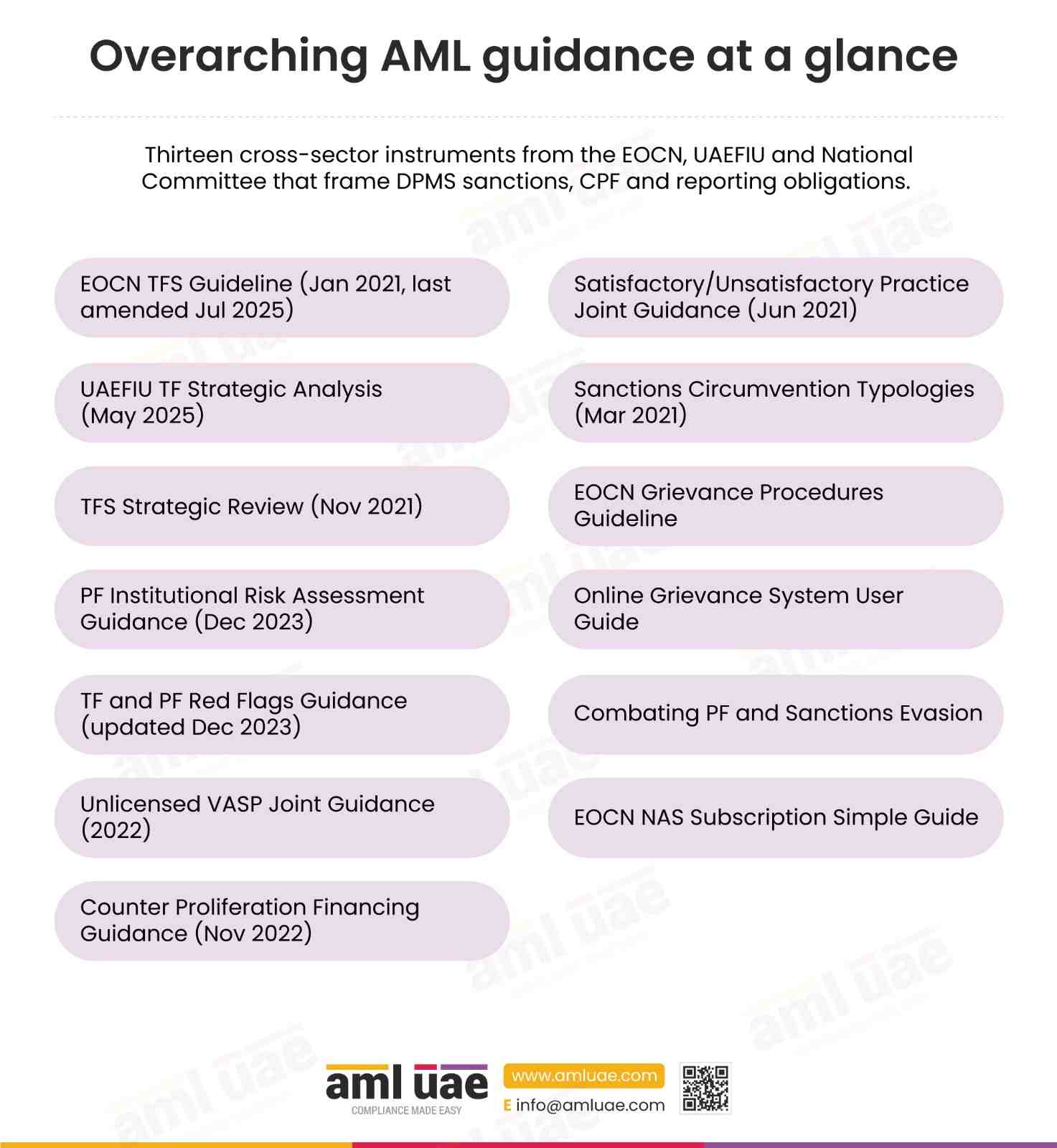
1. Guideline on Targeted Financial Sanctions for Financial Institutions, DNFBPs and VASPs — Executive Office for Control and Non-Proliferation (EOCN), issued January 2021, last amended July 2025
The EOCN TFS Guideline is the authoritative reference for how DPMS implement UN-led and UAE-local sanctions obligations. It explains the scope of TFS measures, the concept of ‘funds or other assets’, the screening expectations on customers, beneficial owners and counterparties, and the freezing obligation that must be executed without delay. The Guideline also sets the five-business-day reporting window for Confirmed Name Match Reports (CNMRs) and Partial Name Match Reports (PNMRs) on goAML, and DPMS rely on it to calibrate screening frequency, to interpret partial-match handling and to build CNMR and PNMR workflows.
2. UAEFIU’s Strategic Analysis Report on Terrorist Financing Typologies and Facilitators — May 2025
This UAEFIU strategic analysis sets out the dominant terrorist-financing typologies observed in the UAE and the facilitators most frequently exploited. For DPMS, the relevance lies in the report’s analysis of how precious metals and cash movements intersect with TF networks, and in the red-flag indicators that should feed into the DPMS’s transaction-monitoring rules and staff training.
3. Strategic Review on Targeted Financial Sanctions Case Studies 2019-2021 (IEC-SR.01.22) — Executive Office, November 2021
The Strategic Review compiles sanitised case studies from 2019 to 2021 where UAE private-sector obligations to apply TFS were tested. DPMS use these case studies to benchmark their own sanctions screening, to understand which typologies should trigger enhanced due diligence and to test the strength of their freezing and reporting playbooks.
4. Proliferation Finance Institutional Risk Assessment Guidance for FIs, DNFBPs and VASPs — December 2023
This Guidance explains how an institutional proliferation-finance risk assessment should be structured. DPMS, because of their exposure to dual-use goods pathways and to jurisdictions subject to UNSC proliferation-related sanctions, must run a specific proliferation-finance assessment as part of their wider business-wide risk assessment, separate from the ML and TF analyses.
5. Terrorist and Proliferation Financing Red Flags Guidance — December 2023
This cross-sector red-flag bulletin lists concrete indicators that front-line DPMS staff should watch for in transactions involving gold, bullion, high-value stones and jewellery. Where one or more red flags are present, the DPMS must escalate and, if suspicion persists, file an STR with the UAEFIU without delay.
6. Joint Guidance on Combating the Use of Unlicensed Virtual Asset Service Providers in the UAE — Central Bank, SCA, VARA, DFSA, FSRA and Ministries of Justice and Economy (2022)
DPMS frequently encounter customers who wish to settle precious metals purchases through virtual assets. This Joint Guidance from the Central Bank, CMA, VARA and ADGM/DIFC regulators sets out the obligations to deal only with licensed VASPs, and the red flags that indicate a counterparty is operating without a UAE VASP licence. DPMS integrating virtual-asset settlement must apply these expectations alongside their own AML controls.
7. Guidance on Counter Proliferation Financing for FIs, DNFBPs and VASPs — November 2022
This is the authoritative cross-sector CPF guidance. It explains the definition of proliferation financing in UAE law, the institutional risk assessment framework, the specific red flags linked to dual-use goods and the interaction with UNSC resolutions 1718 (DPRK) and 1737/2231 (Iran). DPMS sourcing or selling bullion and stones in trade-finance-heavy structures use this Guidance to build their CPF controls.
8. Joint Guidance on Satisfactory and Unsatisfactory Practice — June 2021
This joint supervisors’ Guidance contrasts observed satisfactory practice against unsatisfactory practice across governance, risk assessment, CDD, record-keeping and reporting. It is the single most practical benchmarking document for DPMS that want to self-assess the maturity of their AML programme before an inspection.
9. Typologies on the Circumvention of Targeted Sanctions — March 2021
This typology paper walks through common techniques used to circumvent sanctions, including the use of front companies, intermediaries in jurisdictions with lighter controls, and trade-based disguise of value. DPMS face each of these typologies in their own market; the paper informs its enhanced due diligence expectations for trades involving high-risk jurisdictions.
10. Guideline on Grievance Procedures
This EOCN Guideline explains how a DPMS, a customer or a designated person requests de-listing, removal of a freezing measure or permission to use frozen funds. It sets out the information to include, the review process and the timelines. DPMS need it when handling a CNMR or PNMR that is subsequently contested.
11. Online Grievance System User Guide
The Online Grievance System is the digital channel for submitting grievances to the EOCN. The User Guide walks through account creation, grievance submission, document uploads and status checks. DPMS with dedicated compliance functions should register up-front so they are not delayed if a grievance becomes necessary.
12. Combating Proliferation Financing and Sanctions Evasion
This EOCN awareness document synthesises the CPF and sanctions-evasion obligations into a practitioner-oriented narrative. DPMS training curricula should map each module of this document to one or more of their internal controls, so staff can explain the underlying risk in the context of real-world gold and stone transactions.
13. Simple Guide to Subscribe to the EOCN Notification Alert System (NAS)
The NAS is the EOCN’s subscription channel for updates to the UAE Local Terrorist List, the UN Consolidated List and related designations. The Simple Guide explains the step-by-step subscription process. DPMS compliance officers must subscribe to the NAS so that screening lists are refreshed as soon as designations change.
NRA, SRA, and Other Important Guidelines Applicable to DPMS in the UAE
The UAE’s risk-based approach begins with the National Risk Assessment. For DPMS, the NRA sets the baseline expectation on how seriously to treat sector-inherent risks.
UAE ML/TF National Risk Assessment — 2024
The UAE Money Laundering and Terrorist Financing Risk Assessment 2024 rates the inherent risk of the DPMS sector at medium-to-high, highlighting the combination of trade scale, cash intensity, international exposure and the persistent risk of conflict-affected or high-risk gold entering the supply chain. The NRA instructs DPMS to use these findings as a floor for their own business-wide risk assessment, and to apply enhanced due diligence where sectoral risk factors are present. The Practical Guide for DNFBPs, published alongside the NRA, translates the findings into operational actions for DPMS compliance officers.
Align your business-wide risk assessment with the UAE NRA 2024
AML UAE runs NRA-aligned business-wide risk assessments for DPMS, covering customer, geography, product, channel and delivery dimensions.
DNFBP Sector-Specific Guidance Applicable to DPMS in the UAE
MoET issues dedicated circulars and guidance for all DNFBPs under its supervision. These instruments are the everyday operating manual for DPMS compliance officers and are usually addressed to real estate brokers and agents, DPMS, auditors and accountants, and corporate service providers in parallel.
DNFBP sector-specific guidance at a glance
Ten MoET circulars and implementation guides that govern DPMS screening, CDD, risk-based approach and sanctions obligations
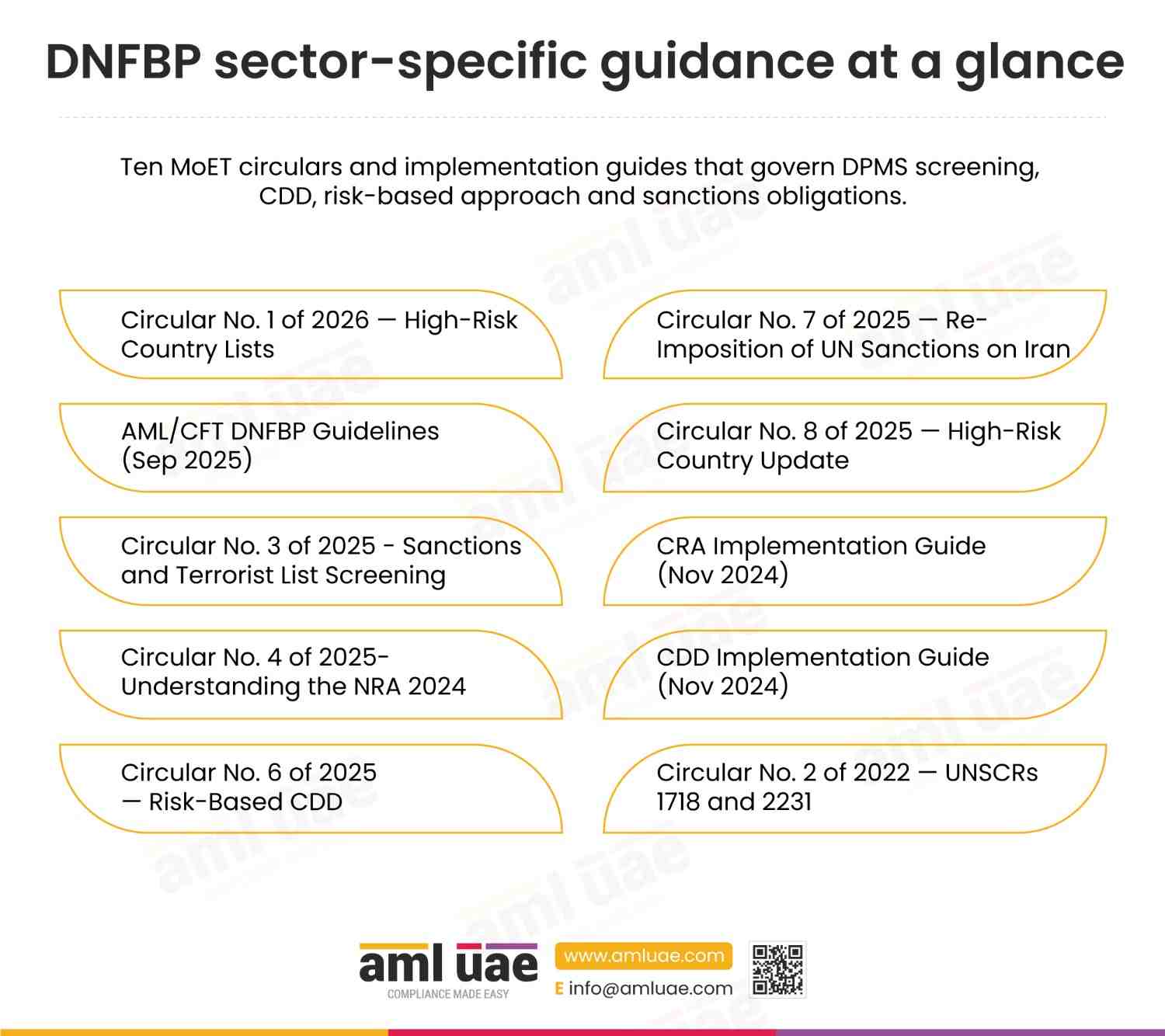
1. Circular No. (1) of 2026 on Updating the Lists of High-Risk Countries, Countries Subject to Increased Monitoring, and Related Measures
Issued on 11 March 2026 as MOET/AML/001/2026, this Circular transposes National Committee Resolution No. 15 of 2025 into DNFBP practice. It reminds DPMS that the Resolution reaffirms existing obligations, updates country listings, and requires alignment of screening, enhanced due diligence and risk-based measures with the revised lists. The Circular cites Federal Decree Law 10 of 2025, Cabinet Resolution 134 of 2025 and Cabinet Decision 74 of 2020 as its legal basis.
2. AML/CFT Guidelines for Designated Non-Financial Businesses and Professions — September 2025
The Revised DNFBP Guidelines are the consolidated MoET rulebook for DNFBPs. Part I sets out the legal framework; Part II covers compliance administration; Part III sets out the identification and assessment of ML/TF/PF risks; Parts IV and V address mitigation controls, customer due diligence, reporting and record-keeping. The Guidelines name DPMS among the four supervised categories and incorporate the CNMR (Confirmed Name Match Report), PNMR, and DPMSR reporting typologies into the compliance officer’s remit.
3. Circular No. (3) of 2025 on Emphasising the Importance of Screening Sanctions and Terrorist Lists
Issued on 19 March 2025 as MOEC/AML/003/2025, this Circular is the clearest recent statement that DPMS must screen every customer, beneficial owner and transaction counterparty against sanctions and terrorist lists, irrespective of transaction value, payment method or whether the transaction crosses the AED 55,000 reporting threshold. Screening is not optional below the threshold; only the DPMSR reporting trigger is threshold-based.
4. Circular No. (4) of 2025 on the Importance of Understanding the UAE 2024 National Risk Assessment
This Circular directs DPMS to read the National Risk Assessment 2024 and to map its findings into their own business-wide risk assessment, customer risk matrix and transaction-monitoring rules. Where the NRA identifies a sectoral threat or typology, conflict-affected gold, trade-based money laundering, or shell companies, the DPMS is expected to demonstrate that the threat has been analysed and that mitigating controls are in place.
5. Circular No. (6) of 2025 on Emphasising the Implementation of Risk-Based Customer Due Diligence Measures
Issued on 5 August 2025 as MOET/AML/6/2025, this Circular reinforces the risk-based approach and clarifies the appropriate use of simplified due diligence (SDD). DPMS must apply enhanced due diligence to high-risk customers, standard CDD to medium-risk customers where no suspicion exists, and may apply SDD only to low-risk customers where no suspicion of ML, TF or PF exists. The Circular cross-references to the Customer Risk Assessment and CDD implementation guides issued by the Ministry.
6. Circular No. (7) of 2025 Regarding the Re-Imposition of United Nations Sanctions Related to Iran
Issued on 19 December 2025 as MOET/AML/007/2025, this Circular flags the re-imposition of UN sanctions under Security Council Resolution 1737 (2006) and subsequent resolutions. DPMS must update screening systems to the latest UN Consolidated List, re-screen existing customers and counterparties, apply freezing measures without delay, and report confirmed name matches (CNMR) and partial name matches (PNMR) to the EOCN via goAML in accordance with the procedures in the EOCN TFS Guideline (which sets a five-business-day reporting window from the freeze or suspension measure).
7. Circular No. (8) of 2025 on Updating the Lists of High-Risk Countries, Countries Subject to Increased Monitoring, and Related Measures
Issued on 25 December 2025 as MOET/AML/008/2025, this Circular (later superseded by Circular 1 of 2026) updates the high-risk country lists in line with National Committee Resolution 15 of 2025 and the FATF country review. DPMS must monitor the FATF lists, align customer risk categorisation and transaction monitoring, and apply the measures required by the Ministry when a customer, beneficial owner or counterparty is connected to a listed jurisdiction.
8. Implementation Guide for DNFBPs on Customer Risk Assessment (CRA) — November 2024
The CRA Implementation Guide walks DPMS through the construction of a customer risk matrix, identifying customer, product, service, geography, channel and delivery risk factors; weighting them; and assigning a final risk rating that drives the intensity of CDD, monitoring and review frequency. DPMS use the guide to design their client-onboarding questionnaires and periodic-review templates.
9. Implementation Guide for DNFBPs on Customer Due Diligence (CDD) — November 2024
The CDD Implementation Guide is the operational companion to the CRA guide. It explains how to identify and verify customers and beneficial owners, when to apply simplified, standard or enhanced due diligence, how to approach politically exposed persons, and how to document decisions. DPMS staff handling threshold transactions reference this Guide when collecting identification under MoE Circular 08/AML/2021.
10. Circular No. (2) of 2022 on Implementation of Targeted Financial Sanctions under UNSCRs 1718 (2006) and 2231 (2015)
Issued on 31 March 2022, this Circular covers the implementation of TFS related to the Democratic People’s Republic of Korea (DPRK) and Iran. It requires DPMS to screen every transaction party against the DPRK and Iran sanctions regimes, to apply enhanced due diligence to transactions linked to those jurisdictions, to verify cross-border transactions suspected of involving dual-use goods, and to file confirmed and partial name matches via goAML. The Circular has been superseded in part by later EOCN guidance, but its operational obligations continue to apply.
Build DPMS-ready screening and goAML reporting workflows
AML UAE designs sanctions-screening, PEP-screening and goAML-filing workflows engineered to the MoET circular stack and the CNMR/PNMR reporting timelines.
Sector-Specific Guidelines Applicable to DPMS in the UAE
A final layer of guidance targets DPMS directly. These documents address gold sourcing, DPMSR reporting, compliance officer appointment and DPMS typologies. They sit on top of the federal and DNFBP layers and are the instruments regulators cite most often in DPMS inspections.
DPMS sector-specific guidelines at a glance
Eight directly applicable instruments covering gold sourcing, DPMSR reporting, compliance-officer appointment and precious-metals typologies.
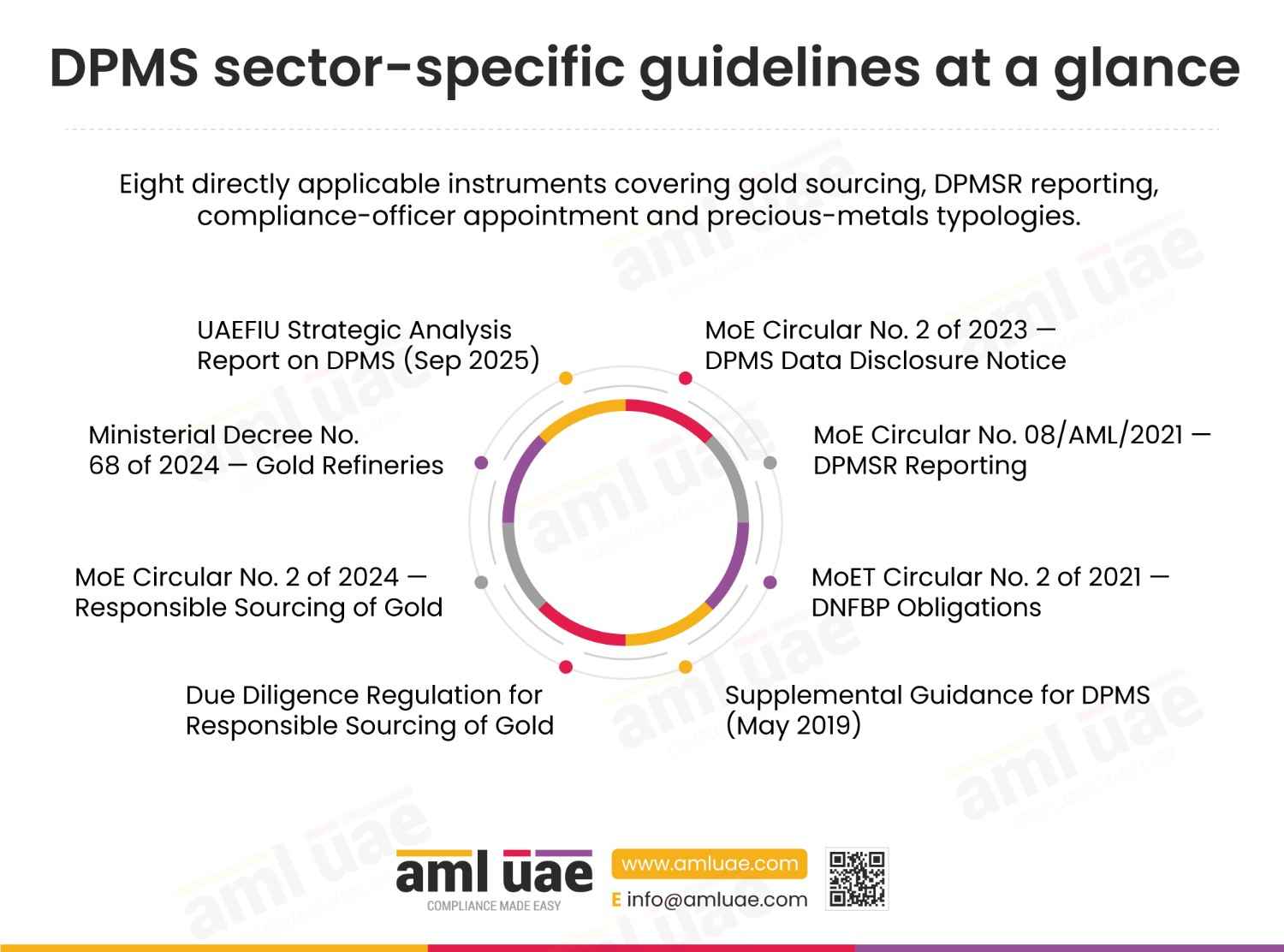
1. UAEFIU’s Strategic Analysis Report on Misuse of Precious Metals and Stones in Financial Crime — September 2025
This is the most recent UAEFIU strategic analysis covering the DPMS sector. It notes that UAE foreign trade in precious stones, metals and their articles grew from AED 497 billion in 2021 to more than AED 959 billion in 2024, and that 8,191 DPMS were registered on goAML as of 30 June 2025, an 81 per cent increase over June 2022. The report analyses 1,448,825 DPMSRs filed between July 2021 and June 2025, as well as around 700 STRs and SARs related to the sector. It identifies five dominant typologies: conflict-affected and high-risk gold; gold smuggling; use of front and shell entities; trade-based money laundering; and the use of precious metals and stones in terrorist financing. It concludes with thirty-two DPMS-specific red-flag indicators covering customer due diligence, trade activities and behavioural triggers.
2. Ministerial Decree No. (68) of 2024 Regarding Gold Refineries’ Adherence to the Policy of Due Diligence Regulations for Responsible Sourcing of Gold
Ministerial Decree 68 of 2024 was issued on 29 March 2024 by the Minister of Economy. Article One requires every entity engaged in refining gold or recycling its products, and every supply-chain stakeholder operating in the UAE (including commercial free zones under MoE supervision), to adhere to the attached Due Diligence Policy for Responsible Sourcing of Gold. Supply-chain participants and precious-metals dealers must establish strong management systems, assess gold-supply-chain risks and implement a management strategy to respond to identified risks. Refineries (and recyclers) must additionally appoint an independent third-party auditor and submit a due diligence report on the gold supply chain. Article Three confirms that administrative penalties apply to violations of the Decree and the attached Policy.
3. Circular No. (2) of 2024 regarding Due Diligence Regulation for Responsible Sourcing of Gold
MoE Circular No. 2 of 2024, dated 29 March 2024, directs every regulated entity with gold refineries as an activity in its licence operating in the UAE to undertake the 5-step framework of the Due Diligence Regulation for Responsible Sourcing of Gold. The Circular confirms that from 1 January 2023, gold refineries must conduct an independent third-party audit of their due diligence measures, with audits expected to be completed within 90 days of the effective date (that is, 90 days from 31 December 2023). The Ministry has a dedicated inbox at [email protected]. Entities that fail to comply are subject to administrative actions under the AML/CFT framework.
4. The Due Diligence Regulation for Responsible Sourcing of Gold
The Due Diligence Regulation for Responsible Sourcing of Gold is the policy instrument annexed to the Ministerial Decree and referenced in Circular 2 of 2024. It is built around five steps: (1) establishing an effective governance framework, including a board-approved sourcing policy, management structures and a confidential grievance mechanism; (2) identification and assessment of supply-chain risk, including the use of red flags and enhanced due diligence for conflict-affected and high-risk areas (CAHRAs); (3) management of supply-chain risk through a risk-control plan, continuous monitoring and senior-management reporting; (4) an independent third-party audit of the due-diligence measures; and (5) annual reporting on management systems, risk assessment and risk management. The Regulation is the detailed implementation manual behind Ministerial Decree 68 of 2024.
5. Circular No. (2) of 2023 — Data Disclosure Notice for Dealers in Precious Metals and Stones
MoE Circular No. (2) of 2023 instructed DPMS to display prominently in customer-facing premises a notice informing customers that the dealer will collect identification documents, and they should disclose their data.
6. Ministry of Economy Circular No. (08/AML/2021) on the Dealers in Precious Metals and Stones Report
MoE Circular 08/AML/2021, dated 2 June 2021, is the DPMSR reporting foundation. Effective 12 June 2021, it requires DPMS to: (1) obtain Emirates ID or passport for resident individuals and ID or passport for non-resident individuals on any cash transaction at or above AED 55,000, and register the information in the UAEFIU’s goAML platform using the DPMSR form; (2) obtain trade licence and ID for corporate counterparties on transactions at or above AED 55,000 in cash or by wire transfer, and register the information in goAML as a DPMSR; and (3) keep records of every document and piece of information relating to the above transactions for a minimum of five years. The Circular refers queries to [email protected] and continues in force under the new federal law.
7. MoET Circular No. (2) of 2021 on AML/CFT Obligations for DNFBPs
MoE Circular 2 of 2021, dated 4 February 2021, is the baseline DNFBP implementation circular. It confirms that MoE supervises real estate brokers and agents, dealers in precious metals and stones, account auditors and company services providers. It requires each supervised entity to appoint a compliance officer in accordance with Article 21 of the Executive Regulations, adopt internal policies, deliver staff training, register on goAML and cooperate with supervisory inspections. DPMS compliance officers cite this Circular when explaining the governance perimeter of their role.
8. Supplemental Guidance for Dealers in Precious Metals and Stones — May 2019
The 2019 Supplemental Guidance is the most detailed sector-specific narrative issued for DPMS. It explains why precious metals and stones are inherently vulnerable to ML/TF: high intrinsic value in a compact form, ability to maintain or increase in value, ease of physical transport, cash-based and decentralised markets, difficulty in tracing specific items and low compliance-awareness among smaller participants. It walks through the AED 55,000 ‘covered transactions’ concept, introduces sector-specific red flags and sets out expectations for customer due diligence, record-keeping and reporting. It continues to serve as a training reference for DPMS compliance teams.
Conclusion
The AML regulations for DPMS in UAE are dense but internally coherent. Federal Decree Law 10 of 2025 and Cabinet Resolution 134 of 2025 set the primary obligations; Cabinet Resolutions 71 of 2024, 109 of 2023 and 132 of 2023 govern penalties and beneficial ownership; a stack of EOCN and UAEFIU guidance operationalises targeted financial sanctions, proliferation-finance controls and reporting; the 2024 NRA sets the risk baseline; and a layer of MoET DNFBP and DPMS-specific circulars translates the regime into daily practice. On top of that, Ministerial Decree 68 of 2024 and Circular 2 of 2024 impose a 5-step responsible sourcing overlay on gold refiners and supply-chain participants.
A DPMS that wants to remain compliant must: submit DPMSR wherever applicable; screen every customer, beneficial owner and counterparty against the local terrorist list and the UN Consolidated List, regardless of transaction size; run a proliferation-finance assessment alongside the ML and TF assessments; integrate the five-step gold sourcing framework where applicable; and make sure that every circular, whether issued under the old Decree Law 20 of 2018 or the new Decree Law 10 of 2025, is understood through the lens of the current federal law.
Talk to AML UAE about your DPMS compliance programme
We design, test and audit AML programmes for gold retailers, refineries, jewellers and diamond traders across the UAE. From business-wide risk assessment to goAML DPMSR workflows and health check, we have you covered.
FAQs
Who counts as a DPMS under UAE AML law?
Under Article 3(3) of Cabinet Resolution 134 of 2025, a dealer in precious metals and stones is any person, natural or legal, trading in precious metals or precious stones in the course of business who carries out a single cash transaction, or several linked cash transactions, equal to or above AED 55,000. The definition covers gold retailers, jewellers, refineries, bullion wholesalers, diamond and coloured-stone traders and recyclers. Below AED 55,000, AML obligations still apply for screening, record-keeping and suspicion-based reporting, but no DPMSR is triggered.
What transactions must DPMS report in the UAE?
MoE Circular 08/AML/2021 requires DPMS to file a Dealers in Precious Metals and Stones Report (DPMSR) on the UAEFIU’s goAML platform for every cash transaction at or above AED 55,000 with a resident or non-resident individual, and for every transaction at or above AED 55,000 with a legal entity, whether paid in cash or by wire transfer. Separately, any suspicion of ML, TF or proliferation financing, regardless of amount, must be filed as a Suspicious Transaction Report via goAML, and confirmed and partial name matches against sanctions lists must be filed as CNMR or PNMR within five business days of the freeze or suspension.
Do gold refineries have extra due diligence duties?
Yes. Under Ministerial Decree 68 of 2024 and MoET Circular 2 of 2024, entities that engage in refining or recycling gold must adhere to the 5-step Due Diligence Regulations for Responsible Sourcing of Gold and, additionally, appoint an independent third-party auditor and submit an annual due diligence report on the gold supply chain. The audit obligation has applied since 1 January 2023. Refineries remain subject to all the generic DPMS obligations under Decree Law 10 of 2025 and Cabinet Resolution 134 of 2025 in parallel.
What are the main AML red flags for DPMS?
The UAEFIU Strategic Analysis Report on DPMS (September 2025) lists thirty-two sector-specific indicators. The most common include: refusal to provide identification; inability to demonstrate funding sources; forged certificates of origin, refinery stamps or fake invoices; supply chains transiting conflict-affected or high-risk jurisdictions; large or frequent cash transactions inconsistent with the customer’s profile; structuring through multiple visits or split invoices just below AED 55,000; payments via multiple third parties or offshore entities without clear commercial link; and repeated requests for duplicate invoices or refunds after cash purchases.
Do DPMS in ADGM and DIFC follow different AML rules?
DPMS established in ADGM and DIFC are supervised by the AFDGM Registration Authority (RA) and the Dubai Financial Services Authority (DFSA), respectively. Their rulebooks implement UAE federal AML/CFT law and the UAE’s international AML/CFT commitments, so the substantive obligations and the AED 55,000 threshold logic track federal law. The procedural touchpoints licensing, inspections, filings and enforcement are, however, with the financial free-zone regulator rather than MoET. DPMS in commercial free zones outside ADGM and DIFC remain under MoET supervision.
Was this guide useful?
If this DPMS guide helped your compliance team, a short Google review genuinely helps other jewellers, refineries and dealers find the same answers quickly.
Share via :
About the Author

Pathik Shah
FCA, CAMS, CISA, CS, DISA (ICAI), FAFP (ICAI)
Pathik is an ACAMS-certified AML consultant specialising in governance, risk, and compliance for regulated entities in the UAE. He brings over 28 years of experience, with 1,000+ hours of AML training and 200+ advisory engagements across DNFBPs, VASPs, and FIs. He supports businesses in aligning with AML/CFT requirements from the CBUAE, DFSA, MoET, MoJ, VARA, CMA, FSRA, and FATF. Known for translating complex regulations into audit-ready procedures, Pathik enables operational clarity and compliance readiness.

Reach Out to Pathik