

How can UAE businesses be AML Compliant?

Pathik Shah

Table of Contents
MicrosoftTeams-image (5)

How can UAE businesses be AML Compliant?

It is obligatory for banks, financial institutions, and other regulated entities to follow the AML rules and regulations or face penalties. UAE has imposed hefty fines for violation of AML rules and regulations. The penalties range from AED 50,000 to AED 1,000,000! By not being AML compliant, businesses put their reputation at stake and face the government’s ire. So, they need to ensure that they diligently follow the AML rules and make their business AML compliant.

The UAE Ministry of Economy has defined 26 categories of fines for non-compliance with the AML rules and regulations. It’s essential to mitigate the risks involved in non-compliance. AML consultants prove to be of great assistance to be AML compliant.  

With the aid of technology, businesses in UAE and worldwide can harness its power and streamline the AML compliance process. The AML software is a great tool to facilitate the AML process.
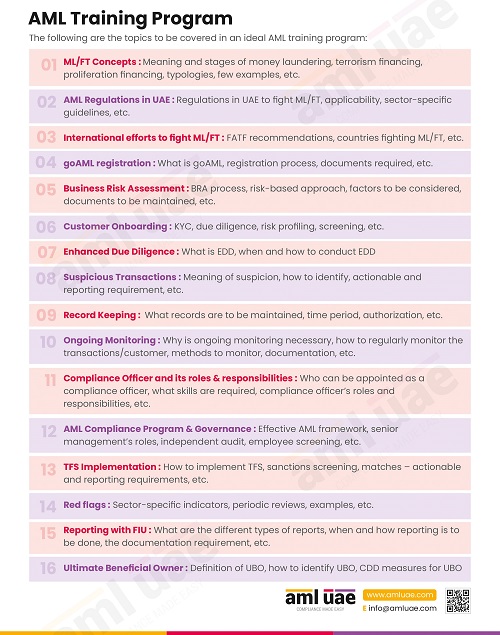
Designing a comprehensive AML Training Program

AML software plays a crucial role in being AML compliant

Optimizing the AML compliance program is of paramount importance to ensure that it is efficient, cost-effective, and scalable. It is critical to keep pace with the changing AML rules and leave no scope of non-compliance. The risk profile may also change over a period. So the business needs to ensure that their system is updated and equipped with the knowledge of the latest amendments to comply with the AML rules effectively

There are various aspects to look for following the AML rules and regulations. A business has to create a robust AML/ CFT program, provide AML training to its employees, follow the proper procedure for AML policy, rules and documentation. It also includes the selection of the right AML software.

The AML software will help the business incorporate all these elements into the AML compliance program and avoid any risk of non-compliance. The AML software will enable companies to immediately identify suspicious transactions and strengthen the AML compliance strategy.

The software collects and stores customers’ KYC data and verifies it. It also verifies the customers’ risk and screens against a sanction list. It will provide information about PEPs and enable businesses to be sure about whom they’re entering into a business relationship. The software alerts them on any suspicious transaction or account and provides real-time updates to take the necessary action to prevent money laundering. 

Role of AML Consultants

Businesses are occupied with running their businesses efficiently, providing high customer satisfaction, enhanced customer experience, promoting growth, and maximising profitability. Dealing with the complex AML compliance process can take a back seat in a competitive marketplace.

Businesses are at risk of non-compliance, so following the AML/ CFT Policy, Controls, and Documentation procedure is necessary. With the help of reliable AML consultants, companies can get the proper rules, policies, and systems in place and create a strong AML compliance framework that will help them fight money laundering successfully.

Consequences for Non-compliance with UAE AML Regulations

It is an elaborate process that involves risk identification by analysing the business process and identifying the risk which money launderers will take advantage of and be successful in their criminal intentions. Companies can immediately identify the illegal movement of money. The consultants will also examine the existing AML policies, letting the business know if their current AML compliance procedure is competent enough to keep money launderers at bay.

The gap analysis will clarify the appropriate actions that need to be taken to achieve AML compliance for the business.

The gap analysis report is shared with the AML compliance officer and the stakeholders. After the discussion, the consultants create the best AML/ CFT program.

A customized AML program is required to combat the challenges of the non-compliance risk and fight money laundering. The AML policy, controls, and procedures are created, eliminating or minimising the risk of non-compliance, and businesses can focus on improving customer growth. 

Building an effective AML compliance process

The FATF –Financial Task Force has provided several recommendations for AML rules and regulations that define the AML compliance process. The FATF was founded in 1989 to fight money laundering and terrorist financing. It also aims to prevent the funding of accumulation and expanding weapons of mass destruction. FATF has provided some standard recommendations on the global level which countries can follow to fight the menace of money laundering

In 2020 the Minister of Justice had issued ministerial resolutions for setting up specialised courts for dealing with money laundering cases.

AML Compliance Requirements

This resolution was meant for the judiciary in the courts of Sharjah, Umm AI Quwain and Ajman, and Fujairah. It is noteworthy that each country has particular AML compliance requirements that businesses must follow.

It is crucial to have a robust AML compliance program that will meet all the needs and prevent the risk of non-compliance. Organisations can efficiently fulfil the requirements of AML compliance, avoid penalties, guard their reputation by not associating with suspicious activities or entities, and help the government achieve the goal of preventing money laundering.

UAE has issued the Federal Decree No. 20 of 2018 on the Anti-Money Laundering and Countering the Financing of Terrorism which defines the legal structure to ensure AML compliance with the international standards.

The law aims to prevent money-laundering practices and create a legal framework that assists authorities in ensuring AML compliance and arresting the criminals involved in money laundering. The law aims to counter the financing of terrorist activities and suspicious entities

AML Software

Standardising the AML program is necessary. An AML software will help to fulfil this objective. A reliable AML service provider will assist in selecting the proper AML software. 

It is vital to empower the AML compliance team with the right resources and transparent policies to adhere to without any confusion. 

How to get an effective AML compliance program?

The intricacies involved in the AML compliance program might prove overwhelming for businesses already occupied with keeping the company afloat, providing high customer satisfaction. The complex legislation might prove daunting for companies, so it would be best to hire an AML consultant to create an effective AML compliance program.

So how an AML compliance service provider will help in this arena? They will assist in setting up an AML compliance department and help businesses always stay AML compliant with their services. 

As business owners in the UAE, people need to invest time and energy in the research to follow the AML / CFT policy,  rules,  and documentation process or set up an  In-house AML compliance department. It is compulsory for banks, financial institutions, and other regulated entities to integrate an AML compliance framework into the company. It is best to create an in-house AML compliance department.

In addition to this, an AML compliance officer has to be appointed who will manage the AML compliance process. The AML consultants play a huge role in helping businesses be AML compliant. 

Conclusion

AML UAE is one of the most reliable AML compliance in the UAE, providing services to thousands of businesses and helping in AML risk assessment and mitigation. AML compliance is an absolute necessity. Organisations need to follow the AML rules and regulations to protect their business against financial crime and assist the government in preventing money laundering and funding criminal and terrorist activities. With our array of AML compliance services such as AML/ CFT Policy, Controls, Procedures & Documentation, and in-house AML compliance Department set up, AML trainingAnnual AML/ CFT Risk Assessment reportand AML/ CFT health checkup ; businesses can get complete peace of mind as they can stay AML compliant at all times.

FAQs

Who is responsible for compliance with AML? 

The following businesses must comply with AML: 

  • Banks 
  • Financial institutions 
  • Real estate agents 
  • Dealers in precious metals and gems 
  • Trust and company service providers 
  • Lawyers, notaries, and other legal professionals 
  • Accountants and auditors 

If the employee is compliant with AML regulations, identifying suspicious transactions and carrying out risk assessments would be easier. Also, employees would carry out activities in alignment with internal AML policies, procedures, and controls, and conduct due diligence of customers before onboarding them.  

For everyday AML compliance, an employee’s responsibilities are: 

  • To check daily activities for any suspicion of money laundering or any other financial crime 
  • To ensure KYC and CDD of customers are conducted 
  • To raise complaints if any doubt is raised 
  • To comply with the AML policies, processes, and internal controls implemented in the company 

A company can be tested for AML compliance in the following ways: 

  • Implementation of risk-based AML measures 
  • Identity verification of customers through CDD and EDD measures 
  • Checking customers against Sanctions screening and PEP status 
  • Identifying suspicious transactions and submitting reports 
  • Forming AML team, appointing AML Compliance Officer, and conducting AML training 

Share via :

About the Author

Pathik Shah

FCA, CAMS, CISA, CS, DISA (ICAI), FAFP (ICAI)

Pathik is an ACAMS-certified AML consultant specialising in governance, risk, and compliance for regulated entities in the UAE. He brings over 28 years of experience, with 1,000+ hours of AML training and 200+ advisory engagements across DNFBPs, VASPs, and FIs. He supports businesses in aligning with AML/CFT requirements from the CBUAE, DFSA, MoET, MoJ, VARA, CMA, FSRA, and FATF. Known for translating complex regulations into audit-ready procedures, Pathik enables operational clarity and compliance readiness.

Reach Out to Pathik

A complete guide to global AML Regulations

Pathik Shah

Table of Contents

Protect your business with reliable and effective AML strategies with AML UAE.

A complete guide to global AML Regulations

AML compliance requires financial organisations, DNFBP, and other regulated entities to comply with the AML rules and regulations – both local and international. They have to follow the legislations and the recommendations provided by the global organisations dedicated to preventing money laundering and financial terrorism. The global AML compliance rules and regulations are vast and require organisations to keep pace with the evolving amendments and improved recommendations. Let’s discuss the AML regulations made by global organizations-the recommendations which need to be followed to be AML compliant and deter, detect and catch the criminals involved in money laundering and other financial crimes. 

Guide to Global AML Regulations

The Financial Action Task Force (FATF)

The FATF comprises 36 member states, and the primary function of this intergovernmental organisation is to prevent money laundering and the funding of financial terrorism. It sets global standards for AML compliance and ensures that the AML rules are followed diligently, leaving no scope for non-compliance. The updated AML and CTT guidelines are issued regularly. The global standards issued by the FATF help financial institutions detect and deter money laundering activities. The member countries and the financial institutions should follow the below-mentioned measures- 

  • Follow the KYC- Know Your Customer process cautiously.
  • Follow the Customer Due Diligence Process.
  • Follow the record-keeping process for accurate risk assessment.
  • Ensure continuous monitoring of financial activities and suspicious transactions and filing Suspicious Transaction Reports to the concerned authority. 
  • Take appropriate actions for anti-money laundering non-compliance, such as enforcing effective sanctions against legal and obliged entities. 

The European Union

EU 5AMLD and 6AMLD: The European Union’s Anti-Money Laundering Directives framework ensures effective enforcement of the AML/ CFT rules and regulations. The directives are published periodically, which shed light on the current scenario of money laundering, terrorism financing, and risk assessment of the financial markets. 

5AMLD: The Fifth Anti-money laundering directive (5AMLD) came into effect on 10 January 2020. Financial Institutions need to comply with the 5AMLD rules, and this compliance includes 

Cryptocurrency regulation. It defines the term cryptocurrency in legal terms and explains the reporting obligations and rules for the currency. The directive has also introduced new legal obligations for PEPs, transactions of high-value goods, prepaid cards, beneficial ownership, and customers from high-risk third countries. 

6AMLD: The Sixth Anti-money laundering directive came into effect in June 2021. It defines money laundering—the broad scope of money laundering and the criminal liability and stringent punishments for the guilty. 

The UK

The Financial Conduct Authority (FCA)

The FCA in the UK is an independent body that regulates the financial services industry. The objective of FCA is consumer protection, market stability, and providing a leveled competition field for all players. To achieve these goals, the FCA introduces new rules and monitors the compliance process to ensure that organisations avoid violation of the compliance rules. AML/ CFT compliance falls under the ambit of the FCA. 

Regulation: The FCA keeps an eye on the financial products in the UK and sets the minimum legal standard, non-compliance of which leads to bans on the products.

Supervision: The FCA ensures that the financial institutions operate in a safe market environment and comply with the AML regulations. It ensures that they correctly follow the compliance process and adhere to the customer identification and risk assessment procedures. Further, they also monitor that they continuously monitor the customers’ transactions and identify any suspicious activity. The financial institutions need to report the suspicious transactions to the concerned authority. 

Authorization: The FCA imposes the registration rules for financial institutions before authorising them to commence business in the UK

The US

The Bank Secrecy Act: The Bank Secrecy Act (BSA) is run by the Financial Crimes Enforcement Network (FinCEN). The main goal is to deal with money laundering, but gradually, its scope has been widened, and therefore it also focuses on other financial crimes. Financial institutions should comply with the below-mentioned rules: 

Compliance Program: US financial institutions must create and implement an internal AML program that meets their risk assessment requirements. AML programs should contain all the mandatory elements such as written policies and procedures, employee training, independent audits, and the appointment of an MLRO.  

Reporting: Financial Institutions have to fulfill different AML reporting requirements such as creating and filing Suspicious Activity Reports (SAR) and Currency Transaction Reports (CTR).

Record Keeping: Financial institutions should maintain all the suspicious activities’ details that mention the customer identities and the amount of money transacted. Non-compliance with the BSA regulations attracts $250,000 and imprisonments while prosecuted under the US criminal codes. 

Australia

AUSTRAC: The Australian Transaction Reports and Analysis Centre deals with money laundering. It is a dedicated government agency in Australia that prevents money laundering, financial fraud, criminal and terrorist financing. It works as per the rules stated in the Anti-Money Laundering and Counter-Terrorism Financing Act (2006). It identifies and works towards preventing financial fraud and misuse of the Australian financial system. The efforts of AUSTRAC include identification and monitoring of money laundering and funding of terrorist activities. Another aspect that the agency looks into is reporting the AML/ CTF obligations. It focuses on reporting suspicious activities. Suspicious Reporting is an essential part of the AML compliance process as it triggers the series of measures or actions taken against the criminals. 

This governmental authority works closely with different governmental agencies to implement the AML/ CFT policy effectively. They ensure that the AML laws are adequately enforced and cooperate with revenue agencies and security services. Entities are subjected to heavy fines & penalties and imprisonment for non-compliance with AML rules. 

Asia

Hong Kong Monetary Authority (HKMA): The Hong Kong Monetary Authority ensures that Hong Kong’s financial system remains stable and works smoothly. The HKMA works as per the Anti-Money Laundering and Counter-Terrorist Financing Ordinance, so it plays an essential role in preventing money laundering and financing terrorism. It ensures that the financial institutions adhere to the AML rules and regulations. It is also entrusted with creating an AML/ CFT program and implementing it. The HKMA AML program involves the following elements-

Risk Assessment: Financial institutions should create AML programs to combat the challenges of money laundering and financial terrorism. 

Procedures and Controls: There are numerous procedures and controls in the AML/CTF programs, such as independent audit, employee training, and compliance management.

Compliance Officers: It is mandatory to appoint a compliance officer responsible for properly executing the AML/ CFT program and reporting and filing suspicious transactions.  

Monetary Authority of Singapore (MAS): The (MAS) is the central bank of Singapore responsible for regulating the financial sector. It includes various functions such as implementing the monetary policy, managing assets, and strengthening the financial position of Singapore at the international level. The AML policy is mentioned in the Notices on the Prevention of Money Laundering and Countering the Financing of Terrorism. The policy includes the following: 

Due Diligence: Due Diligence and Enhanced Due Diligence is necessary for identifying suspicious transactions and fraudulent accounts. So, financial institutions should perform these compliance procedures and help fight the menace of money laundering. 

KYC: KYC is an essential process of customer identification and assessment process. The financial institutions have to maintain the records of the KYC process carried out. 

Reporting and Monitoring: It is mandatory for financial institutions to continuously monitor the customer accounts create and file the suspicious transaction activity to the MAS.

It is noteworthy that non-compliance to the AML rules and regulations attracts a huge penalty of up to $ 1 million. So it’s necessary that the AML compliance process is duly followed. 

UAE

The Federal Decree by Law No. (10) of 2025 Regarding Anti-Money Laundering, and Combating the Financing of Terrorism and Proliferation Financing requires Financial Institutions and Designated Non-Financial Businesses and Professions to establish a comprehensive AML/CFT Program including AML Policy for KYC, Screening, Risk Profiling, Governance, STR Filing, and more.

AML Compliance Service From AML UAE

If you are looking for a reliable AML compliance services provider, you can contact AML UAE – a top AML consultant service provider. The company offers a myriad of AML compliance services such as AML Training, AML / CFT policy, controls, procedures documentation, AML software selection, AML/ CFT health check-up, and in-house AML compliance department set up. 

Concerned about money laundering risks
for your business?

At AMLUAE, we offer expert solutions to protect and guide you.

Add a comment

Share via :

About the Author

Pathik Shah

FCA, CAMS, CISA, CS, DISA (ICAI), FAFP (ICAI)

Pathik is an ACAMS-certified AML consultant specialising in governance, risk, and compliance for regulated entities in the UAE. He brings over 28 years of experience, with 1,000+ hours of AML training and 200+ advisory engagements across DNFBPs, VASPs, and FIs. He supports businesses in aligning with AML/CFT requirements from the CBUAE, DFSA, MoET, MoJ, VARA, CMA, FSRA, and FATF. Known for translating complex regulations into audit-ready procedures, Pathik enables operational clarity and compliance readiness.

Reach Out to Pathik

What are the Important terms in the AML-CFT Compliance Program?

Blog-3_1

Pathik Shah

Table of Contents

Protect your business with reliable and effective AML strategies with AML UAE.

UAE is leaving no stone unturned to prevent money laundering by implementing the AML policy rules and regulations. The introduction of the AML- CFT program (Anti-Money Laundering and Combatting Financing of Terrorism) which includes strict penalties and deterrence in the form of imprisonment as well, is a decisive step towards fighting money laundering. Non-compliance with the AML laws attracts heavy fines and jeopardizes the company’s reputation. It is best to hire a reliable AML consultancy firm to avoid the risk of non-compliance and always keep the business AML compliant.

But some companies fail to comply with the AML rules and regulations and in turn have to face the consequences of non-compliance. They sabotage their reputation and damage the goodwill in the market and face financial losses in the form of heavy penalties. One of the reasons for this attitude is a lack of awareness of the AML laws as companies might be willing to stay compliant, but lack of knowledge can prove to be a deterrent in AML compliance. Let us discuss the critical AML/ CFT terms with which every business should be acquainted.

Important terms in the AML-CFT Compliance Program

Money Laundering

According to the FATF- Financial Action Task Force, money laundering is defined as processing the illegally obtained money from criminal activities and hiding the origin/ source of the illicit cash. This money is run through the legal system- banks and financial institutions and made to appear as lawful money. The money is used to fund various criminal activities such as illegal trade of goods, drugs, human trafficking, prostitution, extortion, kidnapping, and funding of terrorism with illicit arms sales. These activities generate a considerable amount of money, and criminals are always looking for new ways to legitimize it.

The UAE law applicable for money laundering is the Federal Decree by Law No. (10) of 2025. Article 2 of this UAE law states that the following acts fall under the ambit of money laundering.

It involves transferring the proceeds, converting them, or indulging in any transaction to hide their illegal source as well as hiding the nature, origin, or location of the profits and the methods which involve the movement or ownership of the proceeds. The Article further states that money laundering is an act that consists of acquiring or using the proceeds on receiving and helping the person committing the predicate offense to avoid punishment.

Financing of Terrorism

Financing of Terrorism includes the act of offering, preparing, sourcing, or providing the funds for use (in part or whole) in the commission of a terrorist offense. It also includes offering money to a terrorist organization or person while being aware of the purpose of the terrorist financing. Moreover, when the funds are obtained, managed, invested, deposited, kept, used, or disposed of for conducting any commercial or financial bank transaction, the money is received from a terrorist offense.

AML-CFT Program

AML- CFT refers to the Anti-Money Laundering and Combatting Financing of Terrorism (AML-CFT) Program, which is a structured system that helps organizations to prevent the financial crime of money laundering. Banks, financial institutions, and other regulated organizations must follow the AML rules and regulations and stay AML compliant. The Central Bank of UAE (CBUAE) manages the implementation of the AML-CFT program. There are different components in the AML-CFT program that should include:

  • Written policies, procedures, and measures
  • Designated AML Compliance Officer (MLRO)
  • Continuous employee training
  • Independent audit of the AML/ CFT program

Designated Non-Financial Businesses and Professions

Article 3 of the Cabinet Resolution No. (134) of 2025, a DNFBP, refers to brokers in real estate, precious metals dealers, and precious stones dealers who carry out single or multiple transactions worth AED 55,000. The term also includes independent auditors and Corporate and Trust Service Providers who carry out the transactions on behalf of their customers. DNFBPs also have to implement the AML-CFT program which is similar to that of banks and financial institutions.

MLRO

MLRO is the Money Laundering Reporting Officer. The AML Compliance Officer is a natural person who manages the AML programs of the companies required by law to follow the AML rules and regulations. The person is entrusted with ensuring that the organization complies with the AML/ CFT regulations.

GoAML System

The GoAML system is an integrated software developed by the UNODC – United Nations Office on Drugs and Crime (UNODC). All the financial institutions and DNFBPs have to register in the goAML system and submit their reports. Data is collected, managed, analyzed, and insights are drawn from the document management system that helps prevent money laundering and end massive funding of criminal and terrorist activities.

Ultimate Beneficial Owner

An Ultimate Beneficial Owner- UBO is a natural person who eventually or ultimately owns or benefits when a transaction is initiated. It also includes the natural person on behalf of whom a transaction is being carried out and the one who exercises effective ultimate control over a legal person.

Customer Due Diligence

Customer Due Diligence (CDD) is a step that helps the banks, DNFBPs, and other financial institutions establish and verify the customer identification of a beneficial owner. With CDD, the institutions can learn about the customers, verify their claims of who they say they are, and understand the nature of economic activities, ownership structure, and control exercised by the natural person or legal entity. They can know whether it is a high-risk customer and the risk involved in money laundering.

High-Risk Customer

A High-risk customer is one with which the risk of money laundering increases. As per the AML rules and regulations, banks or financial institutions have to identify high-risk customers and take the best actions to deal with the instances of money laundering. The assessment and evaluation of the high-risk customer are handled with EDD- Enhanced Due Diligence.

Politically Exposed Persons

PEP is defined as natural persons who have been assigned high-level public responsibilities. PEP includes Heads of States or Governments, senior people- politicians, government officials, judicial or military officials. The terms also refer to senior executive managers of state-owned corporations. PEP represents a higher risk of involvement in corruption and similar activities owing to their primary public function and their influence due to their position.

Suspicious Transactions

They pertain to the transactions about which there are valid reasons to suspect that the money has been derived from criminal proceeds and is related to the funding of terrorist activities or financing of criminal organizations, whether committed or attempted.

Enhanced Due Diligence

Enhanced Due Diligence measures under UAE AML Regulations
As the name suggests, EDD-it is an enhanced or advanced form of the due diligence process carried out for further risk assessment. EDD is carried out when the involvement of high-risk customers is present, and a probe is required in large volumes of transactions.

Economic Sanctions

Economic sanction is the imposition of trade restrictions, financial limitations, and penalties by a country or countries on other countries, entities, or individuals. It is an instrument of foreign policy used to coerce the government, entity, or individual to follow international trade and guidelines. There are several types of sanctions such as Tariffs, Embargoes, Non-tariff barriers, and asset freezers.

Financial Intelligence Unit

Financial Intelligence Unit (FIU) is a central national agency that receives information on suspicious transactions, analyses the data obtained, and shares the disclosures with the concerned authorities. The FIU receives the information on the goAML portal.

AML Consultancy Services

Lack of awareness can cause a huge problem for banks, financial institutions, DNFBs, and other regulated bodies which have to follow the AML rules. One of the best ways to stay AML compliant is to outsource AML compliance services and get access to the updated knowledge and resources of AML compliance. With the assistance of a reliable AML compliance service provider, businesses can put all their worries to rest, and they can focus on augmenting business growth.

The AML consultancy provider will offer a wide range of services such as AML CFT Controls and Procedures Documentation, In-house AML compliance department set up, and AML training. They will also assist in AML software selection, Annual AML/ CFT Assessment Report, and AML / CFT Health Check-up services. The experts will handle the complexities involved in the AML compliance process at a nominal fee and help the business avoid hefty fines and penalties. AML UAE is one of the top AML Consultants in the UAE, assisting thousands of companies with its expertise, knowledge, and experience in the AML domain. For more information on this company, feel free to visit AML UAE.

Focused. Flexible. Relevant.

Intelligent, all-encompassing AML training for your business is just a call away.

Share via :

About the Author

Pathik Shah

FCA, CAMS, CISA, CS, DISA (ICAI), FAFP (ICAI)

Pathik is an ACAMS-certified AML consultant specialising in governance, risk, and compliance for regulated entities in the UAE. He brings over 28 years of experience, with 1,000+ hours of AML training and 200+ advisory engagements across DNFBPs, VASPs, and FIs. He supports businesses in aligning with AML/CFT requirements from the CBUAE, DFSA, MoET, MoJ, VARA, CMA, FSRA, and FATF. Known for translating complex regulations into audit-ready procedures, Pathik enables operational clarity and compliance readiness.

Reach Out to Pathik

Know the Differences between KYC and AML

Pathik Shah

Table of Contents

Protect your business with reliable and effective AML strategies with AML UAE.

Know the Differences between KYC and AML

There’s a massive surge in AML compliance due to the fast-evolving online space and increased money laundering threats. The Fintech industry is also growing and needs robust AML compliance programs. KYC is an integral part of the AML compliance process, but there are some key differences between KYC and AML. Let’s discuss how the two approaches differ.

What is KYC?

KYC is an acronym for ‘Know Your Customer’ in which organizations collect relevant data about prospective customers, establish their identity, and create a risk profile. They verify the customers’ identity before opening a bank account or indulging in any financial activity. The regulated firms have to strictly follow the AML regulations, protect their business, and guard their reputation by doing business only with legitimate organizations and verified individuals. The KYC will help them identify any suspicious accounts with a high probability of being a money-laundering entity. 

What is AML?

AML is an abbreviation for Anti-Money Laundering that encompasses various rules and regulations imposed by the government that regulated firms should follow in dealing with money laundering. The AML laws help identify financial crimes and prevent money laundering. With the help of AML laws, governments can stop black money from entering into the legal systems. They help to avoid funding of criminal and terrorist activities. Financial institutions must follow the sanctions screening process, a stringent AML control that helps detect any suspicious economic activity and provides timely information to prevent financial fraud. 

Sanction screening is a crucial step in the KYC process and allows to detection of financial frauds with great ease. The sanctions are imposed to coerce a regime or individuals within a regime and force them to change their behaviour by increasing the cost on them to change their behaviour and not repeat the undesired or offending behaviour. The AML policy is a part of an elaborate AML compliance program that enables the regulated entities to comply with the local AML rules and regulations. 

How do KYC and AML procedures differ?

KYC and AML are often used as interchangeable terms, but the frameworks are different for both. They differ in their processes and their objectives. It is noteworthy that AML is a broader term and includes several functions. It helps institutions stay AML compliant, protect against financial fraud by identifying suspicious entities and deter criminals from legalizing illicit money. Often, the AML compliance process is outsourced to AML service providers.

AML includes an array of services such as AML / CFT Policy Controls and Procedures Documentation, AML/ CFT Health Check, Annual AML/ CFT Health Checkup, AML Training, Annual AML CFT risk assessment report, and AML software selection, AML Training and more. 

Secure your business from money laundering risks,

With AML UAE’s AML compliance services!

Key differences between KYC and AML

KYC

- KYC collects relevant customer data and evaluates it on different parameters.

- Verifies the identity of the customers.

- Customer Screening, identity verification, and Risk Profiling.

- The risk-based approach makes it elaborate and identifies fake, fraudulent accounts.

AML

- AML establishes processes and controls to fight money laundering and other financial crimes.

- Deter criminals from indulging in financial crimes. Financial sanctions are used to coerce a regime, constrain a target, signal disapproval, and protect the value of assets. 

- AML regulations, Policies, and controls, Suspicious Activity Reports.

- Stay compliant with the new regulations and implement a robust AML compliance framework to prevent financial crimes.

 Standard components of the AML Compliance Process

  • KYC Compliance
  • AML guidelines
  • AML policies
  • Continuous risk assessment and monitoring services
  • AML Training
  • Internal Controls and Audits
  • Escalation Procedures
KYC is an integral part of the AML compliance program and starts with the KYC process, which establishes the true identity of the customers. Financial crimes cannot be detected and prevented unless a stringent KYC process is followed.       

AML Compliance

The AML compliance process requires an in-depth analysis of large amounts of data and the right tools and core expertise in AML compliance services to detect financial frauds and arrest criminals. Automation with the help of the right AML software streamlines the AML process and makes it cost-efficient. Automation eliminates the possibility of human errors leading to high accuracy and increased efficiency.

The compliance process is speed up, and compliance with new regulations is possible without any delays. The software solution empowers businesses with advanced technology to comply with the AML, CFT, and KYC requirements. FIs can develop the proper AML compliance framework and make AML training necessary- they need to train the employees for risk profiling, identifying any suspicious accounts, and minimizing false positives. The AML software is a cost-efficient medium that helps organizations be completely compliant with the AML, CFT, and KYC requirements.

What is the role of AML Software?

The AML software is instrumental in keeping the AML compliance framework and verifying customer information. It evaluates the customers’ risk profiles and screens against a sanction list. It extracts further details on the PEPs. Counter-Terrorist Financing and Sanctions Module (AML rules) must be followed in the UAE.

All the financial institutions must establish AML training programs for the CFT and AML obligations. Law No. 4/2002 Anti-Money Laundering Law, Law No. 1/2004 the Counter-Terrorism Law and Counter-Terrorist Financing and Sanctions Module (AML Rules) are the local AML laws and regulations in the United Arab Emirates. Law No. 1/ 2004 states that people engaged in terrorist financing face imprisonment and death sentences. The AML software helps in KYC and transaction monitoring and creates and executes an effective AML compliance strategy. The software sends real-time alerts to the MLROs- Money Laundering Reporting Officers.

Conclusion

AML UAE has served organizations in different industry verticals to keep pace with the CFT/ AML rules and regulations and prevent money laundering. So, the financial institutions in the UAE should comply with the AML/ CFT programs, detect suspicious financial activities, and deter money laundering. They can use the services of a reliable AML compliance firm that will offer an array of AML compliance services. It will also help choose the right AML software that meets the unique business requirements and help businesses to stay AML compliant at all times. 

FAQs

What is the relationship between KYC and money laundering? 

KYC is the process of identifying and verifying your customers. Money laundering is a medium of conducting financial crime. The process of KYC helps reduce the chances of money laundering because customers are identified, their relation with any terrorism or financial fraud is monitored, and their transactions are reviewed.  

Knowing your customers is essential to check if they are related to financial fraud or money laundering. With KYC, you know your customers’ identity, beneficial owners, any relation with Sanction lists or terrorist organizations, or any other information that is useful to eliminate risks of money laundering.  

Concerned about money laundering risks
for your business?

At AMLUAE, we offer expert solutions to protect and guide you.

Add a comment

Share via :

About the Author

Pathik Shah

FCA, CAMS, CISA, CS, DISA (ICAI), FAFP (ICAI)

Pathik is an ACAMS-certified AML consultant specialising in governance, risk, and compliance for regulated entities in the UAE. He brings over 28 years of experience, with 1,000+ hours of AML training and 200+ advisory engagements across DNFBPs, VASPs, and FIs. He supports businesses in aligning with AML/CFT requirements from the CBUAE, DFSA, MoET, MoJ, VARA, CMA, FSRA, and FATF. Known for translating complex regulations into audit-ready procedures, Pathik enables operational clarity and compliance readiness.

Reach Out to Pathik

How do Criminals Launder Money using Video Games?

Pathik Shah

Table of Contents

Protect your business with reliable and effective AML strategies with AML UAE.

How do Criminals Launder Money using Video Games?

Money Laundering is a financial crime and poses a great danger to the country’s economy and the world at large. The illicit money is used to find terrorist activities and criminal activities such as extortion, kidnapping, human trafficking, smuggling, etc. So, governments ensure that this illicit money does not enter the legal, financial system, deteriorates the economy, and damage the country’s social fabric. The FATF- Financial Action Task Force was established to deal with money laundering by the G-7 Summit in Paris in 1989. It has developed 40 recommendations that national governments should follow to comply with anti-money laundering laws diligently and implement effective anti-money laundering programs.
The criminals use the illegally obtained money to process the criminal proceeds and get the profits while hiding the origin of the funds. They get large amounts of proceeds from various criminal activities such as drug trafficking, human trafficking, illegal arms sales, and computer frauds which extend to video games. Yes, criminals are getting innovative, and they are using various new ways to launder illicit money, use the proceeds without attracting the authorities’ attention.

Financial Institutions have made the KYC process more stringent using advanced technologies such as AI, ML, and AML software to streamline the AML compliance process. The online gaming industry is unregulated, and there are no stringent KYC rules which users need to follow. They quickly transfer in-game currency, and the fraudulent transactions are lost in the legit transactions.

More about in-game currencies

The video games use a virtual currency known as the in-game currency, which is earned by winning the challenges and overcoming the hurdles in the video games. It is also used to acquire new skills sets, props, or accessories that empower them and make them better players than other games.
There are two types of in-game currencies:

Convertible in-game currency

A player can exchange the real fiat currency- the currency made legal by a government decree or fiat. In simple words, it refers to legal-tender paper money or coins, and their face values exceed the commodity values and are not redeemable in gold and silver. The convertible game currency has a fluctuating exchange rate and a particular exchange platform. This currency is used to sell, buy, or exchange virtual properties with other players.

Non-convertible in-game currency

In the non-convertible in-game currency, the players can exchange real fiat- real money for the game’s currency. This currency cannot be exchanged with other players. It can be used to buy accessories in the video game, skills, weapons, and other items to improve the skills sets of a particular character or customize it. Today, many worldwide popular games use this type of currency and monetize by selling non-convertible in-game currencies.

How are Video Games used for Money Laundering?

Microtransactions are the element in video games that attract criminals, and therefore they choose the platform to launder money. There are thousands of online games downloaded every day. Here come the cybercriminals who download the game on the PC or any other mobile device like any regular player. They will create a character in the game and might also hack an existing account of any regular player to conceal their identity.
Criminals will buy expensive characters, props, or skills in the game via microtransactions and sell the characters or the in-game virtual currency in the grey secondary market websites at discounted works. The money is invested in the game and converted into the game’s currency. The whole process is completed seamlessly. With the help of microtransactions which allow buying items as low as under $ 200, the criminals are successful in not drawing the attention of the authorities.
Loot Boxes refer to an array of weapons and skins that players obtain to power up their characters. Loot boxes are considered equivalent to gambling as real money is used as it’s a gamble to find and get items in the game. And for this, real money is used. This key is required, and the criminals exchange it on popular online gaming retailers’ platforms. It is not surprising that most such transactions are used to launder black money. So, countries that have implemented anti-gambling laws will find that such transactions are gross violations of the rules. It attracts heavy fines and penalties and imprisonment.

How to prevent money laundering in video games?

Since the gaming industry is largely unregulated, criminals use identity theft as their modus operandi to launder money. The FATF has added a note to the 15th recommendation that guides virtual asset activities and service providers regarding money laundering and terrorist financing laws. They come to know how to regulate and supervise the VASPs – Virtual Asset Service Providers. Gaming companies that sell virtual currencies fall under the ambit of the AML regulations. But the challenge is that many in-game items are not meant to be sold or exchanged online on unauthorized third-party websites, and the developers should not bear the brunt of AML penalties.
Strict regulations should be created and implemented to trade assets and virtual currencies. Companies that use non-convertible currencies should be covered under the ambit of AML/ CFT regulations. On the contrary, games involving non-convertible currencies need not be strictly tied to the AML / CFT regulations. The government should exercise greater control over the fast-evolving gaming industry and create a robust AML compliance framework that doesn’t allow criminals to use the platform to launder money

AML UAE is one of the most reliable firms that offer an array of complete information about the AML compliance services . It offers AML software selection, AML / CFT Policy Controls and Procedure documentation process, in-house AML compliance department set up, AML Training, Annual AML/ CFT Risk Assessment Report, and AML/ CFT Health Checkup. Gather more information on the company by visiting  AML UAE.

Concerned about money laundering risks
for your business?

At AMLUAE, we offer expert solutions to protect and guide you.

Add a comment

Share via :

About the Author

Pathik Shah

FCA, CAMS, CISA, CS, DISA (ICAI), FAFP (ICAI)

Pathik is an ACAMS-certified AML consultant specialising in governance, risk, and compliance for regulated entities in the UAE. He brings over 28 years of experience, with 1,000+ hours of AML training and 200+ advisory engagements across DNFBPs, VASPs, and FIs. He supports businesses in aligning with AML/CFT requirements from the CBUAE, DFSA, MoET, MoJ, VARA, CMA, FSRA, and FATF. Known for translating complex regulations into audit-ready procedures, Pathik enables operational clarity and compliance readiness.

Reach Out to Pathik

AML Compliance in a Cost-Effective Manner

Pathik Shah

Table of Contents

Protect your business with reliable and effective AML strategies with AML UAE.

AML Compliance in a Cost-Effective Manner

Businesses need agility to keep pace with the customers’ evolving demands. Similarly, AML compliance requires quick responses and services to ensure the rules and regulations are followed diligently, and businesses do not have to pay any penalties. The quality sanction and PEP screening requirements compliance prove costly for SMEs that drain their resources while meeting the evolving AML compliance requirements. 

The in-house solution might not handle the complex AML compliance requirements. They might fail to properly comply with the anti-money laundering laws, which will attract a penalty and cause loss of goodwill and reputation.
So, businesses need robust, cost-effective solutions that don’t burden the company’s financial structure. 

Faster Turnaround Times

The online world has made instant gratification a necessity, making the customer’s requirements more demanding. Businesses realize this need for instant gratification, and so they are making sure that they can meet the customers’ requirements with greater efficiency. They need to deliver projects faster while keeping pace with the evolving demands for same-day delivery.   
Organisations collaborate with companies that can deliver with a quick turnaround time. The technology they use helps them serve the clients with greater efficiency, and therefore they are chosen to perform certain functions.

The manual AML compliance is time-consuming and prone to errors. There are cases of false positives which arise from incorrect sanction screening. 

It delays the work and causes mental agony for businesses as they have to repeat the process to follow the AML compliance process accurately. With the help of technology, the AML compliance process is streamlined and yields accurate results. 

Advanced technologies such as AI and ML are streamlining the AML compliance process. AI can be highly beneficial in combating the challenges businesses face in AML compliance of false positives. It quickens the screening process, approval time, and onboarding process without worrying about not identifying suspicious accounts. With continuous monitoring and upgrading of the compliance databases and using Machine Learning, all such worries of non-compliance are put to rest.

High-quality process

The AML software collects and stores the customer information – KYC, CDD, and EDD and verifies the customers’ data. It evaluates the profile risks of the customers and screen against a sanctions list and extracts more information about the PEPs. 
The AI models identify the pattern of false negatives being detected, and therefore, there’s no mistake in recognising the false positives in the future. The use of AML software gives the best results and yields high returns on investment. Small and medium-sized businesses can cost-effectively comply with the AML rules and regulations, so investing in these technologies should be an essential part of the AML compliance strategy. 

Cost-efficiency

The AML software is highly competent and empowers businesses to comply with the AML, CFT, and KYC requirements. The right software helps to provide a robust compliance framework that plugs in all the loopholes which criminals can use to escape the vigilant eyes of financial institutions. The software automates the AML compliance process. The cost comes down with a rapid iteration process, and organisations can strictly follow the AML compliance process, which becomes affordable. On the contrary, the cost of the AML compliance process rises steeply as the process is manual. Clearing the false positives and using the right AML software will help in reducing the cost while adhering to the AML rules and regulations. It will reduce the overhead cost for the manual screenings.

Conclusion

Small and medium-sized businesses can easily comply with the anti-money laundering rules and regulations cost-efficiently with the help of software solutions and continue with their business activities without any financial burden or worries of AML compliance. Moreover, it speeds up the process, and businesses can concentrate on mission-critical tasks. So, whether it’s a sanction or PEP identification, the screening is done correctly and quickly.

The AML solution uses emerging technologies such as AI and ML to avoid false positives and offer in-depth results in real-time. It speeds up the process of customer onboarding as the financial institutions can make educated decisions on a timely basis. The complexity is eliminated, and the process is streamlined. 

AML UAE is a popular and highly reliable company offering a wide range of AML compliance services. The team is dedicated to improving the process of AML compliance of different businesses across different verticals. Please visit  AML UAE complete information about the AML documentation process and choose the correct AML software to stay AML compliant. Get a comprehensive range of AML compliance services; for more detailed information, feel free to visit AML UAE.

Add a comment

Share via :

About the Author

Pathik Shah

FCA, CAMS, CISA, CS, DISA (ICAI), FAFP (ICAI)

Pathik is an ACAMS-certified AML consultant specialising in governance, risk, and compliance for regulated entities in the UAE. He brings over 28 years of experience, with 1,000+ hours of AML training and 200+ advisory engagements across DNFBPs, VASPs, and FIs. He supports businesses in aligning with AML/CFT requirements from the CBUAE, DFSA, MoET, MoJ, VARA, CMA, FSRA, and FATF. Known for translating complex regulations into audit-ready procedures, Pathik enables operational clarity and compliance readiness.

Reach Out to Pathik

How Blockchain helps in AML Compliance

Pathik Shah

Table of Contents

Protect your business with reliable and effective AML strategies with AML UAE.

Money Laundering is an omnipresent crime and is defined as the process of transferring illegal money, hiding its origin, and moving it into the legal system. Criminals try to do so with innovative ways so that they don’t attract the attention of the authorities. As per a recent UN report, approximately $2 trillion is laundered annually, 2% to 5 % of the total GDP. Money laundering is a serious crime, and governments implement AML – Anti-Money Laundering laws to prevent dirty money from entering the economy. This money is used to fund criminal activities such as kidnapping, extortion, human trafficking, drug smuggling and to support terrorist activities. So, it’s a massive threat to a country’s socio-economic fabric and is dangerous to society. Countries are adopting various measures to identify suspicious financial activities that might be the source of illicit money. Blockchain is being used for AML compliance to combat the AML procedures’ challenges and implement the AML laws with greater efficiency. Exploring Blockchain is a step towards keeping pace with the fast-evolving technological world and using innovative methods to prevent money laundering.

What is Blockchain?

Blockchain is a technology that streamlines the backend systems, which is an inherent part of every business- it’s the foundation on which the system runs. The technology helps to make the AML process more efficient and cost-effective. The Blockchain framework is immutable as the data entries cannot be edited but can be appended within the system only. AML laws require monitoring of transactions, and this process can be strictly followed as the transactions cannot be masked and cannot avoid detection. Financial institutions can use Blockchain effectively and protect their reputation by detecting financial frauds early in the screening process.

AML software, when used in conjunction with Machine Learning, can immediately identify patterns in money laundering in the data. It can identify any suspicious activities in large volumes of data and be ahead of the innovative methods used by the criminals to launder their dirty money.

Blockchain is a new system that records information, making it almost impossible to hack and change the system. It consists of a chain of records or blocks used to record transactions and track assets in a computer network. Each block in the technology contains different transactions, and new transactions are added to the digital Ledger. This digital Ledger of the transaction can be duplicated or distributed across the network on the Blockchain.
Banks and other financial institutions can effectively use the data structure of Blockchain technology to ensure transparency and security of financial transactions. Government authorities are making tremendous efforts and implementing AML- Anti-Money Laundering policies. With the help of Blockchain, financial institutions can comply with AML policies. The characteristics of Blockchain, which make it an immutable platform for recording transactions, prove to be highly useful for detecting fraudulent transactions. Let us discuss how the technology is highly competent to deal with the financial crime of money laundering.
Complete Ledger available: The Blockchain is a decentralized network that is highly secure as each user has to validate the transactions to make any changes. The entire record of the complete Ledger is available, and the user can easily compare the modifications and identify any unauthorized changes. Blockchain removes the changes, and therefore it helps keep the authorities ahead of the criminals.
Evokes trust: Since the Blockchain platform is immutable, it creates trust among the users. They trust every transaction- every block of the chain of records. Moreover, banks can track the trail of transactions quickly and monitor financial transactions easily.
Automation: Blockchain automates the process of fraud detection with the help of built-in algorithms. The transactions are continuously monitored, and alerts for any suspicious activities are created, and therefore, financial institutions can stop such transactions, which might lead to money laundering. So, no suspicious transactions are missed, and the culprits can be identified immediately.

Blockchain-enabled KYC

KYC is an inherent part of the AML compliance process- and with Blockchain, the financial institutions can strengthen this process and get better monitoring results. KYC deals with establishing the customer’s identity and verifying if the prospective customer poses any threat to the financial structure of the organization and the country at large. When information is recorded on Blockchain, a decentralized ledger, the data cannot be altered. This technology characteristic proves to be highly useful in being KYC compliant. It is a strong deterrent to the criminals as FIs will catch them in the screening process.

There are several steps involved in the AML/ KYC Blockchain-enabled processes.

Profile Creation: First, the user creates a profile- the users will register and make a digital profile on the Blockchain-enabled AML software. The users’ information and the proof of identity will have to be entered into the system.

KYC Documents: The user uploads KYC documents: the KYC data entries are verified using APIs after uploading the information. The data is encrypted in the Blockchain and cannot be manipulated. The data is stored on the FI server and not the Ledger.

KYC verification via KPIs After confirmation by the financial institutions, the information with a hash is uploaded to the server. Any changes made in the KYC will be reflected in the hash, and the platform will create the alerts. The technology will notify the change via alerts, and the authority will immediately get notifications.

AML checks: Regular checks monitor the customers’ financial activities, including the transactions – the amount being transacted, the frequency of the transactions, the source of money, any taxes or penalties levied, etc.

KYC monitoring: After the AML analysis, the system generates a risk score which analyses the risk level of the customer’s profile. The KYC monitoring process is also carried out accordingly. The frequency of the monitoring level is increased or decreased as per the risk score generated. When a bank or a financial institution has to verify the information provided by the customer, the user will provide access to the AML document. The bank will then compare the data with the hash associated with the particular records and know whether the data has been modified. It can ensure that it receives the same data validated by a financial institution earlier.

Conclusion About How Blockchain helps in AML Compliance

Blockchain streamlines the process of KYC, which is an integral part of the AML compliance process. AML UAE has an expert team to assist you in AML/ KYC compliance. Get in touch with us today and know how to use the latest technologies to improve the KYC process and comply with the AML rules and regulations.

FAQs

How does blockchain help AML? 

The blockchain process enables companies to detect financial fraud in the screening process. Since blockchain records information, it is difficult to change the records by hacking the system. Companies can use this feature of blockchain to secure their financial transactions from the possible risks of money laundering.  

If the blockchain technology is used in AML KYC, you can create users’ profiles, upload relevant KYC documents and store them on the system. You can conduct regular checks to monitor customers’ financial transactions, generate a risk score for every customer, and monitor the customers frequently.  

The best part about blockchain is that it streamlines the process of KYC. You can collect all information about customers and store it in the blockchain. Blockchain cannot be hacked, and hence, the data remains safe and secure. The platform creates alerts when changes are made to a user profile.  

Add a comment

Share via :

About the Author

Pathik Shah

FCA, CAMS, CISA, CS, DISA (ICAI), FAFP (ICAI)

Pathik is an ACAMS-certified AML consultant specialising in governance, risk, and compliance for regulated entities in the UAE. He brings over 28 years of experience, with 1,000+ hours of AML training and 200+ advisory engagements across DNFBPs, VASPs, and FIs. He supports businesses in aligning with AML/CFT requirements from the CBUAE, DFSA, MoET, MoJ, VARA, CMA, FSRA, and FATF. Known for translating complex regulations into audit-ready procedures, Pathik enables operational clarity and compliance readiness.

Reach Out to Pathik

Terrorist financing process

Terrorist-financing-process-01

Terrorist Financing Process

Terrorist Financing Process

Terrorist Financing Process


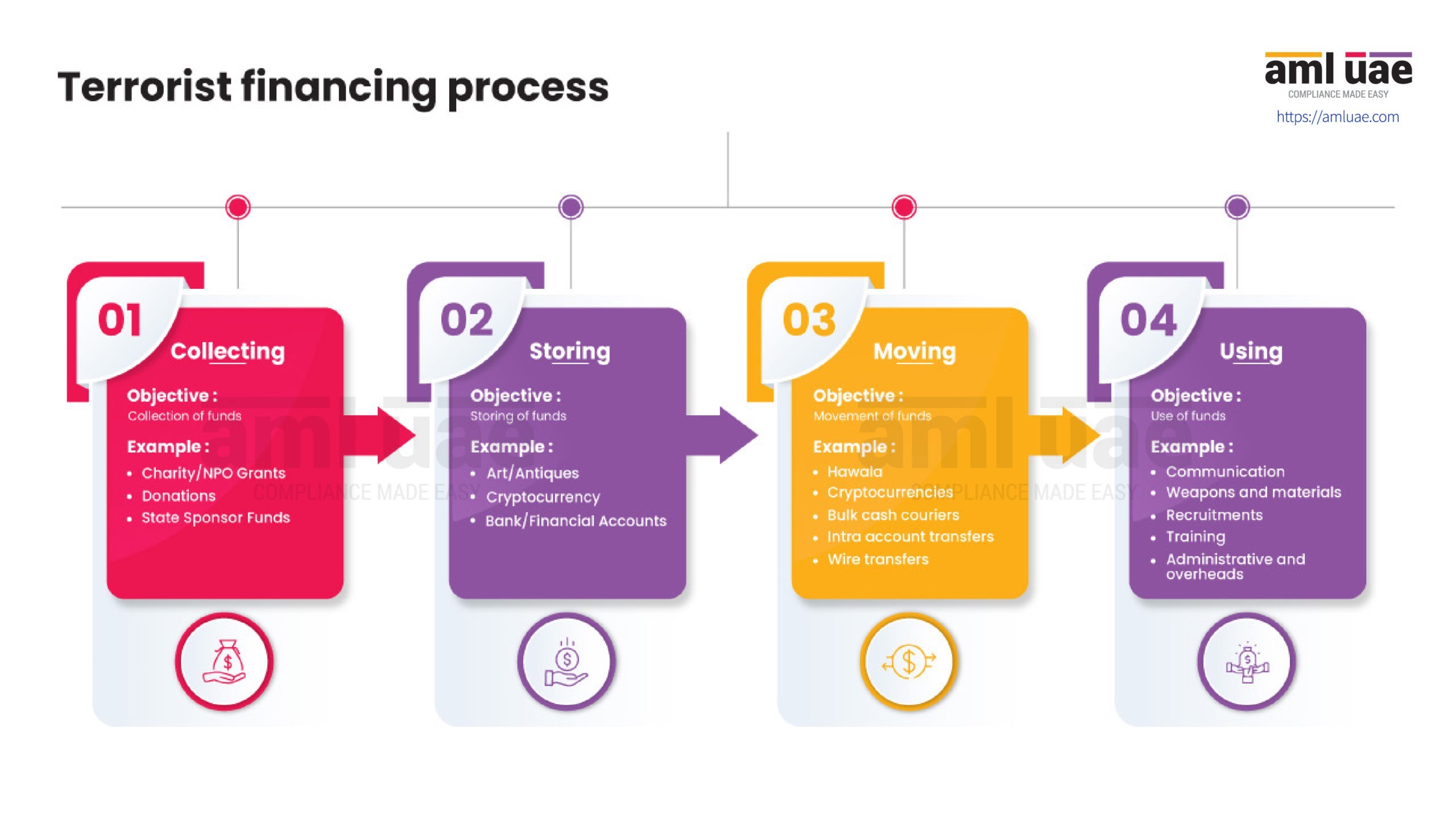
Terrorism Financing is the process of providing financial assistance to terrorists. Terrorists use various methods to avoid the vigilant eyes of law enforcement and crime prevention authorities.

They collect funds from charity/NPO grants and donations and then buy expensive items like antiques or crypto or store funds into bank accounts. They then try to transfer funds to the desired location and account by making hawala transactions, dealing with crypto, or wire transfers. Finally, they use the funds for terrorist activities.

The above infographic depicts the overall Terrorist Financing process. It is also available as a free download in pdf format.

FAQs - Terrorist Financing Process

How are terrorist organisations financed? 

Terrorist organisations are financed through legal or illegal sources. Illegal sources can range from trafficking, cybercrime, kidnapping, corruption, bribery, financial fraud, embezzlement, market abuse, forgery, etc. Legal sources include state sponsorship, microfinancing, donations, remittances, legal business activities, etc.  

The primary sources of terrorist financing can be legal or illegal. Legal sources include government funds, conducting legal business, cultural activities, etc. Illegal sources include corruption, financial fraud, bribery, embezzlement, drugs and human trafficking, cybercrime, kidnapping, etc.  

The three steps of terrorism financing are: 

  • Collecting funds through microloans, donations, charity/NPO grants, etc. 
  • Transferring these funds to terrorist organisations, networks, or cells 
  • Using these funds to fund the activities of terrorists such as buying weapons, bombs, paying for expenses, etc.  

Related Posts

Confused with how to mitigate ML, FT, and PF risks within your Regulated Entity?

How to effectively handle compliance risk

How to manage compliance risk copy (1)-02

7 Crucial steps to handle compliance risk

How to manage compliance risk copy (1)-02

7 Crucial steps to handle compliance risk

Risk assessment is the key to handling compliance risk. Knowing what risks your organization is exposed to and what control mechanisms are already there in place will help you identify the extra measures you need to take and the residual risk that you are willing to take. It is important that you manage your risks related to third parties and develop an ethical business culture. You also need to keep yourself abreast of the latest rules and regulations related to various laws applicable to your business. You will be better off if you harness the power of technology and automate some of the routine compliance work.

Related Posts

Confused with how to mitigate ML, FT, and PF risks within your Regulated Entity?

AML Compliance with the help of Big Data

Pathik Shah

Table of Contents

Protect your business with reliable and effective AML strategies with AML UAE.

AML Compliance with the help of Big Data

Big Data has revolutionized the world of technology and benefits industries with valuable data and insights. Large volumes of data can be instantly accessed, analyzed, and used to make informed business decisions. Financial companies can use big data to identify money laundering cases and keep criminals at bay. This emerging technology has become an inherent part of organizations that want to be AML compliant. AML refers to Anti-Money Laundering laws and regulations created and executed by the government to detect and prevent financial crimes. The AML rules empower banks and other financial institutions to monitor transactions closely and deter criminals from depositing and withdrawing funds from illegal activities.
Money laundering cannot be traced because of the primary reasons that the source of the illegally obtained funds cannot be continuously tracked, and it proves to be a massive deterrent in catching criminals indulging in financial crimes. Gradually economies worldwide are becoming data-oriented and engulfed with enormous data. Digitization and Big Data have become synonymous with each other.

With stricter AML regulations and the need to follow them diligently, organizations are taking the help of Big Data to combat the threat of money laundering. With Big Data, businesses can streamline the AML compliance process and monitor the transactions more efficiently. They can immediately identify any fraudulent activity and prevent money laundering with a risk-based approach by automating the 

AML compliance process, making it more efficient and cost-effective. Big data plays a crucial role in monitoring financial transactions and detecting suspicious customers. Big Data extracts information from varied resources, organizes them, and studies them to arrive at conclusive results. It can be defined as large sets of data multiplying quickly. The technology’s three main components are Volume, Velocity, and Variety popularly referred to as three Vs.

Volume: Big Data deals with large volumes of data from varied sources such as social media, business transactions, videos, etc. the volume of data depends on the organization.

Velocity- refers to the speed at which the data is being received. FIs might accept the data in real-time or batches, which must be analyzed.

Variety- refers to the types of data the Big Data will deal with. It deals with different types of data- structured, semi-structured, and unstructured data including text, audio, video and needs additional pre-processing to derive meaningful insights.

Authorities often fail to detect the sources of illegally obtained funds, and therefore they cannot prevent money laundering to the extent they want to. As per a UN report, 90% of laundered money remains undetected. But, Big Data can assist in tracking the transactions by analyzing large volumes of data, which otherwise is an arduous task if the analysis is done manually. The technology collects KYC information, real-time transactions, and regulatory data. The data collected is analyzed, vectored, and evaluated for fraud checks.
Event-based data are verified with data from different locations, account information, and other systems to detect fraudulent and suspicious activities.

Data Analytics can thwart the following challenges:

CDD- Customer Due Diligence – AML solutions use this information to verify customer identities using external information sources and detect risky profiles. CDD is an essential part of the Risk scoring management program. Businesses can efficiently complete the process of risk scoring in real-time, customize the process, and prevent criminals from being unnoticed.

Customer Onboarding process- The customer onboarding and monitoring process are quickened with Big Data. The KYC – Know Your Customer process ensures that the customers are not involved in money laundering and identifies profiles based on parameters such as PEPs and sanction lists. Companies need to screen customers and identify any suspicious behaviour with continuous monitoring.
Manual data processing is time-consuming, and the onboarding and monitoring process takes much longer. AML software solutions with built-in AI help businesses to stay AML compliant effortlessly.

Transaction Monitoring System: The Transaction Monitoring system regularly monitors the transactions of financial firms. It helps identify suspicious financial transactions that scrutinize areas such as particular transaction patterns.

Behaviour model profile monitoring: AML solutions are equipped to monitor each customer profile based on behaviour models. It will immediately identify any pattern going off-track and not meeting particular behavioural criteria. This way, it flags any suspicious activity and detects any possible money laundering case.

Avoid False positives: It’s essential to reduce the cases of flag positives as that can impact the business negatively. Alerts and notifications in the AML solution and results obtained with advanced analytics closely monitor the fraud detection processes. So, the legitimate customers are not bothered, but criminals are identified who are on the verge of committing financial crimes.

Conclusion

If you are looking for AML Compliance services, you can rely on AML UAE -one of the most reputed and acclaimed consultancy firms that have helped thousands of businesses in the UAE. We provide comprehensive AML consultancy services. Utilize the power of Big Data, streamline and make the AML compliance process more efficient. We are familiar with the UAE AML laws, and we have the requisite experience and in-depth industry knowledge to help you keep your business AML compliant.

Add a comment

Share via :

About the Author

Pathik Shah

FCA, CAMS, CISA, CS, DISA (ICAI), FAFP (ICAI)

Pathik is an ACAMS-certified AML consultant specialising in governance, risk, and compliance for regulated entities in the UAE. He brings over 28 years of experience, with 1,000+ hours of AML training and 200+ advisory engagements across DNFBPs, VASPs, and FIs. He supports businesses in aligning with AML/CFT requirements from the CBUAE, DFSA, MoET, MoJ, VARA, CMA, FSRA, and FATF. Known for translating complex regulations into audit-ready procedures, Pathik enables operational clarity and compliance readiness.

Reach Out to Pathik