


AML Policy Drafting for Dealers in Precious Metals and Stones (DPMS)
AML/CFT Policy Drafting Service for DPMS in the UAE
We provide customised AML/CFT policy drafting services for Dealers in Precious Metals and Stones (DPMS) in the UAE, curated to DPMS obligations under Federal Decree-Law No. (10) of 2025 and its implementing Cabinet Resolution No. (134) of 2025 Concerning the Executive Regulations of Federal Decree-Law No. (10) of 2025 Concerning Combating Money Laundering, Terrorist Financing, and the Financing of the Proliferation of Weapons, and sector specific ML/TF and PF requirements and supply chain risks.
This page highlights how a well drafted Anti-Money Laundering and Combating the Financing of Terrorism (AML/CFT) Policy is the cornerstone of compliance for Designated Non-Financial Businesses and Professionals (DNFBPs) such as Dealers in Precious Metals and Stones (DPMS) in UAE.
An AML/CFT Policy built with precision not only ensures adherence to regulatory standards but also lays down a clear governance structure that reduces exposure to Money Laundering and Terrorist Financing (ML/TF) risks.
More than a formality, a strong AML/CFT Framework becomes a safeguard, offering businesses clarity, accountability, and resilience in the face of regulatory and reputational challenges.

What is an AML Policy?
An AML Policy for DPMS in UAE is a mandatory AML/CFT compliance requirement.
An AML Policy is a formal document that outlines how a business prevents its services from being used for Money Laundering, Terrorist Financing or Proliferation Financing.
Who Does AML/CFT Policies Apply to in the DPMS Sector?
As per Article 3 of Cabinet Decision No. (134) of 2025, Dealers in Precious Metals and Stones (DPMS) are classified as DNFBPs when they carry out specified transactions or activities.
These covered activities include:
- Carrying out single cash transaction whose value equals or exceeds AED 55,000.
- Carrying out multiple transactions whose aggregate value equals or exceeds AED 55,000.
Once they qualify as DNFBPs, they are required to implement comprehensive AML/CFT measures as per the Federal AML/CFT laws of UAE.
As part of these obligations, DPMS are required to establish and document robust AML/CFT Policy that sets out the internal rules, procedures and controls to identify, mitigate and assess ML/TF/PF risks.
However, it should be noted that certain AML/CFT obligations are mandatory for DPMS to comply with irrespective of whether DPMS engage in covered transactions or not as mentioned in Supplemental Guidance for Dealers in Precious Metals and Stones.
In such instances where DPMS are not engaged in covered transactions, they are required to understand their business needs and draft an AML Policy that lays down simplified due diligence requirements for AML/CFT obligations.
Thus, the drafting and developing of an AML/CFT Policy for each DPMS varies, there is no single templet to follow, instead they are required to undertake tailored approach and establish an AML/CFT Policy that fits their business requirements perfectly.
Applicable UAE AML/CFT Laws for DPMS
In the context of DNFBPs, such as DPMS operating in the UAE, an effective policy must be tailored to the entity’s specific risk exposure, addressing areas like Customer Due Diligence (CDD), Suspicious Transaction Reporting (STR), Record Keeping, Staff Training, etc.
regarding the Anti-Money Laundering and Combating the Financing of Terrorism and Proliferation Financing calls for implementing AML/CFT policies.
on the Implementing Regulation of Federal Decree Law No. (10) of 2025, emphasis establishing internal AML/CFT policies commensurate to the nature and size of the business, taking Risk-Based Approach.
DPMS Sector-Specific AML/CFT/CPF Guidelines:
- Supplemental Guidance for Dealers in Precious Metals and Stones calls for establishing, documenting and updating internal policies to mitigate the identified ML/TF/PF risks.
- Ministry of Economy Circular Number: 08/AML/2021 on Dealers in Precious Metals and Stones Report, requires DPMS to mandatorily report Dealers in Precious Metals and Stones Report (DPMSR) for transactions involving cash that exceed AED 55,000 or internal wire transfers, these requirements must be specifically incorporated in AML/CFT Policy for DPMS sector.
- FIU’s Strategic Analysis Report on Misuse of Precious Metals and Stones in Financial Crime – September 2025, this report discusses the relevant typologies pertaining to exploitation of DPMS sector, while preparing an AML/CFT Policy for DPMS, these typologies must be considered.
Why DPMS Policies Must Be Sector-Specific?
DPMS policies must be sector specific as general policy templates are not sufficient for this sector that is full of complexities.
DPMS sector operates through a long and complex supply chain that includes extraction, raw material trading to refining, wholesale and retail sales. Each stage of PMS carries different ML/TF/PF risks.
Moreover, even in supply chain, DPMS have different roles such as traders, refiners, wholesalers, importers, exporters or retailers. The ML/TF/PF risks faced by them depends heavily upon the roles they perform and thus, a general AML/CFT Policy cannot explicitly address these variations.
Many transactions in the DPMS sector involve cross-border movement of goods and customers from different jurisdictions, which increases geographic and customer specific risks that must be carefully addressed in the policy.
Thus, the risk profile of a customer in DPMS sector varies widely based on the factors such as customer type, country of origin, transaction channel, payment method and nature of the PMS involved.
These requires tailored Risk Assessments and controls. Additionally, UAE’s federal AML/CFT laws and DPMS sector-specific guidelines weights on identifying and managing ML/TF/PF risks in line with the actual business activities of DPMS and that can be only done through a customised AML/CFT Policy designed specifically for the DPMS sector.
It is not a template, but a practical framework aligned with legal obligations under the UAE AML laws and sector-specific vulnerabilities.
Purpose of Customised AML/CFT Policy for DPMS
The purpose of the Customised AML/CFT Policy for DPMS is to translate complex AML/CFT Obligations into a customised policy framework that fits the day-to-day operations of a Precious Metals and Stones (PMS) business.
Be it a bullion trader, jewellery manufacturer, dealer of precious stones, or a wholesaler, every DPMS needs to customise AML/CFT Policy according to their business’s unique needs, stemming from varying exposure to different ML, FT, PF, and supply chain related risk factors.
Rather than relying on generic templates, the AML/CFT Policy drafting process for DPMS anchors the AML/CFT Policy in the business’s actual risk exposure, transaction patterns and product lines.
It supports the development of internal controls, reporting systems, and staff responsibilities needed to manage financial crime risks with discipline and consistency and enables these entities to meet the AML compliance expectations.
A customised AML Policy Framework ensures that the policy and procedures don’t just tick a box, rather strengthens the PMS business against regulatory, operational, and reputational risks.
Complete. Consistent. Accurate.
Engage us to create the most suitable AML/CFT policies, controls, and procedures for your business.
Importance of a Tailored AML/CFT Policy for DPMS
DPMS in UAE operate in one of the highest ML/TF and PF risks sectors, making tailored AML/CFT Policies inevitable rather than optional.
In UAE, DPMS businesses are classified as DNFBPs under the AML/CFT Decision. This means they fall squarely within the scope of country’s AML/CFT laws once they carry out any transaction or series of related transactions, worth AED 55,000 or more.
These PMS businesses are therefore subject to specific AML/CFT compliance obligations under the National AML/CFT Framework.
But regulatory compliance is just the starting point. PMS are globally recognised as high-risk commodities, often exploited for laundering proceeds of crime. These risks shift based on how the products are sourced, sold and moved across borders. Without a tailored policy, these vulnerabilities go unmanaged.
Authorities like the Ministry of Economy and Tourism (MOET) of UAE has fostered an AML compliance culture among DPMS, encouraging due diligence, reporting and ethical sourcing. These efforts, supported by sector specific guidance, emphasise a Risk-Based Approach as the foundation for an effective AML/CFT Policy.
A well-structured, risk-based AML Policy and Procedures when curated for DPMS, enhances the quality of internal controls and builds credibility with banks, regulators and financial institutions, and international partners.
It ensures that compliance actions are aligned with actual ML, FT, PF and supply chain risk-exposure. Focusing resources where risk is greatest, rather than following a blanket approach that leaves room for error or oversight.
Challenges Faced by DPMS while Drafting an AML/CFT Policy
Even the most well-prepared PMS businesses face hurdles while putting AML/CFT Policies into action. From adapting to regulatory changes to managing complex supply chains, these challenges require constant attention.
The following are a few pain points concerning the key obstacles DPMS may encounter:
Does your AML/CFT Policy include a detailed ML/FT Risk Assessment tailored to activities such as high-value transactions, sourcing from CAHRAs, or frequent dealings in bullion and uncut stones?
Does your AML Policy comprise of an appropriate Customer Onboarding and Exit Process which captures PEP Screening, third-party payments, and walk-in customers transacting over AED 55,000?
Is your team clear on what Ethical Sourcing involves and how to identify Red Flags in High-risk Supply Chains?
Does your AML Policy provide clear guidance on Group Oversight and coordination if your operations span across free zones, branches, or related entities?
Are you confident that your team knows and when to raise DPMSR, SARs/STRs via goAML, especially in non-obvious or structured scenarios?
Have you embedded Internal Controls that prohibit Tipping Off customers during internal reviews or investigations?
Does your AML Policy equip your team to understand the urgency and distinction between CNMR & PNMR under UAE TFS Obligations?
Are your frontline and compliance staff screened and regularly trained on DPMS-specific red flags, including high-risk supply chain indicators and customer behaviour?
Does your AML Policy provide for a robust Governance Structure with a designated Compliance Officer who is independent, trained, and empowered to act without interference?
Turn Pain into Policy!
Transform your AML/CFT Policies and Procedures into a competitive advantage for your DPMS operations.


“AML/CFT Policy Drafting for DPMS Sector is an altogether different ballgame. When high-value inventory circulates across markets like Dubai’s bullion trade, gold souks and designated DMCC zones, risk is about controlling value that moves faster than money. As gold, diamonds, and high-value stones change hands not only through free zones, refineries and cross borders trade hubs, the AML/CFT Policy must follow the metal; through ethical sourcing, pricing, payment, and delivery channels; while remaining fully aligned with the regulatory expectations and UAE Good Delivery Standards. ”

Step-by-Step Guide: How to Draft an Effective AML/CFT Policy for DPMS
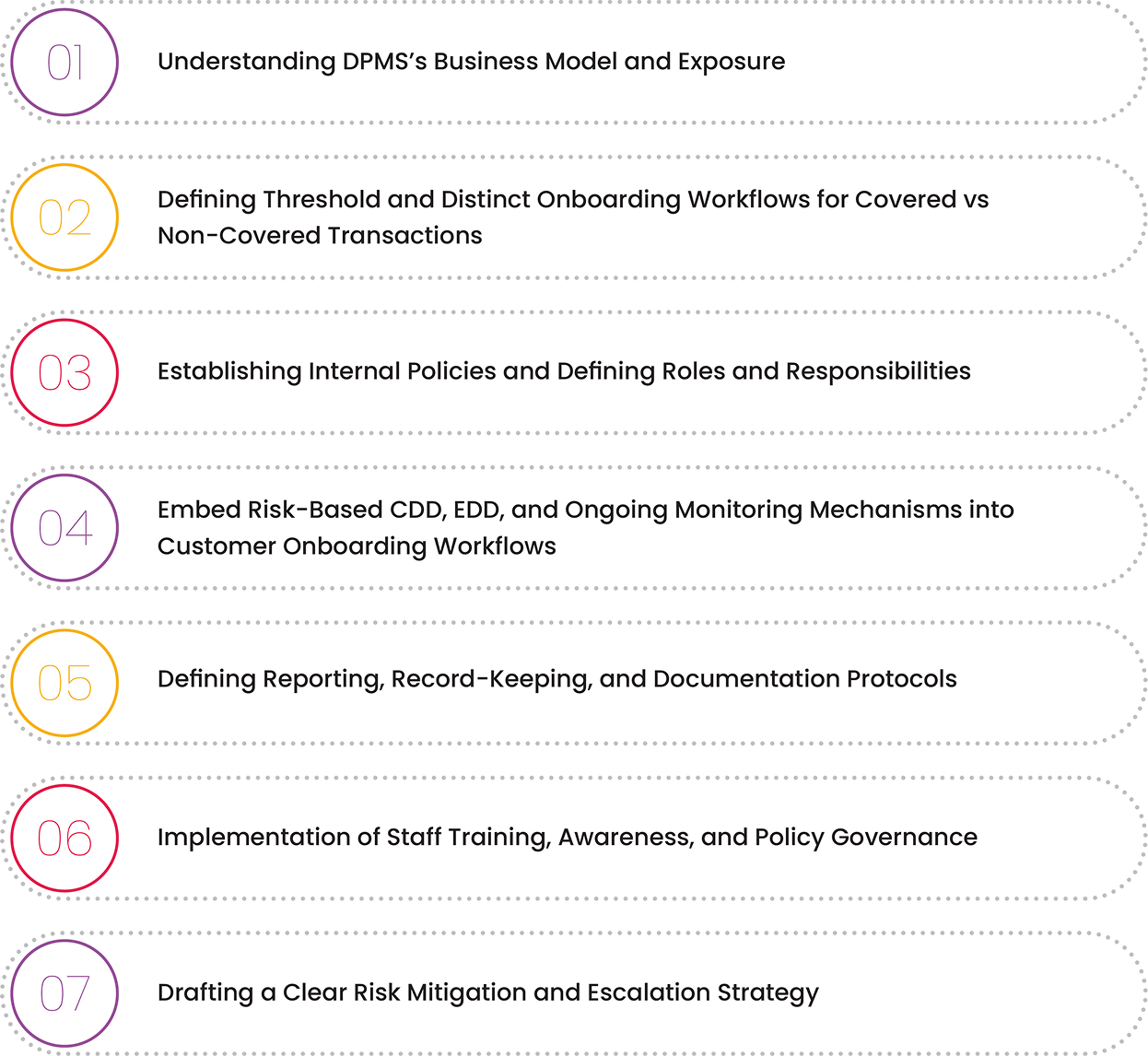
AML/CFT Policy draft for DPMS sector is a structured and systematic procedure that commences with understanding the ML/TF/PF risk associated with their business model.
This continues with defining thresholds, onboarding workflows for covered/non-covered activities, establishing internal policies, defining roles and responsibilities, embedding a risk-based approach for CDD, EDD and Ongoing Monitoring workflows.
The later pathway consists of defining reporting, record-keeping, documentation protocols, implementing staff training and drafting a clear risk mitigation and escalation strategy for an effective drafting of an AML/CFT Policy for DPMS sector.
Step 1: Understanding DPMS’s Business Model and Exposure
Understanding the business model of DPMS and their ML/TF/PF risk exposure is the first step of drafting an AML/CFT Policy for DPMS sector.
The foundation of drafting an effective AML/CFT Policy for DPMS begins with assessing both the enterprise risk and customer-level risks. This includes understanding how the business operates and where it is most exposed to risk via the conduct of an Enterprise-Wide Risk Assessment (EWRA) by the AML Compliance Officer (CO), further reviewed by the Senior Management.
Factors like the type of goods traded role in the supply chain, transaction size, payment method and customer profile all influence vulnerabilities faced by the DPMS.
Adequate due diligence must be done when handling high-value cross-border transactions. This ensures the AML Policy addresses actual, not assumed risk exposures.
Step 2: Defining Thresholds and Distinct Onboarding Workflows for Covered vs Non-Covered Transactions
Crafting distinct onboarding workflows for covered and non-covered transactions of DPMS sector for AML/CFT compliance is the second step while drafting an AML/CFT Policy.
DPMS are subject to AML/CFT obligations when a single transaction or a series of linked transactions equals or exceeds AED 55,000.
The sector-specific Guidance for DPMS calls for mandatory TFS Screening of all customers, irrespective of the threshold or amount of transaction involved, whereas full-fledged AML mitigation measures need to be applied to customers when the threshold is crossed.
The second step involved in drafting an effective AML/CFT Policy is to outline how such covered transactions are identified, monitored and reported in a timely manner.
At the same time, it must be taken into consideration that certain AML compliance obligations apply regardless of transactional value, for instance, compliance with United Nations Security Council (UNSC) Sanctions and UAE regulations. Embedding these requirements within onboarding workflows ensures that due diligence is applied consistently to all the clients.
Step 3: Establishing Internal Policies and Defining Roles and Responsibilities.
Establishing internal policies and defining clear roles and responsibilities is the third step for DPMS’ AML/CFT Policy drafting.
Once risks and thresholds are understood, the next step is to build structured internal policies that address how those risks will be managed daily.
This includes laying out procedures for Customer Due Diligence (CDD), Suspicious Activity Reporting (SAR), Staff Training, etc., all tailored to the DPMS unique operational risks, from accepting large cash payments to sourcing metals from high-risk regions or dealing with walk in clients purchasing high value items without a clear rationale.
The AML/CFT Policy should clearly assign duties to competent individuals with the authority to act for each critical function.
Step 4: Embedding Risk-Based CDD, EDD, and Ongoing Monitoring Mechanisms into Customer Onboarding Workflows
Inserting Risk-Based CDD, EDD and Ongoing Monitoring mechanisms into customer onboarding workflows is the fourth step in drafting AML/CFT Policy for DPMS.
Once the business model of a DPMS is assessed and roles are assigned, the next step to draft an effective AML/CFT Policy is to include and curate CDD and Enhanced Due Diligence (EDD) measures within Customer Onboarding workflows.
DPMS must verify their customer’s identity, understand the purpose of a transaction and identify the Sources of funds and wealth, where needed. If, for instance, payment for imported PMS is made by a third party unrelated to the deal, an appropriate EDD must be triggered.
Including Ongoing-Monitoring during and beyond onboarding becomes vital here, to detect repeated patterns of third-party payments or other anomalies that may otherwise go unnoticed
Step 5: Defining Reporting, Record-Keeping, and Documentation Protocols
Curating Regulatory Reporting, Recor-Keeping and Documentation rules in a DPMS’s AML/CFT Policy is the fifth step.
Following the due diligence measures, an effective AML/CFT Policy crafted for DPMS must further define how suspicious activities are documented, escalated, and reported.
This includes creating an internal workflow for identifying certain red flags and reporting them as suspicious. For instance, frequent small transactions used to bypass AML thresholds, a common ploy in cash-heavy trade, are reported to the CO for potential STR filing.
It must also include a structured process for submitting Confirmed Name Match Report and Partial Name Match Report (CNMR/PNMRs) when potential matches arise during Targeted Financial Sanctions (TFS) Screening.
DPMS should then ensure that the AML Policy also provides for retention of all CDD/EDD records, transaction receipts, staff-training logs, regulatory reporting related materials for a minimum period of 5 years.
Step 6: Implementation of Staff Training, Awareness, and Policy Governance.
Drafting Staff Training, Awareness and Policy Governance requirements in the AML/CFT Policy is the sixth step for ensuring pathway.
The next step in the process is to make sure that the AML/CFT Policy isn’t just written, but it is understood and applied, in totality. DPMS should ensure that its AML/CFT Procedure further defines how its staff will be trained to detect risks unique to the PMS trade.
Procedures should be drafted based on the outcome of the EWRA and must include essential points to guide who needs to be trained, what should be covered, and how often it should occur.
It should apply across the group entities and across branches. While drafting an effective AML/CFT Policy, it must be kept in mind that the training isn’t generic but risk-based, role-based, and relevant.
Step 7: Drafting a Clear Risk Mitigation and Escalation Strategy
Implementing and documenting clear Risk Mitigation and Escalation strategy is the seventh and the last step of drafting an AML/CFT Policy for DPMS.
The final step in AML Policy drafting for DPMS is to ensure that the AML/CFT Policy clearly outlines how identified ML/FT & PF risks will be handled in practice i.e., in situations when potential risks materialise.
For DPMS, this means defining how to respond when high-risk scenarios arise, such as dealing with Politically Exposed Persons (PEP) customers with unclear fund sources, or unusual sourcing routes for precious metals.
The AML/CFT Framework for DPMS must lay out who takes the call, when to escalate, and what additional measures will be applicable. Escalation must be proportional to the threat.
Complete. Consistent. Accurate.
Engage us to create the most suitable AML/CFT Policies, Controls, and Procedures for your DPMS business.
Must Have Elements in an AML/CFT Policy for DPMS
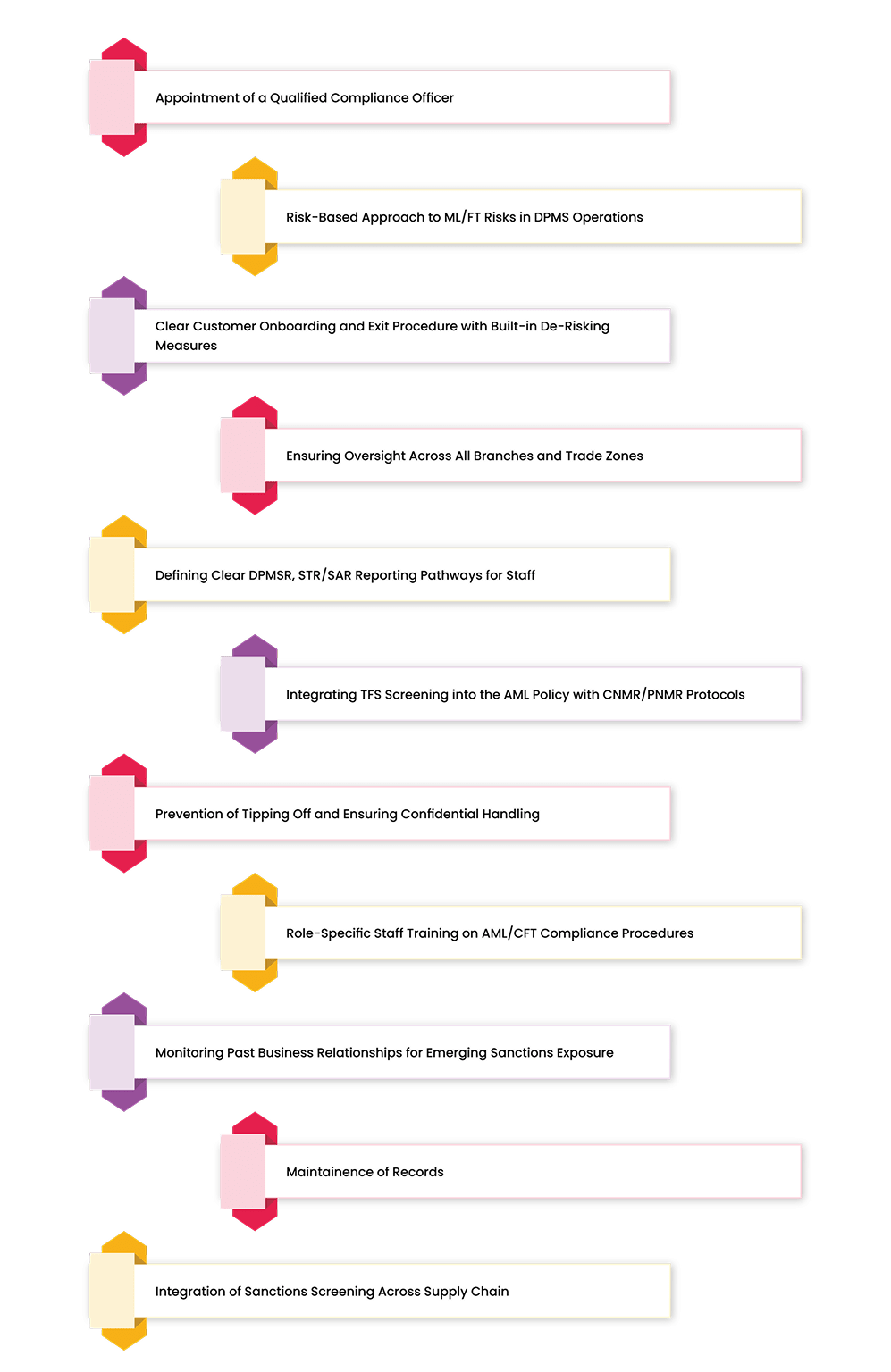
UAE Regulators expect DPMS to have in place, the following non-negotiable elements as every AML/CFT Policy rests on these components. These essentials keep compliance on track, risks in check, and operations running with integrity. Below are a few elements no DPMS Policy should miss.
Appointment of a Qualified Compliance Officer
A strong DPMS AML/CFT Policy must include an AML Compliance Officer with the competence, experience, and independence to manage the AML/CFT Framework concerning the DPMS.
The AML CO, approved by the Supervisory Authority, should operate at the management level, free from conflicts of interest, and oversee program effectiveness, suspicious transaction reporting, and staff training.
They ensure that governance, risk management and compliance measures are aligned with regulatory requirements and the unique risks of the PMS sector.
Risk-Based Approach to ML/FT Risks in DPMS Operations
An effective AML/CFT Policy must apply a risk-based lens to the realities of the DPMS trade.
It should assess ML, FT, PF and sourcing risks arising from customers operating in jurisdictions linked to activities such as unregulated mining, or those dealing in high-risk products like gold bullion and diamonds, which are valuable, portable, and difficult to trace.
Delivery channels like metal accounts, enabling anonymous transactions without face-to-face interaction, also demand greater scrutiny. By ranking risks and applying proportionate controls, the AML procedure ensures resources are focused where vulnerabilities are the greatest.
Having a Clear Onboarding and Exit Procedure with Built-in De-Risking Measures
An AML/CFT Policy for DPMS must have a clear onboarding and exit procedure. It must ensure that only verified, risk-appropriate customers are onboarded. This includes complete Know Your Customer (KYC), screening, and risk assessment before opening any account, with EDD for high-risk profiles and compliance approval.
Shell companies, anonymous ownership, and high-risk jurisdictions must be excluded. Exit triggers, including increased ML/FT Risk, non-cooperation, or adverse changes in profile, should be provided for in the AML Policy.
The AML/CFT Procedures must be documented with related reports such as STRs, SARs, CNMRs, or PNMRs filed as appropriate, ensuring all actions align with risk appetite and regulatory obligations.
Ensuring Oversight Across All Branches and Trade Zones
A DPMS AML/CFT Policy must apply consistently across all branches, whether in UAE trade hubs or international locations, while respecting local AML regulations.
Group Oversight should include regular assessment of branch policies, certification of CDD and transaction data by branch heads, and secure sharing of verified customer and referral information.
In high-risk trade zones, consistent controls safeguard against vulnerabilities, ensuring group-wide compliance, smooth information flow, and readiness to address suspicious activity wherever the DPMS operates.
Defining Clear DPMSR, STR/SAR Reporting Pathways for Staff
The next essential element in a DPMS AML/CFT Policy is establishing clear Dealers in Precious Metals and Stones Report (DPMSR) and STR/SAR reporting pathways for staff.
This means defining exactly how employees should escalate suspicious or covered transactions, whether pending, in progress, or completed, to the AML CO without delay.
The AML/CFT procedures should outline internal investigation steps, timelines, confidentiality safeguards, and Financial Intelligence Units (FIU) submissions through goAML.
By defining both STR/SAR obligations and DPMSR requirements, staff can detect DPMS-specific red flags, such as customers avoiding personal contact, refusing to disclose beneficial ownership, or requesting services like reshaping gold without a legitimate reason.
Integrating TFS Screening into AML Policy with CNMR/PNMR Protocols
In the DPMS industry, where cross-border trade in high-value assets is common, integrated, robust TFS Screening into the AML/CFT Policy is vital to prevent prohibited dealings.
It should require screening all customers, UBOs, business partners, and transactions against UAE and UN sanctions lists, especially before onboarding, processing payments, or upon KYC changes.
For example, if a gold consignment payment is linked to a sanctioned entity overseas, the procedures contained in the AML/CFT Program Framework must ensure that the steps, SOPs, workflows and escalations are in place.
Such triggers must result in freezing of the transaction immediately, a CNMR being filed, and authorities being notified without any delay.
Prevention of Tipping Off and Ensuring Confidential Handling
In drafting a robust AML/CFT Policy for DPMS, parameters for preventing “tipping off” are critical to maintaining the integrity of the investigations.
The procedures of the AML Program should mandate strict confidentiality for all STR/SAR and other regulatory reports-related information, ensuring access is limited to authorised staff only.
First-line staff must be trained to recognise suspicious behaviour, ask appropriate questions, and avoid revealing that a report is being made or an investigation is underway. Secure information flows, controlled system access, and clear internal communication protocols protect both the business and the investigation from compromise.
Role-Specific Staff Training on AML/CFT Compliance Procedures
An effective AML/CFT Policy for DPMS must embed tailored training that equips every role within the organisation to address the unique ML/FT risks of PMS trade.
Frontline staff should be trained to detect red flags such as unusual payment methods, unexplained high-value trades, inconsistent financial patterns, or use of third parties to mask beneficial ownership.
Compliance teams need in-depth knowledge of reporting protocols, red-flag analysis, and escalation steps, while senior management ensures group-wide consistency.
Regular updates on emerging typologies, combined with rigorous pre-employment and promotion screening, strengthen vigilance and embed a compliance culture throughout the organisation.
Monitoring Past Business Relationships for Emerging Sanctions Exposure
A well-drafted AML Policy must include measures to not only monitor current clients but also past business relationships for a period of five years for emerging sanctions exposure.
This ongoing vigilance ensures that changes in the Sanctions Lists, geopolitical conditions, or ownership structures are promptly identified.
The business should establish periodic reviews of historical client data, cross-checking against the updated UN Sanctions List, and investigate any new matches. This process safeguards entities from engaging with sanctioned entities after a relationship has ended.
Maintenance of Records
Accurate and accessible records are the backbone of a DPMS’s AML/CFT compliance.
A robust AML/CFT Policy drafting must define the scope of record-keeping, covering everything from certificate numbers and identifying characteristics of PMS (weight, purity, cut, colour markings) to documentation on warehousing and safekeeping, with ongoing monitoring for changes or substitutions.
Such clarity in the AML/CFT Framework ensures regulatory readiness, traceability, and confidence during audits or investigations. The aim is to keep a clear track of what was done, when, and why.
Integration of Sanctions Screening Across the Supply Chain
An expertly drafted AML/CFT Policy for DPMS ensures that Sanctions Screening is not limited to Customer Onboarding but embedded throughout the PMS supply chain, from extraction to final retail sale.
In the context of DPMS, this means defining clear protocols for checking minders, suppliers, refiners, transporters, wholesalers, and retailers against updated Sanctions Lists at critical points such as onboarding, transaction execution and KYC changes.
Such an AML/CFT Framework safeguards the business by preventing prohibited parties from entering the chain, ensuring compliance, and protecting brand integrity.
Build It Right, From Day One
Protect your business by ensuring every essential element is covered in your AML/CFT Policy Framework.
How to Design and Implement a Proper AML/CFT Policy for DPMS: Best Practices
The strongest policies come from a thoughtful design. By aligning with regulations, addressing sector-specific risks, and setting clear procedures, DPMS can ensure long-lasting compliance. The following are certain best practices which can be followed by businesses to ensure the same:
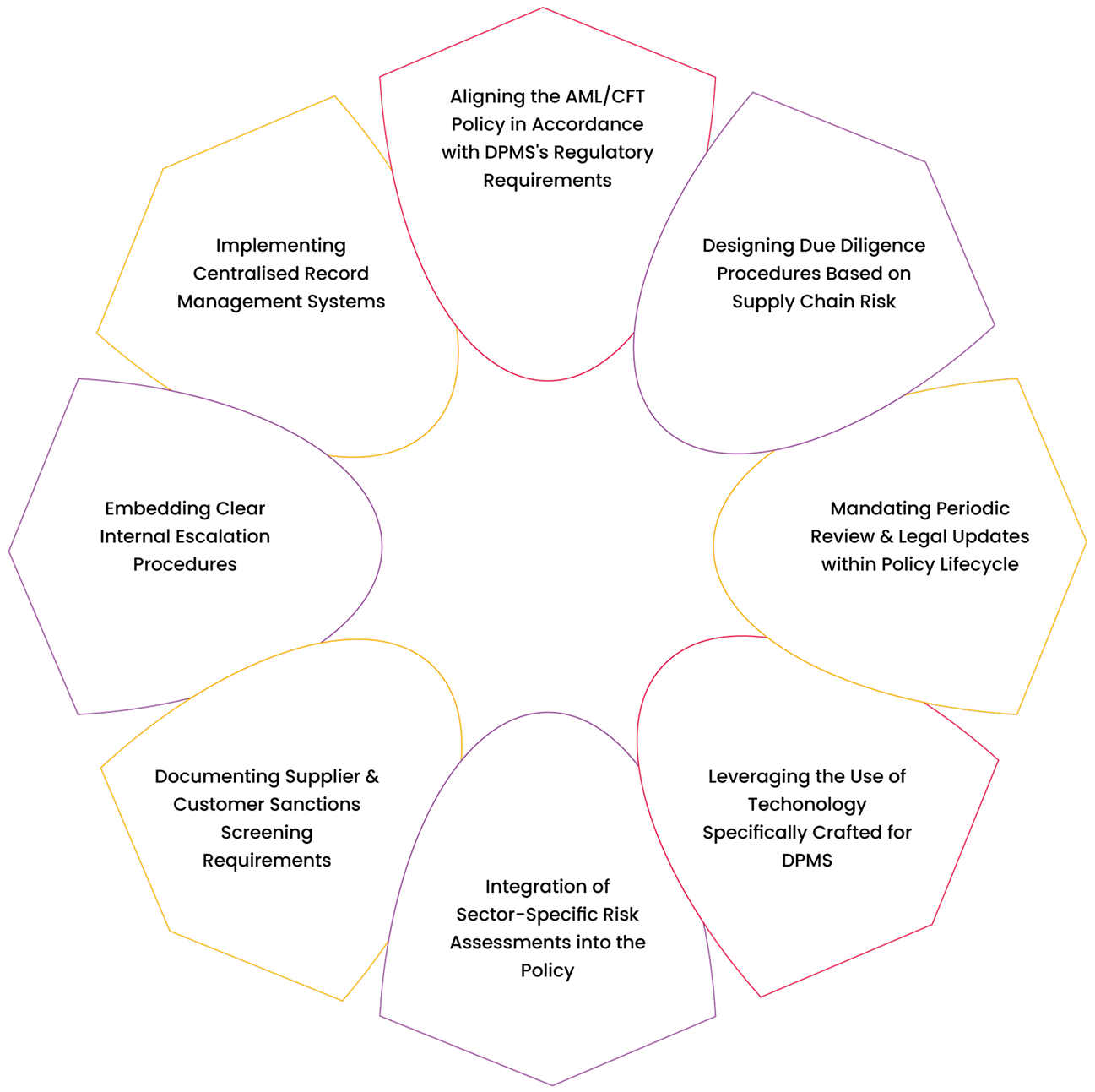
Aligning the AML/CFT Policy in Accordance with DPMS's Regulatory Requirements
A strong AML/CFT Policy for DPMS must be anchored in UAE laws, Cabinet Decisions, and Supplemental Guidance for DPMS, including TFS and DPMSR, STR/SAR requirements.
It should reference obligations under the DPMS sector framework, ensuring coverage of due diligence, sanctions compliance, and record-keeping, while tailoring measures to reflect the unique vulnerabilities of PMS trade.
Integration of Sector-Specific Risk Assessments into the Policy
The AML/CFT Policy should incorporate findings from DPMS-focused ML/FT risk assessments, including supply-chain vulnerabilities, cash transaction exposure, and typologies like commingling or illicit sourcing.
This involves mapping risks at each stage, extraction, beneficiation, wholesale, and retail, and integrating relevant controls, EDD triggers, and transaction monitoring thresholds directly into operational procedures to ensure practical, risk-based application across all business functions.
Designing Due Diligence Procedures Based on Supply Chain Risk
Effective AML/CFT Policies must define due diligence tiers aligned with supply chain risks, considering the origin of goods, supplier reputation, transport routes, and geopolitical factors.
In context of high-risk sources, procedures should include enhanced verification of beneficial owners, physical inspections, and independent audits. These measures ensure traceability, prevent entry of illicit PMS, and comply with the Kimberley Process and sanctions requirements.
Documenting Supplier & Customer Sanctions Screening Requirements
A strong DPMS AML/CFT Policy must integrate sanctions screening into onboarding, transaction processing, and periodic review stages, not as an afterthought, but as a preventive filter.
Using CNMR and PNMR protocols, the AML/CFT Framework should mandate checks on all business relationships, including intermediaries and logistic providers, with full documentation for audit readiness.
Mandating Periodic Review & Legal Updates within Policy Lifecycle
An AML/CFT Policy for DPMS is only effective if it evolves with the law. The AML Procedures should formalise annual reviews and additional updates whenever new legislation, typologies, or Sanctions Lists are issued.
These updates must cascade into procedural changes and staff training, ensuring that the compliance framework reflects the latest regulatory and risk environment without lag.
Embedding Clear Internal Escalation Procedures
Internal escalation procedures within AML Policy of a DPMS should be unambiguous, detailing who’s responsible for investigating suspicious transactions, how quickly alerts must be acted upon, and how findings are documented.
The AML/CFT Program should also reinforce the prohibition on “tipping off”, making it clear that confidentiality obligations apply across all levels, from front-line sales staff to senior management.
Leveraging the Use of Technology Specifically Crafted for DPMS
An AML/CFT Policy should incorporate the use of technology designed specifically for PMS trade, such as automated sanctions screening, digital KYC tools, and supply chain traceability systems capable of recording PMS identifiers such as weight, purity and cut.
Embedding such technology in the AML/CFT Framework reduces manual gaps, speeds up compliance workflows, and enables real-time monitoring of high-value, high-risk goods.
Implementing Centralised Record Management Systems
Centralised record systems must be written into DPMS’’s AML Policy’s “Procedure” portion as a non-negotiable control. These systems should retain transaction data, CDD/EDD files, sanctions screening results, and PMS-specific identifiers for at least five years, as required under mainland UAE laws.
Proper maintenance of such records supports fast regulatory responses and strengthen the audit trail across all operational branches and trade zones.
Adopting these best practices such as regulatory alignment, DPMS specific risk assessments, supply chain risk management, clear screening mechanisms, periodic reviews requirements, escalation workflow, record management and use of advanced technology requirements, enable DPMS to develop and implement effective AML/CFT Policy tailored to their business needs.
Make Your Efforts in the Right Direction
Let the AML UAE defined AML/CFT Policy Framework be Your Compass
Benefits of a Professionally Drafted AML/CFT Policy for DPMS
A sound AML/CFT Policy delivers far more than legal compliance. It builds resilience, prevents misuse, and boosts client and regulator confidence. Unlike generic AML templates, a DPMS-specific AML/CFT Policy addresses the unique commodity driven and supply chain risks that regulators scrutinise the most.
The following are some benefits a business may expect out of a well-crafted AML/CFT Policy specifically designed for DPMS:
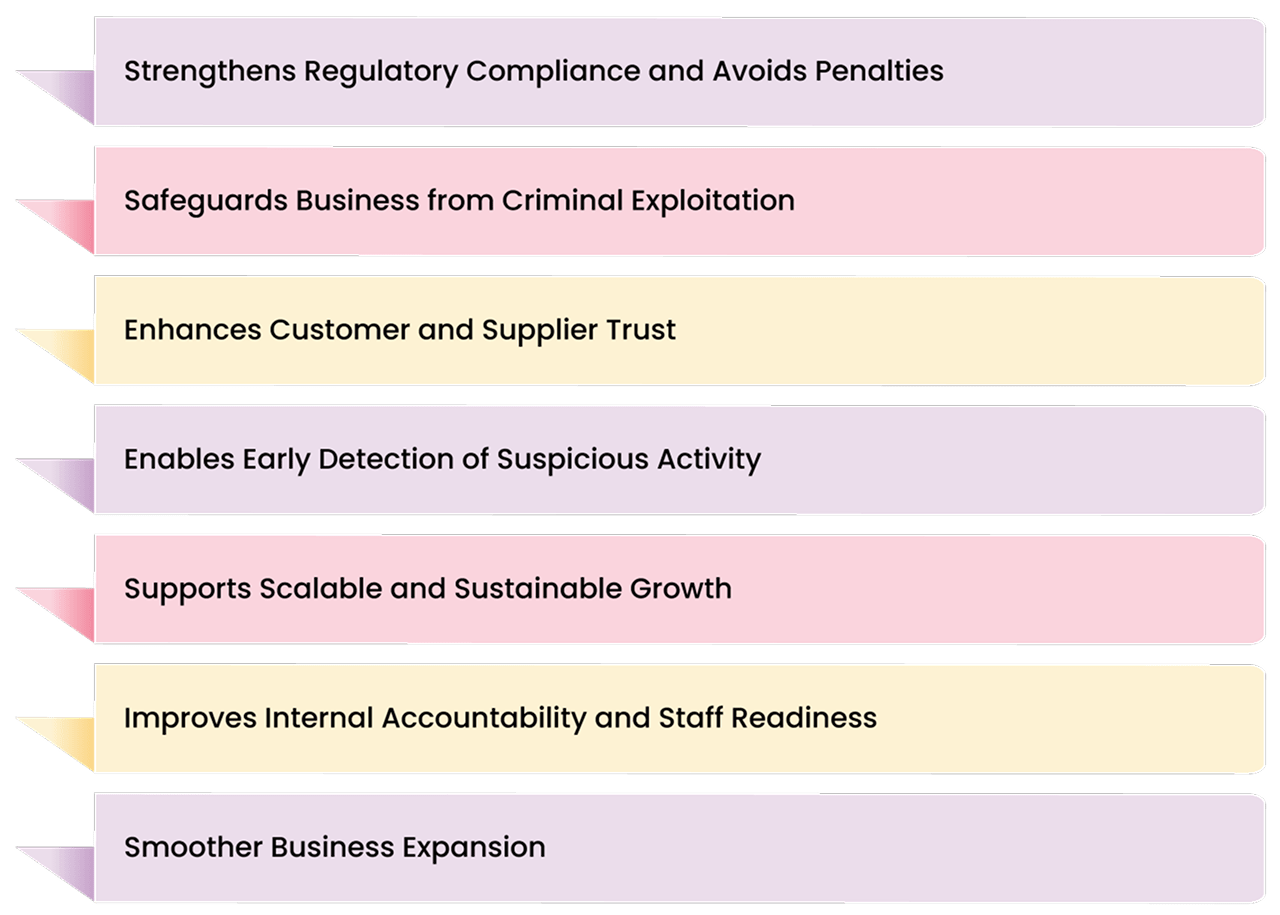
Strengthens Regulatory Compliance and Avoids Penalties
A well-drafted AML/CFT Policy ensures DPMS compliance is precise, current and sector-specific. It captures every legal obligation, from due diligence to reporting thresholds, leaving no compliance gaps that could invite penalties.
Instead of a generic template, the AML/CFT Policy is crafted to mirror a DPMS’s exact operations, helping it to demonstrate to regulators that it’s not just meeting the letter of the law, but actively managing DPMS-specific ML/FT risks.
Safeguards Business from Criminal Exploitation
When criminals target high-value commodities like gold and diamonds, weak compliance controls are their entry point. A tailored AML/CFT Policy for DPMS builds safeguards into every stage, onboarding, monitoring, and transaction handling, so illicit actors find no room to exploit.
The AML Framework becomes a shield, helping an entity reject risky business relationships and maintain a clean, reputable standing in a trade often exposed to cross-border smuggling and value-laundering schemes.
Enhances Customer and Supplier Trust
A well drafted AML/CFT Policy is more than an internal document, it’s a statement of integrity to clients and suppliers. By following ethical trade practices, and meeting regulatory standards, it reassures partners that the DPMS business is safe to deal with.
This trust isn’t accidental, it’s built into the Policy Drafting Process, which aligns the procedures of an entity with the expectations of credible, law-abiding market players worldwide.
Enables Early Detection of Suspicious Activity
A generic compliance checklist won’t flag subtle risks, but an AML/CFT Policy designed for DPMS will. Professional AML Policy Drafting ensures the DMPS business procedures include targeted monitoring to detect unusual transaction patterns, risky jurisdictions, or suspicious payment structures early.
With escalation protocols clearly documented, businesses can act quickly, report where needed, and protect their operations, while also showing regulators that their business responds to threats before they spiral.
Supports Scalable and Sustainable Growth
As DPMS operations expand, whether through higher volumes, new product lines, or entry into foreign markets, the compliance workload multiplies. A custom-drafted AML/CFT Policy scales with the business, keeping onboarding, monitoring, and reporting consistent across all locations.
This stability allows a business to grow without fear that new ventures will create compliance blind spots, ensuring expansion is not only profitable but also legally and ethically sound.
Improves Internal Accountability and Staff Readiness
A strong AML/CFT Policy leaves no room for confusion; each team member knows their compliance role. Through professional AML Policy Drafting for DPMS, the policy document specifies duties, training requirements, and decision-making authority.
In the DPMS sector, where risks can be complex, this clarity ensures that staff respond appropriately to red flags, keeping compliance a shared responsibility rather than an isolated function. Well-trained teams mean fewer mistakes and stronger overall defence.
Smoother Business Expansion
Entering new trade zones or jurisdictions often means navigating different rules, client types, and transaction risks. A well-crafted Policy Drafting Service addresses these variations in advance, setting uniform standards for onboarding, oversight, and due diligence across all branches.
This removes friction when expanding, reassures overseas regulators and partners, and ensures that every branch of a particular DPMS operation operates at the same high compliance level.
Final Thoughts: Securing Your Business with the Right Policy
A professionally drafted AML/CFT Policy for DPMS in UAE provides more than compliance. It covers comprehensive areas such as regulatory requirements for DPMS sector, mechanisms for covered/non-covered transactions, supply chain risk management, risk identification, risk mitigation, customer onboarding, suspicious transactions, regulatory reporting, record-keeping, governance and TFS measures.
A well-structured AML/CFT Policy for DPMS is not just a regulatory checkbox; it is a strategic safeguard that protects the business at every stage of operation. By combining sector-specific risk assessments, robust sanctions screening, clear escalation pathways, and strong governance, such an AML/CFT Program builds resilience against financial crime.
With the right framework in place, DPMS can operate confidently, uphold trust with stakeholders, and meet global compliance standards, ensuring both legal protection and long-term business security.
Secure Your Future, Today
The right AML/CFT Policy isn’t just about compliance, it’s your strongest defence against financial crime and reputational risk.
Frequently Asked Questions on AML/CFT Policy Drafting for DPMS
Are DPMS required to have an AML/CFT policy in the UAE?
Yes, DPMS are required to have an AML/CFT Policy in UAE as they fall under the category of DNFBPs and by virtue of it, it is a compliance requirement for them to develop and maintain AML/CFT policy. However, while developing AML/CFT Policy for DPMS, it is of utmost importance to understand the AML/CFT obligatory requirements for covered and non-covered transactions.
What is an AML/CFT policy drafting service for DPMS?
AML/CFT policy drafting service for DPMS denotes to providing professional assistance in preparing a tailored AML/CFT policy in line with the DPMS sector specific legal requirements for AML/CFT compliance in UAE.
What must a DPMS AML/CFT policy include?
A DPMS AML/CFT Policy must include essential elements such as risk identification and mitigation measures, appointment of a compliance officer, statement of Risk-Based Approach, Customer onboarding rules, Customer exit policy, threshold-based rules, Cash acceptance policy, screening mechanisms, staff-training and record-keeping requirements.
How long must DPMS retain AML/CFT records?
DPMS must retain AML/CFT records for at least five years in the UAE mainland as per the requirement of UAE’s federal AML/CFT laws. For DPMS in DIFC and ADGM, the record-keeping requirements is for 6 years.
Why are precious metals and stones considered high risk?
Precious metals and stones are considered high risk because of their high value, ease of transport, global market demand and ability to be easily converted into the cash.