


Policy Drafting Service for Law Firms, Legal Professionals and Lawyers
We provide customised AML/CFT Policy Drafting Services for lawyers, law firms, and legal professionals in UAE, tailored to ensure compliance with the Federal Decree-Law No. (10) of 2025, its Implementing Regulations, and sector-specific supervisory expectations.
Developing an AML/CFT Policy to meet their legal requirements is a mandatory obligation for Legal Professionals, Lawyers and other legal professionals in UAE as it sets the stage for the implementation of AML/CFT Program.
Here’s a comprehensive overview of what an ideal AML Policy is along with its purpose, importance, legal sector specific requirements, must have elements, benefits and best practices to draft a tailored AML/CFT Policy for legal practitioners.
What is an AML Policy for Law Firms, Legal Professionals and Lawyers in UAE?
Who Must Have an AML/CFT Policy in the UAE Legal Sector
In the context of Designated Non-Financial Business and Professions (DNFBPs), such as Lawyers, Law Firms or any person in the legal profession such as notaries, their AML Policy must be customised to their specific ML/FT and PF risk exposure.

Applicable UAE AML/CFT Laws for Lawyers
The Federal Decree Law No. (10) of 2025 regarding the Anti-Money Laundering and Combating the Financing of Terrorism and Proliferation Financing calls for implementing AML/CFT policies to lawyers, notaries and other legal professionals who conduct activities that are covered in for AML/CFT Compliance.
Cabinet Decision No. (134) of 2025 on the Implementing Regulation of Federal Decree Law No. (10) of 2025, emphasis establishing internal AML/CFT policies commensurate to the nature and size of the business, taking Risk-Based Approach.
Why is DNFBP-Specific Customisation Required?
DNFBP-specific customization is required as each DNFBP operates differently, the risk profiles and vulnerabilities associated with each of them are distinct based on the nature of services offered and the client base served.
Moreover, each DNFBP follows a different customer relationship model that requires tailored approach for due diligence measures. Operational structures, workflow and resources allocation appetite also differs, that makes generic policies ineffective.
A well-designed AML Policy covers comprehensive areas such as Customer Due Diligence (CDD), Enhanced Due Diligence (EDD), Ongoing Monitoring, Screening measures, Regulatory Reporting, Record-Keeping, Staff Training, Periodic Reviews etc. and customize it according to the necessities of the Regulated Entities.
Purpose of Drafting a Tailored AML Policy for Law Firms, Legal Professionals, and Notaries
The purpose of drafting a tailored AML Policy for Law Firms, Legal Professionals and Notaries is to ensure accurate compliance with UAE’s AML/CFT laws and regulations. It provides clear understanding and acts as a practical guide to help Law Firms to understand their responsibilities to prevent the crimes of Money Laundering, Terrorism Financing and Proliferation Financing.
The focal point behind drafting a customised and meticulous AML Policy for Law Firms or Legal Professionals is to ensure accurate compliance with regulatory requirements and international standards.
In addition to this, it serves uniformity across the internal business operations by converting complex AML/CFT obligations into a standardised policy framework that is applicable at every level of the organisation across branches.
Instead of depending on generic policy templates, legal professionals should ensure that the AML/CFT Policy they are implementing in their business operations is customised as per their own business requirements for maximum accuracy and precise implementation.
Not all Law Firms or Lawyers operate the same way, each has a unique business model, client base, location, and regulatory obligations. Therefore, it’s essential they adopt a risk-based approach and emphasize having an AML/CFT policy tailored to their specific operations and risks.
Importance of Customised AML Policy for Legal Professionals
The importance of customized AML Policy for Lawyers, Legal Professionals and Notaries is that it ensures that AML/CFT compliance measures are practical, relevant to the nature, size and services of the legal professionals.
Legal services are majorly vulnerable to exploitation by money launderers and those financing terrorist activities or the proliferation of weapons of mass destruction.
The legal sector’s vulnerability exists due to the confidentiality they offer with their services. This confidentiality can facilitate the misuse of real estate deals, the creation of shell companies for illicit purposes, notarial misuse, etc.
This element of confidentiality facilitates criminals to legitimise their criminal proceeds by misusing the services the legal profession offers. Without proper AML/CFT Policies in place, these vulnerabilities can be unmanageable, causing significant harm to the law firm as well as the broader financial system. Therefore, having a customised AML/CFT policy in place is vital for ML/TF risk management.
Having a well-structured AML/CFT Policy strengthens the law firm’s professional integrity, upholds its ethical stance, and protects the firm from any dire reputational damage or hefty financial penalties.
In addition to this, it enhances the quality of internal controls and builds credibility with the regulatory authorities. Further, it makes sure that compliance actions are aligned with the actual ML/TF risks and resource allocations are prioritised as per the risk mitigation requirements.
Challenges Faced by Law Firms While Drafting a Thorough AML/CFT Policy
The major challenges faced by Law Firms while drafting a thorough AML/CFT Policy include balancing legal professional privilege with AML/CFT Compliance requirements, lack of expertise in team to understand the legal sector specific red flags.
Implementing a structured AML/CFT Policy is a big hurdle even for well-prepared Legal Professionals. It is important to be aware of these challenges and adopt proper measures to rectify them while crafting AML/CFT Policy:
The overlap between legal professional privilege and regulatory reporting obligations creates a practical challenge in AML/CFT policy implementation.
The difficulty in establishing effective controls to manage high-risk clients and complex legal transactions poses a significant challenge to implement AML/CFT Policy.
Understanding whether the services provided by Law firms falls under the covered activities for AML/CFT compliance and customising the policy according to it, is quiet a big challenge for lawyers.
Establishing clear accountability across compliance processes with thorough group oversight is a key challenge while drafting AML/CFT Policy.
Recognising and incorporating legal sector specific red flags and risk indicators is a major hurdle compliance team faces while preparing an AML/CFT Policy.
Lack of expertise in policy drafting team to comprehend the distinction between various Regulatory Reports such as SAR/STR, CNMR/PNMR, poses a big barrier to prepare a legally sound AML/CFT Policy.
The complexity of customising CDD requirements for trusts, nominees and layered benefical ownership structures presents a major challenge in drafting AML/CFT Policy.
With frequent regulatory changes, keeping the AML/CFT Policy current and up-to-date is a crucial issue for legal professionals.
Many a times, aligning the AML/CFT Policy with applicable legislation and presenting it as a strong enforceable document during regulatory inspection is a hurdlesome task for law firms.
If you are facing any one of such hurdles, then don’t worry, you are at the right place!
Get Rid of Your Compliance Headaches!
Transform AML/CFT Policy Challenges into Clarity with Bespoke AML/CFT Policy Drafting Services for Your Legal Profession.


“AML/CFT Policy Drafting for Lawyers cannot be developed on the basis of generic templates. Each Internal Policy, Procedures, Systems, and Controls Framework must reflect the law firm’s actual services, ML/TF and PF risk exposure, and the legal boundaries of professional privilege under UAE law, while remaining fully aligned with regulatory expectations and the Ministry of Justice’s benchmarks.”

Step-by-Step Guide for Lawyers & Legal Professionals for Drafting an Effective AML/CFT Policy
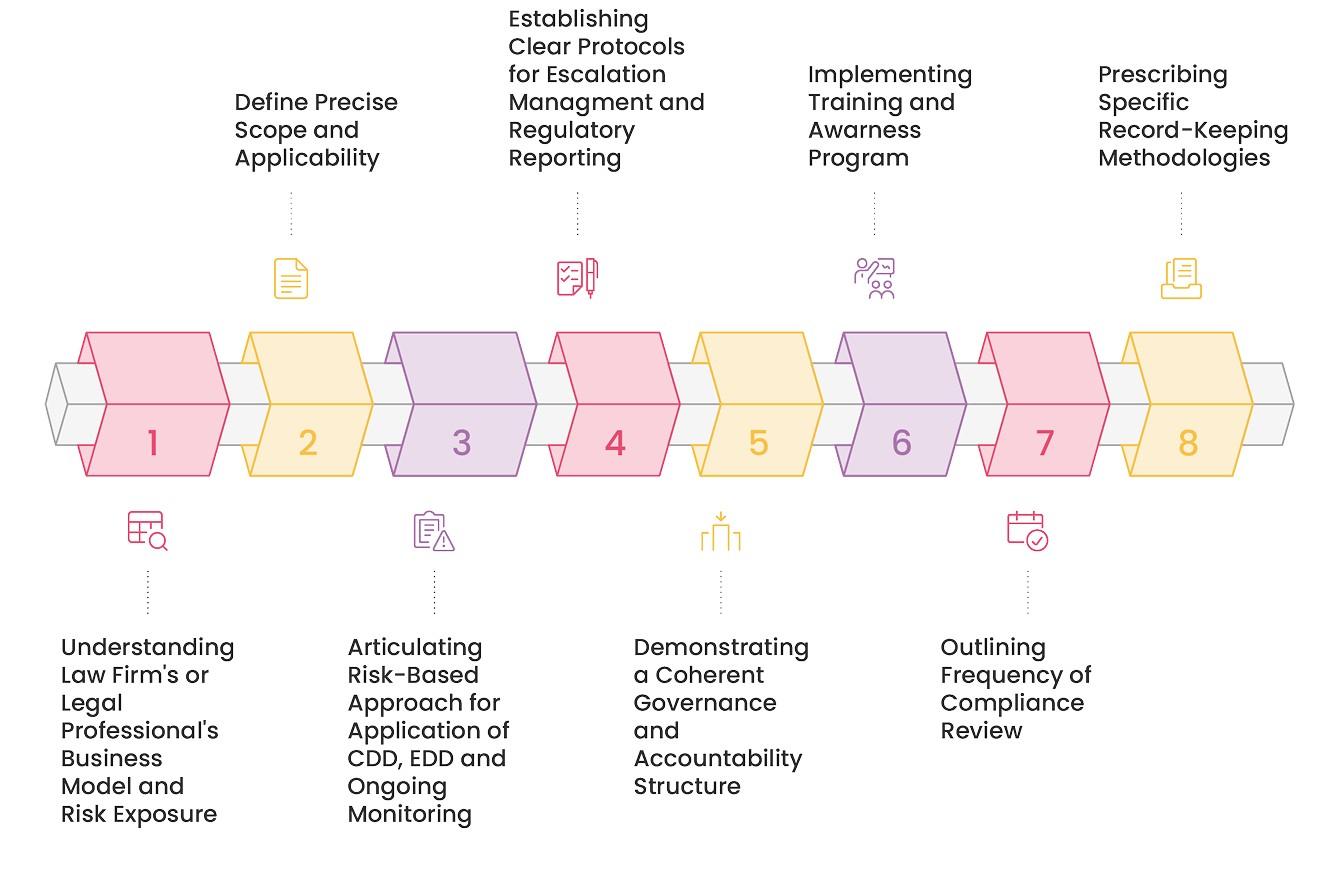
The step-by-step process for drafting an AML/CFT Policy for Lawyers includes understanding their business model, assessing their ML/TF/PF risk and then developing a thorough policy that incorporates structured CDD, Ongoing Monitoring, Regulatory Reporting, Record-keeping mechanisms and effective governance procedures in line with the UAE’s AML/CFT laws.
AML/CFT Policy draft for Legal Professionals or Law Firms is a systematic procedure that commences with understanding the ML/TF risk associated with their services.
This continues with defining scope and applicability, embedding a risk-based approach for CDD, EDD and Ongoing Monitoring, following the establishment of escalation protocols and regulatory reporting framework.
The later pathway consists of demonstrating a governance structure and accountabilities within the organisation, then implementing training programmes, outlining review frequencies and documenting record-keeping methodologies for the creation of an effective AML/CFT Policy.
Step 1: Understanding Law Firm’s or Legal Professional's Business Model and Risk Exposure
Understanding law firm’s business model and ML/TF/PF risk associated with it is the first step to draft AML/CFT policy.
The groundwork of drafting an efficient AML/CFT Policy lies primarily in understanding the Law firm’s business model and the kind of ML, TF and PF risks they’re exposed to.
This includes undertaking a comprehensive appraisal of the firm’s inherent ML/TF risks, evaluating the nature of legal services offered, considering client profiles, jurisdictional risks and transactional complexities through an extensive Enterprise-Wide Risk Assessment (EWRA).
This ensures that actual risks are considered while determining the overall ML/TF risk level faced by a legal professional. Further, the conducted EWRA should be documented and continuously updated as per the requirements of Cabinet Decision No. (134) of 2025.
Step 2: Defining Precise Scope and Applicability
Specifying the scope and applicability of the AML/CFT Policy is the second step.
Once the specific ML, FT and PF risks have been identified, the Law Firms or Legal Professionals should define the precise scope and applicability of the AML/CFT Policy. In the AML/CFT Policy draft, specification as to whom the policy would be applicable must be expressed.
This includes business partners, associates, paralegals, intermediaries or any third-party agents falling under the purview of AML Policy’s applicability. Moreover, Legal Professionals should document the clear rationale of their AML/CFT Policy and risk mitigation strategy appropriate to the risk exposure of their services.
In addition to this, key definitions with respect to the UAE Regulations and FATF standards should be incorporated in the AML/CFT Policy draft, such as “Client”, “Beneficial Owners”, “Business Relationship”, “High-Risk Customers”, “Sanctions List”, “Suspicious Transactions”, etc., which are relevant to the AML/CFT Program.
Step 3: Articulating Risk-Based Approach for Application of CDD, EDD and Ongoing Monitoring
Stating Risk-Based Approach in the AML/CFT policy framework for application of compliance measures is the next step.
The following step to build a systematic AML/CFT Policy is to articulate risk-based internal rules with respect to the Customer Due Diligence (CDD), Enhanced Due Diligence (EDD) and Ongoing Monitoring of the business relationships.
This includes inculcating rules with regard to the onboarding process, Beneficial Ownership tracing, Sanction/PEP/Adverse Media Screening mechanisms, monitoring, and updating Local and International Sanction Lists, and further ensuring adherence to these rules during the establishment of a business relationship.
Moreover, in AML/CFT Policy, Legal Professionals should prescribe heightened scrutiny, multilayered verification and Senior Management approval for high-risk customers, assessing the sources of funds and wealth of PEPs, HNWIs, high-risk customers, complex structure companies, cross-border clients, etc.
In addition to this, transaction thresholds aligned with UAE regulations should be clearly outlined, for instance, incorporating rules regarding the application of Enhanced Due Diligence for real-estate transactions or transactions from high-risk jurisdictions.
Further, the extent and frequency of Ongoing Monitoring of the business relationship must be documented in AML/CFT Policy commensurate with the ML/TF risk mitigation strategy.
Step 4: Establishing Clear Protocols for Escalation Management and Regulatory Reporting
Establishing clear rules for escalation and Regulatory Reporting is the following step.
The next step for Law Firms or Legal Professionals is to establish lucid escalation management and Regulatory Reporting protocols in AML/CFT Policy with an aim to harmonise internal actions when any suspicious activity or transaction is detected.
This includes incorporating red flags/indicators relevant to legal practice or typologies with respect to ML/TF activity, alert management, formalising internal SAR/STR reporting channel, compulsions of MLROs to investigate, and obligations of external SAR/STR reporting aligned with UAE FIU standards.
Legal Sector is exempted from the reporting obligations during instances which demands professional secrecy such as presenting the client in the Court of law or defending the client.
This paramount exemption should be incorporated while crafting AML/CFT Policy for Legal Professionals in a way that it does not diminish the statutory obligations while also upholding the legal exemption privilege.
Moreover, directions related to the filing of other regulatory reports such as CNMR/PNMR, REAR, HRC/HRCA should be codified thoroughly in AML/CFT Policy for efficiency.
In addition, timelines and confidentiality pertaining to the escalations and reporting should be expressed clearly in AML/CFT Policy to ensure effective implementation.
Step 5: Demonstrating a Coherent Governance and Accountability Structure
Integrating rules pertaining to governance and accountability structure in AML/CFT Policy framework is following step.
After integrating escalation and regulatory reporting rules into the AML/CFT Policy, the next step is to demonstrate comprehensible governance and accountability structure within the organisation with respect to the implementation of ML/TF risk mitigation strategies.
Legal Professionals should include the appointment of MLRO or Compliance Officer in their internal policy and define their roles, duties and authorities in detail as per the standards prescribed by the Ministry of Justice of UAE.
Step 6: Implementing Training and Awareness Programs
Implementing Training and Awareness programs in AML/CFT Policy framework is next process.
The following step to build an effective AML/CFT Policy for Legal Professionals is to integrate thorough training and awareness programs for staff into the AML Policy framework.
This includes introducing mandatory induction training for new joiners, incorporating rules to conduct annual or semi-annual training programs and periodic revision sessions for employees on AML/CFT regulations of UAE and other ML/TF related courses. These training modules must be role-specific and risk-based.
In addition to this, there should be instructions in the AML/CFT Policy to conduct prompt training programs during instances of regulatory amendments.
Moreover, these training programs should be tailored to commensurate the risk level of the business and evolving typologies of ML/TF related risks for continuing awareness and compliance.
Step 7: Outlining Frequency of Compliance Reviews
Setting rules regarding the frequency of compliance reviews is next step.
After this, Legal Professionals should outline the review related clauses into the AML/CFT Policy. This includes setting frequency for the cycle of compliance review.
Additionally, there should be declarations in the AML/CFT Policy framework with regards to the mandatory policy review upon material changes in UAE’s AML/CFT legislations, FATF Recommendations, and the likes.
Moreover, the policy should integrate obligations related to the approval of Senior Management or Law Firm partners, ensuring oversight.
Step 8: Prescribing Specific Record-Keeping Methodologies
Detailing specific record-keeping methodologies is next step in preparing an AML/CFT Policy.
The final stage of drafting a proficient AML/CFT Policy is mandating retention of records of all AML Compliance related activities for Law Firms or Legal Professionals.
AML/CFT law requires Legal Professionals to retain, maintain and organise records of AML compliance events for the prescribed duration by the applicable regulatory authorities.
This obligation should be formalised in the AML/CFT Policy for Lawyers. The record-retention clause should provide for record-keeping of CDD/EDD details, transaction receipts, training logs, Regulatory Reporting related materials and other relevant documentation with respect to the AML/CFT Program of the Law Firm.
In addition to this, the methodologies that are supposed to be implemented to maintain records should be clearly specified in the AML/CFT Policy to avoid any confusion.
The AML Policy should clearly outline the organisational roles and responsibilities for the record maintenance and audits such as cataloguing, organising, archiving, handling and transferring of records and documents including the destruction of expired records.
There should be documented rules in AML/CFT Policy regarding the protection of active and archive data and records from unauthorized access.
Ready to Move from Guidance to Action?
Partner with Us to Create a Tailored AML/CFT Policy for Your Law Firm with Precision
Must have Elements in AML/CFT Policy for Law Firms
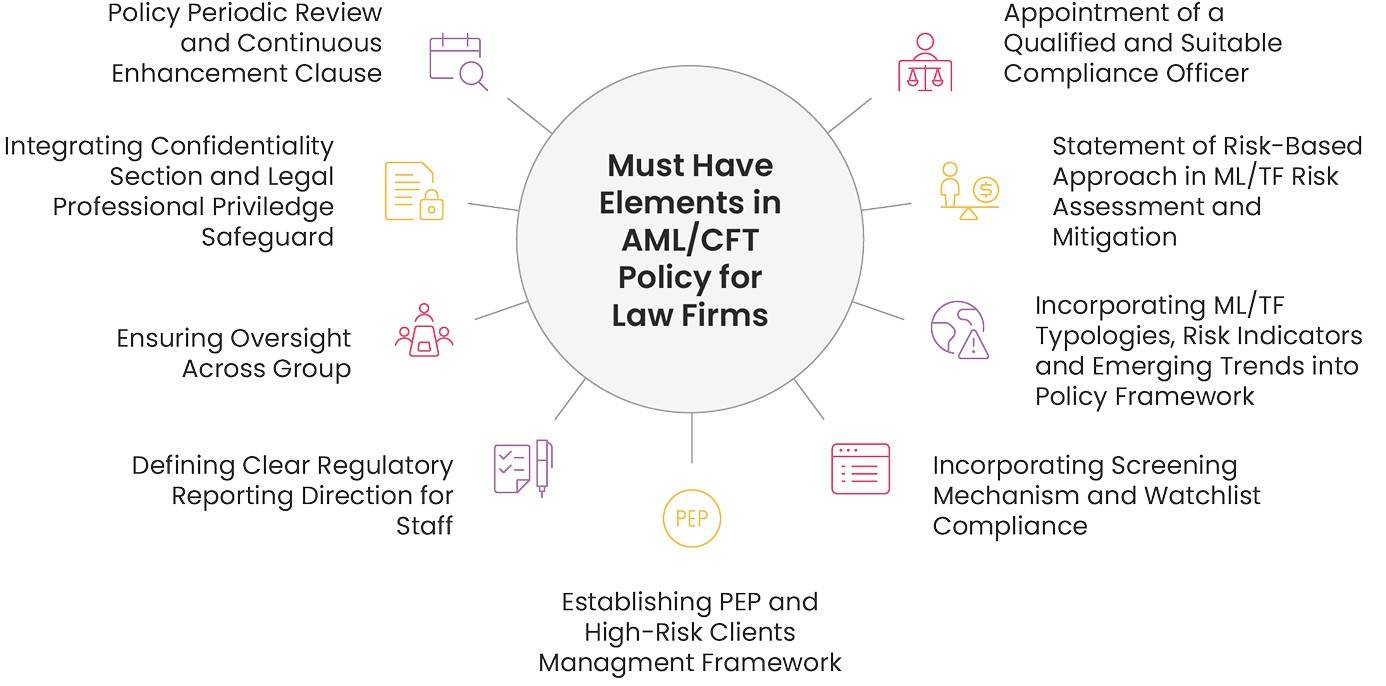
The Ministry of Justice in UAE expects Legal professionals to include certain must have elements related to appointment of qualified compliance officer, statement of Risk-Based Approach, ML/TF typologies, risk indicators, screening mechanism, high-risk client management framework, regulatory reporting direction, oversight, legal professional privilege safeguard and policy enhancement clauses in their AML/CFT Policy.
Every AML/CFT Policy for Legal Professionals should have certain integral elements to be up to the mark.
These must have clauses or elements related to appointment of qualified compliance officer, statement of risk-based approach, ML/TF typologies, risk indicators, screening mechanism, high-risk client management framework, regulatory reporting direction, oversight, legal professional privilege safeguard and policy enhancement clauses.
Appointment of a Qualified and Suitable Compliance Officer
A Robust AML/CFT Policy for Lawyers should include the provisions for appointment of a competent and well-versed Compliance Officer. The criteria for the appointment of a Compliance Officer should be clearly included in the AML Policy draft.
The AML/CFT Policy for the Legal Professionals must define the roles and responsibilities of the Compliance Officer to avoid any ambiguity. This includes formulating accountabilities with respect to ML/FT Reporting, AML/CFT Programme Management, AML/CFT Training and Development.
Statement of Risk-Based Approach in ML/TF Risk Assessment and Mitigation
Legal Professionals must include a statement of Risk-Based Approach in the formation of their ML/TF risk assessment and the risk mitigation strategies.
The AML/CFT Policy provisions and clauses should be developed commensurate with the nature and extent of their services and must be in concert with the ML, FT and PF risks to which their business is exposed.
Moreover, methodologies for identifying and assessing the firm’s enterprise-wide risk and customer risk matrix should be documented in the AML/CFT Policy in accordance with the risk appetite of the law firm.
Incorporating ML/TF Typologies, Risk Indicators and Emerging Trends into Policy Framework
Another significant element of a well-drafted AML/CFT Policy is integration of ML/TF typologies, risk indicators and emerging trends of ML/TF crimes in the AML/CFT Policy Framework.
These typologies should be specific to legal sector and the legal business itself, such as the formation of shell companies, concealing identity through complex structures, cross-border client risks, large value real estate deals and many other typologies must be considered by legal sector.
This ensures sector-specific risk awareness and helps in identifying unusual patterns or transactions.
Incorporating Screening Mechanism and Watchlist Compliance
An efficient AML/CFT Policy for Law Firms should incorporate screening rules, procedures and watchlist compliance into the AML Policy Framework. This includes detailing procedures for Sanction Screening against the UAE Local Terrorist List and UNSC Consolidated List, PEP Screening and Adverse Media screening.
Besides, there should be clear assertions in the AML Policy with respect to the continuous monitoring for changes in client status for proactive detection of PEPs and Sanctioned individuals or entities in real time to facilitate timely regulatory reporting.
Establishing PEP and High-Risk Clients Management Framework
Legal Sector is exposed to ML, FT and PF risk from high-risk clients such as PEPs, High-Net Worth Individuals (HNWIs), Cross-Border Clients, Complex Legal Structures, and Large Turnover Companies, which pose significant ML/TF risks.
Legal Professionals, while drafting a tailored AML/CFT Policy for their services, should establish statements concerning the management of high-risk clients.
This includes formulating requirements of Senior Management’s approval before onboarding such clients, outlining requirements for Enhanced Due Diligence (EDD), specifying additional documentations and scrutiny thresholds for effective implementation of the AML/CFT Program.
Defining Clear Regulatory Reporting Direction for Staff
Lawyers should contain clauses in their AML/CFT Policy Framework with respect to the continuous monitoring, alert triggers, escalation protocols and internal investigation.
Furthermore, obligations and directions to file regulatory reports such SAR/STR, CNMR/PNMR, REAR should be thoroughly incorporated in the AML/CFT Policy framework with clear statements regarding its accountabilities.
Legal Professionals should also include elements of whistleblower protection parameters and prohibition of tipping off provisions in their AML/CFT Policy structure.
Ensuring Oversight Across Group
A well-foresighted AML/CFT Policy for Law Firms should have elements of inclusive oversight in its policy statement that are uniform across all levels of organisation and all branches.
This oversight section should comprise a governance structure for the implementation of policy, regular assessment of the effectiveness of implemented policy, internal control safeguards against prevalent ML/TF vulnerabilities, smooth information flow and overall group-wide compliance.
Integrating the Confidentiality Section and Legal Professional Privilege Safeguard
In order to make the AML/CFT Policy stand out and tailored for the legal service, it should encompass clauses regarding the legal professional privilege safeguard and confidentiality.
The Legal Profession is discharged from the regulatory reporting in certain circumstances to maintain professional secrecy; however, the AML/CFT Policy for lawyers and legal professionals must integrate elements related to it and define boundaries between statutory reporting duties and attorney-client privilege effectively.
In addition to this, the AML Policy should establish rules for handling privileged information responsibly.
Periodic Policy Review and Continuous Enhancement Clause
A well-drafted AML/CFT Policy for the legal sector should have components of periodic policy review and enhancement clauses in its statements.
This includes formulating annual review requirements, approval of partners for AML/CFT Policy Review, and prompt amendments in Policy Framework post major regulatory changes.
In addition to this, frequent mapping of the efficacy of implemented policy and continuously augmenting the AML Policy framework for stronger AML/CFT Program implementation must be articulated adequately in the AML/CFT Policy.
Turn AML Policy Must-Haves into Your Strongest Defence.
Let’s Design a Policy that Protects, Guides and Strengthens Your Practice.
Benefits of Crafting a Well-Designed AML/CFT Policy for Legal Professionals
Crafting a well-articulated AML/CFT Policy customised for the legal profession is very advantageous. Unlike generic AML templates, a tailored AML/CFT Policy ensures clear understanding of the compliance requirements that are commensurate with the nature, scale and risk profile of the law firm’s business.
It safeguards the law firm from being misused as ML/TF channel, ensuring accountability, strong compliance culture, operational efficiency, professional integrity, client trust and readiness for regulatory inspection.
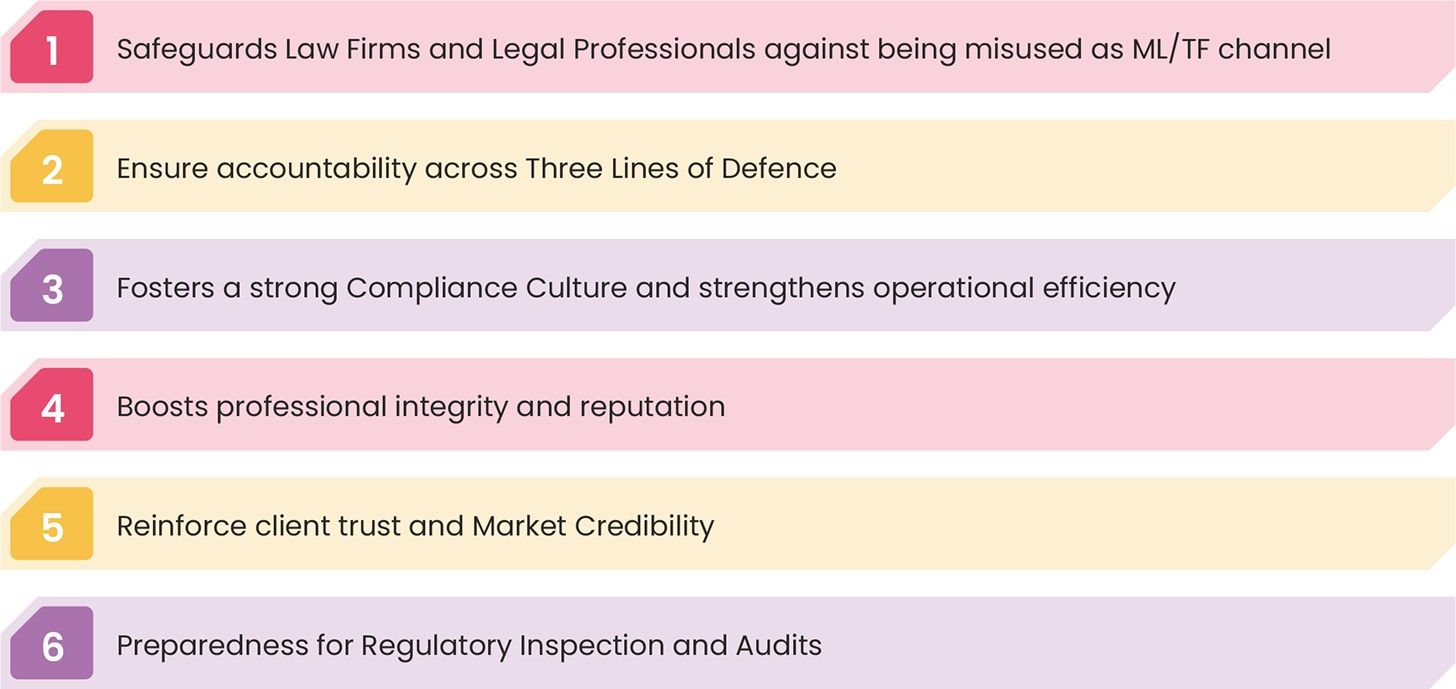
Safeguards Law Firms and Legal Professionals against being misused as ML/TF Channel
Legal Services are often a favourite medium for miscreants to launder money. Having a strong and well-articulated AML/CFT Policy aligned with UAE’s AML/CFT Legislations builds safeguards at all stages from onboarding, screening, monitoring and transaction monitoring, leaving no room for exploitation.
The robust policy framework empowers legal professionals to identify and mitigate dubious engagements early and shield from being complicit knowingly or unknowingly in financial crime.
Ensure accountability across Three Lines of Defence
A proficient AML/CFT Policy for Law Firms isn’t just the generic form, it outlines specifies duties, training requirements and decision-making authority. This creates clarity with regard to the roles and responsibilities across the team for AML compliance-related tasks.
From the front-line team to the Compliance Officer and Senior Management/Partners, everyone knows where they fit in, in terms of their responsibility towards carrying out their roles and responsibilities.
This ensures accountability, organised structure, shared responsibilities across three lines of defence of the legal profession and prevents critical breaches.
Fosters a strong Compliance Culture and strengthens operational efficiency
Having an efficient AML/CFT Policy in place provides a standardised framework for compliance functions such as client onboarding, monitoring and reporting. This reduces ambiguity and human error regarding the compliance workflow.
The AML/CFT Policy is a single referenceable document that outlines rules and statements pertaining to the implementation of the AML/CFT program and is uniform across the entire law firm.
This enhances internal coordination and strengthens operational efficiency, fostering a stronger compliance culture.
Boost professional integrity and reputation
Implementing a well-crafted AML/CFT Policy demonstrates a law firm’s commitment to UAE’s AML/CFT Legislation and International norms. This boosts professional integrity and reputation for the Legal Professionals among regulatory authorities, peers, clients, counterparties and international partners.
It sends out a strong message that the law firm is ethical, compliant and transparent. Moreover, it makes sure that the firm’s name is protected from any alleged association with financial crime.
Reinforce client trust and market credibility
A well-formulated and defined AML/CFT Policy instils confidence among clients that the Lawyers operate within the secure compliance standards and adhere to regulatory obligations.
Moreover, it builds market credibility, fosters sustainable growth and expand the customer force by attracting international clients and companies who demands robust AML/CFT safeguards.
It strengthens the firm’s position as trusted advisor in an increasingly compliance-driven market.
Preparedness for Regulatory Inspection and Audits
An effective AML/CFT Policy in place ensures that the law firm is always ready and prepared for the regulatory inspections and audits. It formulates record-keeping and governance mechanisms to provide for a comprehensive audit-trail.
During regulatory inspections, Law Firms can rely on AML/CFT Policy to demonstrate veracity of their compliance program to the regulatory authorities as it is a well-documented and enforceable statement.
Lawyers Deserves More Than a Templete
We’ll Help You to Develop Customised and Enforceable AML/CFT Policy, Let’s Start Drafting.
Best Practices for Legal Professionals to Design a Proficient AML/CFT Policy
The Legal Professionals should implement AML/CFT Policy that aligns well with UAE’s regulatory framework, integrate advanced technology, such a policy must strike balance with legal professional privilege, apply risk-based approach, mandate periodic reviews, provide for record retentions, implement data centralisation rules and provide for a training program.
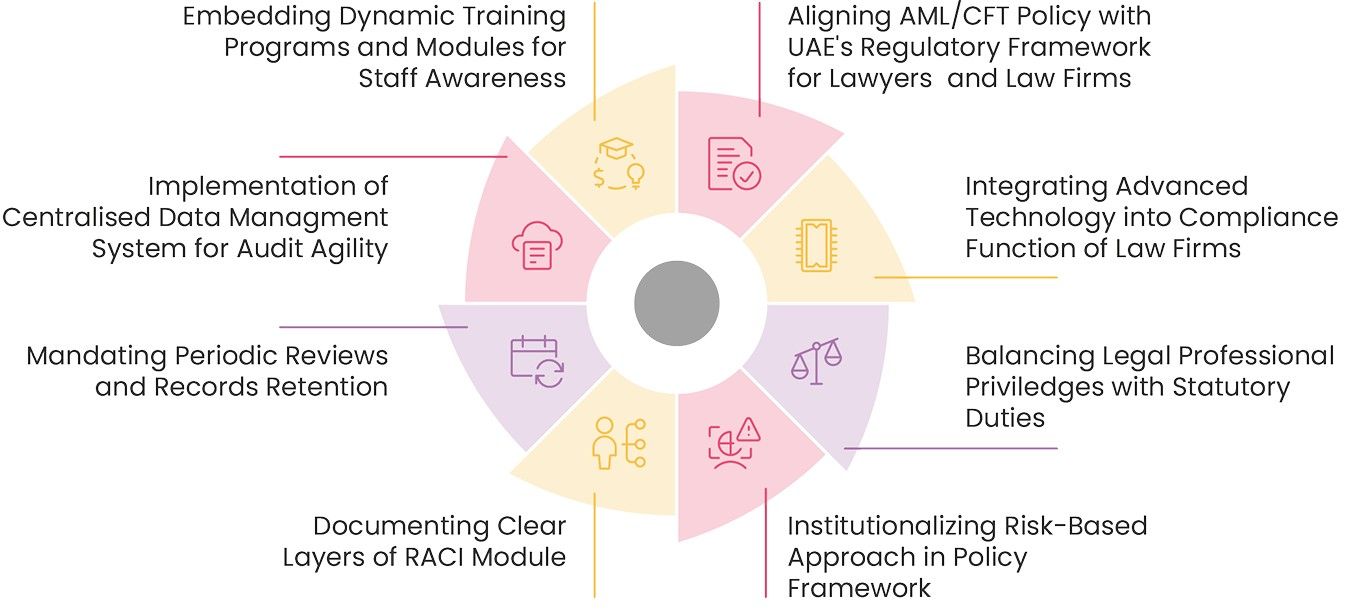
Aligning AML/CFT Policy with UAE’s Regulatory Framework for Lawyers and Law Firms
Legal professionals must align their AML/CFT Policy statements with the UAE’s regulatory framework, FATF Recommendations, Lawyers Supplemental Guidance by Ministry of Justice, and TFS Guidelines.
From policy’s core rationale to the internal compliance functions such as CDD, EDD, Screening, Monitoring, Reporting, Training, Reviews, each clause should reflect compliance to the regulatory obligations and commitment towards combating the crimes of Money Laundering or Terrorism Financing.
Integrating Advanced Technology into the Compliance Function of Law Firms
While crafting an AML/CFT Policy for law firms, Legal Professionals must integrate rules related to leveraging and utilising advanced technologies to carry out the day-to-day compliance functions.
This includes integrating Software tools, AI and Machine Learning Technologies, Screening and Case Management tools, Data Analytics systems and other relevant high-scale RegTech platforms suitable to the needs of legal profession.
This integration ensures workflow automation, reduces manual gaps and enables real-time monitoring.
Balancing Legal Professional Privileges with Statutory Duties
A major component that must be integrated into the AML/CFT Policy for legal sector is, the exemption privilege that Lawyers are attributed by virtue of their profession.
However, the articulation should be in a way that the legal professional privilege does not overlap the statutory duties of the regulatory reporting. The boundaries for privilege and the procedure for handling sensitive disclosures must be formulated clearly in alignment with the Ministry of Justice’s Lawyers’ Guidance on the dual obligations.
Institutionalizing Risk-Based Approach in Policy Framework
Legal Professionals must apply a risk-based approach while developing their AML/CFT Policy. This includes integrating outcomes of business risk assessments, findings of risk factors, extent of the legal services offered such as real estate conveyancing, corporate structuring and ML/TF typologies specific to the legal field.
Moreover, Law Firms must avoid using generic templates for AML Policy and instead institutionalize a framework that is tailored to their specific practice area and commensurate to the risk appetite of their firm.
Documenting Clear Layers of RACI Module
Legal Professionals must instil layers of RACI segment in the AML/CFT Policy to establish uniformity in governance structure.
By clearly documenting who is Responsible for executing tasks, who is Accountable for the compliance functions, who should be Consulted for insights and who needs to be Informed of the decisions, creates a transparent chain of duties at every level.
Employees can take reference of the AML/CFT Policy to understand their roles that prevents ambiguity and encourages operational efficiency in implementing AML/CFT Program.
Mandating Periodic Reviews and Record Retentions
A robust AML/CFT Policy for Law Firms must include statements with respect to the requirement of periodic reviews of the policy.
AML Policy should not be treated as rigid directive but an instrument that is open to changes and enhancement to keep pace with evolving requirements in terms of law, typologies, and technology.
In addition to this, rules related to the record retentions of all compliance operations must be formulated abstractly in the AML/CFT Policy. This includes setting minimum period of at least 5 years for record keeping as mandated by UAE’s AML-CFT Decision.
Implementation of Centralized Data Management System for Audit Agility
Law Firms must include rules related to the centralized data management system in their AML/CFT Policy framework to embed audit readiness in their compliance functions.
This includes formulating statements related to the consolidation of CDD data, Transaction Monitoring data, Regulatory Reporting data into the one single secure platform.
The aim of incorporating this element in AML/CFT Policy is to ensure that relevant data is easily accessible and retrievable during the regulatory inspections.
Embedding Dynamic Training Programs and Modules for Staff Awareness
A robust AML/CFT Policy for legal practitioners must incorporate rules to conduct dynamic training programs for staff awareness. The policy statements should clearly articulate to embed role-based training programs tailored separately for partners, associates, compliance team and front-line Lawyers.
In addition to this, the frequency of conducting these programs should be formulated and the modules must be interactive and practical. Including revision rules in AML/CFT Policy ensures that awareness continues and evolves.
Incorporating these best practices while drafting AML/CFT Policy facilitates legal professionals to build a robust, strong and efficient AML/CFT Policy that translates regulatory requirements into practical, effective system.

A Tailored and Right Policy is Your Strongest Defence
A well-formulated and articulated AML/CFT Policy for Legal Professionals isn’t just a basic regulatory checkbox, but a strategic shield against the predicate offences of Money Laundering or Terrorism Financing.
It protects the operations of Law Firms at every level from unexpected exploitations. However, Law Firms often miss the mark to create a thorough AML/CFT Policy due to lack of resources, scattered understanding of legal sector’s specific risks and unaware staff. The ML/TF risks faced by legal sector is unique and more, so every law firm and their services are unique.
Thereby, Lawyers or Law Firms must count on customised solutions to develop AML/CFT Policy for their services as adopting a general policy template is not enough. With right framework in place, Legal Professionals can thrive efficiently while complying with UAE’s regulatory obligations.
AML UAE comes here as savior, with it’s end-to-end AML/CFT Policy, Controls and Procedures Documentation services, it facilitate creation of customized AML/CFT Policy for law firms by undertaking effective risk assessment, analyzing gaps in previous policies and creating robust AML/CFT policy that stands out in every storm.
Future-Proof Your Practice!
Get a Custom-Built AML/CFT Framework Today, To Stay Ahead of Regulators and Protect Your Clients.
Frequently Asked Questions on AML/CFT Policy Drafting Service for Lawyers
Do lawyers and law firms in the UAE need an AML/CFT policy?
Yes, lawyers and law firms need an AML/CFT Policy as they fall under the category of Designated Non-Financial Businesses and Professions (DNFBPs) in UAE and by virtue of it, it is a compliance requirement for them to maintain a AML/CFT Policy, describing the measures they are committed to take to combat the risks of financial crimes.
What is an AML/CFT policy drafting service for lawyers in the UAE?
AML/CFT policy drafting service for lawyers in UAE denotes to preparing a formal written document laying down the set of internal rules to comply with UAE’s Federal AML/CFT legislations and FATF’s international standards. The rules are designed in accordance with the law firm’s risk exposure to financial crimes.
Why should AML/CFT policies for law firms be customised instead of using templates?
Instead of using templates, AML/CFT Policies for law firms should be customised because the nature, scale and services of every lawyer or law firm is different. Using generic templates for all businesses may not identify and mitigate specific risks and allocate resources efficiently.
What are the key components of an AML/CFT policy for lawyers?
The key components of an AML/CFT Policy for lawyers include legal professional privilege, statement of Risk-Based Approach, appointment of a compliance officer, integration of ML/TF typologies, risk indicators, screening mechanisms, high-risk client management framework, cash acceptance policies, client onboarding and exit policy, strong oversight and policy review clauses.
What role does a Compliance Officer or MLRO play in a law firm?
A Compliance officer or MLRO supervises the implementation and ongoing effectiveness of the law firm’s AML/CFT/CPF program including clear execution of policies and procedures.
How often should AML/CFT policies for lawyers be reviewed?
AML/CFT Policies for lawyers should be reviewed when there are material changes in circumstances that warrants policy to be updated. These include amendment in UAE’s AML/CFT laws, changes in FATF grey list, changes in business’s ML/TF/PF risk exposure, introducing new product or services, or modifications in software configuration.
How does an AML/CFT policy help law firms during regulatory inspections?
During regulatory inspections, an AML/CFT Policy helps law firms to demonstrate that they have structured compliance mechanism in place to combat ML/TF/PF risks in line with the regulatory requirements.