Transaction Monitoring Consulting in UAE
At a glance:
AML UAE’s transaction monitoring consulting helps UAE banks, exchange houses, payment providers, VASPs and DNFBPs prove that their monitoring is calibrated to their own risk. We test scenarios against your enterprise-wide risk assessment, tune thresholds with above-the-line and below-the-line testing on your own data, sample closed alerts for investigation quality, and leave you with a documented framework that meets the ongoing monitoring duty in Cabinet Resolution No. 134 of 2025 and CBUAE transaction monitoring guidance.
Your transaction monitoring system is producing alerts. The harder question is whether they are the right alerts, and whether you could defend the thresholds behind them to a supervisor. AML UAE works with regulated entities across the UAE to assess, redesign and tune transaction monitoring frameworks so that detection is genuinely risk-based, alert volumes stay proportionate to your investigation capacity, and every monitoring decision is documented, approved and reviewable.
Transaction Monitoring Consulting Services in the UAE
A transaction monitoring consulting engagement is an independent, hands-on review of how your entity detects unusual and suspicious activity, followed by a structured programme of work to make that detection better. It is built for compliance functions, MLROs and boards that already have a monitoring capability in place and now need to know whether it is working. Our transaction monitoring services cover the full arc of that question, running from framework assessment and scenario design through threshold tuning and alert quality assurance to independent effectiveness validation.
The UAE framework sets the bar plainly. Federal Decree-Law No. 10 of 2025 and its Executive Regulations issued under Cabinet Resolution No. 134 of 2025 make ongoing monitoring a standing element of customer due diligence (Cabinet Resolution No. 134 of 2025, Article 8). Transactions must be scrutinised against what you already know about the customer, and the customer information you hold must stay current enough for that scrutiny to mean anything. The CBUAE AML/CFT Guidelines for Financial Institutions (July 2023) go further on method, expecting entities to choose monitoring rules, thresholds, and parameters on a risk basis, document them, obtain senior management approval, and review them periodically for effectiveness. Monitoring may be automated, semi-automated or manual depending on the nature and size of the business, but in every case it has to be deliberate, and it has to be defensible.
Most entities we work with are not missing a system. They are missing evidence that the system is calibrated to their risk. When an inspector asks why a particular threshold sits where it does, or why a typology identified in your own risk assessment has no corresponding scenario, the answer needs to be a document rather than an opinion. Closing that gap is what this engagement is for.
Transaction Monitoring Framework Assessment
We begin with the methodology rather than the tool. The assessment establishes whether your monitoring design traces back to your enterprise-wide risk assessment, whether the rules currently running were ever formally approved, and whether the paper trail supports the decisions that were actually made.
In practice, this tends to surface uncomfortable findings. Scenarios switched on during implementation that nobody has owned since. Thresholds carried across from a previous system because migrating them was faster than rethinking them. Approval records that stop several configuration versions behind what is live today. None of this is unusual, and all of it is a finding waiting to be written up by somebody else if you do not find it first.
Review of the existing transaction monitoring methodology and its design rationale
Assessment of governance, policies, procedures and senior management approval records
Identification of control and documentation gaps against UAE requirements
Evaluation of alignment between live monitoring coverage and the entity’s risk profile
Transaction Monitoring Scenario Design
Scenarios should reflect how money actually moves through your business and how that flow is most likely to be abused. We design and rationalise scenario sets around your customer base, products, delivery channels and geographic exposure, drawing on UAE typologies and the findings of the national and sectoral risk assessments rather than a generic vendor library.
A vendor library is a reasonable starting point and a poor finishing point, because it reflects the average customer of the platform rather than your book. The work involved is deciding which scenarios earn their place, which duplicate each other and can be consolidated, which need behavioural logic instead of a fixed value, and which risks in your own assessment currently have no detection at all. Each decision is recorded with its rationale, so the scenario set becomes something you can explain rather than something you inherited. The Executive Regulations require entities to establish indicators for identifying suspicion and to update them on an ongoing basis as criminal methods change (Cabinet Resolution No. 134 of 2025, Article 17), so a scenario set that has not changed since go-live is a gap in its own right.
- Risk-based scenario development mapped to your own inherent risk drivers
- Application of UAE-relevant AML/CFT typologies and published red-flag indicators
- Customer, product, geography and delivery-channel risk differentiation
- Rules targeting unusual behavioural patterns rather than transaction value alone
Threshold and Parameter Tuning
Thresholds are where monitoring frameworks most often fail. Set them too high and genuine activity passes unseen. Set them too low and your investigators drown, which quietly degrades the quality of every investigation they carry out. We use your own transaction data to model the effect of a change before you commit to it, so that threshold tuning becomes an evidence-based decision rather than a guess.
The method is straightforward, but the discipline matters. We test above the line and below the line: what a proposed threshold would have caught across a representative historical period, and, just as importantly, what activity sitting immediately beneath it would have been missed. Sampling below-the-line activity is the only way to demonstrate that a threshold increase reduced noise rather than reduced detection, and it is precisely the evidence a supervisor looks for whenever a limit has been raised.
Segmentation is applied at the same time, because a single value applied across an entire customer book will always be simultaneously too high for one group and too low for another. A cash deposit pattern that is routine for a trading company is significant for a salaried individual, and a remittance corridor that is unremarkable in one direction may carry real risk in the other. Segmented thresholds cost more to design, but they are far easier to defend.
Set thresholds with risk-based customer, product, and channel segmentation
Use past transaction data to test above-the-line and below-the-line.
Analyse alert volume and identify ways to reduce false positives.
Balance operational capacity with detection effectiveness.


“Most threshold problems I see in the UAE are not technical. Someone raised a limit to clear a backlog, nobody tested what sat underneath it, and two years later the institution cannot explain the number to an inspector. Below-the-line testing is what turns a threshold from a guess into a decision you can defend,” says

Threshold calibration with risk-based customer, product and channel segmentation
Above-the-line and below-the-line testing on your own historical data
Alert-volume analysis and targeted false-positive reduction
Balancing detection effectiveness against realistic operational capacity
Regulatory anchor. CBUAE guidance is explicit that monitoring must apply appropriate rules, thresholds and parameters, and that transactions are to be examined in relation to the CDD information and risk profile of the customer. Threshold-based, transaction-based, location-based and customer-based rules may be combined in whatever way suits the business, but the choice has to be justified by risk, documented, approved by senior management and reviewed periodically for effectiveness.
Transaction Monitoring Alert Review and QA
An alert is only as valuable as the investigation behind it. We sample closed alerts and cases to test whether analysts reached supportable conclusions, whether escalation criteria were applied consistently across the team, and whether the surviving record would withstand supervisory inspection or independent audit.
Consistency between analysts is usually the weakest point in alert review. Two analysts presented with materially identical activity should reach the same disposition, and where they do not, the cause is normally an escalation criterion that exists in the procedure but not in practice. We also test whether closure narratives actually explain the decision that was taken. A note recording that activity was cleared as consistent with the customer profile is worth very little unless it says which part of the profile it matches and where in the file the supporting information can be found. Ongoing monitoring records and the results of any analysis must be kept for at least five years and organised so individual transactions can be reconstructed (Cabinet Resolution No. 134 of 2025, Article 25), which makes the closure narrative part of the legal record.
- Alert-quality assessment and end-to-end investigation workflow review
- Structured sampling across analysts, scenarios and customer risk tiers
- Escalation criteria, disposition controls and second-line review testing
- Evidence sufficiency and audit-trail review
Transaction Monitoring Effectiveness Review
Effectiveness is a measurable property rather than an assertion. We assess whether your scenario set covers the typologies that matter for your risk profile, how alerts convert into cases and reports, and what your management information genuinely tells the board.
Conversion rates read in isolation can mislead. A scenario producing very few cases may be badly calibrated, or it may be covering a low-frequency but high-severity risk that you are entirely right to keep watching. The judgement lies in reading yield alongside typology coverage, alert ageing, backlog trends and quality assurance outcomes, then presenting that combination so senior management can see where the framework is strong and where it is exposed. Reporting that shows only how many alerts were closed tells the board nothing about whether the right ones were opened.
Scenario performance and coverage against relevant AML/CFT typologies
Detection gaps and alert-to-case conversion analysis
STR and SAR escalation effectiveness and management reporting quality
Not sure your monitoring would hold up under inspection?
A scoped assessment gives you a written answer within weeks, with findings rated by severity, threshold recommendations supported by your own data, and a remediation plan you can put straight to your board.
What Transaction Monitoring Consulting Can Improve
Optimisation should produce outcomes you can point to: in alert quality, in investigator capacity, and in the strength of the record you would put in front of a supervisor. The four areas below are where regulated entities in the UAE typically see the fastest measurable change.
Reduce Excessive False Positives
High alert volumes are usually a calibration problem rather than a staffing problem. Thresholds inherited from a vendor default, or applied uniformly across an entire customer book, will misfire because a value that is unremarkable for a corporate client may be highly significant for a retail one. Risk-based segmentation, where thresholds reflect the customer type, product, geography, and delivery channel involved, brings volumes down without weakening detection.
We quantify your current false-positive rate scenario by scenario, isolate the small number of rules that typically generate the majority of non-productive alerts, and model recalibration options so you can see the detection trade-off before approving any change. Where several scenarios fire on the same underlying activity, consolidating them removes duplicated investigation effort at no cost to coverage.
The commercial effect is worth stating plainly. Every hour spent closing an alert that was never going to be suspicious is an hour not spent on one that is. Reducing non-productive volume does more than save cost: it raises the quality of the investigations that actually matter, and it clears the backlog that inspectors read as a control weakness in its own right.
Improve Detection of Genuine Suspicious Activity
The test CBUAE guidance sets out is whether a transaction is normal, reasonable and legitimate for that particular customer and their counterparties. That question cannot be answered from the amount alone. We review whether your scenarios draw on CDD data, expected activity and behavioural baselines rather than static values, and whether the customer information feeding those scenarios is current enough to be relied on at all.
Coverage is then tested against the patterns that matter in the UAE context: structuring beneath identification and reporting triggers, rapid pass-through activity where funds arrive and leave with no discernible economic purpose, transactions inconsistent with a stated line of business, unexplained third-party involvement, dealings with higher-risk jurisdictions, and the typologies flagged in the UAE National Risk Assessment and in UAE FIU strategic reports.
Where a risk appears in your enterprise-wide risk assessment but has no corresponding scenario, document, size, and prioritise that gap rather than note it in passing.
Strengthen Investigation and Escalation
Detection is only the beginning of the obligation. An alert has to connect to a documented investigation, a recorded and justified disposition, MLRO review where escalation criteria are met, and, where suspicion exists, a report filed with the UAE FIU through goAML without delay. There is no minimum value threshold for suspicion, and an attempted transaction can trigger the same duty as a completed one (Federal Decree-Law No. 10 of 2025, Article 18; Cabinet Resolution No. 134 of 2025, Article 18).
We test the handover points between the monitoring team, the MLRO and the reporting process, because that is precisely where evidence tends to go missing. Common findings include escalation criteria that rely on individual judgement without any recorded rationale, investigations that reach the right conclusion without capturing the information that supported it, and reports filed with materially less supporting detail than the case file actually contained. The Executive Regulations require the compliance officer to decide whether to notify the FIU or retain the matter, stating the reasons (Cabinet Resolution No. 134 of 2025, Article 22), so an unrecorded decision not to report is a finding in its own right.
“A good STR starts long before goAML. If the alert narrative does not record why activity was escalated or closed, the MLRO ends up reconstructing the reasoning from memory, and the report the FIU receives is thinner than the case behind it,”
Post-reporting handling receives specific attention. A relationship reported to the FIU should attract defined continued monitoring rather than reverting to business as usual, and the tipping-off prohibition in Article 19 of Cabinet Resolution No. 134 of 2025 means the way that monitoring is applied, recorded and communicated internally needs to be worked out in advance rather than improvised under pressure.
Improve Monitoring Governance
The UAE Executive Regulations require internal policies, controls, and procedures, including your monitoring methodology, to be approved by senior management, reviewed on an ongoing basis, and assessed for effectiveness (Cabinet Resolution No. 134 of 2025, Articles 5 and 21). CBUAE guidance applies the same expectation to monitoring rules, thresholds and parameters. In practice, that means named ownership of the scenario inventory, a change-management process for threshold adjustments with recorded rationale and approval, a defined review cycle with a trigger list for interim reviews, and management information that lets the board see whether the framework is genuinely performing.
Change management is the control most often missing entirely. Thresholds get adjusted in response to volume pressure, the adjustment is made in the system, and nothing records who approved it or on what basis. Six months later, the live configuration no longer matches the approved methodology, and no audit trail explains the difference.
We help you build the governance layer that prevents this, so that a decision taken today remains explainable in two years, when the analyst who made it has moved on and an inspector is asking why the limit sits where it does.
“Boards rarely ask the question that matters, which is whether the monitoring framework running today is still the one they approved. A scenario inventory with named owners and a change log answers that on one page, and it is usually the first document we build,”
Want the numbers behind your own alert volumes?
We will quantify your false-positive rate scenario by scenario, identify the rules driving the bulk of it, and show you exactly what recalibration would change before you commit to anything.
Our Transaction Monitoring Consulting Process
AML UAE’s transaction monitoring consulting process runs in six stages, scoped to the size of your book and the maturity of your existing framework. Each stage produces a deliverable you can use on its own, so you are never waiting until the end of the engagement to see value, and the sequence can be entered at any point if only part of the work is needed.
1. Current-State Assessment
We review the monitoring solution in place, the rules and scenarios actually running, current thresholds and parameters, investigation workflows, the data feeding the system, and the governance wrapped around all of it. The output is a clear picture of what your framework does today, which frequently differs from what the documentation says it does.
2. Risk and Typology Analysis
We map monitoring coverage against your entity’s inherent AML/CFT risks as recorded in your enterprise-wide risk assessment, then against UAE-specific typologies and current supervisory guidance. This is the step that exposes risks you have formally acknowledged on paper but are not detecting in operation, which is the most difficult position to defend in an inspection.
3. Scenario and Threshold Review
Every scenario is classified as effective, redundant, overly sensitive, insufficiently sensitive or missing. Thresholds are tested against your own historical data, above the line and below it, and recalibration options are modelled with their expected effect on both alert volume and detection so that any change can be approved on evidence.
4. Alert and Investigation QA
We sample alerts and cases across scenarios, analysts and risk tiers to test whether alerts are meaningful, whether investigations are proportionate to the risk raised, whether dispositions are consistent between analysts, and whether decisions are documented well enough to be defended long after the event.
5. Optimisation and Remediation
We convert findings into a prioritised remediation plan sequenced by risk exposure and operational impact rather than ease of delivery. We work alongside your team and, where the change sits inside the platform, alongside your technology vendor, documenting the rationale for every adjustment as it is made rather than reconstructing it afterwards.
6. Effectiveness Validation
We define measurable indicators covering alert-to-case conversion, scenario yield, alert ageing and backlog, quality assurance pass rates and typology coverage, then re-test once the changes have taken effect. The result is evidence of improvement rather than an assertion of it, in a form that can go straight into board reporting.
Ready to scope the work?
Tell us your entity type, your monitoring solution and your approximate transaction and alert volumes. We will come back with a realistic scope, timeline and fee basis, with no obligation to proceed.
Transaction Monitoring Consulting for Different UAE Regulated Entities
Monitoring expectations differ by sector and by supervisor. The engagement is shaped around the framework you are actually accountable to rather than a generic model, because the questions an inspector asks depend a great deal on who is asking them.
Banks and Financial Institutions
For CBUAE-supervised institutions the emphasis falls on scenario coverage across complex product sets, threshold segmentation across large and varied customer books, wire transfer and correspondent flows, trade finance where relevant, and the depth of management information reaching the board. Institutions in the DIFC and ADGM are assessed against the DFSA and FSRA AML rulebooks respectively, which differ in detail from the federal framework even where the underlying detection questions are identical. Intermediary and beneficiary institutions must also take reasonable measures to identify international wire transfers that arrive without the required originator or beneficiary information, for example by monitoring them during or after execution, and have risk-based rules for executing, suspending or rejecting them (Cabinet Resolution No. 134 of 2025, Articles 29 and 30).
Fintechs and Payment Service Providers
High transaction velocity, low individual values and app-based onboarding create a distinct detection challenge, in which aggregation and behavioural rules matter far more than single-transaction thresholds. Rapid product release cycles also mean monitoring coverage tends to lag the business, so new-product risk assessment needs to operate as a standing control with a defined trigger rather than as something remembered shortly after launch.
Exchange Houses and Money Services Businesses
Cash intensity, remittance corridors into higher-risk jurisdictions, structuring beneath identification and reporting triggers, and repeat use by apparently unconnected customers are the dominant typologies. Monitoring must work across walk-in and account-based activity, which many configurations handle poorly, and corridor risk belongs in threshold design rather than being applied uniformly to every destination. The triggers themselves are fixed in law: occasional transactions of AED 55,000 or more, single or linked, and occasional wire transfers of AED 3,500 or more require customer due diligence (Cabinet Resolution No. 134 of 2025, Article 7), so scenarios need to aggregate linked activity sitting just beneath those values.
Virtual Asset Service Providers
VASPs need on-chain analytics working alongside conventional monitoring, covering exposure to mixers and privacy-enhancing protocols, cross-chain bridging, unhosted wallet transfers, rapid round-tripping and Travel Rule data gaps. Whether you are licensed by VARA, the CBUAE, the DFSA, or the FSRA determines which rulebook applies, but the underlying detection questions are common across all of them.
Regulatory anchor. VARA’s Compliance and Risk Management Rulebook requires licensed VASPs to operate transaction monitoring capable of identifying unusual patterns, layering and structuring, high-velocity activity, exposure to sanctioned jurisdictions and transfers to mixing services. It also requires those monitoring methods and the associated suspicious-transaction indicators to be maintained, documented and updated as emerging risk patterns are identified in supervisory guidance and threat assessments.
DNFBPs and Other Regulated Businesses
Real estate agents and brokers, dealers in precious metals and stones, auditors and accountants, corporate service providers, legal professionals and commercial gaming operators are all subject to ongoing monitoring obligations, even where activity is low in volume, and no automated platform exists. For these sectors, the work is rarely about tuning an engine. It is about designing a proportionate, documented and genuinely applied manual or semi-automated transaction monitoring framework that stands up to review by the Ministry of Economy and Tourism, the Ministry of Justice, the General Commercial Gaming Regulatory Authority or, in the DIFC and ADGM, the DFSA and ADGM RA, and about making sure the person responsible for applying it actually knows what they are looking for. Scope can turn on value: a dealer in precious metals and stones is caught by a cash transaction of AED 55,000 or more, single or linked, and a commercial gaming operator by transactions of AED 11,000 or more (Cabinet Resolution No. 134 of 2025, Article 3), so even a manual framework has to aggregate linked transactions.
Supervised by CBUAE, CMA, VARA, DFSA, FSRA, ADGM RA, GCGRA, MoET or MoJ?
We work across all of these regimes. Tell us who supervises you and we will explain what that supervisor typically tests on monitoring, and where entities in your sector are most often found short.
Transaction Monitoring Consulting vs Transaction Monitoring Software
Transaction monitoring consulting and transaction monitoring software solve different problems. Software gives you the capability to monitor. Consulting determines whether what you are monitoring is the right thing, calibrated correctly, investigatdefensiblef, being defended. Entities that buy a platform without addressing scenario design, threshold calibration and alert governance usually end up with exactly the same detection gaps they started with, only faster and at higher volume. If you are still selecting a platform, our transaction monitoring software page covers functionality, integration and vendor selection.
| Transaction monitoring consulting (this service) | Transaction Monitoring Software |
|---|---|
| Strategy and framework design | Technology and product capability |
| Scenario design and rationalisation | System functionality and rule engine |
| Threshold and parameter optimisation | Automated monitoring and processing |
| Alert quality assurance | Platform-generated alerts |
| Effectiveness assessment | Features, modules and integrations |
| Regulatory and control assessment | Software selection and licensing |
There is a second boundary worth drawing, because the two engagements are frequently confused when scoping. This service owns the optimisation, tuning, assessment and effectiveness of transaction monitoring. Testing whether AML technology has been implemented and configured correctly, including data-feed reconciliation and user acceptance testing, is independent system validation, which is a separate engagement with a different purpose and a different report.
| This service (monitoring consulting) | AML system validation and UAT |
|---|---|
| Scenario tuning | System implementation testing |
| Threshold optimisation | Data-feed reconciliation |
| Alert quality assurance | User acceptance testing |
| Monitoring effectiveness | Independent system validation |
When Should You Engage a Transaction Monitoring Consultant?
Some of the clearest triggers are operational rather than regulatory. If any of the following describes your current position, monitoring optimisation is probably overdue.
Your Alert Volumes Are Too High
Backlogs, ageing alerts and rushed dispositions are a compliance risk in themselves. Volume that exceeds capacity produces low-quality investigations on the genuine alerts, not merely wasted effort on the false ones, and a visible backlog is one of the first things an inspection team will ask about.
Your Monitoring Rules Generate Too Many False Positives
A persistently high false-positive rate points to thresholds that were never calibrated to your customer base, or to scenario logic that fires on value without any reference to customer context. Both are fixable, and both are far cheaper to fix than to staff around indefinitely.
Your Risk Assessment Has Changed
A new enterprise-wide risk assessment that identifies risks your scenario set does not address creates a visible and self-documented gap between the risks you have formally acknowledged and the risks you are actually detecting. Refreshing monitoring coverage should follow every material update to the risk assessment.
You Are Launching a New Product or Service
New products, services, delivery channels, corridors and technologies have to be risk-assessed before launch (Cabinet Resolution No. 134 of 2025, Article 24), and monitoring coverage should be designed in at that point rather than retrofitted after the first incident. Building it in is a design task; retrofitting it becomes a remediation project.
Your Monitoring System Has Not Been Independently Reviewed
If nobody outside the team that built and runs the framework has ever tested it, you hold no independent evidence of effectiveness. Independent review is precisely what supervisors and auditors look for. The Executive Regulations require an independent audit function to test the effectiveness and adequacy of internal controls (Cabinet Resolution No. 134 of 2025, Article 21), so its absence is itself a finding.
You Are Preparing for Regulatory or Internal Review
Monitoring calibration and alert-handling quality are standard inspection focus areas. Finding and closing the gaps yourself, on your own timetable and with your own rationale on record, is a materially better position than having them recorded as findings with a deadline attached. Supervisory findings can lead to administrative penalties ranging from a warning to fines of AED 10,000 to AED 5,000,000 and licence revocation (Federal Decree-Law No. 10 of 2025, Article 17).
You Have Identified Gaps in Monitoring Coverage
Known typologies with no corresponding scenario, dormant rules nobody has reviewed, or customer segments effectively sitting outside monitoring all need to be documented, sized, prioritised and closed against a defined timetable. An identified gap left open is worse than an unidentified one.
Recognise more than one of these?
Most entities that come to us recognise three or four. A short, no-obligation call is usually enough to work out which of them is the real priority and what closing it would involve.
What to Expect From a Transaction Monitoring Consulting Engagement
You should know exactly what you are buying before you commit. Every engagement produces a defined set of documents you can put in front of your board, your auditor or your supervisor.
Monitoring Framework Assessment Report
A written assessment of your current framework against UAE requirements and your own risk profile, with findings rated by severity, supported by evidence and written so that a non-specialist board member can follow the argument.
Scenario and Rule Inventory
A complete, documented register of every active scenario and rule, its risk rationale, its current parameters and its recent performance. For many entities this is the first time that information has existed in one place.
Threshold and Parameter Recommendations
Specific proposed values with the data modelling behind them, segmented by customer, product, geography and channel, and framed as a documented rationale ready for senior management approval rather than as a list of suggestions.
Alert QA Findings
Sampling results covering investigation quality, consistency of disposition between analysts, escalation accuracy and evidence sufficiency, with the specific weaknesses identified, attributable and capable of being addressed through training or procedure.
Typology and Coverage Gap Analysis
A mapping of relevant UAE typologies against your active scenarios, showing precisely where you are exposed, how material each gap is, and what would be required to close it.
Prioritised Remediation Roadmap
Sequenced actions with owners, effort estimates and target dates, ordered by risk reduction. This is the document that turns a set of findings into a defensible programme of work with a visible completion path.
Management-Level Reporting
A concise summary written for senior management and the board, together with a recommended ongoing monitoring MI pack so that effectiveness stays visible after the engagement ends.
Why Choose AML UAE for Transaction Monitoring Consulting?
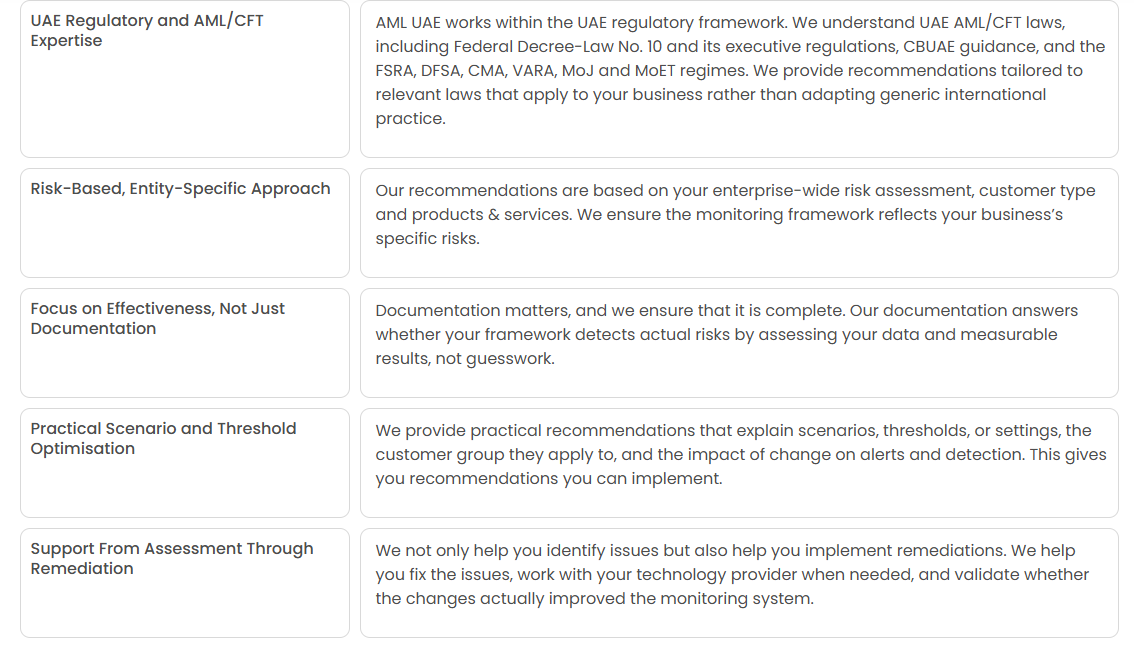
UAE Regulatory and AML/CFT Expertise
We work only within the UAE framework: Federal Decree-Law No. 10 of 2025 and its Executive Regulations, CBUAE guidance, and the DFSA, FSRA, Capital Market Authority (CMA), VARA, MoET and MoJ regimes. Recommendations are anchored to the rules that apply to you specifically, not to generic international practice adapted after the fact. Our founder, Pathik Shah, brings more than 28 years of experience, over 1,000 hours of AML training delivered and more than 200 advisory engagements across DNFBPs, VASPs and financial institutions.
Risk-Based, Entity-Specific Approach
Every recommendation traces back to your enterprise-wide risk assessment, your customer base and your product mix. We do not arrive with a standard scenario library to install, because a framework that does not reflect your own risk profile cannot be described as risk-based no matter how sophisticated it looks.
Focus on Effectiveness, Not Just Documentation
Documentation matters and we make sure yours is complete. But the question we set out to answer is whether your framework detects what it should, assessed against your own data using measurable indicators rather than reassurance.
Practical Scenario and Threshold Optimisation
Our recommendations are specific and implementable: this scenario, this parameter, this customer segment, this expected effect on volume and detection. You receive values you can action and defend, not principles you still have to translate into settings.
Support From Assessment Through Remediation
We stay through implementation. The same people who identify the gaps help close them, work with your technology provider where necessary, and validate that the changes achieved what they were supposed to, so findings do not sit unresolved in a report until the next review cycle.
The Transaction Monitoring Consultants Behind Your Framework
Your transaction monitoring framework is designed and reviewed by certified AML specialists with UAE regulatory experience, aligning monitoring scenarios, thresholds and escalation procedures with your business risks and supervisory requirements:

Pathik Shah
CAMS, FCA, CS, CISA, DISA (ICAI), FAFP (ICAI)
Experience
28+ years
Regulatory Coverage
MoET, MoJ, CBUAE, CMA, FSRA, DFSA, VARA · AML/CFT framework design, RegTech

Jyoti Maheshwari
CAMS, ACA
Experience
11+ years
Regulatory Coverage
MoET, MoJ, CBUAE, CMA, FSRA, DFSA, VARA · AML/CFT/CPF framework, health checks

Dipali Vora
CAMS, ACS
Experience
10+ years
Regulatory Coverage
MoET, MoJ, CBUAE, CMA, FSRA, DFSA, VARA · Consulting, training, implementation

Monika Shah
CAMS
Experience
3+ years
Regulatory Coverage
MoET, MoJ, CBUAE, CMA, FSRA, DFSA, VARA · managed KYC, consulting, goAML reporting
Can You Explain Your Monitoring Decisions?
AML UAE helps you build evidence behind the rules, thresholds and key decisions.
Speak to a Transaction Monitoring Consultant in the UAE
If you are unsure whether your monitoring framework would hold up under supervisory scrutiny, the fastest way to find out is a structured assessment. Tell us where you are and we will scope the work realistically, including the option of a limited diagnostic first if a full engagement is more than you need right now. If you would rather benchmark your framework first, our self-assessment questionnaire for SARs, STRs and transaction monitoring is a free starting point.
To make the first conversation useful, it helps to share your regulatory status and entity type, the monitoring solution you currently use, the specific monitoring challenge you are facing, your approximate transaction and alert volumes, and whether you need assessment, optimisation or implementation support.
Frequently Asked Questions About Transaction Monitoring Consulting in the UAE
It is a specialist advisory service that independently assesses how a UAE regulated entity detects unusual and suspicious activity, then improves it. The work typically covers scenario design, threshold and parameter tuning, alert quality assurance, investigation and escalation workflows, monitoring governance and effectiveness testing. It is distinct from buying monitoring software, because the consultant determines what should be monitored, how sensitively, and whether the resulting framework can be defended.
Ongoing monitoring is a legal requirement rather than a matter of good practice. Federal Decree-Law No. 10 of 2025 and its Executive Regulations require entities to scrutinise transactions against the customer information and risk profile they hold, and to keep that information current (Cabinet Resolution No. 134 of 2025, Article 8). Monitoring is also the mechanism that surfaces the suspicion which triggers the reporting obligation to the UAE FIU through goAML, so a weak monitoring framework tends to produce a weak reporting record as well.
The methodology and the governance around it, the active scenario and rule inventory, threshold and parameter settings, the data feeding the system, alert volumes and disposition quality, investigation and escalation workflows, MLRO involvement, record-keeping and audit trails, and the management information produced for senior management and the board. In most engagements the data review and the alert sampling are where the substantive findings come from.
A defensible transaction monitoring framework in the UAE has six working parts: a methodology that traces back to the enterprise-wide risk assessment; a scenario and rule inventory with a named owner and risk rationale for each rule; thresholds and parameters segmented by customer, product, geography and channel, with the testing evidence behind them; suspicion indicators updated as typologies change (Cabinet Resolution No. 134 of 2025, Article 17); an investigation, escalation and STR workflow with recorded dispositions; and governance covering senior management approval, change control, periodic effectiveness review and board reporting. Monitoring records and the results of any analysis must be kept for at least five years (Cabinet Resolution No. 134 of 2025, Article 25).
On a risk basis, using your own data. Thresholds should be segmented by customer type, product, geography, and delivery channel rather than applied uniformly, and calibrated against historical activity so you understand their effect on both detection and alert volume before making changes. CBUAE guidance expects the chosen rules, thresholds and parameters to be documented, approved by senior management and reviewed periodically for effectiveness, which means the rationale matters as much as the value.
By identifying which scenarios generate the most non-productive alerts, introducing risk-based segmentation so thresholds reflect expected behaviour for each customer group, removing redundant or overlapping rules, refining scenario logic to use customer context rather than value alone, and modelling every proposed change with below-the-line testing so that detection is not quietly weakened in the pursuit of a lower alert count.
At least annually as a good-practice baseline, and additionally whenever something material changes: a new enterprise-wide risk assessment, a new product, channel or market, a system or data change, updated typologies or supervisory guidance, or a pattern of alert-quality issues. CBUAE guidance requires monitoring methods to be reviewed periodically for effectiveness, so the review cycle itself, along with the events that trigger an interim review, should be defined and documented rather than left to judgement.
Software is the technology that executes monitoring. Consulting determines whether the right things are being monitored, at the right sensitivity, with the right investigation and governance around the output. Capable software configured with poorly calibrated scenarios will still miss suspicious activity, which is why platform selection and framework optimisation are best treated as separate exercises with separate objectives.
Yes. The UAE framework is built on the risk-based approach, and CBUAE guidance states that entities should use a risk-based approach to determine the policies, methods, procedures and controls applied to monitoring, including the extent of monitoring for particular customers or categories of customer. Higher-risk relationships warrant enhanced and more frequent scrutiny, and in some cases it is mandatory: enhanced ongoing monitoring applies to foreign PEPs and to higher-risk relationships with domestic PEPs, and enhanced due diligence to countries the National Committee identifies as high-risk (Cabinet Resolution No. 134 of 2025, Articles 16 and 23); and lower-risk relationships may be monitored less intensively, provided that decision is documented, justified and, where simplified measures are used, applied in coordination with your supervisor (Cabinet Resolution No. 134 of 2025, Article 5).
Directly. Monitoring calibration, alert-handling quality and the evidence behind threshold decisions are standard inspection focus areas. An engagement produces precisely the artefacts inspectors ask to see: a documented scenario inventory, threshold rationale supported by data, quality assurance results, effectiveness indicators, and a prioritised remediation plan with named owners and target dates.
Banks and financial institutions, exchange houses and money services businesses, fintechs and payment service providers, insurance and securities firms, virtual asset service providers, and DNFBPs including real estate agents, dealers in precious metals and stones, auditors and accountants, corporate service providers and legal professionals. The engagement is adapted to whichever authority supervises you, whether that is the CBUAE, CMA, DFSA, FSRA, VARA, ADGM RA, GCGRA, MoET or MoJ.
Still weighing it up?
A 30-minute conversation costs nothing and will tell you whether your monitoring framework needs a full assessment, a targeted tuning exercise, or simply better documentation of what you already do well.