



Supplemental Guidance for Dealers in Precious Metals and Stones (DPMS)
Published On: 06/03/2026
Protect your business with reliable and effective AML strategies with AML UAE.
Last Reviewed On: 07/24/2026 | Last Updated On: 07/24/2026
MoET's DPMS Guidance in Nutshell
- Applies to all UAE dealers in precious metals and stones (DPMS), covering metals above set purity thresholds, diamonds, coloured gemstones and pearls above defined weights.
- The AED 55,000 threshold is the minimum legal trigger for treating a transaction as a covered transaction requiring full AML/CFT/CPF measures, not an exemption below it. DPMSR filing is a separate threshold-based reporting obligation with its own specific triggering circumstances. Related transactions, instalments, and cash equivalents must all be aggregated toward the threshold.
- CDD and EDD must be applied on a risk-driven basis and are not limited to transactions at or above AED 55,000. Sanctions screening is a threshold-independent obligation; its depth and frequency must be proportionate to the risk profile. Ongoing monitoring applies to business relationships, with proportionate steps taken for occasional transactions. A five-year record retention rule applies across four specific triggering events.
- Sub-sector risk varies: refineries and bullion traders face the highest ML risk, wholesalers are most exposed to TBML, and retail jewellers face placement and structuring risk.
- Common gaps include mistreating the AED 55,000 threshold, missing DPMSR filings, and weak supply chain CDD, particularly in higher-risk subsectors.
- MoET expects a documented, proportionate risk-based programme: strong governance, supply chain due diligence, TBML detection, red-flag training and an empowered MLRO.
What UAE Dealers in Precious Metals and Stones Need to Know About AML/CFT/CPF Compliance
Where a person or entity is regularly engaged in dealing in precious metals and stones in the UAE and carries out transactions meeting or exceeding the AED 55,000 covered transaction threshold, it falls within the DNFBP category under Federal Decree-Law No. (10) of 2025 and Cabinet Resolution No. 134 of 2025, and must comply with the applicable AML/CFT/CPF obligations.
Entities whose business involves only incidental or infrequent dealings in PMS, where such transactions are not a regular component of the business, should assess carefully whether they qualify as a DPMS for these purposes.
MoET published sector-specific Supplemental Guidance for Dealers in Precious Metals and Stones in March 2026 to set out sector-specific expectations, risk factors, and practical considerations. It should be read alongside the UAE AML/CFT/CPF legal framework, MoET’s broader DNFBP guidelines, and applicable EOCN guidance.
The 2024 UAE National Risk Assessment (NRA) identifies the DPMS sector as one with high inherent exposure to money laundering risks, yielding a residual risk rating of medium-high. The key drivers include high cash intensity, the portability of high-value goods, extensive cross-border trade, involvement of legal persons, and reliance on intermediaries.
The 2024 MoET Sectoral Risk Assessment (SRA) specifically flags bullion trading, refinery, and wholesale activities as higher-risk subsectors.
Need a BRA or AML Programme Tailored to Your DPMS Sub-Sector?
Develop a risk-based compliance framework aligned with your business model, supply chain exposure, and MoET expectations.
Legal Status and Applicability of the MoET DPMS Supplemental Guidance
Who Does the Guidance Apply To?
- Scope of Applicability
- How to Read Mandatory vs Recommended Requirements
- Relationship with EOCN Guidelines on TFS and CPF
Scope of Applicability
Unless otherwise stated, this guidance applies to all Dealers in Precious Metals and Stones, including their boards of directors, management, and employees, established and operating in the territory of the UAE and in Commercial Free Zones.
It applies whether they establish or maintain a business relationship with a customer or engage in the financial activities and transactions outlined in Articles 2 and 3 of Cabinet Resolution No. 134 of 2025. The guidance applies equally to entities in the mainland UAE and in Commercial Free Zones without distinction.
How to Read Mandatory vs Recommended Requirements
The guidance draws a clear distinction between mandatory and recommended obligations. Requirements indicated by ‘shall’ or ‘must’ are compulsory. Requirements indicated by ‘should’ signify recommended practice, unless a recorded, risk-based justification supports an alternative approach that provides equal or greater control. In cases of any discrepancy between this guidance and the Federal Decree Law, Cabinet Resolutions, and directives from the Competent Authority, the legislation and directives take precedence.
Relationship with EOCN Guidelines on TFS and CPF
While this guidance provides high-level direction on Targeted Financial Sanctions (TFS) and Counter-Proliferation Financing (CPF), all operational, procedural, and implementation requirements in these areas remain governed by the applicable EOCN guidelines.
DPMS entities must refer separately to the full TFS guidelines issued by the Executive Office for Control and Non-Proliferation (EOCN) under Cabinet Decision No. 74 of 2020, which detail their obligations for screening, freezing, and reporting in relation to designated persons or entities.
The primary legislative basis for TFS and CPF obligations also sits in Federal Decree-Law No. (10) of 2025, Part 5, and Cabinet Resolution No. 134 of 2025, Chapter 6; Cabinet Decision No. 74 of 2020 provides the operative procedural framework for implementation.
DPMS should additionally refer to the EOCN Guidance on Counter Proliferation Financing and the Guidance on Proliferation Financing Institutional Risk Assessment to incorporate PF risk into their Business Risk Assessment.
Legal Status of This Guidance
What This Guidance Is and Is Not
The MoET Supplemental Guidance for DPMS is a practical compliance tool. It does not constitute additional legislation or regulation and is not intended to set legal, regulatory, or judicial precedent. It does not replace or supersede any legal or regulatory requirements or statutory obligations. Regulated entities should perform their own assessments of how to meet statutory obligations and should seek legal or other professional advice if they are unsure of the application of the legal or regulatory frameworks to their specific circumstances.
Nothing in this Supplemental Guidance should be interpreted as providing any explicit or implicit guarantee or assurance that supervisory or other Competent Authorities would defer, waive, or refrain from exercising their enforcement, judicial, or punitive powers in the event of a breach of the prevailing laws, regulations, or regulatory rulings. The guidance also notes that the lists and examples it provides are not exhaustive and do not set limitations on the measures regulated entities may need to take.
Unsure Whether Your Business Qualifies as a DPMS?
Get a free initial assessment to test whether your activity falls within DPMS scope and how the AED 55,000 threshold applies.
Regulatory Definition of Precious Metals and Stones Under UAE AML Law
One of the most practically important sections of the MoET DPMS Guidance is the precise regulatory definition of what counts as a precious metal or stone for AML/CFT/CPF purposes. This definition determines whether and when your compliance obligations are triggered. These classifications align with UAE federal legislation governing the control, stamping, and identification of PMS, as well as with the Kimberley Process Certification Scheme for raw diamonds.
Precious Metals: Minimum Purity Thresholds
Which Metals Are Covered and at What Purity
The guidance sets out four precious metals and their minimum purity levels for the purposes of applying AML/CFT/CPF measures. Gold must have a minimum purity of 500 parts per 1,000. Silver must have a minimum purity of 800 parts per 1,000. Platinum must have a minimum purity of 850 parts per 1,000. Palladium must have a minimum purity of 500 parts per 1,000. These purity thresholds define the point at which the metals carry sufficient value and liquidity to pose material ML/TF/PF risks. Metal falling below these thresholds may fall outside the specific PMS definition for this purpose. However, DPMS should still consider whether the product’s value, the customer’s risk profile, or the transaction pattern calls for proportionate AML/CFT/CPF measures. See Other High-Value Materials That Carry Similar Risk below.
The 50% Rule for Composite Objects
Any object where at least 50% of its monetary value is derived from precious metals or precious stones must be treated as PMS for AML/CFT/CPF purposes, irrespective of its form or intended use.
Other High-Value Materials That Carry Similar Risk
The guidance further notes that DPMS may engage in transactions involving other types of metals and gemstones, which, while technically not classified as PMS, may nevertheless carry ML/TF/PF risks similar in nature to PMS. These include other high-value metals such as platinum-group or platinoid metals like rhodium, semi-precious gemstones such as amethysts, opals, and jade, and synthetic, treated, or artificial gemstones, including lab-grown diamonds, emeralds, rubies, sapphires, and pearls. DPMS should apply a risk-based approach to these materials, considering the nature, value, and risk indicators of each transaction.
Precious Stones and Pearls: Weight Thresholds
Diamonds: Rough and Polished
The guidance establishes separate weight thresholds for rough and polished diamonds. Rough diamonds of any weight in carats fall within the definition. Polished diamonds that are loose require a minimum weight of 0.3 carats per stone to fall within the definition. Polished diamonds that are mounted in a setting require a minimum weight of 0.5 carats per single stone, whether the setting contains one or more stones. The weight thresholds define the point at which polished diamonds typically acquire sufficient value and liquidity to pose material ML/TF/PF risks. The trade in rough diamonds is also specifically subject to the Kimberley Process Certification Scheme requirements, which DPMS must verify and document.
Coloured Gemstones and Pearls
Coloured gemstones, specifically polished emeralds, rubies, and sapphires, must meet a minimum weight of 1 carat per stone if loose, or a minimum weight of 2 carats per single stone when mounted in a setting, to fall within the definition. Loose pearls require a minimum diameter of 3 millimetres per bead. Pearls that are strung or mounted in a setting require a minimum diameter of 10 millimetres per single bead. While pearls are not technically gemstones, they are included in the definition for the purpose of the DPMS guidance because they carry comparable value and liquidity characteristics.
Understanding the AED 55,000 Covered Transaction Threshold
The AED 55,000 threshold is the most commonly misunderstood aspect of UAE DPMS compliance. The MoET DPMS Guidance devotes significant space to clarifying exactly how it works and, critically, what it does not mean. Understanding this correctly is essential to passing a MoET supervisory inspection.
What the AED 55,000 Threshold Means
How Related Transactions Are Aggregated
The guidance makes clear that the threshold applies to single transactions or to a series of transactions that appear to be related. This includes one or more transactions involving the same business relationship or customer, whether related to a single item or set of items.
It also includes one or more transactions which, in the judgment of the dealer, appear to be structured so as to avoid the established threshold. The nature of the transaction, customer behaviour, and other relevant risk indicators should be considered when determining whether transactions are related or structured.
DPMS cannot treat separate invoices for the same visit as unrelated transactions simply because each individual invoice is below the threshold.
Cash Equivalents Count Toward the Threshold
A significant and frequently overlooked element of the threshold rules is that cash equivalents count toward the AED 55,000 limit in exactly the same way as cash. Cash equivalents are bearer negotiable instruments, including cashier’s cheques, money orders, postal orders, treasury bills, bearer bonds, and promissory notes. They are instruments that can be transferred without identifying the underlying owner, and they function as cash for the purposes of the AML/CFT/CPF framework. Trade-in items accepted as part payment are also treated as cash equivalents.
The guidance provides a specific worked example: a retail dealer who accepts a diamond ring valued at AED 10,000 as a trade-in toward an AED 60,000 pendant, resulting in a net cash transfer of only AED 50,000, is still conducting a covered transaction because the payment in kind is a cash equivalent.
Worked Examples from the Guidance
Separate Invoices Do Not Defeat the Threshold
The guidance provides a worked example of a customer who makes cash purchases of several different PMS items at the same time and requests separate invoices for each piece. No individual invoice meets the threshold of AED 55,000, but the total purchase price exceeds this amount. The guidance is explicit that these are covered transactions. This worked example directly addresses one of the most common structuring techniques observed in the DPMS sector and makes clear that separating a single visit or transaction into multiple invoices does not defeat the obligation.
Instalment Payments Are One Transaction
The guidance provides a worked example of a customer who wishes to purchase items with a total value meeting or exceeding AED 55,000 and places a 25% deposit in cash below the threshold, then pays further cash instalments over subsequent weeks. The guidance confirms that all of these transactions are related and are therefore covered transactions, even though each individual payment is below AED 55,000. The practical implication is that DPMS must assess the total transaction value when a customer agrees to purchase items, not merely the value of each individual cash payment.
The Refinery Services Example
The guidance provides a worked example specifically relevant to gold refineries: a retail jeweller brings 9 karat diamond-studded jewellery for refining to a gold refinery, requesting diamond separation and gold refining. The value of the lot of jewellery is AED 90,000, and the charges from the refinery paid in cash by the retailer are AED 2,500. This is a covered transaction even though the cash involved in the service fee is well below the threshold. The exchange of the material in the form of jewellery is above the threshold, and hence the transaction is a covered transaction. This clarifies that refineries must assess the value of the material they are processing, not merely the cash fee they charge for the service.
The DPMSR Reporting Obligation
The Three DPMSR Triggering Circumstances
Covered transaction classification and DPMSR filing are connected but legally distinct obligations. A transaction may trigger the full AML/CFT/CPF framework as a covered transaction under Section 2.2 of the guidance, while DPMSR filing must be assessed separately under the specific reporting circumstances in Section 1.4.1. Not every covered transaction automatically generates a DPMSR obligation, and the DPMSR triggering circumstances differ depending on whether the counterparty is an individual, a company or an entity.
Separate from the SAR/STR obligation, DPMS must file a Dealers in Precious Metals and Stones Report (DPMSR) in three specific circumstances.
- First, when conducting a transaction with resident individuals for cash equal to or more than AED 55,000 or its equivalent in foreign currency.
- Second, when conducting a transaction with non-resident individuals for cash equal to or more than AED 55,000 or its equivalent in foreign currency.
- Third, when conducting transactions with companies or entities equal to or more than AED 55,000 or its equivalent in foreign currency, whether in cash or through wire transfer. Note that for company and entity transactions, the wire transfer trigger makes the obligation significantly broader than for individual transactions.
The DPMSR Is Not Risk-Dependent
The obligation to file a DPMSR is not risk-dependent and must be fulfilled even when CDD measures have been satisfactorily completed, and no red flags have been identified. This is a critical point that many DPMS entities get wrong. Entities cannot decide not to file a DPMSR on the basis that a customer is low risk or that the transaction appeared clean. The filing obligation exists independently of the risk assessment outcome. Failure to submit a DPMSR within the predefined parameters and timelines may undermine the effectiveness of the entity’s compliance framework and expose it to enforcement action.
When Both DPMSR and SAR/STR Must Be Filed Simultaneously
Where a transaction both exceeds the DPMSR threshold and raises reasonable grounds for suspicion, both the threshold-based reporting and suspicion-based reporting obligations must be met in accordance with their respective requirements. The two reporting obligations are entirely independent of each other. Filing a DPMSR does not discharge the obligation to file a SAR/STR, and filing a SAR/STR does not discharge the DPMSR obligation. Effective reporting relies on well-defined internal escalation mechanisms, clear allocation of responsibilities between business functions and the Compliance Officer, and ongoing staff training.
Need Help with DPMSR Filing and STR Quality?
Get support for threshold reporting, suspicious activity escalation, and filing quality across qualifying transactions.
Core AML/CFT/CPF Obligations for UAE Dealers in Precious Metals and Stones
Section 1.4 of the MoET DPMS Guidance sets out eight core compliance obligations under Federal Decree-Law No. (10) of 2025 and Cabinet Resolution No. 134 of 2025. Together they form the basis of an effective risk-based AML/CFT/CPF programme designed to prevent sector misuse for ML, TF, or PF purposes.
|
Obligation |
What It Requires |
|
Compliance Administration |
Appoint a qualified CO/MLRO; staff training and screening mandates; subject the AML/CFT/CPF framework to independent audit; overall oversight by senior management; group-wide programmes where applicable. |
|
Risk Identification and Assessment |
Undertake a Business Risk Assessment proportionate to the nature, size, and complexity of activities, incorporating the 2024 NRA and MoET SRA findings. |
|
Policies, Procedures, and Internal Controls |
Establish, document, implement, and regularly update AML/CFT/CPF policies and procedures tailored to the entity’s specific business model and risk exposure. |
|
Customer Due Diligence and Ongoing Monitoring |
Identify and verify customers and beneficial owners; create and maintain customer risk profiles; apply EDD where higher risks are identified; risk-driven approach, not threshold-driven. |
|
Sanctions and PEP Compliance |
Screen against UNSCR lists; comply with TFS; apply EDD for PEPs; foreign corruption is a key ML threat per the 2024 NRA. |
|
SAR/STR Reporting |
Promptly report suspicious activities and transactions. Timeliness and quality of SAR/STR reporting are explicitly named as key supervisory focus areas for the DPMS sector. |
|
Record Keeping |
Retain all CDD, transactional, and correspondence records for at least five years from the triggering event. Records must support reconstruction of transactions and be available to competent authorities without undue delay. |
|
DPMSR Threshold Reporting |
File a DPMSR for cash transactions with resident and non-resident individuals of AED 55,000 or more, and for all transactions with companies or entities of AED 55,000 or more whether in cash or by cross-border wire transfer. The obligation is not risk-dependent. |
Key Points Across the Eight Obligations
Five-Year Record Retention and the Four Triggering Events
Records must be retained for at least five years from the latest of: the termination of a business relationship or closure of a customer account; the completion of an occasional transaction where no business relationship exists; the issuance of a final judgment by a competent judicial authority; or the dissolution, liquidation, or termination of a legal person or arrangement. All CDD and transactional records must be readily available to Competent Authorities upon request and without undue delay.
SAR/STR Quality as a Supervisory Focus Area
The guidance explicitly names the timeliness and quality of SAR/STR reporting as key supervisory focus areas for the DPMS sector, signalling that these are among the specific areas MoET examines during supervisory inspections. A SAR/STR that is filed late, filed without sufficient supporting detail, or not filed at all for a clearly suspicious transaction represents a distinct compliance weakness that can arise independently of other weaknesses in the entity’s programme.
PEP Exposure and Foreign Corruption as a Key ML Threat
The guidance specifically notes that entities must adopt an approach for dealing with Politically Exposed Persons (PEPs) and must be cognisant that foreign corruption is identified as one of the key ML threats in the 2024 NRA. PEP exposure in the DPMS sector is therefore directly linked to an identified ML threat vector, not merely a generic DNFBP obligation.


“The weight and purity thresholds in the guidance are not arbitrary numbers. They define the point at which PMS acquire sufficient value and liquidity to pose material ML/TF/PF risks. The most common misunderstanding we see is entities treating these thresholds as an exemption below which no AML measures apply. They are not. They define the product scope. The AED 55,000 threshold governs the transaction trigger. The two are entirely separate concepts, and conflating them is one of the most common inspection failure points.”

DPMS Compliance Gap Analysis: Where UAE Entities Most Commonly Fall Short
This section provides a practitioner-level gap analysis, mapping each of the eight core obligations to the most common implementation failures observed across UAE DPMS entities during compliance reviews. These observations are drawn from practitioner experience and are consistent with the expectations set out in the MoET DPMS Guidance, but are not themselves derived from the guidance. Every gap listed represents a real inspection risk.
|
Obligation |
Most Common Gap Observed in Practice |
Supervisory Consequence |
|
BRA was completed once at entity setup and never updated. Does not reference the 2024 NRA or MoET SRA findings. Senior management is not formally involved in the approval. |
MoET expects BRA to be updated periodically and whenever significant changes occur in business, risk, or regulatory environments. An outdated BRA is a core inspection failure point. |
|
|
AED 55,000 Threshold |
Treated as a hard on/off switch. CDD is applied only when the threshold is met. No risk-based measures applied to sub-threshold transactions regardless of risk indicators present. |
The guidance is explicit: the threshold is a minimum legal trigger, not an exemption. Sub-threshold transactions showing elevated risk indicators must still be assessed. This is a primary inspection finding for the DPMS sector. |
|
DPMSR Filing |
Not filed when CDD is clean. Not filed for cash equivalent transactions such as cashier’s cheques or trade-ins. Not recognised as applicable to wire transfers for company or entity transactions. |
The obligation is not risk-dependent. Failure to file within predefined parameters exposes the entity to enforcement action regardless of whether the transaction was otherwise clean. |
|
SAR/STR Quality |
Filed too late, filed with insufficient detail, or not filed at all for sub-threshold suspicious transactions. Internal escalation not connected to the STR process. |
Timeliness and quality of SAR/STR reporting are explicitly named as key supervisory focus areas for the DPMS sector. Poor quality reports and delayed filing are treated as independent compliance failures. |
|
UBO verification relies entirely on customer self-declaration without corroboration from independent sources. Complex legal structures are not traced beyond the immediate counterparty. |
Sole reliance on customer representations where the overall risk profile warrants enhanced scrutiny is specifically identified as insufficient. Entities must refuse or exit relationships where UBO cannot be verified. |
|
|
Supply Chain CDD |
The origin of gold or diamonds is accepted on trust from the counterparty. KPCS documentation has not been checked for rough diamonds. Scrap gold claims are accepted without assessing plausibility relative to quantity. |
Where documentation is incomplete, inconsistent, or unverifiable, shipments are to be rejected. Bullion and refinery operations are specifically identified as higher-risk subsectors requiring demonstrably effective controls. |
|
Generic AML training with no DPMS-specific content on typologies, red flags, or TBML. Front-line sales staff are not trained. No scenario-based exercises. |
MoET expects training programmes to address sector-specific risks, emerging typologies, and reporting obligations. Front-line staff who cannot identify DPMS-sector red flags represent a direct compliance gap. |
|
|
Record Keeping |
Records are fragmented across emails, physical files, and informal channels. No structured retrieval system. Five-year retention is not tracked or enforced. |
Records must be sufficient to reconstruct transactions, must be readily available to Competent Authorities upon request without undue delay, and must support investigations or be used as evidence in legal proceedings. |
Most Critical Gaps and Why They Matter
Threshold Treatment: The Most Pervasive Gap
Treating the AED 55,000 threshold as a hard on/off switch is the single most common gap observed across UAE DPMS entities. The guidance is explicit: the threshold is a minimum legal trigger, not an exemption. Entities that cannot demonstrate risk-based measures applied below the threshold are exposed during inspection, regardless of how clean their above-threshold records are.
Supply Chain CDD: The Gap Specific to Higher-Risk Subsectors
For bullion traders, refiners, and wholesale entities, supply chain CDD is the most consequential gap. The specific supervisory expectations, including origin plausibility assessment, weight/purity reconciliation, and the mandatory rejection of shipments with incomplete or unverifiable documentation, are set out in the Sub-Sector Specific Compliance Controls table under Gold Refinery / Bullion Trader.
Concerned About Gaps in Your DPMS Programme?
Review your BRA, CDD, monitoring, training, and record-keeping against MoET expectations before the next inspection.
Sub-Sector Specific Compliance Controls for UAE Dealers in Precious Metals and Stones
Each sub-sector within the DPMS space has a distinct risk profile and correspondingly different control requirements. The table below maps each sub-sector to its primary risks and the specific controls required, derived entirely from the source document.
|
Sub-Sector |
Primary ML/TF/PF Risk |
Key Controls Required |
|
Gold Refinery / Bullion Trader |
Highest risk: refining and re-melting eliminates all origin identifiers, enabling commingling. Exposure to PF/sanctions evasion via incoming materials from high-risk regions. UAEFIU highlights ongoing responsible sourcing weaknesses. |
(1) Reject shipments with incomplete, inconsistent, or unverifiable documentation. (2) Compare the declared origin against the known production capability of the jurisdiction. (3) Reconcile weight, purity, and value against documentation. (4) Apply EDD to all scrap gold purchases. (5) Treat unverifiable scrap claims as high-risk by default. |
|
Wholesale PMS Trader |
TBML via over/under-invoicing, circular trading patterns, and use of intermediaries to obscure buyer/seller identity. Complex transactional structures and third-party payments without economic rationale. |
(1) Scrutinise price deviations from global benchmarks. (2) Check for mismatched weights, purity discrepancies, or document inconsistencies. (3) Detect circular trading patterns. (4) Validate third-party payments with documented economic rationale. (5) Identify trade routes for unusual detours or low-oversight jurisdictions. |
|
Retail Jeweller (Buy/Sell) |
Classic placement, layering, and integration risks. Structuring transactions across invoices. Use as a substitute currency. Resale through secondary channels. PEP and criminal association exposure. |
(1) Monitor transaction patterns and cumulative totals against the AED 55,000 threshold. (2) Apply risk-based CDD at all transaction values, not only at the threshold. (3) Verify source of funds for high-value cash purchases. (4) Record denomination and serial numbers when accepting cash and cash equivalents. (5) Reassess customer risk profile when patterns change suddenly. |
|
Diamond Dealer (Rough/Polished) |
Falsification of KPCS certificates. Conflict diamond commingling. Multi-jurisdictional obscuring of origin. Use as an alternative currency in drug trafficking and arms dealing. |
(1) Verify the KPCS certificate for all rough diamond shipments. (2) Reject shipments without valid KPCS documentation or where the certificate appears forged or has an unusually long validity period. (3) Verify the country of origin is a KPCS participant. (4) Apply the weight thresholds in Section 2.1 to determine AML/CFT/CPF applicability. |
|
Gold/Silver Scrap Dealer |
Stolen jewellery and conflict gold are entering formal supply chains via recycling. Inability to trace origin once re-melted. Deliberate use of scrap channel to introduce illicit gold into legitimate supply chains. |
(1) Evaluate the plausibility of scrap claims relative to the quantity supplied. (2) Where volumes indicate commercial-scale supply chains, apply enhanced scrutiny. (3) Identify and verify all suppliers, including small-scale collectors. (4) Document rationale for accepting each scrap consignment. (5) An individual or small-scale collector presenting volumes exceeding the stated operational capacity is a red flag. |
|
Free Zone PMS Entity |
Cross-border trade opacity, multiple jurisdictions, and use of general trading licences to conduct PMS activities without specific authorisation. Invoice-only gold trading as a layering mechanism. |
(1) Verify that the licensed activity is consistent with actual trading activity. (2) Escalate where material discrepancies exist between licensed activities and actual trade behaviour. (3) Flag frequent pro forma invoice requests with no corresponding physical delivery. (4) Scrutinise payment flows through multiple intermediaries across jurisdictions. |
Understanding the Risk Differences Across Sub-Sectors
Risk differs significantly by business model. Refineries and bullion traders carry the highest origin and responsible-sourcing risk because the beneficiation process eliminates traceability: once PMS is refined or re-melted, its origin cannot be recovered. Wholesale traders are most exposed to TBML through over/under-invoicing, false documentation, and multi-intermediary layering. Retail jewellers are primarily exposed to placement and structuring through repeated sub-threshold transactions. The table below maps each sub-sector to its specific risk profile and the controls MoET expects.
Need Sub-Sector-Specific AML Policies?
Build procedures tailored to your DPMS model, whether you operate in retail, wholesale, refining, or scrap.
DPMS AML/CFT/CPF Self-Assessment Diagnostic: Where Does Your Business Stand?
Use this diagnostic to assess your entity’s current compliance posture against the eight core obligations in the MoET DPMS Guidance. For each obligation, identify which description most accurately reflects your current position: GREEN (compliant), AMBER (partially compliant), or RED (non-compliant or not yet implemented). Every RED or AMBER finding represents a regulatory risk that should be addressed before your next MoET supervisory examination.
|
Obligation |
Diagnostic Question |
GREEN (Compliant) |
AMBER (Partial) |
RED (Non-Compliant) |
|
Business Risk Assessment |
Do you have a documented BRA updated within the last 12 months that references the 2024 NRA medium-high residual risk rating and MoET SRA subsector findings? |
✅ Documented, board-approved BRA updated within 12 months referencing NRA and SRA |
⚠ BRA exists but does not reference NRA/SRA or is over 12 months old |
❌ No BRA documented, or BRA covers generic risks only |
|
AED 55,000 Threshold |
Are CDD and risk-based measures applied to ALL transactions regardless of value, treating the threshold as a minimum trigger only? |
✅ Risk-based measures applied at all transaction values; threshold treated as minimum legal trigger |
⚠ CDD applied below threshold for flagged cases only; no systematic approach |
❌ CDD and measures are applied only when the threshold is met |
|
DPMSR Filing |
Is DPMSR filing integrated into operational workflows and filed for all three triggering circumstances regardless of risk outcome? |
✅ DPMSR filed for all qualifying transactions; process integrated into operations |
⚠ DPMSR filed inconsistently or only when red flags are present |
❌ DPMSR not filed, partially understood, or omitted when CDD is clean |
|
Beneficial Ownership |
Can you identify and verify the UBO of every legal person counterparty before executing a covered transaction using independent sources? |
✅ UBO verified through reliable independent sources for all legal persons |
⚠ UBO sought but relies mainly on customer self-declaration without corroboration |
❌ UBO not systematically verified; documentary ownership chain not established |
|
SAR/STR Quality |
Are suspicious transaction and activity reports filed promptly and with sufficient quality and completeness to satisfy supervisory expectations? |
✅ STRs filed promptly with full supporting detail; timeliness and quality reviewed internally |
⚠ STRs filed, but quality is inconsistent, or timing is frequently delayed |
❌ No STR programme in place or significant under-reporting observed |
|
Supply Chain CDD |
Do you verify the origin of gold, rough diamonds, and other PMS using export certificates, KPCS documentation, customs declarations, and shipment documents? |
✅ Full supply chain CDD applied; KPCS checked; origin compared against known production capability |
⚠ Origin documentation reviewed but not systematically verified against production capability |
❌ No supply chain CDD; origin taken on trust from counterparty |
|
Staff Training |
Have all staff, including front-line sales and senior management, received AML/CFT/CPF training covering DPMS-specific typologies and red flags? |
✅ Regular, documented, sector-specific training including TBML, structuring, PF red flags |
⚠ Basic generic training in place; no DPMS-specific content on typologies or red flags |
❌ No training programme or last training over 24 months ago |
|
Record Keeping |
Are all CDD, transactional, and correspondence records maintained in a format that allows reconstruction and is accessible to MoET on request without delay? |
✅ Structured record management system; records retrievable quickly; five-year retention met |
⚠ Records exist but are fragmented across emails, files, and systems |
❌ Records incomplete, inaccessible, or retention period not met |
How to Use Your Results
Interpreting RED Findings
Any RED finding requires immediate remediation. Red findings on BRA currency, threshold treatment, and DPMSR filing are the three most commonly identified in MoET DPMS supervisory examinations and are the first areas an inspector will test. A RED finding on beneficial ownership verification is particularly serious because the guidance specifies that entities must refuse or exit relationships where beneficial ownership cannot be reasonably verified. An entity that cannot demonstrate a systematic UBO verification process has a structural programme failure, not merely a documentation gap.
Interpreting AMBER Findings
AMBER findings indicate partial compliance. They typically indicate that a process exists but is inconsistently applied, insufficiently documented, or not yet embedded into operational workflows. AMBER findings on supply chain CDD, staff training, and SAR/STR quality are the most common. These must be strengthened with documented procedures, staff training records, and evidence of operational implementation before a supervisory examination. An AMBER finding that cannot be explained and evidenced during an inspection is likely to be treated as RED by the inspector.
Using the Diagnostic as a Pre-Inspection Tool
This diagnostic is designed to reflect the actual areas a MoET inspector evaluates during a DPMS supervisory examination. The most effective use is to run it at least six weeks before any anticipated inspection, identify all RED and AMBER findings, assign ownership and deadlines for remediation, and document the remediation steps taken. Entities that can demonstrate awareness of their own gaps and a structured remediation plan are better positioned during an inspection than entities that appear unaware of weaknesses that the inspector identifies.


“What MoET is saying in this guidance is something we see confirmed in client engagements regularly. The risk for IAA firms is not primarily that they will be caught in an obvious fraud. The risk is that a client with a complex ownership structure, a plausible business story, and a well-presented set of financials will slowly draw the firm into legitimising something that should have triggered a closer look three engagements ago. By the time the pattern becomes visible, the audit trail showing how the firm responded to each early warning sign becomes the story. Risk-based controls are not just a regulatory obligation; they are the firm’s own protection.”

Pathik Shah - CAMS, FCA, CISA | Founder and Principal Consultant, NIYEAHMA Consultants LLP
Sector and Risk Context: Why the DPMS Sector Is High Risk
Section 2 of the MoET DPMS Guidance explains the specific risk landscape of the DPMS sector. Understanding this context is essential for building a credible Business Risk Assessment and for demonstrating to a supervisor that your compliance programme is proportionate to the risks your entity actually faces
Why Precious Metals and Stones Are Attractive to Criminals
Intrinsic Value, Portability, and Anonymity
The guidance identifies several specific characteristics of PMS that make them attractive to criminals. PMS represent high intrinsic value in a relatively compact form, tends to maintain or even increase in value over time, and can be easily transported physically in many forms. PMS can be used both as a means to generate criminal proceeds through various predicate offences and as a vehicle to launder them. PMS can be used for illicit purposes, including ML/TF/PF, in a variety of ways, either directly through physical exchange as a form of currency or indirectly through exchange of value via various formal and informal financial systems, as well as via international trade.
Decentralised Markets and Cultural Factors
There are large, well-established, decentralised, and often cash-based markets for certain types of precious metals and stones, particularly for gold and diamonds, which often allow them to be traded or exchanged with relative anonymity. The difficulty in tracing specific items, combined with the global nature of PMS markets, makes it easier for criminals to exploit cross-border, multi-jurisdictional situations to obscure paper and money trails while rendering it more difficult for national law enforcement authorities to detect and investigate cases. The guidance also notes that in certain geographic regions, the buying and selling of PMS is a common cultural practice, making it difficult to distinguish between legitimate transactions and their illicit counterparts.
The ML Threats Identified for the DPMS Sector
The guidance identifies the key money laundering threats for the DPMS sector as trade-based money laundering (TBML), smuggling, laundering of proceeds from drug trafficking and foreign corruption, and activities of professional money laundering networks. While the 2024 NRA did not identify misuse of the sector for terrorism financing, the sector’s characteristics make it vulnerable to misuse for illicit value transfer, sanctions evasion, and proliferation financing, especially through trade-based activities that include degrees of opacity.
The PMS Supply Chain: Risk at Every Stage
Upstream vs Downstream Risk: A Critical Distinction
Upstream activities (extraction, raw minerals trading) carry heightened origin, traceability, and commingling risk. Downstream activities (wholesale and retail) are more exposed to placement, layering, and integration. MoET expects entities to understand their specific position in the chain and calibrate controls accordingly.
The Five Supply Chain Stages and Their Specific Risks
The guidance maps five supply chain stages, each with distinct risk profiles. The table below sets out the key risks and MoET’s control expectations at each stage.
|
Supply Chain Stage |
Key ML/TF/PF Risks |
MoET Control Expectation |
|
Extraction / Production |
Infiltration by criminal or terrorist groups, commingling, over/under invoicing, accounting fraud, theft, smuggling, bribery. |
Stronger emphasis on source of origin information, counterparty assessment, and any indicators of commingling or illicit sourcing. |
|
Trading in Raw Minerals |
Falsification of KPCS certificates, commingling of conflict minerals, cash transactions, smuggling, multi-jurisdictional opacity with multiple traders. |
Enhanced scrutiny of counterparties, payment methods, and trade documentation especially where multiple intermediaries or cross-border movements are involved. |
|
Beneficiation (Refining / Cutting) |
Loss of traceability through refining or smelting, TBML, cash transactions, commingling. Origin is very difficult to trace once PMS goes through the beneficiation process. |
Deploy adequate controls relating to source of origin information and consistency of purity, volumes, and valuation. |
|
Wholesale Trade |
TBML, commingling, placement/layering/integration typologies, complex transactional structures, third-party payments. Bullion and scrap: unverifiable scrap claims are high-risk. |
Sufficient awareness and capability to spot TBML typologies. Evidence origin plausibility, reconcile weight/purity vs documentation, treat unverifiable scrap claims as high-risk. |
|
Retail Trade |
Commingling, placement/layering/integration, fraud, theft, robbery, embezzlement. High-value and repeated transactions particularly vulnerable. |
Greater emphasis on monitoring customer behaviour, transaction patterns, and payment methods, especially where high-value or repeated transactions occur. |
Why MoET Expects You to Know Where You Fit
Supply chain stages do not necessarily proceed in sequence, and entities may operate across multiple stages simultaneously. A Business Risk Assessment must identify the entity’s specific supply chain position and calibrate controls to the cumulative risk exposure across every stage in which it participates.
Risk Factors to Consider When Building Your BRA
Customer and Counterparty Risk Factors
The guidance sets out a range of customer and counterparty risk factors that DPMS must consider. These include whether the counterparty is a physical person, legal person, or legal arrangement; if a legal person or arrangement, whether it is part of a larger or more complex group; and whether there is any association with a PEP. A particular focus is placed on whether the party appears to be acting on their own behalf or at the behest of a third party, and whether the party’s knowledge and experience in relation to the product or service type is appropriate for the transaction being proposed.
Geographic Risk Factors
Geographic risk is pivotal, particularly at upstream supply chain stages in relation to mining and initial sourcing operations. The guidance notes that gold mining can be vulnerable to terrorist financing if it occurs in remote locations with minimal governmental presence or infrastructure, and that in some areas gold mining can be dominated by armed non-governmental groups. Mining for jewels is largely small and informal, often carried on in areas of significant turmoil and conflict. The guidance encourages entities to develop their own country-risk model, drawing on publications issued by the NAMLCFTC, analytical reports and advisories issued by the UAE FIU, and the FATF lists of High-Risk Jurisdictions subject to a Call for Action and Jurisdictions under Increased Monitoring.
Product and Transaction Risk Factors
Product and transaction risk factors include the type, nature, quantity, quality, purity, price, form, rarity, portability, and potential for anonymity of the products or services involved. The type, size, complexity, cost, and transparency of the transaction, including whether a physical or virtual exchange of merchandise is involved, and the means of payment or financing, are also relevant factors, particularly in relation to whether they appear consistent with the counterparty or customer’s socio-economic profile and the degree of expertise required. Novelty or unusual nature of the transaction, such as requirements to expedite beyond what is customary, unusual delivery requirements, or unusual requests for secrecy, are specific risk indicators that the guidance flags.
Does Your BRA Reflect Supply Chain Risk?
Update your risk assessment to reflect origin, counterparty, and transaction risks across your PMS supply chain.
Customer Due Diligence and Ongoing Monitoring for UAE Dealers in Precious Metals and Stones
MoET DPMS Guidance highlights additional CDD and monitoring points that are specific to DPMS and must be applied on top of the general DNFBP requirements. These points highlight typologies and risk indicators specific to the DPMS sector and are intended to support entities in implementing measures that are risk-based, proportionate, and effective.
Sanctions Screening: A Threshold-Independent Obligation
Maintain Threshold-Independent Sanctions Screening
Irrespective of the size of the transaction or the method of payment, DPMS must maintain a process for screening all existing and prospective business relationships and customers against Sanctions Lists. This applies even to transactions that fall well below the AED 55,000 threshold, and does not depend on the risk classification of the customer.
Depth and Frequency of Screening Must Match the Risk
The guidance notes that DPMS are expected to ensure that the depth and frequency of screening are commensurate with the associated risks. Screening should include adverse media checks to identify any potentially adverse information, including associations with PEPs or financial or other crimes. The guidance also requires background checks in addition to sanctions list screening.
Beneficial Ownership: The Core CDD Challenge
Third-Party Intermediaries as a Concealment Technique
The guidance identifies the attempt to conceal beneficial ownership through third-party intermediaries, proxies, or legal structures as a characteristic technique used in a variety of ML/TF/PF typologies. Such intermediaries may include family members, friends, business associates, other legal representatives, or other third persons. These arrangements can help to create distance between the source of the illicit funds and the transaction or activity in question. In the DPMS context, DPMS should be particularly attentive to establishing and verifying the identity of the true beneficial owner and corroborating the legitimacy of their source of funds through reliable independent sources, wherever ongoing business relationships are concerned or when high-risk situations are identified.
The Verification and Corroboration Process
The starting point in determining beneficial ownership of a legal entity or legal arrangement is to ask pertinent questions and obtain information directly from the business relationship or customer. The information thus obtained should be analysed for reasonableness and consistency and should be appropriately confirmed or corroborated with reference to reliable independent sources whenever possible. The guidance specifies that sole reliance on representations provided by customers where the overall risk profile warrants enhanced scrutiny is not sufficient. Reliable independent sources include (but are not limited to) bank references or bank account information provided by financial institutions or commercial credit reporting agencies, public registries, and federal or national tax identification numbers.
CDD Alerting Factors Specific to DPMS
The guidance identifies three specific CDD alerting factors for DPMS entities. First, compatibility of the customer’s profile, including their economic or financial resources, with the specifics, including nature, size, and frequency of the transaction or activities involved. Second, use of complex or opaque legal structures or arrangements such as trusts, foundations, personal investment companies, investment funds, or offshore companies, which may tend to conceal the identity of the true beneficial owner or source of funds. Third, possible association with politically exposed persons, especially in regard to foreign customers. These factors must be taken into account both at the time of establishing a business relationship and on an ongoing basis.
When to Refuse or Exit a Relationship
The guidance is explicit that DPMS must refuse or exit relationships where beneficial ownership or source of funds and origin cannot be reasonably verified, or where sanctions and PF risks cannot be mitigated. This is a mandatory obligation, not a discretionary one. An entity that continues a relationship with a customer or counterparty where beneficial ownership has not been verified is operating in breach of the guidance, regardless of how long the relationship has existed or how commercially important the customer may be.
Ongoing Monitoring: Practical Steps for DPMS
What Ongoing Monitoring Looks Like in the DPMS Context
The guidance acknowledges that ongoing monitoring in the DPMS sector is more complex than in sectors with continuous customer relationships. In retail and occasional transaction contexts, it may not always be possible to perform detailed ongoing monitoring of the entirety of business partners’ or customers’ activity. Nevertheless, DPMS must take reasonable steps to protect itself from misuse, particularly where high-risk customers have been identified. The guidance provides three specific monitoring examples: in covered transactions, maintaining careful records of certificate numbers and identifying characteristics of PMS including weight, purity, colour, shape, cut, inclusions, and other markings; in warehousing or safekeeping arrangements, monitoring the status of the merchandise throughout the transaction lifecycle to detect unusual changes or substitutions; and in contracted services such as refining, cutting, or polishing, ensuring that funds received come from known sources on which CDD has been performed.
Payment Method Consistency as a Monitoring Signal
The guidance emphasises that payment methods should be consistent with the customer’s profile and should not be methods that could disguise the origin of funds. Methods that raise monitoring concerns include cash, cashier’s cheques, traveller’s cheques, postal money orders, prepaid cards, third-party endorsed cheques, cryptocurrencies, IOUs, and promissory notes or other difficult-to-trace payment methods. Where it is necessary to accept such forms of payment, particularly cash, DPMS should record as much information as possible, such as the denomination and serial numbers of the banknotes or complete details regarding negotiable instruments. Anomalies identified through monitoring should be assessed and subjected to enhanced scrutiny and reporting where applicable.
Need a DPMS CDD and Ongoing Monitoring Framework?
Put beneficial ownership, source-of-funds checks, and risk-based monitoring into a practical workflow.
Practical Document Checklist for DPMS CDD by Customer and Supplier Type
MoET DPMS Guidance establishes the general principles for beneficial ownership verification and source of funds corroboration. The guidance identifies acceptable evidence, including bank statements, loan or financing agreements, proof of savings, income records, and documents relating to prior property sales. The table below translates these principles into a practical, role-specific checklist for front-line use. This checklist is derived from the obligations set out in the guidance and from practitioner experience of what MoET supervisors expect to see in a customer file during inspection.
|
Customer / Supplier Type |
Minimum CDD Documents |
EDD Trigger and Additional Documents Required |
|
Individual (UAE National) |
Emirates ID (verified); source of funds declaration; nature and purpose of transaction; sanctions screening record. |
Risk-Based EDD depending on the facts of the case. Add: PEP status check, adverse media review, enhanced source of funds documentation. |
|
Individual (Non-Resident / Foreign National) |
Passport (verified); country of residence confirmation; source of funds documentation; nature and purpose of transaction; sanctions screening. |
EDD is triggered by any high-risk jurisdiction link. Add: source of wealth documentation, independent corroboration of source of funds (bank reference, income records), adverse media review, and jurisdictional risk assessment. |
|
Corporate Entity (UAE) |
Trade licence; memorandum and articles of association; UBO declaration tracing to natural person owning or controlling 25%+; authorised signatory ID; source of funds; sanctions screening of entity and UBO. |
EDD triggered by offshore involvement, PEP shareholders, or a complex structure. Add: full ownership chain documentation, audited financial statements, and independent corroboration of UBO identity. |
|
Corporate Entity (Foreign / Offshore) |
Certificate of incorporation; constitutional documents; UBO declaration tracing to a natural person; authorised signatory ID; source of funds; sanctions screening. |
Foreign and offshore structures present elevated ML/TF risk and the guidance identifies them as requiring enhanced scrutiny in Section 2.3. Whether full EDD is applied depends on the entity’s risk assessment of the specific structure. At minimum, additional steps should include: full legal structure documentation across all jurisdictions; independent verification of UBO through public registries or commercial databases; source of wealth documentation; and, where nominee arrangements are involved, a legal opinion on the structure. Where the risk assessment identifies heightened opacity, layering indicators, or high-risk jurisdiction exposure, EDD measures should be applied. |
|
Politically Exposed Person (PEP) |
All documents applicable to individual or corporate types above, plus documented PEP identification and classification. |
EDD measures are required where the risk profile of the PEP relationship warrants them, which in practice will apply to most PEP relationships. The guidance requires entities to adopt a documented approach for dealing with PEPs. As a minimum, that approach should address: senior management approval before establishing or continuing the relationship; enhanced source of wealth verification; documented assessment of transaction purpose against the PEP profile; adverse media review; and ongoing enhanced monitoring throughout the relationship. The degree of EDD applied should be proportionate to the specific risk presented by the PEP’s role, jurisdiction, and business relationship. |
|
Supplier (Gold / Rough Diamonds) |
Business licence; UBO documentation; supply chain documentation; KPCS certificate for rough diamonds; customs declarations; export certificates. |
EDD triggered by high-risk jurisdiction origin, unverifiable documentation, or CAHRA exposure. Add: mine-of-origin verification compared against known production capability, independent assay or certification from an internationally recognised body, full chain of custody documentation. |
|
Supplier (Scrap / Recycled PMS) |
Business or individual identification; description and weight of material; stated source of the material. |
EDD triggered where quantity supplied exceeds plausible retail or personal source volumes. Add: documentary evidence supporting the plausibility of the scrap claim, independent assessment of origin where volumes exceed expected capacity. |
|
Intermediary / Third-Party Payer |
Identification of intermediary; documented commercial rationale for the involvement of the intermediary; CDD on the party on whose behalf the intermediary acts. |
EDD triggered where intermediary involvement has no clear economic rationale. Add: full CDD on the underlying principal, documented assessment of whether the intermediary arrangement indicates UBO concealment, confirmation that the intermediary is not being used to distance the beneficial owner. |


“The eight obligations in Section 1.4 form an interconnected system, not a checklist. The BRA informs the policies. The policies drive CDD. CDD drives monitoring. Monitoring drives SAR/STR quality. If any link is weak, the entire programme is exposed during a supervisory inspection. The most common failure pattern we observe is strong documentation at the policy level but poor operationalisation at the front-line level. MoET inspectors test the front line, not the policy document.”

Common Sectoral Challenges and Best Practices for UAE DPMS Entities
Section 4 of the MoET DPMS Guidance identifies the specific challenges that make DPMS compliance difficult in practice and sets out the best practices that MoET expects entities to adopt. Understanding these challenges and responses is essential for designing a compliance programme that is both effective and proportionate.
Challenges and MoET Expected Responses
|
Sectoral Challenge |
Why It Matters |
Best Practice / MoET Expected Response |
|
Fragmented supply chains and commingling |
Re-melting or re-cutting PMS removes origin identifiers, allowing illicit material to enter legitimate supply chains undetected. |
Identify all counterparties in the supply chain; verify PMS origin against production capabilities; reject incomplete or inconsistent documentation. |
|
High value in small quantities |
PMS can be moved or stored discreetly, enabling proceeds storage and transport outside formal financial channels. |
Apply risk-based CDD at all transaction values; treat PMS acquisition disproportionate to customer profile as a red flag. |
|
Cash dominance and structuring |
Cash and cash equivalents create traceability gaps; structuring enables criminals to stay below reporting thresholds. |
Maintain denomination recording; apply source-of-funds enquiries; monitor cumulative transaction totals; aggregate related transactions. |
|
Responsible sourcing weaknesses |
Smaller entities often accept documentation at face value, enabling conflict gold and sanctioned-network material to enter formal supply chains. |
Verify origin using KPCS certificates, customs declarations, and export documentation; compare against known jurisdiction production capacity; reject unverifiable shipments. |
|
TBML techniques |
Minor purity or weight manipulations justify large price variations; market volatility masks artificially inflated or deflated pricing. |
Scrutinise price deviations from global benchmarks; check document consistency across invoices, weights, and purity; detect circular trading and identify unusual trans-shipment routes. |
|
Low AML/CFT/CPF awareness among smaller DPMS |
Limited compliance capacity leads to inconsistent red flag identification and under-reporting, providing easy access points for criminals. |
Appoint a qualified CO/MLRO; ensure regular front-line training; implement independent audit; apply technology-assisted monitoring proportionate to business size and risk. |
|
Governance and risk-based framework |
Absence of documented, proportionate risk policies leaves entities unable to demonstrate compliance during supervisory examinations. |
Establish written policies and procedures aligned to the entity’s specific risk profile; subject to routine updates when business, risk, or regulatory environment changes significantly. |
Is Your Programme Inspection-Ready?
Run a self-assessment to spot RED and AMBER gaps before MoET does.
ML/TF/PF Typologies Used to Exploit UAE Dealers in Precious Metals and Stones
Section 5 of the MoET DPMS Guidance sets out the common typologies used to exploit the DPMS sector, drawing on FATF research and case analysis. Multiple typologies are often used in combination in a single transaction or series of transactions. Entities should incorporate the regular review of ML/TF/PF trends and typologies into their employment screening and compliance training programmes, as well as into their risk identification and assessment procedures.
Six Typologies Identified in the Guidance
|
Typology |
How PMS Is Exploited |
Key Detection Signals |
|
PMS as Alternative Currency |
Gold and diamonds used as payment for illicit goods and services (drugs, arms, trafficking), bypassing the formal financial system. |
PMS accepted or tendered in lieu of cash; no commercial rationale; correlation with known criminal networks. |
|
PMS as Stored Value |
PMS purchased to hold illicit value over time, transferred across borders, and later converted. Also used in PF/sanctions evasion to shift value into insurable, portable instruments. |
Purchase scale inconsistent with customer profile; weak commercial purpose; warehousing or insurance arrangements disproportionate to declared business. |
|
Trade-Based Money Laundering (TBML) |
Over/under-invoicing, false documentation, VAT/customs fraud, and virtual trading used to move value. Proforma-only trades and settlement without physical movement are specific indicators. |
Repeated proforma requests without completion; frequent document revisions; price deviations from market benchmarks; settlement without physical delivery. |
|
Physical Smuggling |
High value-to-weight ratio makes PMS easy to conceal. Techniques include disguising gold or diamonds as ordinary low-value objects. UAE is identified as a primary wholesale supply market in FATF typologies. |
PMS sourced for subsequent export to high-risk jurisdictions; inconsistencies between declared weight/value and physical goods; routing through CAHRA countries. |
|
Intermediaries and Front / Shell Entities |
Layered ownership, nominee directors, unlicensed brokers, and shell companies used to separate sanctioned or criminal principals from visible transactions. |
Ambiguous or frequently changing ownership; authorised signatories inconsistent with declared profile; non-transparent trade documentation. |
|
Exploitation of High-Risk Subsectors |
Refining and re-melting eliminates origin identifiers, enabling commingling of illicit gold. Inadequate responsible sourcing controls at refineries and bullion traders create entry points for PF and sanctions evasion. |
Reluctance to provide origin documentation; supply chain custody gaps; economic justification absent or implausible; links to CAHRA or sanctioned counterparties. |
Does Your Team Know the Latest DPMS Typologies?
Train staff to recognise TBML, smuggling, sanctions evasion, and other sector red flags.
Red Flag Indicators for UAE Dealers in Precious Metals and Stones
Section 6 of the MoET DPMS Guidance provides an extensive catalogue of red flag indicators across five categories. The presence of one or more red flags does not automatically imply criminal activity. It indicates that enhanced due diligence or further investigation is warranted. The appointed Compliance Officer must carefully assess all circumstances to determine whether the activity or transaction is indeed suspicious.
Red Flag Summary Table
The table below consolidates the red flags from all five categories in Section 6 of the guidance for operational reference.
|
Category |
Red Flag Indicator |
|
Customer: Structuring |
Numerous small transactions over a short period below the CDD threshold, with a substantial cumulative total, are also known as smurfing |
|
Customer: Structuring |
Customer approaches different branches of the same DPMS in a short period to conduct sub-threshold transactions |
|
Customer: Structuring |
Payments restructured or split shortly after being informed of reporting or identification requirements |
|
Customer: Unusual Requests |
Sudden and unusual inquiries about refund policies, followed by requests for large refunds |
|
Customer: Unusual Requests |
Requests to alter or cancel a transaction after being asked for identity or supporting documents |
|
Customer: Unusual Requests |
Abnormal requests for precious metal conversions into ordinary objects to disguise PMS identification |
|
Customer: High-Risk Association |
Customer appears related to a high-risk country or entity associated with CAHRA origin gold trading or to a designated terrorist |
|
Customer: Transparency |
Customer fails to provide sufficient explanation or documentation for the source of funds |
|
Customer: Secrecy |
Requests that normal business records not be kept |
|
Customer: Secrecy |
Unusually concerned about reporting thresholds or the entity’s AML/CFT/CPF policies |
|
Transaction: Payment |
Unusual or complex payment arrangements without an apparent legitimate business or economic purpose |
|
Transaction: Third Parties |
Payments received from a third party who is not the owner of the funds, without a legitimate business purpose |
|
Transaction: Third Parties |
Introduction of third parties late in the transaction lifecycle without a documented commercial rationale |
|
Transaction: Profile |
Transactions beyond the customer’s means based on stated occupation, income, or industry experience |
|
Transaction: Refunds |
Overpayment and requests for refunds to a third party or in cash; payment in one form, refund requested in another |
|
Supplier: Documentation |
Contracts, invoices, or trade documents with vague or missing descriptions, appearing counterfeit, or frequently modified |
|
Supplier: Origin |
PMS originating directly or indirectly from CAHRA, including routing through intermediary countries to disguise the true origin |
|
Supplier: KPCS |
Rough diamonds not accompanied by a valid Kimberley Process certificate, or a certificate that appears forged or has unusually long validity |
|
Supplier: Origin |
Repeated changes in the declared country of origin across invoices, certificates, or shipping documents |
|
PF: Evasion |
PMS trade structures with unclear end-use, end-user, or ultimate destination of value |
|
PF: Evasion |
Inconsistencies in trade documents, financial flows, destinations, ports, or addresses |
Real-World Case Studies with UAE Control Mapping d
Section 7 of the MoET DPMS Guidance contains seven UAE-contextualised case studies and eight additional international case studies drawn from FATF research. The tables below summarise each case study, the key ML method used, and the primary UAE DPMS control it tests.
UAE-Contextualised Case Studies (CS 1–7)
|
Case Study |
Synopsis |
Key Red Flags |
Primary Control |
|
CS 1: PMS as Substitute Currency and Store of Value |
Drug trafficking network purchased gold and jewellery via split invoices to stay below the threshold; resold through wholesale channels. |
Sub-threshold structuring; repeated purchase-and-resale; no personal rationale. |
Aggregate related transactions; apply risk-based CDD regardless of individual invoice value. |
|
CS 2: Gold Smuggling / TBML |
Gold smuggled across borders; proceeds laundered through trade documentation misrepresentation and informal value transfer. |
Mismatched trade documents; informal payment channels; CAHRA origin gold. |
Verify customs documentation; screen against CAHRA; apply supply chain CDD. |
|
CS 3: Retail-Level Misuse for Drug Trafficking |
Criminal group accepted diamonds and jewellery as drug payment; converted incrementally to cash through retail outlets. |
Continual resale of personal jewellery; no interest in design or value; incremental cash conversion. |
Identify unusual resale patterns; apply CDD to walk-in customers showing repeated sub-threshold resale. |
|
CS 4: Gold as Substitute Currency and Laundering Vehicle |
Criminal syndicate used gold purchases from informal prospectors as remuneration and value storage; resold through unrelated dealers. |
Cash purchases from unregistered suppliers; rapid resale; gold used as remuneration; no business infrastructure. |
Apply EDD for cash-sourced gold from informal suppliers; assess plausibility of acquisition and resale trajectory. |
|
CS 5: Illicit Gold Trade through Wholesale Trading |
Wholesaler used large cash withdrawals to buy gold from undocumented ‘private individuals’; structured transactions below thresholds; used front company. |
Cash-only procurement at wholesale scale; generic supplier identification; structured tranches; implausible scrap volumes. |
Identify and verify all suppliers including beneficial ownership; assess plausibility of claimed scrap origins; escalate structuring patterns. |
|
CS 6: Jewellery Merchant as Narcotics Proceeds Conduit |
Diamond merchant received cash, money orders, and cashier’s cheques (structured across instruments) to purchase high-value diamonds for a criminal network. |
Payment via multiple instruments; incomplete records; third-party purchaser; no interest in jewellery characteristics. |
Identify true purchaser and payer; apply EDD for payments via multiple instruments; retain complete records. |
|
CS 7: Trade Documentation Used to Facilitate Cross-Border Laundering |
UAE free zone entity issued invoices for gold that never moved; illicit funds entered as payment for supposed bullion supply. |
Invoice-only trading; no physical gold movement; proforma requests without completion; mismatched licensed activity. |
Scrutinise invoice-only trades; verify physical delivery; escalate where trade pattern serves purely documentary purpose. |
International Case Studies (CS 8–15): FATF Research Mapped to UAE Controls
The following international case studies from Section 7.1 of the guidance are drawn from FATF research and mapped to the UAE DPMS controls they test.
|
Case Study |
Country |
Synopsis |
Primary Control |
|
CS 8: Scrap Gold Smuggling |
United States (HSI) |
Scrap gold declared at USD 6.4m on import; actual payments USD 24m. TBML via customs undervaluation. |
Scrutinise price deviations from global benchmarks; verify declared values, weights, and purity against customs documentation. |
|
CS 9: Fraudulent Gold Refinery |
Switzerland (MROS) |
STR filed by major refinery after adverse media linked customer to fraud, forgery, and ML. Turnover grew from EUR 150m to EUR 1,000m in three years. |
Evaluate commercial plausibility of supplier growth trajectories; sudden unexplained volume increases are a red flag. |
|
CS 11: Bangladesh Gold Smuggling |
Bangladesh |
Gold physically smuggled in soft drink bottles and soap bars. UAE, Oman, and Saudi Arabia identified as primary wholesale supply markets for the network. |
Assess whether gold is purchased for export to high-risk jurisdictions; physical smuggling can involve disguising PMS as ordinary objects. |
|
CS 12: SEZ Jewellery Substitution |
India (DRI) |
Gold jewellery imported into a Special Economic Zone then substituted with brass before export. USD 100–120m in fraudulent imports. |
Free zone entities face analogous risks; trade documentation must be scrutinised for substitution and false certification indicators. |
|
CS 15: Gold as Funds Justification |
Costa Rica |
Company offered above-market gold purchase prices to justify large cross-border fund transfers; funds withdrawn as cash immediately on arrival. |
Validate third-party payments and ensure plausible economic rationale; above-market purchase offers are a documented red flag. |
Frequently Asked Questions: MoET Supplemental Guidance for Dealers in Precious Metals and Stones
What is the MoET DPMS Supplemental Guidance and is it legally binding?
It is not legislation and does not constitute legal advice, but it sets out the minimum expectations MoET uses as its benchmark during supervisory examinations. Where it conflicts with Federal Decree by Law No. (10) of 2025 or Cabinet Resolution No. 134 of 2025, the legislation prevails.
Does the AED 55,000 threshold mean I can ignore AML obligations for smaller transactions?
No. The threshold is a minimum legal trigger for mandatory full AML/CFT/CPF measures, not an exemption below it. Where a transaction below AED 55,000 presents elevated ML/TF/PF risk indicators, proportionate risk-based measures must still be applied.
What is a DPMSR and when must it be filed?
The DPMSR must be filed for cash transactions with individuals of AED 55,000 or more, and for all transactions with companies or entities of AED 55,000 or more (cash or wire). The obligation is not risk-dependent; where a transaction also gives rise to suspicion, both the DPMSR and the SAR/STR must be filed independently.
What counts as a cash equivalent for the AED 55,000 threshold?
Cash equivalents are bearer negotiable instruments (cashier’s cheques, money orders, postal orders, treasury bills, bearer bonds, promissory notes) that can be transferred without identifying the owner. Trade-in items accepted as part payment are also treated as cash equivalents and count toward the AED 55,000 threshold.
Which DPMS sub-sectors are identified as higher risk in the MoET SRA?
The 2024 MoET SRA identifies bullion trading, refinery, and wholesale activities as higher-risk because of supply chain opacity, reliance on intermediaries, and non-standard payment mechanisms. The UAEFIU report additionally highlights ongoing responsible sourcing weaknesses across the sector.
What is the Kimberley Process Certification Scheme and why does it matter?
The KPCS is an international certification regime requiring that rough diamond shipments be conflict-free and accompanied by a valid certificate; DPMS must verify this documentation as part of CDD and supply chain controls. Absent, forged, or unusually long-validity KPCS certificates are red flags requiring escalation.
What is TBML and how does it apply specifically to the DPMS sector?
TBML involves disguising criminal proceeds through trade transactions, using techniques such as over/under-invoicing, false documentation, and layering through intermediaries. In DPMS, gold and diamonds are particularly susceptible because minor purity or weight manipulations can justify large price deviations; repeated proforma requests, document revisions, or settlement without physical delivery are specific high-risk indicators.
What is CAHRA and why does it matter for gold trading compliance?
CAHRA (Conflict-Affected and High-Risk Areas) refers to regions affected by conflict, weak governance, sanctions exposure, or illegal mining. PMS originating from or routed through CAHRA requires enhanced scrutiny; DPMS must compare declared origin against known production capabilities and reject shipments with incomplete, inconsistent, or unverifiable documentation.
How often should I update my Business Risk Assessment?
BRAs must be updated periodically and whenever significant changes occur in business, risk, or regulatory environments. The 2025 legislative changes (Federal Decree by Law No. (10) of 2025 and Cabinet Resolution No. 134 of 2025) and the 2024 NRA and SRA findings are all qualifying trigger events; a BRA not updated to reflect these is unlikely to meet MoET’s minimum benchmark.
What documents must I collect for scrap gold purchases?
No fixed list is prescribed, but entities must assess the plausibility of scrap claims against the volume supplied. At minimum, collect supplier identification, a description and weight of material, and a stated source; where volumes suggest a commercial rather than personal origin, enhanced scrutiny and documented justification are required.
Conclusion: What Every UAE DPMS Entity Must Do Next
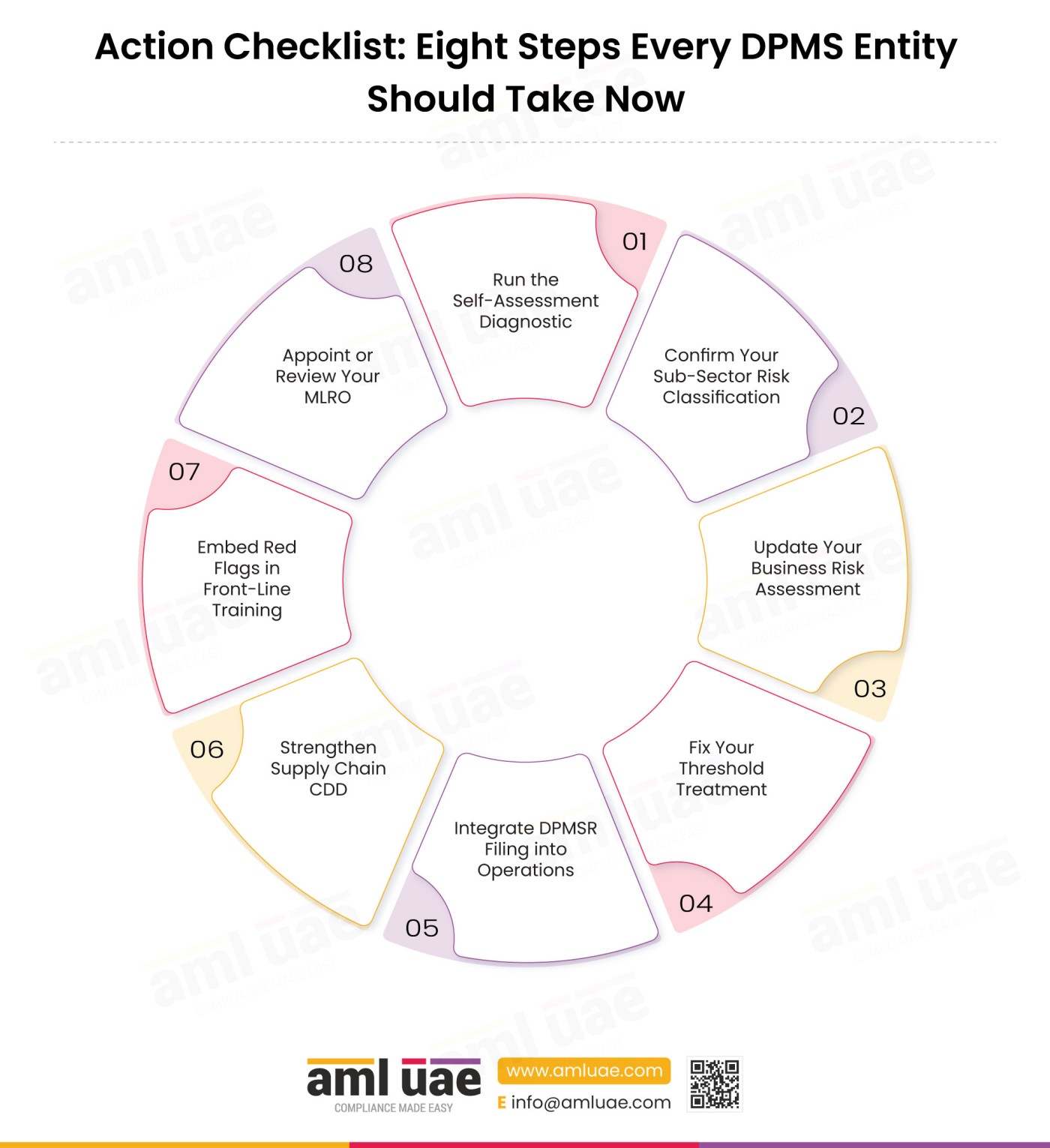
Step 1: Run the Self-Assessment Diagnostic
Use the RAG diagnostic table in Section 8 of this article to assess your current compliance posture across all eight obligations. Any RED finding requires immediate remediation. Document your results and assign ownership and timelines for remediation before your next supervisory examination.
Step 2: Confirm Your Sub-Sector Risk Classification
Identify which of the six sub-sectors in the sub-sector table applies to your operations and implement the corresponding controls. Bullion traders, refiners, and wholesale entities face the highest expectations and must apply origin verification, responsible sourcing documentation, and enhanced counterparty assessment as standard practice
Step 3: Update Your Business Risk Assessment
Incorporate the 2024 NRA medium-high residual risk rating and the MoET SRA findings on bullion, refinery, and wholesale subsectors into your BRA. Obtain formal senior management approval. Document the methodology used, the weights applied to risk factors, and the rationale for the risk ratings assigned to your customer and supplier base.
Step 4: Fix Your Threshold Treatment
If your entity currently applies CDD only at or above AED 55,000, revise your procedures immediately. Your policy must explicitly state that risk-based measures apply at all transaction values wherever risk indicators are present. Document the specific risk factors that trigger sub-threshold CDD in your sector context.
Step 5: Integrate DPMSR Filing into Operations
Confirm that your DPMSR filing process covers all three triggering circumstances, including the wire transfer trigger for company and entity transactions. Build the DPMSR trigger into your transaction processing workflow as an automatic step, not a compliance judgment call. Ensure filing is not conditional on the absence of red flags.
Step 6: Strengthen Supply Chain CDD
Map your position in the PMS supply chain and implement origin verification, KPCS checks, and counterparty due diligence proportionate to your stage and risk exposure. Specifically, compare declared origin against known production capabilities of the declared jurisdiction for every significant supply transaction. Document the comparison and retain the supporting documents.
Step 7: Embed Red Flags in Front-Line Training
Train all front-line staff on the Section 6 red flag indicators, specifically including TBML indicators, supplier behaviour flags, and proliferation financing red flags. Use scenario-based exercises that reflect the case studies in Section 7 of the guidance. Document all training delivered and record attendance.
Step 8: Appoint or Review Your MLRO
Ensure your Compliance Officer or MLRO has sector-specific DPMS knowledge, including familiarity with TBML typologies, KPCS requirements, responsible sourcing standards, and the UAE-specific reporting obligations for DPMSR, SAR, and STR. The guidance requires a qualified CO/MLRO with sector-specific knowledge and a sound understanding of regulatory obligations.
Ready to Build a MoET-Compliant AML Programme?
Get sector-specific support to align governance, controls, reporting, and training with the guidance.
Share via :
About the Author
Pathik Shah
FCA, CAMS, CISA, CS, DISA (ICAI), FAFP (ICAI)
Pathik is an ACAMS-certified AML consultant specialising in governance, risk, and compliance for regulated entities in the UAE. He brings over 28 years of experience, with 1,000+ hours of AML training and 200+ advisory engagements across DNFBPs, VASPs, and FIs. He supports businesses in aligning with AML/CFT requirements from the CBUAE, DFSA, MoET, MoJ, VARA, CMA, FSRA, and FATF. Known for translating complex regulations into audit-ready procedures, Pathik enables operational clarity and compliance readiness.

Reach Out to Pathik