



AML Regulations for DNFBPs in UAE
Published On: 04/24/2026
Protect your business with reliable and effective AML strategies with AML UAE.
Last Reviewed On: 07/21/2026 | Last Updated On: 07/21/2026
AT A GLANCE
- What a DNFBP is: A non-financial business or profession listed in Article 3 of Cabinet Resolution 134 of 2025, the Executive Regulations of Federal Decree Law No. 10 of 2025.
- Six DNFBP categories: Commercial gaming operators, real estate brokers and agents, dealers in precious metals and stones, lawyers/notaries/legal professionals, independent accountants and auditors, company and trust service providers, and any other businesses added by Supervisory Authority resolution.
- Federal AML statute: Federal Decree-Law No. 10 of 2025 (replacing FDL 20 of 2018) and Cabinet Resolution 134 of 2025.
- DPMS cash threshold: AED 55,000 threshold for single or linked cash transactions per Article 3(3) of CR 134/2025.
- Commercial gaming threshold: AED 11,000 single or linked financial transactions per Article 3(1) of CR 134/2025; gaming chips alone do not count.
- Supervisors: MoET for accountants, auditors, TCSPs, DPMS and real estate; MoJ for lawyers and notaries; GCGRA for commercial gaming; DFSA in DIFC; RA in ADGM.
- STR channel: All DNFBPs must report suspicious transactions immediately via the goAML portal of the UAE Financial Intelligence Unit per Article 18 of FDL 10/2025.
- Maximum administrative fine: AED 5,000,000 per violation under Article 17(1)(b) of FDL 10/2025; criminal penalties on top.
AML Regulations for DNFBPs in UAE
Quick Overview
AML regulations for DNFBPs in UAE are anchored in Federal Decree-Law No. (10) of 2025 on Anti-Money Laundering, Combating the Financing of Terrorism and Proliferation Financing and its Executive Regulations in Cabinet Resolution No. (134) of 2025. Article 3 of CR 134/2025 designates six categories of Designated Non-Financial Businesses and Professions (DNFBPs): commercial gaming operators, real estate brokers and agents, dealers in valuable metals and precious stones, lawyers/notaries/other legal professionals and independent accountants, company and trust service providers, and any other category added by Supervisory Authority resolution. DNFBP-wide guidance issued by the Ministry of Economy and Tourism applies alongside sector-specific instruments, while the Ministry of Justice supervises lawyers and the General Commercial Gaming Regulatory Authority (GCGRA) supervises licensed gaming activity.
This guide explains who qualifies as a DNFBP, the supervisory map across MoET, MoJ and GCGRA, the federal AML legal framework, the cross-sector guidance issued by the Executive Office for Control and Non-Proliferation (EOCN) and the UAE Financial Intelligence Unit (FIU), and the dedicated guides for each DNFBP sector. Common AML obligations are summarised next, with sector-specific depth in the linked child pages.
DEFINITION
A DNFBP is any business or profession listed in Article 3 of Cabinet Resolution 134 of 2025 that, although not a financial institution, is exposed to money-laundering, terrorist-financing or proliferation-financing risk and must therefore meet the same federal AML statute, customer due diligence rules, beneficial-owner reporting and goAML suspicious-transaction reporting obligations as financial institutions.
What Is a DNFBP Under UAE AML Law?
A DNFBP is a non-financial business or profession that, by reason of the activities it carries out, is brought within the federal AML/CFT/CPF perimeter. Article 1 of Federal Decree-Law No. (10) of 2025 defines DNFBPs by reference to Article 3 of its Executive Regulations. Article 3 of Cabinet Resolution No. (134) of 2025 sets out six categories that qualify as DNFBPs in the UAE.
The six categories in Article 3 of Cabinet Resolution 134 of 2025.
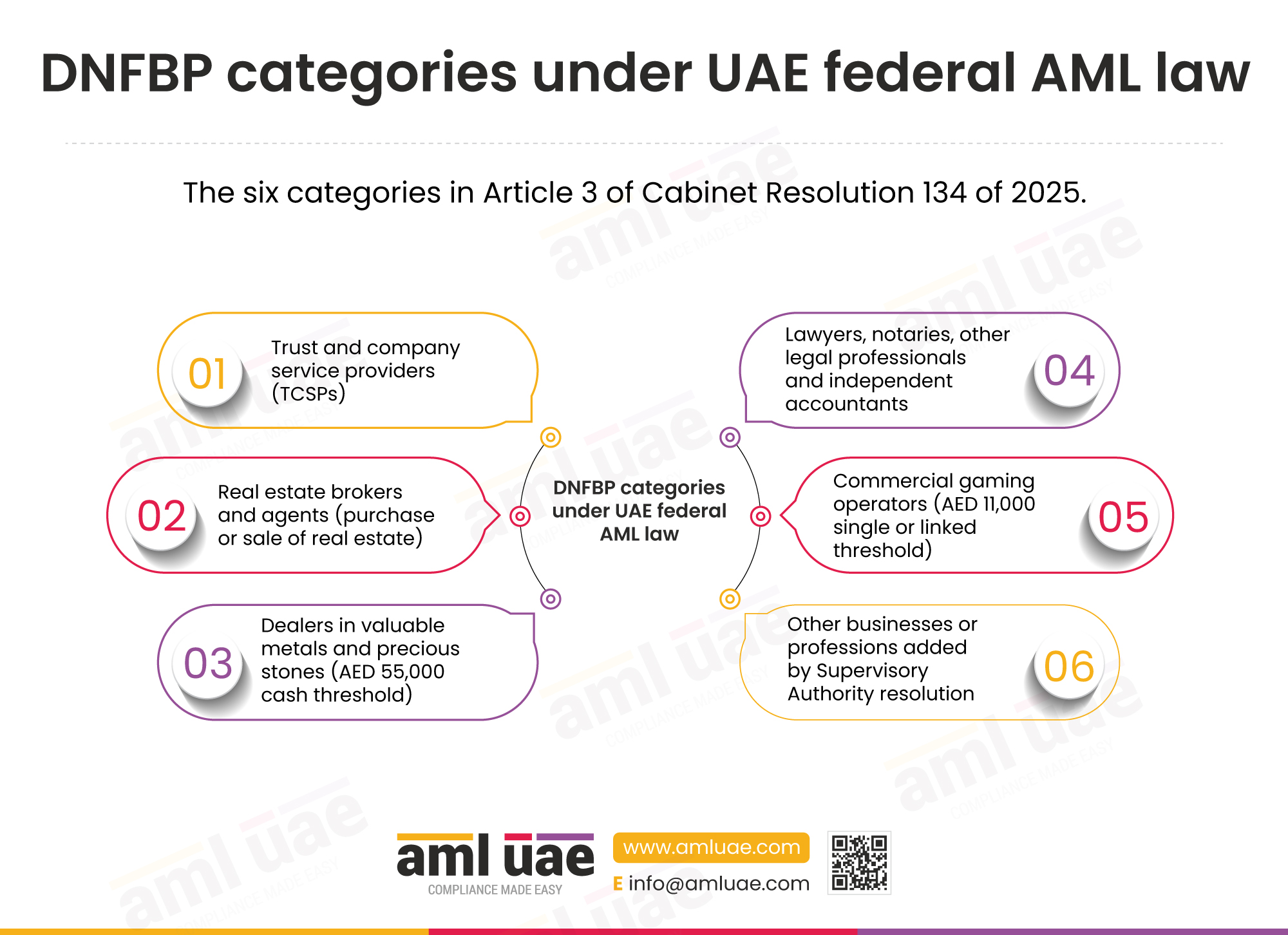
Company and trust service providers (TCSPs)
Per Article 3(5) of CR 134/2025, TCSPs are DNFBPs when, on behalf of customers, they: act as agent in the incorporation of legal persons; act as a director or secretary, partner or in a similar position; provide a registered office or correspondence address; act as trustee of an express trust or in an equivalent function for another legal arrangement; or act as a nominee shareholder.
Real estate brokers and agents
Per Article 3(2) of CR 134/2025, real estate brokers and agents are DNFBPs when concluding transactions or settlements on behalf of customers in relation to the purchase or sale of real estate. The UAE National Risk Assessment 2024 rates the sector as having a high residual ML risk, given high-value cash dealings and the use of third parties.
Dealers in valuable metals and precious stones (DPMS)
Per Article 3(3) of CR 134/2025, DPMS are DNFBPs when carrying out any single cash transaction or linked transactions equal to or exceeding AED 55,000. The NRA 2024 rates the sector Medium-High residual ML risk on the mainland and in commercial free zones, citing cash intensity and de-risking by some financial institutions.
Lawyers, notaries, other legal professionals and independent accountants
Per Article 3(4) of CR 134/2025, lawyers, notaries, other independent legal professionals and independent accountants are DNFBPs when they prepare, conduct or execute financial transactions on behalf of customers in relation to: (a) buying and selling real estate; (b) managing customer funds; (c) managing bank, savings or securities accounts; (d) organising contributions for the establishment, operation or management of companies; or (e) establishing, operating or managing legal persons or legal arrangements, or selling or purchasing commercial entities.
Commercial gaming operators
Per Article 3(1) of CR 134/2025, commercial gaming operators are DNFBPs when they conduct a single financial transaction or several linked transactions equal to or exceeding AED 11,000, including gaming on board vessels, halls and internet gaming licensed by the General Commercial Gaming Regulatory Authority. A transaction limited to gaming chips or instruments is not a financial transaction for this purpose.
Catch-all category
Per Article 3(6) of CR 134/2025, any other businesses or professions may be brought within the DNFBP perimeter by a resolution issued by the Supervisory Authority in coordination with the National Committee.
Who supervises each DNFBP sector?
Supervisory responsibility is split across three federal authorities and two financial-free-zone authorities:
| DNFBP sector | Mainland & commercial FZ | ADGM | DIFC |
|---|---|---|---|
| Real estate brokers and agents | MoET | RA | DFSA |
| Dealers in precious metals and stones (DPMS) | MoET | RA | DFSA |
| Company and trust service providers (TCSPs) | MoET | RA | DFSA |
| Independent accountants and auditors | MoET | RA | DFSA |
| Lawyers, notaries and legal professionals | MoJ | RA | DFSA |
| Commercial gaming operators | GCGRA | NA | NA |
| Federal AML law applies | Yes (FDL 10/2025) | Yes (FDL 10/2025) | Yes (FDL 10/2025) |
ADGM AND DIFC READERS
Federal Decree-Law 10 of 2025 applies across the entire UAE, including the Abu Dhabi Global Market and the Dubai International Financial Centre. The difference is operational supervision: DNFBPs in DIFC follow DFSA rules and DNFBPs in ADGM follow FSRA rules. For ADGM-specific or DIFC-specific guidance see our jurisdiction pages.
Need help confirming whether your business is a DNFBP?
AML UAE assists professional firms across real estate, gold and jewellery, accountancy, legal practice and trust services to confirm scope and build a compliant AML programme.
Core AML obligations for DNFBPs
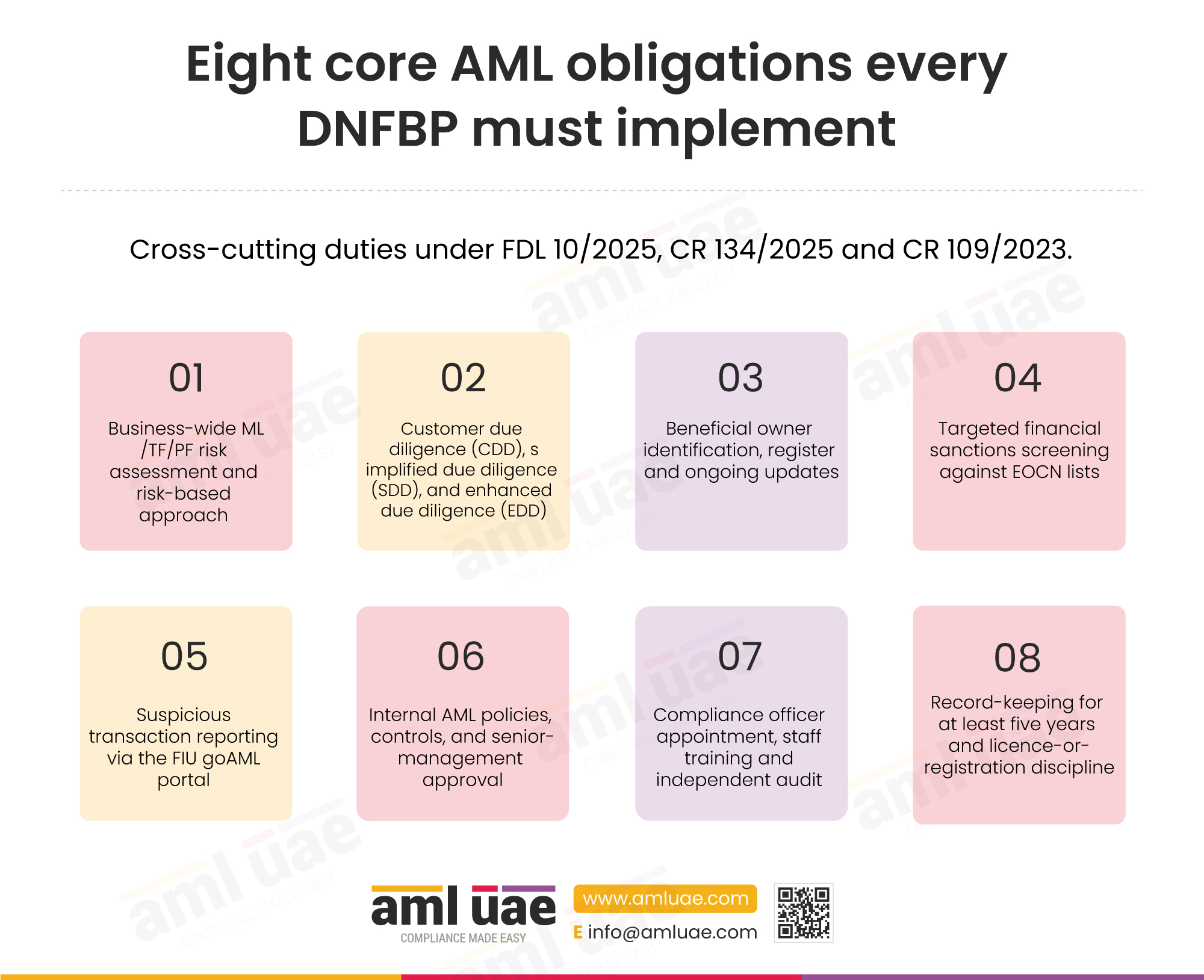
Every DNFBP, regardless of sector, must implement the same core obligations set by Articles 18 to 20 of Federal Decree-Law No. (10) of 2025, as expanded by Cabinet Resolution No. (134) of 2025, Cabinet Resolution No. (109) of 2023 on Beneficial Owner Procedures, and the September 2025 AML/CFT Guidelines for DNFBPs. These obligations apply alongside any sector-specific rules and are summarised below.
Cross-cutting duties under FDL 10/2025, CR 134/2025 and CR 109/2023.
Risk-based approach and business-wide risk assessment
Article 19(1)(a) of FDL 10/2025 requires DNFBPs to identify, understand, manage, assess, document and continuously update ML/TF/PF risks in their business, in line with the National Risk Assessment. Article 5 of CR 134/2025 obliges entities to keep this assessment current and to make it available to the Supervisory Authority on request. The Ministry of Economy and Tourism’s Implementation Guide for DNFBPs on Customer Risk-Assessment (CRA), November 2024, sets out the methodology in detail.
Article 19(1)(b) of FDL 10/2025 requires DNFBPs to apply CDD measures and continuous monitoring, with scope set by the multiple risk dimensions and the NRA outcomes. Articles 6 to 17 of CR 134/2025 expand the rules: identification and verification of the customer, beneficial owner identification, ongoing monitoring, EDD for high-risk situations including PEPs, and SDD only where the documented risk is genuinely low. The Implementation Guide for DNFBPs on Customer Due Diligence (CDD), November 2024 and Circular No. (6) of 2025 on Risk-Based CDD with a Focus on Simplified Due Diligence guide application across DNFBP sectors.
Beneficial owner identification and reporting
Articles 4 to 8 of Cabinet Resolution No. (109) of 2023 requires legal persons licensed or registered in the UAE (excluding wholly Government-owned companies and entities in financial free zones) to disclose their real beneficiary information to the Registrar, maintain a Real Beneficiary Register and a Partners or Shareholders Register, and notify changes within 15 days. Failures attract administrative fines under Cabinet Resolution No. (132) of 2023, with a three-strike escalation that can include suspension of the commercial licence and closure of the commercial store.
Targeted financial sanctions (TFS) screening
Article 19(1)(e) of FDL 10/2025 requires DNFBPs to implement, without delay, the instructions of the Executive Office for Control and Non-Proliferation (EOCN) and other competent authorities on TFS. Cabinet Decision No. (74) of 2020 governs the UAE Local Terrorist List and the implementation of UN Security Council resolutions on terrorism and the proliferation of weapons of mass destruction. DNFBPs must subscribe to the EOCN’s Notification Alert System (NAS) and the Automatic Reporting System (ARS), screen customers and counterparties pre-transaction and on an ongoing basis, and freeze and report matches without delay. The duty to screen and act applies before any transaction is executed.
Suspicious transaction reporting via goAML
Article 19(1)(d) of FDL 10/2025 requires DNFBPs to establish internal policies, controls and procedures approved by senior management, applied to all branches and majority-owned subsidiaries, and reviewed continuously. Section 7 of the September 2025 AML/CFT Guidelines for DNFBPs prescribes a designated Compliance Officer, staff training and screening, group oversight, an independent audit function and senior-management responsibility, with proportionality for resource-limited DNFBPs.
Internal policies, governance and training
Article 18(1) of FDL 10/2025 requires DNFBPs that suspect, or have reasonable grounds to suspect, that a transaction or funds are linked to ML/TF/PF to notify the FIU without delay through the goAML portal with all available data. Article 18(2) carves out a narrow professional-secrecy exception for lawyers, notaries, other legal professionals and independent legal auditors where the information was obtained under circumstances of professional secrecy. Tipping off the customer or third parties is prohibited under Article 24 and carries criminal penalties under Article 29 (imprisonment and a minimum AED 50,000 fine).
Record-keeping and licensing
Article 19(1)(f) of FDL 10/2025 obliges DNFBPs to retain transaction records, CDD documentation and supporting data and ensure their immediate availability to competent authorities. Section 11 of the September 2025 DNFBP Guidelines confirms a minimum five-year retention period. Article 20 of FDL 10/2025 prohibits any natural or legal person from carrying on DNFBP activities without a licence, registration or enrolment from the competent authority or relevant Supervisory Authority; breach is a criminal offence under Article 32, punishable by imprisonment and a fine of AED 200,000 to AED 10,000,000.
Penalties for non-compliance
Article 17 of FDL 10/2025 empowers Supervisory Authorities to impose administrative penalties on DNFBPs ranging from a written warning to a fine of AED 10,000 to AED 5,000,000 per violation, restriction of board powers, suspension of personnel, suspension or restriction of activity and revocation of licence. Recurrence within one year may attract incremental fines, and penalties may be published. The Unified List of Violations and Administrative Fines under Cabinet Resolution No. (71) of 2024 sets the violation-by-violation tariff for DNFBPs supervised by MoET and MoJ. Criminal penalties under Articles 26, 28, 29, 32, 33 and 35 of FDL 10/2025 apply on top, with imprisonment and fines from AED 10,000 up to AED 100,000,000 for legal persons convicted of ML, TF or PF.
Build a defensible AML programme that meets all eight core obligations
Our team designs and operates end-to-end AML programmes for UAE DNFBPs, from CDD and goAML setup to staff training, risk assessment and supervisory inspection readiness.
AML Legal Framework Applicable to DNFBPs in UAE
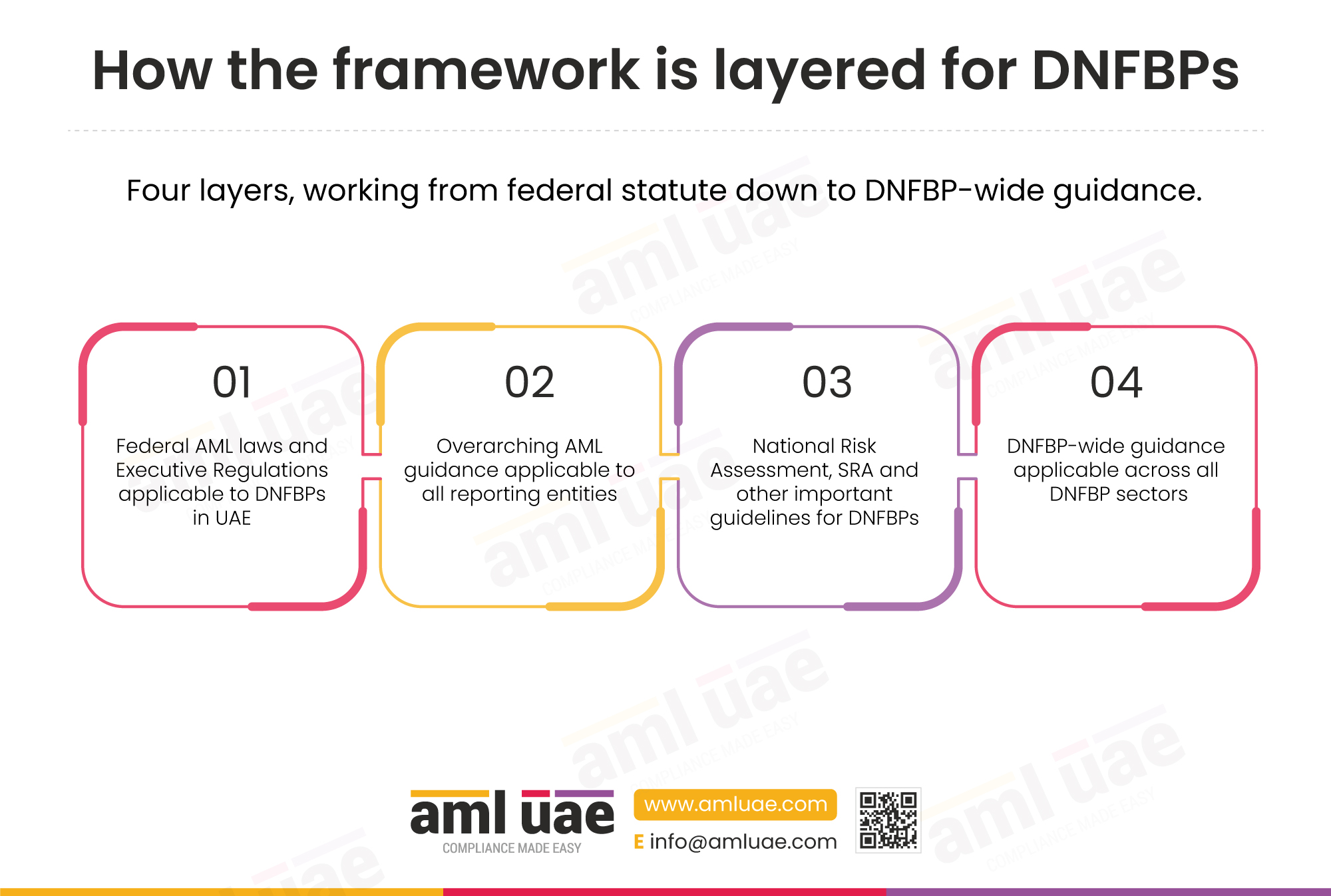
The legal and regulatory framework that governs DNFBPs in the UAE has four layers: (1) the federal AML statute and its executive regulations; (2) overarching guidance issued by the Executive Office for Control and Non-Proliferation (EOCN), the FIU and the Anti-Money Laundering Department of the Ministry of Foreign Affairs and International Cooperation; (3) the National Risk Assessment and supervisory risk reports; and (4) DNFBP-wide guidance and circulars issued by the Ministry of Economy and Tourism (MoET).
Four layers, working from federal statute down to DNFBP-wide guidance.
Federal AML Laws and Executive Regulations Applicable to DNFBPs in UAE
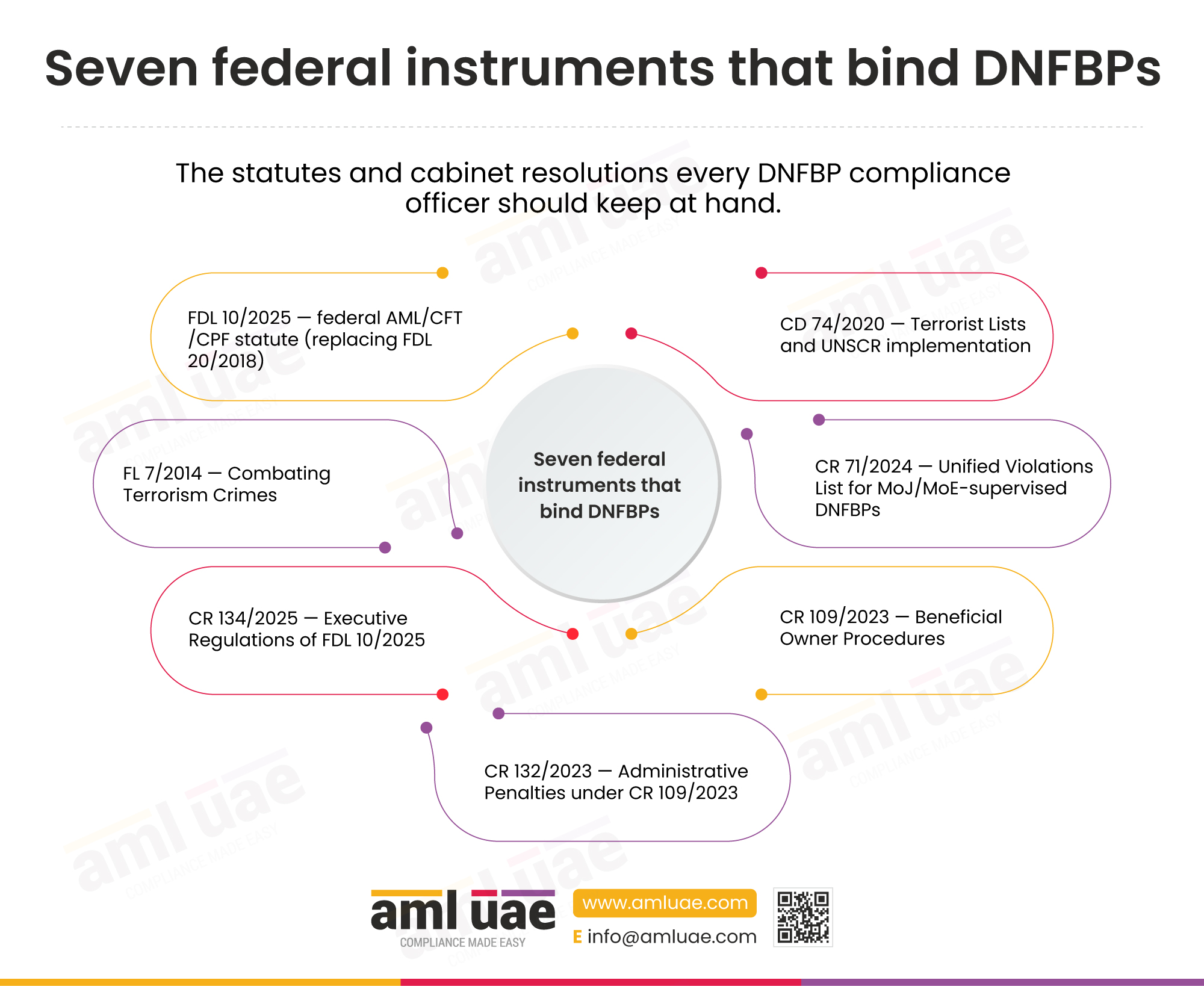
The federal layer sets the binding legal duties for every DNFBP. There are seven federal instruments to know.
The statutes and cabinet resolutions every DNFBP compliance officer should keep at hand.
Seven federal instruments that bind DNFBPs
1. Federal Decree by Law No. (10) of 2025 Regarding Anti-Money Laundering, and Combating the Financing of Terrorism and Proliferation Financing
FDL 10/2025 is the supreme AML statute in the UAE. It defines DNFBPs (Article 1 read with Article 3 of CR 134/2025), prescribes core obligations (Articles 18 to 20), grants Supervisory Authorities supervisory and inspection powers (Article 16), sets administrative penalties up to AED 5,000,000 per violation (Article 17), and prescribes criminal penalties for ML, TF and PF (Articles 26 to 35). Article 41 expressly repeals Federal Decree-Law No. (20) of 2018; existing executive regulations, resolutions and circulars issued under FDL 20/2018 remain effective only insofar as they do not conflict with FDL 10/2025, until superseded.
2. Federal Law No. (7) of 2014 Combating Terrorism Crimes
FL 7/2014 defines terrorist acts, terrorist purposes, terrorist organisations and terrorist offences, and is the predicate criminal regime cross-referenced by FDL 10/2025 for the financing of terrorism. DNFBPs encountering customers, transactions or counterparties on UAE Local Terrorist Lists must apply CD 74/2020 measures and report immediately to the FIU.
3. Cabinet Resolution No. (134) of 2025 Concerning the Executive Regulations of Federal Decree-Law No. (10) of 2025
CR 134/2025 is the operative rulebook. Article 3 designates the six DNFBP categories and the gaming-AED 11,000 and DPMS-AED 55,000 thresholds. Articles 5 to 17 set the rules for risk assessment, CDD, beneficial owner identification, EDD, PEPs, ongoing monitoring, reliance on third parties, and the conditions for SDD. Articles 18 to 32 cover STR procedures, group-wide AML programmes, training, audit, record-keeping and the conditions on TFS implementation.
4. Cabinet Decision No. (74) of 2020 Regarding Terrorism Lists Regulation and Implementation of UN Security Council Resolutions
CD 74/2020 governs the UAE Local Terrorist List and the operational implementation of UNSCR 1267 / 1989, 1988, 1718 (DPRK) and other targeted sanctions resolutions. DNFBPs must screen against the consolidated lists communicated by the EOCN, freeze without delay any matched funds, and report matches to the EOCN and the FIU.
5. Cabinet Resolution No. (71) of 2024 Regulating Violations and Administrative Penalties for DNFBPs Subject to MoJ and MoE Supervision
CR 71/2024 is the Unified List of Violations and Administrative Fines for DNFBPs supervised by the Ministry of Justice and the Ministry of Economy. It replaces Cabinet Resolution No. (16) of 2021. The schedule sets specific fine ranges for failures of internal policies, CDD, beneficial owner procedures, sanctions screening, STR filing and record-keeping, with the right to double a fine on repeat violation (Article 5(2)).
6. Cabinet Resolution No. (109) of 2023 On Regulating the Beneficial Owner Procedures
CR 109/2023 sets the federal beneficial owner regime that applies to legal persons licensed or registered in the UAE (excluding wholly Government-owned companies and entities in financial free zones). Article 5 sets the test for who is a real beneficiary (25 percent ownership or ultimate effective control) and Articles 6 to 8 prescribe the Real Beneficiary Register, the Partners or Shareholders Register and the obligation to notify changes within 15 days.
7. Cabinet Resolution No. (132) of 2023 Concerning Administrative Penalties under CR 109/2023
CR 132/2023 attaches a tariff of administrative fines to violations of CR 109/2023, with an annexed schedule of fine amounts and a three-strike escalation that empowers the Registrar to suspend the commercial licence and close the commercial store of a violating legal person until the violation is corrected and the fine paid (Article 3).
AML Guidance Applicable to All Reporting Entities
These EOCN, FIU and AMLD publications are written for all reporting entities (FIs, DNFBPs and VASPs) and bind DNFBPs as a matter of supervisory expectation. There are 13 documents to be aware of.
Cross-sector EOCN, FIU and AMLD instruments that DNFBPs must apply.
Thirteen overarching guidance publications
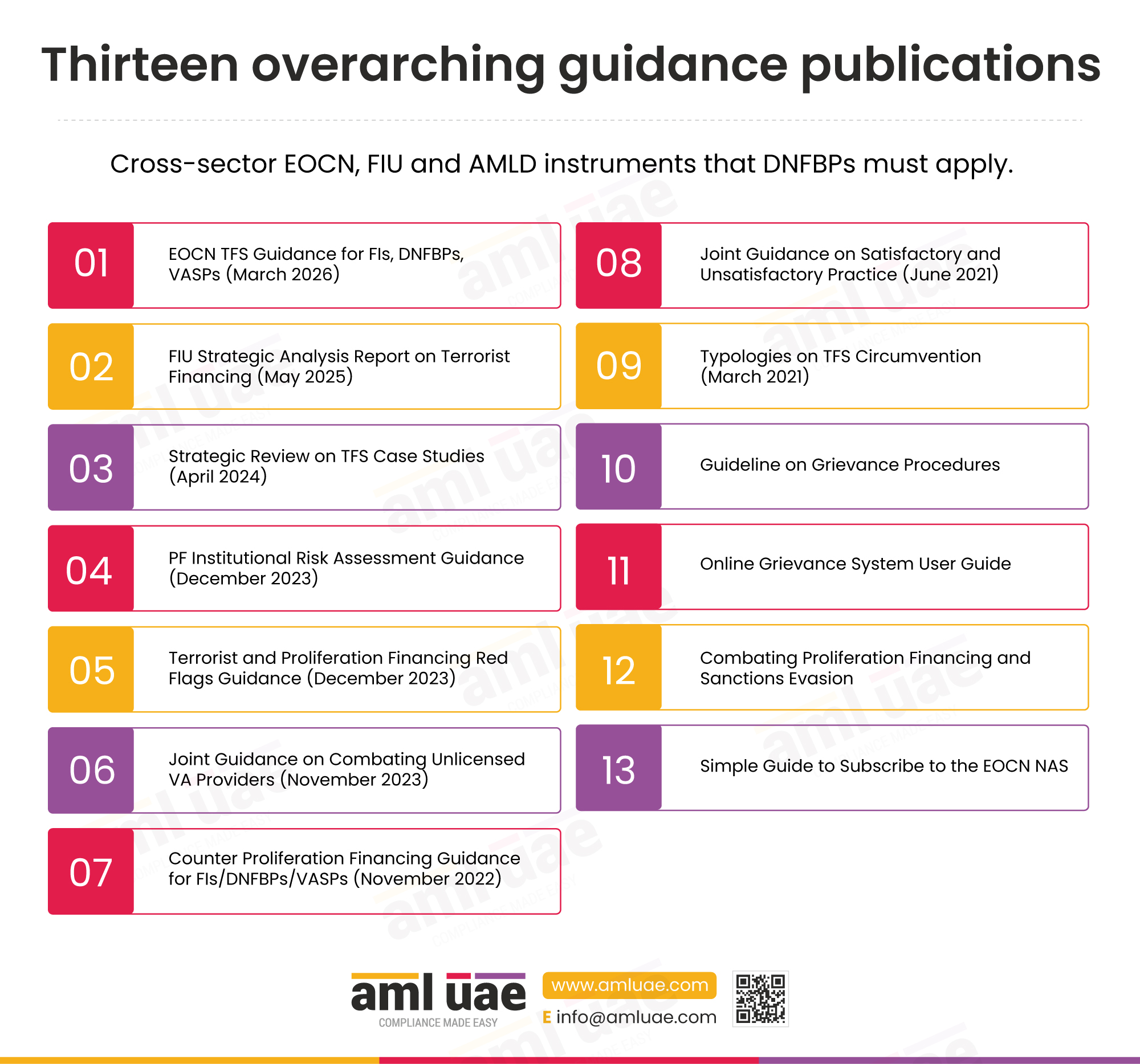
1. Guidance on Targeted Financial Sanctions for FIs, DNFBPs and VASPs (EOCN, last amended March 2026)
The EOCN’s TFS Guidance is the principal operational manual for sanctions compliance. It prescribes the duty to subscribe to the NAS, the workflow for screening and freezing, the immediate reporting obligation to the EOCN and the FIU, treatment of partial matches and false positives, communication with customers under the no-tipping-off rule, and unfreezing on de-listing. DNFBPs must align internal policies, screening tools and CDD records to this guidance
2. FIU Strategic Analysis Report on Terrorist Financing — May 2025
The UAEFIU’s Strategic Analysis Report on terrorist financing typologies and facilitators sets out current TF typologies, indicator clusters and case observations relevant to UAE DNFBPs. It informs DNFBP risk-assessment scenarios and STR-quality expectations.
3. Strategic Review on Targeted Financial Sanctions Case Studies (EOCN, April 2024)
The Strategic Review for the private sector (IEC-SR 01 22v2) presents anonymised TFS case studies covering 2019 to 2021, drawing common breakdown points and supervisory expectations. DNFBPs should benchmark internal screening practice against the case studies and self-assess against satisfactory and unsatisfactory practice indicators.
4. Proliferation Finance Institutional Risk Assessment Guidance for FIs, DNFBPs and VASPs (EOCN, December 2023)
This guidance walks DNFBPs through the steps of an institutional PF risk assessment: identifying inherent PF risk (customer, geography, product, channel), assessing residual risk after mitigation, documenting controls and reporting findings. It supports the obligations under FDL 10/2025 Article 19(1)(a) and CR 134/2025 Article 5.
5. Terrorist and Proliferation Financing Red Flags Guidance (EOCN, updated December 2023)
This document lists indicators for TF and PF specific to the UAE economy, including red flags relevant to DNFBP touchpoints such as cash-intensive trade, shell companies, dual-use goods and high-risk geographies. It is the reference list for tagging customer behaviours during CDD and ongoing monitoring.
6. Joint Guidance on Combating the Use of Unlicensed Virtual Asset Providers in the UAE (CBUAE/EOCN/FIU, November 2023)
Although directed at FIs and VASPs, this guidance binds DNFBPs that interact with virtual-asset payments. It explains how to detect interactions with unlicensed VA providers, the duty to refuse such transactions, and the STR-filing expectations.
7. Guidance on Counter Proliferation Financing for FIs, DNFBPs and VASPs (EOCN, November 2022)
The original CPF Guidance (PF.01.22) sets the foundational definitions of WMD, PF and dual-use goods and prescribes minimum CPF measures, including BO transparency, sanctions screening and trade-financing red flags.
8. Joint Guidance on Satisfactory and Unsatisfactory Practice (June 2021)
Issued jointly by the AML/CFT Supervisory Authorities, this guidance illustrates supervisory expectations through paired examples of satisfactory and unsatisfactory practice across CDD, screening, STR filing, governance and training. DNFBPs benefit by mapping internal procedures against the satisfactory column.
9. Typologies on the Circumvention of Targeted Sanctions against Terrorism and the Proliferation of Weapons of Mass Destruction (March 2021)
The TFS Typology Paper documents common circumvention techniques, including the use of front companies, nominee shareholders and trade-based laundering. DNFBPs use it to design typology-based monitoring rules and EDD checklists.
10. Guideline on Grievance Procedures (EOCN)
The Guideline on Grievance Procedures sets out the channel and timing for designated persons or third parties to challenge a TFS designation or sanctions match. DNFBPs should be ready to assist customers procedurally without breaching the no-tipping-off rules.
11. Online Grievance System User Guide (EOCN)
The User Guide is the operational manual for filing a TFS grievance through the EOCN’s online portal. DNFBPs should retain the link in their compliance manuals for customers who wish to challenge a designation.
12. Combating Proliferation Financing and Sanctions Evasion (EOCN)
This awareness publication summarises WMD definitions, PF mechanics and sanctions-evasion techniques. It is widely used in DNFBP staff training programmes.
13. Simple Guide to Subscribe to the EOCN Notification Alert System (NAS)
The Simple Guide explains how to register for the EOCN NAS to receive UN and Local list updates via email. NAS registration is the front-line operational requirement for sanctions compliance and is the practical means of complying with the immediacy duty under FDL 10/2025 Article 19(1)(e).
NRA, SRA, and Other Important Guidelines Applicable to DNFBPs Sector
This layer is the national risk evidence base. DNFBPs must align their business-wide risk assessments with NRA findings.
UAE ML/TF National Risk Assessment — 2024
The UAE National ML/TF Risk Assessment 2024 (issued by the National Anti-Money Laundering and Combatting Financing of Terrorism Committee) sets the benchmark for residual ML/TF/PF risk by sector. For DNFBPs, the NRA assesses real estate as High residual ML risk, DPMS as Medium-High, TCSPs as Medium, accounting and audit as Medium-Low, and the legal-professionals sector as Medium-Low. It also notes the establishment of the General Commercial Gaming Regulatory Authority (GCGRA) in September 2023. Every DNFBP must read the NRA findings into its own business-wide risk assessment, as required by Circular No. (4) of 2025 and the November 2024 Implementation Guide on CRA.
DNFBP Sector-Specific Guidance Applicable Across All DNFBP Sectors
These ten MoET publications form the DNFBP-wide baseline that every DNFBP, regardless of sector, must observe alongside any sector-specific instruments.
Ten DNFBP-wide MoET publications
MoET circulars and implementation guides that supplement the federal statute.
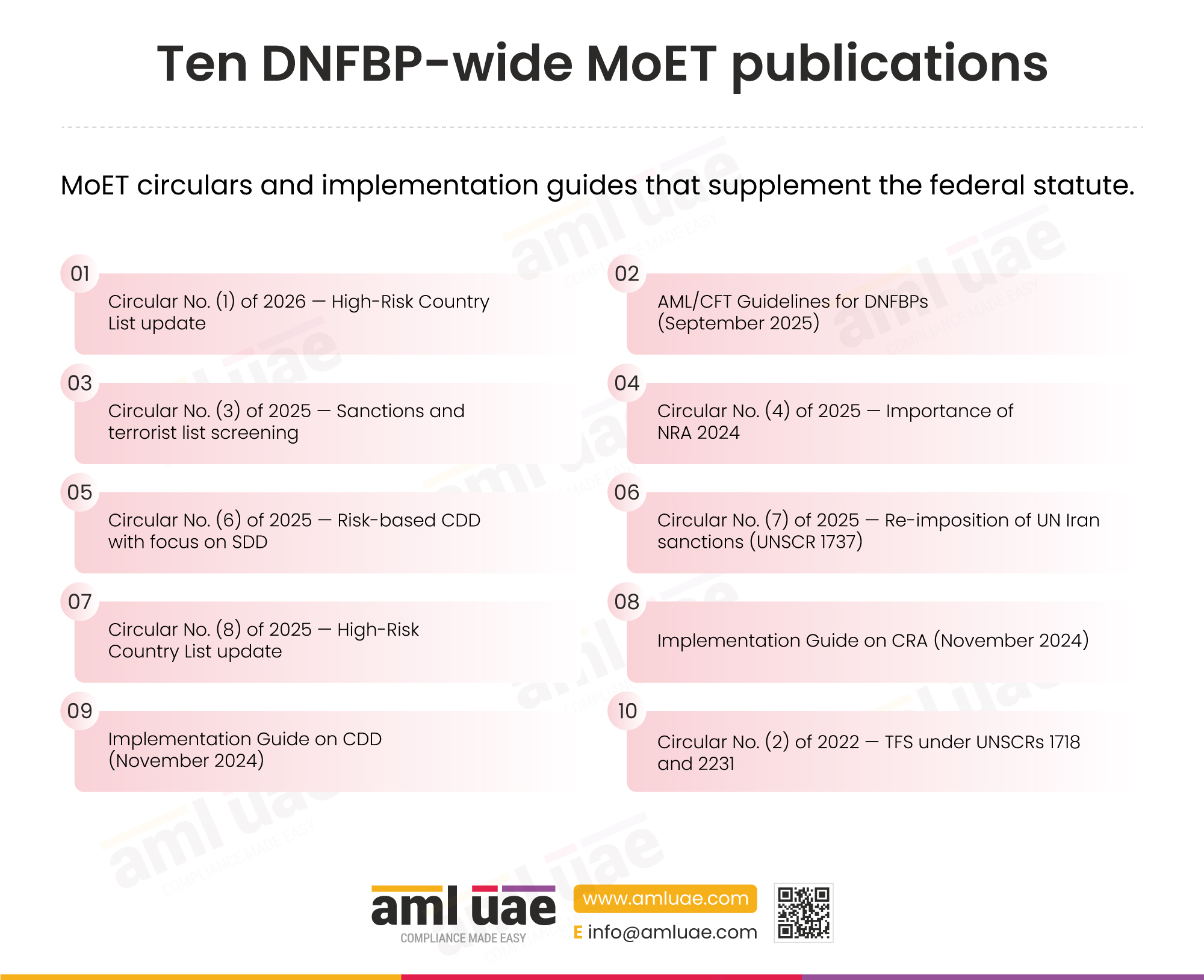
1. Circular No. (1) of 2026 on Updating the Lists of High-Risk Countries, Countries Subject to Increased Monitoring, and Related Measures
Issued 11 March 2026 (MOET/AML/001/2026), this circular updates the High-Risk Country and Increased-Monitoring lists used by DNFBPs in CDD and EDD decision-making, and prescribes the related counter-measures. DNFBPs must update screening rules and country-risk matrices accordingly.
2. AML/CFT Guidelines for Designated Non-Financial Businesses and Professions — September 2025
The September 2025 DNFBP Guidelines (76 pages) are the consolidated MoET handbook for DNFBPs. They cover the legislative and regulatory framework, statutory obligations, governance, risk-based approach, business-wide risk assessment, CDD/SDD/EDD, ongoing monitoring, STR procedures, record-keeping and the supervisory map (MoET, MoJ, DFSA, FSRA). The Guidelines apply alongside any sector-specific MoET supplemental guidance.
3. Circular No. (3) of 2025 on Emphasising the Importance of Sanctions and Terrorist List Screening
Issued 19 March 2025 (MOEC/AML/003/2025), this circular re-emphasises the duty to screen all customers and counterparties against UN, UAE and other applicable sanctions lists in real time, with documented evidence of screening at onboarding and on an ongoing basis.
4. Circular No. (4) of 2025 on Understanding the Importance of the UAE 2024 National Risk Assessment
Issued 9 June 2025 (MOEC/AML/004/2025), this circular tells DNFBPs how to align internal business-wide risk assessments with the 2024 NRA findings. It is supplemented by the MoE’s NRA 2024 Practical Guide for DNFBPs.
5. Circular No. (6) of 2025 on Emphasising the Implementation of Risk-Based Customer Due Diligence Measures (with a Focus on Simplified Due Diligence)
Issued 5 August 2025 (MOET/AML/6/2025), this circular reinforces the conditions on SDD: SDD is permitted only where the documented risk is genuinely low and may not be applied where TFS, sanctions or higher-risk indicators are present. It also reaffirms that EDD is mandatory for high-risk customers, PEPs and high-risk jurisdictions.
6. Circular No. (7) of 2025 Regarding the Re-Imposition of United Nations Sanctions Related to Iran Pursuant to UNSCR 1737 (2006) and Subsequent Resolutions
Issued 19 December 2025 (MOET/AML/007/2025), this circular communicates the re-imposition of UN sanctions related to Iran, with operational guidance on screening, freezing and reporting. DNFBPs must reassess Iran-linked customers, beneficial owners and counterparties immediately.
7. Circular No. (8) of 2025 on Updating the Lists of High-Risk Countries, Countries Subject to Increased Monitoring, and Related Measures
Issued 25 December 2025 (MOET/AML/008/2025), this circular updates the high-risk country list and the increased-monitoring list communicated to DNFBPs, and prescribes the related counter-measures to be applied in CDD and EDD.
8. Implementation Guide for DNFBPs on Customer Risk Assessment (CRA) — November 2024
This MoE Implementation Guide on CRA (Version 0.3.1.1) sets the methodology for assessing client, geographic, product, channel and transaction risk. It is the practical companion to FDL 10/2025 Article 19(1)(a) and CR 134/2025 Article 5, and must be read with the September 2025 DNFBP Guidelines.
9. Implementation Guide for DNFBPs on Customer Due Diligence (CDD) — November 2024
This MoE Implementation Guide on CDD (Version 0.3.2.1) explains how DNFBPs apply CDD, SDD and EDD measures, including the KYC stage, identification and verification of natural and legal persons, identification of beneficial owners and ongoing monitoring. It supports CR 134/2025 Articles 6 to 17.
10. Circular No. (2) of 2022 regarding Implementation of Targeted Financial Sanctions (TFS) on UNSCRs 1718 (2006) and 2231 (2015)
Issued 31 March 2022, this circular sets the TFS implementation rules for the UNSCR 1718 (DPRK) and UNSCR 2231 (Iran nuclear) regimes. Although issued under FDL 20/2018, it remains in force pursuant to the saving in Article 41(3) of FDL 10/2025 insofar as it does not conflict with FDL 10/2025.
Map your DNFBP obligations to the right circular and guideline
AML UAE maintains a current matrix of every DNFBP obligation against its source instrument and its supervisor. We translate this into your firm's policies, procedures and inspection-readiness pack.
DNFBP Sector Guides
Each DNFBP sector has its own dedicated guide on amluae.com. The cards below summarise the scope and supervisor; click through for the full sector article.
One card per DNFBP sector, with the supervising authority noted.
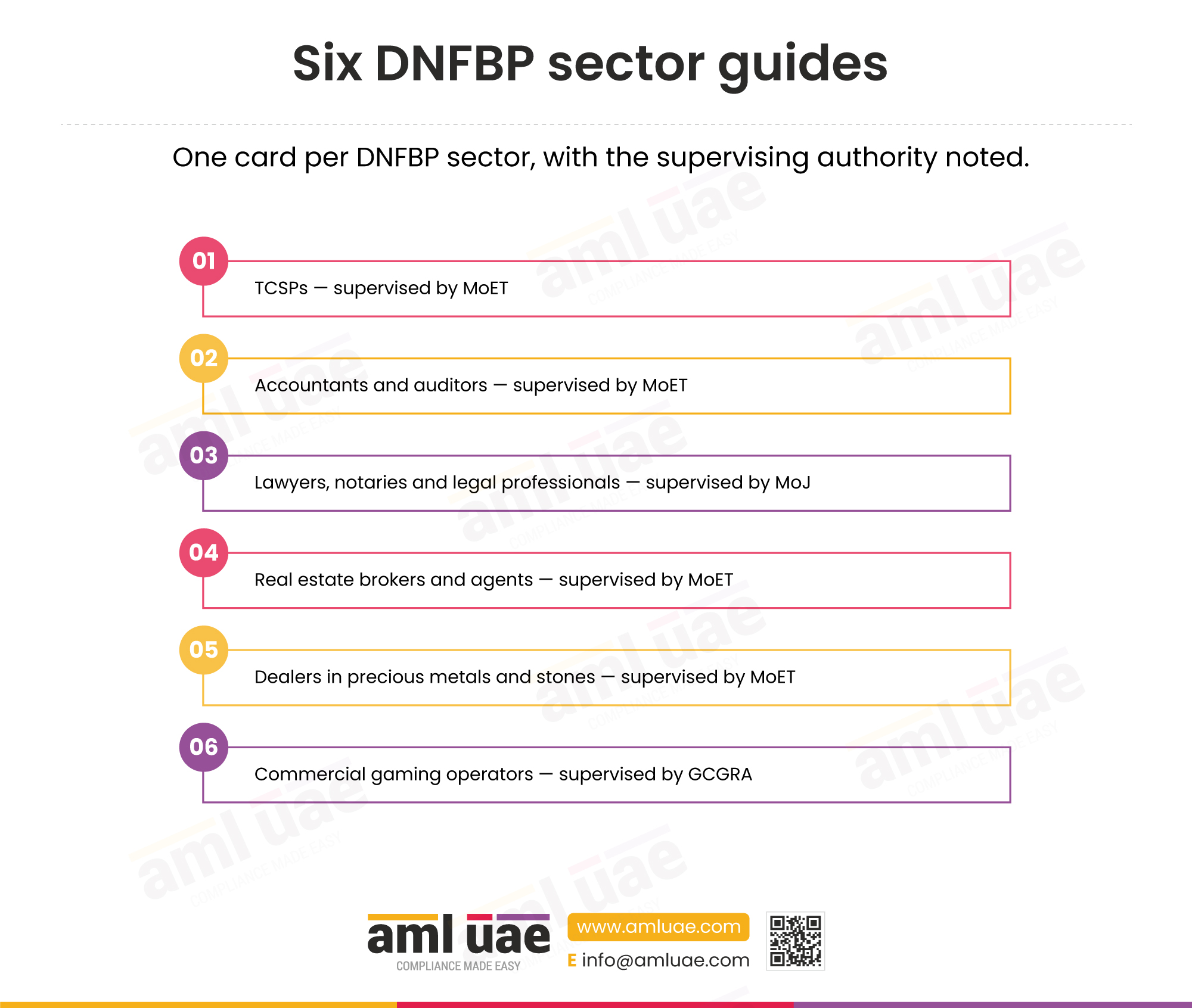
MoET Circular No. (4) of 2021
Supervisor: Ministry of Economy and Tourism (MoET). Company and trust service providers fall within DNFBPs under Article 3(5) of CR 134/2025 when they incorporate legal persons, act as directors or secretaries, provide a registered office, act as trustees of an express trust or act as nominee shareholders for customers.
Read the full guide: AML regulations for TCSPs in UAE.
AML Regulations for Accountants and Auditors in UAE
Supervisor: Ministry of Economy and Tourism (MoET). Independent accountants and auditors are DNFBPs under Article 3(4) of CR 134/2025 when they prepare, conduct or execute financial transactions for a customer in relation to real estate, fund management, account management, company contributions or the establishment, operation or sale of legal persons.
Read the full guide: AML regulations for accountants and auditors in UAE.
AML Regulations for Lawyers, Notaries, and Other Legal Professionals in UAE
Supervisor: Ministry of Justice (MoJ). Lawyers, notaries and other independent legal professionals are DNFBPs under Article 3(4) of CR 134/2025 for the same five trigger activities, with a narrow professional-secrecy carve-out from STR filing under Article 18(2) of FDL 10/2025; MoJ supervises this sector on the mainland.
Read the full guide: AML regulations for lawyers, notaries and legal professionals in UAE.
AML Regulations for Real Estate Agents and Brokers in UAE
Supervisor: Ministry of Economy and Tourism (MoET). Real estate brokers and agents are DNFBPs under Article 3(2) of CR 134/2025 when they conclude transactions or settlements for a customer in relation to the purchase or sale of real estate; the NRA 2024 rates this sector High residual ML risk on the mainland and in commercial free zones.
Read the full guide: AML regulations for real estate agents in UAE.
AML Regulations for Dealers in Precious Metals and Stones (DPMS) in UAE
Supervisor: Ministry of Economy and Tourism (MoET). Dealers in valuable metals and precious stones are DNFBPs under Article 3(3) of CR 134/2025 when carrying out single or linked cash transactions equal to or exceeding AED 55,000; the NRA 2024 rates the sector Medium-High residual ML risk.
Read the full guide: AML regulations for DPMS in UAE.
AML Regulations for Commercial Gaming Operators in UAE
Supervisor: General Commercial Gaming Regulatory Authority (GCGRA). Commercial gaming operators are DNFBPs under Article 3(1) of CR 134/2025 for single or linked financial transactions equal to or exceeding AED 11,000 (gaming chips alone do not count); GCGRA was established in September 2023 and licenses, regulates and supervises commercial gaming activity in the UAE.
Read the full guide: AML regulations for commercial gaming operators in UAE.
Conclusion
AML regulations for DNFBPs in UAE are anchored in a single federal statute, FDL 10/2025, supplemented by Cabinet Resolution 134/2025 and a layered set of overarching guidance, the National Risk Assessment, and DNFBP-wide MoET circulars and implementation guides. Six DNFBP categories are in scope, supervised by MoET (real estate, DPMS, TCSPs, accountants and auditors), MoJ (lawyers, notaries and other legal professionals) or GCGRA (commercial gaming operators). The core AML obligations, business-wide risk assessment, CDD/SDD/EDD, beneficial owner identification, sanctions screening, goAML reporting, governance, training and record-keeping, are the same across sectors; the sector guides linked below detail how each obligation translates into sector practice.
THE SINGLE LEGAL TEST FOR DNFBP SCOPE
If your business carries out one or more activities listed in Article 3 of Cabinet Resolution 134 of 2025, you are a DNFBP and the full federal AML framework applies. Free-zone status does not exclude you, although DIFC and ADGM businesses are operationally supervised by DFSA and ADGM RA respectively.
FAQs
What are DNFBPs under the UAE AML law?
A DNFBP is a Designated Non-Financial Business or Profession listed in Article 3 of Cabinet Resolution No. (134) of 2025 (the Executive Regulations of FDL 10/2025). Six categories qualify: commercial gaming operators (AED 11,000 threshold); real estate brokers and agents; dealers in valuable metals and precious stones (AED 55,000 cash threshold); lawyers, notaries, other independent legal professionals and independent accountants when carrying out specified financial transactions; company and trust service providers (TCSPs); and any other category added by Supervisory Authority resolution.
Which DNFBPs regulator applies in the UAE?
Three federal authorities supervise DNFBPs on the mainland and in commercial free zones: the Ministry of Economy and Tourism (MoET) supervises accountants, auditors, TCSPs, dealers in precious metals and stones and real estate brokers and agents; the Ministry of Justice (MoJ) supervises lawyers, notaries and other legal professionals; and the General Commercial Gaming Regulatory Authority (GCGRA) supervises commercial gaming operators. The Dubai Financial Services Authority (DFSA) and the Registration Authority (RA) supervise DNFBPs operating in the DIFC and ADGM, respectively.
Do all DNFBPs follow the same AML rules?
Yes for the federal layer. Every DNFBP is bound by FDL 10/2025, CR 134/2025 and the same DNFBP-wide MoET guidance and circulars. The core obligations, business-wide risk assessment, CDD, beneficial owner identification, sanctions screening, goAML reporting, internal policies, training and record-keeping, are the same. Sector-specific MoET supplemental guidance and the September 2025 DNFBP Guidelines layer on top, calibrated to each sector’s typical customer types and risk drivers.
Which DNFBPs sectors need their own detailed guide?
All six DNFBP categories warrant a dedicated guide because their CDD trigger activities, customer types and risk profiles diverge. amluae.com publishes individual sector guides for TCSPs, accountants and auditors, lawyers/notaries/legal professionals, real estate agents and brokers, dealers in precious metals and stones, and commercial gaming operators. Each guide explains the sector-specific MoET or MoJ supplemental guidance, registration, goAML enrolment and the typical inspection focus.
Are DNFBPs in DIFC and ADGM covered differently?
Federal Decree-Law No. (10) of 2025 applies across the entire UAE, including the Dubai International Financial Centre and the Abu Dhabi Global Market. The federal AML statute therefore binds DNFBPs in DIFC and ADGM. The difference is operational: in DIFC, the Dubai Financial Services Authority (DFSA) supervises and applies its own AML Module; in ADGM, the Regulatory Authority (RA) supervises and applies its AML and Sanctions Rulebook. For full operational guidance, see our dedicated ADGM and DIFC pages.
What administrative fines can a DNFBP face for non-compliance?
Under Article 17(1)(b) of Federal Decree-Law No. (10) of 2025, a Supervisory Authority can impose an administrative fine of not less than AED 10,000 and not exceeding AED 5,000,000 for each violation, alongside warnings, restriction of board powers, suspension of personnel, suspension of activity and revocation of licence. Repeat violations within one year may attract incremental fines. The Unified List under Cabinet Resolution No. (71) of 2024 sets the violation-by-violation tariff for MoJ- and MoE-supervised DNFBPs, and Cabinet Resolution No. (132) of 2023 sets the BO-specific tariff with a three-strike escalation that can include suspension of the commercial licence.
Talk to AML UAE about your DNFBP obligations
Whether you are a real estate broker, gold dealer, accounting firm, law firm, TCSP or licensed gaming operator, we will help you build, run and defend a compliant AML programme.
Legal disclaimer: This guide is for general information only and reflects publicly available UAE law and guidance current as of 18 April 2026. It is not legal advice. AML/CFT/CPF obligations depend on specific facts and the supervisory authority for your business. Consult AML UAE for tailored advice.
Share via :
About the Author

Pathik Shah
FCA, CAMS, CISA, CS, DISA (ICAI), FAFP (ICAI)
Pathik is an ACAMS-certified AML consultant specialising in governance, risk, and compliance for regulated entities in the UAE. He brings over 28 years of experience, with 1,000+ hours of AML training and 200+ advisory engagements across DNFBPs, VASPs, and FIs. He supports businesses in aligning with AML/CFT requirements from the CBUAE, DFSA, MoET, MoJ, VARA, CMA, FSRA, and FATF. Known for translating complex regulations into audit-ready procedures, Pathik enables operational clarity and compliance readiness.

Reach Out to Pathik