Protect your business with reliable and effective AML strategies with AML UAE.
Last Reviewed On: 10/31/2026 | Last Updated On: 10/31/2026
Updated FATF Grey-Lists and Blacklists at a glance:
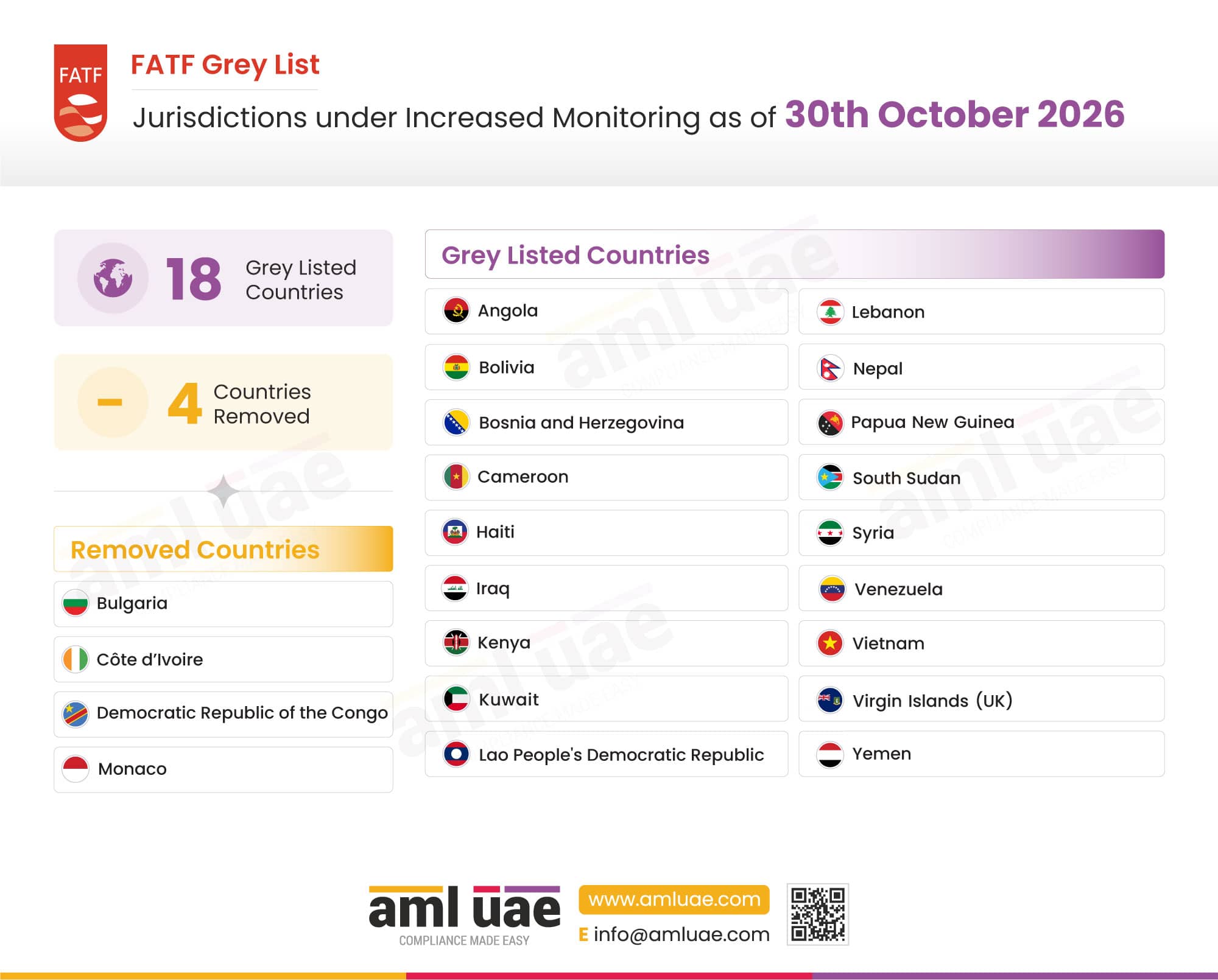
- As at 30 October 2026, 18 jurisdictions are under FATF increased monitoring (grey list).
- New additions to the grey list on 30 October 2026: None.
- Removed from the grey list on 30 October 2026: Bulgaria, Côte d’Ivoire, the Democratic Republic of the Congo and Monaco.
- Blacklist: Remains unchanged (Iran, North Korea, Myanmar) as of 30 October 2026
What are FATF Blacklist and Grey list countries? October 2026
The Financial Action Task Force (FATF) maintains two public lists of jurisdictions with weaknesses in their systems for tackling money laundering, terrorist financing and proliferation financing. The grey list covers jurisdictions under increased monitoring. The blacklist refers to high-risk jurisdictions subject to a call for action.
As at 30 October 2026, 18 jurisdictions are on the FATF grey list. Three jurisdictions are on the call-for-action list: Iran, the Democratic People’s Republic of Korea (North Korea) and Myanmar. Bulgaria, Côte d’Ivoire, the Democratic Republic of the Congo and Monaco were removed from the grey list in October 2026. There were no additions.

About the FATF Blacklist and Grey list
The countries people usually mean by “blacklist countries” or “grey list countries” are those named on the two FATF lists set out below: high-risk jurisdictions subject to a call for action, and jurisdictions under increased monitoring.
The two lists reflect different FATF monitoring and response arrangements. Jurisdictions on the grey list are working to address strategic deficiencies under agreed action plans. Jurisdictions on the call-for-action list require enhanced due diligence and, in the most serious cases, countermeasures. Neither list should be confused with a sanctions list.
FATF Blacklist 2026 - Updated as of 30 October 2026
What is FATF Blacklist?
The FATF blacklist is the commonly used term for “High-Risk Jurisdictions subject to a Call for Action”. These jurisdictions have serious strategic deficiencies in their AML/CFT/CPF regimes. The FATF calls for enhanced due diligence for such jurisdictions and, in the most serious cases, countermeasures.
The current list comprises Iran, North Korea and Myanmar. However, these countries are not all subject to the same FATF response: the FATF calls for countermeasures against Iran and North Korea; for Myanmar it calls for enhanced due diligence proportionate to the risks and expressly not countermeasures. Myanmar’s status is under further review.
Please note that the FATF updates the blacklist three times annually, so businesses must continuously check it for new listings and delistings. The number of countries on the blacklist varies depending on the effectiveness of the AML compliance framework. The FATF analyzes this and makes an informed decision about continued listing or delisting. The FATF continuously monitors the country’s contributions and efforts to combat financial crime and gathers reliable information on which it bases the listing process.
FATF listing does not itself impose a blanket trade ban. Firms must apply the measures specified in the relevant FATF statement alongside applicable sanctions laws and national or supervisory requirements. The required response differs between jurisdictions.
As of 30 October 2026, only the Democratic People’s Republic of Korea (DPRK), commonly North Korea, Iran, and Myanmar are mentioned in the FATF blacklist.
FATF Grey List 2026 - Updated as of 30 October 2026
What is FATF Grey List?
The FATF grey list is formally called “Jurisdictions under Increased Monitoring”. It covers jurisdictions that have committed to addressing identified strategic deficiencies in their AML/CFT/CPF frameworks within agreed timeframes. The FATF reviews their progress and publishes updates after its plenary meetings.
Grey-listing does not mean that a jurisdiction is subject to a general trade ban, that all its residents are suspicious, or that every customer linked to it must be refused. The FATF specifically says that it does not call for enhanced due diligence solely because a jurisdiction is grey-listed, and it discourages indiscriminate de-risking. Country status is an important input into a properly documented risk assessment.
How does a country enter or leave the FATF grey list?
FATF may place a jurisdiction under increased monitoring when it identifies strategic weaknesses and the jurisdiction commits to an agreed action plan. The existence of weaknesses does not mean that the country has taken no action, or that everyone connected to it is high risk.
For removal, FATF normally expects all or nearly all action-plan items to be addressed. An on-site visit then verifies that the country is implementing the relevant legal, regulatory, or operational reforms and can sustain them. A successful visit supports a plenary decision to end increased monitoring. The jurisdiction still undergoes the normal FATF or regional-body follow-up process afterwards.
The four October 2026 removals followed successful on-site visits.
FATF said Bulgaria, Côte d’Ivoire, the Democratic Republic of the Congo and Monaco had made positive progress on the weaknesses found in their mutual evaluations. For the reforms behind each removal, see why Bulgaria, Côte d’Ivoire, the DRC and Monaco were removed from the FATF grey list.
Vietnam remains on the grey list. FATF said it will consider next steps if Vietnam does not make tangible improvements to fix its strategic deficiencies by the next plenary.
The FATF Grey List is also updated thrice annually, and de-listings and new additions are made based on the performance of the countries and the thorough analysis done by the FATF basis various parameters.
FATF Grey List – FATF Jurisdictions under Increased Monitoring – Update History
On 30th October 2026, Bulgaria, Côte d’Ivoire, the Democratic Republic of the Congo and Monaco were removed from the FATF grey list.
On 19th June 2026, Iraq and Bosnia and Herzegovina were added to the FATF Grey List, while Algeria and Namibia were removed.
On 13th February 2026, Kuwait and Papua New Guinea were added to the FATF Grey List.
On 24th October 2025, South Africa, Nigeria, Mozambique, and Burkina Faso were removed from the Grey List.
On 13th June 2025 , Croatia, Mali, and Tanzania were removed from the Grey List while Bolivia and the Virgin Islands (UK) were added to Grey list.
On 21st February 2025, Philippines was removed from the FATF Grey List and Nepal, and Laos – Lao People’s Democratic Republic (Lao PDR or LPDR) were added to the Grey List, which is also known as jurisdiction under an increased monitoring list.
On 25 October 2024, Senegal was removed from the FATF Grey List and Algeria, Angola, Côte d’Ivoire, and Lebanon were added to the Grey List, which is also known as jurisdiction under an increased monitoring list.
On 28th June 2024, Jamaica and Türkiye were removed from the FATF Grey List and Monaco, and Venezuela were added to the Grey List.
On 23rd February 2024, UAE was removed from the FATF Grey List.
Source: Financial Action Task Force (FATF): Jurisdictions under Increased Monitoring as of 30 October 2026.
Full List of FATF Grey List Countries (as of 30th October 2026)
1 Angola · 2 Bolivia · 3 Bosnia and Herzegovina (added 19 June 2026) · 4 Cameroon · 5 Haiti · 6 Iraq (added 19 June 2026) · 7 Kenya · 8 Kuwait · 9 Lao PDR · 10 Lebanon · 11 Nepal · 12 Papua New Guinea · 13 South Sudan · 14 Syria · 15 Venezuela · 16 Vietnam · 17 Virgin Islands (UK) · 18 Yemen
Bulgaria, Côte d’Ivoire, Democratic Republic of the Congo, and Monaco were removed from the FATF grey list at the October 2026 plenary. The FATF blacklist, formally High-Risk Jurisdictions Subject to a Call for Action, remains unchanged, with Iran, the Democratic People’s Republic of Korea, and Myanmar.
How can readers check whether a country is on a FATF list today?
Check FATF’s dated “Jurisdictions under Increased Monitoring” and “High-Risk Jurisdictions subject to a Call for Action” statements. The country lists in this article were checked against the statements dated 30 October 2026. If you are reading this after a subsequent FATF plenary, check whether a newer statement has been issued before making a compliance decision.
Official current-list index: https://www.fatf-gafi.org/en/countries/black-and-grey-lists.html.
What is the difference between FATF blacklisted countries and greylisted countries?
Let us understand the difference between the FATF black list and the FATF grey list. The FATF blacklisted countries or jurisdictions suffer from strategic deficiencies in combating money laundering, terrorist financing, and financing the proliferation of weapons of mass destruction. FATF calls for enhanced due diligence and, in the most serious cases, countermeasures. Sanctions obligations arise separately under applicable legal regimes.
The FATF Greylisted countries are the jurisdictions working closely with the FATF to address strategic deficiencies in their regimes to counter money laundering, terrorist financing, and proliferation financing. The Greylisted jurisdictions are committed to resolving the identified issues within agreed timeframes and are subject to increased monitoring.
How many countries does the FATF grey list include?
AML Compliance pertaining to grey-listed and blacklisted countries
All Financial Institutions (FIs) and Designated Non-Finance Businesses and Professions (DNFBPs) are required to have appropriate risk-based AML/CFT protections in place to limit the potential of money laundering and terror financing posed by countries subject to increased monitoring or listed as high-risk jurisdictions subject to a “Call for Action” by FATF.
As a result, FI and DNFBPs must screen customers against the FATF Jurisdictions under Increased Monitoring and High-Risk Jurisdictions Subject to a Call for Action while onboarding and continuously monitor their transactions throughout their business relationship. DNFBPs should ensure that their customer due diligence measures verify their customer’s residence in, or business with, listed countries and that their transaction monitoring measures can examine the size, frequency, and pattern of transactions involving high-risk countries to determine the possibility of occurrence of financial crimes such as money laundering.
Red flags must be assessed and escalated. Reporting is required where there is suspicion or reasonable grounds for suspicion, in accordance with applicable UAE requirements.
Further, FIs and DNFBPs are obligated to report the transaction or activity with high-risk countries subject to a “Call for Action” to the FIU by filing High-Risk Country Transaction Report or High-Risk Country Activity Report (HRC/HRCA), as the case may be
How many countries are part of FATF?
What happens if FATF blacklists a country?
FATF does not impose sanctions itself. It calls for enhanced due diligence and, in the most serious cases, countermeasures. Sanctions obligations arise under separate applicable legal regimes.
Blacklisting may increase compliance costs, restrict access to international finance and affect trade or investment. The impact varies with the jurisdiction, the FATF measures called for, separately applicable sanctions and counterparties’ risk assessments; these outcomes are not automatic or identical in every case.
What happens when a country is grey-listed?
Grey-listing is not a sanction and does not ban anyone from dealing with the country. It is a public signal that a jurisdiction has strategic deficiencies in its AML/CFT framework and is working under an agreed action plan to fix them. Even so, the signal carries real economic and financial consequences, because investors, global banks and counterparties treat grey-listing as a risk marker and adjust their behaviour accordingly.
Capital inflows decline on average by 7.6% of GDP when a country is grey-listed.
Source: Kida and Paetzold, The Impact of Gray-Listing on Capital Flows, IMF Working Paper WP/21/153 (2021).
The most studied effect is on capital flows. A 2021 IMF working paper found that capital inflows decline on average by 7.6 percent of GDP when a country is grey-listed, with foreign direct investment and portfolio inflows each falling by around 3 percent of GDP. Much of this is driven by higher compliance costs and de-risking, where global banks reduce or cut ties to avoid the added cost and risk, which in turn can lower financial inclusion and push some flows into less regulated channels.
In practice, a grey-listed country tends to experience the following:
| Consequence | What it means in practice |
|---|---|
| Lower capital inflows | Foreign direct and portfolio investment slows as investors reprice country risk |
| Correspondent banking pressure | Global banks may restrict or withdraw correspondent relationships, making cross-border settlement harder |
| Costlier, slower payments | Cross-border payments and trade finance attract more checks, higher fees and delays |
| Currency and funding strain | Reduced inflows and confidence can weigh on the currency and raise the cost of external funding |
| Heavier external scrutiny | Foreign financial institutions apply enhanced checks, on a risk basis, to customers and transactions linked to the jurisdiction |
| Domestic compliance burden | The country must deliver its action plan within agreed timeframes to exit, which absorbs supervisory and institutional resources |
What grey-listing does not mean
It is worth being precise, because this is widely misread. Grey-listing does not require firms anywhere to terminate relationships with the country, and FATF does not call for enhanced due diligence to be applied simply because a jurisdiction is grey-listed. The expectation is a risk-based approach: regulated entities treat the listing as one input into their country and customer risk assessment, and apply enhanced due diligence or monitoring only where their own assessment warrants it. This is different from the black list, where FATF does call for enhanced due diligence and, for the highest risk, countermeasures.
Does FATF grey-listing automatically impose sanctions?
No. FATF monitoring and targeted financial sanctions are different systems. FATF assesses shortcomings in national AML/CFT/CPF frameworks; sanctions laws identify particular persons, organisations, assets, activities or restrictions. A person may have no sanctions designation even where a country is grey-listed. Equally, a person in a country outside the FATF lists may be sanctioned.
Neither a FATF grey-list entry nor its removal automatically approves a transfer, cancels a sanctions screening obligation, changes immigration or visa rules, or makes an otherwise high-risk transaction low risk. UAE firms should check the relevant UAE and UN sanctions instruments and supervisory instructions independently of the FATF classification.
What it means for UAE regulated entities
For UAE Financial Institutions, DNFBPs and Virtual Asset Service Providers, a new grey-listing is a trigger to update the country risk inputs in the Enterprise-Wide Risk Assessment, refresh screening lists, and apply enhanced measures on a risk basis to relationships connected to the jurisdiction. Where transactions or activity involve a country subject to a call for action, the High-Risk Country Transaction or Activity Report (HRC or HRCA) obligations continue to apply. The aim is calibrated risk management, not blanket de-risking.
Grey-listing is also reversible. When a country completes its action plan and exits the list, these effects typically unwind as investor confidence and banking access recover, as the UAE saw after its own removal in February 2024.
What does grey-listing mean for bank customers, remittances and trade payments?
Grey-listing is not a general payment ban. A bank may nevertheless ask further questions about the customer, source of funds, beneficiary, transaction purpose, or underlying trade, and some transactions may take longer to process. The treatment varies by institution, applicable law and actual risk. FATF discourages indiscriminate de-risking and unnecessary disruption to legitimate remittances, non-profit activity and humanitarian assistance.
A customer with a legitimate transfer should be prepared to provide the ordinary transaction evidence the bank requests. A FATF list entry does not automatically establish suspicion, and removal from the grey list does not guarantee lower fees, account opening, or payment approval.
Why North Korea is blacklisted by the Financial Action Task Force (FATF)
The Financial Action Task Force (FATF) has blacklisted North Korea because the Democratic People’s Republic of Korea (DPRK) has failed to address the deficiencies in its money-laundering and terrorist financing (AML/CFT) regime, and it poses serious threats to the integrity of the global financial system. The FATF has serious concerns about North Korea’s illicit activities related to the proliferation of weapons of mass destruction (WMDs) and its financing.
Is Russia on FATF blacklist?
No. Russia is not one of the three FATF jurisdictions subject to a call for action as of 30 October 2026. The FATF confirmed that the suspension of the Russian Federation’s FATF membership continues. Membership suspension and high-risk-country listing are different matters; separate sanctions regimes must also be checked.
FATF Grey List, Blacklist, and AML Compliance
The FATF Grey List and Blacklist serve as a guiding light for businesses to assess the risks associated with jurisdictions and customers. The regulated entities take a risk-based approach and decide if the risks posed by a customer are within its risk appetite. The FATF lists for jurisdictions subject to a call for action, and jurisdictions under increased monitoring undergo review and change 3 times a year.
Are grey list countries high risk?
Grey-list status is an important geographic-risk factor. Firms must apply applicable UAE requirements and assess the overall customer or transaction risk. FATF grey-listing alone does not automatically determine every customer’s risk rating.
Are blacklist countries high risk?
Yes, countries on the FATF black list are high-risk countries for money laundering, terrorist financing, and proliferation financing.
What must UAE regulated entities do when FATF lists change?
UAE firms should check both the FATF statements and any applicable decisions of the UAE National Committee or its supervisory authority. Article 23 of Cabinet Resolution No. 134 of 2025 requires enhanced customer due diligence proportionate to the risk level of relevant business relationships or transactions involving persons from high-risk countries or countries with AML/CFT/CPF deficiencies. It also addresses countermeasures and any additional measures the supervisor or National Committee requires.
An appropriate response may involve refreshing geographic-risk inputs to the enterprise-wide risk assessment (EWRA), reviewing customer risk assessment (CRA) scores, checking beneficial-owner and transaction-country links, reviewing existing due diligence, and updating country lists within systems and procedures. Removing a country from the grey list should prompt reassessment, not automatically downgrade every customer.
Where a transaction or activity falls within the UAE’s applicable High-Risk Country Transaction Report (HRC) or High-Risk Country Activity Report (HRCA) requirements, the firm should follow the relevant FIU/goAML and supervisory instructions.
Are FATF lists the same as UAE, EU or UN sanctions and high-risk-country lists?
No. FATF publishes jurisdiction-monitoring and call-for-action statements. Under UAE law, the UAE National Committee and supervisory authorities may determine specific high-risk-country treatment or countermeasures. The European Union has a separate high-risk third-country regime, while UN and UAE targeted financial sanctions involve different legal designations and obligations. A regulated firm must check each applicable source instead of substituting one list for another.
FATF Blacklist and Grey list - Screening & monitoring process
Financial institutions, DNFBPs and virtual asset service providers should monitor FATF list changes and assess their relevance to customers, beneficial owners and transactions. Country status should inform documented risk assessments and appropriate controls, rather than automatically rejecting every customer or transaction connected to a listed jurisdiction. Assess applicable sanctions, enhanced due diligence, countermeasures, and national or supervisory requirements separately.

So, they should keep the identity verification, Customer Due Diligence, and Enhanced Due Diligence process updated and screen the customers regularly against the sanction lists, the FATF blacklist, and the grey list. Identification of suspicious transactions and accounts should be immediately reported to the authorities. With the timely submission of STRs and SARs – institutions will contribute to and help strengthen the fight against money laundering and financing of terrorism.
FAQs About the FATF Blacklist and Grey list
What does grey list mean?
Grey list means a country has been placed on the FATF list of jurisdictions under increased monitoring. It has strategic AML/CFT weaknesses and has committed to fixing them under an agreed action plan with FATF. Grey-listing is not a sanction and does not by itself require enhanced due diligence.
What does it mean when a country is blacklisted?
A blacklisted country is on the FATF list of high-risk jurisdictions subject to a call for action. FATF calls on all members to apply enhanced due diligence, and in the most serious cases countermeasures. Three countries are currently blacklisted: Iran, North Korea and Myanmar.
What is the difference between the FATF blacklist and the grey list?
The FATF blacklist names jurisdictions with significant strategic AML/CFT deficiencies, and FATF calls on all members to apply enhanced due diligence and, in the most serious cases, countermeasures. The grey list names jurisdictions working with FATF under an agreed action plan; FATF does not call for enhanced due diligence on grey-listed countries alone.
How many countries are on the FATF blacklist in 2026?
Three: Iran, the Democratic People’s Republic of Korea (North Korea) and Myanmar. This did not change at the 30 October 2026 plenary.
How many countries are there on the Grey List of FATF 2026?
As at 30 October 2026, the FATF grey list contains 18 jurisdictions, including Angola, Bolivia, Bosnia and Herzegovina, Cameroon, Haiti, Iraq, Kenya, Kuwait, Lao People’s Democratic Republic, Lebanon, Nepal, Papua New Guinea, South Sudan, Syria, Venezuela, Vietnam, Virgin Islands (UK), and Yemen.
How often does the FATF update the grey list and blacklist?
Three times a year, at the February, June and October plenaries. UAE regulated entities should refresh country risk inputs in their EWRA and screening lists after each plenary.
What are the implications for a country if it is included in the FATF grey list?
Countries placed on the FATF Grey List are committed to addressing strategic deficiencies in their AML/CFT frameworks within agreed timelines. While these jurisdictions work towards strengthening their AML/CFT regimes, designated entities should apply a risk-based approach when dealing with customers connected to such countries.
Where the customer is from a FATF Grey List jurisdiction, or has a close business or transactional association with such a jurisdiction, the entity should assess whether the relationship presents a higher level of ML/TF risk. Where higher risk is identified, appropriate enhanced due diligence measures may be applied, such as obtaining additional information on the customer’s source of funds and source of wealth, understanding the purpose and intended nature of the transaction or business relationship, and seeking senior management approval before onboarding or continuing the relationship.
Is India in FATF grey list?
India is not included in the FATF grey list, as its measures to combat money laundering (ML)/terrorist financing (TF) and proliferation financing (PF) are comprehensive, according to the latest Mutual Evaluation of India, conducted in 2024.
In the latest Mutual Evaluation, India’s AML/CFT framework is found to be Compliant and Largely Compliant in most technical assessment parameters, with a moderate to Substantial level of effectiveness in the Effectiveness Parameters.
The 2024 Mutual Evaluation highlights India’s ability to effectively prevent, tackle and mitigate ML/TF and PF risks with relative ease, despite its large population. Currently, it is categorised as “regular follow-up,” requiring reporting to the Plenary within three years of the latest assessment.
Is Turkey in FATF grey list?
Turkiye was included in the FATF grey list in 2021, but was removed from the same in 2024 due to significant measures taken to combat ML/TF.
Is UAE in FATF grey list?
No. The UAE was removed from increased monitoring in February 2024 and remains outside the FATF grey list as at 30 October 2026.
Is KSA in FATF grey list?
As of 30 October 2026, KSA is not on the FATF grey list.
Is Kuwait in FATF grey list?
Yes. Kuwait was added in February 2026 and remains on the grey list as at 30 October 2026.
Is Papua New Guinea in FATF grey list?
Yes, as of 30 October 2026, Papua New Guinea is on the FATF grey list.
Do customers from grey-listed countries require EDD?
FATF does not call for automatic EDD simply because a jurisdiction is grey-listed. UAE firms must separately apply Article 23 of Cabinet Resolution No. 134 of 2025 and applicable national and supervisory directions, with measures proportionate to the risks of the relationship or transaction.
Can a customer’s risk rating fall after their country is delisted?
Yes, but not automatically. Delisting should trigger a documented reassessment of the customer’s overall risk, including ownership, activities, transaction patterns, other geographic links and continuing sanctions or regulatory requirements. A lower rating is appropriate only where the reassessment supports it.
Does FATF delisting mean a country is now fully compliant?
No. Delisting confirms that the strategic deficiencies in the FATF action plan have been sufficiently addressed and that the required on-site review succeeded. It is not a declaration that all financial-crime risks have disappeared or that every recommendation has been rated fully compliant. Normal follow-up and local risk assessment continue.
Can a bank refuse a transfer solely because a country is grey-listed?
FATF does not ask institutions to cut off whole categories of customers simply because of grey-list status. A bank may nonetheless need to assess an individual transaction against its legal obligations, country risk, customer information, sanctions rules, and risk appetite. An institution should make and document a proportionate decision under applicable law, not treat the FATF list as an automatic universal prohibition.
Which countries were removed from the FATF grey list in October 2026?
Bulgaria, Côte d’Ivoire, the Democratic Republic of the Congo, and Monaco were removed on 30 October 2026, and none were added. The list now has 18 jurisdictions.
Is Vietnam still on the FATF grey list?
Our timely and accurate AML consulting services
For your smooth journey towards your goals
Share via :
About the Author

Jyoti Maheshwari
CAMS, ACA
Jyoti has over 11 years of hands-on experience in regulatory compliance, policymaking, risk management, technology consultancy, and implementation. She holds vast experience with Anti-Money Laundering rules and regulations and helps companies deploy adequate mitigation measures and comply with legal requirements. Jyoti has been instrumental in optimizing business processes, documenting business requirements, preparing FRD, BRD, and SRS, and implementing IT solutions.

Reach Out to Jyoti