


Partial Name Match Report
Sanctions Screening and Reporting is a legal obligation for Designated Non-Financial Businesses and Professions (DNFBPs), Financial Institutions (FIs) and Virtual Asset Service Providers (VASPs), collectively referred to as Reporting or Regulated Entities (REs). The Partial Name Match during the Sanctions Screening necessitates filing a Partial Name Match Report (PNMR). It becomes essential for the REs to undertake the measures listed under the AML Law.
What is a Partial Name Match Report?
A Partial Name Match Result is obtained when the key identifiers of a customer partially match with individuals and entities listed in the UAE Local Terrorist List, or the UN Security Council Consolidated List.
A Partial Name Match Report (PNMR) is filed via the goAML platform, as the match cannot be classified as a Confirmed Name Match or a False Positive.
The UAE’s Targeted Financial Sanctions (TFS) regime is administered by the Financial Intelligence Unit (FIU) and Executive Office for Control and Non-Proliferation (EOCN).
EOCN plays a critical role in disambiguating such a match further by providing additional instructions and measures to undertake via goAML.

Operational Pain Points in Filling Partial Name Match Report
A Regulated Entity (RE) may already have internal Sanctions Screening policies and automated systems in place to detect potential matches against UAE and UNSC consolidated lists.
But are these controls truly sufficient to ensure accurate and timely PNMR filing under the UAE’s Targeted Financial Sanctions (TFS) framework?
Here are some of the common operational challenges organisations face when handling Partial Name Match Reporting (PNMR):
The screening systems fail to capture real-time updates to sanctions lists, minimise false positives, and lack a standardised process to validate whether a potential hit truly qualifies as a partial match before escalating to a PNMR filing.
There is no documented SOP for PNMR handling and escalation, outlining how to suspend transactions or services pending verification, hindering the seamless communication between compliance, operations, and senior management when a partial match is detected.
Reporting Entities fail to efficiently collect, verify, and attach all supporting documents when preparing a PNMR, and maintain a clear, well-organised archive to meet the five-year record-keeping requirements for audits and regulatory inspections?
Staff members are insufficiently trained to differentiate between partial and confirmed matches, they lack awareness of PNMR reporting timelines, and regular refresher training is absent which hampers accuracy and regulatory compliance pertaining to PNMR.
Regulatory Obligations for PNMR in UAE
In UAE, the Cabinet Decision No. 74 of 2020 establishes the framework for implementing Targeted Financial Sanctions (TFS), covering both the UAE Local Terrorist List and the UN Security Council Consolidated Sanctions Lists.
The Federal Decree Law No. 10 of 2025 imposes penalties for failing to abide by the instructions pertaining to Targeted Financial Sanctions by the Executive Office or any other Competent Authority. The Cabinet Decision No. (134) of 2025 is an implementing regulation of the Federal Law.
Penalties for Non-Compliance
The Federal Decree Law No. 10 of 2025 lays strict penalties pertaining to Targeted Financial Sanctions. Article (33) states that failing to fulfill the instructions pertaining to Targeted Financial Sanctions would result in imprisonment or a fine of not less than AED 20,000 or both these penalties.
Reporting Entities must ensure that they strictly adhere to the instructions regarding the Targeted Financial Sanction and comply with the reporting timelines and requirements.
Key Identifiers to be Considered while Conducting Sanctions Screening
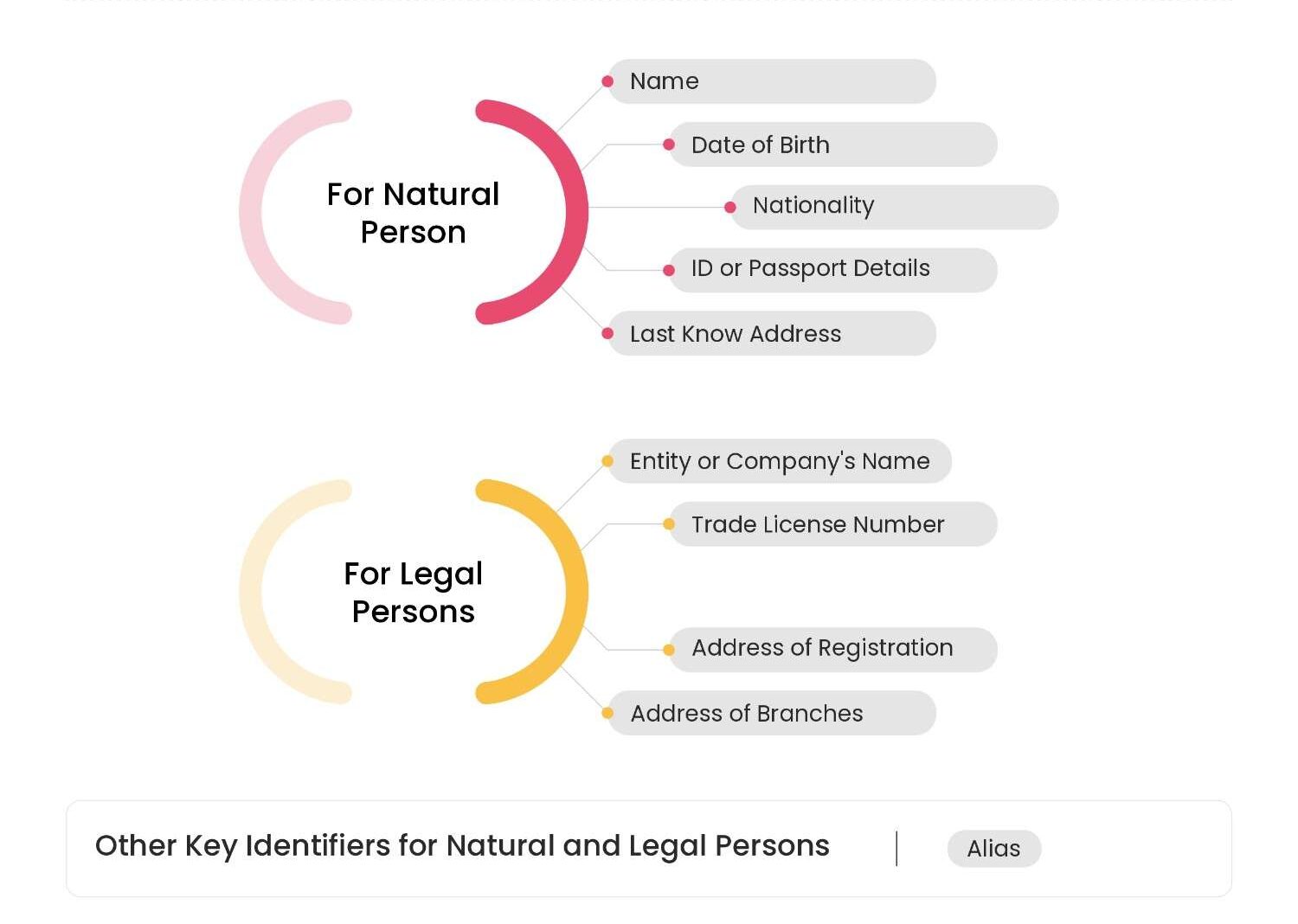
There are two lists which govern Sanctions Screening in the UAE: the UAE Local Terrorist List and the UNSC Consolidated List. REs need to ensure that they are collecting key information of their customers to conduct Screening against both sanctions lists.
Regulated Entities while filing a PNMR, have to support the same by providing this key information which is as follows:
Step-by-Step Filing Process for Regulated Entities in UAE
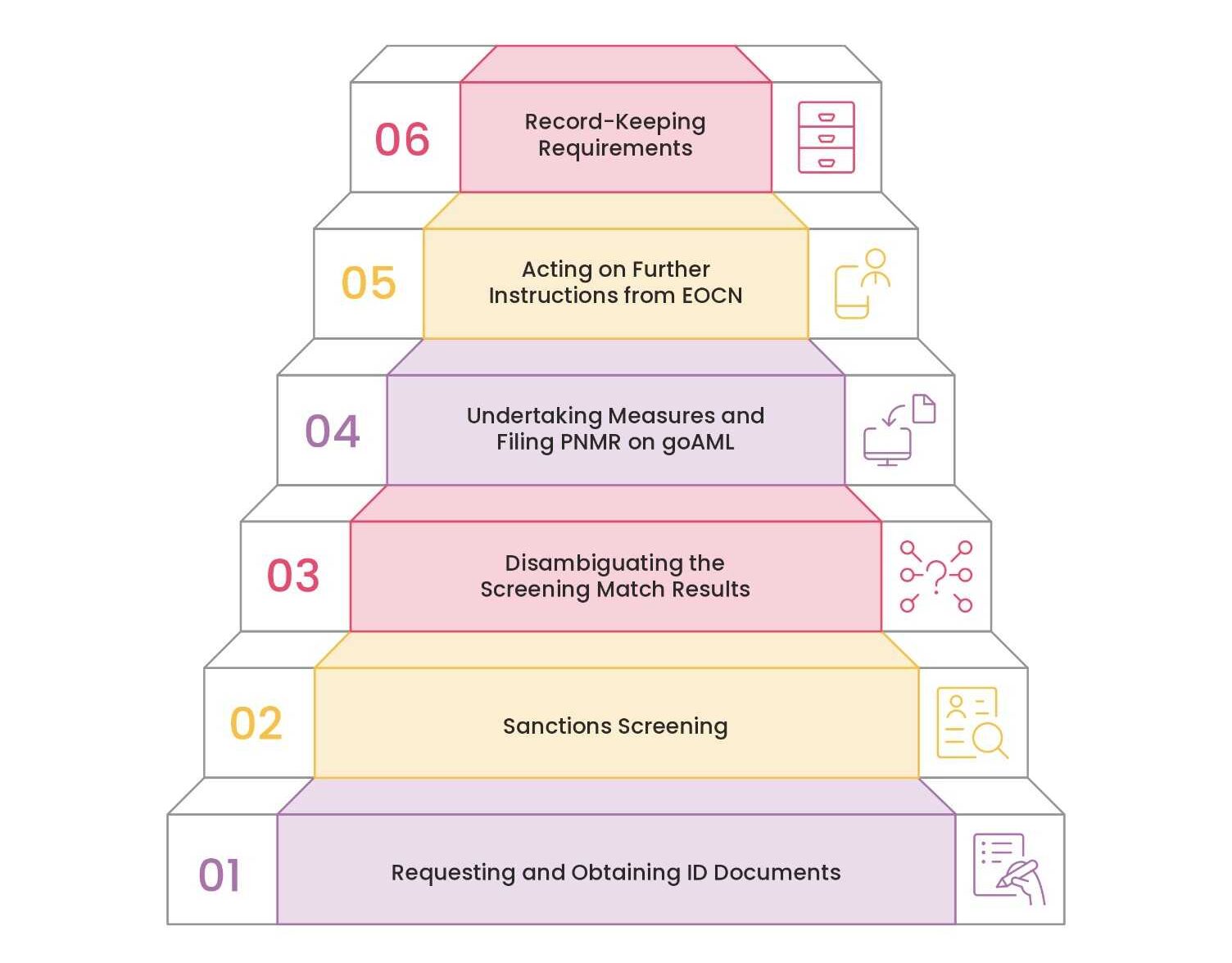
Screening needs to be undertaken by Regulated Entities for existing customers, potential customers, counterparties, beneficial owners, etc., against the UAE Local Terrorist List and the UNSC Consolidated List on a regular and ongoing basis.
This includes requesting and obtaining ID documents, conducting sanctions screening, disambiguating the screening match results, undertaking measures and filing PNMR, acting on further instructions from EOCN, and record-keeping requirements.
Step 1: Requesting and Obtaining ID Documents for Screening
The first and foremost step for any Reporting Entity is to obtain the required documents to conduct screening.
It becomes crucial for REs to bridge the gap of not having adequate information. This is done by requesting ID documents to conduct the Screening. In most cases, inadequate information leads to inconclusive results.
Existing Customer
In the case of an existing customer, the REs already possess the required ID documents. The REs must review the same before screening the customer.
Potential Customer/Counterparty
In the case of a potential customer or a Counterparty, making efforts to obtain adequate ID Documents becomes crucial for REs. In such cases, Reporting Entities are provided with ten (10) business days as a timeline to obtain the required ID documents before concluding on the filing of PNMR.
Step 2: Sanctions Screening
Sanctions Screening is done to ensure that the REs are not dealing with any individual/organisation listed on the sanctions list.
The first and foremost step is screening the customers against both the sanctions list, i.e., the UAE Local Terrorist List and the UNSC Consolidated List.
The REs need to subscribe to EOCN’s Notification Alert System (NAS) to receive alerts and updates on the Sanctions Lists.
Step 3: Disambiguating the Screening Match Results
The screening is conducted by cross-checking the key identifiers of the customer against the key identifiers listed in the Sanctions List.
A Partial Name Match result is obtained when there is a partial match between the key identifiers listed in the Sanctions List and the customer information provided in the RE’s database.
The Compliance team must promptly address this and disambiguate the result.
Step 4: Undertaking Measures and Filing PNMR on goAML
After disambiguating the match result, REs need to promptly file a PNMR report on the goAML portal and implement suspension measures. The suspension measures for the customers are as follows:
Existing Customer
In the case of existing customers, the REs have a screening result of Partial Name Match in place. The measures taken in case of existing customers are as follows:
- Suspending the transaction effective immediately
- Refraining from offering anything associated with funds, assets, and services
- Filing a PNMR through the goAML Portal within five (5) business days of levying the suspension measures.
Potential Customer/Counterparty
In the case of potential customers and counterparties, the measures and reporting undertaken are as follows:
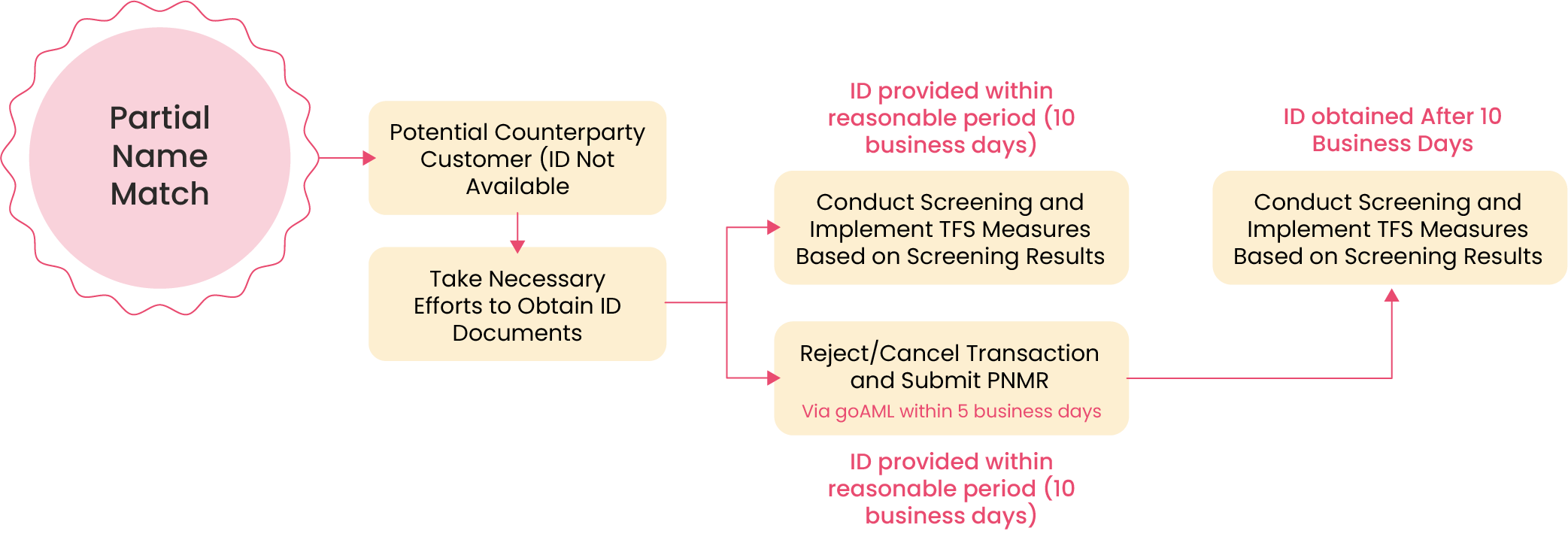
- The RE obtains the ID Documents within ten (10) business days, and the following measures are taken:
– If RE is able to conclude the match as a False Positive, then the RE moves ahead and works on establishing the business relationship or processes the transaction without filing a PNMR. The internal documentation pertaining to false positives is to be maintained for future audit trails.
– If RE is able to conclude the match as a Confirmed Name Match, the process for filing the Confirmed Name Match Report (CNMR) follows.
- If the RE is unable to obtain the ID Documents within the reasonable timeframe of ten (10) business days, the following measures are taken:
– Rejecting the transaction or service, and
– Filing a PNMR within five (5) business days (from the date of rejection of the transaction/service), citing a lack of adequate documents for the Partial Name Match. - The RE obtains the ID Documents after the transaction has been rejected as a result of a lack of ID Documents, as ten (10) business days have passed, and PNMR has been reported, citing the same. The following measures are to be undertaken:
– Conducting the Screening as per the newly obtained ID Documents, and
– Undertaking measures based on the screening results, and
– Considering the case as a new transaction and submitting a new report based on the screening results.
Step 5: Acting on Further Instructions from EOCN
The REs after filing the PNMR on the goAML portal need to wait for further instructions from EOCN regarding suspending TFS measures and freezing funds.
The record-keeping obligations are followed by levying suspension measures until official clearance or further instruction is provided by the Executive Office (EOCN).
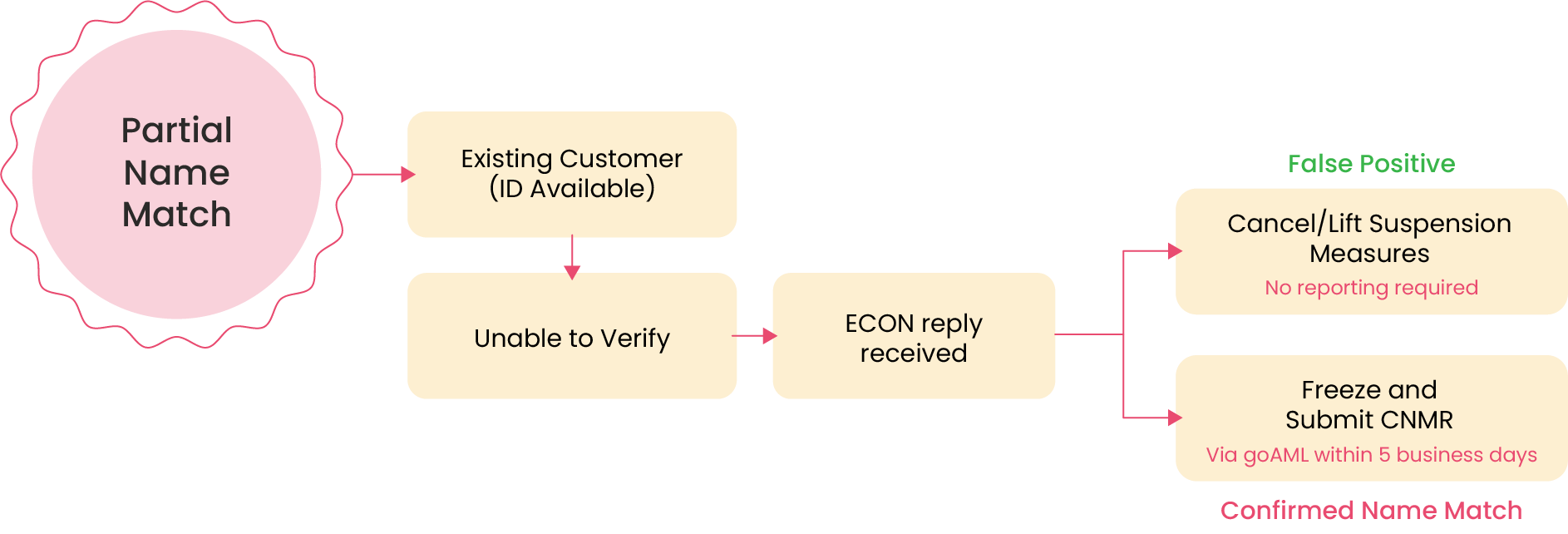
The REs need to wait for a reply from the EOCN. The reply from EOCN prompts the following steps:
- If the EOCN concludes the PNMR filed to be a False Positive, the suspension measures are to be reinstated, and business continues.
- If the EOCN validates the PNMR, freezing funds and filing the CNMR follow.
In the case of a Potential Customer/Counterparty, adequate documents have to be provided supporting the PNMR, for the EOCN to accurately verify and provide a reply.
Step 6: Record Keeping Requirements
The reply, once received, must be kept for at least five (5) years and should be made readily available for audits and regulatory inspections.
Details to be Included in PNMR Filing
Reporting Entities must provide certain information mandatorily while filing PNMR via the goAML portal.
This includes the full name of the partial match, the amount of funds or other assets suspended, a description of the rejected transaction or service, and previous Business Relationships/Transactions and Record Keeping.
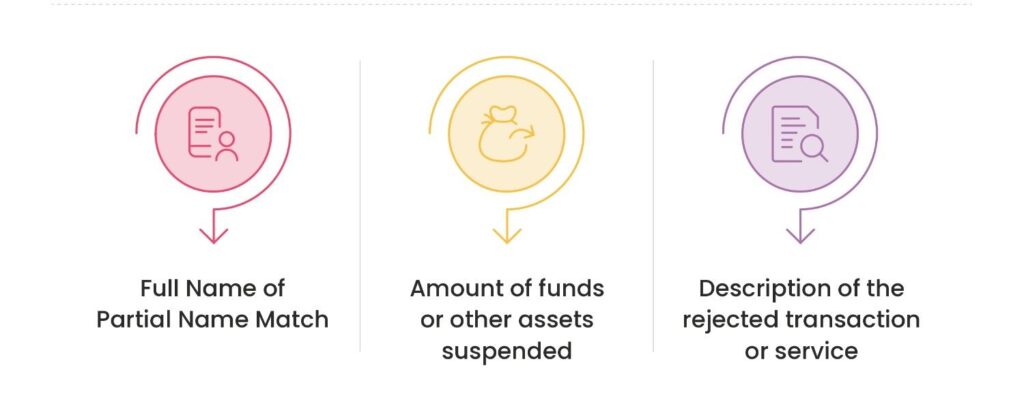
Full Name
In the case of Partial Name Match, attaching ID Documents such as passports or IDs for individuals and trade licenses and articles of association for entities becomes crucial.
Note: Submitting adequate documents is crucial as it helps EOCN in verifying the result.
Amount of funds or other assets suspended
In the event of a partial name match, attach documentary proof such as bank statements, transaction receipts, securities portfolio summaries, title deeds, and other documents showing the value of funds in the bank account, the value of transactions undertaken, and the value of securities and real estate obtained.
Description of the rejected transaction or service
In the case that no funds are held by the Reporting Entity, and the transaction is service-based, a detailed description of the transaction or services rejected should be provided in the report.
Common Challenges Faced During Filling PNMR
Most REs would find filing a Partial Name Match Report (PNMR) under the UAE’s Targeted Financial Sanctions (TFS) framework is not a straightforward task.
A partial match entails several grave consequences, including suspending services, verifying the details, and detailed reporting within tight deadlines. REs face several operational and compliance hurdles during the PNMR preparation and submission process.
Common challenges include obtaining false positives, time-sensitive suspension measures, documenting and collecting evidence, maintaining customer relationships, and other constraints related to resources and technology.
They are outlined as follows:
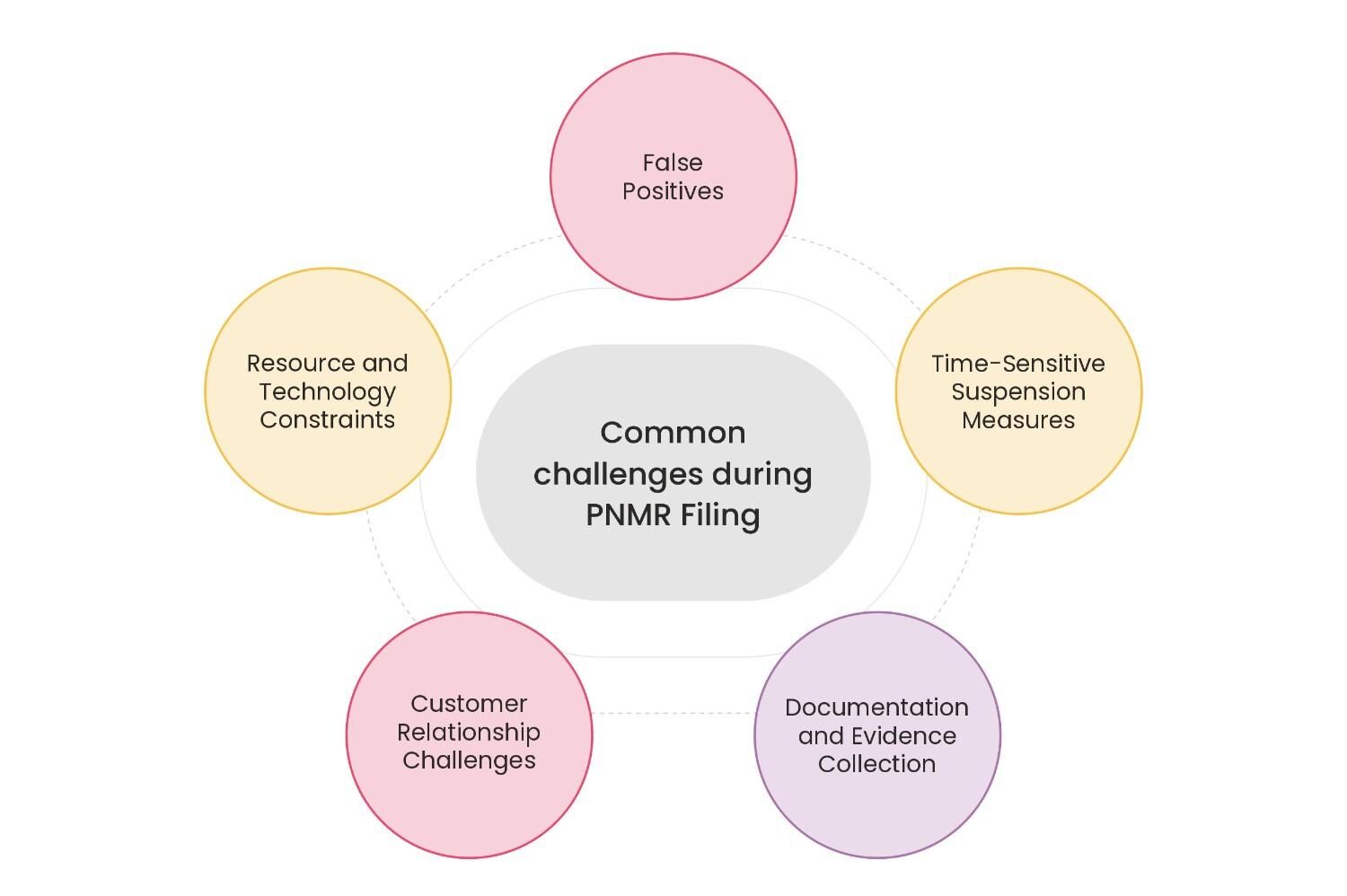
False Positives and Difficult Identification
Handling name variations and transliterations between Arabic and English spellings often generates a large volume of false positives.
PNMR deals with “potential” matches; the lack of standardised validation procedures leads to inconsistencies for escalating the partial matches further. This increases the workload and creates the risk of overlooking genuine threats.
Time-Sensitive Suspension Measures
When a partial match occurs, suspending transactions or services needs to be applied immediately.
Compliance teams should act quickly, but unclear escalation channels, internal approvals, or delays in communication with frontline staff can slow down this process, risking non-compliance.
Documentation and Evidence Collection
Each PNMR filing requires supporting documentation, including customer identification records, account details, and internal investigation notes.
Collecting, verifying, and attaching these documents within the five-day reporting window can be challenging, especially if customer records are incomplete or outdated.
Customer Relationship Challenges
Suspending legitimate clients’ services while verification often leads to customer dissatisfaction.
Balancing regulatory obligations with customer communication is a sensitive challenge, especially for DNFBPs and smaller firms without dedicated compliance teams.
Resource and Technology Constraints
Smaller firms and DNFBPs often operate with limited compliance staff and outdated technology.
This makes it harder to handle the operational burden of PNMR filings, especially when multiple alerts are triggered simultaneously.
Best Practices for Regulated Entities to Stay on Top of PNMR Reporting Game
Regulated Entities should undertake practices such as implementing robust screening systems, setting up clear escalation of SOPs, maintaining a centralised document repository, automating PNM Reporting, strengthening staff training and awareness.
Some of the best practices to be employed by Regulated Entities to stay on top of their Partial Name Match Reporting game are as follows:
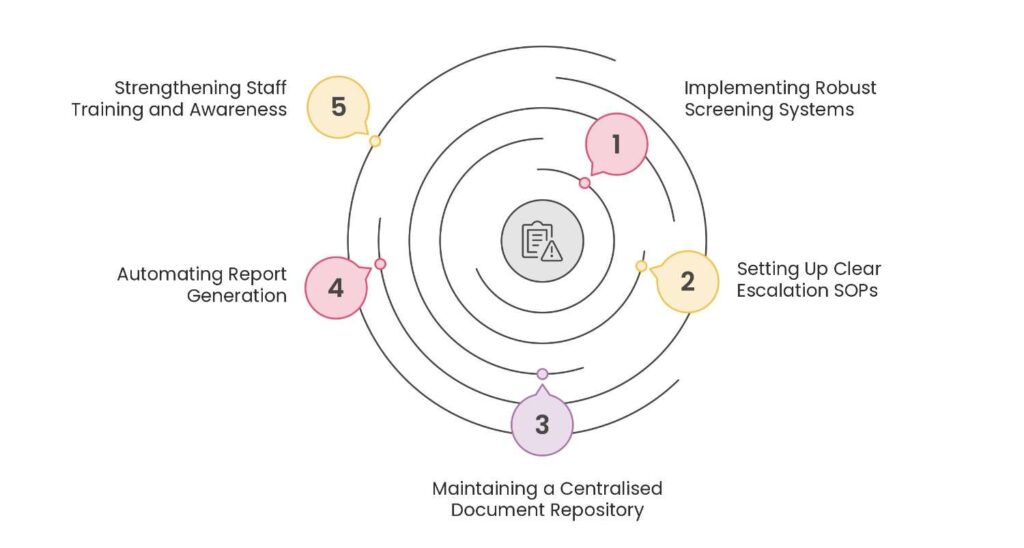
Implementing Robust Screening Systems
Regulated Entities should deploy advanced sanctions screening software equipped with fuzzy logic to minimise false positives and improve accuracy.
These systems must be integrated with customer and transaction databases to allow for real-time monitoring and ensure that potential partial matches are flagged immediately before transactions proceed.
Setting Up Clear Escalation SOPs
It is essential to establish well-documented step-by-step procedures for handling partial matches. These procedures should cover immediate suspension, internal review, and final reporting.
Responsibilities should be clearly allocated among frontline staff, compliance teams, and senior management to avoid unnecessary delays and ensure accountability throughout the process.
Maintaining a Centralised Document Repository
Regulated Entities must maintain a secure centralised document repository. This enables them to store KYC files, customer records, and transaction histories in a single location.
This not only speeds up evidence collection but also ensures the organisation is audit-ready and able to meet the five-day reporting deadline without unnecessary delays.
Automating Report Generation
Automation can reduce human error and improve efficiency by leveraging compliance tools that support compliance teams.
Organisations should also conduct regular testing of uploads to minimise common technical problems such as formatting errors or file size restrictions.
Strengthening Staff Training & Awareness
Regulated Entities must undertake regular training sessions to understand AML and reinforce the intricacies of PNMR.
The Staff Training should also incorporate real-life examples, which would help employees in understanding reporting requirements and filing them accurately.
Need help building any of these best practices into your current framework?
AML UAE helps you build smart, customised compliance processes — from screening to reporting — tailored to your business needs.
Mitigate PNMR Reporting Challenges: How AML UAE Becomes Your Compliance Wingman
At AML UAE, we help businesses comply with Cabinet Decision No. (74) of 2020 and Federal Decree Law No. 10 of 2025 by building strong PNMR frameworks, enhancing sanction screening policies, deploying automation tools, and streamlining reporting mechanisms. Our aim is to enable REs and DNFBPs to overcome operational hurdles and ensure seamless compliance with the UAE’s Targeted Financial Sanctions (TFS) obligations.
Fill the Gap with Customised Policies
PNMR Pain Point:
“We don’t have a dedicated workflow for PNMR reporting, even though AML policies exist.”
Smart Solutions offered by AML UAE:
We design customised PNMR compliance policies aligned with UAE laws & FATF standards
Benefits of a Comprehensive PNMR Filing:
You gain a structured, clear, and audit-ready process.
Stay Up-To-Date with Real-Time Alerts
PNMR Pain Point:
“Our screening system doesn’t update sanctions lists in real time, so partial matches may be missed.”
Smart Solutions offered by AML UAE:
We enable real-time integration with the EOCN notification alert system (NAS) and UN Consolidated List for instant updates.
Benefits of a Comprehensive PNMR Filing:
You stay updated with zero missed alerts or partial match risks.
Automating to Prevent Manual Exhaustion
PNMR Pain Point:
“Manual preparation and verification of PNMR reports is exhausting and error-prone.”
Smart Solutions offered by AML UAE:
We provide automation for collecting, validating, and attaching PNMR documents.
Benefits of a Comprehensive PNMR Filing:
You achieve faster, error-free, and efficient reporting.
Grapple Struggles with Clever Escalation Mechanisms
PNMR Pain Point:
“Our compliance team struggles to detect and escalate partial matches quickly.”
Smart Solutions offered by AML UAE:
We provide API-based advanced screening tools with instant alerts and intelligent escalation mechanisms.
Benefits of a Comprehensive PNMR Filing:
You act swiftly before risks escalate further.
Seamlessly Integrate Compliance Ecosystem
PNMR Pain Point:
“Our AML systems don’t integrate smoothly with PNMR reporting.”
Smart Solutions offered by AML UAE:
AML UAE ensures seamless integration with KYC, CRM, and customer onboarding platforms.
Benefits of a Comprehensive PNMR Filing:
You benefit from a complete, unified AML compliance ecosystem.
Timeline is the Key to Compliance Filing
PNMR Pain Point:
“We are not fully clear about PNMR timelines and obligations.”
Smart Solutions offered by AML UAE:
We provide a goAML-ready reporting framework covering PNMR, CNMR, STR, & SAR submissions.
Benefits of a Comprehensive PNMR Filing:
You file timely, accurate, and stress-free regulatory reports.
Get Accurate Matches and Overcome False Alerts
PNMR Pain Point:
“False positives consume too much time during PNMR checks.”
Smart Solutions offered by AML UAE:
We deploy fuzzy logic, transliteration support (Arabic/foreign names), and risk-based filters.
Benefits of a Comprehensive PNMR Filing:
You get fewer false alerts and more precise matches.
Gain Complete Insights into Reporting Requirements
PNMR Pain Point:
“Our compliance staff lacks confidence in PNMR-specific reporting.”
Smart Solutions offered by AML UAE:
We deliver UAE-focused PNMR and sanctions screening training tailored to your team’s needs.
Benefits of a Comprehensive PNMR Filing:
You build a confident, well-trained, and capable compliance workforce.
Keep Your Compliance Framework Dynamic
PNMR Pain Point:
“Regulatory changes around PNMR are hard to keep up with.”
Smart Solutions offered by AML UAE:
We provide ongoing compliance advisory, system audits, and regulatory update alerts.
PNMR preparation and filing support
Prepare a partial name match report
An unresolved potential sanctions match needs a documented response while further clarification is sought. We help your team prepare a PNMR pack that explains the matching identifiers, unresolved differences and relevant activity.
Show why the match remains unresolved
We organise the screening result, customer documents, research and details of funds, assets or services affected. The narrative states what has been checked and what remains uncertain, without presenting a potential match as a confirmed identity.
Maintain the follow-up trail
You receive a reviewed report pack, a record of suspension measures where applicable and a tracker for authority instructions. The authorised officer controls submission and subsequent action. A pending report or customer explanation does not itself authorise release of suspended activity.
Your next PNMR filing shouldn’t be a last-minute scramble.
Minimise false positives, detect partial matches early, and simplify your reporting with complete confidence.

Let Partial Name Match Report Filing Help You Achieve Reporting Excellence
Regulated Entities in the UAE often find it difficult to navigate the goAML portal and meet the reporting requirements for PNMR. Lack of adequate documentation, absence of knowledge pertaining to reporting requirements, lack of information, and other aspects result in inefficient filing that is prone to being rejected.
Therefore, it is crucial for Regulated Entities to count on solutions that incorporate the best practices which address inefficiencies and gaps that arise during filing.
Integrating robust screening systems, leveraging automated reporting processes, utilising advanced screening tools, regularly training staff to decode filing intricacies helping achieve Partial Name Match Report (PNMR) filing excellence.
Your next PNMR filing shouldn’t be a last-minute scramble.
Minimise false positives, detect partial matches early, and simplify your reporting with complete confidence.