


AML Regulations for CMA-Regulated Advisors and Promoters in UAE
MLRO and Compliance Officer Support Services in the UAE
Key takeaways
MLRO and Compliance Officer support services add specialist capacity, technical depth and independent challenge behind your appointed MLRO. The officer keeps the role, the authority and the accountability.
UAE law requires financial institutions, DNFBPs and VASPs to appoint a Compliance Officer at management level, with independence in decision-making and appropriate competence and experience (CR 134/2025, Art. 22).
Typical scope covers AML programme oversight, risk assessment, CDD and EDD oversight, transaction monitoring escalation, STR/SAR and goAML reporting, sanctions and PEP controls, regulatory correspondence, board reporting and training.
Support is different from an outsourced or nominated MLRO, which may need your supervisor’s prior approval (CR 134/2025, Art. 49(18)). Accountability stays with your entity in both models.
AML UAE supports regulated entities in Dubai, Abu Dhabi and across the UAE, with scope set against the regulator that supervises your licence.
Strengthen Your Compliance Function Without Building a Department
Every UAE regulated entity needs capable AML leadership. Very few need, or can justify, a large internal compliance department to deliver it.
The gap between an appointed MLRO and a properly supported one is where most compliance risk accumulates. The MLRO is appointed and competent, but has limited time, limited specialist depth in areas such as sanctions or monitoring calibration, and nobody to test a difficult judgement against. Reports get filed late or thinly documented. Escalations are decided in conversation rather than on record. Board reporting becomes an activity summary rather than genuine oversight. None of this reflects poor intent. It reflects a function operating without support.
AML UAE provides MLRO services and specialist support to your appointed MLRO and AML compliance officer, for regulated entities in Dubai, Abu Dhabi and across the UAE. We work behind the role, not in place of it: preparing and reviewing regulatory reports, testing escalation decisions, running compliance monitoring, building governance packs for senior management and the board, and preparing the evidence a supervisor will ask to see. The scope is agreed against your regulator, your sector and your risk profile, and can range from advisory access through to structured ongoing support.
Where an entity’s applicable regulator permits particular arrangements for the role itself, we assess that position with you before anything is proposed. What we never do is suggest that accountability can be transferred out of your business, because it cannot.
Direct experience across CBUAE, DFSA, FSRA, ADGM RA, CMA, VARA, MoJ, GCGRA, and MoET supervised entities
Sector-specific support for financial institutions, DNFBPs and virtual asset businesses
Ongoing advisory rather than one-off documentation projects
Practical inspection readiness, built from evidence created as the work happens
What Are MLRO and Compliance Officer Support Services?
MLRO and Compliance Officer support services are specialist advisory and operational services that strengthen an entity’s existing compliance function. The appointed officer retains the role, the authority and the accountability. The support provides capacity, technical depth, and independent challenge, so the work the role requires is delivered to a standard that withstands review.
In practice, support takes three forms, and most engagements use a mix of all three. Advisory support answers technical questions as they arise. Execution support prepares and reviews the work product: reports, assessments, monitoring plans, governance packs. Assurance support tests whether the framework operates as documented and identifies what needs fixing before someone else finds it.
What an MLRO does in a UAE regulated entity
The MLRO sits at the centre of the AML/CFT/CPF framework. The precise duties vary by regulator and sector, but the core responsibilities are consistent. At the federal level, they are set out in Cabinet Resolution No. 134 of 2025 (CR 134/2025), Article 22.
AML/CFT/CPF oversight:
owning the design and operation of the compliance programme in practice
Suspicious activity review and reporting:
assessing internal escalations and deciding whether a report is required
Regulatory reporting:
filing with the UAE FIU through goAML, and submitting required returns and surveys
Regulatory liaison:
acting as the point of contact for the supervisor and the FIU
Controls testing:
ensuring controls exist, operate and are periodically tested
Risk assessment:
contributing to and challenging the enterprise-wide and customer risk assessments
Compliance reporting:
informing senior management and the board with reporting that supports real oversight
Training and awareness:
ensuring staff can recognise and escalate red flags relevant to their role
For financial institutions, CBUAE guidance describes the Compliance Officer or MLRO as responsible for reviewing suspicious activity, reporting to the FIU, overseeing the AML programme and liaising with the competent authorities. The demanding part is rarely understanding these duties. It is evidencing that each was discharged consistently across a full year.
What a Compliance Officer does
Where the roles are separate, the Compliance Officer typically carries broader regulatory responsibility beyond financial crime.
- Regulatory compliance oversight across the entity’s full licence conditions
- Compliance monitoring: planned testing of whether controls operate as designed
- Regulatory reporting: periodic returns, notifications and disclosures to the supervisor
- Breach and issue management: identification, logging, root cause analysis and remediation
- Policy and control oversight: ensuring the framework stays current and approved
- Senior management and board reporting on compliance status, risks and open issues
In smaller UAE entities, one individual frequently holds both roles. That is common and often permitted, but it concentrates a significant workload in a single person and creates a clear single point of failure during absence, resignation or an inspection.
MLRO vs Compliance Officer: what is the difference?
| Area | MLRO | Compliance Officer |
|---|---|---|
| AML/CFT oversight | Core responsibility | Core or related responsibility |
| Suspicious activity reporting | Core responsibility | Depends on the regulatory framework |
| Regulatory compliance scope | AML/CFT/CPF focused | Broader licence and conduct compliance |
| Regulatory liaison | Yes | Yes |
| Board and senior management reporting | Yes | Yes |
| Compliance monitoring and testing | AML controls | Full compliance programme |
How the MLRO and Compliance Officer roles are split, and what each must deliver, is not identical across the UAE. Requirements differ between CBUAE-supervised institutions, DFSA and FSRA firms in the financial free zones, VARA-licensed virtual asset businesses, and DNFBPs supervised by MoET, MoJ or other authorities. They can also differ by licence category within a single regulator. Any support arrangement should start by confirming precisely what your regulator requires of the role, which is the first thing we establish in an engagement.
Why Do Regulated Entities Need MLRO and Compliance Officer Support?
Regulated entities need MLRO and Compliance Officer support because UAE AML/CFT/CPF obligations have grown faster than most compliance functions, supervisors now test evidence rather than descriptions, and effective oversight needs independent challenge.
Growing AML/CFT/CPF regulatory obligations
The UAE framework has developed substantially. Federal Decree-Law No. 10 of 2025 and its Executive Regulations issued under Cabinet Resolution No. 134 of 2025 now sit at the centre of the federal AML/CFT regime, replacing Federal Decree-Law No. 20 of 2018 and Cabinet Decision No. 10 of 2019 (FDL 10/2025, Art. 41; CR 134/2025, Art. 70), supported by supervisory guidance from CBUAE and rulebooks issued by the free zone regulators and sector supervisors.
The direction of travel is consistent: more explicit expectations around risk assessment, ongoing monitoring, beneficial ownership, targeted financial sanctions and governance, with a heavier emphasis on demonstrating that obligations were met rather than asserting compliance. For an MLRO, that shift is significant. The role has moved from performing tasks to evidencing a programme.
Proliferation financing has also become a standing part of the framework rather than a specialist annex. Where high PF risks are identified, entities must apply proportionate measures, keep documented records and review controls periodically (CR 134/2025, Art. 5(4)). Entities that assessed money laundering and terrorist financing risk but never documented a proliferation financing assessment now carry a visible gap, and it is one supervisors ask about directly.
Limited internal compliance resources
Most entities we support are not under-resourced by choice. They are at a stage where the obligations have outgrown the function.
- New regulated businesses building a framework from zero while also launching operations
- Growing firms whose customer numbers, volumes or product range have moved faster than compliance hiring
- Lean compliance teams where one person covers AML, regulatory compliance and often operations or legal
- Temporary capability gaps created by resignation, secondment, parental leave or extended absence
- Specialist requirements that no generalist function can reasonably hold, such as monitoring calibration, sanctions escalation governance or complex ownership analysis
When obligations outgrow the compliance function, the consequence is predictable. Urgent daily work displaces periodic obligations. Reviews slip, training lapses, and the file that should evidence a decision holds only the decision. None of it is visible until someone looks.
Increasing regulatory scrutiny
Supervisors conduct risk-based on-site and off-site inspections and can request any information they need (CR 134/2025, Art. 49(9)). Inspections test evidence rather than accept description, and the requests are specific.
Inspection preparation:
document requests that arrive with short deadlines and cover several years of activity
Evidence and documentation:
proof that reviews, training, screening and escalations actually occurred, with dates and owners
Regulatory requests:
ad hoc information requests requiring accurate, timely and internally consistent responses
Internal reporting:
MLRO and management reporting that a supervisor may read to assess whether oversight is genuine
Remediation of findings:
a credible plan with owners, dates and evidence of closure, then proof the fix held
An entity with a capable MLRO and no support can usually answer these questions. The difficulty is answering them within the deadline, while continuing to run the compliance function, and without discovering mid-inspection that the evidence was never retained.
The need for independent compliance expertise
Second-line effectiveness depends on challenge. When the person who designed a control is also the person who tests it and reports on it, the assurance is structurally weak, regardless of how capable that person is. Independent input introduces the challenge the framework is supposed to contain. Separately, the Executive Regulations require an independent audit function to test the effectiveness and adequacy of AML/CFT policies and controls (CR 134/2025, Art. 21(6)). Specialist support complements that audit function; it does not replace it.
Independence also brings a comparative perspective. A consultant who has seen how other entities in your sector handle escalation documentation, or what a supervisor questioned in a recent inspection, brings context an internal team cannot generate on its own.
One boundary matters when bringing in independent expertise. Independent expertise strengthens governance. It does not relocate it. Senior management and the governing body retain ownership of the AML/CFT framework and its outcomes (policies must be approved by Senior Management and the Compliance Officer reports directly to it, CR 134/2025, Arts. 21 and 22(3)), and any arrangement that appears to dilute that ownership creates a problem rather than solving one.
Is Your MLRO Carrying Too Much?
Add specialist capacity behind the role without building a department.
What Does MLRO Support Include?
Scope is agreed against your regulator, sector, size and existing capability. MLRO support typically covers seven areas: programme oversight, risk assessment, CDD and EDD oversight, transaction monitoring escalation, STR/SAR and goAML, sanctions and PEPs, and regulatory reporting. Each can be scaled up or omitted depending on where your function needs reinforcement.
AML/CFT/CPF programme oversight
Programme oversight support focuses on whether the programme operates as documented, and on producing the evidence that it does.
Policy review against current UAE requirements and your supervisor’s expectations, with version control and approval records
Control assessment covering design adequacy and operating effectiveness, not just existence
Compliance monitoring: a risk-based plan, scheduled testing, documented findings and tracked remediation
Risk-based calibration so that control intensity matches assessed risk rather than applying uniform effort everywhere
CBUAE guidance emphasises the MLRO’s role in implementing and overseeing the AML/CFT/CPF compliance programme. In practice, this means a programme with a documented plan, a record of what was tested, findings with owners, and evidence of closure.
ML/TF/PF risk assessment support
The enterprise-wide risk assessment drives every other control, so an outdated or superficial EWRA compromises the whole framework. The risk assessment must be documented, updated on an ongoing basis and provided to the concerned authorities on request (CR 134/2025, Art. 5(1)(b)).
Business risk assessment methodology design, refresh cycles and challenge of the ratings applied
Customer risk considerations, including the customer risk assessment model and its calibration
Product and service risk analysis, including new products before launch rather than after (CR 134/2025, Art. 24(2))
Geographic risk covering customer, counterparty and transaction exposure
Delivery channel risk, including non-face-to-face onboarding and third-party reliance
Risk mitigation mapping, so each identified risk traces to a specific control
An important governance point: while the MLRO drives the assessment, ownership of risk remains with the business and its senior governance bodies. Our support strengthens the analysis and the documentation. The decisions and their approval stay with your entity.
CDD, EDD and KYC oversight
CDD and KYC support works at the oversight level rather than the processing level, focused on whether the CDD framework produces reliable outcomes.
Customer identification and verification standards, and their consistent application across channels
Beneficial ownership identification, including layered structures, nominees and trusts, against the 25% ownership and control tests in CR 134/2025, Art. 10
Higher-risk customer identification, approval routing and periodic review cycles
Enhanced due diligence adequacy: whether EDD measures genuinely address the risk that triggered them (CR 134/2025, Art. 5(2)(c))
Documentation review through sampling, testing whether files support the conclusions recorded in them
Where the finding is volume-driven, such as a substantial back book of incomplete files, we remediate it as a separate project rather than absorbing it into ongoing support. We will say so rather than let it quietly consume the retainer.
Transaction monitoring and alert escalation
Monitoring generates the alerts. The MLRO owns what happens next, which is where most documentation weakness appears.
Review process design: who investigates, to what depth, within what timeframe
Escalation frameworks with criteria clear enough that two analysts reach the same conclusion on comparable activity
Investigation support on complex cases, including second-opinion review before a filing decision
Documentation standards for closure narratives, so each explains the reasoning and points to supporting evidence
Oversight reporting covering alert volumes, ageing, backlog and conversion, so pressure is visible before quality drops
Where the underlying issue is the monitoring configuration itself, such as thresholds generating unmanageable volumes, that points to a transaction monitoring consulting engagement. Support at the escalation layer cannot fix a calibration problem upstream.
STR/SAR and goAML support
Suspicious transaction reporting is where the MLRO role carries its sharpest exposure, and where support is most valued.
Suspicious activity assessment, including borderline cases where the decision is genuinely finely balanced
Escalation review, testing whether internal escalations were assessed consistently and on a documented basis
Report preparation support: clear narrative, correct structure, complete supporting informati
goAML process support covering registration, profile maintenance and filing mechanics
Record keeping so that a filed report can be reconstructed with its full evidence base years later, in line with the five-year retention and reconstruction requirements in CR 134/2025, Art. 25
Two points we reinforce in every engagement. Suspicion has no minimum value threshold (the reporting duty applies “regardless of their value”, CR 134/2025, Art. 18(1); FDL 10/2025, Art. 18), so escalation criteria cannot be built on transaction size alone. And a decision not to file must be documented with the same rigour as a decision to file, because it is equally likely to be examined. The Compliance Officer must decide “whether to notify the Unit or to retain the matter stating the reasons therefor” (CR 134/2025, Art. 22(2)).
Sanctions and PEP compliance support
Sanctions failures carry immediate consequences and very little tolerance for delay.
Screening governance: list coverage, update frequency, screening scope and re-screening triggers
Alert escalation and disposition procedures, including who can clear a potential match and on what basis
Control reviews covering data quality, name matching outcomes and coverage of UBOs and counterparties
Freezing, reporting and record-keeping procedures aligned with the applicable UAE requirements (Cabinet Resolution No. 74 of 2020, Arts. 15 and 21; EOCN Guidance on Targeted Financial Sanctions, March 2026)
PEP identification, source of wealth expectations and senior management approval routing (CR 134/2025, Art. 16)
Screening technology identifies a possible match. The framework decides what the entity must do next, within the required timeframe, and records that it did so. The second part is where most entities are exposed.
Regulatory reporting and correspondence
Written interactions with your supervisor form a permanent record and set the tone for the relationship.
Periodic compliance reporting, returns and risk assessment surveys prepared to a consistent standard
Responses to regulatory information requests, checked for accuracy, completeness and internal consistency
Supervisory correspondence support, including tracking of commitments made and their completion
Inspection preparation: document packs, evidence indexes and briefing for those who will be interviewed
A recurring problem in supervisory correspondence is lost commitments. Entities commit to remediation dates in correspondence and then lose track of them. Supervisors do not. A simple commitments register, maintained as part of support, prevents a self-inflicted finding.
Compliance Officer Support Services for UAE Regulated Entities
Compliance Officer support covers the wider regulatory compliance role beyond financial crime: compliance monitoring, regulatory advisory, board and senior management reporting, and training.
Compliance monitoring
A structured monitoring programme is what converts a policy framework into demonstrable assurance.
- A risk-based monitoring plan covering the obligations that matter most, with a defined annual cycle
- Testing executed against documented procedures with sampling that can be justified
- Findings recorded with severity, root cause and a named owner rather than a general observation
- Remediation tracking through to evidenced closure, with re-testing where the issue was significant
Regulatory compliance advisory
The value of regulatory compliance advisory is translation, not circulation.
- Regulatory updates filtered to what applies to your licence and sector
- Interpretation support for how a requirement applies to your specific business model
- Control implications: what must change in policy, procedure, system or training
- Implementation guidance with a sequence, an owner and a realistic deadline
Board and senior management reporting
Reporting is the artefact supervisors use to judge whether oversight is real.
- Compliance dashboards showing status and trend rather than activity counts
- Key risks presented with context, direction and what is being done about them
- Open issues with age, owner and the consequence of continued delay
- Remediation status linked to commitments made internally and to the regulator
- MLRO reporting prepared to the frequency and standard your framework requires
A practical test: if the board pack could be read by a supervisor without causing concern about the quality of oversight, it is doing its job. If it lists what the team did last quarter and nothing else, it is not.
Compliance training and awareness
Training is a control, and like any control it must be designed, delivered, evidenced and refreshed.
- Senior management and board training covering their specific accountability, not the general staff deck
- Staff AML/CFT training aligned to the entity’s actual risks and typologies (CR 134/2025, Arts. 21(5) and 22(4))
- Role-specific training for front-line staff, onboarding teams, relationship managers and operations
- Evidence of completion, comprehension testing and follow-up for non-completion
Generic annual training delivered to everyone identically is one of the most common findings, because it demonstrates a training activity rather than a training control.
Need Support Behind Your Compliance Function?
We build the support model around your regulator, sector and resources.
Who Can Benefit From MLRO Support Services in the UAE?
MLRO support benefits financial institutions, DNFBPs, virtual asset businesses and firms in the DIFC and ADGM. Requirements differ substantially by sector and supervisor, so support should reflect those differences rather than apply one template.
Financial institutions
Banks, finance companies, exchange houses, payment-related businesses and other CBUAE-supervised institutions face the most detailed expectations and the most frequent supervisory contact.
- Banks: governance depth, correspondent banking, trade finance and complex customer structures
- Finance companies: portfolio risk, source of funds testing and third-party introducer oversight
- Exchange houses: high cash volumes, remittance corridors, structuring patterns and walk-in customer risk
- Payment-related businesses: transaction velocity, merchant and agent oversight, and rapid onboarding risk
Support at this level usually concentrates on monitoring oversight, reporting quality, governance packs and inspection readiness rather than basic framework construction.
DNFBPs
Designated non-financial businesses and professions carry real obligations with limited resources, which makes proportionate design essential.
- Real estate businesses: cash and third-party payments, beneficial ownership and the applicable real estate reporting requirements
- Dealers in precious metals and stones: the AED 55,000 cash transaction threshold that brings dealers into scope (CR 134/2025, Art. 3(3)), DPMSR reporting and high-value customer due diligence
- Auditors and accounting professionals: client risk assessment, source of funds and engagement-level escalation
- Corporate service providers: ownership structures, nominee arrangements and ongoing monitoring of client entities
- Legal professionals where in scope: activity-based application of AML obligations and privilege considerations (CR 134/2025, Arts. 3(4) and 18(2))
For most DNFBPs the appropriate answer is a documented, proportionate framework operated with periodic specialist support, not a replica of a bank’s programme.
Virtual asset businesses
VARA-regulated entities and other licensed virtual asset businesses combine conventional AML obligations with technology-specific risk.
- AML/CFT/CPF governance appropriate to the licence category and activities permitted
- Transaction monitoring combining blockchain analytics with customer and off-chain information
- Travel Rule compliance including originator and beneficiary information completeness (CR 134/2025, Art. 36(2))
- Suspicious activity reporting where the underlying evidence is on-chain and must be explained clearly to a reader who is not a specialist
Virtual asset service providers are directly subject to Federal Decree-Law No. 10 of 2025 and Cabinet Resolution No. 134 of 2025, which require them to be licensed, registered or listed and to apply the financial-institution rules on correspondent relationships, wire transfers (including the Travel Rule) and financial groups in proportion to their activities, together with the targeted financial sanctions obligations that apply to financial institutions (CR 134/2025, Art. 36), so federal obligations and VARA’s own requirements apply together rather than as alternatives.
Firms operating in DIFC and ADGM
Entities in the financial free zones operate under their own regulators, and the differences are material.
- DFSA requirements for DIFC firms, including the specific expectations attaching to the MLRO role
- FSRA requirements for ADGM firms, with their own appointment and reporting framework
- Jurisdiction-specific appointment expectations, which may address residency, seniority, authorisation and independence
- The need for regulator-specific advice rather than generalised UAE guidance
Treating “UAE regulated entity” as a single category is a common and costly error. Before any support model is proposed, we confirm which regime applies to you and what it specifically requires of the role.
When Should a UAE Business Consider MLRO Support?
A UAE business should consider MLRO support during licensing, when its MLRO lacks capacity, during an MLRO transition, when findings need remediation, before an inspection, when growth outpaces the compliance function, or when a decision needs specialist input.
During licensing or regulatory authorisation
Applications are assessed on the credibility of the proposed framework. Support at this stage helps produce a risk assessment, policy suite and governance structure that match the business you are actually authorising, and prepares the appointed individual for what the role will require once trading begins.
When an internal MLRO needs additional capacity
A capable MLRO under sustained time pressure will prioritise the urgent over the periodic. Support restores the periodic work: reviews, testing, training cycles and reporting, so the role covers its full scope rather than its most immediate demands.
During MLRO transition or absence
Resignation, extended leave or an internal move creates immediate exposure, because obligations continue regardless. Support maintains continuity, preserves institutional knowledge that would otherwise leave with the individual, and provides a structured handover to the incoming officer, subject to your regulator’s requirements for the appointment itself.
When AML compliance findings require remediation
Findings from an audit, internal review or inspection arrive with deadlines and expectations. Support brings the capacity to run remediation properly: root cause analysis, a credible plan, tracked implementation and evidenced closure, without the existing compliance function stopping everything else it is responsible for.
Before a regulatory inspection
The gap between being compliant and being able to demonstrate compliance quickly is where inspections are lost. Support closes it in advance: evidence assembled and indexed, gaps identified and either fixed or documented with a remediation plan, and the people who will be interviewed properly prepared.
When the compliance function is growing slower than the business
Growth in customers, volumes, products or jurisdictions increases obligations immediately, while hiring takes months. Support bridges the period so the framework scales with the business instead of lagging behind it.
When specialist independent advisory is required
Some questions sit outside generalist expertise: complex ownership structures, sanctions escalation judgements, monitoring calibration, cross-border considerations, or a difficult filing decision. Specialist input is faster and safer than internal deliberation, and it provides a documented basis for the decision.
Facing a Transition, Finding or Inspection?
Get experienced MLRO support in place quickly.
What Is the Difference Between MLRO Support and an Outsourced MLRO?
The distinction between MLRO support and an outsourced MLRO is frequently blurred in the market, and getting it wrong creates regulatory risk for the entity, not for the provider. It is worth being precise.
MLRO support
MLRO support operates behind an appointment your entity already holds.
- Supports the entity’s existing MLRO or Compliance Officer in discharging their duties
- Provides specialist expertise in areas where the internal function lacks depth
- Helps execute compliance activities: reports, assessments, monitoring, governance packs
- Adds advisory and operational capacity that scales with need
- Leaves the appointment, the authority and the accountability entirely with your entity
Outsourced or nominated MLRO
An outsourced or nominated MLRO is a different arrangement with different regulatory consequences.
- May involve a formal regulatory appointment of an external individual to the role
- Permissibility depends on the applicable regulator, the entity type and the licence held
- Appointment criteria commonly address residency, seniority, availability, independence and competence
- Approval or notification requirements may apply before the arrangement takes effect; supervisors must keep a list of Compliance Officers and require their prior approval before appointment (CR 134/2025, Art. 49(18))
- Reporting lines, access to information and escalation authority must be established and evidenced
Does an outsourced MLRO transfer accountability?
| Consideration | MLRO support | Outsourced or nominated MLRO |
|---|---|---|
| Regulatory appointment | Remains with your entity | May transfer, where permitted |
| Accountability for the framework | Entity and senior management | Entity and senior management |
| Regulatory approval | Generally not required for support | May be required before appointment |
| Speed to implement | Immediate | Subject to approval processes |
| Typical use | Capacity, expertise, assurance | Specific permitted arrangements only |
No. Accountability for the AML/CFT framework stays with the entity and its senior management in both models. The Compliance Officer is appointed “under their responsibility” (CR 134/2025, Art. 22), and an entity that relies on a third party for CDD remains responsible for its accuracy (Art. 20(1)). An external appointment, where permitted, changes who performs the role. It does not move responsibility for the programme off your board.
We will not promise to replace a statutory or regulatory appointment where your applicable regulator requires a specific in-house, resident, authorised or otherwise qualifying individual. Any provider who does is exposing you rather than helping you. Our first step is always to confirm what your regulator actually permits, and then design a support model that works within it.
How AML UAE Supports Your MLRO and Compliance Function
AML UAE supports your MLRO and compliance function in four stages: an initial compliance assessment, a tailored support plan, ongoing compliance support, and a documented audit trail.
Initial compliance assessment
We begin by establishing the facts rather than assuming them.
- Understanding the business model, customer base, products, channels and growth plans
- Identifying the regulatory perimeter: which authorities supervise you and which obligations attach to your licence
- Reviewing the existing AML framework, including policies, risk assessment, controls and reporting
- Identifying capability gaps by comparing what the role requires against what the function can currently deliver
The initial assessment produces a short, direct report on where you stand and what needs attention first.
Tailored support plan
After the initial assessment, support is scoped to your actual gap rather than to a standard package.
- Advisory-only access for established functions needing specialist backup
- Ongoing retainer support for entities needing the programme actively maintained
- Compliance monitoring delivery where independent testing is the priority
- MLRO support covering reporting, escalation review and governance
- Regulatory reporting support for returns, correspondence and goAML
- Inspection readiness as a defined workstream where a review is expected or announced
The plan states deliverables, cadence, response times and named consultants in writing, so the arrangement can be evaluated against something concrete.
Ongoing compliance support
Ongoing support runs on an agreed rhythm rather than on request.
- Regular reviews on a defined cycle, with findings and actions recorded
- Regulatory updates filtered and translated into required actions for your business
- Risk assessment support across the annual cycle and on material change
- Reporting preparation for management, the board and the supervisor
- Escalation support for difficult cases, available when the decision needs to be made
- Management advisory on structure, resourcing and framework development as you grow
Documentation and audit trail
The documentation and audit trail is the part entities value most at inspection, and it accumulates as a by-product of the work.
- Evidence of activities performed, with dates, scope and owners
- Compliance records maintained in a consistent, retrievable structure
- Decision records capturing what was decided, by whom, on what basis and with what supporting information
- Action tracking from identification through to evidenced closure
- Reporting history demonstrating continuous oversight rather than periodic bursts of activity
The standard we work to is straightforward: five years from now, someone who was not involved should be able to reconstruct what happened and why, using only the file.
Benefits of Professional MLRO and Compliance Officer Support
Professional MLRO and Compliance Officer support strengthens AML governance, adds specialist expertise, improves regulatory readiness, reduces compliance gaps, supports internal teams, lets compliance scale without a large team, and keeps the approach documented and risk-based.
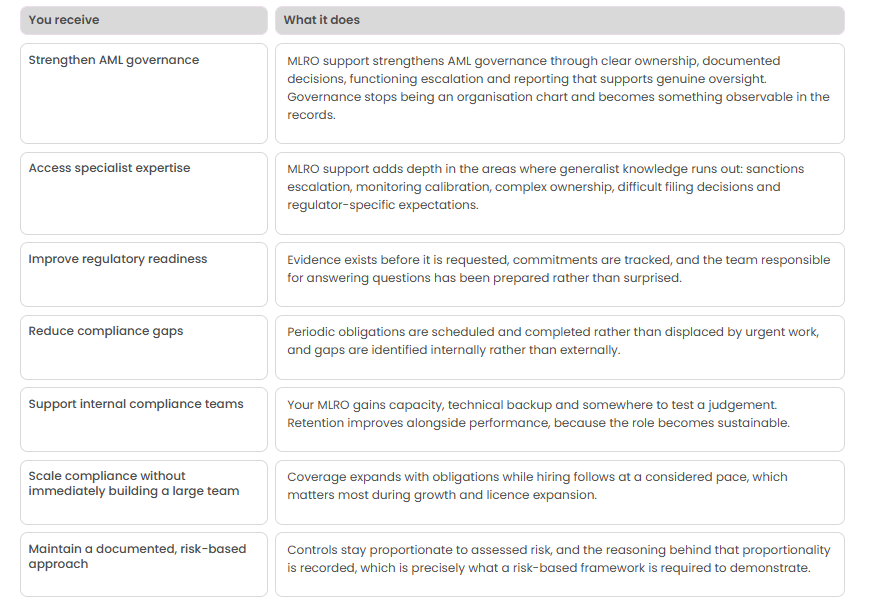
You receive
What it does
Strengthen AML governance
MLRO support strengthens AML governance through clear ownership, documented decisions, functioning escalation and reporting that supports genuine oversight. Governance stops being an organisation chart and becomes something observable in the records.
Access specialist expertise
MLRO support adds depth in the areas where generalist knowledge runs out: sanctions escalation, monitoring calibration, complex ownership, difficult filing decisions and regulator-specific expectations.
Improve regulatory readiness
Evidence exists before it is requested, commitments are tracked, and the team responsible for answering questions has been prepared rather than surprised.
Reduce compliance gaps
Periodic obligations are scheduled and completed rather than displaced by urgent work, and gaps are identified internally rather than externally.
Support internal compliance teams
Your MLRO gains capacity, technical backup and somewhere to test a judgement. Retention improves alongside performance, because the role becomes sustainable.
Scale compliance without immediately building a large team
Coverage expands with obligations while hiring follows at a considered pace, which matters most during growth and licence expansion.
Maintain a documented, risk-based approach
Controls stay proportionate to assessed risk, and the reasoning behind that proportionality is recorded, which is precisely what a risk-based framework is required to demonstrate.
Our MLRO Support Process
Our process runs in six steps, each producing something you can use immediately.
| Step | What we do | Output |
|---|---|---|
| 1. Understand your regulatory environment | We confirm your supervisor, licence category and the specific obligations that attach to the MLRO or Compliance Officer role in your regime, including anything your regulator requires regarding the appointment itself. | Confirmed obligation perimeter |
| 2. Assess your current compliance function | We review the existing framework, resourcing, reporting and records to establish what is genuinely delivered today, which is not always what the documentation describes. | Capability baseline |
| 3. Identify gaps and priorities | Gaps are listed with risk significance and regulatory exposure so sequencing is driven by consequence rather than by ease of completion. | Prioritised gap register |
| 4. Define the appropriate support model | We agree scope, cadence, response times, named consultants and deliverables in writing, explicitly scoped around what your regulator permits. | Written scope and cadence |
| 5. Implement ongoing support | Support runs on the agreed schedule: reviews, reporting, escalation availability and regulatory change translation, with evidence produced as the work happens. | Recurring deliverables |
| 6. Monitor, report and improve | We report on what was delivered, what changed and what is outstanding, then reset the plan annually or whenever the business or the framework changes materially. | Reporting and annual reset |
Why Choose AML UAE for MLRO and Compliance Officer Support?
Entities choose AML UAE for MLRO and Compliance Officer support because of its UAE regulatory knowledge, practical risk-based approach, sector-specific experience, flexible advisory model, support for internal teams, and focus on inspection readiness.
UAE regulatory knowledge
AML UAE works within the UAE framework: Federal Decree-Law No. 10 of 2025 and its Executive Regulations, CBUAE guidance, and the DFSA, FSRA, ADGM RA, CMA, VARA, MoJ, GCGRA, and MoET regimes, applied to the rules that govern your licence rather than adapted from generic international material.
Practical, risk-based approach
Recommendations are proportionate to your assessed risk, your size and your resources. We do not propose a bank-grade programme for a ten-person DNFBP, and we do not accept a minimal framework where the risk profile requires more.
Sector-specific support
Banking, exchange houses, payments, fintech, virtual assets, real estate, precious metals, corporate services and professional firms each carry distinct risks, typologies and supervisory expectations, and our support reflects those differences.
Flexible ongoing advisory model
Scope can start narrow and expand, or contract as your internal capability develops. The objective is a compliance function that eventually needs less from us, not a dependency.
Support for internal MLROs and compliance teams
AML UAE is built to work behind your appointed officers, strengthening the role and evidencing its work, with a clear record of the support provided and the officer’s decisions.
Regulatory and inspection readiness
Because evidence accumulates as the work is performed, inspection preparation becomes an exercise in assembly rather than reconstruction.
Discuss Your MLRO Support Requirements
Tell us your regulator, sector and current gaps. We will propose a scope.
The MLRO and Compliance Specialists Behind Your Compliance Function
Your MLRO and Compliance Officer support is delivered by certified AML specialists with UAE regulatory experience, helping you meet your reporting obligations, manage suspicious transaction escalations through goAML and stay ready for supervisory inspections:

Pathik Shah
CAMS, FCA, CS, CISA, DISA (ICAI), FAFP (ICAI)
Experience
28+ years
Regulatory Coverage
MoET, MoJ, CBUAE, CMA, FSRA, DFSA, VARA · AML/CFT framework design, RegTech

Jyoti Maheshwari
CAMS, ACA
Experience
11+ years
Regulatory Coverage
MoET, MoJ, CBUAE, CMA, FSRA, DFSA, VARA · AML/CFT/CPF framework, health checks

Dipali Vora
CAMS, ACS
Experience
10+ years
Regulatory Coverage
MoET, MoJ, CBUAE, CMA, FSRA, DFSA, VARA · Consulting, training, implementation

Monika Shah
CAMS
Experience
3+ years
Regulatory Coverage
MoET, MoJ, CBUAE, CMA, FSRA, DFSA, VARA · managed KYC, consulting, goAML reporting
Every obligation in your document traces to a specific article of UAE law or supervisory guidance, so your compliance officer can defend any line of it in an inspection. Every framework carries a named reviewer and a review date, and passes an independent quality review under a documented delivery and quality assurance method before it reaches you, which is what separates a tailored framework from a sold template. We are also straight about scope: what your policy must contain depends on your licence, your activities, your regulatory perimeter and your risk profile, and we will tell you plainly what you need and what you do not. And we stay engaged after delivery: training, health checks, annual reviews, and realignment when the law or your business changes.
MLRO and Compliance Officer Support FAQs
The Money Laundering Reporting Officer is the individual appointed by a regulated entity to oversee its AML/CFT/CPF framework, assess internal suspicious activity escalations, report to the UAE FIU through goAML, liaise with the supervisor and report to senior management. The federal Executive Regulations call the role the Compliance Officer (CR 134/2025, Art. 22), and the specific requirements attached to it depend on the regulator, sector and licence.
Core duties include overseeing the AML programme and its controls, contributing to risk assessments, reviewing escalations and deciding on suspicious activity reporting, filing with the FIU, acting as the regulatory point of contact, ensuring training is delivered, and reporting to senior management and the board. In practice, the role must also evidence that each duty was discharged.
The MLRO focuses on AML/CFT/CPF and owns suspicious activity reporting. The Compliance Officer generally carries broader responsibility for regulatory compliance across the entity’s licence conditions. In many UAE entities, one person holds both roles, which is often permitted but concentrates significant workload and creates a single point of failure.
Yes. Financial institutions, DNFBPs and VASPs must appoint a Compliance Officer at management level, with independence in decision-making and appropriate competence and experience (CR 134/2025, Art. 22). Many regulators and firms call this role the MLRO, and individual regulators may add requirements on title, residency and seniority. Confirming exactly what your supervisor requires is the necessary first step before any support arrangement is designed.
Sometimes. Whether the MLRO function can be outsourced depends on your regulator, entity type and licence. Some regimes permit certain arrangements subject to conditions such as approval, residency, availability, independence and competence. Others require a qualifying in-house individual. Confirm the position with your applicable regulator before putting any arrangement in place. Accountability for the framework remains with the entity regardless.
Yes. We support MLROs and AML compliance officers at regulated entities in Dubai, Abu Dhabi and the other emirates, on the mainland, in the commercial free zones, and in the DIFC and ADGM, including entities supervised by the CBUAE, DFSA, FSRA, ADGM RA, CMA, VARA, MoJ, GCGRA and MoET. The scope of each engagement is set against the regulator that supervises your licence.
Yes. Supporting an appointed officer with reporting, escalation review, monitoring oversight, governance packs, training and regulatory correspondence is a well-established arrangement. The appointment, the authority and the accountability remain with your entity, and the support provided should itself be documented.
Typical scope covers AML programme oversight, risk assessment support, CDD and EDD oversight, transaction monitoring escalation support, STR and SAR preparation and goAML support, sanctions and PEP governance, regulatory reporting and correspondence, board reporting and training. Scope is agreed in writing against your regulator, sector and existing capability.
Yes. Support covers registration, profile maintenance, report preparation, narrative quality review and record keeping around the filing. The decision to file and the filing itself sit with your appointed officer (CR 134/2025, Art. 22(2)), and the supporting evidence should be retained so the report can be reconstructed later if questioned.
Yes, and it is one of the most common reasons entities engage. Support covers document pack preparation, evidence indexing, gap identification and remediation before the review, interview preparation for those who will be questioned, and assistance with responses and commitment tracking afterwards.
Reviews should be both periodic and event-driven, because policies, controls and procedures must be reviewed and updated on an ongoing basis (CR 134/2025, Art. 21). Many entities align framework and policy review with the annual risk assessment cycle, with ongoing monitoring and testing through the year, plus reviews triggered by regulatory change, new products, system changes, material business change or findings. The appropriate frequency depends on your regulator, sector and risk profile.
Cost depends on scope, regulatory complexity, entity size, transaction volumes and how much your internal function already delivers. Arrangements range from advisory access through to structured ongoing support, with project work scoped separately. A short scoping discussion produces a written deliverable list and a reliable quote.
Yes. MLRO support is frequently delivered alongside our ongoing AML compliance retainer, which covers the compliance calendar, policy maintenance, risk assessment cycles and regulatory change monitoring. Many entities start with an assessment, then move to ongoing support once priorities are clear.
Conclusion: Strengthen Your UAE AML Compliance Function
Effective MLRO support is not about attaching a name to a compliance role. It is about ongoing governance, genuine oversight and the evidence that both exist. Supervisors do not assess intent. They assess records.
MLRO support must fit your regulatory jurisdiction, your sector and your risk profile. A DIFC firm, a VARA-licensed virtual asset business, a mainland exchange house and a real estate brokerage face genuinely different expectations, and a support model that ignores those differences will not hold up.
AML UAE works behind your appointed MLRO and Compliance Officer: adding specialist depth, delivering the periodic work that otherwise slips, and building the documented trail that makes your framework defensible. Tell us your regulator, your sector and where the pressure currently sits, and we will propose a support model that matches it.
Strengthen Your Compliance Function
Request an MLRO and Compliance Officer support consultation.