
Money Laundering Should Involve Money

You’ll Know When Someone is Laundering Money- It’s Easy to Detect

Money Laundering Should Involve Money

Money Laundering Should Involve Money

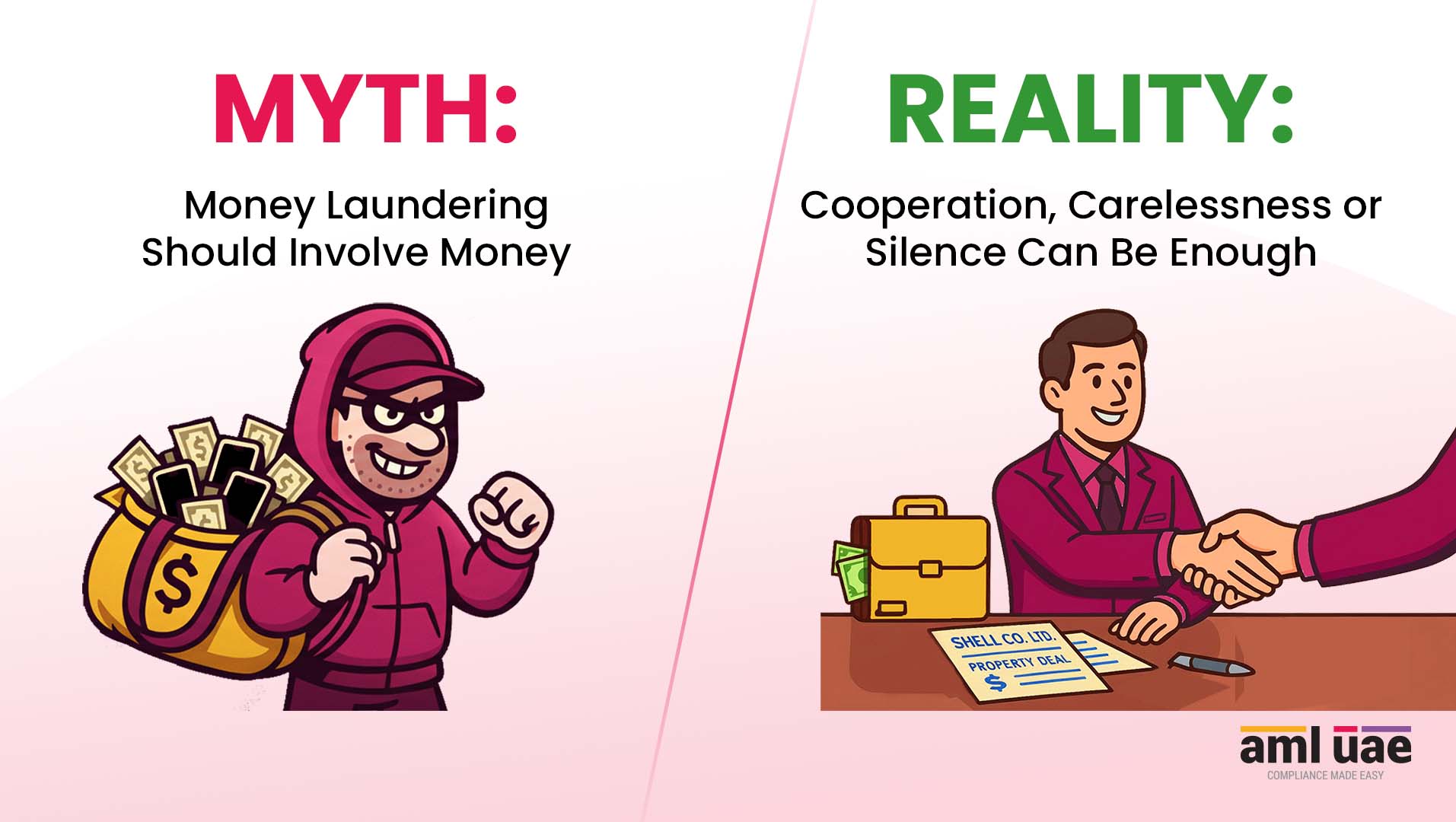
Myth: Money Laundering Should Involve Money

Reality: There need not be cash for there to be a crime. Just cooperation, carelessness, or silence.

When we hear ‘money laundering,’ the imagination leaps. Bundles of cash, Swiss accounts, a man in sunglasses at an airport, nervously glancing sideways as he wheels a suspicious heavy suitcase.

Very cinematic.

Money laundering is not always about having a lot of cash- it’s a myth. In reality, it can happen even without a single dollar exchanging hands.

Have you ever booked a cab for someone else? You didn’t drive it, and you didn’t ride in it, but you set the route and made the journey happen, all through your phone. This is exactly how money laundering works.

Let’s walk through the clearer side of it. Money laundering is not about a terrorist or a gangster wearing balaclavas and owning a suitcase full of cash. Sometimes, it’s as simple and subtle as:

  • Registering a shell company without fact-checking.
  • Letting a friend “borrow” your bank account without asking any questions.
  • A landlord renting an apartment and accepting a large amount of money in cash.

In these cases, none of them have touched the money, but they have created a path, they have become a helping hand, and this is exactly what laundering looks for.

These actions feel harmless and worthy of letting go, but they are not. Thinking “I am just doing a favour” or “that’s not a big deal,” this thought leads to laundering sneaking in. A circle of carelessness, loopholes, and lack of questions will make you play merry-go-round, which you might not enjoy.

Now laundering has become like filtered water- clear to the eye, yet full of invisible toxins unless tested. It’s not just drug lords or arms dealers; it could be any valued professional. People like you and me are unintentionally pulled into a system that feeds on low suspicion and high opportunity.

That’s why understanding this myth, that laundering always involves cash or a crime, which is obvious, is not just necessary but urgent as well.

Because money laundering is not about spotting the obvious, it’s about questioning the ordinary or a deal too clean to doubt.

As old wisdom says: ‘Prevention is better than the cure.’

Being alert won’t cost you anything, but being ignorant and hiding behind the pillars of innocence will cost you a lot.

Prevention is Protection

Share via :

Share via :

Money Laundering is a concern for big firms

Money Laundering is a concern for big firms

Money Laundering is a concern for big firms

Money Laundering is a concern for big firms

The idea is outdated. The reality is inconvenient. And ignoring it is risky. Let’s get one thing straight. This myth needs to retire. Permanently.  

Do you think only billionaires pay taxes? Adorable.  

Let’s dismantle this myth. Small and medium-sized businesses have clung to the comforting illusion that money laundering is a ‘big firm problem.’ That it’s something for multinational banks and global financial institutions to worry about, it is as if criminal networks check your balance sheet before exploiting you.  

They’re not interested in your annual turnover. They’re interested in your blind spots.  

The belief that money laundering is only the problem of banks, billion-dollar conglomerates, and multinational corporations is dangerously misleading. It gives smaller businesses a false sense of immunity and offers criminals exactly what they want: low-profile entry points with minimal resistance. 

Criminals aren’t flashy. They love businesses that think they’re too small to matter.  

The myth persists because it’s convenient. It’s easier to believe that ‘money laundering happens elsewhere.’ That’s a plot point in movies. That it’s someone else’s problem, but that thinking creates a blind spot. And blind spots are exactly where financial crime flourishes.  

Criminals, their creativity cares about your inattention. Your charming lack of paperwork. Your delightful habit of “not overcomplicating things.” Believing money laundering only happens to big firms is like thinking arson only happens to mansions. The fire doesn’t care what neighbourhood it’s in. It just wants fuel. 

And small businesses are flammable. Criminals select you because you are small. Launderers don’t fear your size. They fear your systems. And that’s exactly what you’re expected to have. It’s the bare minimum. You’re expected to: 

None of these is optional. There is no ‘small firm exemption.’ 

Old wisdom says, “Big door swings on small hinges.” 

It’s easy to watch skyscrapers and assume the storm only hits them. But sometimes the lightning strikes the tool shed. The one no one thought to lock. 

Don't let subtle transactions outsmart your compliance program

Share via :

Share via :

Myth – Only Large Sums of Money are Laundered

Myth - Only Large Sums of Money are Laundered

Myth - Only Large Sums of Money are Laundered

Myth - Only Large Sums of Money are Laundered

Reality Check: It’s not always the millions. In fact, the clever ones keep it small. Subtle. Silent. They know that if you want to avoid a spotlight, you don’t stride onto the stage in sequins. You slip in through the side door with your head down and your pocket full.

Somewhere along the way, we picked up the idea that if money laundering doesn’t involve suitcases full of cash or secret accounts, it’s probably not worth worrying about.

The logic lies in the assumption: if it’s not millions, it’s not a crime.

But let’s pause there.

Because the idea is like assuming only big dogs bite. Sure, the Rottweiler looks scary, but have you met a Chihuahua with a grudge?

In most imaginations, we associate money laundering with a scene worthy of a blockbuster: back alleys, coded phone calls, suitcases stuffed with dollars.

Let’s throw that logic out of the window. The big argument. The big success. The big mistake. But it’s usually the small stuff that slowly moves the needle. A dozen late texts chip away at a friendship. A quiet daily walk improves your health. Tiny purchases drain your bank account.

We tend to overlook the slow trickle. A few thousand here. A payment just under the threshold there. Nothing dramatic. And that’s the trick, technically known as structuring. The danger lies in the pattern. Not the storm. Not the flood. Just small, persistent nibbles until there’s nothing left.

So, yes, a small transaction won’t make the headlines. But 30 of them linked across accounts?

Laundering isn’t a cinematic heist. It’s quiet, consistent, and cunning. And unless your transaction monitoring program is tuned in to the subtleties, you’re only watching the stage, while the magic happens behind the curtains.

Old wisdom says, “Little drops of water make a mighty ocean.”

Well, little dirty drops? They make for a laundering scheme.

Let’s not miss the puddle just because it didn’t look like a flood.

Don't let subtle transactions outsmart your compliance program

Share via :

Share via :