



Protect your business with reliable and effective AML strategies with AML UAE.
Last Reviewed On: 07/30/2026 | Last Updated On: 07/30/2026
Dealers in Precious Metals and Stones (DPMS) operate in a sector that is highly prone to Money Laundering (ML), Terrorism Financing (TF), and Proliferation Financing (PF) activities. To address this, DPMS sector Regulated Entities must file Dealers in Precious Metals and Stones Report (DPMSR) for specified high-risk transactions.
Explore DPMSR requirements, common challenges and practical ways DPMS businesses can efficiently report DPMSR.
What is Dealers in Precious Metals and Stones Report (DPMSR)?
Dealers in Precious Metals and Stones Report (DPMSR) is a DPMS sector-specific Regulatory Report submitted for transactions that equal or exceed AED 55,000 in cash or wire transfers.
Who Needs to File DPMSR in UAE?
Dealers in Precious Metals and Stones (DPMS) in the UAE are required to file the DPMSR. This obligation arises when DPMS are involved in covered activities for Anti-Money Laundering (AML), Counter-Financing of Terrorism and Counter Proliferation Financing (CPF) compliance as specified in Article 3 of Cabinet Decision No. (134) of 2025.
When to File a DPMSR?
DPMS sector must submit DPMSR when they are involved in transactions that meet the following specific criteria for reporting:
- Cash transactions amounting to AED 55,000 or more with resident individuals or non-resident individuals.
- Cash transactions with corporate entities amounting to AED 55,000 or more.
- Transactions with corporate entities involving international wire transfers equal to or exceeding AED 55,000
- All international wire transfers to be reported when the amount equals to or above AED 55,000
- Any wire transfer conducted through an exchange house, even if the transaction is within UAE.
- Cash installment or advance payments equal to or exceeding the AED 55,000 threshold, to be reported at the time of receiving funds.
- Unfixed gold transactions in cash equals to or exceeding AED 55,000 threshold.
- Transaction between two free trade zone companies settling the payment in USD through international wire transfer.
- Settlement between a free trade zone company and an onshore company (not part of the same group) in the UAE conducted via international wire transfer.
If the above criteria are satisfied, then DPMSR is filed via the goAML portal.
What Transactions are Exempt from being Reported into a DPMSR?
There are certain transactions that are exempted from being reported into DPMSR. These specific transactions are:
- Credit card, cheque or bank transfers with individuals, irrespective of the amount.
- Old gold exchange or old gold/jewellery exchange for new jewellery, where no cash component exceeds the threshold limit.
- Local wire transfers or cheque transactions from a local bank within the UAE.
- Gold to gold barter trading, where making charges are paid via cheque or wire transfer.
- Payment towards Margin calls and loans with banks.
- Intra-company transfers and intra-company sales or purchases in cash, even if they exceed the AED 55,000 threshold.
- Cash making charges exceeding the threshold, provided no buying or selling of precious metals and stones is involved in that specific payment.
- Transactions conducted via Letters of Credit issued by banks.
- Wire transfer within the same group, such as between a mainland company and a company in a free zone.
- Transaction between two Free Trade Zone companies, settling the payment through the bank accounts in the same bank in UAE.
- Local USD transfers between two entities registered in UAE, using accounts at the same bank in the UAE.
- Settlements between two onshore companies in the UAE conducted in USD through local banks.
- Physical trade of precious metals and stones with commercial banks that are regulated and operating outside the UAE.
- Transaction between related parties, even if one is on the mainland and the other is in Free Trade Zone, provided they use UAE bank accounts.
Legal Obligation for Filing DPMSR
Ministry of Economy’s Circular No. 08/2021 on Dealers in Precious Metals and Stones Report is the primary mandate explicitly introducing the DPMSR filing requirement for the DPMS sector in UAE. It has extensively mentioned DPMS transactions that need to be reported.
Article 3 of Cabinet Decision No. (134) of 2025,classifies Dealers in Precious Metals and Stones (DPMS) as Designated Non-Financial Businesses and Professions (DNFBPs) when they carry out single or several linked cash transactions whose value equal or exceed AED 55,000.
By virtue of it, they must comply with AML/CFT/CPF obligations mandated by UAE’s Federal AML/CFT/CPF Laws, Cabinet Decisions and other directives issued by relevant Supervisory Authorities in connection therewith.
Consequences of Failure to File DPMSR
Ministry of Economy and Tourism is a Supervisory Authority that oversees the AML/CFT/CPF compliance in the DPMS sector.
Article 17 of Federal Decree Law No. (10) OF 2025, gives power to MOET to impose severe penalties, including fines ranging from AED 10,000 to AED 5,000,000, potential suspension or revocation of their business license, restriction on business activities for non-compliance with any directives issued by them in connection with the AML/CFT/CPF compliance.
Accordingly, Dealers in Precious Metals and Stones are subject to regulatory penalties from MOET if they fail to report DPMSR when required.
What is the Timeline for filing DPMSR on the goAML Portal?
Dealers in Precious Metals and Stones Report (DPMSR) need to be filed on the goAML portal within 2 weeks of the occurrence of a qualified transaction for DPMSR.
Why is DPMSR Filing Necessary for the DPMS Sector?
DPMSR filing is necessary for the DPMS sector, as it is one of the most lucrative sectors for miscreants to disguise illegal money, according to MOET’s Supplemental Guidance for DPMS. This necessitates stronger regulatory oversight and transparency.
DPMS sector deals in high-value commodities such as gold, diamonds and other precious metals. The transactions pertaining to these high-value items can be misused for Money Laundering (ML), Terrorism Financing (TF), or Proliferation Financing (PF) activities.
Specified transactions that need to be reported in DPMSR, as stated by MOET, carry a higher risk of ML/TF/PF. Reporting these transactions to the Financial Intelligence Unit (FIU) serves as a preventive compliance measure and helps authorities keep visibility over such transactions.
Common Challenges Faced by the DPMS Sector in Filing DPMSR
While filing the DPMSR, the DPMS sector often faces several problems. These common challenges include the detection of structured transactions below the reporting threshold, understanding DPMSR obligations, an unclear escalation path for reporting, problems navigating goAML, and a lack of skilled resources.
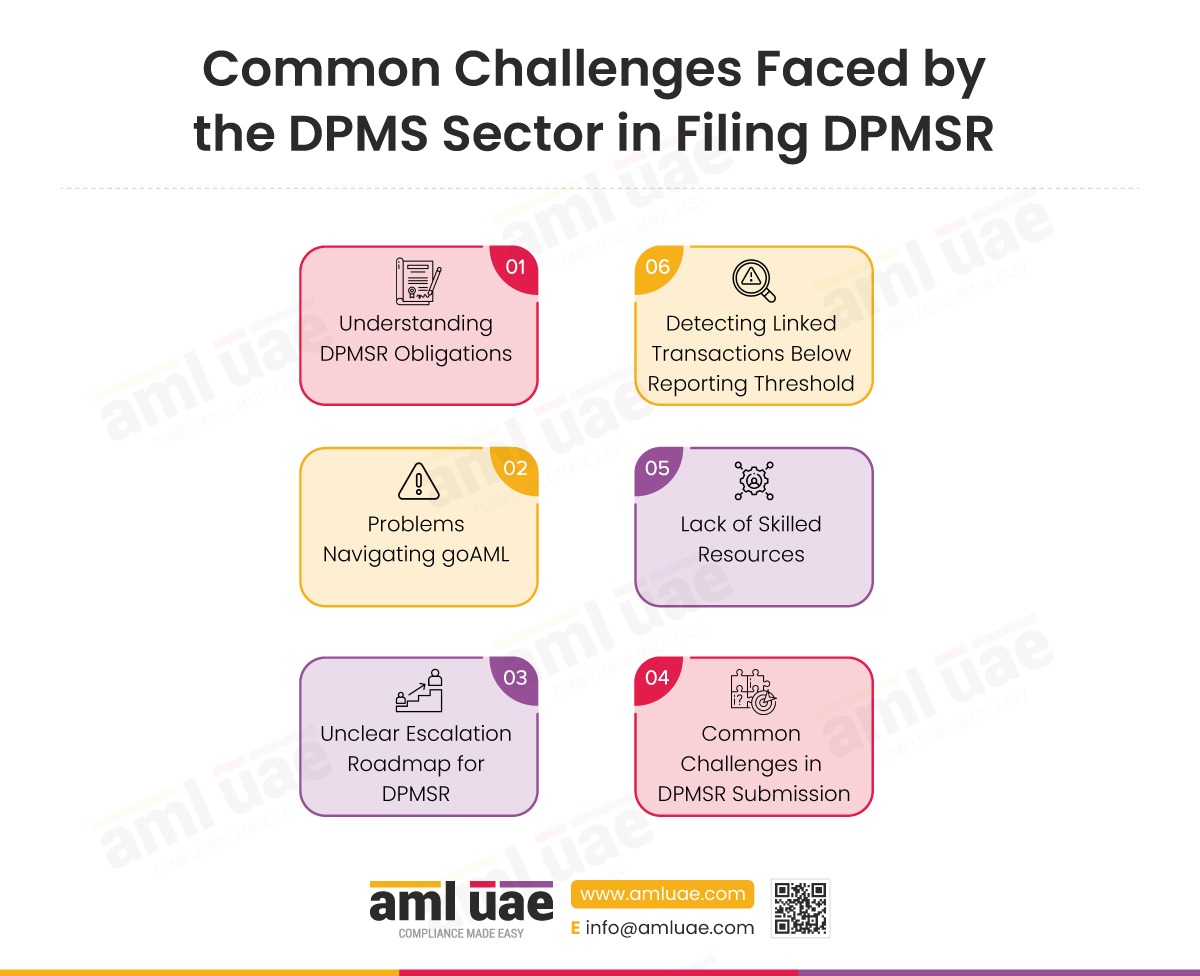
Understanding DPMSR Obligations
Many DPMS businesses struggle to determine whether a transaction meets the AED 55,000 reporting threshold, especially when payments involve mixed methods, such as partial cash and partial wire transfers.
This creates uncertainty about whether a transaction qualifies for DPMSR and when exactly the reporting is required.
Detecting Linked Transactions Below Reporting Threshold
Detecting linked transactions below the reporting threshold is another major issue for DPMS businesses. Customers may split payments into smaller amounts and make multiple purchases over a short period.
Identifying when such transactions are connected and should be treated as a single reportable transaction can be difficult without robust transaction monitoring tools.
Problems Navigating goAML
DPMSR is filed via the goAML portal; the DPMS sector often struggles to navigate this platform due to a lack of understanding of the portal and technical inabilities.
Lack of Skilled Resources
Another major problem in submitting DPMSR is that not all DPMS businesses have dedicated compliance staff, as many of them are small enterprises with a lack of economic and human resources.
This can increase the risk of errors or missed reporting because verifying transactions and preparing accurate reports require skilled resources.
Unclear Escalation Roadmap for DPMSR
Many of the DPMS businesses have outdated or inconsistent procedures in place for escalating reportable transactions. Sometimes these procedures exist only on paper; execution is totally scattered.
This creates internal confusion about when and how to file DPMSR, leading to missed or delayed reporting.
Say Bye to DPMSR Submission Challenges!
Let Experts Help You Fix DPMSR Reporting Gaps.
Step-by-Step Guide for DPMS Sector to Submit DPMSR
Accurately filing DPMSR requires a structured approach and chronological process from DPMS businesses.
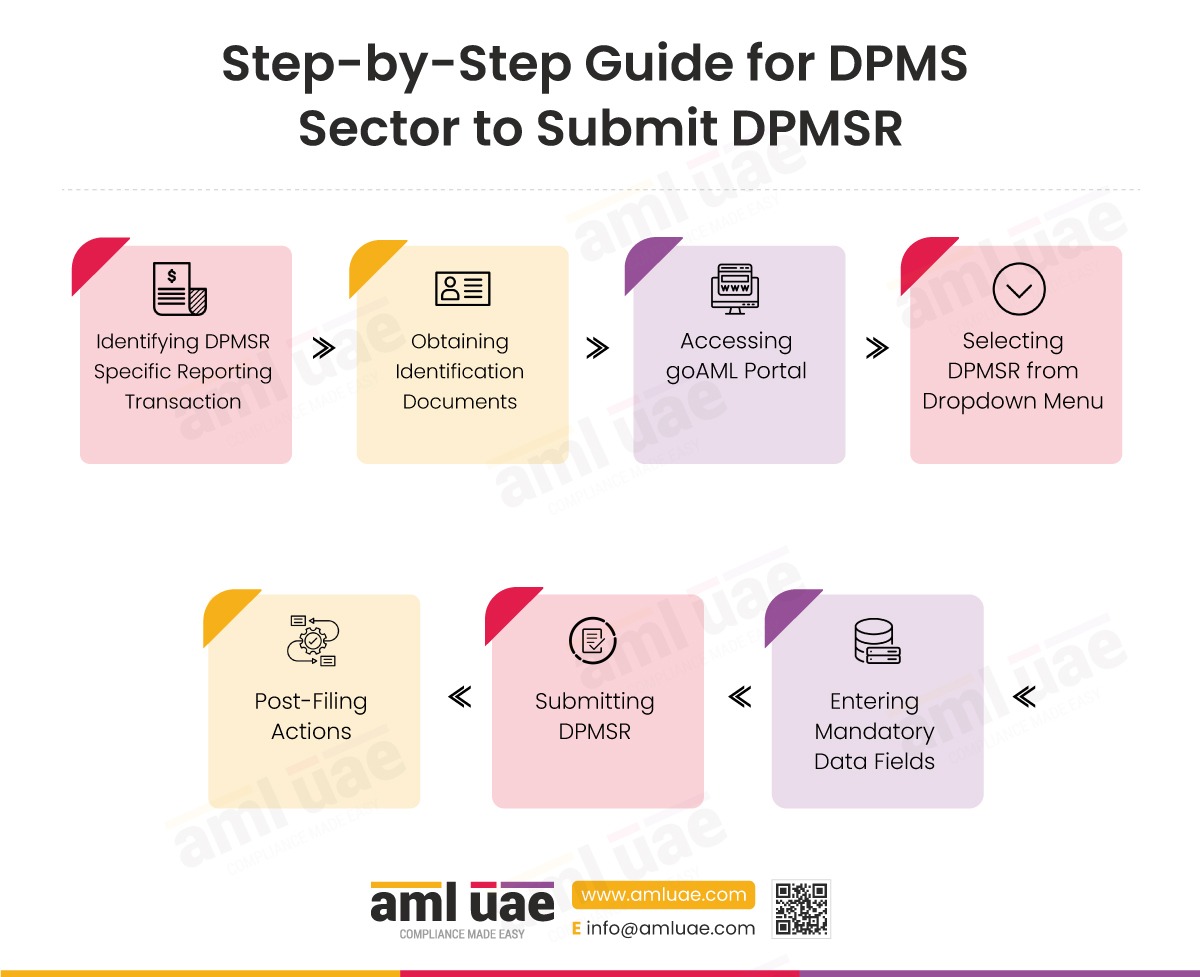
The DPMSR filing process involves identifying DPMSR-specific reporting transactions, obtaining identification documents, logging into the goAML portal, selecting the DPMSR report type, entering mandatory data fields and submitting the report.
Identifying DPMSR Specific Reporting Transaction
The first and foremost step is to determine whether the transaction meets the reporting requirements of DPMSR.
As explicitly stated by MOET, when a transaction crosses the threshold of AED 55,000 in cash or international wire transfer, the obligation to file DPMSR arises. If thresholds are met or suspected to be met collectively, the transaction qualifies for DPMSR reporting.
Obtaining Identification Documents
The next step is to obtain identification documents of the parties involved in the reportable transaction.
The following identification documents need to be collected:
- Resident individual: obtain an Emirates ID or a passport copy
- Non-Resident individual: valid Govt. issued ID or passport copy
- Corporate Entities: Trade License, Emirates ID or passport copy of representative person
Accessing goAML Portal
The following step after obtaining ID documents is to log into goAML portal.
DPMS businesses can log into goAML portal with the credentials given at the time of registration. Also, goAML profile needs to be updated and current.
Selecting DPMSR from the Dropdown Menu
The next step is to select the DPMSR report type from the given dropdown menu.
After logging into goAML portal, click on the web report tab, navigate to the report type dropdown menu and select Dealers in Precious Metals and Stones Report (DPMSR) from the list of reports given.
Entering Mandatory Data Fields
The next step for DPMS sector Regulated Entities is to enter mandatory data fields on goAML portal before submission.
Reporting Entities need to complete all fields marked with an asterisk (*) as these are mandatory for submission.
Key sections include transaction information, details of parties involved in the transaction, and the reason for reporting.
While entering these data fields, Regulated Entities should ensure that no required data is missing, as it can cause system rejection.
Submitting DPMSR
Once the mandatory data fields are filled out, the next step is to click on the submit button and complete the filing of DPMSR.
Before clicking on the submission, it is advisable to review the report for accuracy and completeness. The supporting documentation, such as ID documents, proof of address, deposit slips, and client information, is attached post-saving the report.
It should be noted that each attachment must be under 5 MB in size as a total of 20 MB is allowed per report, and attachment file names should be short and without any special characters.
Post-Filing Action
The final step following the submission of DPMSR is to retain and maintain a submission copy of DPMSR and its supporting documents for at least 5 years, subject to the obligation of record-keeping under the UAE’s AML/CFT/CPF laws.
Need Help in Navigating goAML for DPMSR Filing?
Let Our Experts Guide You to File an Accurate DPMSR
DPMSR Reporting Excellence: A Best-Practice Guide for the DPMS Sector
Dealers in Precious Metals and Stones Report (DPMSR) is not just a generic compliance obligation, but it safeguards the financial system from any kind of potential ML/TF/PF risks arising out of high-value PMS transactions.
Regulated Entities in the DPMS sector must maintain accuracy and timeliness while filing DPMSR by adopting some of the best practices.
These best practices include leveraging advanced transaction monitoring tools, setting clear reporting triggers in policies, inculcating staff with DPMSR-specific knowledge, maintaining audit-ready documentation and establishing a transparent escalation workflow for swift filing.

Leverage Advanced Transaction Monitoring Tools
Regulated Entities must implement advanced transaction-monitoring tools and calibrate their rules to align with the DPMSR triggers.
Transaction monitoring tools ensure that DPMSR-specific reportable transactions are identified in real time, especially when payments are split, structured or made through different channels.
Set Clear Reporting Triggers in Policies and Procedures
DPMS sector Regulated Entities must explicitly define the obligation to file DPMSR and set clear reporting triggers for it in their internal AML/CFT/CPF policies and procedures.
Well-documented triggers remove guesswork for staff and ensure consistent reporting decisions.
Inculcate Staff with DPMSR Knowledge
Regulated Entities in the DPMS sector must inculcate DPMSR-specific training for their staff to ensure accurate filing.
Training employees on reporting thresholds, red flags and documentation requirements ensures that they understand why DPMSR is required and what transactions qualify for it.
Moreover, Reporting Entities should also train their employees on how to navigate the goAML platform, as ultimately, they must go and file the report there only.
Maintain Audit-Ready Documentation
Regulated Entities must ensure that audit-ready documentation is in place.
All transaction records, customer identification documents, invoices, and payment proofs must be organised and easily retrievable. Proper documentation supports accurate reporting and demonstrates preparedness for regulatory inspections.
Establish Transparent Escalation Workflow
Regulated Entities in the DPMS sector must establish transparent internal escalation workflows for DPMSR filing.
A clearly defined escalation procedure makes sure that reportable transactions are escalated, reviewed, filed, and submitted by the right person. This closes major reporting gaps such as inconsistencies, delays and ensures swift, efficient DPMSR reporting.
How AML UAE Supports Robust Submission of DPMSR by Mitigating Common Challenges
Despite clearly written regulatory obligations for DPMSR filing, the DPMS sector often faces several problems in executing this compliance measure.
We here at AML UAE support DPMS businesses to develop a strong AML/CFT/CPF compliance framework that resonates with regulatory expectations and DPMS sector-specific requirements. In this, we cover comprehensive solutions for efficient DPMSR filing tailored to your business.
- Problem: Regulated Entities often enter incorrect data fields in the goAML portal while filing DPMSR, leading to report rejection.
Solution: AML UAE assists DPMS sector Regulated Entities in preparing, reviewing and submitting DPMSR accurately on the goAML portal through its AML Regulatory Reporting services. - Problem: DPMS businesses struggle to detect linked transactions that cross the threshold of AED 55,000 when multiple purchases are made by the same customer on different days.
Solution: AML UAE supports DPMS businesses to detect linked transactions by recommending advanced tools and systems that automatically flag such related transactions through its AML Software Selection services. - Problem: DPMS staff are mostly unsure which payment types or transaction scenarios trigger DPMSR filing and often confuse it with other regulatory reports, leading to incorrect reporting.
Solution: AML UAE’s AML Training services provide practical guidance for filing DPMSR. These training sessions are tailored to the DPMS sector, which helps teams to understand sector-specific compliance requirements and remove confusion. - Problem: A lot of DPMS sector Regulated Entities maintain compliance documentation but lack alignment with written controls and actual reporting practices.
Solution: AML UAE, through its AML Health check services, helps DPMS sector Regulated Entities to assess whether the existing framework works effectively in real operation, and through its AML Policies, Controls and Procedures Documentation services, enhances the internal AML/CFT/CPF framework as per DPMS sector-specific AML/CFT/CPF compliance requirements.
Fulfil Dealers in Precious Metals and Stones Report (DPMSR) Reporting Requirement Confidently
Meeting Dealers in Precious Metals and Stones Report (DPMSR) reporting requirement is essential for DPMS sector Regulated Entities for complete compliance with the UAE’s AML/CFT/CPF regulatory obligation.
Even small lapses in identifying reportable transactions, capturing details or filing reports in the required timeline can expose the DPMS businesses to greater ML/TF/PF risks and regulatory scrutiny.
Thus, they need to count on tailored solutions and approaches for accurately filing DPMSR. AML UAE supports DPMS businesses to simplify the complex DPMSR reporting process through its specialised services and expert team. It offers the right guidance and advice that helps entities confidently meet their regulatory obligations.
Manage DPMSR Filing with Clarity and Confidence
Full-proof DPMS Sector AML/CFT/CPF Compliance with Our Expert Support and Efficient Services
FAQs on Dealers in Precious Metals and Stones Report (DPMSR)
Specified transactions that equal or exceed AED 55,000 are to be reported in DPMSR on the goAML portal.
No, both B2B and B2C transactions are to be reported in DPMSR on the goAML portal if transactions exceed the specified amount.
No, as the transaction involves the local transfer between accounts in the same bank in the UAE.
Yes, as the transaction involves an international wire transfer, the same needs to be reported.
No, the transaction does not involve an international wire transfer, and hence it need not be reported as a DPMSR on the FIU goAML portal.
Share via :
About the Author

Jyoti Maheshwari
CAMS, ACA
Jyoti has over 11 years of hands-on experience in regulatory compliance, policymaking, risk management, technology consultancy, and implementation. She holds vast experience with Anti-Money Laundering rules and regulations and helps companies deploy adequate mitigation measures and comply with legal requirements. Jyoti has been instrumental in optimizing business processes, documenting business requirements, preparing FRD, BRD, and SRS, and implementing IT solutions.

Reach Out to Jyoti