


Utility Bill Verification
Last Updated: 28th January 2026
Verifying the Utility Bill is a crucial step to establishing the identity of the customer. The Utility Bill is presented as proof of address, which can be cross-checked against their current location to verify their actual presence. This step is necessary for carrying out identity verification and for compliance checks.
What is Utility Bill Verification in the UAE?
Utility Bill Verification is the process of using a recent Utility Bill, such as electricity, water, gas, or internet bill, for confirming and verifying a customer’s residential or business address during identity verification and compliance checks. This process is also known as the address verification process.
It forms a core part of Know Your Customer (KYC) and Anti-Money Laundering (AML) and Combatting the Financing of Terrorism (CFT) procedures across Regulated Entities like Financial Institutions (FIs), Designated Non-Financial Businesses and Professions (DNFBPs), Virtual Assets Service Providers (VASPs).

Utility Bill Verification: Regulatory Framework in UAE
The Federal Decree Law No. (10) of 2025, calls to implement thorough Customer Due Diligence (CDD) measures before onboarding the customer, which includes identifying and verifying the information pertaining to the customer, like address details.
Cabinet Decision No. (134) of 2025 highlights the need to obtain basic information such as residential address (for natural persons) and head office or principal place of business address (for legal persons and legal arrangements).
The FATF Recommendation 10 necessitates verifying the identity of the customer as part of CDD measures. This includes obtaining basic information such as the address of the registered office or principal place of business. This forms the regulatory framework for Address Proof Verification.
In addition to this, the Guidelines for DNFBPs provide for the identification and verification of natural persons, legal persons and legal arrangements by obtaining proof of their residential address, such as a utility bill.
The regulations and recommendations mandate verifying the details in the Address Proof, such as a Utility Bill, as part of conducting due diligence.
What is the Importance of Utility Bill Verification?
In the UAE, conducting Customer Due Diligence (CDD) is a crucial aspect of compliance checks for Regulated Entities (REs). This involves seeking adequate information for the customer identification process.
The adequate information collected includes address information, which helps REs make a reasonable decision pertaining to the customer onboarding.
In Address Proof Verification, a document such as a utility bill is considered. This helps in ascertaining the legitimacy of the customer, completing the CDD process, identifying discrepancies, preventing fraud and supporting risk profiling.
The following outlines the importance of Address Proof Verification:
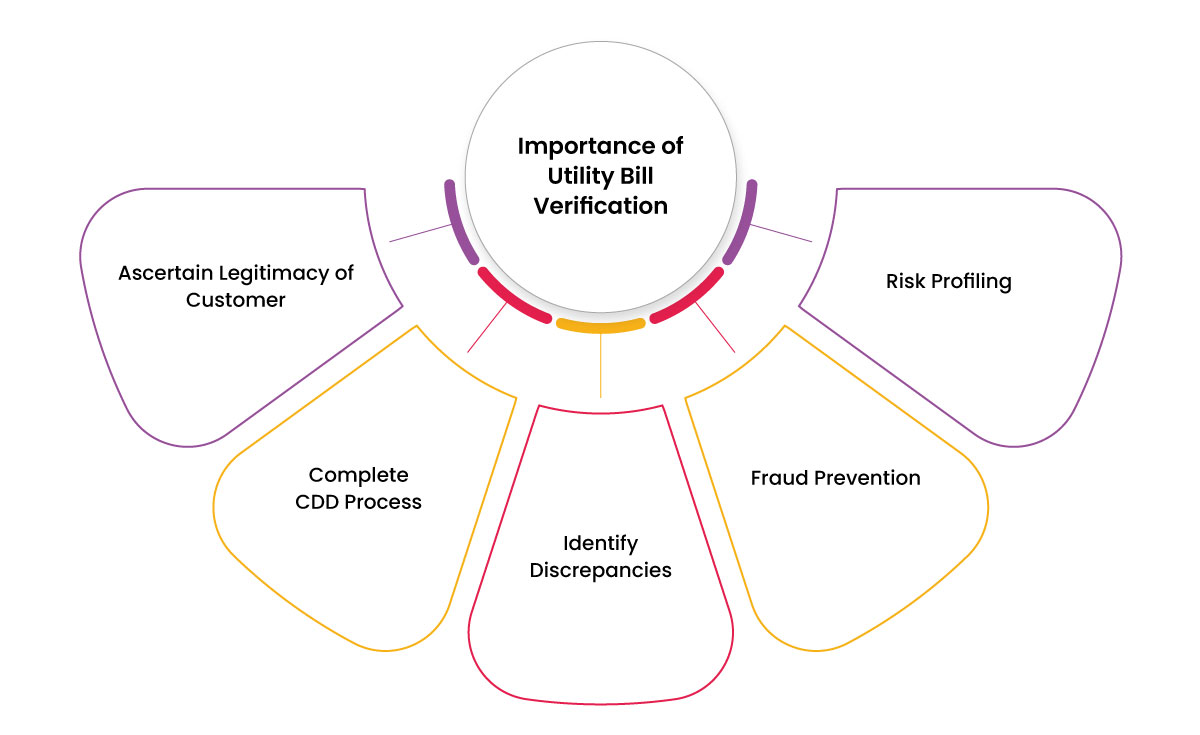
Ascertain the Legitimacy of the Customer
The process of customer identification and verification involves using Address Proof, such as a Utility Bill. It allows Regulated Entities to examine the genuineness of the customer details, such as their identity and address.
Complete CDD Process
The CDD process includes customer identification and verification. REs need to make it a point to make sure they are collecting, identifying and verifying the details of the customer to satisfactorily conclude the CDD process.
Identify Discrepancies
The process of verifying the address might bring forward several discrepancies. This includes mismatches in the customer profile and address, similarities in correspondence address across multiple customers, mismatches in geolocation and IP address for transaction, frequently changing address, etc.
Fraud Prevention
It promotes detecting fake identities, shell companies, or non-existent addresses, which ultimately aids in reducing fraud and illicit activity risks. For example, identifying a tampered bill submitted by a corporate client during onboarding.
Risk Profiling
It supports adopting risk-based approaches for onboarding and ongoing due diligence, enhancing customer risk scoring. The customer addresses that are associated with high-risk jurisdictions enable REs to undertake proper measures to counter the risks associated with such customers.
What are the Operational Pain Points for Utility Bill Verification
The process of Utility Bill Verification may entail suspicious indicators which may arise beyond transactional patterns such as inconsistent address details, hesitating or refusing to provide updated documents, or signs of document tampering.
It becomes pertinent to ensure Regulated Entities are identifying and escalating these non-transactional red flags as they are critical for maintaining AML/CFT compliance and ensuring timely reporting.
The common pain points faced while carrying out compliance are as follows:
Regulated entities often do not have clear procedures to collect, verify, and escalate discrepancies found during Utility Bill checks. As a result of this, businesses often struggle to ensure that all verifications are accurate and complete.
Due to siloed systems, entities often find it difficult to reconcile the findings of the Utility Bill verification with sanctions, PEP, and adverse media checks. This results in delays in customer onboarding and failure in detecting suspicious patterns
Struggling with Utility Bill Verification challenges?
AML UAE helps you streamline verification, detect anomalies, and future-proof your AML/CFT compliance.
Step-By-Step Process for Regulated Entities to Verify Utility Bills
The process of effectively verifying the address proves to be a critical component of the KYC and AML/CFT framework in the UAE. It helps in ensuring that the information provided for the customer address is accurate, up-to-date, and compliant with regulatory requirements and international standards.
There are several acceptable sources to verify address proof, and this includes acquiring the Utility Bill to verify the same.
The step-by-step process for verifying Utility Bills includes collecting the documents, checking recency, matching the customer details, record keeping, escalating, and reporting the matter to the UAE FIU when required. The process is outlined as follows:
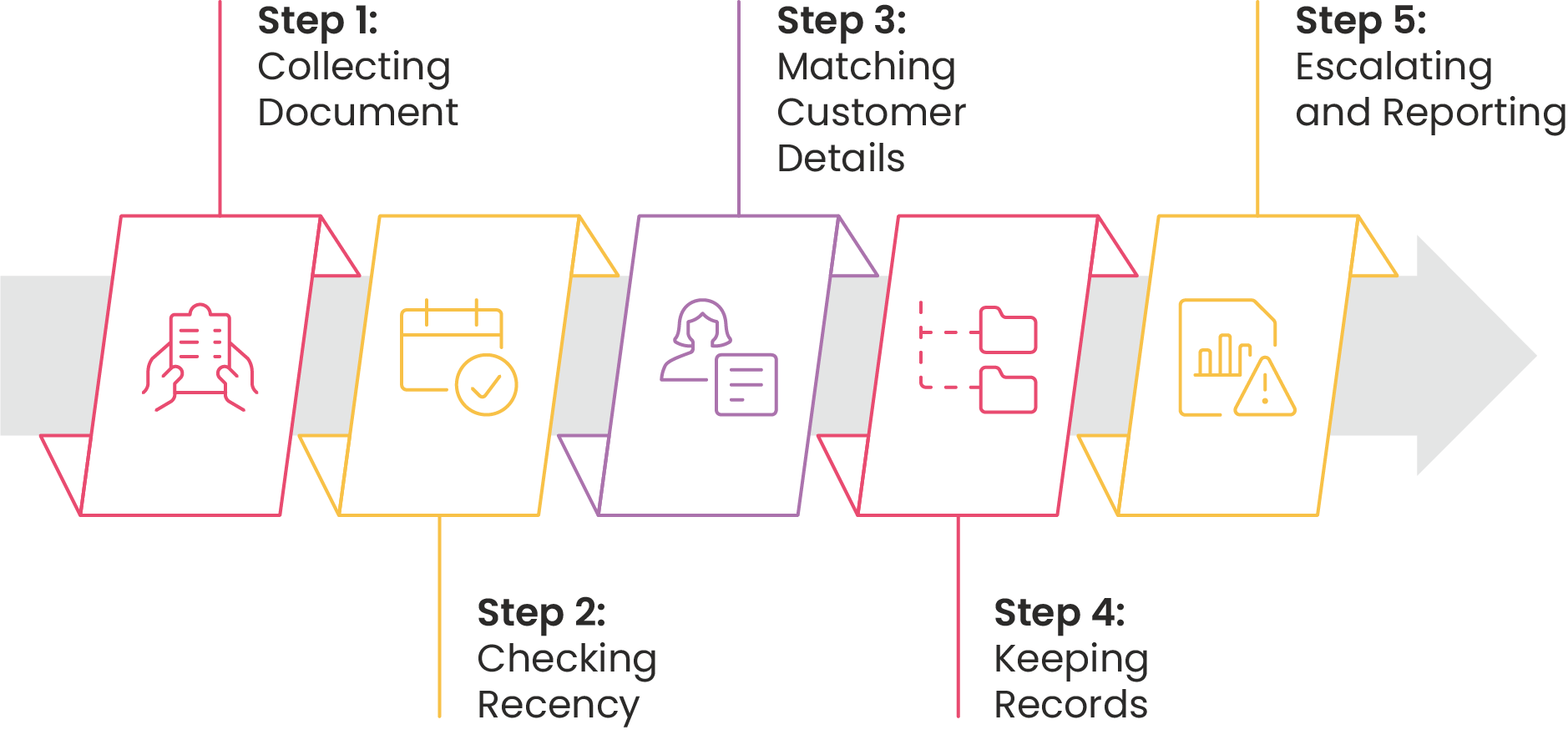
Step 1: Collecting Documents
The first step is requesting proof of residence from the customer. A recent Utility Bill from the customer (electricity, water, telecom, or internet) is an acceptable source of proof of residence. It is important to ensure the bills provided are clear, complete, readable, and from acceptable sources.
Step 2: Checking Recency
This process is necessary to confirm if the utility bill is not outdated.
Step 3: Matching Customer Details
The next step is verifying that the name and address match the details provided during onboarding.
In the case of corporate customers, the bills need to be compared with the trade license or other official corporate records. In addition to this, using digital verification tools that can detect tampering, verify issue dates, and identify red flags improves accuracy.
Step 4: Record Keeping
The later step involves verifying the Utility Bills that need to be saved in the customer’s KYC profile and securely keeping the same, such that they are easily accessible for regulatory audits.
These essential documents related to KYC and Identity verification of customers are required to be maintained for at least five (5) years for Regulated Entities in the UAE mainland as per the AML/CFT legislation of the UAE.
Step 5: Escalating and Reporting
The final step involves cases where discrepancies or suspicious behaviour are identified.
For instance, if despite requesting valid address proof multiple times, a customer refuses to provide or there are doubts of tampering, then such occurrences require escalation to the Compliance Officer for further review.
Common Challenges faced During Utility Bill Verification
There are several challenges which arise while verifying the Utility Bill which can prove to be a bottleneck and prevent REs from carrying out due diligence.
Handling poor-quality documents, detecting tampered bills or managing outdated records can create bottlenecks in onboarding, periodic reviews, and ongoing monitoring.
The challenges include poor quality or missing information, tampering, or submitting fraudulent or expired bills, having inconsistent formats across providers, having limited skilled resources, and obtaining mismatches in name and address.
The challenges elaborated are as follows:
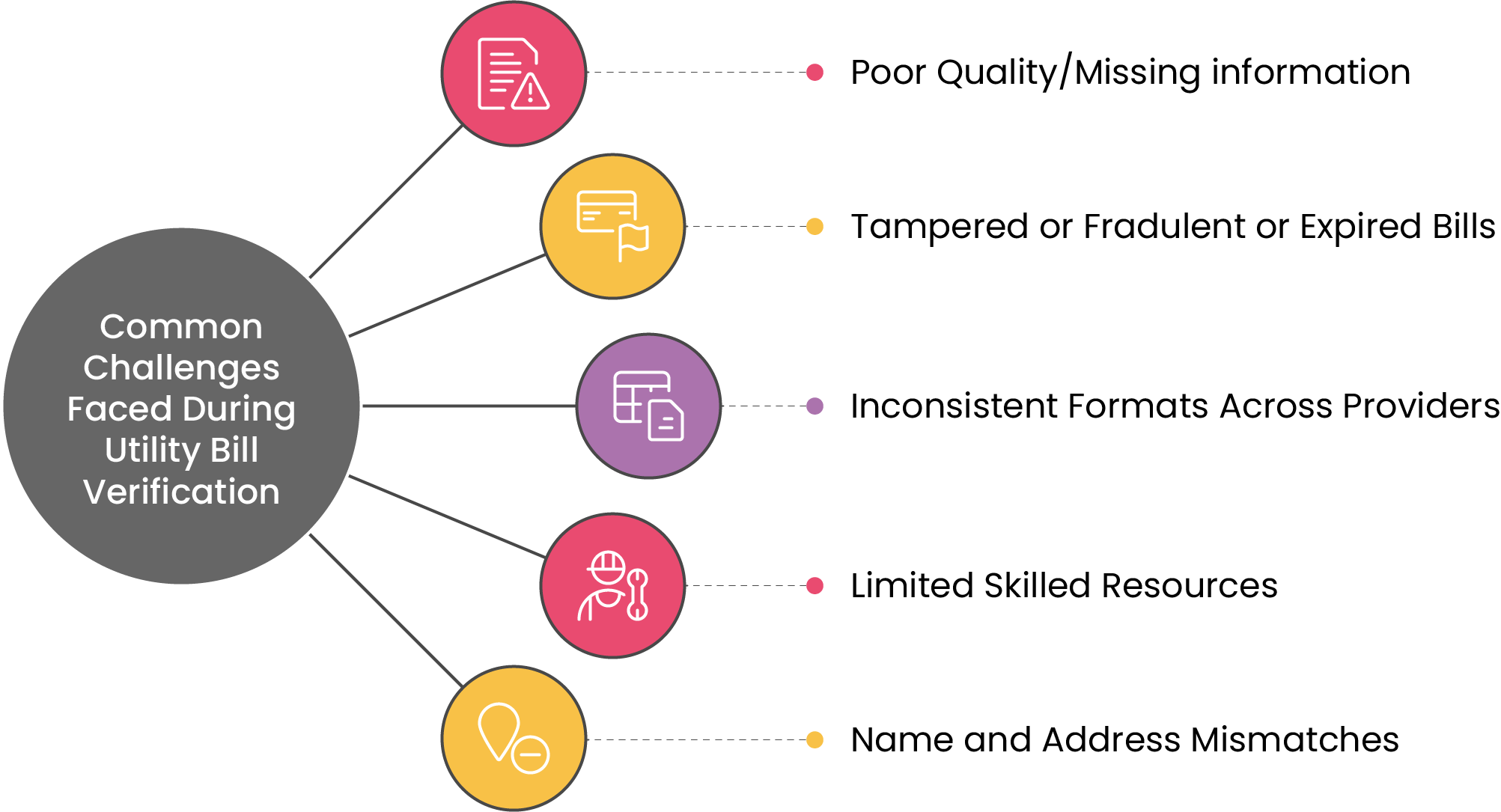
Poor Quality/Missing Information
The process of due diligence requires customers to submit images and scans, which end up being blurry, incomplete, cropped or ineligible, making it difficult to accurately verify the details. The process of due diligence also requires customers to submit proper details or clear addresses.
However, the information submitted lacks proper details, the address cannot be located, and the address is not specific or clear, which makes it challenging to verify authenticity and leads to repeated follow-ups and delayed onboarding.
Tampered, fraudulent, or Expired Bills
There are instances where fraudsters bypass the systems by submitting digitally altered/tampered/expired, or fake bills. The lack of advanced tools and trained staff allows them to slip through manual checks, which ends up openly exposing the institutions to regulatory breaches.
Inconsistent Formats Across Providers
Different utility companies have different formats and templates. This lack of uniformity complicates automation and slows down verification.
Limited Skilled Resources
A shortage of trained compliance staff increases dependency on manual processes. This often results in delayed verifications, errors in review, and a higher operational burden.
Name and Address Mismatches
Customers often submit bills not matching their registered name or declared address. This creates additional verification steps, such as requesting tenancy agreements or alternate proof, adding friction to the customer journey.
There are many instances where there is a mismatch in the address provided by the legal person and the address listed on the website. This mismatch creates confusion and raises red flags and suspicion.
Struggling with these challenges?
Let AML UAE simplify your address verification process — accurate, efficient, and fully compliant
Best Practices for Regulated Entities to Conduct Efficient Utility Bill Verification
There are some best practices that every RE must undertake to support their compliance processes and align them with the UAE’s evolving AML/CFT framework.
These best practices include having robust policies and procedures, ongoing training, implementing collaborative measures, and integrating technology and automation, which are outlined as follows:
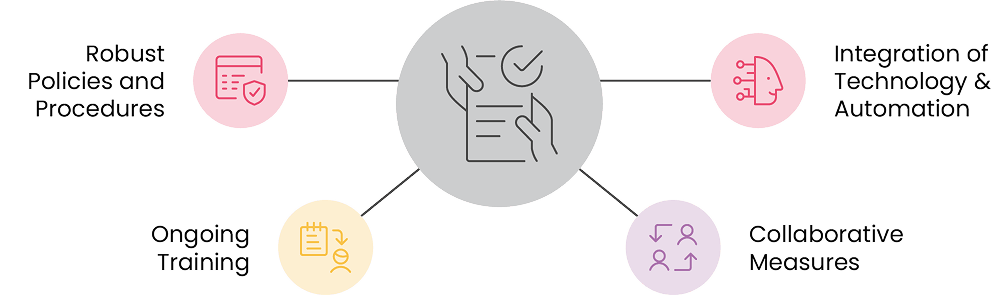
Robust Policies & Procedures
Regulated Entities must establish clear policies for collecting, validating, updating, and archiving Utility Bills.
It is also necessary to have escalation protocols in place to address discrepancies, mismatched names and addresses, and suspected fraudulent documents.
Ongoing Training
Regulated Entities must ensure to provide continuous training on evolving AML/CFT regulations, fraud detection techniques, and digital verification tools to the staff and compliance teams.
In addition to this, incorporating real-world examples and red flags in training modules helps to improve staff readiness.
Collaborative Measures
Regulated Entities must ensure that they are collaborating with the utility service providers, regulators and even verification vendors.
This ensures real-time data validation and improves the authentication procedure.
Integration of Technology & Automation
Regulated Entities must leverage advanced technology and automation in their AML/CFT program, specifically for procedures that require verifications.
The use of AI-powered KYC and RegTech solutions would aid in automating the verification processes. This helps in reducing manual workload and increasing accuracy, efficiency, and turnaround times.
Need help embedding these best practices into your compliance framework?
AML UAE helps you design and implement smart, customised, and fully compliant verification processes.
Reign Over Utility Bill Verification Problems:
How AML UAE Helps
At AML UAE, we offer comprehensive solutions designed for businesses operating in the mainland UAE and other free zones for overcoming the challenges they often face in Utility Bill Verification. Our customised approach integrates government-proven methods and ensures that not a single detail is missing regarding the customer.
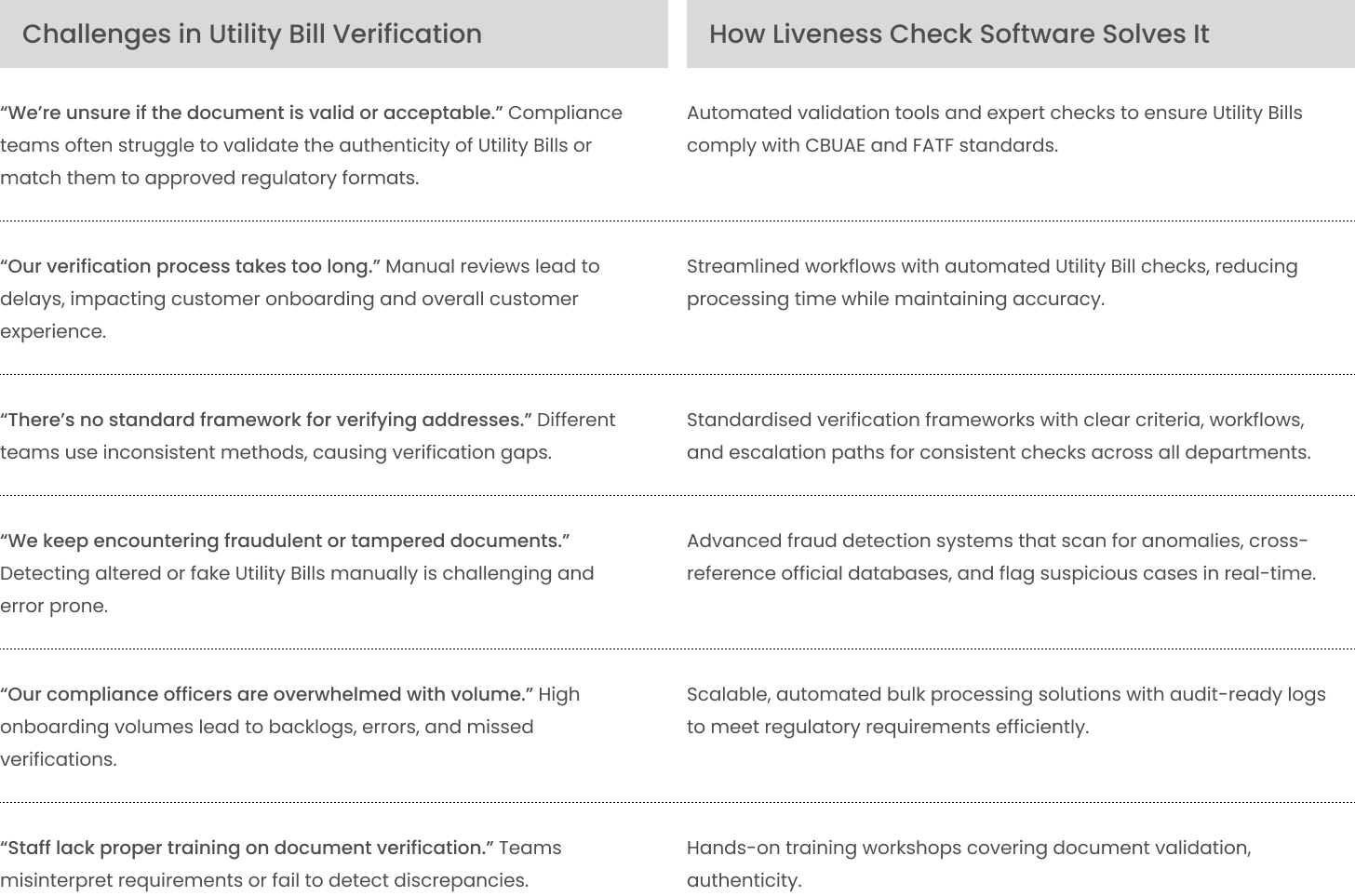
Challenges in Utility Bill Verification
How Liveness Check Software Solves It
“We’re unsure if the document is valid or acceptable.” Compliance teams often struggle to validate the authenticity of Utility Bills or match them to approved regulatory formats.
Automated validation tools and expert checks to ensure Utility Bills comply with CBUAE and FATF standards.
“Our verification process takes too long.” Manual reviews lead to delays, impacting customer onboarding and overall customer experience.
Streamlined workflows with automated Utility Bill checks, reducing processing time while maintaining accuracy.
“There’s no standard framework for verifying addresses.” Different teams use inconsistent methods, causing verification gaps.
Standardised verification frameworks with clear criteria, workflows, and escalation paths for consistent checks across all departments.
“We keep encountering fraudulent or tampered documents.” Detecting altered or fake Utility Bills manually is challenging and error prone.
Advanced fraud detection systems that scan for anomalies, cross-reference official databases, and flag suspicious cases in real-time.
“Our compliance officers are overwhelmed with volume.” High onboarding volumes lead to backlogs, errors, and missed verifications.
Scalable, automated bulk processing solutions with audit-ready logs to meet regulatory requirements efficiently.
“Staff lack proper training on document verification.” Teams misinterpret requirements or fail to detect discrepancies.
Hands-on training workshops covering document validation, authenticity.
End Authentication Struggles with Regulator-Aligned Tools
“We’re unsure if the document is valid or acceptable.” Compliance teams often struggle to validate the authenticity of Utility Bills or match them to approved regulatory formats.
AML UAE Solutions:
Automated validation tools and expert checks to ensure Utility Bills comply with the legal requirements.
Overcome Manual Hassles with Automatic Checks
“Our verification process takes too long.” Manual reviews lead to delays, impacting customer onboarding and overall customer experience.
AML UAE Solutions:
Streamlined workflows with automated Utility Bill checks, reducing processing time while maintaining accuracy.
Bridge Verification Gaps with Standardised Framework
“There’s no standard framework for verifying addresses.” Different teams use inconsistent methods, causing verification gaps.
AML UAE Solutions:
Standardised verification frameworks with clear criteria, workflows, and escalation paths for consistent checks across all departments.
Counter Document Alterations with Advanced Systems
“We keep encountering fraudulent or tampered documents.” Detecting altered or fake Utility Bills manually is challenging and error-prone.
AML UAE Solutions:
Advanced fraud detection systems that scan for anomalies, cross-reference official databases, and flag suspicious cases in real-time.
Handle Volume Overloads with Automated Processing Solutions
“Our compliance officers are overwhelmed with volume.” High onboarding volumes lead to backlogs, errors, and missed verifications.
AML UAE Solutions:
Scalable, automated bulk processing solutions with audit-ready logs to meet regulatory requirements efficiently.
Overcome Document Confusion with Specialised Training
“Staff lack proper training on document verification.” Teams misinterpret requirements or fail to detect discrepancies.
AML UAE Solutions:
Hands-on training workshops covering document validation and authenticity.

Let Detailed Utility Bill Verification Support Your Dreams of Achieving Robust Compliance
Regulated Entities often end up missing out on detecting potentially risky customers due to incomplete or incorrect information. This can prove to be a major threat to the compliance requirement that must be mandatorily carried out.
The ever-evolving landscape of UAE demands having a robust Address Proof Verification in place that ensures compliance is met thoroughly. Our managed KYC and CDD services help you meet your compliance requirements by verifying the utility bill in a systematic manner.
Integrating a robust Address Proof Verification ensures that Regulatory Obligations, such as Customer Due Diligence, are being carried out. This encourages efficient regulatory compliance.
Achieve Your Dreams of Having a Robust Compliance in Place
Utility Bill Verification, the Key to Your Dreams