


Last Reviewed On: 07/24/2026 | Last Updated On: 07/24/2026
Outcome of FATF Plenary, 19th June 2026
- The FATF June 2026 Plenary added Iraq and Bosnia and Herzegovina to the grey list and removed Algeria and Namibia.
- The grey list, formally Jurisdictions Under Increased Monitoring, now stands at 22 jurisdictions.
- The black list, formally High-Risk Jurisdictions Subject to a Call for Action, is unchanged: Iran, North Korea and Myanmar.
- The Plenary, held in Paris from 17 to 19 June, was the final one under Mexico’s Presidency. The United Kingdom takes over from 1 July 2026.
- UAE FIs, DNFBPs and VASPs should feed the change into their country risk, EWRA, screening and due diligence using a risk-based approach, without indiscriminate de-risking.
On 19 June 2026, FATF added Iraq and Bosnia and Herzegovina to its grey list and removed Algeria and Namibia. The grey list now includes 22 jurisdictions under increased monitoring. The FATF black list remains unchanged, covering Iran, North Korea and Myanmar.
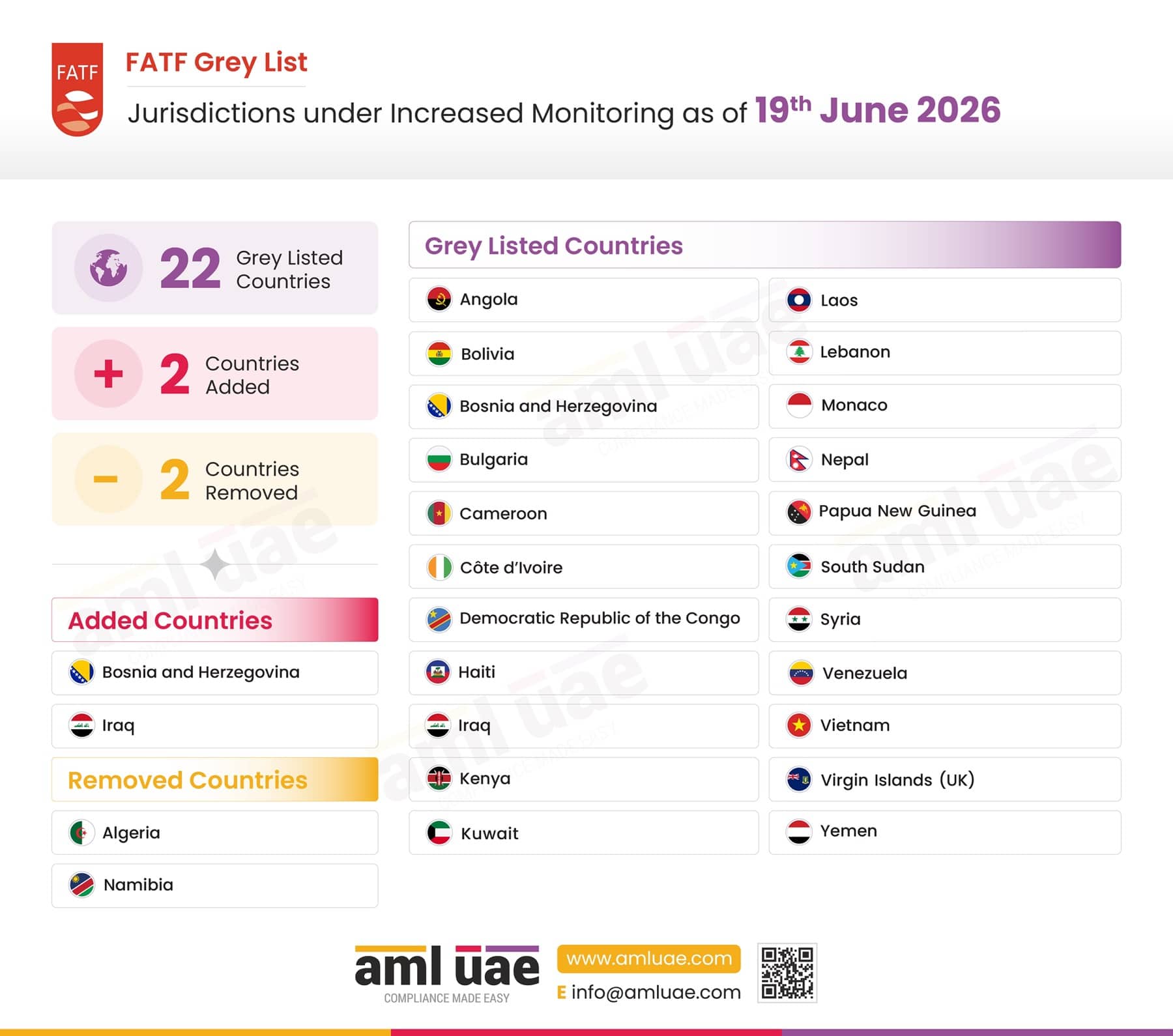
Key takeaways of the FATF Plenary June 2026
On 19 June 2026, the Financial Action Task Force (FATF) concluded its June Plenary and updated its lists of monitored and high-risk jurisdictions. This FATF grey list update for June 2026 is summarised below.
- Added to the Grey List: Iraq; Bosnia and Herzegovina
- Removed from the Grey List: Algeria; Namibia
- Black List (Call for Action): No Change: Iran, North Korea, Myanmar
What changed on the FATF Grey List in June 2026
The FATF reviews its grey list of jurisdictions under increased monitoring at each Plenary, which meets three times a year, in February, June and October. At the June 2026 Plenary it made two additions and two removals.
Countries Added to Increased Monitoring on 19th June 2026
Bosnia and Herzegovina and Iraq were added to the list of jurisdictions under increased monitoring. Both have committed to action plans to address strategic deficiencies in their measures against money laundering, terrorist financing and proliferation financing, within agreed timeframes.
Countries Removed from FATF Grey List on 19th June 2026
Algeria and Namibia were removed after successful on-site visits confirmed they had completed their action plans. Algeria will continue working with its FATF-style regional body, MENAFATF, and Namibia with ESAAMLG, to sustain the improvements.
FATF Grey List countries in full, as of 19 June 2026
The following 22 jurisdictions are under increased monitoring after the June 2026 Plenary. Official FATF names are used, with the common name in brackets where helpful. The two newest additions are marked.
1. Angola
2. Bolivia
3. Bosnia and Herzegovina (Added 19th June 2026)
4. Bulgaria
5. Cameroon
6. Cote d’Ivoire
7. Democratic Republic of Congo
8. Haiti
9. Iraq (Added 19th June 2026)
10. Kenya
11. Kuwait
12. Laos
13. Lebanon
14. Monaco
15. Nepal
16. Papua New Guinea
17. South Sudan
18. Syria
19. Venezuela
20. Vietnam
21. Virgin Islands (UK)
22. Yemen
FATF Blacklist countries in full, as of 19 June 2026
The FATF blacklist for 2026, formally High-Risk Jurisdictions Subject to a Call for Action, was not changed at this Plenary. These three jurisdictions remain subject to enhanced due diligence and, in the most serious case, countermeasures.
- Iran: Call for action and countermeasures by FATF members.
- Democratic People’s Republic of Korea (North Korea): Call for action and countermeasures by FATF members.
- Myanmar: Call for enhanced due diligence proportionate to the risk.
What the grey list and black list actually mean
The grey list identifies jurisdictions that are actively working with the FATF to fix strategic AML/CFT/CPF deficiencies under an agreed action plan. Importantly, FATF does not call for enhanced due diligence to be applied to a jurisdiction solely because it is grey-listed, and it discourages indiscriminate de-risking. Grey-list status is an input into a firm’s risk assessment, not an automatic trigger for enhanced measures.
The black list identifies jurisdictions with serious deficiencies, where the FATF calls on members to apply enhanced due diligence and, for the highest risk, countermeasures.
Wider outcomes of the June 2026 Plenary
Beyond the list changes, the Plenary agreed several measures that shape the year ahead:
- Presidency handover: This was the final Plenary under the Mexican Presidency of Elisa de Anda Madrazo. Giles Thomson of the United Kingdom becomes FATF President from 1 July 2026, with priorities on fraud, the risk-based approach and information sharing.
- New Vice-President: Vivek Aggarwal of India was appointed incoming FATF Vice-President for July 2026 to June 2027.
- Recommendation 6 updated: Targeted financial sanctions standards now carry the humanitarian exemption in UN Security Council Resolutions 2664 and 2761, so sanctions do not block humanitarian assistance and basic human needs.
- Recommendation 16 consultation: A public consultation was approved on guidance to implement the strengthened cross-border payment transparency standard.
- Mutual evaluations: The Plenary adopted the mutual evaluation reports of Canada and Turkiye, to be published in late 2026.
UAE AML compliance: What regulated entities should do now
UAE Financial Institutions, Designated Non-Financial Businesses and Professions (DNFBPs) and Virtual Asset Service Providers (VASPs) should treat this FATF grey list update as a trigger to reassess exposure, not as a reason to de-risk wholesale. Recommended actions:
- Refresh the country risk model and the Enterprise-Wide Risk Assessment (EWRA) to reflect Iraq and Bosnia and Herzegovina as higher risk, and to re-rate Algeria and Namibia.
- Update screening and risk metrics so country risk lists, customer risk assessment scoring and transaction monitoring rules carry the revised grey list.
- Apply a risk-based approach to due diligence. Apply enhanced due diligence or enhanced monitoring where the risk assessment warrants it, particularly for customers, beneficial owners, counterparties, transactions or delivery channels linked to higher-risk jurisdictions. For jurisdictions subject to a FATF call for action, apply enhanced due diligence and countermeasures, where required, in line with applicable UAE regulatory requirements and the firm’s risk-based framework.
- Refresh sanctions and name screening and confirm regulatory reporting workflows reflect the updated risk landscape.
- Update policies, procedures and controls to evidence the change, and record the rationale to demonstrate a risk-based approach.
- Brief and train staff so front-line and compliance teams handle affected relationships consistently.
Does the FATF grey list affect UAE customer onboarding?
Grey-list status should be used as an input into country risk scoring, customer risk rating, due diligence decisions, transaction monitoring and senior management escalation. It should not lead to automatic rejection or blanket de-risking of customers connected to a grey-listed country. A UAE firm should document how the listing feeds its risk-based approach, and reserve enhanced measures for relationships its own assessment rates as higher risk.
FAQs on FATF Greylist update June 2026
Which countries were added to the FATF grey list in June 2026?
Iraq and Bosnia and Herzegovina were added to the list of jurisdictions under increased monitoring at the 19 June 2026 Plenary.
Which countries were removed from the FATF grey list in June 2026?
Algeria and Namibia were removed after completing their action plans and passing on-site visits.
How many countries are on the FATF grey list now?
The following twenty-two jurisdictions are under increased monitoring after the June 2026 Plenary:
1. Angola
2. Bolivia
3. Bosnia and Herzegovina (Added 19th June 2026)
4. Bulgaria
5. Cameroon
6. Cote d’Ivoire
7. Democratic Republic of Congo
8. Haiti
9. Iraq (Added 19th June 2026)
10. Kenya
11. Kuwait
12. Laos
13. Lebanon
14. Monaco
15. Nepal
16. Papua New Guinea
17. South Sudan
18. Syria
19. Venezuela
20. Vietnam
21. Virgin Islands (UK)
22. Yemen
What are the FATF blacklist countries in 2026?
The black list, formally High-Risk Jurisdictions Subject to a Call for Action, is unchanged: Iran, North Korea and Myanmar.
Does grey-listing mean sanctions or automatic enhanced due diligence?
No. Grey-listing is not a sanction, and FATF does not call for enhanced due diligence solely because a country is grey-listed. It signals that a risk-based approach should be applied, with enhanced measures reserved for relationships a firm’s own assessment rates as higher risk.
How often does the FATF update its lists?
After each Plenary, which is held three times a year, in February, June and October.
Need Support Updating Compliance Framework with FATF List Updates?
We help you assess the impact of recent grey list changes on your business and update your risk assessment, policies, procedures, and controls accordingly.
Share via :
Share via :