


Suspicious Transaction Report
Suspicious Transaction Reports exist as a medium through which the Financial Intelligence Unit (FIU) detects and counters financial crimes while ensuring Regulatory Compliance and protecting the integrity and reputation of businesses. It enables the FIU to undertake appropriate measures to counter financial crime.
What is a STR?
A Suspicious Transaction Report (STR) is a report detailing the transaction patterns that may signal potential Money Laundering (ML), Terrorism Financing (TF), and Proliferation Financing (PF) crimes.
What is a Suspicious Transaction?
A Suspicious Transaction is any actual, attempted, or past transaction, regardless of amount or timing, where there are reasonable grounds to suspect that it:
- Involves proceeds of crime (Money Laundering, predicate offences, Terrorism Financing, illegal organisations),
- Is linked to such crimes, or
- Is intended for use in such crimes.
As per the Cabinet Decision No. (134) of 2025, a transaction is deemed suspicious if there are reasonable grounds (such as red flags, incomplete Customer Due Diligence (CDD) data, unusual patterns, or adverse media) linking it to criminal activity, even if there is no concrete proof or evidence.

Such suspicion applies not only to completed transcations but also to attempted or past ones.
In the UAE, the requirement to report a Suspicious Transaction (via an STR) comes under Federal Decree-Law No. (10) of 2025 Regarding Anti-Money Laundering, and Combating the Financing of Terrorism and Proliferation Financing, and Cabinet Decision No. (134) of 2025 Implementing Federal Decree-Law No. 10 of 2025.
Who needs to file an STR?
Under Cabinet Decision No. (134) of 2025, the filing of Suspicious Transaction Reports with the UAE FIU is undertaken via goAML:
- Financial Institutions (FIs): Banks, exchange houses, finance companies, insurers, securities dealers, investment firms.
- Designated Non-Financial Businesses and Professions (DNFBPs): Real estate brokers, precious metals/stones dealers, lawyers, accountants, auditors, company service providers, commercial gaming operators (per Cabinet Decision No. 134/2025).
- Virtual Asset Service Providers (VASPs): Crypto exchanges, wallet providers, safeguarding virtual assets, providing financial services for the sale of a virtual asset by an issuer (Cabinet Decision No. 134/2025).
- Other Entities: Any business directed by its supervisory authority to comply with AML/CFT obligations.
When to file a STR?
Suspicious Transaction Report (STR) needs to be filed immediately upon experiencing a transaction or attempted transaction when there are reasonable grounds to suspect that the transaction or activity is linked to:
- Money Laundering
- Terrorism Financing
- Proliferation Financing
There is no specific reporting threshold that triggers the filing of a Suspicious Transaction Report (STR) with FIU via the goAML portal.
Operational Pain Points in Suspicious Transaction Reporting
A Regulated Entity may already have internal procedures such as transaction monitoring alerts, CDD reviews, and periodic audits for detecting and reporting suspicious transactions.
It is important to ascertain whether the systems are truly capturing all forms of suspicious transactions, including attempted and historical transactions, and align them with the STR framework with UAE’s AML-CFT law.
Drafting STR narratives that are both comprehensive and firmly grounded in facts often requires specialised expertise and experience that may not always be readily available in-house.
CDD/KYC records are outdated, inaccurate and vague which make achieving a precise and compliant STR submission without delays a dream.
Poorly integrated Sanctions and PEP screening systems subjects the STR workflow to missed alerts resulting in compliance gaps.
Absence of process controls proves to be an obstacle for bulk STR submission and peak alert periods which results in bottlenecks and missed goAML deadlines.
Transaction monitoring thresholds, typology scenarios, and risk models are not optimised to detect both high-value and frequent low-value suspicious patterns.
Staff lack adequate training to tell the difference between unusual but legitimate activity and genuinely suspicious transactions.
If you are facing even one of these pain points.
AML UAE helps you identify, fix, and future-proof your compliance processes.
Regulatory Obligations for Suspicious Transaction Reporting in UAE
In the UAE, compliance with STR is a legal requirement under the Federal AML/CFT framework. These obligations are placed to ensure that any transaction or even the attempted transaction that gives rise to reasonable grounds for suspicion, whether linked to ML, TF, or PF, is being addressed.
The most crucial step is promptly identifying and reporting the suspected transactions to the relevant authorities. This plays a crucial role in safeguarding the integrity of the financial system and the entity’s regulatory standing.
In the UAE, the requirement to report a Suspicious Transaction comes under Cabinet Decision No. (134) of 2025 and Federal Decree Law No. 10 of 2025.
This forms the primary legal framework mandating LFIs and DNFBPs to file STRs with the UAE Financial Intelligence Unit (FIU) through the goAML platform.
Step-By-Step Guide for Robust Suspicious Transaction Reporting Across UAE
A robust Suspicious Transaction Reporting (STR) framework is not just a requirement of law in the UAE; it is an especially important step for maintaining financial integrity and combating financial crime.
The mainland entities and those in financial free zones such as Abu Dhabi Global Market (ADGM) and Dubai International Financial Centre (DIFC) need to ensure they establish clear policies, procedures, and controls to ensure timely and accurate reporting to the Financial Intelligence Unit (FIU).
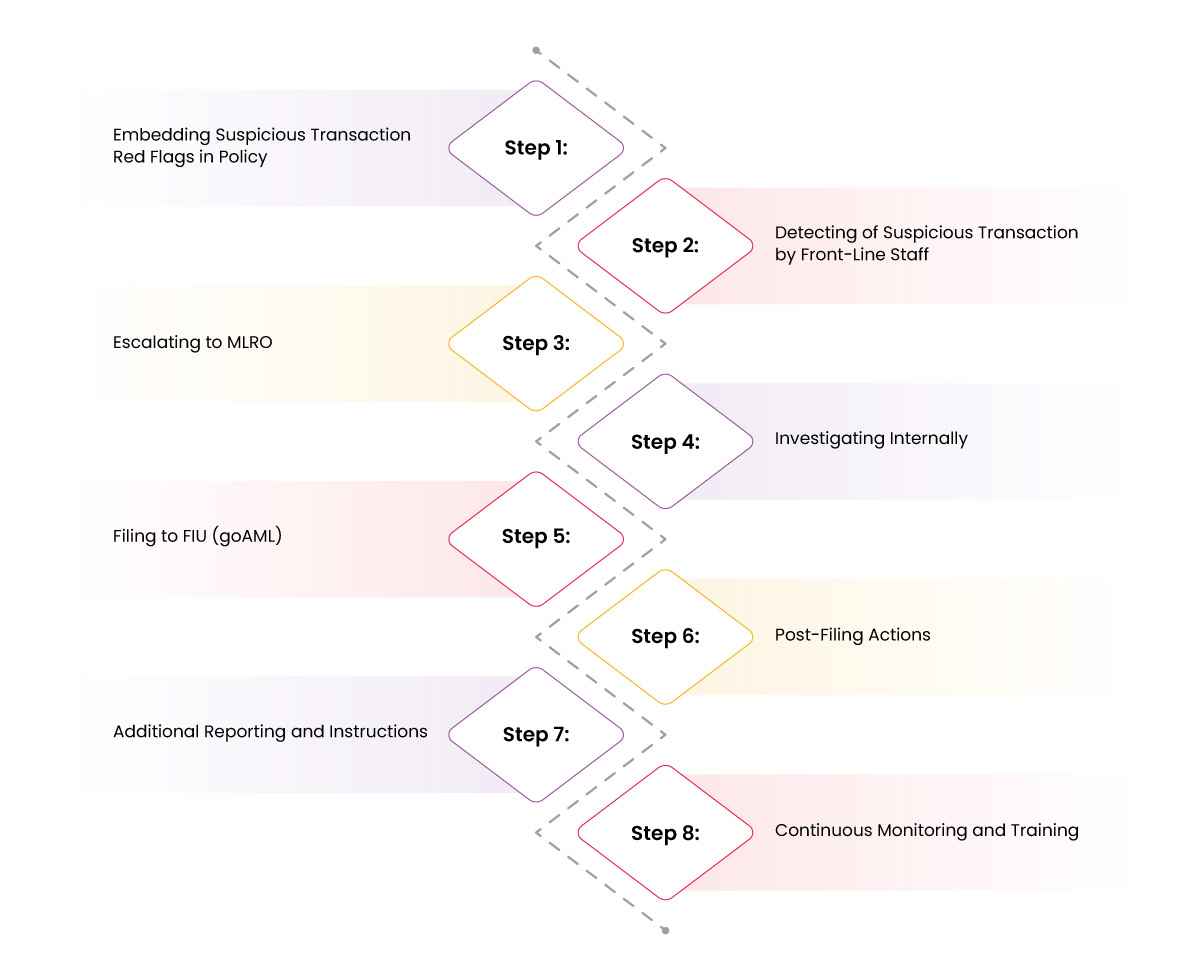
The entire STR process includes embedding Suspicious Transaction red flags in the policy, front-line staff detecting STR, escalating the matter to MLRO, filing the matter before FIU on the goAML portal, having post-filing actions in place, additional reporting and instructions, continuous monitoring, and training.
They are outlined as follows:
Step 1: Embedding Suspicious Transaction Red Flags in Policies
Regulated Entities are required to implement adequate methodologies, procedures, and controls for recognising suspicious transactions, evaluating potentially layered transactions, and managing the STR reporting process.
REs need to document indicators, red flags, and evolving ML/TF typologies in their internal policies to facilitate smooth identification and timely detection of suspicious transactions.
Step 2: Detecting Suspicious Transaction by Front-line Staff
Regulated Entities need to adequately train their front-line staff to detect suspicious transactions by recognising red flags and indicators for potential ML/TF movement.
Transactions that raise doubts of ML/TF activity or seem unusual, such as large cash deposits inconsistent with customer profile, multiple rapid transactions just above the reporting threshold, fund transfers to high-risk jurisdiction, etc., need to be detected by the front-line staff through system-generated alerts or manual monitoring.
Step 3: Escalating to MLRO
The transactions creating doubts about ML/TF activities that are detected during monitoring need to be promptly escalated by front-line staff to the in-house compliance officer or Money Laundering Reporting Officer (MLRO) by submitting an internal STR.
The reporting process needs to be properly documented and confidential. Additionally, REs need to define clear roles and accountabilities regarding the escalation process to avoid unnecessary delays and internal confusion.
Step 4: Investigating Internally
The designated Compliance Officer or MLRO, upon receiving the internal STR, is required to review the submission and undertake an investigation to analyse the reported matter in detail.
The Compliance Officer or MLRO decides whether to submit STR with the FIU on the goAML platform. The legitimacy of grounds of suspicion, the customer’s earlier transactions, and risk profile, along with various other factors, are taken into consideration during this process.
Step 5: Filing to FIU (goAML portal)
The designated Compliance Officer or MLRO needs to identify reasonable doubts of suspicion and then file an external STR to UAE FIU via the goAML portal without any delay.
The STR needs to be factual, concise, and submitted in the prescribed format. It needs to align with the FIU reporting standards and include all required details, supporting evidence and documentation.
Step 6: Post-Filing Actions
The Regulated Entities need to ensure that after the STR is submitted, a submission acknowledgement, an investigation log, timelines, justifications, detailed records of internal reviews, records of decision to file a STR or not and all supporting documentation for at least five (5) years are attached in case of mainland UAE.
Step 7: Additional Reporting and Instructions
In addition to this, after filing the STR, the Guidelines for DNFBPs provide for following the instructions provided by the FIU and classifying the customer/relationship as high-risk and applying the appropriate measures to mitigate risks associated with the same.
The FIU might request further details pertaining to the STR from the reporting entity. In case no transaction details are required, an Additional Information File without Transaction(s) (AIF) is requested, and if transaction details are required, an Additional Information File with Transaction(s) (AIFT) request is made on goAML portal.
The FIU might also request further information pertaining to the STR from multiple reporting entities. A Request for Information without Transactions (RFI) in case no transaction details are required, and a Request for Information with Transactions (RFIT), in case transaction details are required, is sent out through goAML.
Step 8: Continuous Monitoring and Training
Regulated Entities need to ensure that customer profiles are kept under close watch and scrutiny for additional suspicious activity or transactions. Additional STRs are required to file if new development arises.
In addition to this, Regulated Entities need to deliver periodic training to their employees regarding the identification, escalation, and reporting mechanisms to file a STR, ensuring continued awareness and compliance.
Suspicious Transactions: Indicators and Action Required
There are several indicators which hint at a possible suspicious transaction. The table below highlights such indicators, the risk level, and the suggested action required.
| Category | Indicator | Example | Risk Level | Action Required |
|---|---|---|---|---|
| Customer Behaviour | Inconsistent declared purpose vs. actual transaction. | Declares “import payments” but transfers to personal accounts. | Very High | STR filing required |
| Structuring transactions to avoid reporting thresholds | Deposits of AED 49,000 multiple times | High | Investigate, consider STR | |
| Account Activity | Sudden activity in a dormant/low-balance account | A Dormant account starts receiving large transfers | Medium High | Enhanced monitoring, escalate |
| Rapid movement of funds | Money credited and transferred within the same day, same amount | High | Investigate the origin and destination | |
| Multiple accounts with similar patterns | Same customer operating 4 accounts with repetitive transfers. | Medium | Escalate for internal review | |
| Cash Transactions | Large cash deposits inconsistent with the profile. | Small retail shop depositing AED 500,000 monthly. | High | Review business justification, STR if no basis |
| Frequent small deposits (structuring/smurfing). | Daily AED 9,900 deposits from different branches. | High | Escalate, file STR if suspicious. | |
| Cash-intensive business showing inflated turnover. | Restaurant declaring double its actual sales in cash deposits. | High | On-site verification, STR. | |
| International Transactions | Transfers to/from high-risk jurisdictions (FATF lists). | Funds sent to a sanctioned country without a business purpose. | Very High. | Immediate escalation, STR. |
| Frequent round-tripping of funds. | Money sent to Europe, returned within 48 hours. | High | Escalate for suspicious activity. | |
| Multiple offshore accounts without a purpose. | A company in UAE holding 5 accounts in Caribbean jurisdictions. | High | Enhanced due diligence. | |
| Trade Transactions | Over/under-invoicing of goods. | Invoice showing AED 10M for goods worth AED 2M. | Very High. | Investigate with trade docs, STR. |
| Misrepresentation of goods/services. | Shipping documents show “textiles,” but the cargo is electronics. | Very High. | Escalate immediately. | |
| Complex trade/shipping routes. | Goods shipped via 3 countries unrelated to trade. | Medium-High. | Review legitimacy. | |
| Terrorism Financing | Small, frequent transfers inconsistent with the customer profile. | Student account sends 20 transfers monthly to risky regions. | Very High. | Escalate, STR. |
| Donations to high-risk NGOs/charities. | Large donations routed to an unregistered overseas charity. | Very High. | Report immediately. | |
| Sudden inflows with immediate multiple transfers. | AED 200,000 received, split into 50 transfers on the same day. | High. | Escalate. | |
| High Risk Products | Heavy use of prepaid cards/crypto/anonymous payments. | Customer cashing AED 100,000 into crypto repeatedly. | High. | Enhanced monitoring. |
| Real estate purchases with unexplained funds. | An individual buying a villa with cash, with no clear source of income. | Very High. | Reports STR. |
Common Challenges Faced while Filing STR
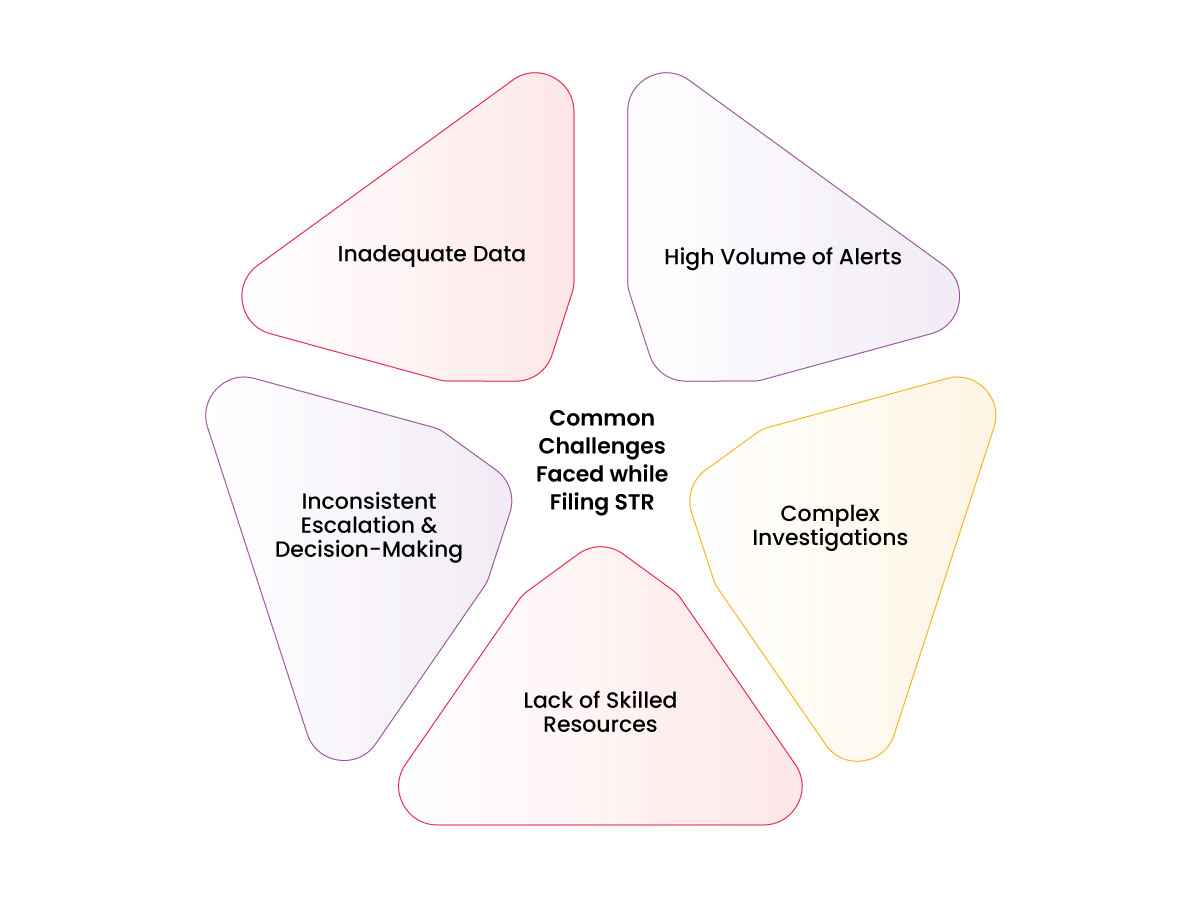
Regulated Entities face significant challenges in filing Suspicious Transaction Reports (STRs) accurately and on time. The challenges include high volume of alerts, complex investigations, lack of skilled resources, inconsistent escalation and decision-making, and inadequate data to file the STR.
High Volume of Alerts
Regulated Entities generate several alerts daily, many of which are false positives. This increases the workload of the compliance team, which can make prioritising genuine suspicious activity over noise difficult.
Complex Investigations
Cases involving multiple accounts, customers, jurisdictions, or legal referrals consume excessive time. Timely filing becomes difficult for Regulated Entities when investigations span several data sources
Lack of Skilled Resources
The limited AML-trained investigators and MLRO bandwidth slows down reviews. Regulated Entities often face a rise in backlog and resource consumption due to high dependence on manual investigation.
Inconsistent Escalation & Decision-Making
The absence of well-defined thresholds and unorganised procedures creates internal confusion on when to escalate to the MLRO. This results in Regulated Entities facing delays in decision-making, pushing STR filings closer to deadlines.
Inadequate Data
Monitoring transactions requires complete data; any inadequate information pertaining to such information, like personal details, transaction details, location, etc., results in inaccurate results. This leads to unsuccessful investigation on the part of Regulated Entities due to a lack of adequate or inaccurate information.
Struggling with these challenges?
Let AML UAE streamline your reporting obligations—simple, smart, and compliant. Button text: Contact Us Now
Best Practices to Stay on Top of STR Reporting Game
In the ever-evolving compliance landscape, filing a Suspicious Transaction Report is not just a compliance tick-box, but a powerful safeguard against threats of ML/TF activities. Regulated Entities in UAE need to maintain accuracy and timeliness in filing STR by adopting some of the best practices.
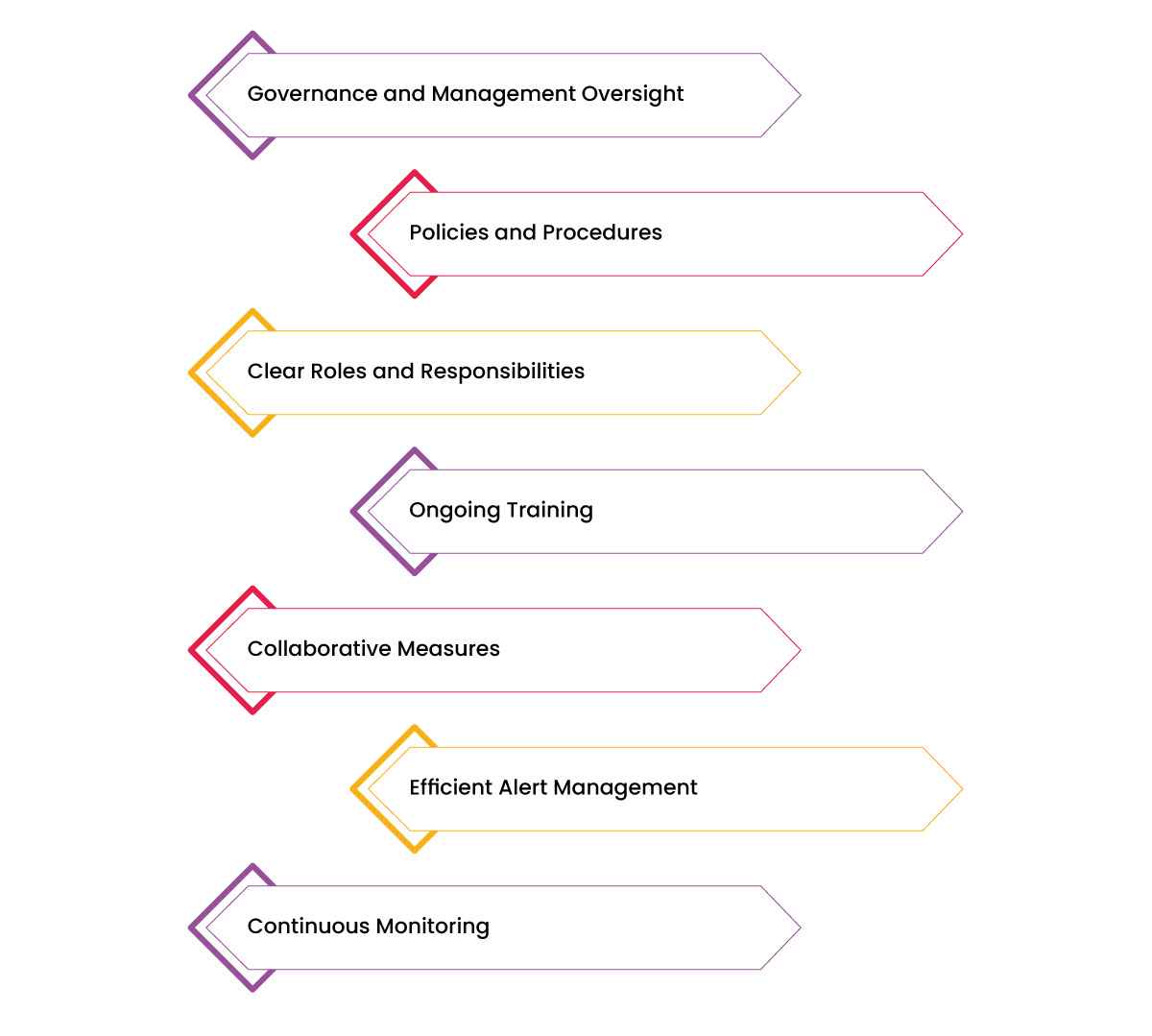
These best practices include implementing governance and management oversight, policies and procedures, enforcing clear roles and responsibilities, ongoing training, enacting collaborative measures, ensuring efficient alert management is in place, and establishing continuous monitoring.
Governance and Management Oversight
Regulated Entities must appoint a Board of Directors that ensures compliance programs are independent, well-resourced, and prioritised. Further, Senior management and Compliance Officer (MLRO) must have authority, independence, and access to information.
There must be regular updates on AML/CFT program performance, risks, and suspicious activity reporting must be provided to the Board.
Policies and Procedures
Regulated Entities must maintain structured policies for designing, updating, validating, and retiring detection scenarios. Additionally, clear procedures should exist for investigating alerts and filing STRs/SARs promptly and accurately.
Clear Roles and Responsibilities
Regulated Entities must calibrate clear documentation of roles, responsibilities, and reporting lines across all spheres, such as general employees, compliance employees, and the independent testing function. Further, Regulated Entities should ensure robust mechanisms to escalate issues, report filings, and corrective actions to senior management and the Board.
Ongoing Training
Regulated Entities must deploy continuous employee training on UAE AML/CFT regulations, internal policies, and emerging risks to staff and compliance teams. Training should be customised and include lessons from past STRs/SARs and thematic risk trends.
Collaborative measures
It is important to ensure continuous compliance that is free from hang-ups or obstacles. Regulated Entities should collaborate with relevant local and international regulatory authorities. This helps with building rapport, goodwill, and improves handling and understanding of situations before and after submitting STRs.
Efficient Alert Management
Regulated Entities in the UAE are required to have efficient Alert Management in place, along with a robust Suspicious Transaction Reporting mechanism, ensuring compliance with AML/CFT laws.
This helps minimise delays, backlogs, and compliance risks by combining strong governance, streamlining workflows, clarifying timelines, and putting technology in place to support, detect, investigate, and report suspicious activity effectively.
Continuous Monitoring
Suspicious transaction monitoring is not a one-time task. Regulated Entities need to make sure that it is conducted on an ongoing basis to identify any anomalies in the transaction patterns of a customer after their onboarding and help with identifying any suspicious activity.
Need help embedding STR best practices into your compliance framework?
AML UAE help you implement compliance and requirements in a smart and Customised way.
Mitigate STR Filing Challenges: How AML UAE Becomes Your Trusted Wingman
At AML UAE, we help businesses comply by implementing strong STR (Suspicious Transaction Reporting) frameworks, policies, and internal controls. We know that STR reporting can be complex, time-sensitive, and prone to operational challenges. To help Regulated Entities file STRs efficiently and without regulatory slip-ups, we offer end-to-end STR support services.
Become STR Timeline Expert with Customised Framework
“We don’t know when exactly to file an STR.” Timelines confuse most compliance officers—immediate? 24 hours? 3 days?
AML UAE Solutions:
We guide you on regulatory timelines and help build an STR framework for immediate escalation, internal review, and submission to goAML within the legal period. No delays, no penalties.
Classify Alerts that Matter with the Management System
“Our alerts are all over the place—what counts as suspicious?” Teams struggle to differentiate between false positives and genuine suspicious cases.
AML UAE Solutions:
We design a clear Alert Management Framework that classifies alerts, escalates suspicious ones to the MLRO, and documents decision-making trails. Your team knows exactly what becomes an STR.
Eliminate Difficulties in STR Documentation
“STR documentation is a nightmare. What goes where?” Teams find it difficult to structure narratives in goAML STR forms.
AML UAE Solutions:
We help prepare STR narratives and structured reports—who, what, when, how, why—ensuring regulators clearly understand suspicion. No missing fields, no rejected submissions.
End Delays with Real-Time Detection
“We only realise after an incident that an STR should have been filed.” Delayed detection increases regulatory and reputational risk.
AML UAE Solutions:
We set up real-time detection and escalation protocols integrated with transaction monitoring systems. Suspicious red flags are caught as they happen—not weeks later.
Reduce False Positives with Advanced Monitoring Systems
“Our MLROs are drowning in false positives.” Too many unnecessary escalations slow STR filing.
AML UAE Solutions:
Our calibrated monitoring solutions filter noise, reducing false positives. MLROs handle fewer but sharper cases worth filing as STRs.
Reduce Knowledge Gaps with Dynamic Training
“Training on STR filing is boring and outdated.” Staff lack clarity on how to detect, escalate, or file STRs.
AML UAE Solutions:
We deliver engaging STR training workshops with real UAE case studies, covering indicators, escalation, and goAML filing. Teams stay confident, audit-ready.
Ensure Updated Regulatory Compliance
“We don’t know if we’re still compliant next month.” AML laws evolve, leaving STR processes outdated.
AML UAE Solutions:
We provide ongoing STR compliance advisory—regulatory updates, refresher training, and process reviews. You remain aligned with CBUAE & FIU requirements.
STR preparation and narrative review
Prepare a clear suspicious transaction report narrative
An STR should explain the transaction, the people involved and why the facts give rise to suspicion. We help your compliance officer turn a complex case file into a clear chronology and a supported narrative for the UAE FIU.
Connect facts to the concern
We organise customer information, ownership details, transaction records and supporting documents. The draft distinguishes verified facts from explanations, inconsistencies and analytical conclusions. It describes relevant attempted activity and avoids unsupported accusations or copied generic red flags.
Support the officer responsible for reporting
You receive a reviewed narrative, evidence index and data-quality checklist. Your authorised officer makes the reporting decision and controls submission. We agree urgent handling at the outset so external drafting support does not delay a report that must be made promptly.
Post-STR relationship management
Manage a customer relationship after an STR
Filing an STR does not answer every question about the relationship that follows. We help you document a controlled approach to ongoing monitoring, customer communication, restrictions and any proposed exit, taking account of authority instructions.
Assess the next decision separately
The review considers continuing exposure, pending transactions, contractual arrangements and the risk of tipping off. We help define who may approve further activity and how information is shared on a need-to-know basis. A filing should not be treated as automatic permission to proceed or an automatic instruction to close the relationship.
A documented action plan
You receive a relationship decision record, monitoring actions and communication controls for management and compliance officer approval. Where freezing, suspension or other binding instructions apply, those requirements govern subsequent action.
Suspicious-activity escalation workflow design
Design a clear internal suspicious activity escalation route
Employees need a simple way to raise a concern without deciding for themselves whether an external report is required. We design the internal escalation process from first observation to the compliance officer’s documented decision.
Define the handover
The procedure explains the information to record, the secure reporting channel and how urgent concerns reach the officer. It covers absence arrangements, linked cases and restrictions on discussing the concern with the customer or unrelated colleagues.
Make escalation usable
You receive an internal report template, responsibility map and decision-record structure. We can test the workflow with an example from your sector and identify training needs. The authorised compliance officer retains the external reporting decision and access to the information needed to make it.

Enhance Your Regulatory Compliance with Prompt and Efficient Suspicious Transaction Reporting
Regulated Entities in the UAE often lag in submitting Suspicious Transaction Reports on time due to inconsistent control measures, fragmented escalation management, inadequate data, and a lack of expertise among employees.
Regulated Entities need to count on tailored solutions and approaches to effectively detect unusual transaction patterns and file a Suspicious Transaction Report to Regulatory Authorities. It facilitates ensuring Regulatory Compliance, maintaining the integrity of the financial ecosystem by closing the gaps in reporting irregularities.
Every missed STR is a regulatory red flag.
File on time, file it right—stay compliant without the stress with AML UAE.