


Suspicious Activity Report
Reporting any Suspicious Activity (SAR) to Supervisory Authorities forms the backbone of Regulatory Compliance as it supports combating financial threats like Money Laundering (ML), Financing of Terrorism (FT), and Proliferation Financing (PF).
Escalating activities signalling towards potential financial crimes not only serves the regulatory purpose for Regulated Entities but also contributes to protecting the integrity of the entire financial system. Regulated Entities in the UAE should broaden their horizons by adopting approaches for prompt and accurate filing of SAR.
What is Suspicious Activity?
Suspicious Activity means any behaviour, intent, or actions indicating the risk of Money Laundering, Terrorist Financing, or Proliferation Financing, even before the actual transaction takes place.
It includes actions that are inconsistent with a customer’s usual profile, or risk classification, even when no actual transaction has taken place. It often is an attempt to conceal true beneficial ownership, evade regulatory obligations, or disguise the fund’s origin, purpose, and movement of assets.
Suspicious Activity is a much broader term than Suspicious Transaction as it encompasses factors like actions, intentions, or red flags that can indicate something unusual or unlawful.

How is Suspicious Activity Different from Suspicious Transaction?
Suspicious Activity Report (SAR) differs from Suspicious Transaction Report (STR) on various levels. The notable differences in various aspects are outlined as follows:
Nature : Suspicious Activity Report relates to behaviour, intent, or pattern (may not involve money), whereas STR relates to an actual or attempted financial transaction.
Trigger : Suspicious Activity Report is triggered by conduct that looks unusual, evasive, or inconsistent, whereas STR is triggered by money or value movement that looks unusual.
Example :
- SAR may be filed on grounds such as refusal to share identity documents or to cooperate in completing CDD.
- SAR may be filed when the customer’s profile does not align with the transaction he intends to make.
Operational Pain Points While Filing Suspicious Activity Reporting
Suspicious Activity may include unusual customer behaviour, or requests, refusal to provide documents, or other non-transactional red flags. Ensuring these signals are properly escalated and timely reported becomes critical.
The common operational pain points faced by AML compliance professionals, AML analysts, and AML compliance officers while filing Suspicious Activity Reports are as follows:
Difficulty in following the prescribed timeline that requires reporting entities to capture, document, and escalate suspicious behaviours during onboarding, account updates, or periodic reviews
The monitoring systems do not seamlessly function in parallel to the staff, which makes it difficult to identify suspicious activities.
It is challenging to draft clear, factual and sufficiently detailed SAR narratives which reflect the customer’s behaviour, intent or unusual conduct in a structured way and align with FIU standards and regulatory reporting.
Regulated Entities often fall short of ensuring that their KYC and CDD records are consistently updated, accurate, and comprehensive enough to highlight discrepancies such as reluctance to provide information, inconsistent documentation, or usual declarations which affect SAR filing.
Skipping out on seamlessly integrating Sanctions, PEP, Adverse Media Screening alerts into the SAR reporting workflow, Regulated Entities end up overlooking and delaying high-risk associations and non-transactional suspicious behaviours, resulting in staff becoming bottlenecks that are unequipped to differentiate unusual yet legitimate customer behaviour from genuinely suspicious behaviour affecting SAR filing
Untrained staff become bottlenecks that are unequipped to differentiate unusual yet legitimate customer behavior from genuinely suspicious behavior affecting SAR filing.
If you are facing even one of these pain points.
AML UAE helps you identify, fix, and future-proof your compliance processes.
Regulatory Obligations for Suspicious Activity Reporting in the UAE
There is a strict AML-CFT framework in the UAE that imposes obligations on all Regulated Entities (REs), including Financial Institutions, DNFBPs (Designated Non-Financial Businesses and Professions), and VASPs (Virtual Asset Service Providers).
The obligations include detecting, escalating, and reporting Suspicious Activities promptly to the Financial Intelligence Unit (FIU) through the goAML platform.
Regulated Entities in the UAE are required to file Suspicious Activity Report (SAR) promptly to the UAE FIU, if any suspicious or unusual activity signalling towards ML/TF is detected, as mandated by Federal Decree Law No. 10 of 2025.
What are the Key Reporting Obligations for SAR?
There are several key reporting obligations which need to be undertaken while filing a SAR. The obligations can be summed up as follows:
Prompt Reporting
SARs need to be submitted to the FIU via goAML as soon as any suspicion is formed, and ensure no customers are tipped off.
Non-Transactional Scope
Reporting obligations cover not only Suspicious Transactions but also behavioural red flags, such as refusal to provide Know Your Customer-related details or misrepresentation.
Internal Escalation
Clear procedures need to be put in place for staff to escalate suspicions to the Money Laundering Reporting Officer (MLRO).
Record Keeping
All records, internal supporting documentation, need to be kept for at least five (5) years in the mainland UAE from the date of the most recent event, which might be one of the following:
- Termination of Business Relationship
- Closure of the Customer’s account
- Completing an occasional transaction
- Investigation completion by the Supervisory Authority
- Investigation conclusion date
- Date of issuance of the final judicial judgment.
Cooperation with Authorities
Entities need to respond to FIU inquiries and remain cooperative while providing additional information during investigations.
What are the Penalties for SAR Non-Compliance?
Under the UAE’s AML-CFT Law, failing to file a Suspicious Activity Report (SAR), whether deliberately or through gross negligence, is a serious offence.
Violation: Notifying, warning other persons; disclosing information related to STR/SAR under review; revealing investigations and inquiries by Competent Authorities.
Penalty: Either imprisonment or a fine of not less than AED 50,000 or both.
Reference: Article 29 Clause 1, Federal Decree Law No. 10 of 2025.
Step-by-Step Process for Regulated Entities for Accurate SAR Filing
Regulated Entities need to tailor their SAR reporting processes, policies, procedures, and methodologies to comply with regulatory requirements.
The SAR Filing process involves detecting Suspicious Activity, filing an internal SAR to the MLRO, preparing the SAR for submission, accessing the goAML Platform, submitting the SAR, post-submission actions undertaken, continuous monitoring and training.
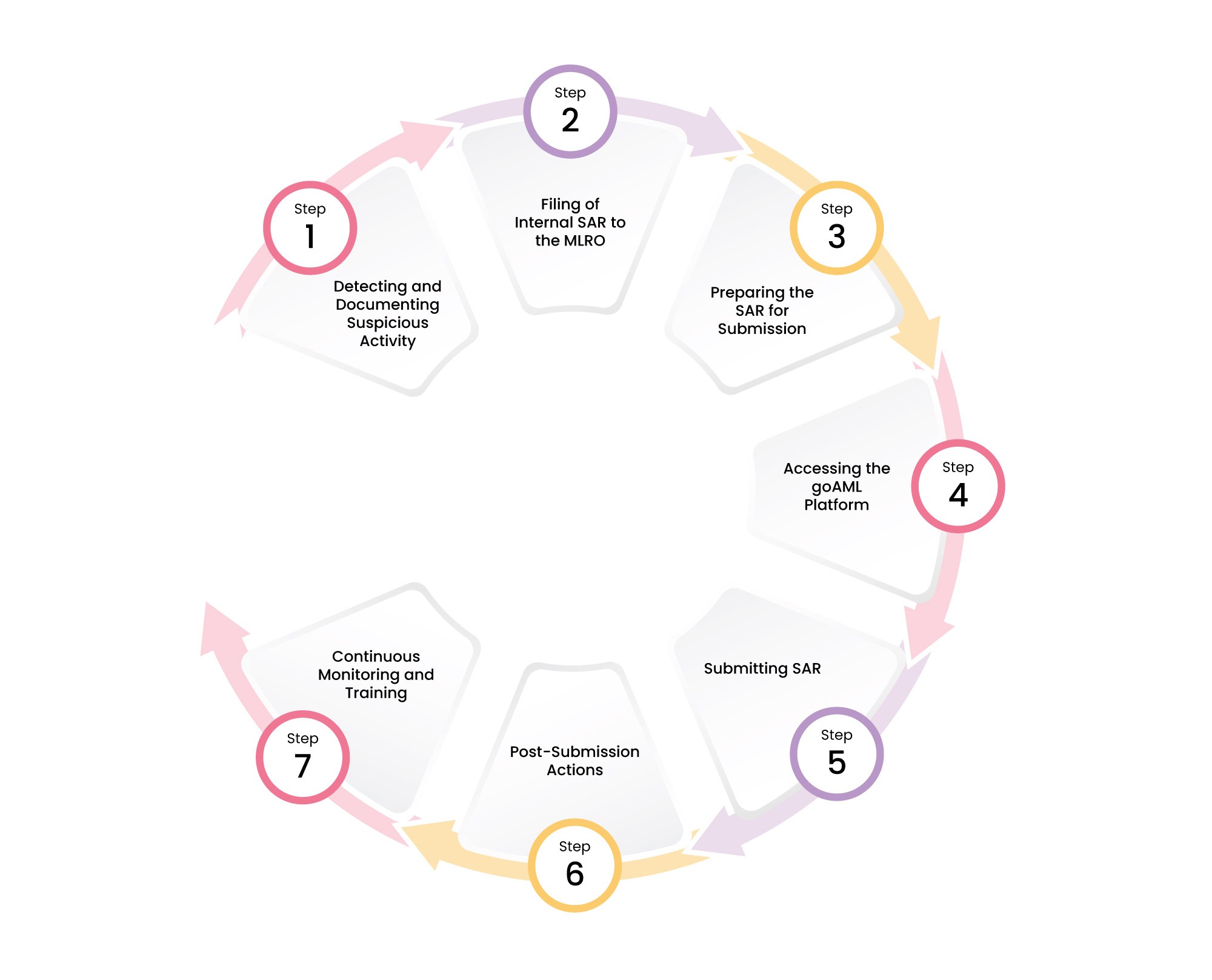
Step 1: Detecting and Documenting Suspicious Activity
Regulated Entities need to decipher Suspicious Activities by monitoring transactions, behaviours, and customer profiles through Transaction Monitoring Systems, Customer Due Diligence (CDD), Enhanced Due Diligence (EDD) reviews, periodic internal audits, and compliance checks.
Regulated Entities must document red flags related to unusual customer behaviour, unusual transaction patterns, high-risk customers, etc., to counter ML, TF, and PF risks effectively.
Step 2: Filing of Internal Suspicious Activity Report to the MLRO
Regulated Entities detecting Suspicious Activity need to begin tailoring their SAR procedure and obligate filing an internal SAR primarily by staff to MLRO, with an aim to escalate the case for review when a potentially suspicious customer, behaviour pattern or transaction is being identified.
After receiving the said internal SAR, the compliance officer begins reviewing the submission and investigates and analyses the reported activity in detail. At this stage, the Compliance Officer decides whether the case needs to be reported in the form of a SAR.
Step 3: Preparing the Suspicious Activity Report for Submission
Once the internal report is filed and the MLRO confirms that SAR needs to be escalated, they start preparing the report strictly in the prescribed format as outlined by the goAML portal.
The MLRO ensures that the report remains factual, concise, and in line with FIU submission standards and compiles all relevant details required.
Step 4: Accessing the goAML Platform
The SAR report is prepared, after which, the MLRO or the Compliance officer sign in to the FIU goAML portal.
Step 5: Submitting Suspicious Activity Report
Post logging in to the goAML Portal, Regulated Entities are prompted to fill in all the mandatory details and attach all the supporting documents, such as KYC records, internal investigation notes, etc., to upload the SAR.
The REs need to fill in all the details carefully and accurately, and attach all required documents and cross-check before making the final submission.
Step 6: Post-Submission Actions
After submitting SAR, it is essential that Regulated Entities store submission acknowledgements securely along with detailed records of the internal review and escalation process for at least five (5) years in the case of the mainland UAE.
Step 7: Continuous Monitoring and Training
Post SAR Submission, Regulated Entities need to ensure that customer profiles are kept under close watch for additional Suspicious Activity and ensure that supplemental SAR is filed if new developments arise.
Regulated Entities also need to deliver continuous training to first-line staff and compliance teams while reviewing the whole process, including detection, escalation, and reporting mechanisms. This step is crucial for maintaining compliance excellence.
SAR: Red Flag Scenarios, Triggers and Action Required
There are several red flag scenarios which require specific actions to be undertaken. They are outlined as follows:
Unusual Behaviour
SAR Specific Scenario:
Refuses, avoids or delays providing KYC documents.
Action Required:
Escalate to MLRO, document, file SAR via goAML.
SAR Specific Scenario:
Does not provide information regarding the source of funds, the purpose of the account, or the beneficial ownership.
Action Required:
Apply Enhanced Due Diligence (EDD), escalate, and file a SAR.
SAR Specific Scenario:
Provides false, forged, or inconsistent IDs.
Action Required:
Verify authenticity, escalate immediately, file SAR.
Onboarding/Relationship
SAR Specific Scenario:
Customer abandons account opening after being asked for KYC or EDD information.
Action Required:
Record attempt, escalate internally, consider SAR filing.
SAR Specific Scenario:
Use intermediaries or nominees to open/maintain an account.
Action Required:
Review, escalate to Compliance, SAR if unexplained.
Beneficial Ownership
SAR Specific Scenario:
Refusal to disclose UBO or provide an unreliable or complex ownership structure.
Action Required:
Escalate for EDD, verify corporate structure, and file a SAR if non-cooperation continues.
SAR Specific Scenario:
Frequent changes in ownership, control, or authorised signatories without any reason.
Action Required:
Investigate rationale, escalate, and SAR if an unusual pattern persists.
Adverse Media/Sanction
SAR Specific Scenario:
Customer or related party appears in adverse media involving financial crime, fraud, or corruption.
Action Required:
Escalate immediately, verify facts, and file a SAR if relevant.
SAR Specific Scenario:
The customer is associated with sanctioned/high-risk persons, but does not provide details.
Action Required:
Escalate to MLRO; SAR filing required.
SAR Specific Scenario:
Customer identity matches any multilateral or bilateral sanction lists.
Action Required:
Escalate to MLRO and file a SAR to FIU.
Interaction/Communication
SAR Specific Scenario:
Provides vague, evasive, or contradictory answers during CDD reviews or periodic audits.
Action Required:
Document discrepancies, escalate for SAR consideration.
SAR Specific Scenario:
Shows unusual nervousness, secrecy, or over-defensiveness when asked basic compliance questions.
Action Required:
Escalate internally, assess intent, and SAR filing if warranted.
Common Challenges Faced While Filing SAR
Regulated Entities face various operational, procedural, and technological challenges while filing SAR. It becomes pertinent to ensure REs are identifying these challenges, as it helps them in constructing and implementing robust SAR reporting frameworks.
The framework needs to meet all regulatory requirements and expectations of the UAE Financial Intelligence Unit (FIU) while also aligning with international best practices.
The common challenges faced while filing SAR include delay in identification of Suspicious Activity, inconsistent escalation procedures, limited training or expertise, and complex investigations.
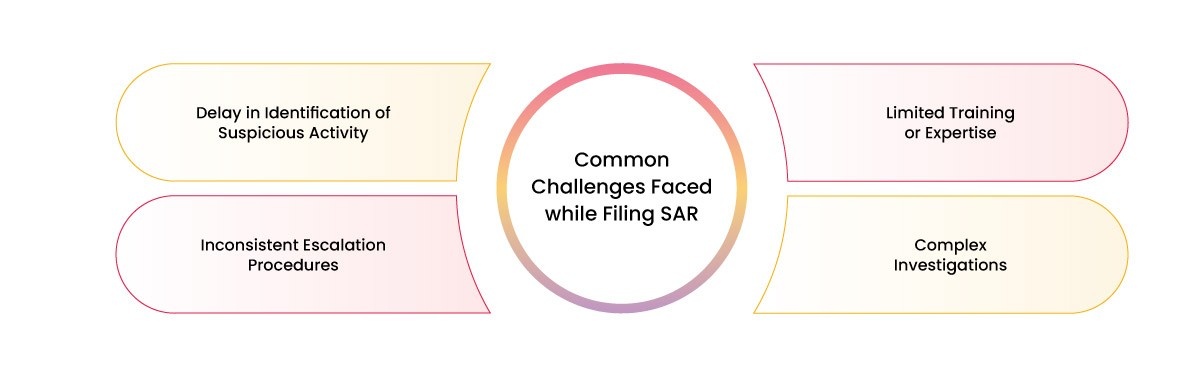
Delay in Identification of Suspicious Activity
Regulated Entities often face unintended delays in recognising Suspicious Activities. Front-line staff might end up missing some early red flags and fail to escalate unusual customer behaviour quickly to the compliance team.
This failure can result in missing reporting and attract heavy regulatory penalties.
Inconsistent Escalation Procedures
The absence of clear internal policies or an escalation framework can lead to internal confusion on when to involve the MLRO or senior compliance teams.
Such inconsistencies can not only delay decision-making but also risk non-compliance with statutory requirements and SAR filing timelines for Regulated Entities.
Limited Training or Expertise
Regulated Entities often face operational bottlenecks due to the absence of AML-trained investigators and MLROs.
Over-reliance on manual reviews and investigations increases the backlog, reducing the overall efficiency and accuracy of SAR reporting processes.
Complex Investigations
Suspicious Activities often involve multiple customer accounts, cross-border transactions, layered structures, or referrals from law enforcement agencies.
These complex investigations involve time-consuming analysis of various internal and external data sources, making it difficult for Regulated Entities to meet the regulatory requirements.
Struggling with SAR challenges?
Let AML UAE simplify, strengthen, and future-proof your Suspicious Activity Reporting process.
Best Practices for Regulated Entities to Achieve SAR Filing Excellence
The ever-evolving compliance landscape, filing Suspicious Activity Report, isn’t just a tick box, but a powerful safeguard against threats of ML/TF activities and a shield to prevent regulatory non-compliance and penalties.
The best practices include implementing policies and procedures, conducting ongoing training and awareness, continuous monitoring, technology utilisation, and ensuring governance and management oversight.
Here’s how Regulated Entities in the UAE should maintain accuracy in SAR filing by adopting some of the best practices:
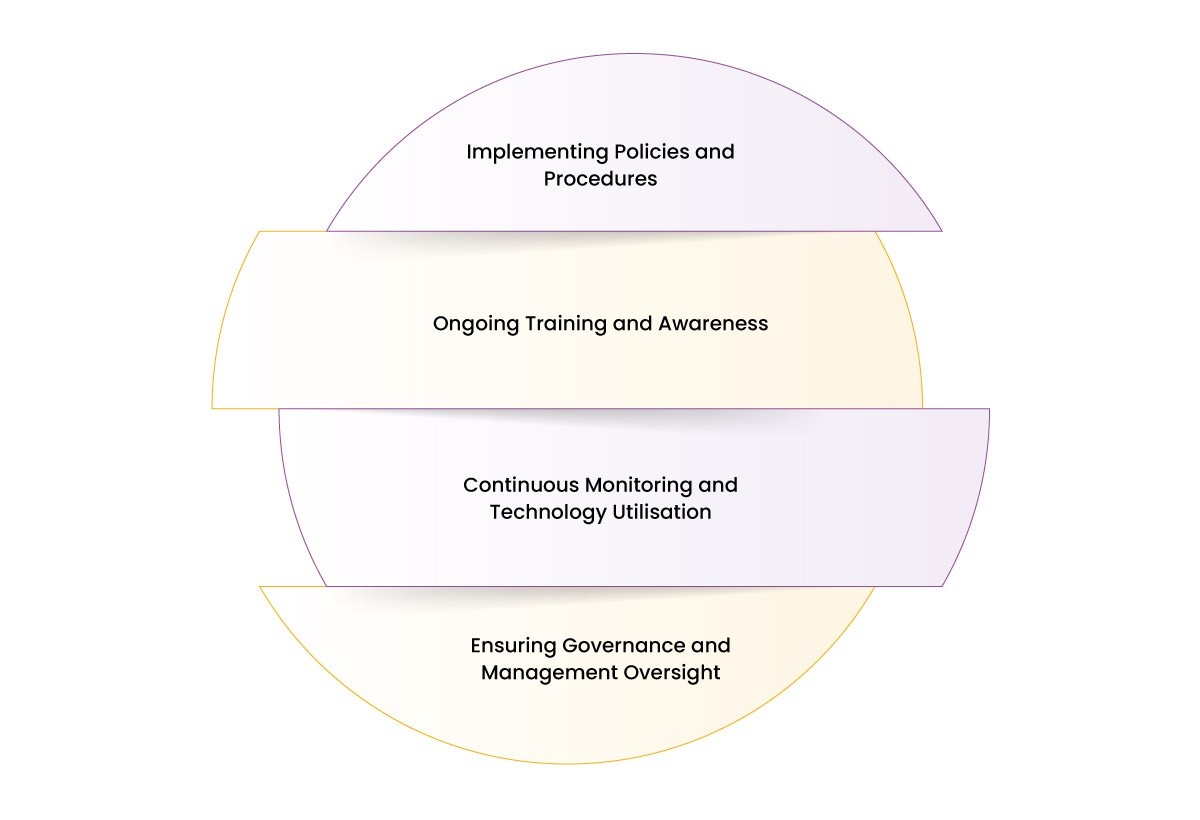
Implementing Policies & Procedures
Regulated Entities must maintain structured and well-documented policies and procedures. This helps with escalating, investigating, and reporting Suspicious Activity promptly.
These policies must be periodically reviewed and updated to align with FIU guidance, typology changes, and regulatory updates.
Ongoing Training and Awareness
Regulated Entities must provide continuous training to their staff and compliance teams, tailored according to their respective roles and responsibilities.
Training must cover AML/CFT regulations, internal escalation procedures, case studies from past SARs, and emerging typologies. There must be periodic tests to ensure that employees are aware and ready to promptly identify Suspicious Activities.
Continuous Monitoring and Technology Utilisation
Regulated Entities must implement continuous and proactive monitoring of customer transactions and behaviours. Advanced technology and analytics tools must be utilised to reduce false positives and prioritise genuinely suspicious cases.
Transaction monitoring rules and alert parameters must be regularly calibrated to keep up with ever-evolving risks and regulatory changes.
Ensuring Governance and Management Oversight
Regulated Entities must ensure that the SAR compliance program is independent, adequately resourced, and prioritised within the organisation.
MLRO should have full authority, independence, and unrestricted access to customer and transaction data to make informed decisions. Regular updates on SAR filing trends must be provided to the Board to maintain strong oversight and accountability.
Need help embedding SAR best practices into your compliance framework?
AML UAE helps you implement smart, customised, and regulator-ready compliance solutions.
Mitigate SAR Filing Challenges: How AML UAE Can Help
At AML UAE, we help businesses comply with Federal Decree Law No. 10 of 2025 by implementing robust Suspicious Activity Reporting (SAR) frameworks, policies, and internal controls. We understand that SAR filing is complex, time-sensitive, and prone to operational challenges. To help Regulated Entities file SARs efficiently and stay audit-ready, we offer end-to-end SAR support services.
Clear the Fog on Documentation and Timelines
“We don’t know when exactly to file a SAR.” Compliance teams often face confusion about thresholds, timing, and criteria for filing.
AML UAE Solutions:
We provide clear guidance on timelines and triggers and design a standardised escalation framework for immediate internal review and timely SAR submission on the goAML portal.
Filter Out Disruptions with Customised Alerts
“Our alerts are inconsistent—what counts as Suspicious Activity?” Teams struggle to filter real Suspicious Activity from noise.
AML UAE Solutions:
We create a customised Alert Management Framework that classifies alerts, escalates genuine cases to the MLRO, and maintains a clear decision-making audit trail.
Overcome SAR Filing Gaps with Expert Drafting Assistance
“SAR narratives are confusing to prepare.” Structuring clear, regulator-friendly narratives is challenging for many institutions.
AML UAE Solutions:
We assist in drafting well-structured narratives covering who, what, when, how, and why, ensuring clarity and compliance with FIU expectations.
End Detection Delays with Real-Time Monitoring
“Delayed escalation is putting us at risk.” Suspicious Activity often gets detected or reported too late, causing regulatory scrutiny.
AML UAE Solutions:
We implement real-time monitoring and escalation protocols integrated with your transaction systems for instant red-flag detection.
Counter False Positives with Calibrated Systems
“Our MLROs are overwhelmed with irrelevant alerts.” High volumes of false positives lead to backlogs and delays.
AML UAE Solutions:
We offer calibrated monitoring and detection solutions that minimise noise, helping MLROs focus on high-priority cases.
Fill Employees’ Knowledge Gaps with Dynamic Training
“Staff training is outdated and ineffective.” Employees lack practical skills to identify, escalate, or report Suspicious Activities.
AML UAE Solutions:
We deliver interactive, scenario-based SAR training using real UAE case studies for practical, hands-on learning.
Simplify Cross-Border SAR Regulatory Obligations
“Cross-border cases are too complex.” Multiple jurisdictions, foreign accounts, or correspondent banking relationships create confusion during investigations.
AML UAE Solutions:
We guide on cross-border regulatory obligations and build protocols for multi-jurisdiction SAR handling with international coordination support.
Remove Hindrances with Seamless Compliance Systems
“Our systems are outdated and not integrated.” Legacy systems hinder real-time monitoring and timely detection of Suspicious Activities.
AML UAE Solutions:
We assist in upgrading and integrating monitoring tools with automated escalation workflows for seamless compliance.
End Inconsistencies with Defined Internal Reporting Workflows
“Inconsistent internal reporting lines.” Ambiguity in escalation protocols leads to delays and confusion between teams.
AML UAE Solutions:
We design clear internal reporting workflows defining roles, responsibilities, and escalation levels across all three lines of defence.
Comprehensive Training to Build Reporting Skills
“Fear of over- or under-reporting.” Teams are hesitant to escalate due to a lack of confidence or fear of regulatory repercussions.
AML UAE Solutions:
We conduct confidence-building training and set up decision-support frameworks to ensure balanced, accurate reporting without hesitation.
SAR preparation and narrative review
Prepare a suspicious activity report with a clear evidence trail
Suspicious conduct can arise during an enquiry or onboarding process even when no transaction is completed. We help your compliance team document the activity, relevant people and reasons for concern in an appropriate SAR narrative.
Describe what happened
We reconstruct the sequence from enquiries, documents, communications and internal reports. The review identifies material inconsistencies, missing information and any connection to other activity. We help the officer select the appropriate reporting route based on the facts and current FIU guidance.
Keep the decision traceable
You receive a draft narrative, supporting evidence index and a list of unresolved points. The authorised officer retains responsibility for the reporting decision, confidentiality and submission. Access to the case is restricted to the people who need it for the agreed work.

Accomplish Regulatory Excellence with Meticulous Suspicious Activity Reporting
Regulated Entities in the UAE often fall behind in filing Suspicious Activity Reports on time due to unforeseen delays, inconsistent and scattered escalation procedures, and a lack of knowledge and expertise among employees.
Therefore, Regulated Entities need to count on customised models and methodologies to accurately detect Suspicious Activities, to prompt the escalation and to file a timely and thorough Suspicious Activity Report. This encourages an organised approach, reinforces regulatory compliance, and prevents hefty penalties.
Integrating the required internal policies and procedures allows for timely and prompt filing, leveraging advanced tools makes identifying suspicious activity easier, and training staff promotes meticulous Suspicious Activity Report (SAR) filing.
Every missed SAR is a compliance risk.
Detect, document, and file accurately—stay compliant with AML UAE’s expert support.