


Fit and Proper Assessment
A Fit and Proper Assessment forms a crucial component of AML/CFT Compliance and enables organisations to induct legitimate candidates. Organisations skipping out on employee background checks expose themselves to hiring risks, such as sanctioned individuals, which could become potential threats to the organisation. This could expose the organisation to financial loss and reputational damage.
What is a Fit and Proper Assessment?
A Fit and Proper Assessment is conducted by employers to ensure individuals, in key positions such as directors and senior management, possess the necessary competence, integrity, and economic soundness. It is a process used for confirming the identity, qualifications, criminal history, and overall suitability of a candidate before onboarding them to the organisation.
In the UAE, this is especially important because many sectors—like Financial Institutions (FIs), Designated Non-Financial Businesses and Professions (DNFBPs), government-linked projects, and other regulated industries require verification and risk-assessment processes to safeguard the organisations from insider fraud.

Typically, Background Checks include:
- Identity & Emirates ID validation
- Education & employment history verification
- Professional license & certification checks
- Police Clearance Certificate (PCC) from the Ministry of Interior (MOI) or the relevant authority
- Credit & financial behaviour review (for sensitive roles)
- Compliance checks for employment positions in sensitive or regulated industries.
- Checks on honesty, integrity, and reputation
- Continuing Professional Development
- Checks on conflict of interest
Operational Pain Points in Conducting Know Your Employee
Many UAE companies have basic HR onboarding processes in place — but are these procedures robust enough to meet regulatory expectations and mitigate hiring risks?
In reality, organisations face several recurring operational challenges like missing or unclear documents, delays in verification, complex rules across different authorities, manual errors, verification bottlenecks from overseas institutions, etc., that make fit and proper tests complex, time-consuming, and vulnerable to errors. Many companies conduct basic onboarding, but background screening often becomes harder than expected.
The Employee Background Check procedures are not capable of accurately verifying and identifying employment history, education, and criminal records, including foreign records.
Fit and Proper Assessment records are not maintained with complete documents supported by verifiable evidence, attestation documents, and timestamped logs, which leads to issues during HR audits, labour inspections, compliance checks, and due diligence reviews.
Regulated Entities often lack a robust mechanism for ongoing re-verification to ensure that employees in sensitive or regulated roles continue to meet eligibility, licensing, and compliance requirements after onboarding.
The lack of proper fit and proper assessment workflow, disintegration from HRMS/onboarding platforms, and inconsistencies across internal audit teams contribute to manual scrambles and overburdening the compliance team.
Most background check systems are outdated and fail to offer a centralised dashboard with real-time status tracking, automated reminders, secure document uploads, and role-based access while complying with data privacy, hosting, and encryption standards.
Screening processes are not equipped to validate international qualifications, detect forged documents, verify foreign employment, or authenticate attested certificates, resulting in unnecessary delays and overwhelming the HR and compliance teams
Regulatory Obligations for Fit and Proper Assessment in the UAE
While the UAE Labour Law does not mandate universal background checks, multiple UAE frameworks encourage employee background checks as a compliance requirement, which are as follows:
- Cabinet Decision No. 134 of 2025
- VARA Rulebook advocate fit and proper assessment for key positions
- FSRA Rulebook requires entities to carry out a fit and proper assessment
- The DFSA Rulebook also requires Fit and Proper tests for authorised individuals
In this multi-layered environment, businesses need to strive to maintain a robust, comprehensive, and documented background verification process.
Step-by-Step Guide to Conduct a Fit and Proper Assessment
Entities need to undertake proper measures to implement a comprehensive Employee Fit and Proper Assessment.
These measures include collecting and verifying candidate information and documents, verifying education and professional qualifications, criminal record screening, police clearance and legal checks, Sanctions Screening and reputational review, analysing, red flag assessment and preparing a final report incorporating all these measures.
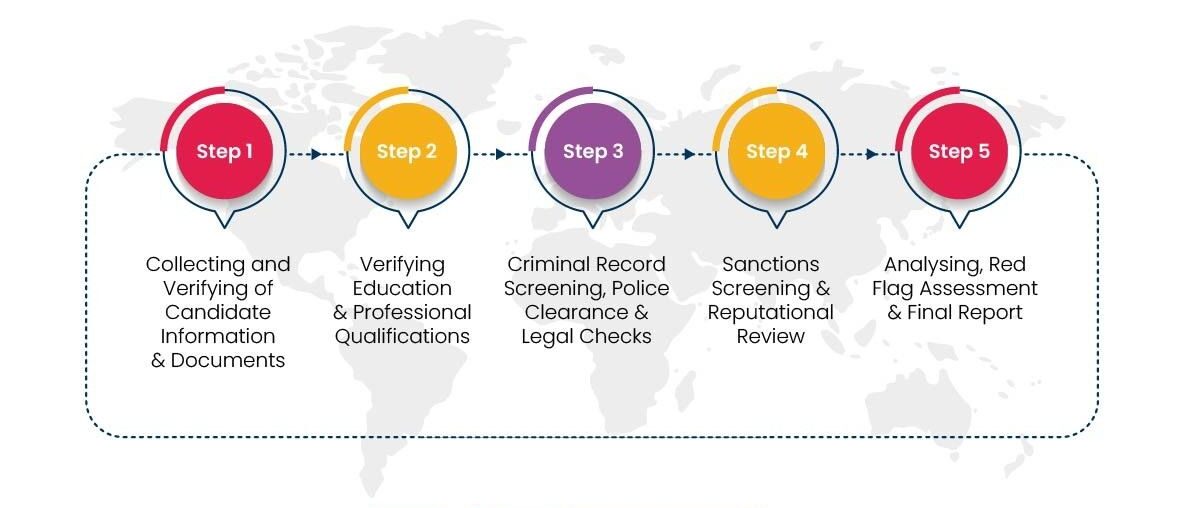
Step 1: Collecting and Verifying Candidate Information & Documents
The first step of the background check involves collecting essential details such as personal information, identification documents, employment history, academic qualifications, and professional credentials.
After collecting all the documents, they need to be evaluated for accuracy, completeness, consistency, and authenticity. Verifying the identity becomes pertinent as it helps in confirming the legitimacy of official documents such as passports, visa pages, and national IDs.
Step 2: Verifying Education & Professional Qualifications
Once the documents are collected and verified, the next step involves verifying details with previous employers, educational institutions, training providers, licensing bodies, and relevant regulatory authorities.
These details include job titles, responsibilities, performance, reasons for exit, checking accreditation, reviewing transcripts or mark sheets, and following up with professional references.
Step 3: Criminal Record Screening, Police Clearance & Legal Checks
After the verification is completed, it is followed by criminal background checks, obtaining Police Clearance Certificates, civil litigation checks, financial dispute searches, and conducting regulatory history reviews.
All records need to be reviewed, considering the data protection rules and UAE legal requirements.
Step 4: Sanctions Screening & Reputational Review
The criminal record check is followed by screening employees’ identities against global sanctions lists, watchlists, adverse media sources, and regulatory databases.
This becomes a crucial step if hiring prospects for financial, sensitive, compliance-based roles.
Reputational screening needs to be done, which includes workplace conduct checks, behavioural insights through references, and ethical red flags visible in publicly available sources like social media platforms.
Step 5: Analysing, Red Flag Assessment & Final Report
Upon completing all verifications, the findings need to be compared against the submitted information and analysed for inconsistencies or discrepancies.
Any red flags, such as unverifiable qualifications, criminal alerts, sanctions, hits, or behavioural concerns, need to be documented and escalated clearly.
The final background check report needs to outline the following:
- Verified information
- Non-verified or incomplete items
- Areas requiring escalation
- Compliance considerations
- Recommended risk categorisation.
This final assessment enables organisations to make informed onboarding decisions while maintaining regulatory and due diligence standards.
Common Challenges Faced While Conducting a Fit and Proper Check
There are several obstacles that arise during the Fit and Proper Check.
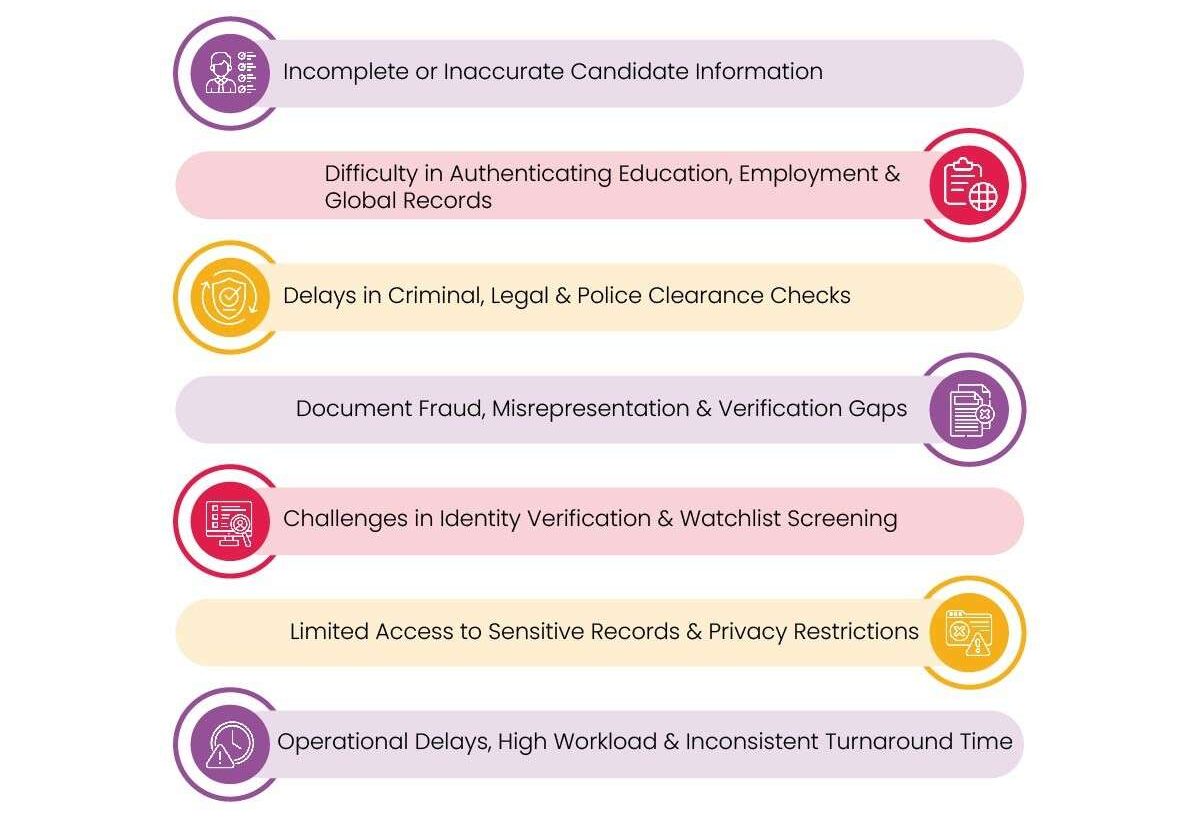
These obstacles include incomplete or inaccurate candidate information, difficulty in authenticating education, employment and global records, delays in criminal, legal and police clearance checks, document fraud, misrepresentation, and verification gaps.
Other obstacles include identity verification and watchlist screening challenges, limited access to sensitive records and privacy restrictions, operational delays, high workload, and inconsistent turnaround time.
Incomplete or Inaccurate Candidate Information
Background checks are often delayed by incomplete documents, mismatched dates, and inconsistent personal details.
These gaps force organisations to conduct repeated follow-ups, making verification difficult. Reliable screening depends heavily on accurate data from the start.
Difficulty Authenticating Education, Employment & Global Records
In case of authenticating educational qualifications, many universities, previous employers, and institutions do not respond promptly or lack proper verification channels to do so.
International checks can additionally bring up language barriers and outdated databases, making it even more challenging to confirm qualifications and employment details.
Delays in Criminal, Legal & Police Clearance Checks
Criminal record checks, court searches, and Police Clearance Certificates take up a significant amount of time, depending on the jurisdiction.
Different countries have different approval processes, privacy restrictions, and documentation requirements. This lack of a unified and global process for checks can further cause unpredictable delays.
Document Fraud, Misrepresentation & Verification Gaps
With today’s evolving technology, instances of forged degrees, altered experience letters, and manipulated personal information are more common.
Detecting such fraud tactics requires expert knowledge, strong verification tools, and access to authentic databases.
Challenges in Identity Verification & Watchlist Screening
Sanctions and watchlist screenings can often produce false positives for common names, which in turn requires time-consuming manual review to determine accurate matches.
This takes up additional time and resources and slows down the compliance process.
Limited Access to Sensitive Records & Privacy Restrictions
There are usually many restrictions on access to civil litigation records, financial disputes, and regulatory history, which proves to be an obstacle in the verification process.
Strict privacy and data protection rules both in the UAE and internationally can limit what can be collected or verified during the screening process.
Operational Delays, High Workload & Inconsistent Turnaround Time
Fit and Proper Assessment depends on external third parties such as employers, registrars, and government departments.
Their response timelines vary, and high verification volumes make it difficult to maintain consistent speed and quality. Multi-country checks add extra operational pressure.
Struggling to complete fit and proper checks accurately and on time?
Let us simplify your KYC and AML compliance journey.
Best Practices for Strengthening Fit and Proper Assessment Processes
Running employee background checks for key positions does not have to be complicated. With the right framework and habits, organisations can make the entire process faster, cleaner, and far more accurate.
This includes establishing clear internal policies and mandatory screening protocols, standardising documentation and information collection, incorporating digital tools and automated verification systems, ensuring strong data protection and confidentiality measures, and maintaining detailed records and continuous monitoring.
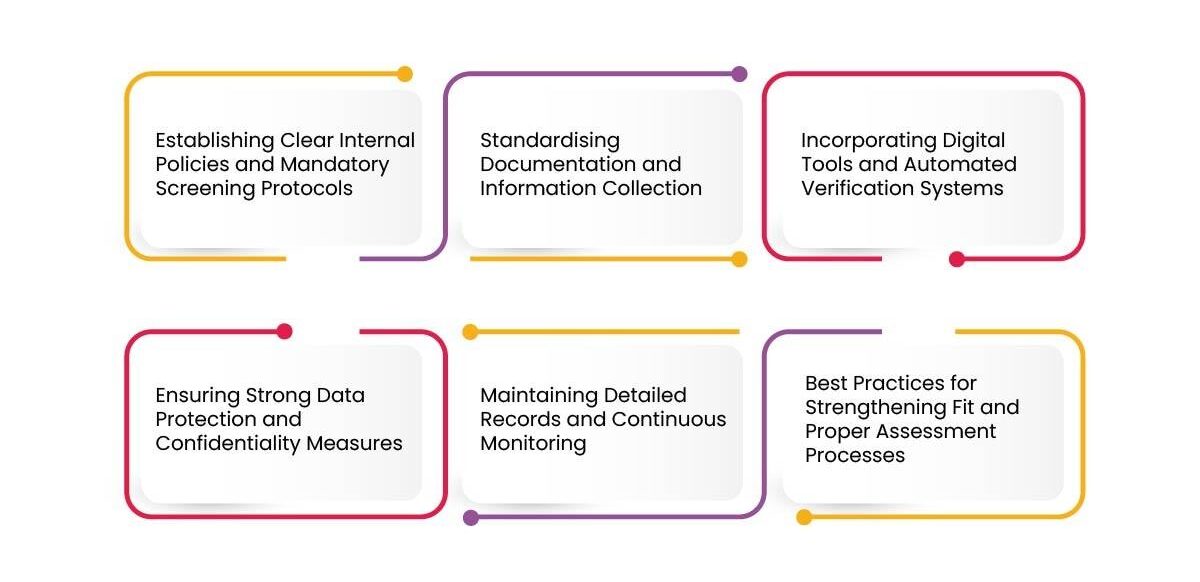
Establishing Clear Internal Policies and Mandatory Screening Protocols
Organisations must have a formal background check policy which outlines mandatory verifications, timelines, and red-flag criteria. A well-structured framework can help ensure consistent evaluations across all roles and minimise compliance gaps.
Standardising Documentation and Information Collection
A uniform document checklist should be in place to avoid missing data or inconsistencies. Standardised forms, employee declarations, and ID verification of workflows can help in maintaining accuracy and reducing manual rework.
Incorporating Digital Tools and Automated Verification Systems
Advanced tools like automation, OCR extraction, digital ID checks, and online verification APIs must be used to speed up reviews and reduce human error. Technology also helps in maintaining audit trails and ensuring the authenticity of data.
Ensuring Strong Data Protection and Confidentiality Measures
Employee data is considered sensitive information, and it should be handled under strict privacy protocols, using encryption, access controls, and regulated storage practices. Compliance should always be combined with local data protection laws at every stage to support overall compliance.
Maintaining Detailed Records and Continuous Monitoring
Clear logs of verification reports, communications, and clearance notes must always be maintained for compliance and audit requirements. For high-risk roles, periodic re-verification should be considered to detect new risks.
Need help implementing best practices around fit and proper checks?
AML UAE provides tailored, compliant solutions for Employee Background Checks, address verification, and more.
Mitigate Fit and Proper Assessment Challenges: How AML UAE Becomes Compliance Wingman
At AML UAE, we promote comprehensive Fit and Proper Assessment frameworks that are designed to help organisations meet stringent AML/CFT/CPF regulatory expectations and maintain a trustworthy workforce.
By integrating structured verification processes, automated validation tools, risk-based screening models, and secure documentation controls, AML UAE enables Regulated Entities to address operational challenges effectively.
The objective is to ensure that every individual hired meets integrity standards, supports AML/CFT compliance, and strengthens the organisation’s overall risk management posture.
Fraud-proof your Verification Processes with Advanced Tools
EBC Pain Point:
“We receive fake or unverifiable documents.”
Smart Solutions by AML UAE:
Advanced document authentication & global verification tools.
Benefits of Comprehensive Fit and Proper Assessments:
Accurate, fraud-proof Fit and Proper checks.
Eliminate Language Barriers with a Dedicated Global Team
EBC Pain Point:
“International checks take too long.”
Smart Solutions by AML UAE:
Dedicated global verification partners & multilingual verification team.
Benefits of Comprehensive Fit and Proper Assessments:
Faster turnaround, reduced delays.
End Forgery with Authentic Document Verification
EBC Pain Point:
“Our HR team cannot detect forged degrees.”
Smart Solutions by AML UAE:
Qualification verification + embassy/Ministry of Foreign Affairs (MOFA) attestation management.
Benefits of Comprehensive Fit and Proper Assessments:
Guaranteed authentic , validated credentials.
Reduce Policy Alignment Concerns with Unified Processes
EBC Pain Point:
“We lack standardised verification workflows.”
Smart Solutions by AML UAE:
Customised Employee Background Check (EBC) policies aligned with UAE compliance.
Benefits of Comprehensive Fit and Proper Assessments:
Clear, unified, audit-ready process.
Eliminate Data Security Concerns with Secure Storage Systems
EBC Pain Point:
“We struggle to store sensitive employee data securely.”
Smart Solutions by AML UAE:
Encrypted, UAE-compliant data management systems.
Benefits of Comprehensive Fit and Proper Assessments:
Secure records and reduced compliance risk.
Minimise Visibility Concerns with Real-Time Status Updates
EBC Pain Point:
“We don’t have visibility on verification progress.”
Smart Solutions by AML UAE:
Centralised dashboard with real-time status tracking.
Benefits of Comprehensive Fit and Proper Assessments:
Transparency, control, and HR efficiency.
Diminish Slow Systems with Quick Quality Checks
EBC Pain Point:
“Background checks slow down onboarding.”
Smart Solutions by AML UAE:
Automated workflows, parallel verification, and digital forms.
Benefits of Comprehensive Fit and Proper Assessments:
Faster hiring without compromising quality.
Our next hire shouldn’t be a risk.
Strengthen your workforce integrity with fast, reliable, and UAE-compliant background checks.
Fit and Proper Assessment Is the Key to Achieving Regulatory Excellence
Regulated Entities in UAE often hire individuals without conducting an Employee Background Check, and this becomes a Compliance Risk for them in the future. Regulated Entities need to understand the importance of a fit and proper Check and undertake proper measures to conduct it.
Regulated Entities need to devise a proper methodology to conduct a fit and proper check before they appoint an employee to their organisation.
Incorporating Employee Background Check can help REs smoothly navigate across AML/CFT Compliance by implementing smart practices such as clear internal policies and mandatory screening, establishing proper channels for documentation and information collection, integrating digital tools and automated systems while upholding confidentiality.
Every Missed Employee Background Check is a Compliance Risk.
Collect, Verify, Screen, Check and Clear Employees – with AML UAE’s expert support.