


Confirmed Name Match Report (CNMR)
Compliance with Targeted Financial Sanctions (TFS) in UAE is imperative obligation for Regulated Entities such as Financial Institutions (FIs), Designated Non-Financial Businesses and Professions (DNFBPs), Virtual Assets Service Providers (VASPs).
The TFS legal framework in UAE mandates submitting certain reports to relevant supervisory authorities detailing the implemented TFS measures. One of these reports is Confirmed Name Match Report (CNMR).
What is a Confirmed Name Match Report?
Confirmed Name Match Report (CNMR) is a mandatory report that Regulated Entities (REs) should file via the goAML portal, under the UAE’s Targeted Financial Sanctions (TFS) regime, administered by the Financial Intelligence Unit (FIU).
A CNMR is filed at the time when, a customer’s identity fully matches all key identifiers on the UNSC Consolidated List or UAE Local Terrorist List during the screening process.
CNMR is a critical component of the UAE’s Sanctions Compliance and AML scheme. It ensures that when a customer matches exactly with a listed individual or entity, freezing actions are taken promptly and reported accurately to Regulatory Authorities.

Operational Pain Points in Filing Confirmed Name Match Report
A Regulated Entity (RE) may already have internal policies in place for conducting Sanctions Screening and generating alerts for potential matches, often using automated tools. These measures are not truly sufficient for accurate and timely CNMR filing under the UAE’s TFS framework.
Here are some of the common operational challenges organizations face when handling Confirmed Name Match Reporting (CNMR):
Are you confident that your screening systems capture all real-time updates to Sanctions List, minimize false positives or false negatives, and follow a standardised process for validating an exact match before filing a CNMR?
Do you have a documented SOP for CNMR handling and escalation, the ability to freeze assets quickly after identifying a confirmed match, and seamless communication between your operations, compliance, and Senior Management teams?
Can you efficiently collect, verify, and attach all required supporting documents when preparing a CNMR, and maintain a well-organised, easily accessible archive to meet the five-year record-keeping requirements for audits and regulatory inspections?
Is your AML Software fully integrated with your customer databases and transaction systems, able to generate timely alerts and, capable of producing audit-ready CNMR reports without heavy manual effort or delays?
Are your staff members adequately trained to differentiate between partial and confirmed matches, fully aware of regulatory timelines and provided with regular refresher training to ensure compliance accuracy?
Regulatory Obligations for Confirmed Name Match Report in UAE
In UAE, The Cabinet Resolution No. 74 of 2020 sets the procedure to implement the Targeted Financial Sanctions consisting of UAE Local Terrorist List and UNSC Consolidated List, in particular those related to the Combating of Terrorism, Terrorists Financing & Financing Proliferation of Weapons of Mass Destruction.
Article 19 of the Federal Decree Law No. 10 of 2025 direct Regulated Entities to enforce the directions issued by the Executive Office and other Competent Authorities pertaining to TFS.
Key Identifiers to be Considered While Conducting Sanctions Screening
The UAE Local Terrorist List and UNSC Consolidated List contains wide range of information to foster the identification of designated individuals or organisations. Regulated Entities are required to obtain key identification data from their customers to screen their names against those contained in the relevant Sanction Lists.
These key identifiers for natural persons and legal persons as per the TFS implementation guide are as follows:
For Natural Persons:
- Name
- Date of Birth
- Nationality
- ID or passport information
- Last Known Address
For Legal Persons:
- Entity or Company’s name
- Trade license number
- Address of registration
- Address of branches
Other Key Identifiers for Natural/Legal Persons:
- Aliases
Step-by-Step Filing Process for Ensuring Error-Free Confirmed Name Match Report
The filing of Confirmed Name Match Report and implementing relevant measures with respect to TFS requires a systematic approach from Regulated Entities.
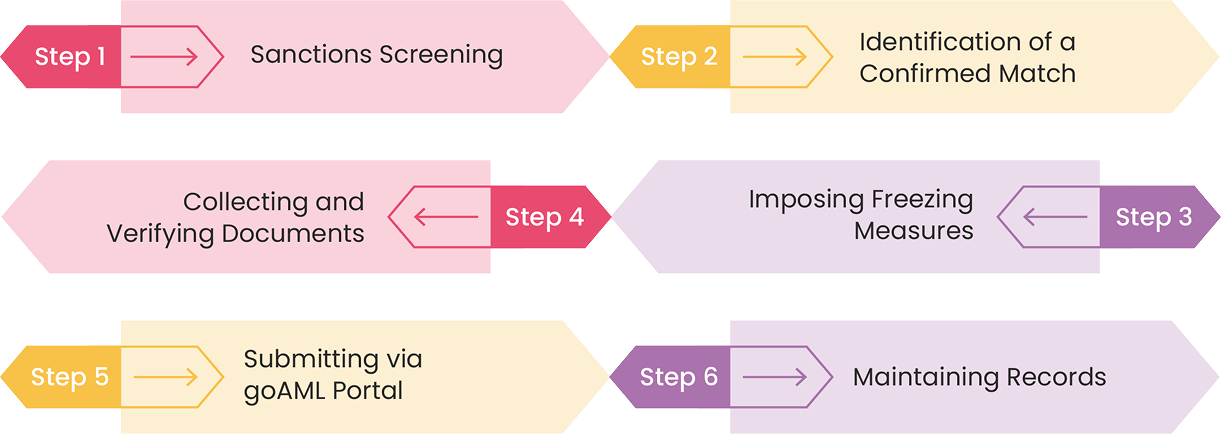
It involves conducting Sanctions Screening, identifying a confirmed match, imposing freezing measures, collecting and verifying documents, submitting the report on goAML portal, and finally maintaining records.
Step 1: Sanctions Screening
The foremost step begins with screening customers against UAE Local Terrorist List and UNSC Consolidated List.
Regulated Entities can rely on Sanction List obtained through Notification Alert System (NAS) of EOCN or a specialized AML Screening Software to conduct Sanctions Screening.
Using reliable software tools for Sanctions Screening ensures that Sanctions Lists are updated in real time and are not outdated.
This process of screening customers generates screening outcomes that need to be disambiguated by the Screening Analyst.
Step 2: Identification of a Confirmed Match
While conducting Sanctions Screening, the system flags a potential hit, if there is a match. The process is followed by the Compliance team or screening team promptly verifying whether it is a true match or not.
For Regulated Entities, establishing confirmed match relies on the customer’s key identifiers. These identifiers are cross checked against the corresponding identifiers of the designated individual or entity in Sanctions List, against whom the potential match has been flagged.
If all key identifiers of the customer match with the sanctioned entity, in such instances, it is confirmed match and further actions are taken.
Step 3: Imposing Freezing Measures
After establishing a confirmed match, the subsequent action is to impose TFS measures as mandated by the TFS obligations. The freezing measures should be applied immediately (within 24 hours), once the match is confirmed.
The action to be taken depends on the kind of customer which is as follows:
- Potential Customer: Rejecting the onboarding process or blocking the intended transaction.
- Existing Customer: Freezing all accounts, assets, and funds, and stopping all services or relationships.
- Former Customer: Even if no assets remain, a CNMR should still be filed, indicating that the relationship has already ended.
Article 33 of the Federal Decree Law No.10 of 2025 imposes imprisonment and fine of not less than AED 20,000 for violating the instructions issued by the EOCN or any other Competent Authority related to TFS.
Step 4: Consolidating Documents
The next step after freezing funds is consolidating mandatory documentation, which typically includes Proof of Identification (passport, Emirates ID, trade license), transaction records or asset details, evidence of the freezing action taken etc.
Accurately verifying these documents ensures that CNMR is ready for upload and cannot subject to rejection later due to incomplete information.
Step 5: Submitting CNMR via goAML Portal
The next step is to file Confirmed Name Match Report (CNMR) to UAE FIU via goAML portal within 5 business days from implementing the freezing measures. The submission process consists of logging into goAML portal, selecting CNMR from the list of options given in the dropdown menu, entering obligatory details and submitting the report.
Step 6: Maintaining Records
Regulated Entities are legally required to retain all records related to Sanctions Screening, match validation, freezing measures, and CNMR filings for at least five years. The records should be well organised, easily retrievable if required during audits or regulatory inspections.
Your next CNMR filing shouldn’t come as a last-minute scramble.
Reduce false positives, catch true matches on time, and streamline your reporting process with confidence.
Must Have Details Required to be in CNMR
Regulated Entities are required to ensure that they don’t file the CNMR just for the sake of it. There are certain important mandates that they are required to follow while submitting a CNMR to UAE FIU.
This includes filing the report with accurate and detailed information about whom the report is filed, what actions are taken, which TFS measures are applied and to what extent.
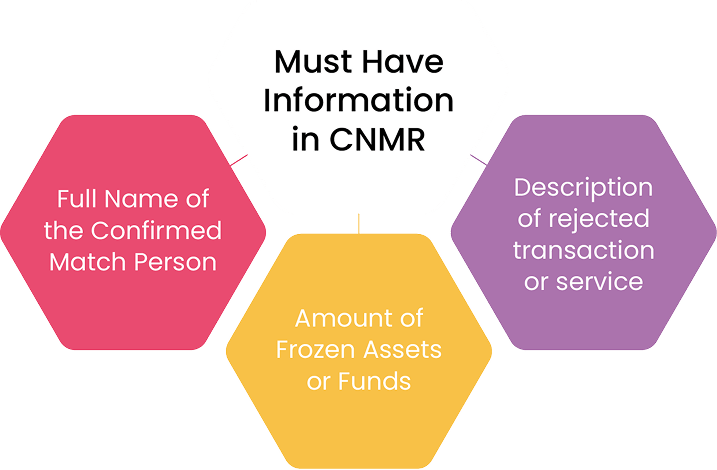
These details consist of full name of the confirmed match person, elaboration of rejected transactions or services and amount of freezing funds.
Full Name of the Confirmed Match Person
While filing the CNMR via goAML portal, it is mandatory for Regulated Entities to provide the full name of the person whose confirmed match is identified.
Along with that, attaching valid ID documents of confirmed match person is indispensable for REs in the CNMR. These ID documents include passport or ID card for individuals and trade license or MOA/AOA for corporates.
Amount of Frozen Assets or Funds
Another essential detail that Regulated Entities are required to mention in the CNMR is the TFS measures that they have applied post identification of Confirmed Match.
This includes detail information about the amount of funds or assets that Regulated Entities have freeze as part of their TFS obligation. Moreover, they are required to attach documentary proof of the frozen assets such as bank statements, transaction receipts etc.
Description of Rejected Transaction or Services
There are instances where Regulated Entities do not have funds available to freeze and the transaction is services based.
In such occurrence, Regulated Entities are required to fill out the detailed description of the transaction or services they have rejected in CNMR of the confirmed match person.
Common Challenges Faced During Filing CNMR
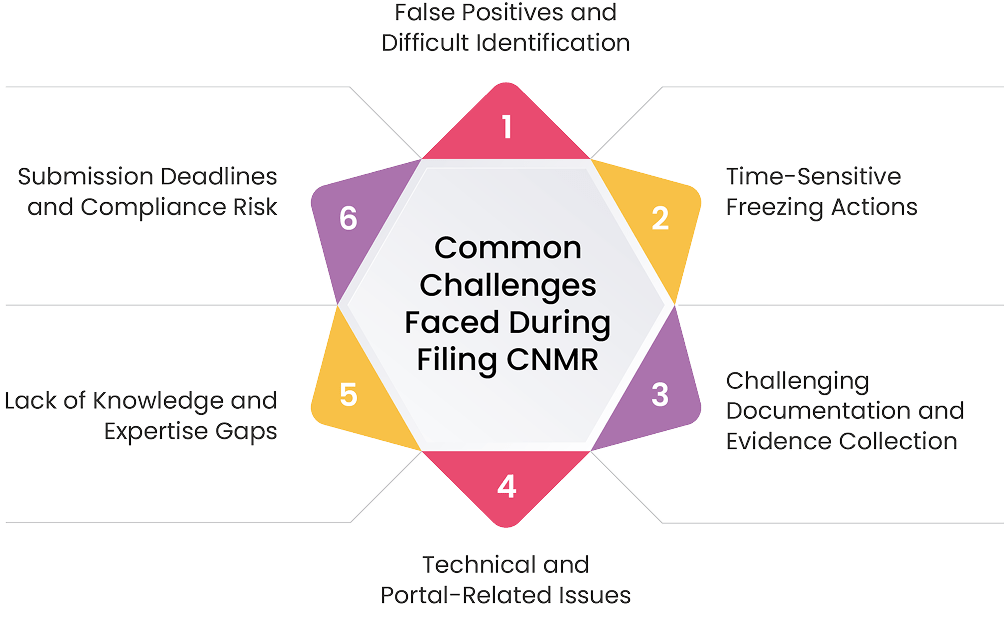
The filing of a CNMR under the UAE’s TFS framework is not a simple one-step task. REs faces several operational challenges during the CNMR preparation and submission process.
The challenges include securing false positives and difficulties in identifying matches, placing time-sensitive freezing actions, challenging documentation and evidence collection process, technical and portal-related issues, lack of knowledge and expertise gaps, submission deadlines and compliance risk.
False Positives and Difficult Identification
Handling name variations and transliterations, especially between Arabic and English spellings can be difficult which can lead to false positives.
In addition to this, many Regulated Entities lack standardised validation procedures, leading to inconsistencies in how exact matches are confirmed for CNMR filing.
Time-Sensitive Freezing Actions
Filing a CNMR requires freezing measures to be applied within 24 hours of confirmation. This tight deadline creates pressure on compliance teams, particularly when internal escalation procedures are slow or unclear.
There exists the layer of complexity which comes from applying different actions for potential, existing, and former customers, which often leads to confusion or delays in taking the right action.
Challenging Documentation & Evidence Collection
Collecting documents that need to be mandatorily attached to the CNMR within the stipulated timeline can be challenging.
The situation becomes even more difficult with former customers, where records may no longer be easily accessible. Without a centralized document repository, this step becomes highly time-consuming.
Technical & Portal-Related Issues
Regulated Entities often face technical issues while submitting CNMRs on the goAML portal. Problems such as XML formatting errors, file size restrictions, or portal downtime can delay submission.
This process can become inefficient and prone to human error especially when handling multiple reports and large sets of data which are difficult to process.
Lack of knowledge & Expertise Gaps
Many employees struggle to identify which report needs to be submitted. For instance, it gets difficult to differentiate a Partial Name Match Report (PNMR) and a Confirmed Name Match Report (CNMR).
The compliance teams that are not trained regularly or new staff join without proper induction face issues like wrong attachments, or misunderstanding reporting requirements and incomplete filing.
Submission Deadlines & Compliance Risk
The major challenge remains submitting the CNMR, even if preparation measures are taken prior to it. The five-day submission requirement after imposing freezing measures often suffers with clashes such as internal delays, documentation bottlenecks, or workload surges.
Relying heavily on manual workflows further increases the risk of late or incomplete submissions, raising the possibility of penalties for non-compliance.
Struggling with CNMR Reporting Challenges?
From freezing assets within 24 hours to filing accurate reports on goAML, our experts help you stay compliant without the stress.
Best Practices for Regulated Entities to Stay on Top of CNMR Reporting Game
Some of the best practices REs must undertake to keep their compliance processes sharp and aligned with UAE’s evolving landscape.
These includes establishing clear match validation procedures, implementing immediate escalation protocols, automating goAML reporting where possible, and staff training and awareness programs.

Establishing Clear Match Validation Procedures
Regulated Entities must develop standardised processes to verify confirmed matches by cross-checking unique identifiers like Nationality, Emirates ID, passport numbers, and date of birth. This avoids unnecessary escalations of false positives and ensures only genuine matches proceed to CNMR filing.
Implementing Immediate Escalation Protocols
Regulated Entities must have well-defined workflows for escalating potential matches to the AML Compliance Officer.
Automated systems must be established that ensure asset-freezing measures are applied within 24 hours overcoming delays caused by internal coordination gaps.
Automating goAML Reporting Where Possible
Regulated Entities must rely on robust AML Sanctions Screening Software and Regulatory Reporting Software to generate automated CNMR-ready reports in line with FIU requirements. This not only reduces manual data entry errors, but also speeds up submission, and improves overall accuracy.
Staff Training and Awareness Programs
Regulated Entities must conduct regular training sessions for compliance teams and front-line staff on regulatory requirements for CNMR filing.
The training programs must emphasize the difference between various reports, reporting timelines, and the consequences of non-compliance.
Need help building any of these best practices into your current framework?
AML UAE helps you build smart, customised compliance processes — from screening to reporting — tailored to your business needs.
Mitigate CNMR Reporting Challenges: How AML UAE Becomes Compliance Wingman
At AML UAE, we help businesses comply with Regulatory Obligations by implementing strong CNMR frameworks, robust Sanctions Screening policies, automation tools, and streamlined reporting mechanisms.
Our goal is to enable Regulated Entities to overcome operational hurdles and ensure full compliance with UAE’s TFS obligations.
Bridge the Policy Gap with Customization
CNMR Pain Point:
“We don’t have a dedicated policy or workflow for CNMR reporting, even though AML policies exist.”
Smart Solutions offered by AML UAE:
We Provide Customised CNMR Compliance Policies aligned with UAE laws, TFS requirements & FATF standards.
Benefits of Robust CNMR Compliance:
You get Structured, clear, defined and audit-ready process.
Never Miss a Sanctions Update with Real-Time Integration
CNMR Pain Point:
“Our screening system doesn’t always update sanctions lists in real time, creating risks of missed matches.”
Smart Solutions offered by AML UAE:
Our experts assist with Real-time integration with EOCN notification alert system (NAS) and UN Consolidated List, which facilitates real time notifications of updated list.
Benefits of Robust CNMR Compliance:
You always receive up to date, zero missed updates/Hits/Matches.
Cut off Manual Hassle with Automation
CNMR Pain Point:
“Manual preparation and verification of CNMR documents is exhausting and error prone.”
Smart Solutions offered by AML UAE:
Not anymore! We provide full automation for collection, verification, and attachment of CNMR documents.
Benefits of Robust CNMR Compliance:
You will be free of manual hassle and derive accurate and faster compliance.
Eliminate Detection Delays with Instant Alerts
CNMR Pain Point:
“Our compliance team faces delays in detecting and escalating confirmed matches.”
Smart Solutions offered by AML UAE:
You will not now! We here at AML UAE, provide API-based advanced screening with instant alerts and swift match detection without any unnecessary delays.
Benefits of Robust CNMR Compliance:
You will be in position to act before risk escalators.
End Fragmented CNMR Reporting with Unified AML/CFT Ecosystem
CNMR Pain Point:
“Our current AML tools don’t integrate well with CNMR reporting requirements.”
Smart Solutions offered by AML UAE:
We understand but it will not be the issue anymore as AML UAE facilitates seamless integration with other AML Compliance systems such as: KYC/CRM and Customer Onboarding Tools.
Benefits of Robust CNMR Compliance:
You will procure, one complete AML compliance ecosystem.
Remove CNMR Reporting Confusion with goAML Readiness
CNMR Pain Point:
“We are not fully clear about CNMR reporting timelines and obligations.”
Smart Solutions offered by AML UAE:
We hear you, you are not going to face such confusions anymore, as AML UAE is equipped with goAML-ready to support framework for CNMR, PNMR, STR & SAR submissions.
Benefits of Robust CNMR Compliance:
You will be enabled with seamless, timely, accurate, and stress-free Regulatory Reporting.
Minimize False Matches with Advanced Screening
CNMR Pain Point:
“False positives are overwhelming our team and slowing down CNMR reporting.”
Smart Solutions offered by AML UAE:
It will not be the case henceforth, as we provide fuzzy logic, local as well as foreign language transliteration & risk-based filters.
Benefits of Robust CNMR Compliance:
You will get fewer false alerts and faster true matches.
Reduce Reporting Knowledge Gaps with Tailored Training
CNMR Pain Point:
“Our compliance staff lacks confidence in handling CNMR-specific requirements.”
Smart Solutions offered by AML UAE:
We offer tailored approach to provide UAE-focused CNMR and Sanction Screening Training to your employees.
Benefits of Robust CNMR Compliance:
You will be armed with confident, smart, and well-versed compliance staff.
Remove CNMR Reporting Confusion with goAML Readiness
CNMR Pain Point:
“Keeping pace with regulatory changes in CNMR is difficult for our team.”
Smart Solutions offered by AML UAE:
It will not be struggle anymore as we facilitate continuous compliance advisory & system audits.
Benefits of Robust CNMR Compliance:
Strengthens you with future-proof compliance program.
CNMR preparation and filing support
Prepare a confirmed sanctions match reporting pack
A confirmed sanctions match requires prompt protective action and an accurate record of the response. We help your compliance team assemble the evidence and report details for the applicable confirmed-match or funds-freeze reporting route.
Build a consistent case record
We organise identifiers, designation details, relevant accounts or assets, attempted activity and the chronology of measures taken. The review checks whether the narrative and reported values agree with the supporting records. We confirm the report type against current goAML and supervisory instructions, as official materials may use CNMR or FFR terminology.
Support filing and follow-up
You receive a reviewed reporting pack, submission checklist and follow-up tracker. The authorised reporting officer retains the decision and submission responsibility. Required freezing or other protective measures must proceed without waiting for drafting support.

Boost Your Regulatory Credibility with Efficient CNMR Filing
Regulated Entities in UAE often get lost in loops while implementing TFS measures. Technical issues, confusion regarding reporting types, lack of knowledge and expertise and other factors contribute to inefficiency.
Therefore, Regulated Entities in UAE should rely on solutions that encompass best practices and reinforce operational strength while ensuring efficient regulatory compliance.
Incorporating internal policies and procedures to take care of timely screening, leveraging advanced Sanctions Screening Software tools, establishing clear escalation protocols, instituting goAML readiness, administering TFS training to employees fosters robust and timely Confirmed Name Match Report (CNMR) filing.
Your next CNMR Filing be your Step to Achieving Robust Compliance
Reduce stress-induced last-filing concerns and build a Compliance policy.